



Abstract
While the health-enhancing benefits of exercise and good nutrition have been well documented, the ability of health professionals to encourage healthier lifestyle behaviors among those they serve continues to prove challenging. Creating the conditions where healthier living can both occur and be sustained requires thinking beyond the traditional provision of services and prescriptions that occur in healthcare settings. Healthy Lifestyle Centers are emerging as a way of deploying lifestyle medicine practices. Turning these centers into cooperative businesses has the potential to make them more effective. Cooperative business principles are well established, and they enable individuals to become makers and producers of their own healthy lifestyles, providing a greater opportunity for sustained lifestyles changes. The purpose of this article is to further examine the role of engagement practices and coproduction as they relate to cooperative business models and to propose a framework for a Cooperative Healthy Lifestyle Center.
While the health-enhancing benefits of exercise and good nutrition have been well documented, 1 the ability of health professionals to promote and develop healthier lifestyles for individuals remains limited.2,3 However, research and work being done by the American College of Lifestyle Medicine, as well as other health-serving organizations, has elevated the practice of Lifestyle Medicine to a “team approach for preventing, treating, and reversing chronic diseases with causes that are primarily behavioral and environmental.” 4 Central to this approach is the premise that encouraging evidence-based changes in behavior can positively impact health status, and that a Lifestyle Medicine approach also increases both the quantity and quality of life, but at a lower cost. 4 One outcome of this focus is that Healthy Lifestyle Centers are emerging as a potential opportunity for realizing the promise of Lifestyle Medicine. These centers can be found in diverse settings, including primary care clinics, 5 workplaces, 6 and communities. 7 As a common practice, these centers help guide individuals toward healthier behavior changes and lifestyle habits that enhance the individual’s health status, instead of prescribing drugs and deploying medical interventions.
In considering how to create the conditions where healthier living can both occur and be sustained, thinking beyond the traditional provision of services and prescription of change elements that occurs in healthcare settings is necessary. While existing Healthy Lifestyle Centers are a step in the right direction, the purpose of this paper is to further examine the role of engagement practices and coproduction as they relate to cooperative business models. Additionally, this paper proposes a framework for Cooperative Healthy Lifestyle Centers that utilize the benefits of these practices.
Participatory Practices
In 2010, an article by Horowitz and colleagues 8 reminded us that “despite an increasing arsenal of effective treatments, there are mounting challenges in developing strategies that prevent and control cardiovascular diseases, and that can be sustained and scaled to meet the needs of those most vulnerable to their impact.” They posited that participatory approaches, like those used in community-based participatory research, could be useful because they involve both those who affect and those who are affected by a problem or concern. While not yet widespread, this focus on participatory approaches continues to permeate medical and health research and practice.9,10 Theoretical and applied evidence for participatory approaches and the overall concept of involvement can help guide this work. This allows for the translation of existing research into meaningful practice and helps us to develop Healthy Lifestyle Centers that can better serve the needs of those they set out to support. The coproduction work of the Nobel laureate, Elinor Ostrom, combined with decades of data collection and research from the Gallup Organization, and previously published arguments by Ellery and Ellery, emphasize the importance of allowing those who will be impacted by initiatives and services to also be involved in the development and implementation of those initiatives and services.
Coproduction “implies that citizens can play an active role in producing public goods and services of consequences to them.” 11 A review of Ostrom’s work serves as a reminder to consider those who benefit from services being provided as “experts” because they already have a high level of knowledge about their lives. Coproduction is also supported by segments of Gallup’s research. The data collection and analysis leading to Gallup’s release of Born to Build 12 suggests that we are builders by nature, and we possess specific talents that are unique to us. Their goal has become to inspire self-motivation so people will build things that will change the world and not simply become consumers of other’s work. Previous work by Ellery and Ellery13-15 provides theoretical support for re-thinking change practices. Instead of simply providing services to and for clients, activities done in partnership with clients needs to be amplified. Additionally, everything the clients do for themselves should now become a primary focus. This shifts them away from being commodities and consumers and gives them the privilege of being makers and producers. It is this participation that affords individuals the opportunity to experience high-level wellness. One way to do this is through Cooperative Healthy Lifestyle Centers.
Cooperative Business Models
Cooperative businesses operate across nearly all industries. They are owned and governed by their members, providing an inclusive economy. The National Cooperative Business Association offers a concise discussion of cooperative practices in agriculture, education, financial services, grocery, health care, housing, insurance, purchasing, utility services, and other work sectors. Focusing on the healthcare arena, hospitals were represented among the early cooperative organizations after they came together as purchasing groups in the early 1900s to gain better access to goods and services, and the Affordable Care Act launched 23 health insurance cooperatives focused on improving the health and well-being of members. A cooperative organizational structure allows the resources generated to be allocated toward benefiting the members rather than covering the cost of executives and external shareholders. One example of a cooperative health system is Minnesota-based HealthPartners, serving over 1.2 million members and employing 26,000 people. In another healthcare industry, worker-owned home care cooperatives offer improved working conditions for staff and provider networks in both rural and urban settings. 16 Cooperative Home Care Associates has been operating in the Bronx since 1985.
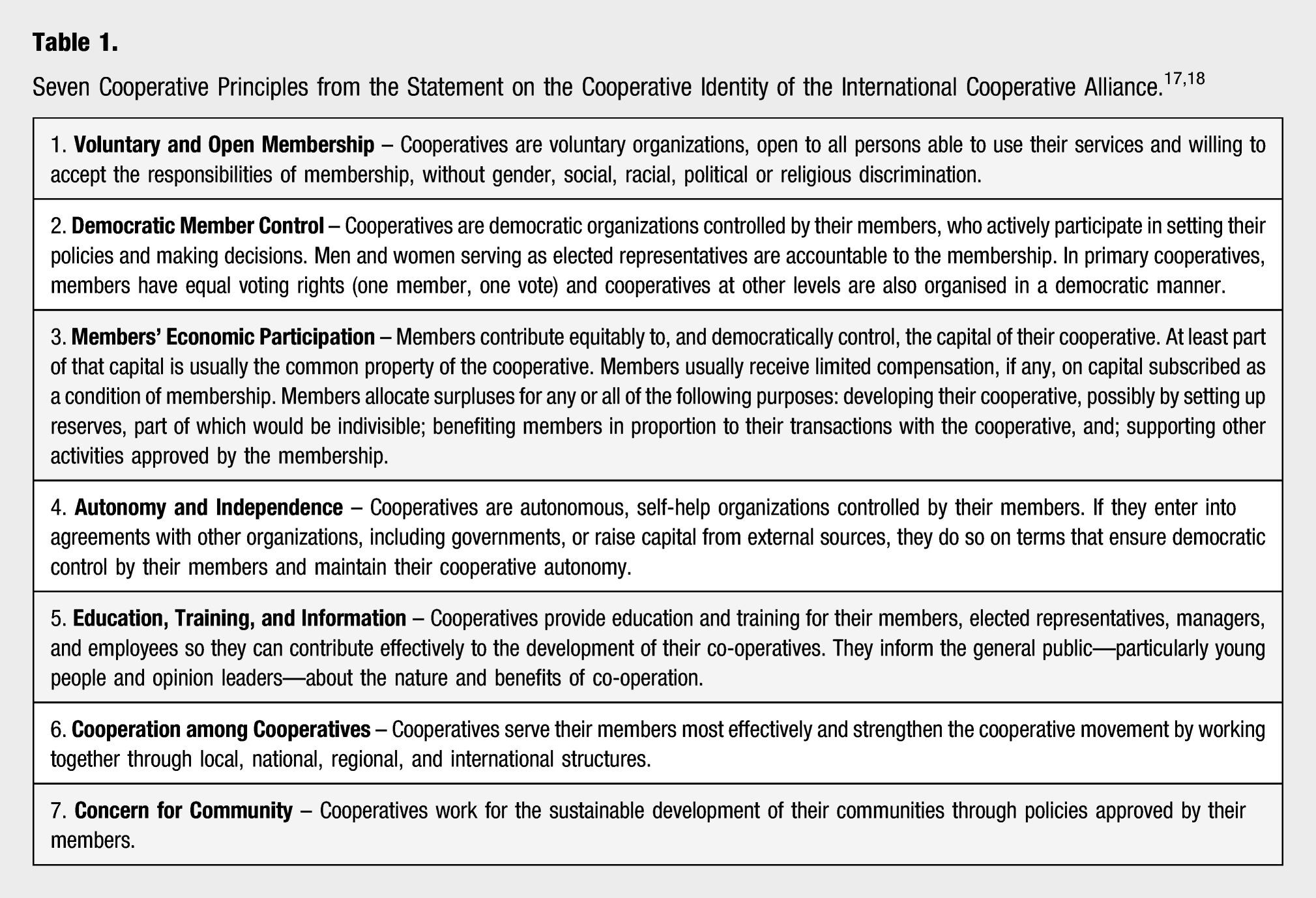
The cooperative purpose for organizing can vary from pure economic benefits for members to values-based benefits for members and the community. 19 While cooperatives that lean toward the economic benefits side of this continuum are more dominant in the cooperative business ecosystem, exploring the governance of a Cooperative Healthy Lifestyle Center is more consistent with a values-based member and community benefits model.
The example highlighted below uses the stages identified in “How to Start a Cooperative,” from the Cooperative Information Report 45 20 as well as a business model that includes non-member employees, associates working to meet the conditions of membership, and user-members. 21 Resources such as CooperationWorks!, the Cooperative Development Network, 22 are available for those interested in starting a cooperative.
Exploring Economic Need and Potential Membership
The first step in cooperative development is to assess the current market and determine that there is a need for the business. Three key areas where Cooperative Healthy Lifestyle Centers satisfy an economic need include improved quality of products and services, reduced financial costs, and the opportunity to obtain user-centered products and services. Combining these identified needs with the concept that as a member or “producer” in the system an individual will be more involved is an appropriate justification for moving into the next stage of development. That next stage involves identifying potential initial members and holding an exploratory meeting. Items discussed at this first meeting include cooperative principles and terms, advantages and disadvantages of a cooperative, and financial and other commitments from future user-members.
Discussing a Cooperative Solution and Determining Member Interest
Starting a Cooperative Healthy Lifestyle Center, like any business, should include an initial market analysis that identifies potential member needs, anticipated business volume, location options, and characteristics of the services that will be provided. Upon completion of these tasks, a second exploratory meeting to discuss the initial market analysis and to ask for a financial commitment if the group decides to move forward is warranted.
Developing a Cooperative Governance Plan and Assessing Feasibility
A Cooperative Healthy Lifestyle Center can utilize many different strategies and will likely fall under a multi-stakeholder cooperative structure. These structures are thoroughly detailed by the University of Wisconsin Center for Cooperatives. 23 The governance plan should allow for the infrastructure and coordination needed to develop a comprehensive path for healthier living. This path will likely include learning and development related to support for active living, healthy eating, and smoke-free environments as key components. It should also include opportunities to develop healthy relationships and positive personal and professional connections. Because the built environment can also be a key contributor to health and well-being, 24 consideration should be given to community development and healthy place-making. Helping to plan, advocate, and build healthier spaces is a key element of the change process. Choosing to bike or walk to work as a healthy transportation option is difficult if the community does not have safe cycling and walking opportunities, and social connections are hard to make if the environment does not support social gatherings.
Every cooperative governance plan is unique. Business-related activities can be provided in many ways and will involve members and non-members working together. It will also likely include both paid (e.g., office managers and healthy lifestyle coaches) and unpaid (e.g., board governance and membership-related expectations) work positions. The founding group of interested members will draft articles of incorporation and bylaws that would need to be approved at the first annual meeting. The next steps include electing a board of directors, hiring employees, acquiring facilities, and beginning operations. One of the most important hires is a manager who will assume responsibility for the day-to-day operations. Finding someone who is committed to cooperative principles, connecting people, and the values and mission of the organization set the stage to move a Cooperative Healthy Lifestyle Center forward.
Conclusion
Many organizational structures are available for businesses to adopt, though cooperative business models are often overlooked in the marketplace. Cooperative business practices have the potential to enhance lives and provide a unique opportunity to involve those who are interested in healthier living. By giving people the opportunity to create their environment, cooperative businesses can help nudge people toward making healthier choices by making these the default options. According to the International Cooperative Alliance, “Cooperatives are people-centered enterprises owned, controlled, and run by and for their members to realize their common economic, social, and cultural needs and aspirations.” 25 Healthy Lifestyle Centers can go beyond having healthcare professionals provide services to clients or patients by enhancing their efforts through community involvement, coproduction, and cooperative governance to provide a greater opportunity for healthier lives to emerge.
Footnotes
Declaration of Conflicting Interests
The author(s) declared no potential conflicts of interest with respect to the research, authorship, and/or publication of this article.
Funding
The author(s) received no financial support for the research, authorship, and/or publication of this article.