



Abstract
We had previously demonstrated on various stable cell cultures exposed to chemically different nanoparticles when assessing their cytotoxicity by different outcomes, dose-response relationships may be either monotonic or non-monotonic falling within an extended understanding of the hormesis paradigm. Presently, on human fibroblasts exposed to the copper-oxide and/or selenium-oxide nanoparticles, we assessed their cytotoxic effect by the inhibition of oxygen uptake against modulating the respiratory function of mitochondria (oligomycin, followed by carbonyl cyanide-4-(trifluoromethoxy) phenylhydrazone, and, finally, rotenone with antimycin A). It is hypothesized that a given type of this relationship is closely associated with the mitochondrial respiratory function. However, in only one case, this hypothesis was confirmed by finding that the monotonic dose-response relationship transformed into a non-monotonic one of the hormesis type under exposure to SeO-NP with the mitochondrial respiratory function fully inhibited by the effect of rotenone + antimycin А. In all other variants of the experiment, the shape of this relationship did not depend on the addition of the above agents to the cell culture. Neither did the effect of these modulators change the pattern of combined action of CuO-NP and SeO-NP, which was additive in all cases.
Keywords
Introduction
The importance of modeling experimentally the comparative and combined toxicity of copper-oxide (CuO-NP) and selenium-oxide (SeO-NP) nanoparticles is associated primarily with the fact that this combination is actually present in copper-smelting settings. This combination is of particular scientific interest because both of these elements are essential and, therefore, exposure to nanoparticles of these species may be expected to cause not only harmful but also beneficial dose-dependent responses of the organism. Nevertheless, previously we demonstrated their cytotoxicity on a culture of fibroblast-like cells 1 as assessed by the effect of ATP-dependent chemoluminescence inhibition.
Taking into consideration the damage to mitochondria caused by a considerable range of nanoparticles studied and related inhibition of cell respiration,2-10 it is of a considerable interest whether the impact of CuO-NP and SeO-NP on oxygen consumption in the same cell culture could be modified by modulators capable of inhibiting or stimulating the mitochondrial respiratory function. We have not found any answer to this question in the scientific literature. To fill in this lacuna, we used oligomycin, which hyperpolarizes the mitochondrial membrane thus stopping the passage of protons through the protein complexes; carbonyl cyanide-4-(trifluoromethoxy) phenylhydrazone (FCCP), which reverses the hyperpolarized state caused by oligomycin by transporting protons across the inner membrane of the mitochondria; and rotenone + antimycin А, which inhibit complexes I and III thus completely blocking mitochondrial respiration. We believe that such an experiment gave important data to elucidate the problem under consideration.
Materials and Methods
Suspensions of spherical selenium-oxide and copper-oxide nanoparticles (SeO-NP with mean diameter 51 ± 14 nm and CuO-NP with mean diameter 21 ± 4 nm) were prepared by laser ablation of 99.9% pure соpper or selenium targets under deionized water. The experiments were performed on a FLEH-104 cell line from BioloT Ltd. (Saint-Petersburg, Russia), which presents a monolayer culture of fibroblast-like cells derived from an 8-week human embryo. We added to the monolayer of cells in a 96-well plate CuO and/or SeO nanoparticles at concentrations of 25–50–100 μg/mL and incubated for 24 hours under standard conditions. Then, the mitochondrial function of cells was studied using a kit for carrying out a Cellular Mito Stress Test (Seahorse XF Cell Mito Stress Test Kit, Agilent Technologies, U. S. A., California). The main parameters of the mitochondrial function were determined by directly measuring the rate of oxygen consumption (OCR, pmol O2/min) by cells using an Agilent Seahorse XF cellular metabolism analyzer (Agilent Technologies, U. S. A., California). The results were processed using the Seahorse Wave software (Agilent Technologies, U. S. A., California). The Cellular Mito Stress Test Kit was provided for successive addition to the cell culture of the following modulators: oligomycin, carbonyl cyanide-4-(trifluoromethoxy) phenylhydrazone (FCCP), and rotenone + antimycin A. The injection of oligomycin hyperpolarizes the mitochondrial membrane, stopping the passage of protons through protein complexes. FCCP reverses the hyperpolarized state induced by oligomycin by transferring protons across the inner mitochondrial membrane. Rotenone + antimycin A inhibit complexes I and III, completely blocking mitochondrial respiration. Cell respiration was re-measured following the addition of each of the modulators.
The experimental data obtained allowed us to construct an approximation for the isolated dose-response relationship of each of the nanoparticle species using the standard least squares method.11,12
For CuO-NP, sufficient adequacy was attained with polynomial approximations, represented as linear combinations of Chebyshev polynomials. For SeO-NP, a hyperbolic approximation was sufficient in the most of the cases. In all cases, the quality of the model as evaluated by the magnitude of the coefficient of correlation between the experimental and model values was from .85 to .97.
Besides, for assessing the combined toxicity of two nanoparticle species, we modeled it by constructing the response surface y as a function of the main effects with a cross term13-16

In this particular case, y is OCR, and x1 and x2 are the nanoparticle concentrations. The type of combined action was described as usual,17,18 by arrangement of the lines (isoboles) obtained when dissecting the response surface at different levels of y.
Results and Discussion
Isolated Impacts of the Nanoparticles Species
Like in our previous experiments on cell cultures exposed to different nanoparticles species,19-21 in this study, too, we observed two types of NP dose-response relationship.
Under exposure to CuO-NPs, the rate of oxygen consumption as measured in the absence of any modulators was found to be non-monotonic, with 3 phases (Figure 1), where the 25 μg/mL and 100 μg/mL doses of CuO-NP caused a decrease in OCR while the 50 μg/mL dose produced an increase in OCR. This type of response could be interpreted as hormesis within the framework of an extended understanding of this paradigm which we had considered in detail elsewhere.19,22 Meantime, an examination of the dose-OCR response for SeO-NP revealed that it was monotonic with these nanoparticles causing a sharp drop in the oxygen consumption rate already at the minimal experimental dose (25 μg/mL), reaching a plateau at 50 μg/mL (Figure 2). Change in the baseline rate of oxygen consumption in the culture of fibroblasts under exposure to different doses of CuO-NP without any modulators added. The abscissa plots experimental concentrations of nanoparticles in the incubation medium, μg/mL; the ordinate plots rate of oxygen consumption values, pmol O2/min. Dots represent means with standard error of the mean. The equation for the approximation curve is given by Decrease from the baseline rate of oxygen consumption in the cell culture under exposure to different doses of SeO-NO without any modulators added. The abscissa plots experimental concentrations of nanoparticles in the incubation medium, μg/mL; the ordinate plots rate of oxygen consumption values, pmol O2/min. Dots represent means with standard error of the mean. The equation for the approximation curve is given by 

Following the injection of oligomycin into the cell culture incubated with CuO-NP, the non-monotonic (triphasic) dependence of OCR on dose was practically similar to the baseline one (Figure 3). The same applies to the monotonic dose-response relationship under exposure to SeO-NP (Figure 4). Change in the rate of oxygen consumption in the cell culture under exposure to different doses of CuO–NP with oligomycin added. The abscissa plots experimental concentrations of nanoparticles in the incubation medium, μg/mL; the ordinate plots rate of oxygen consumption values, pmol O2/min. Dots represent means with standard error of the mean. The equation for the approximation curve is given by Change in the rate of oxygen consumption in the cell culture under exposure to different doses of SeO–NP with oligomycin added. The abscissa plots experimental concentrations of nanoparticles in the incubation medium, μg/mL; the ordinate plots rate of oxygen consumption values, pmol O2/min. Dots represent means with standard error of the mean. The equation for the approximation curve is given by 
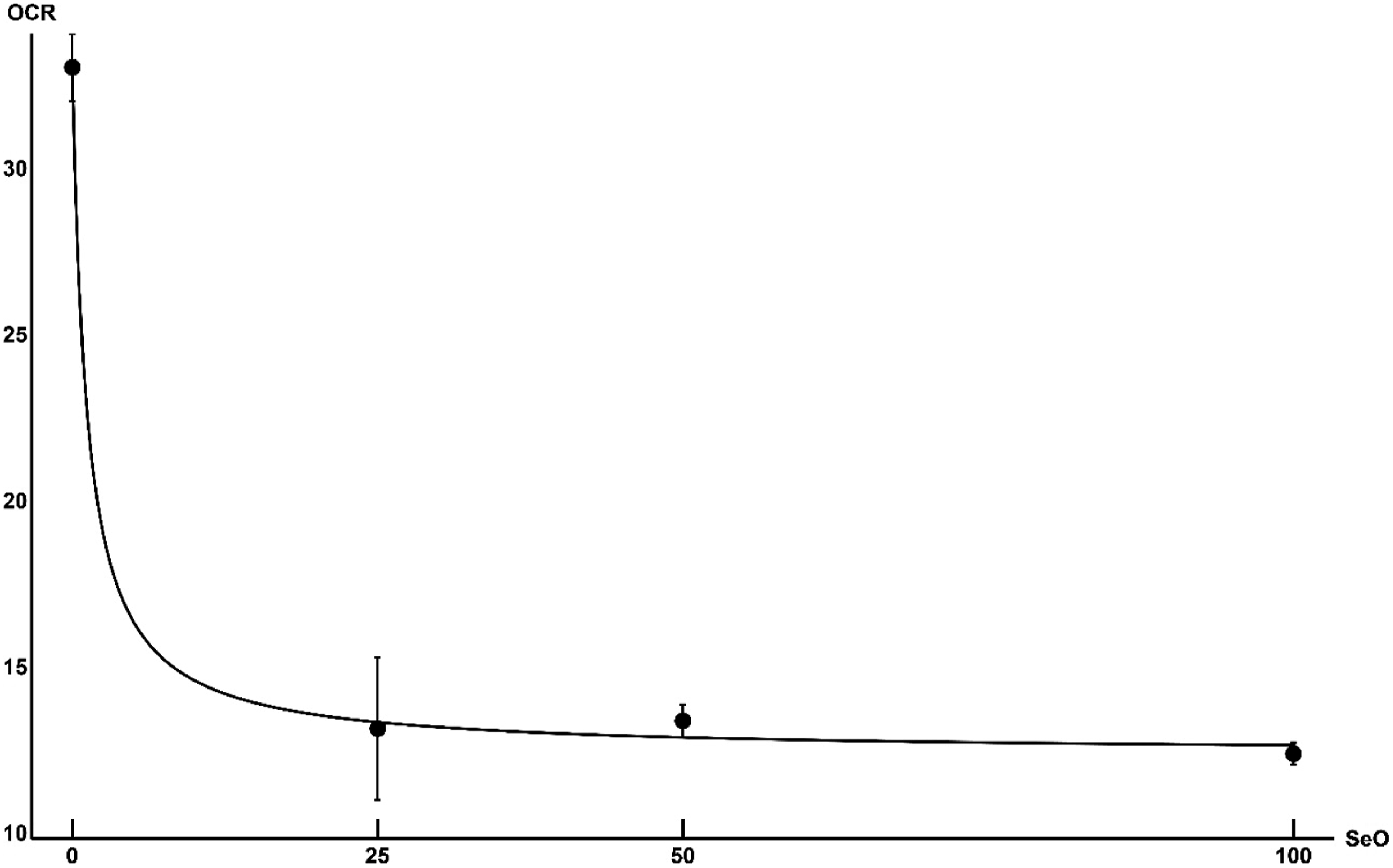
Subsequent addition of FCCP to the cell culture under exposure to CuO-NP leads to the transformation of the triphasic dose-response relationship into a biphasic one, which could be described as hormesis as it is commonly understood (Figure 5). However, the non-monotonic character of this relationship remained essentially the same. Again, as can be seen in Figure 6, under the action of FCCP (added after oligomycin), the dose-response relationship is monotonic with no difference from the baseline one. Change in the rate of oxygen consumption in the cell culture under exposure to different doses of CuO–NP with carbonyl cyanide-4-(trifluoromethoxy) phenylhydrazone added after oligomycin. The abscissa plots experimental concentrations of nanoparticles in the incubation medium, μg/mL; the ordinate plots rate of oxygen consumption values, pmol O2/min. Dots represent means with standard error of the mean. The equation for the approximation curve is given by Decrease in the rate of oxygen consumption in the cell culture under exposure to different doses of SeO–NP with carbonyl cyanide-4-(trifluoromethoxy) phenylhydrazone added after oligomycin. The abscissa plots experimental concentrations of nanoparticles in the incubation medium, μg/mL; the ordinate plots rate of oxygen consumption values, pmol O2/min. Dots represent means with standard error of the mean. The equation for the approximation curve is given by 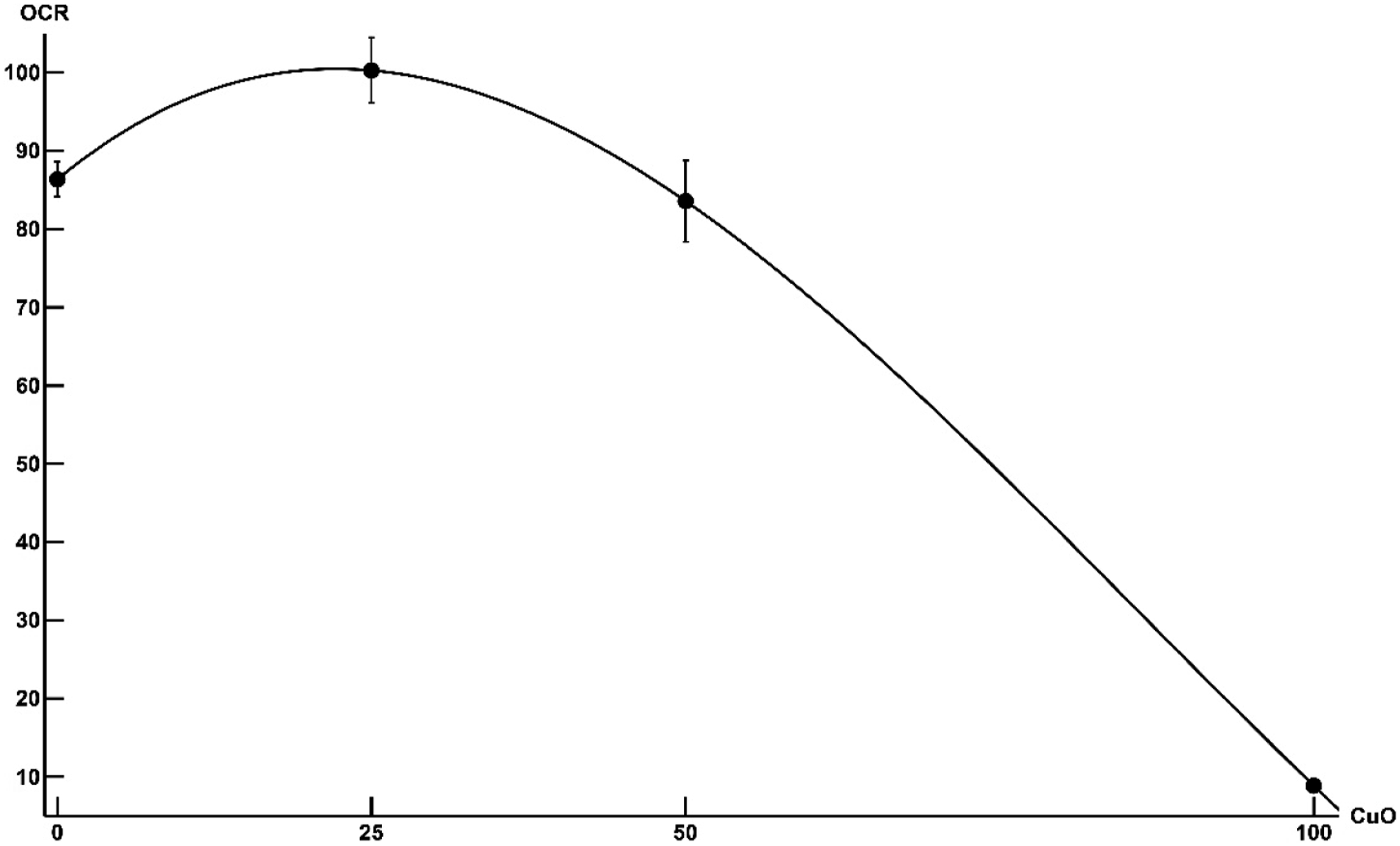

Finally, following the addition of rotenone + antimycin А (after oligomycin and FCCP) to the culture exposed to CuO-NP, the dose-response relationship is still non-monotonic, but it is again triphasic rather than a biphasic one (Figure 7). In other words, with the mitochondrial respiratory function completely inhibited, the dose-response relationship under consideration returns to the baseline one. On the contrary, in the culture exposed to SeO-NP, this pattern changed essentially: whereas it was monotonic at the baseline and upon addition of both oligomycin and FCCP, after the addition of rotenone + antimycin А, it suddenly transformed into a non-monotonic and triphasic relationship of the hormesis type in an extended interpretation of this paradigm.
22
Change in the rate of oxygen consumption in the cell culture under exposure to different doses of CuO–NP with rotenone + antimycin A added after oligomycin and carbonyl cyanide-4-(trifluoromethoxy) phenylhydrazone. The abscissa plots experimental concentrations of nanoparticles in the incubation medium, μg/mL; the ordinate plots rate of oxygen consumption values, pmol O2/min. Dots represent means with standard error of the mean. The equation for the approximation curve is given by 
Combined Impact of the Nanoparticles
An analysis of combined toxicity (see the section “Materials and Methods”) revealed an additivity of effects for all the levels of dose studied. Whichever agents added (FCCP, oligomycin, and rotenone + antimycin A), this type of combined toxicity pattern remained the same (Figures 8–10). Change in the rate of oxygen consumption in the cell culture under exposure to different doses of SeO–NP with rotenone + antimycin added after oligomycin and carbonyl cyanide-4-(trifluoromethoxy) phenylhydrazone. The abscissa plots experimental concentrations of nanoparticles in the incubation medium, μg/mL; the ordinate plots rate of oxygen consumption values, pmol O2/min. Dots represent means with standard error of the mean. The equation for the approximation curve is given by Isoboles characterizing the type of combined toxicity under exposure of the cell culture to CuO and SeO nanoparticles with no agents added. The axes plot nanoparticles concentrations, μg/mL. The numbers at each isobole show the magnitude of the response to which it corresponds. Isoboles characterizing the type of combined toxicity of SeO and CuO nanoparticles with the addition of various agents. The axes plot nanoparticles concentrations, μg/mL. The numbers at each isobole show the magnitude of the response to which it corresponds. (a) With oligomycin added, (b) with carbonyl cyanide-4-(trifluoromethoxy) phenylhydrazone added next, and (c) with Rotenone + antimycin A added last.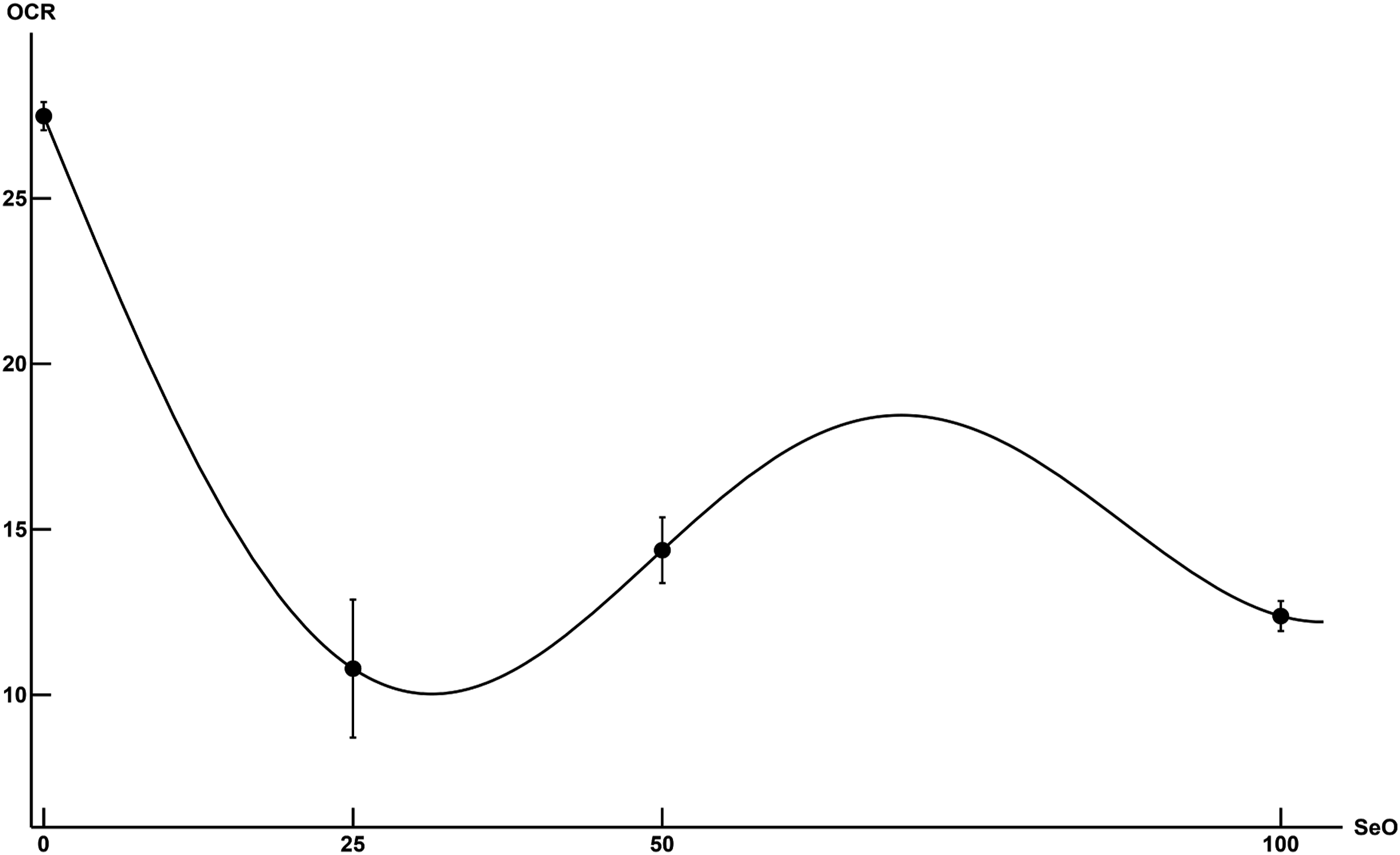


Conclusion
The data obtained in this study confirm that, for nanoparticles cytotoxicity, the dose-response relationship may be either monotonic or non-monotonic falling within an extended understanding of the concept of hormesis. Having now chosen the inhibition of cell respiration as the outcome, we expected that a particular type of this relationship would be closely associated with the mitochondrial respiratory function. Indeed, with the respiratory function completely inhibited by the effect of rotenone + antimycin А, the monotonic dose-response relationship transformed into a non-monotonic one of the hormesis type. However, in all the other variants of the experiment, the type of the dose-response relationship did not depend on the addition to the cell culture of the agents known to influence the mitochondrial respiratory function. Besides, the action of these additives did not influence markedly the type of combined toxicity of CuO-NP and SeO-NP.
Footnotes
Declaration of Conflicting Interests
The author(s) declared no potential conflicts of interest with respect to the research, authorship, and/or publication of this article.
Funding
The author(s) received no financial support for the research, authorship, and/or publication of this article.
