



Abstract
Gout is a chronic disease. Gout symptoms are often experienced in the middle of the night. The onset of gout in the middle of the night is closely related to abnormal liver and gallbladder meridian. The purpose of this study was to investigate the clinical efficacy and possible mechanism of action of Tongbixiao pills in the treatment of hyperuricemia and gouty arthritis. The Tongbixiao pills we used included several traditional Chinese medicines, most of which tonify the spleen; strengthen the liver; benefit the kidney; and reduce heat, dampness, and blood stasis. In this randomized clinical study of 105 patients, we found that Tongbixiao pills can reduce uric acid levels in hyperuricemia patients. Additionally, the efficacy was similar to that of allopurinol and the level of uric acid did not increase significantly at eight weeks after withdrawal. In the absence of notable adverse reactions, Tongbixiao pills can also increase uric acid excretion, reduce serum creatinine and lipid levels, and reduce inflammation and relieve gout symptoms. In addition, we used SD rats to simulate gout and arthritis and divided them into five groups: normal group, model group, low-dose group, medium-dose group, and high-dose group. The inflammatory indices of the 40 SD rats were observed. After seven days, ankle swelling in rats in the treatment group was significantly reduced. The indices of uric acid, creatinine, and urea nitrogen in the treatment group were significantly lower than those in the model group, which proved that Tongbixiao pills could inhibit hyperuricemia in rats, thus treating gout. This study demonstrates that Tongbixiao pills can treat gout, provide more treatment options for gouty arthritis, and improve the quality of life of patients.
Introduction
Gout is the most common form of arthritic disease. 1 From 1992 to 2017, the global incidence and prevalence of gout increased by 37% and 41%, respectively. 2 Currently, it is not yet proven that diet and lifestyle change can reduce high uric acid; therefore, patients need to use related drugs and other special treatment methods. 3 The onset of gout is common in men over 40 years of age. 4
The occurrence of gout is closely related to uric acid and purine. Uric acid (UA) is mainly produced in the intestine and liver. 5 Hyperuricemia usually causes renal tubular damage, macrophage infiltration, and the upregulation of inflammatory indicators. 6 Decreased renal excretion and excessive intake of foods rich in purine can lead to an increased risk of gout. 7 Abnormal purine metabolism leads to elevated uric acid. 8 Disrupted purine metabolism can cause urate crystals to deposit and cause swelling of the joints. 9 Gout can also cause chronic nephritis, renal failure, and the formation of urinary tract stones. 10 Uric acid-lowering treatment is beneficial for the dissolution of sodium urate crystals, thereby preventing gout attacks. 11
In the clinic, the current drugs for treating hyperuricemia mainly include uric acid excretion agents and xanthine oxidase (XOD) inhibitors; 12 however, challenges such as side effects and easy recurrence after drug withdrawal exist. 13 For example, although febuxostat and allopurinol drugs can reduce uric acid levels, they increase the risk of cardiovascular disease. 14 In order to provide more diversified treatment options for patients, we have studied the role of Chinese medicine in the treatment of gout. Tongbixiao pills were developed by the Gout TCM Research Cooperation Group of Jingzhou Hospital of Traditional Chinese Medicine. According to observations in clinical practice, we found that the basic pathogenesis of gout is based on the theory of liver, spleen, and kidney dysfunction, and suggested tonifying the liver and invigorating the spleen. According to the principles of renal treatment of hyperuricemia and gout, the prescription of Tongbixiao pills was formulated.
Materials and Methods
Clinical Research in Patients With Gout
A total of 105 patients with hyperuricemia, including 89 men and 16 women, who signed informed consent forms in the nephrotic gout outpatient department and inpatient Department of Jingzhou Hospital of Traditional Chinese Medicine from January 2018 to January 2020, were selected. The 105 patients were randomly divided into a control group and an observation group. The control group was composed of 43 men and 9 women (aged 19–69 years; average (37.5±7.6) years old; the duration of the disease ranged from 1 month to 8 years; 13 patients had blood uric acid value of 420–480 μmol/L, 29 patients had 481–600 μmol/L, and 10 patients had more than 600 μmol/L). There were 53 patients in the observation group, including 46 male and 7 female patients (aged 19–68 years; average (37.8±7.5) years old; the duration of the disease ranged from 2 months to 9 years; 12, 30, and 11 patients had serum uric acid levels of 420–480μmol/L, 481–600μmol/L, and more than 600umol/L, respectively. There was no statistical difference in general information between the two groups (P>.05).
We take 30 g/day of traditional Chinese medicine pills as the standard. Our observation group was given Tongbixiao pills (10 g), 3 times a day, before meals, for 8 weeks on the basis of controlling diet, restricting the intake of high-purine food, and smoking cigarettes and other conventional treatments. In the control group, allopurinol (100 mg) was administered orally once a day before breakfast for eight weeks. The blood uric acid, liver and kidney function, blood lipids, uric acid, and urine microalbumin of the two groups were checked before treatment and at 8 and 16 weeks of treatment. Pain (VAS) score and swelling score before and after treatment of gouty arthritis were also recorded. Refer to the diagnostic criteria in “Clinical Disease Diagnosis Based on Cure and Improvement Criteria” for evaluation (Significantly effective: blood uric acid ≤380 μmol/L, or blood uric acid lower than before treatment> 35%; Effective: blood uric acid ≤440 μmol/L but> 380 μmol/L, or decreased more than 20% but <35%; Invalid: blood uric acid> 440 μmol/L, or dropped by <20%). 15 All Tongbixiao pills were provided by the Jingzhou Hospital of Traditional Chinese Medicine.
Preparation of Tongbixiao Pills
Tongbixiao pills were prepared according to the Chinese Pharmacopoeia. 16 We developed Tongbixiao Wan according to the pathogenesis of gout and the principles of traditional Chinese medicine treatment. The formula of Tongbixiao pills contains Shudi, Baishao, Qinjie, Achyranthes sichuanensis, Qianjianjian, and Lujiao cream to nourish the liver and kidney. Papaya, coix seed, Tuckahoe, and tangerine peel invigorate the spleen and remove dampness. Baiwei, Phellodendron, Atractylodes, Red Flea, Honeysuckle, Tongcao, Plantain, and Tuckahoe clear heat and relieve dampness. Wei Lingxian, Bone-seeking Wind, Qingfengteng, Bixie, Betel Nut, Lulu, Baiying, Shanci Mushroom, Angelica, Guizhi, and Mulberry branch to remove dampness and relieve pain, Angelica to promote blood circulation and remove blood stasis. Pill excipients are an important part of pill production, including excipients and additives. We stabilized the efficacy of the medicine by making various prescriptions into the pills. The medicine preparation method adopted in this study was as follows: after drying each Chinese medicine, it is grinded into a powder. Water is then added for fusion to modulate the drug. The mixed medicine is made into pills using a pill-making machine. It is then polished and dried. The special-shaped pills and the cracked and adhered pills are sifted out, and the pills of uniform size and color are saved. The manufacturing process is complicated, and drug requirements are high.
In Vivo Experimental Protocol
Male Sprague–Dawley rats (weight: 200–220 g, Wuhan Ruizhi Dr Biotechnology Co Ltd Wuhan, China, 91420103MA4KRFX19 K); SCXK (E) 2020-0018 were used. All animals were kept in a standard laboratory animal room with a temperature of 24–26°C, relative humidity of 50–55%, and light/dark cycle of 12 h. All rats were allowed to eat freely throughout the experiment, and after one week of adaptive feeding, the high uric acid model was first copied according to a previous study. 17 The rats were randomly divided into five groups, with eight rats in each group.18,19 Rats in the normal group were administered .9% normal saline once a day for 21 days. The other four groups were administered a mixture of potassium oxazinate (300 mg/kg) and hypoxanthine (600 mg/kg) by intragastric administration. Potassium oxazinate + hypoxanthine powder was mixed with a .5% sodium carboxymethyl cellulose (CMC Na) suspension. 20 At the 3rd and 4th weeks, the serum uric acid levels were measured.21When the rat serum uric acid level reached 110 μmol/L, the model was successfully established. Successful model rats were divided into a model group, low-dose Tongbixiao pills group (TBX-L, .6 g/kg/day), medium-dose Tongbixiao pills group (TBX-M, 1 g/kg/day), and high-dose Tongbixiao pills group (TBX-H, 1.5 g/kg/day), with 8 rats in each group22. Seven days after the administration of Tongbixiao pills, pentobarbital sodium was administered for intraperitoneal anesthesia. 23 Blood was taken from the abdominal aorta for uric acid, creatinine, urea nitrogen, and other experiments, and the kidney and ankle joints of the rats were sampled for pathological analysis. The rats were then sacrificed.
MSU Crystals Formation
In gout disease, monosodium urate (MSU) crystals are often deposited in joints or connective tissues. 24 Studies have confirmed that traditional Chinese medicine can further affect the deposition of MSU crystals by inhibiting the degradation of proteoglycans. 25 Crystal preparation was done according to the method described by Coderre,26,27 with some adjustments. All reagents were prepared under pyrogen-free conditions. After the hyperuric acid model was successfully established, all rats were anesthetized with pentobarbital, and 50 μL MSU crystals were injected into the model group, TBX-L, TBX-M, TBX-H, and normal group, with 50 μL PBS. According to the classification of dysfunction indicators and inflammation indicators related to acute arthritis symptoms, an acute gouty arthritis model was established. 28 Dysfunction index evaluation was also recorded (Level 0: normal gait, evenly landing on all four feet; Level 1: relaxed left foot, toes spread out, mild lameness; Level 2: left hind foot flexed, toes touching the ground, visible limp; Level 3: Left hind foot completely leaves the ground). After injection of MSU crystals or PBS solution, the dysfunction index of rats was evaluated at 0h, 12h, 24h, and 48h. When using traditional Chinese medicine treatment, the swollen volume (mm3) of the rat ankle joint was measured with a soft ruler, and the data was recorded at 0h, 12h, 24h, 36h, and 48h.
Biochemical Analysis
At the 3rd and 4th week of intragastric administration, eyelid blood was collected to measure the serum uric acid value, urea nitrogen, and creatinine index. When the gouty arthritis model was successfully established, the rats were anesthetized with 2% pentobarbital after one week of treatment with the Chinese medicine,29,30 and blood was collected through the abdominal aorta. All blood samples were incubated at room temperature for 30 min. The blood samples were centrifuged at 3500 r/min for 15 min at 4°C, and the supernatants were separated. The uric acid value, creatinine, and urea nitrogen-related indexes were measured again following the corresponding steps.
Histopathological Examination
After the rats were anesthetized, the kidney tissue and ankle joint tissue were sampled, and the kidney tissue slices were placed in a tissue embedding box soaked in 4% paraformaldehyde for fixation for more than 24 h. The ankle joint tissue was soaked in 4% paraformaldehyde for fixation. The nitric acid aqueous solution was prepared by adding 5 mL concentrated nitric acid to distilled water to 100 mL, and soaking the ankle joint in the liquid for 12h for decalcification. The kidney tissue and ankle joint were then dehydrated with gradient alcohol and xylene, embedded in conventional paraffin, separated into 3 μm-thick slices, and stained with hematoxylin and eosin (H&E).
Statistical Analysis
All data are expressed in terms of mean and standard deviation. SPSS 21.0 was used for data processing. The X2 test was used for counting data, Ridit analysis was used for grade data, and T-test was used for measurement data expressed as (±s). Differences were considered statistically significant when P <.05.
Results
Tongbixiao Pills Decreased Uric Acid in Patients With Gout
Comparison of blood uric acid levels before and after treatment between the two groups. Data are presented as mean ± SD.

Note: Compared with before treatment (*P<.05); compared with the control group (△P> .05); after stopping the drug for eight weeks compared with the control group (#P<.05).
Comparison of curative effect before and after treatment and comparison of curative effect after eight weeks of drug withdrawal. The data is expressed as a percentage of statistical statistics.

Note: Compared with before treatment (*P < .05); compared with the control group (△P > .05); after stopping the drug for eight weeks compared with the control group (#P < .05).
Comparison of the Levels of Urine Uric Acid, Blood Creatinine, and Blood Lipids Between the Two Groups Before and After Treatment
Comparison of UUA/24h, Scr, and TG before and after treatment in the two groups. Data are presented as mean ± SD.
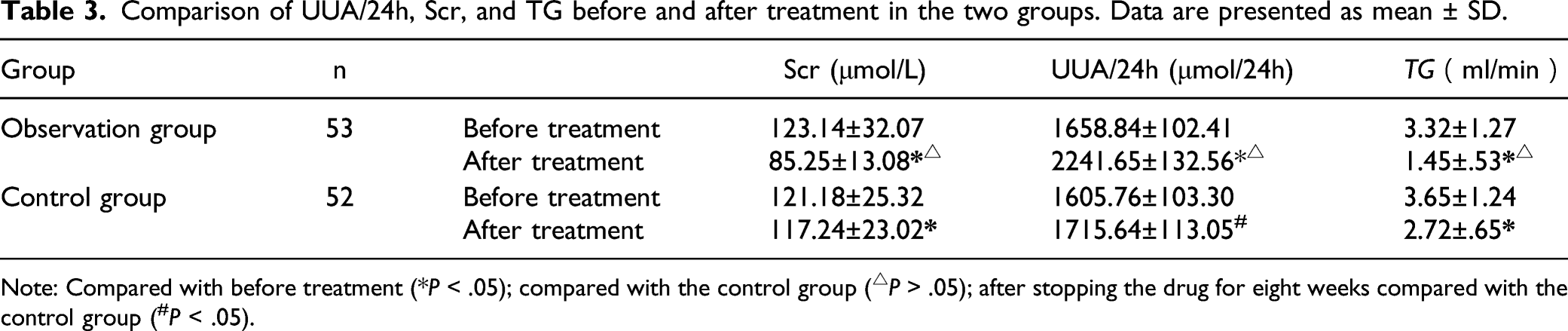
Note: Compared with before treatment (*P < .05); compared with the control group (△P > .05); after stopping the drug for eight weeks compared with the control group (#P < .05).
Comparison of VAS Scores Between the Two Groups Before and After Treatment and Reduced Side Effects
Comparison of VAS scores between the two groups before and after treatment. Data are presented as mean ± SD.

Note: Compared with before treatment (*P<.05); compared with the control group (△P> .05); after stopping the drug for eight weeks compared with the control group (#P<.05).
Comparison of mALB and ALT between the two groups before and after treatment. Data are presented as mean ± SD.
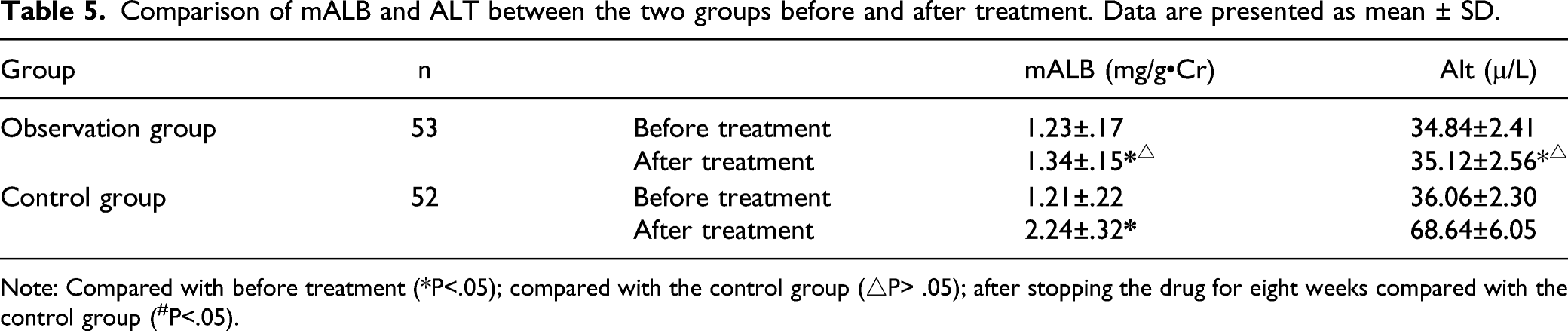
Note: Compared with before treatment (*P<.05); compared with the control group (△P> .05); after stopping the drug for eight weeks compared with the control group (#P<.05).
Tongbixiao Pills Improved Weight Loss in Rats
We observed the growth of the rats and recorded their weight every day. Rats in the normal group gained weight steadily, had smooth fur, good mental state, normal diet, and frequent activities. Compared with the normal group, the model group had dull fur, no shedding, mental discomfort, and less activity time. Compared with the model group, weight loss and diet improvement were observed in the Tongbixiao pills treatment group. We calculated the percentage of weight gain of rats in each group after seven days of Tongbixiao pills treatment, and the weight change trend of rats in the TBX-H group was the most notable (Figure 1). The percentage of weight change in each group given Tongbixiao pills (N=40).
Tongbixiao Pills Improved Rat Ankle Joint Swelling
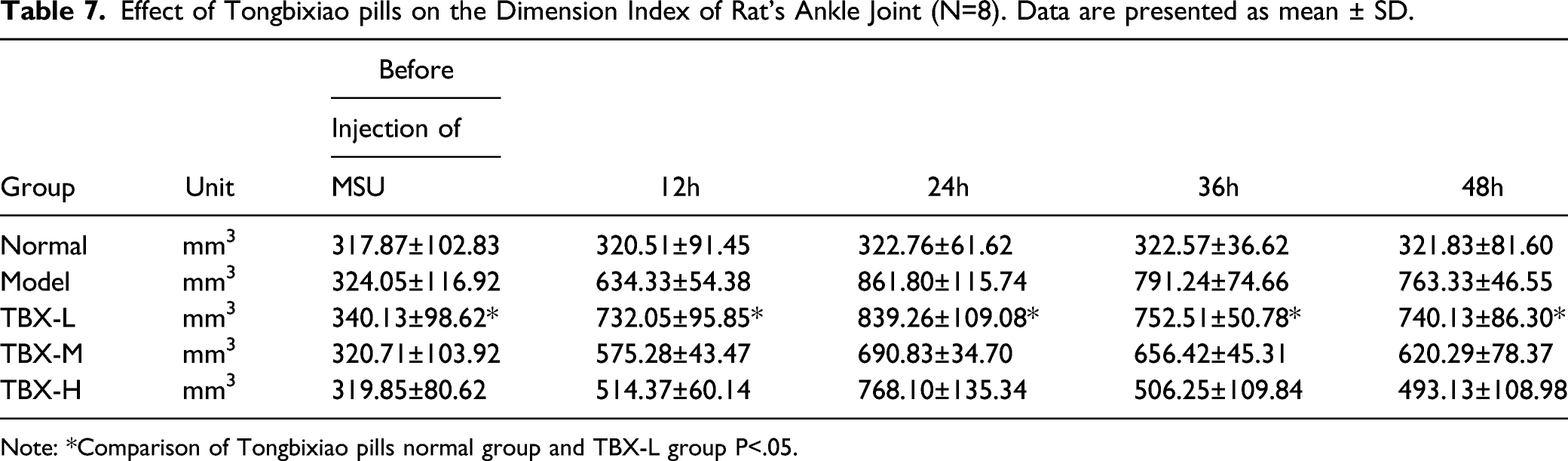
After the hyperuric acid model was successfully established, we used pentobarbital to anesthetize the rat intraperitoneally, the right ankle joint was disinfected with 75% ethanol, and PBS solution was injected into the right ankle joint of the rats in the normal group. The right ankle joint of the rats in the remaining groups were injected with mixed MSU crystals. No visible swelling was observed in the control group. The right ankle joints of rats in the model group, TBX-L, TBX-M, and TBX-H groups had different degrees of swelling, and the gout joint model was formed (Figure 2). After observation, there were no abnormalities in the ankle dysfunction indexes of the normal group after PBS injection. The model group, TBX-L, TBX-M, and TBX-H had different degrees of redness and gait instability after injection of MSU crystals. The grade 0 ankle joints were normal and without inflammation. Grade 1 joints have skin erythema, mild swelling, and severe disease. Although grade 2 joints were visibly red and swollen, bone markers disappeared, and swelling is limited to the joints. External joint swelling was observed in grade 3 joints, with severe inflammation and weak feet that often lifted off the ground. Except for the normal group, all the other groups improved to varying degrees after 48 h. The recovery speed of the TBX-H group was higher than that of the other groups (Table 6). Simultaneously, we measured the swollen volume of the rat’s right ankle with a tape measure. Calculated using the formula: ankle volume 1/2 × ab
2
.
21
The dysfunction index of rats at 0h,12h, 24h, 36h, and 48h, respectively, was observed. The gait recovery of the TBX-H group was faster than that of the other groups, and the gait returned to normal after 48 h. The data show that after administering Tongbixiao pills, the ankle size was significantly reduced. Tongbixiao pills normal group and TBX-L group had statistical significance (P<.05) (Table 7). Tongbixiao pills alleviated rat ankle joint swelling. Normal group (a) was injected with 50 μL PBS; the model group (b), TBX-L (c), TBX-M (d), TBX-H (e) were injected with 50 μL of MSU crystals. There were eight rats in each group (N=8). Tongbixiao pills ankle dysfunction index in rats (N=8). Note: The measurement data represent the interquartile range of the eight animals. #Tongbixiao pills normal group compared with model group (P<.05); *model group compared with traditional Chinese medicine treatment group (P<.05). Note: The measurement data represent the interquartile range of the eight animals. #Tongbixiao pills normal group compared with model group P<.05; *model group compared with traditional Chinese medicine treatment group (P<.05). Note: The measurement data represent the interquartile range of the eight animals. #Tongbixiao pills normal group compared with model group P<.05; *model group compared with traditional Chinese medicine treatment group (P<.05). Note: The measurement data represent the interquartile range of the eight animals. #Tongbixiao pills normal group compared with model group P<.05; *model group compared with traditional Chinese medicine treatment group (P<.05). Effect of Tongbixiao pills on the Dimension Index of Rat’s Ankle Joint (N=8). Data are presented as mean ± SD. Note: *Comparison of Tongbixiao pills normal group and TBX-L group P<.05.

Tongbixiao Pills Improved Hyperuricemia and Renal Function in Rats
We measured serum uric acid levels in rats after intragastric administration of Tongbixiao pills to evaluate whether Tongbixiao pills could reduce uric acid levels. In the early stage, we used the combined gavage of potassium oxazine and hypoxanthine to complete the hyperuric acid model. In the preliminary uric acid test, there was a significant difference between the normal group and the model group. The model group had a uric acid level >110 μmol/L
31
, which suggested that the model was successfully established. After seven days of treatment with Tongbixiao pills, the serum uric acid level of the treatment group decreased, and the treatment effect on the TBX-H group was the most notable (Figure 3A). After the injection of MSU crystals, the Tongbixiao pills were administered for seven days to observe the serum creatinine and serum urea nitrogen levels. Compared with the model group, the TBX-Land TBX-M groups have significantly decreased creatinine levels (Figure 3B). Compared with the model group, the urea nitrogen level was significantly lower in the TBX-M and TBX-H group (Figure 3C). These results suggest that Tongbixiao pills can reduce serum uric acid levels and improve renal function. (a) The effect of Tongbixiao pills on serum uric acid in rats with hyperuricemia. Comparison between model group and normal control group (****P < .0001); comparison between model group and TBX-L group (**P < .01); comparison between model group and TBX-M or TBX-H (****P < .0001). (b) The effect of Tongbixiao pills on serum creatinine in rats. Comparison between normal group and model group (*P < .05); comparison between model group and TBX-L and TBX-M groups, (*P < .05). (c) The effect of Tongbixiao pills on serum urea nitrogen in rats. Comparison between normal group and model group (****P<.0001); comparison between model group and TBX-M groups (****P < .0001); comparison with TBX-H group (**P < .01).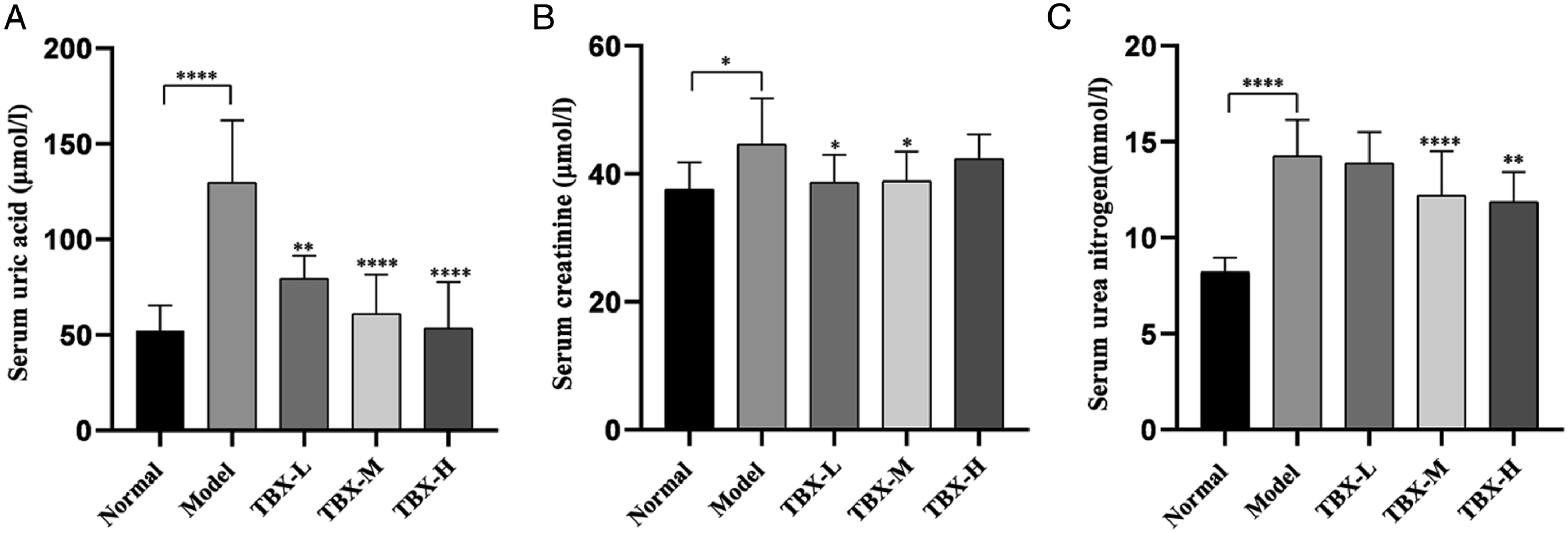
Tongbixiao Pills Improved Ankle and Kidney Injury in Rats With MSU Crystal Deposition
After HE staining of the kidneys and ankle joints, pathological observations of the kidney (renal corpuscles and convoluted tubules) and ankle joints (periosteal and cartilage) lesions of acute gouty arthritis rats were made under a microscope (Figure 4). The picture shows the HE stained image of induced rat ankle inflammation and nephropathy under the microscope (×200). The normal group was the PBS injection group (N=8); the model group was the rat acute gouty arthritis model group; the TBX-L, TBX-M, and TBX-H groups were the rats injected with MSU crystals after joint replacement. The cartilage lesion area is visible: the cell nucleus disappears, the cartilage cell enlarges, and the cell nucleus becomes smaller or dissolved. The synovial lesions can also be seen with inflammatory cells, synovial thickening, and increased cell numbers. Renal corpuscle lesions can be seen with glomerular mesangial cell hypertrophy, glomerular congestion and necrosis, some edema, and the number of parietal cells segmental increased. The area of tortuous tube lesions can also be seen with renal tubule swelling, bleeding, cell shedding, visible red blood cell casts, and white blood cell casts.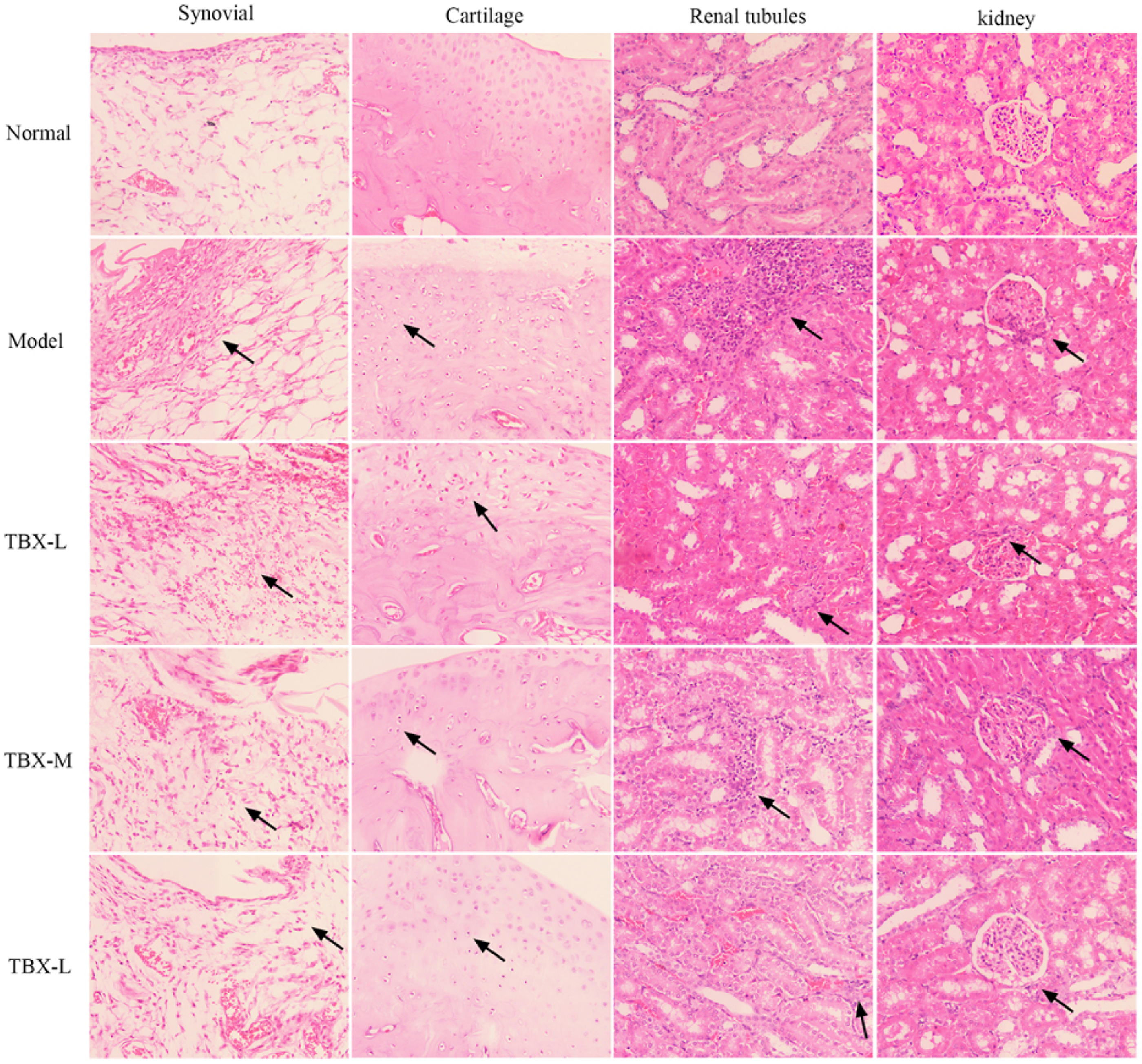
There were no structural abnormalities in the cartilage, synovium, and kidney of the rats in the normal group. The structure of the kidney was normal, the renal cortex and medulla were clear, and there was no notable damage to the cartilage synovium. The ankle joint structure of rats in the model group was abnormal, and the chondrocyte nuclei became smaller, dissolved, or disappeared. Synovial lesions showed thickened synovium, bleeding, increased cell number, and exudates. The kidneys also showed edema, hemorrhage, red blood cell casts, and white blood cell casts can be seen. After one week of treatment with Tongbixiao pills, it was observed that the pathological changes in the ankle and kidney in the TBX-L, TBX-M, and TBX-H groups improved, with a decrease in vacuolar cells, a decrease in nuclear pyknosis, a decrease in inflammatory cells, and an improvement in edema. Treatment of Tongbixiao pills with Chinese medicine can improve ankle and kidney disease in rats.
Discussion
Gout often accumulates in the joints of the hands, knees, and feet.32,33 The clinical stage is divided into asymptomatic hyperuricemia, acute gouty arthritis, intermediate stage, and chronic tophi. 34 According to the TCM theory of traditional Chinese medicine, turbid phlegm and excessive internal dampness are the main causes of hyperuricemia. 35 The etiology of the disease is multifaceted. Due to the lack of righteousness in the human body, the muscle surface or meridians are attacked by wind-cold, damp-heat toxins, resulting in stagnation of qi and blood and turning into heat, resulting in redness, swelling, heat and pain in muscles, joints, and soft tissues, gout nodule formation, and joint deformities. Gout is an acute inflammatory disease. 36 Inflammatory cells affect joints by releasing inflammatory mediators, resulting in acute gouty inflammation. Among them, high uric acid and MSU crystal stimulation often lead to inflammatory reactions.37-39 Studies have reported that MSU induces a variety of cytokines that allow neutrophils to enter the synovium, leading to an inflammatory response. 40 Studies have shown that injection of MSU crystals (200 μg/20 μl) in an experimental mouse model of gout resulted in ankle swelling and inflammation that peaked at 18 hours. Following MSU crystal injection, treatment with Gal-9 significantly reduced ankle swelling in mice. 41 Therefore, suppressing the inflammatory response is beneficial for suppressing the occurrence of gout.
Traditional Chinese medicine usually treats gout by reducing blood uric acid or promoting blood uric acid excretion, inhibiting inflammatory factors in joint fluid, and blocking peripheral nerve sensation. Chinese herbal medicine has the advantage of reducing the frequency of gout attacks and fewer side effects, but the application of Chinese medicine prescriptions should follow the principle of TCM syndrome differentiation. 42 Modern pharmacological studies have found that total saponins can reduce serum uric acid levels in hyperuricemic rats. 43 The honeysuckle vine has a pungent, sweet, and cold nature and can be used as a medicine in four seasons. It has anti-inflammatory effects and can reduce damage to multifunctional organs. 44 Honeysuckle can effectively reduce uric acid and relieve gouty arthritis induced by MSU crystal injection. 45 Morusin A in mulberry branches can significantly reduce urate reabsorption and increase urate excretion. 46 Weilingxian has a strong inhibitory effect on xanthine oxidase activity and its antioxidant effect and can significantly reduce blood uric acid. 47 The water extract of poria cocos can reduce blood uric acid levels in rats, and at the same time can reduce the creatinine level to protect the kidney. 48 Plantago seed extract affects the activity of xanthine oxidase in the liver of model rats, can prevent kidney damage, and reduce inflammation. 49
In the clinical study, we treated 105 gout patients with allopurinol and Tongbixiao pills to demonstrate the efficacy of Tongbixiao pills for gout. In animal experiments, our study used the MSU-induced acute gouty arthritis model. Through clinical observation and animal experiments, it is found that Tongbixiao pills can not only reduce uric acid and prevent the occurrence of gout, but also has a good effect on gout patients. And our experiment shows that after the use of Tongbixiao pills treatment, the patients did not experience recurrence after eight weeks of drug withdrawal. Through clinical comparison, we found that the blood uric acid level, blood creatinine, and blood lipid levels of the patients treated with Tongbixiao pills and allopurinol were lower than those before treatment, and the recurrence rate in the Tongbixiao pills group was lower than that of allopurinol group after withdrawing the drug. The total effective rate was also significantly higher than that in the allopurinol group. In terms of liver damage, liver damage occurred in the allopurinol-treated group. We confirmed that Tongbixiao pills can reduce kidney damage and hyperuric acid, creatinine, and blood lipids. Thus, we conducted a rat experiment to further confirm the effect of the Tongbixiao pills. The rat hyperuric acid acute gouty arthritis model was established by gavage of potassium oxoxazine and hypoxanthine for 21 days. After seven days of treatment with Tongbixiao pills, it was found that the uric acid, creatinine, and urea nitrogen levels of rats improved. In addition, the swelling of the ankle joint of the rats was significantly improved, and kidney injury and synovial inflammation were also improved. Compared with traditional Chinese medicine treatment, western medicine anti-gout drugs can only lower uric acid and cannot be used in the acute stage of gout. There are certain side effects of liver and kidney damage and the occurrence of cardiovascular events. For example, the uric acid-lowering drug febuxostat tablets, the US FDA has a black box warning of cardiovascular events. The use of traditional Chinese medicine to treat gout is expected to become a new trend and way. Provide more treatment options for clinical patients.
Conclusions
In summary, this study provided a novel treatment plan for clinical gout disease and provided patients with more ways to reduce the impact of gout in life. We confirmed through experiments that Tongbixiao pills can improve gout symptoms and reduce uric acid, urea nitrogen, creatinine, and blood lipid levels. It improved inflammation, reduced kidney damage, reduced side effects, and has sustained effects even after stopping the medicine compared with Western medicine. However, more relevant regulatory pathways are required to further explore the relevant drug mechanisms.
Footnotes

Author Contributions
SZG and SB designed and supervised the study. XSJ and PXC checked the references. XSJ and SZG wrote the manuscript. PXC, XSJ, ZW, ZQZ, and ZS contributed to the tables and figures. PXC, LL, GZ, LP, JQ, and YY contributed to image processing. SZG received funding.
Declaration of Conflicting Interests
The author(s) declared no potential conflicts of interest with respect to the research, authorship, and/or publication of this article.
Funding
The author(s) disclosed receipt of the following financial support for the research, authorship, and/or publication of this article: This study was supported by the Hubei Province Health and Family Planning Scientific Research Project [WJ2018H213 to SZG]; the National Innovation and Entrepreneurship Training Program for College Students [202 010 489 017 to PXC]; and the Hubei Province Natural Science Foundation of China [2017CFB786 to PXC].
Trial Registration
All 105 patients have signed informed consent. The clinical trial registration number is CJYXBEC2018-158.