



Abstract
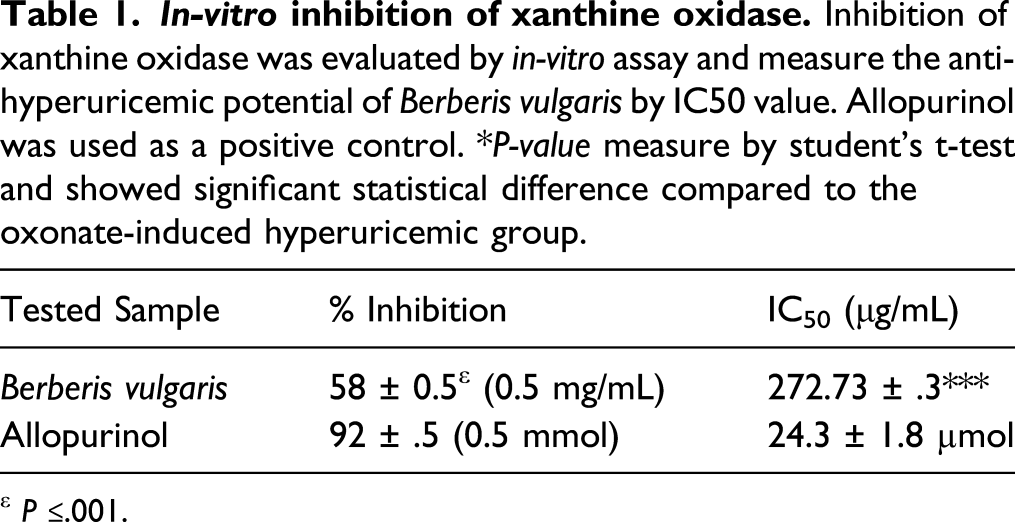
Hyperuricemia is a metabolic disorder with characteristic elevated serum uric acid. Recently, several plant-based medicines are being used for the treatment of hyperuricemia. The study aimed to find the hypouricemic potential of Berberis vulgaris in in-vitro and in-vivo study models. In in-vitro studies, xanthine oxidase inhibition assay was performed to evaluate IC50 value and capsule absorbance of the drug, respectively. For in-vivo experiment, the study comprised 15 groups of rats. In-vitro results revealed that significant xanthine oxidase inhibition was shown by Berberis vulgaris with an IC50 value of 272.73±.3 μg/mL. Similarly, oral administration of Berberis vulgaris with dosages of 250 and 500 mg/kg decreased serum and liver uric acid levels significantly in a dose- and time-dependent manner in oxonate-induced hyperuricemic rats. Furthermore, 3-day and 7-day administration of Berberis vulgaris showed more potential compared to 1-day administrations. The present study indicated marked hypouricemic effects of Berberis vulgaris in rats. Due to caveat of the small sample size, a firm assumption of the hypouricemic effect of Berberis vulgaris cannot be made. However, extensive study is needed to find out the exact molecular mechanism involved and to translate its effects into clinical trials for the further validation of the results.
Introduction
Hyperuricemia is a metabolic disruption, 1 in which the serum urate/uric acid (UA) level increased over 6.8 mg/dL about the saturation for uric acid solubility at physiological pH and temperature. 2 Hyperuricemia may be caused by under-excretion or over-production of uric acid, which is found in 5–30% of the population, and now increasing globally. Hyperuricemia is a causative precursor in the establishment of gout. 3 Xanthine oxidase (XO) inhibitors can reduce the production of UA in the purine metabolism, thus reducing the serum UA level. 4 Allopurinol is a drug for long-term prophylaxis, which reduces the serum urate by blocking XO, and plays a key role in the conversion of hypoxanthine and xanthine into uric acid. However, currently used hypouricemic medicines have various side effects, which limit their use in patients. Therefore, there is an immediate need for new hypouricemic agents 5 to explore.
Berberis vulgaris is a simple garden bush and is an important herbal remedy being utilized in Pakistan. It is the most important and extensively used drug for the elimination of urolithiasis and kidney pain in homeopathic medicine. 6 Traditionally, Berberis vulgaris is used in various diseases such as rheumatoid arthritis, gout, hepatitis, urolithiasis, and nephritis. It is also found to be moderately toxic (in mice LD50 = 2.6 ± .22 g/kg body weight). 7 Many alkaloids have been isolated from roots, stem, fruit, and leaves of the plant, including berberine, 6 bersavine, muraricine, and berbostrejdine, together with seven known isoquinoline alkaloids, 8 and additionally, phenolic compounds are also present. 9 The literature search showed that no study has been conducted to find hypouricemic effects of Berberis vulgaris in in-vitro and in-vivo. The current study aimed to evaluate the hypouricemic effects of Berberis vulgaris on serum, urine, and hepatic uric acid levels in the hyperuricemic rats induced by oxonate. The effects of Berberis vulgaris on XO inhibition assay were also determined.
Methodology
Drugs and Chemicals
Allopurinol (Mega pharmaceutical, Pakistan), potassium oxonate (Sigma-Aldrich, Germany), and xanthine oxidase, Xanthine.
Collection of Plant
The bark of Berberis vulgaris was collected from Bahawalpur, cleaned carefully to remove adulterations, and then identified by botanist, Dr Sarwar, The Islamia University of Bahawalpur, Pakistan.
Preparation of Plant Extract
After proper cleaning, Berberis vulgaris was ground into a powder with the help of a grinder. The powdered plant material was soaked in hydro-alcoholic 30/70 v/v solvent for 15 days with stirring occasionally in a day. Afterward, the solvent was evaporated through a rotary evaporator 10 and kept in a cool and dry place for further use in experiments.
Xanthine Oxidase (XO) Inhibition Assay
Assay was performed according to Ahmad et al., 11 2019. The assay was performed in phosphate buffer (pH 7.4). 20 μL of XO (.003 unit/well) and 20 μL of test samples were taken in a 96-well microplate and were incubated at 30oC for 10 min. After incubation, 20 μL substrate (.1 mM of xanthine) was added in previous mixture. The sample mixture was re-incubated in same condition for 30 minutes. The absorbance was checked at 295 nm by using ELISA micro plat reader. Allopurinol was taken as standard control. % inhibition was calculated by using the following formula
Inhibition (%) = 100 - (Absorbance. of control – Absorbance of test solution)/Absorbance of control ×100.
ELISA Cut-Off Value
ELISA cut-off value was determined as described previously (twenty-two cases of canine neural angiostrongylosis in eastern Australia (2002–2005) and a review of the literature). ELISA cut-off value was measured by taking optical density (OD) of 1–3 negative control samples and cut-off value calculated by the formula
ELISA cut-off value = Means + (3SD)
The OD above the cut-off value was considered as a positive value.
In-vivo Experiment
In-vivo study procedure and laboratory animal care protocols were strictly followed according to the guidelines of the animal care committee of the Department of Pharmacy, The Islamia University of Bahawalpur. The in-vivo experimental protocol was approved by the Pharmacy Research Ethics Committee (PREC), Faculty of Pharmacy and Alternative Medicine, The Islamia University of Bahawalpur vide Ref. No. 37-2015/PREC date 08-09-2015.
Animal Model
Wistar albino male rats weighing 170–200 g were selected for the study. Animals were obtained from the animal house of the Department of Pharmacy, The Islamia University of Bahawalpur. All animals were housed in the animal house of Pharmacology Research Laboratory, Faculty of Pharmacy and Alternative Medicine, The Islamia University of Bahawalpur. Animals were allowed at least one week to adapt to the environment before the experiment gets started. These were housed 6 per cage under the schedule of 12 hours light and 12 hours dark with lights on morning 7 O’clock. Animals were housed at 22 ± 2°C room temperature with 56 ± 5% relative moisture or humidity. Animals were given standard chow and clean water ad-libitum. Animals were kept in polycarbonate cages.
Hyperuricemia Model in Rats
Potassium oxonate, a uricase inhibitor, was used to induce hyperuricemia in the rats model as described.12-14 Intra-peritoneal injection of potassium oxonate was given to rats at a dose of 250 mg per kilogram (kg) body weight (b.w.) just before one hour to the last drug dose administration to increase hepatic and serum uric acid level.
Animal Grouping
Figure 1 describes animal grouping for the in-vivo part of the study. “Resource equation” method was used for the calculation of sample size and was found sufficient for statistical analysis.
15
Animals grouping. Animals were divided equally in the mentioned groups for the proper comparison among them. Negative control and positive control are also included as well for the validation of the data.
Corrected sample size = Sample size/(1− [% attrition/100])
Drug Administration
One hour before the administration of the drug, food was withdrawn from rats. All drugs, allopurinol, and plants extract at different concentrations were dispersed or dissolved in distilled water. The volume or amount of suspension or solution is given to animals was based upon body weight weighing immediately before the administration of each dose, respectively. All the groups received tested materials orally through gavage according to their corresponding groups once daily at 9:00–10:00 am on 1, 3, and 7 days, respectively. Potassium oxonate at dose 250 mg/kg b.w. was injected intra-peritoneally in all groups to induce hyperuricemia except normal control group I, which receives only distilled water.
Collection of Samples
All samples containing blood, urine, and liver were collected 2 hours after administration of the final drug according to Bilal et al. 16 Briefly, urine was collected via metabolic cages and stored for later analysis. However, blood was collected via cardiac puncture and serum was obtained and stored for analysis. After blood collection, liver was excised and stored at −80°C for further utilization.
Determination of Uric Acid
The liver tissue was homogenized in a homogenizer (WiseTis-HG-15D) in 10 volumes of 50 mM ice-cold potassium phosphate buffer at pH 7.4 and was centrifuged at 12 000 × g for 15 min at 4°C. The supernatant was separated and was used for the determination of uric acid. 13 Uric acid of serum, liver, and urine was measured by Uric acid FS TBHBA diagnostic kit of DiaSys, Germany. Urine was diluted 10 times by adding distilled water and the result was multiply by 11 according to the protocol given in the kit manual. The uric acid level of serum and urine were measured in mg/dL, while hepatic uric acid was measured mg/g of wet tissue.
Determination of Creatinine
Serum and urine creatinine was measured by creatinine FS assay kit (DiaSys Diagnostic System, Germany). Urine was diluted 49 times by adding distilled water and the result was multiply by 50 according to the protocol given in the kit manual. Both serum and urinary creatinine levels were measured in mg/dL.
Statistical Analysis
For statistical significance, Student’s t-test was used between negative control and drug groups in various mice samples. *P ≤.01 and #P <.01 were considered significant for the significant difference between the samples. ɛ P≤.001 in SPSS version 20.
Results
In-vitro Xanthine Oxidase Inhibition by Berberis vulgaris
ɛ P ≤.001.
In-vivo Hypouricemic Potential of Berberis vulgaris
Administration of Berberis vulgaris for one day at 250 mg/kg and 500 mg/kg was found to be effectively decreased the serum uric acid level compared to hyperuricemic control. Moreover, 250 mg/kg of Berberis vulgaris pretreatment of rats for three and seven days were also shown a significant reduction of serum urate levels compared to hyperuricemic control. In rats treated with 500 mg/kg of Berberis vulgaris for three and seven days, serum uric acid levels were effectively reduced compared to hyperuricemic control and were found to be more significant than 1-day treatment. The dose of 500 mg/kg of Berberis vulgaris was found to be more effective than 250 mg/kg in a time-dependent manner (Figure 2).
In-vivo Reduction of Liver Uric Acid Level by Berberis vulgaris
Berberis vulgaris was found effective in the reduction of liver uric acid level in a time-dependent manner and was found equally in lowering of liver uric acid in dose-dependent sequence except for 1-day treatment. Administration of 250 mg/kg and 500 mg/kg for one day has significantly reduced the liver uric acid level compared to the hyperuricemic control group. Administration of 250 mg/kg and 500 mg/kg for three and 7 days effectively decreased liver uric acid level but not significant variation in time-dependent manner. Overall, Berberis vulgaris decreased a significant level of liver uric acid compared to the hyperuricemic group (Figure 3).
Discussion
Gout is a metabolic disorder characterized by elevation of serum uric acid levels, which leads to deposition of crystals in the form of monosodium urate in joint and kidney, which results in the development of uric acid renal stones and gouty arthritis. 17 Hyperuricemia is metabolic disorders which strongly linked with hyperlipidemia, hypertension, cardiac risk factors, and type 2 diabetes.18-20 Hyperuricemia is a causative precursor in the establishment of gout. 3 Uric acid levels in interaction with other risk factors put its effect on the development of gout among asymptomatic hyperuricemic men. 21 For the last few years, researchers are taking interest in finding the role of XO inhibitors such as allopurinol on serum uric acid of hyperuricemia and gout. Due to the side effects like hypersensitivity syndrome were observed due to allopurinol, 22 this situation urged us to explore other agents for the treatment of hyperuricemia. Previously, we successfully developed the formulation from plant extract which were significantly effective in the inhibition of xanthine oxidase in-vitro and as hypouricemic drug in-vivo (Development of herbal formulation of medicinal plants and determination of its antihyperuricemic potential in-vitro and in-vivo rat’s model and effects of Trachyspermum ammi L. (Apiaceae) on serum, urine, and hepatic uric acid levels in oxonate-induced rats and in-vitro xanthine oxidase inhibition assay). We presume that drugs developed from herbs are more beneficial with such purposes with lesser adverse effects and safe to use.
Beriberis vulgaris is a folk medicine traditionally used in metabolic diseases due to the presence of berberine alkaloids (Berberis Vulgaris and Berberine: An Update Review). In the current study, anti-hyperuricemic effects were evaluated for Berberis vulgaris extract in in-vitro by XO enzyme inhibition assay and in-vivo by induction of potassium oxonate hyperuricemia in rats. Potassium oxonate significantly increases in the serum as well as hepatic uric acid level compared to normal control, which can be well compared with the study conducted by Zhao. 14 Allopurinol was used as a standard control in in-vitro and in-vivo experimental models. Some medicinal plants with chemical constituents like phenols and flavonoids were represented as an alternative to allopurinol, and these are naturally existing compounds that have xanthine oxidase inhibitory effects.14,23
Berberis vulgaris in in-vitro assay inhibits XO enzyme 58% at .5 mg/mL concentration and IC50 is 272.73 μg/mL. In-vivo anti-hyperuricemic effects of Berberis vulgaris were found significant at the dose of 250 mg/kg and 500 mg/kg in time- and dose-dependent manner. Berberis vulgaris has XO inhibition and anti-hyperuricemic activity because it also has phenolic compounds.
8
The level of FEUA of rats treated with Berberis vulgaris at 250 mg/kg was found insignificant in a time-dependent manner, whereas 500 mg/kg were found insignificant in 1-day treatment but significant in 3-day and 7-day study (Figure 4). Berberis vulgaris increases the FEUA in hyperuricemic rats might be the kidney function improvement by berberine. Along with its XO inhibition activity, single active constituents should be isolated and investigate their anti-hyperuricemic effects. Acute and chronic toxicity can also be measured in future studies. Berberis vulgaris may be proved to be a promising therapy in the future for the treatment of hyperuricemia or gout.
Conclusion
Conclusively, Berberis vulgaris, a common traditional plant of Pakistan, is found to have potential against hyperuricemia and reduce the accumulation of uric acid by increasing the excretion of uric acid through urine. This study may pave the way in the exploration of other plant remedies for the same therapeutic purposes and help in controlling the adverse effects by utilizing synthetic xanthine oxidase inhibitors such as allopurinol. Moreover, the deep insight into the molecular mechanism of the anti-hyperuricemic potential of Berberis vulgaris will help to clarify its mechanism of action and its interaction with any cell receptors or molecules. Further extensive studies are still needed to validate the findings and to adjust the doses in the clinical trials on the human body for translating the effects of the medicine.
Footnotes
Acknowledgments
We are grateful to our colleagues especially Dr. Hafiz Muhammad Asif, in-charge, University College of Conventional Medicine, The Islamia University of Bahawalpur, Bahawalpur, Pakistan, for his unconditional support and guidance.
Author contribution
M Bilal and S Ahmad were involved in the conception and design of the project. T Rehman and AO Ghauri developed the methodology. M Bilal and WM Abbasi and SA Zakki were involved in data analysis and interpretation. M Bilal performed all the experiments. S Khalid performed statistical anaalysis. M Bilal and SA Zakki wrote the manuscript. S Ahmad supervised the project and gave final approval of the manuscript.
Declaration of Conflicting Interests
The author(s) declared no potential conflicts of interest with respect to the research, authorship, and/or publication of this article.
Funding
The author(s) received no financial support for the research, authorship, and/or publication of this article.
Ethical approval and informed consent
The ethical approval for in-vivo experimental protocol was taken by the Pharmacy Research Ethics Committee (PREC), Faculty of Pharmacy and Alternative Medicine, The Islamia University of Bahawalpur vide Ref. No. 37-2015/PREC date 08-09-2015.
Data availability statement
The data that support the findings of this study are available on request from the corresponding author.
