




Abstract
Gout is arthritis caused due to Monosodium urate (MSU) crystals deposition occurring particularly in patients with associated comorbidities limiting the use of conventional therapies. This study was planned to evaluate the therapeutic efficacy of urinile (a herbal drug) for the treatment of gouty arthritis. Allopurinol was used as standard drug (positive control). The study population of 250 volunteers (gouty arthritis patients) were divided into 2 groups as test and control group (n = 125 each). Gouty arthritis patients in test and control group were treated with 300 mg each of urinile and allopurinol, respectively. Clinical symptoms of all the study volunteers were recorded and serum uric acid was determined. Significant (p < 0.05) reduction in serum uric acid level toward normal was found in test group individuals. Clinical symptoms of gouty arthritis patients were also improved in test group compared to control group. Results showed that urinile has the potential to decrease serum uric acid level in gouty arthritis patients probably because of its antioxidant potential and xanthine oxidase inhibitory activity. It can be concluded that the tested herbal drug urinile is more potent in treating gouty arthritis patients and can be used as an effective alternative to the most commonly used allopathic drugs.
Introduction
Gout is arthritis caused due to the deposition of a type of uric acid crystals called Monosodium Urate (MSU) crystals, usually deposited around or within the joints secondary to chronic hyperuricemia. 1,2 It affects 1 to 2% of adult population in developed countries and possibly increased the prevalence. Acute gouty arthritis may be associated with clinical symptoms of inflammation. 1 Gouty joint pain is known since ancient times and well known by the Egyptian in 2640 BC. Gouty arthritis indications ordinarily happen in the limits where body temperature is lesser than in the middle, and accordingly the deposition of monosodium urate is lesser than 0.41 mmol/l. 3 -5 Additionally, monosodium urate crystals deposition in synovial fluid is implicated by different variables, similar to pH, lack of articular hydration, and the closeness of such nucleating operators as non-aggregated proteoglycans, chondroitin sulfate and insoluble collagens. 6,7 Gout is often associated with eating of high protein diet and alcohol consumption. 8 The incidence of gout is about 3 per 1,000 persons, mostly affecting males. The common management of gout is by the use of anti-inflammatory agents and xanthine oxidase (XO) inhibitors to inhibit the synthesis of uric acid. 9 Allopurinol is the most common inhibitor of xanthine oxidase. 10 However, its use is limited due to the adverse effects such as chronic kidney diseases and cardiovascular diseases. 11 Therefore, alternative treatment options for gout are required. Some herbal medicines have been used traditionally by the Unani physicians as a uricosuric and depurative for treating the gout. 12 Urinile is a polyherbal formulation comprising of Trachyspermum ammi (Ajwain), Berberis vulgeris (Barbbery), Colechicum autumnale (Suranjan shireen) and Apium graveolens (Karafs). Colchicum autumnale is beneficial in gouty arthritis. 13 In the Unani Tibb, it is mainly valuable and famous mediator to treat joint pain, back agony as well as gout. Trachyspermum ammi is useful remedy to relief the pain. 14 Based on the pain relieving effects of urinile, we hypothesized that it will limit gouty arthritis. This study was planned to evaluate the therapeutic efficacy of urinile (polyherbal formulation) against gouty arthritis.
Material and Methods
Collection and Identification of Plants Material
The plants material used in the present study for the preparation of herbal drug urinile tablet were purchased from the Jodia market Karachi. Following parts of the plants were purchased i-e. Apium graveolens (Tukhm-e-karafs) seeds, Colchicum autumnale (Suranjan shirin) tuber, Trachyspermum ammi (Ajwain) seeds and Berberis vulgeris (Barbbery) stem bark. Representative sample of plants were submitted to the department of botanical science division, Pakistan Museum of Natural History (PMNH), Islamabad and identified by Dr. Syed Aneel Gilani, Associate Curator and issued the voucher number against each of the submitted plants as Trachyspermum ammi (Ajwain) voucher number PMNH-ISD-01, Berberis vulgeris (Barbbery) voucher number PMNH-ISD-02, Colchicum autumnale (Suranjan shireen) voucher number PMNH-ISD-03 and Apium graveolens (Karafs) voucher number PMNH-ISD-04. Voucher specimen of all the identified plants have been submitted to botanical science division of PMNH.
Plants Extraction and Polyherbal Formulation
The dried plants materials were crushed to obtain fine powder. The powdered material (500 g of each plant) were soaked in 70% ethanol (1:10) for 72 hours with occasional shaking and stirring. After 72 hours, the extract of each plant was filtered using Whatmann No. 1 filter paper and this extraction process was repeated 3 times to extract maximum bioactive compounds present in plants material. The filtered extract was collected in separate beakers for each plant and evaporated through rotary evaporator under reduced pressure at 45 to 50ºC to obtain concentrated extract. Polyherbal formulation i-e urinile tablet was prepared by mixing equal amount of each plant methanolic extract in liquid glucose solution making the tablets of 300 mg weight. The tablets were allowed to dry at 50ºC for 12 hours. Hardness, disintegration and dissolution of the tablets were assessed by hardness test device, disintegration test machine and dissolution test machine, respectively.
Determination of Antioxidant Potential
Antioxidant potential of individual plants ethanolic extract and urinile tablet was determined through different antioxidant assays.
Total Flavonoids Contents (TFC)
Total flavonoids contents was measured through the method described by Pranuthi et al. 15 Briefly the mixture of plants extract (0.5 mL), distilled water (2 mL) and 5% NaNO2 was incubated for 5 to 10 minutes at room temperature followed by the addition of 10% AlCl3 (0.15 mL) and 4% NaOH making the total volume of the mixture upto 5 mL by adding methanol. The reaction absorbance was measured at 510 nm after 15 min incubation at room temperature. TPC was expressed as µg equivalent of catechin per g of plants extract. 16
Total Phenolic Contents (TPC)
Folin Ciocalteu method was used for the determination of TPC. 17 Gallic acid was used as the standard and standard curve was constructed using varying concentrations of gallic acid and the results were expressed as gallic acid equivalents. Plants extract (10 mg/mL) and standard solution (1 mL) were mixed with Folin-Ciocalteu reagent (5 mL) and Sodium carbonate (20%; 4 mL) incubating the mixture for 1 hour. The reaction absorbance was measured at 765 nm.

Where M = Weight of extract (grams), V = Volume of extract (mL), C = concentration of gallic acid (mg/mL).
DPPH Free Radical Reduction Assay
DPPH (2, 2-diphenyl-1-picryl-hydrazyl) radical scavenging assay was utilized to measure the antioxidative action of individual plants extract and the polyherbal formulation (Urinile). 18 Briefly, 1 mL DPPH solution (0.004%) was mixed with plants extract (3 mL) and the mixture was incubated in dark for 30 min. The optical density measured at 517 nm was inversely related to the free radical scavenging action. Ascorbic acid was used as standard and reagent blank as control. The percent inhibition of DPPH free radicals by the sample was calculated by formula:

Where A1 = sample absorbance, A0 = blank absorbance
IC50 values were calculated from the mean values of replicate measurements necessary to scavenge 50% DPPH free radicals. The reduction in absorbance shows augmented radical reducing action.
Xanthine Oxidase Inhibitory Activity
Xanthine oxidase (XO) inhibition potential was determined spectrophotometrically following the protocol described by Noro et al. (1983). 19 The mixture comprising the test solution (50 µL), enzyme solution (0.01 units/mL in 0.1 mM phosphate buffer pH = 7.5; 30 µL) and 0.1 mM phosphate buffer (pH = 7.5; 35 µL). After pre-incubation at 25°C for 15 minutes, the response was started by the expansion of 60 µL of substrate solution (150 mM xanthine). The mixture was then incubated for 30 minutes at 25°C. Optical density at 290 nm was measured using spectrophotometer. One unit of XO was characterized as the measure of enzyme needed to hydrolyze 1 mmol of uric acid/minute at 25°C. IC50 values were determined from the mean values of replicate measurements.
In vivo Study
In vivo study was carried out on gouty arthritis patients after acute and chronic toxicity studies on mouse model.
Acute Toxicity Studies
Forty healthy mice weighing 25 to 35 g were procured from Hamdard University, Karachi. The study animals were divided into 4 groups of 10 animals in each group including 1 control group and 3 test groups. All the study animals were kept under normal husbandry environment with 12 hr light/dark cycle. After 72 hrs of acclimatization, Group I animals was given only water ad libitum while Group II, III and IV animals were administered varying concentrations of Urinile tablet i-e 100, 200 & 300 mg per Kg bw, respectively in addition to water ad libitum for a period of 14 days. Study animals were continuously monitored for clinical sign and symptoms of any toxicity effect throughout the experiment. Mortality rate of study animals was noted.
Chronic Toxicity Studies
For chronic toxicity studies, 40 healthy rats weighing 80 to 100 g were procured from Hamdard University, Karachi. The study animals were divided into 4 groups of 10 animals in each group including 1 control group and 3 test groups. All the study animals were kept under normal husbandry environment with 12 hr light/dark cycle. After 72 hrs of acclimatization, Group I animals was given only water ad libitum while Group II, III and IV animals were administered varying concentrations of Urinile tablet i-e 100, 200 & 300 mg per Kg bw, respectively in addition to water ad libitum for a period of 60 days. Study animals were continuously monitored for clinical sign and symptoms of any toxicity effect throughout the experiment.
Clinical Trial Protocol
This study was a case control, multicenter, randomized prospective, 2 arm parallel group clinical trial conducted at Shifa Ul Mulk Memorial Hospital, Hamdard University Karachi, University Medical Complex & Research Center, University of Sargodha. The study protocol, clinical trial proforma, dosage form design correlated data and informed consent forms were submitted to Research Ethics Committee of Hamdard University, Karachi and were permitted by the same. The study plan was approved by Research Ethics Committee of Hamdard University, Karachi. Written informed consent was taken from all the study participants before inclusion into the study population.
Patients
Trial was conducted on 250 patients of gouty arthritis between 20 and 80 years age divided into 2 groups as control and test group of 125 patients each (n = 125) for 18 weeks irrespective of socioeconomic status (Figure 1). Patients aged 20 to 80 years with symptomatic gouty arthritis, medical history of gouty arthritis without any other presenting complains or associated disorders and serum uric acid >8 mg/dl were included in the study while grouty arthritis patients with other associated disorders were excluded from the study. Control group patients were treated with allopurinol (300 mg tablet) while test group patients were given Urinile (300 mg Tablet) twice a day for a period of 18 weeks.

Flow chart diagram of the participants.
Data Collection
Data on the clinical trial were collected by completing the clinical trial proforma through close to home meetings, individual perception, and the utilization of case record, files and documents.
Follow-up and Assessment
Follow-up assessment of all the patients in the study population was conducted regularly. Musculoskeletal examination and uric acid concentration in the blood were recorded at the end of every 6 weeks and after 18 weeks of treatment. Out of 250 study individuals, 222 patients consented to take an interest in the investigation.
Determination of Serum Uric Acid
Serum uric acid concentration (mg/dl) was determined through uricase method using the commercially available diagnostic kit (Human GmbH, Germany). 20
Statistical Analysis
Statistical analysis was performed using SPSS statistical software by applying Chi Square test. p value less than 0.05 was considered as statistically significant. Means ± SD and percentages of different parameters were also calculated using Microsoft Excel 2007 for Microsoft windows.
Results
Antioxidant Potential
Antioxidants are molecules with reduction capacity for the substrates during oxidative processes. Oxidation reactions produces free radicals that competes with natural antioxidant defensive mechanism of the body causing impairment in the body’s natural defense system leading to oxidative stress. Antioxidant potential of tested plants extract and urinile tablet has been determined through different antioxidant assays and the results are given in Table 1. Variation in the concentration of total phenolics and flavonoids has been observed in different plants extract and urinile tablet. Total flavonoids and total phenolics contents were found increased in combined formulation than in individual plants extract. Urinile showed highest antioxidant potential indicating an increase in the antioxidant activity of polyherbal formulation compared to individual plants extract which is an indication of the synergistic effects of combined formulation. DPPH radical scavenging assay showed highest inhibition percentage of free radicals in urinile tablet in comparison with individual plants extract and is comparable with the scavenging potential of Vitamin C, a known antioxidant used as standard.
Antioxidant Potential of Plants Hydroalcoholic Extract and Polyherbal Drug Urinile.

Values are mean ± SD of replicate measurements; TPC: Total Phenolic Contents; GAE: Gallic Acid Equivalents; TFC: Total Flavonoids Contents; CE: Catechin Equivalents.
Xanthine-Oxidase Inhibition
Xanthine oxidase activity of individual plants extract and Urinile was evaluated through xanthine oxidase inhibition assay. Each plant extract was assayed for the inhibition of xanthine oxidase activity at 25, 50, 100, 200 µg ethanolic plants extract, urinile and allopurinol dissolved per mL of dimethyl sulfoxide (DMSO). Dose dependant inhibition of xanthine oxidase enzyme was observed. IC50 values were calculated through the linear regression analysis of the standard plot by percentage inhibition of enzyme against varying concentrations. Percentage xanthine oxidase inhibition and IC50 values of the tested samples were given in Table 2.
Percentage Inhibition of Xanthine Oxidase Enzyme and IC50 Values of Plants Extract, Urinile and Allopurinol.

All the values are in percentages
Physicochemical Properties of Urinile Tablets
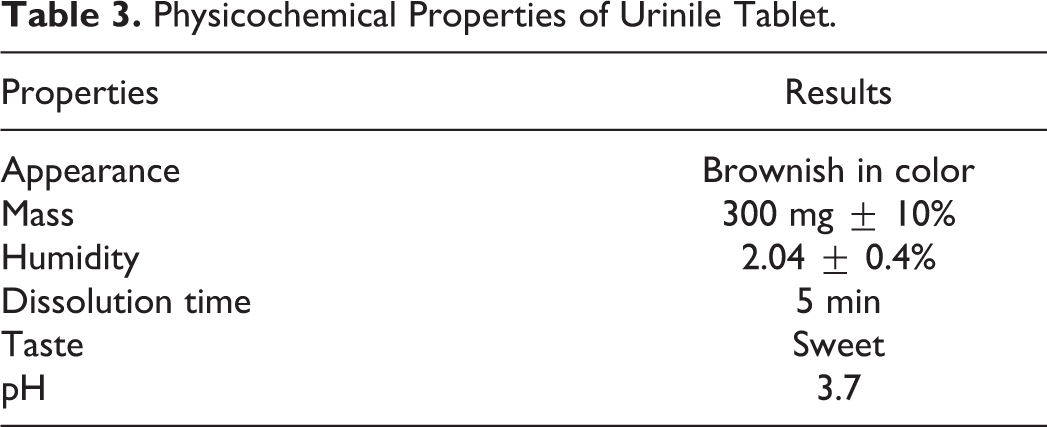
Different physicochemical considerations as like appearance, mass variety as well as breaking down period were determined for polyherbal preparation (Table 3). Hardness and disintegration of the tablets was 8 Lbs and 10 minutes, respectively. Dissolution of the tablets was analyzed and tablet was dissolved in 5 minutes.
Physicochemical Properties of Urinile Tablet.
Acute and Chronic Toxicity Study
Acute toxicity trial of urinile was carried out on mice. Mice were observed for a period of 14 days for their general social mortality. No mortality has been observed at the administered dosages. Different indications of danger like male pattern baldness, bodily fluid layer (nasal), lacrimation, sleepiness, stride and tremors were additionally not noticed.
For chronic toxicity study, rats were used and the study period was extended to 60 days and the animals were kept under strict observation. No mortality was observed in rats treated with varying concentrations of urinile and no signs of toxicity were observed.
Serum Uric Acid Concentration
Serum uric acid was found reduced in 56 subjects (50.90%) out of 110 in test group whereas the concentration of serum uric acid in standard control group was decreased in 76 subjects (67.85%) out of 112. The pattern result of serum uric acid concentration was shown in Figure 2.

Effect of urinile and allopurinol treatment on serum uric acid level.
Bars showing the percentage of patients who’s serum uric acid concentration was decreased after treatment. Bars in this figure showing that in 50.9% of study population in the test group individual treated with urinile whereas 67.85% of the allopurinol treated patients have uric acid concentration <8 mg/dl. Uric acid concentration of all study subjects were >8 mg/dl before giving any type of treatment. So urinile and allopurinol treatment lowers the uric acid concentration in gouty arthritis patients.
Clinical Assessment
Clinical assessment of gouty arthritis patients presenting with various clinical complaints including joints pain, tenderness, redness and swelling of joints, stiffness and joints pain during movement (Figure 3). Urinile was prescribed to 110 patients with complaint of pain in the joints. Urinile showed 70% improvement as compared to control allopurinol (67.85%) improvement as shown in Figure 3. 87 patients with complaint of joint tenderness were given Urinile and found improvement in joint tenderness in 82.7% of the treated patients while 78.65% (70 out of 89) patients showed improvement through allopurinol treatment (Figure 3).

Percentage improvement in joints clinical conditions of gouty arthritis patients after treatment with urinile and allopurinol.
Urinile and allopurinol was prescribed to 95 and 92 patients, respectively with complaint of joint swelling. Urinile treatment showed improvement of joint swelling in 71.57% patients while allopurinol treatment showed improvement in 78.72% of treated patients as shown in Figure 3. Redness of the joint was improved in 68 and 62 patients through urinile and allopurinol treatment, respectively.
Joint stiffness was found improved in 66.67 and 33.33% patients through urinile and allopurinol treatment, respectively (Figure 3). Tophus formation and complaint of pain on joint movement were also improved through urinile treatment compared with allopurinol teatment and the results are shown in Figure 3.
Bars in this figure showing the percentage improvement in various clinical conditions found in study population.
Discussion
Gouty arthritis is a typical sickness portrayed by intense self-constraining assaults of joint pain, because of urate crystals deposition into the joints. 21 Presently there is new pattern to utilize natural drug on account of their capability to cure with less or no side effects. Therapeutic plants having calming, uricosuric and xanthine oxidase inhibitory effects are utilized in gouty joint inflammation. 22 Despite the fact that allopurinol is most commonly used for the management of gouty joint inflammation however this resulted certain side reactions, for example, skin rashes, feelings of queasiness and regurgitation. 23 Along these lines, herbal coded formulations have been formulated that contains ingredients whose synergistic calming, uricosuric effects and xanthine oxidase inhibitory activity have been accounted. 24 Randomized controlled clinical preliminary study was carried out to evaluate the comparative therapeutic potential of urinile and allopurinol in patients with gouty joint inflammation. The study results showed reduction in serum uric acid concentration from >8 mg/dl to <6 mg/dl in patients treated with urinile. This 18 weeks’ investigation exhibited that treatment with Urinile essentially decreased the serum uric acid concentration to <6.0 mg/dl in 91% patients. Conversely, the extent of patients reacting to allopurinol was 78%. The findings presented here demonstrate that Urinile has more potential to inhibit xanthine oxidase enzyme than Allopurinol for the management of gouty arthritis. Urate-lowering response to Urinile (300 mg) twice a day was stronger than the reaction to regularly utilized dosages of allopurinol. Keeping up a mean serum uric acid concentration of between 4.5 and 5.0 mg/dl is the ideal range to stay away from a flare of intense joint pain. In our study, when serum uric acid concentration was decreased to <6 mg/ml, the side effects of gouty joint pain were significantly decreased. Our observations are in accordance with the published reports on the use of herbal products to treat gouty arthritis 25 that hyperuricemia has a solid relationship with relative danger of death in coronary illness, hypertension, stroke, liver infection as well as kidney failure, showing that elevated serum uric acid is a significant hazard factor for decreased life expectancy.
A decrease in serum uric acid after Urinile (300 mg) treatment twice a day indicated that it could be used as a uric acid lowering agent. These values supported the need for further research to assess the xanthine oxidase inhibitory activity. Study findings demonstrated that Urinile has xanthine oxidase inhibitory action. Allopurinol and Urinile (polyherbal drug) was examined for xanthine oxidase inhibitory activity at 25, 50, 100, and 200 µg per mL. Allopurinol and Urinile extracts demonstrated a dose dependent XO inhibitory effect with XO inhibitory action of 86% and 88%, respectively. A large number of the patients experienced improvement in manifestations of gouty arthritis within investigation period. In our investigation, Urinile effectively decreased the serum uric acid level without any toxic effects as compared to Allopurinol. Urinile also decreased the gout symptoms like joint pain, tenderness, redness and stiffness of joint. The outcomes of the present investigation exhibited that treatment with Urinile twice per day for 18 weeks adequately diminishes serum uric acid concentration in patients with hyperuricemia and gout.
Urinile is a polyherbal drug prepared from 4 different medicinal plants extract and all the individual plants extract exhibited significant antioxidant potentials and XO inhibitory activities. On preparing the polyherbal formulations of these plants extract, the synergistic effect of all the included plants extract have much better potential against gouty arthritis than the individual plants extract. It has been reported in the literature that all the plants extract have high content of flavonoids and phenolic compounds with significant potential to inhibit XO and lowers down the uric acid concentration in blood. 26 Due to the presence of active metabolites in plants, urinile drug has the uric acid lowering effect in hyperuricemic gouty arthritis patients. Bilal et al. in their study prepared the polyherbal formulation of medicinal plants and evaluated their antihyperuricemic potential in rats. They found marked hypouricemic effect of polyherbal drug in potassium oxonate induced hyperuricemia. 27 Sharma et al. studied the chronic musculoskeletal pain relieving effect of polyherbal Ayurvedic formulation containing T. ammi oil and found that polyherbal formulation was effective in reducing the pain, swelling and tenderness as well as improving the joint mobility in subjective patients. 28 Various studies reported the pharmacological potential of T. ammi such anti-inflammatory, 29 anti-hypertensive, bronchodilating, antispasmodic, hepatoprotective, 30 hypolipidemic 31 and digestive stimulant. 32 Similarly, immunomodulatory and anti-inflammatory potential of B. vulgaris and its main phytoconstituents have been reported in published literature. The main phytochemicals of B. vulgaris are alkaloids, phenolic compounds, organic acids and flavonoids. 33 So, the presence of bioactive phytochemicals in medicinal plants which are part of urinile are responsible for its effect against gouty arthritis by inhibiting the XO and lowering down the serum uric acid concentration.
Conclusion
From present study, it is evident that polyherbal formulation urinile prepared by combining the hydroalcoholic extracts of 4 different medicinal plants showed increased antioxidant potential and xanthine oxidase inhibitory activity as compared to the potentials of individual medicinal plants extract indicating the synergistic effect of urinile. This increased radical scavenging and xanthine oxidase inhibition potential is possibly due to the presence of antioxidant compounds like flavonoids and phenolics in medicinal plants. Reduction in serum uric acid and improvement in the clinical conditions in joints of gouty arthritis patients through urinile treatment is an indication of its therapeutic potential against gouty arthritis. It can be concluded that polyherbal formulation (urinile) of studied medicinal plants has the potential against gouty arthritis and can be used for therapeutic purposes which can lead to an increased interest of herbal pharmaceuticals producing clinically safe and efficient herbal drugs. Further studies are required to isolate and characterize the therapeutically bioactive compounds and then large scale clinical trials which will be a step forward toward drug discovery.
Footnotes
Authors' Note
Saeed Ahmad is no more affiliated with College of Agriculture, University of Sargodha, Sargodha, Pakistan.
Declaration of Conflicting Interests
The author(s) declared no potential conflicts of interest with respect to the research, authorship, and/or publication of this article.
Funding
The author(s) received no financial support for the research, authorship, and/or publication of this article.
