



Abstract
Mattress plays an important role in the quality of human sleep, warp-knitted spacer fabric (WKSF) is a rather important mattress material, this paper explored the indentation state of WKSFs of 20 mm thickness and 0.12, 0.15, 0.18, and 0.25 mm spacer filaments under the action of curved surface pressure by using spherical compression tests and finite element simulations, with the combination of three-dimensional and non-uniform pressure characteristics exerted on the mattress by the human body when lying down. Tests and simulations analysis would be shown in four aspects: firstly, when the spherical indenter acts on the WKSFs, the compressive stress, Indentation Force Deflection (IFD) and support factor (SF) of the WKSFs increase as the spacer filament fineness increases; secondly, the compression depth of WKSFs should be controlled within 40% when used as mattresses to obtain good compression comfort; thirdly, A warp-knitted spacer fabric with a 0.25 mm spacer filament fineness provides both comfort and pressure resistance and better meets the needs of most people for a spacer fabric for mattresses.
Keywords
Introduction
Sleep is an extremely important physiological function to maintain human life, accounting for approximately 1/3 of the human life cycle. 1 Based on the research studies in the USA, 7% of sleep disorders were related to the discomfort of mattresses. 2 How to choose a mattress that is suitable and comfortable for us has become a matter of concern. Many mattress companies began to develop new mattress materials, warp knitted spacer fabric with its good pressure resistance, and can overcome the polyurethane foam material easy to age, not easy to heat and not enough environmental shortcomings, 3 in the new mattress materials to attract widespread attention.
The warp-knitted spacer fabric (WKSF) is a three-dimensional textile consisting of two surface layers and spacer filaments produced by a Raschel double needle bar warp knitting machine. 4 As a functional textile, it has shown excellent properties in terms of compression resistance, pressure relief, sound insulation, thermal and humidity regulation.5,6 Therefore, it has become one of the best choices for mattress materials. The compression performance is one of the most important indicators to judge the mattress, it not only reflects the mattress itself compression resilience, but also is an important symbol to judge the mattress softness. 7 In this case, many scholars have explored the compression performance of WKSFs.
Miao et al. 8 studied the compression mechanism and influencing factors of WKSFs from several perspectives, pointing out that their compression performance is influenced by various factors such as material, structure, thickness, and performance and inclination angle of spacer filaments. Chen et al. 9 theoretically analyzed the shape change of spacer filament during the compression of WKSFs, and verified it by plate compression test. Ye et al. 10 highlighted the industrial advantages of WKSFs by exploring the compression properties of WKSFs and conducting a comparative analysis with PU foam. Zhang et al. 11 studied a high-distance warp-knitted spacer flexible composite material and concluded that compressive strength of the material keeps growing stronger with an increase in the intensity of the gas pressure. Chang and Ma 12 found that a reduction in the fineness of the spacer filament significantly reduced the energy absorption capacity of the WKSFs by studying the compression properties of the WKSFs. Liu et al. 13 analyzed WKSFs by removing spacer monofilaments in a set ratio and concluded that the compression performance was correlated with the spacer monofilaments ratio. Chen et al. 14 concluded that WKSFs can effectively reduce peak hip pressure and increase contact area by theoretically analyzing the stress dispersion mechanism of WKSFs. Li et al. 15 concluded that the finer the spacer filaments, the more linear the spherical compression by conducting spherical compression tests on WKSFs. Du et al. 16 concluded that spherical indenters with diameters ranging from 5 to 18 cm could effectively characterize the spherical compression performance of WKSFs by simulating spherical compression with different radii. Du and Hu 17 used spherical compression experiments to theoretically analyze the compression performance of WKSFs and derived a theoretical model equation for spherical compression. Zhang et al. 18 derived the fabric transfer load under the spherical pressure model by testing the pressure distribution of WKSFs with different structures.
As mentioned above, most researchers have focused on different ways to study the compression mechanism of WKSFs. However, there is still a lack of research on the fineness of spacer filaments for practical applications and product design of fabrics. This paper therefore addressed the practical application of WKSFs as a mattress material, taking into account the three-dimensional and non-uniform nature of human pressure on mattresses. Firstly, a spherical indenter was selected to apply pressure to the fabric to observe the stress state of different fineness spacer fabrics under the action of curved pressure. The indentation characteristics were then measured based on the IFD and SF in the soft foam material industry. The spherical compression process of the WKSFs was then simulated with finite element, and finally the stress distribution of the WKSFs with different fineness under different degrees of indentation was explored to provide theoretical guidance and practical basis for selection of the best WKSF for mattresses. Through the study of this paper, we can have a further in-depth understanding of the influence of the fineness of the spacer filament on the indentation performance of WKSFs for mattresses, and provide theoretical support for the design of mattresses.
Materials and experiments
Samples preparation
Four kinds of WKSFs with the same material and surface structure were chosen for this experiment, as shown in Figure 1, and the fabric structure parameters were shown in Table 1. The fabric samples were produced on a HDR6 double-needle bad warp knitting machine. Both surface layers of the fabric are the small diamond-shaped mesh structure, knitted with 300D/96F Polyester FDY; the middle layer consists of polyester monofilaments arranged as spacer filaments arranged in X-shaped structure, which is stable and produces good resistance to inversion derivatives. 19 In addition, the spacer filament fineness was chosen from four kinds of mattress materials commonly used and different, 0.12, 0.15, 0.18, and 0.25 mm.
Construction parameter of spacer fabric specimens.

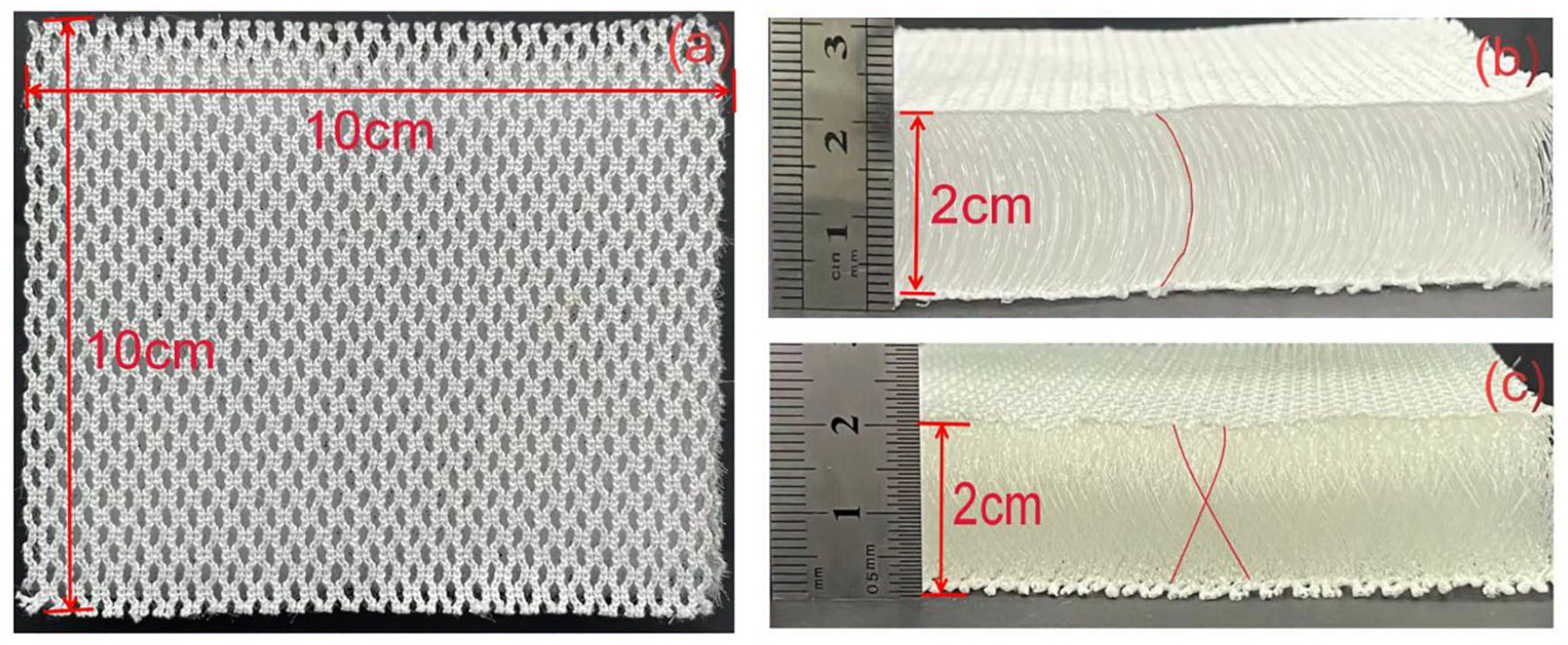
Upper layer and different sections of fabric: (a) upper layer of fabric, (b) longitudinal section of fabric, and (c) cross section of fabric.
Evaluation indicators
When the human body is lying or reclining, it is mostly a three-dimensional and non-uniform pressure due to the characteristics of the human body’s own curves. The deformation state and pressure dispersion of fabric subjected to curved surface pressure can be measured by using spherical compression. IFD 20 is the force required to produce the required indentation deformation of a specimen. It is included as a mandatory test for conventional padding materials – polyurethane flexible foam products, but can also be used for other materials such as springs or fiber mesh. The SF 8 is the indentation ratio, also known as the comfort factor. Different support factors can vary the comfort, support or durability of the material, with larger values indicating better support and more favorable weight distribution. In this paper, several indicators such as 25%IFD, 40%IFD, 65%IFD and SF (65%IFD/25%IFD) were used to characterize the indentation characteristics of fabrics. According to national standards for soft foam polymer hardness, 25% IFD is usually used to characterize the hardness of the material; 65% IFD to characterize the support of the material in deep compression; and 65%/25% is the SF to characterize the bottom support, comfort, etc. 21
Experimental method
This paper refers to the national standard of GB/T 10807-2006 Determination of hardness of soft foam polymeric materials (indentation method). Four specimens (100 mm × 100 mm × 20 mm) were pressed at a speed of 120 mm/min at an ambient temperature of (25 ± 2)℃ and a relative humidity of (65 ± 5)% to record the IFD (N) and the compression stress-strain curves up to 25%, 40%, and 65% compression respectively. In this test, five measurements were taken for each sample and then the average of the five measurements was taken as the experimental result. And to ensure the accuracy of the data, the average of the five test results was taken as the standard, and the coefficient of variation was kept within 10%, and when the coefficient of variation was greater than 10%, it was proposed to add an additional experimental test.
Results and analysis
Experimental compression characteristics
Compression force analysis
In order to objectively reflect the deformation and pressure distribution of the WKSFs for mattresses under non-uniform pressure during use, the spherical indenter was selected to apply pressure to the fabric for analysis. In the process of fabric pressure, with the continuous downward pressure of the spherical indenter, the fabric is gradually compressed, the contact area between the surface of the fabric and the spherical indenter gradually increases, and the number of spacer filaments under pressure increases. As shown in Figure 2, where (a) is a physical diagram and (b) is a simplified model diagram. The total compressive force exerted by the spherical indenter on the fabric can be divided into the contact area force and the non-contact area force. The non-contact area force is mainly caused by the bending of the spacer filaments on the contact area resulting in the displacement of the coils connected to it in the surface structure, which drives the displacement of the coils in the non-contact area, thus causing the coils in the non-contact area to drive the connected spacer filaments to produce bending force. This makes the vertical downward pressure gradually transit to the lateral action with the change of the action point, the vertical downward pressure is weakened, while the non-contact part of the spacer filaments produces certain force bending, this effect makes the WKSFs can better accommodate the human body form, and play a role in dispersing the pressure.

Spherical compression diagram of WKSF: (a) physical compression diagram, (b) simplified model compression diagram, and (c) force analysis diagram.
The pressure distribution analysis of the WKSF is shown in Figure 2(b) and (c). The upper end point

The spacer filaments acting as supports in the fabric are equated to slender compression rods hinged at both ends. 22 It follows from the mechanics of materials that:

In the formula: F is the pressure applied to the slender rod, E is the elastic modulus of the slender rod, I is the moment of inertia of the cross-section of the slender rod to the neutral axis, and h is the distance between the two ends of the slender rod. Bringing formula (1) into (2) to obtain the resultant compression force

Where the compression force component of single spacer filament along the direction of the central axis

The closer the spacer filament is the central axis

Where,
Thus, as the compression of the fabric continues, more spacer filaments will be compressed, and the degree of compression of the spacer filaments will also increase. That is to say, n is increasing and the corresponding
Stress-strain curve analysis
The bending stiffness of the fibers in compression reflects the ability of the fibers to resist flexion, commonly referred to as stiffness or softness. Particularly, it combines the essential bending factor, the effective flexural modulus and the cross-sectional factor, the diameter and cross-sectional shape 23 :

Where,
WKSF is a coil structure knitted from fibers of different linear densities and is a fiber aggregate. In the case of equal areal density, the actual support area within the plane of the fabric unit consisting of fibers of different thicknesses differs and thus the overall flexural stiffness differs and so does the fabric stress. Figure 3 illustrates the stress-strain curves of four kinds of WKSFs under compression by hemispherical indenter. Where the compression strain is the ratio of the compression distance of the spherical indenter to the thickness of the WKSF, and the stress is the compression force divided by the area of the sample under stress. It can be concluded that in the early stage of compression, the contact area is small and the number of spacer filaments under compression is small. Therefore, stress of 0.31–1.27 kPa can reach 25% of the compression depth. As the compression depth increases, the contact area between the bottom end of the sphere and the fabric increases, the number of spacer filaments under stress becomes larger, and the overall flexural stiffness of the fabric increases. When the indentation reaches 65%, the stress reaches 0.97–4.2 kPa. Under the same depth of indentation, it can be obtained from equation (5): For the fabric with thick spacer filament, EI is also larger, so its stress is greater than that of the fabric with finer spacer filament. It can be seen from this that when the fabric is compressed by the spherical indenter, the stress increases gradually with the increase of the indentation depth, and the thicker WKSF can provide greater SF when used as a mattress material, leading to a firmer mattress experience.

Stress-strain curves for four kinds of WKSFs under compression with a spherical indenter.
Evaluation and analysis of compaction
The IFD is an important index to evaluate the indentation characteristics of cushioning materials, and is listed as an inspection-required item for conventional cushion materials. 24 According to the test results in Figure 4(a), it can be seen that: ① 65%IFD > 40%IFD>25%IFD >25%PU for the same sample; ②Indentation to the same depth (25%, 40%, and 65%) all show: IFD of sample D> IFD of sample C > IFD of PU > IFD of sample B > IFD of sample A; ③With the increase of the fineness of the spacer filaments, the increase ratio of 65% IFD > 40% IFD > 25% IFD. As shown in Figure 4(b), It can be seen that SF increases with increasing spacer filament fineness and depth of indentation, However, the SF is significantly lower in high-resilience soft PU foam. The SF of the four kinds of WKSFs tested are mainly distributed in the range of 3.05–4.31, and it is generally accepted that the SF of high-resilience soft PU foam used as furniture, mattresses and cushions is greater than 2.7, which can achieve the balance between comfort and support. 25 And the thicker spacer filaments also provides greater support during deep compression, and the bottom surface supports better when used as a mattress material. This shows that WKSFs can meet the support standard of high quality soft PU foams well when used as mattress material and can be used as a good alternative to such products for cushioning.

Comparison of IFD and SF of four kinds of WKSFs and PU: (a) IFD for WKSFs and PU at 25%, 40%, and 65% compression and (b) SF of WKSFs and PU.
Simulation and analysis
Compression performance comparison between theoretical and experimental results
In order to analyze the spherical compression process of WKSFs and to better reveal the whole process and behavior of its compression when used as mattress material, this paper used ANSYS software to simulate the compression process of WKSFs. In the ANSYS analysis, the upper and lower surface layers of the fabric were considered as homogeneous isotropic shell unit sheet, defined as SHELL63, with an elastic modulus EX of 1E11 Pa, Poisson’s ratio PRXY of 0.3 and density DENS of 40 kg/m3; the spacer filaments were considered as slender elastic rods with circular cross-section and fixed ends, defined as BEAM188, with an elastic modulus EX of 1.5E*0.1 Pa, a Poisson’s ration PRXY of 0.3E*(−3) and a density DENS of 2e2 kg/m3. The mesh on the surface layers is first divided to produce elements and nodes, then the spacer wire is divided to produce elements and nodes, and the two parts are connected by merging multiple nodes at the same location to produce element connections. One for every 10 spacer filaments is used instead, and the simulation of the spacer filaments in the longitudinal and transverse axes is carried out while ensuring the same force as the sample. The properties of compression hemispheres were defined as SOLID185, with an elastic modulus EX of 1.5E11 Pa, a Poisson’s ratio PRXY of 0.27 and a density DENS of 7300 kg/m3. This then established a spherical compression model of WKSF, as showed in Figure 5.

Simulation diagram of WKSF spherical compression.
The corresponding simulated compressive stress and strain curves was obtained by applying a load to the model sphere. For comparison, with the stress increasing with strain, the experimentally obtained compressive stress-strain curves were also depicted together, as showed in Figure 6. It can be seen from the figure that the simulated compressed image curves are in good agreement with the experimental compression image curves. With the stress increasing with strain, especially for sample A and sample B where the spacer filaments are finer. However, the simulation value of sample D is significantly greater than the experimental value at the post-compression stage of 20%, primarily due to the fact that the simulation idealizes the spacer filaments as a positive circular elastic rod. The thicker the spacer filament, the greater the modulus, and the spacer filament has a variety of factors such as uneven material and being crushed, making it more different from the ideal value, but the difference between the simulated and experimental values does not exceed 11%, so the simulation is valid.
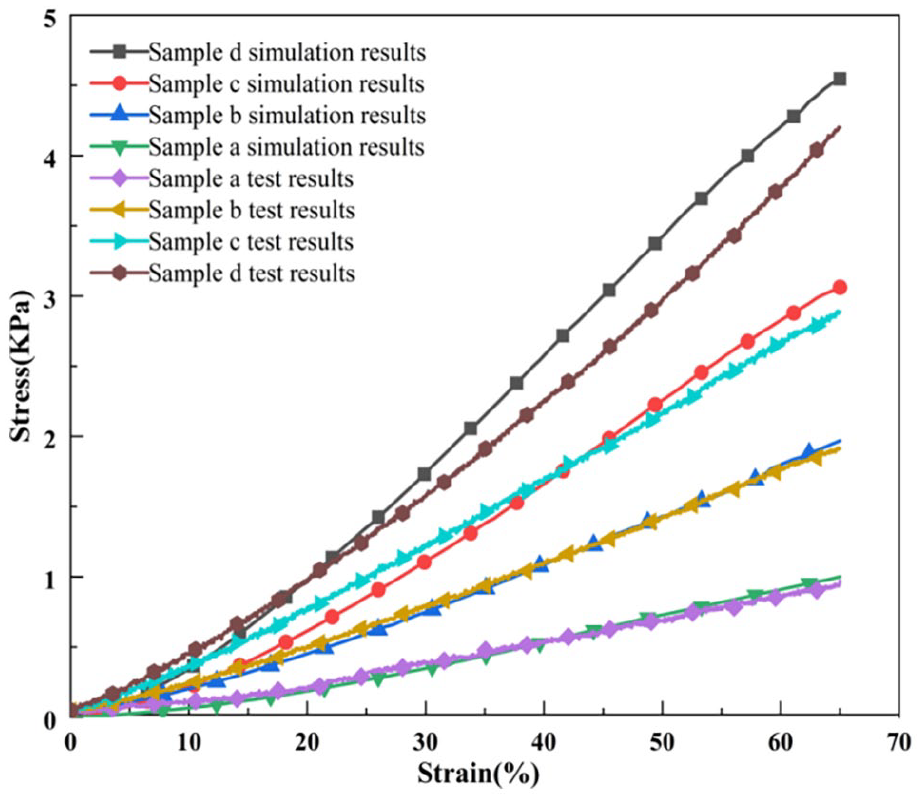
Stress and strain curves for spherical compression simulation and experiments with WKSFs.
Analysis of pressure distribution
The pressure distribution profile of a mattress is an important factor in sleep comfort. 26 Figure 7 shows the equivalent stress cloud diagram and upper layer node compression force diagram of WKSFs with a fineness of 0.25 mm indented to 25%, 40%, and 65%. And Figure 8 shows the compression diagram of nodes per unit area of the upper layer with Y-axis of 5 cm at different depths. As can be seen from Figures 7 and 8, the stress relief at the bottom end of the indenter is most obvious when the fabric is indented to 25%, and increases when the indentation reaches 40%, but the overall relief effect is still achieved until the indentation depth reaches 65%, when the pressure concentration at the bottom end of the indenter is more obvious and the compression relief effect is barely achieved. The overall pressure relief at the bottom of the indenter gets better as the spacer filament fineness decreases up to the same depth. This indicates that the stress relief at the bottom of the indenter is effective at both 25% and 40% indentation. And when pressed to the same depth, the fabric with a fine spacer fineness has better relief pressure effect and coating property. Therefore, when WKSFs are used as mattresses in practice, it is best to keep them within 40% of the compression depth to ensure that a good compression relief is achieved.

Stress diagram for WKSF with spacer filament fineness of 0.25 mm indented to different depths: (a) equivalent stress cloud diagram at 25% indentation, (b) 40%, (c) 65%, and (d) compression force diagram of the upper layer nodes at 25%, 40%, and 65% indentation.

The compression diagram of nodes per unit area of the upper layer with Y-axis of 5 cm at different depths: (a) 25%, (b) 40%, and (c) 65%.
In order to obtain good comfort, the mattress design should be able to carry the weight of all parts of the sleeping person, and the average value of the pressure of the body parts on the mattress when the human body is lying flat can reflect the overall force situation and characterize the comfort to a certain extent. 27 According to the research of Wong et al. the pressure on the buttocks per unit area is the largest, accounting for about 40% of the entire body weight. 28 From the pressure distribution test by Du et al. it can be seen that the average pressure on the buttocks of different body weight is 0.505–0.713 N/cm2. 29 From the compression diagram of unit area in Figure 8(b), it can be concluded that the pressure values around the spherical indenter when the WKSFs with spacing filament fineness of 0.18 and 0.25 mm is depressed to 40% are 0.48–1.10 N/cm2 and 0.75–2.01 N/cm2 respectively. Therefore, the WKSF with spacing fineness of 0.25 mm can fully meet the different weight of the personnel on the mattress material support requirements.
Combined with the principle of partial pressure at the bottom of the spherical indenter of WKSFs and the characteristics of three-dimensional and uneven pressure distribution of body pressure when the human body is lying down, it can be concluded that: In the case of non-partition design of WKSF mattress, the maximum bearing part in the weight distribution of human body when lying flat – hip compression depth within 40%, and the average compression of the whole body is less than 40% at this time, which makes the overall effect of partial pressure best. This means that the WKSF with spacer filament fineness of 0.25 mm can balance both the comfort and compression resistance, and can better meet the needs of people of different weight when sleeping on the mattress.
Conclusions
The following conclusions can be drawn from the spherical compression tests and simulation analysis of WKSFs of 20 mm thickness, using four different spacer fineness of 0.12, 0.15, 0.18, and 0.25 mm:
(1) The compression stress, IFD and SF of WKSFs increase with the fineness of the spacer filament when a spherical indenter is applied; At the same time, the WKSF is best controlled within 40% of the indentation depth when used as mattress material, which can better achieve good compression comfort effectiveness.
(2) Four kinds of WKSFs with different spacer filament fineness with SF mainly in the range of 3.05–4.31, all of which are better than traditional high resilience soft PU foam and can be used as an alternative cushioning material for furniture, mattresses and cushions, which is conducive to green production and sustainable development.
(3) Spacer filament fineness of 0.25 mm WKSF in the indentation to 40% of the pressure around the indenter value of 0.75–2.01 N/cm2, and the corresponding demand for mattress material value of 0.505–0.713 N/cm2. Thus, WKSF with filament fineness of 0.25 mm can balance both the comfort and pressure resistance as mattress material, which can better meet the needs of people of different weight when they sleep.
Footnotes
Declaration of conflicting interests
The author(s) declared no potential conflicts of interest with respect to the research, authorship, and/or publication of this article.
Funding
The author(s) disclosed receipt of the following financial support for the research, authorship, and/or publication of this article: The authors acknowledge the financial support from the National Science Funds of China (11972172), and a Project Funded by the Priority Academic Program Development of Jiangsu Higher Education Institutions (PAP).
