




Abstract
With its unique three-dimensional structure, high porosity, and lightweight, warp-knitted spacer fabric (WKSF) is an excellent insulation material. Multilayer fabric is an effective solution for better heat control, meeting the different requirements of a wide range of applications in the field of temperature control. To know the relationship between structural parameters and heat conductivity, this study highlighted the heat transfer mechanism of multilayer WKSFs. Experimental WKSF samples were fabricated in a double needle bar warp knitting machine and had mesh and plain side layers, different thicknesses of 3 mm, 4 mm, and 4.7 mm. These samples were grouped into multilayer systems by changing thickness and contacting modes between two samples. Experimental results show that the number of layers and the type of contact between the layers affects the internal thermal convection of the multilayer system and thus has a significant effect on its thermal resistance. Also, the WKSF thickness plays a role in the thermal resistance of the multilayer system. To further clarify the heat conducting behavior from a microscopic perspective, a geometry model of multilayer WKSFs and transfer of heat physical field was constructed to perform finite element simulation by ANSYS. By comparing the simulation results with the test results, the established simulation model was practical and it was found that the heat transfer paths of multilayer WKSFs were affected by the distribution of media with different thermal conductivities. The research provides a theoretical reference for studies on thermal insulation materials.
Introduction
Studies show that buildings account for approximately 40% of total global energy consumption and play a critical role in the energy market.1,2 Global energy requirements for buildings are expected to continue to grow in the coming decades. With the global vision of achieving carbon neutrality, there is an urgent need to develop thermal insulation materials for energy-efficient buildings to alleviate the pressure of energy shortages. Researchers have categorized building insulation materials into traditional, state-of-the-art, and renewable insulation materials according to their material properties, as shown in Figure 1(a).
3
The traditional insulation materials currently commercially available have superior thermal insulation properties. However, some of their drawbacks also limit their application: for example, organic materials, such as polyurethane (PU), expanded polystyrene (EPS), and phenolic foam (PF), are extremely flammable with poor stability and eco-friendliness; and severe hygroscopicity of inorganic materials, such as mineral wool, expanded vermiculite, and expanded perlite, improves thermal conductivity at high humidity.4–6 Schematics of: (a) classification of building insulation materials; (b) factors affecting fabric thermal resistance.
During the process of optimizing traditional insulation materials, researchers have developed state-of-the-art insulation materials with lower heat transfer coefficients, such as vacuum insulation panels, closed-cell foams, aerogels, and phase change insulation materials.7–10 However, these materials have not been widely used because of their high price. The principle of state-of-the-art insulation materials except for phase change materials relies on their inherent high porosity or hollow structure to confine gases to achieve ultra-high insulation capacity. On this basis, warp-knitted spacer fabrics (WKSFs) with a medium-space partition structure that are inexpensive, non-flammable, and recyclable have great potential for building insulation materials. As shown in Figure 1(b), researchers have found that the thermal resistance of regular two-dimensional fabrics is related to their fabric and yarn structure.11–15 The heat transfer mechanism of three-dimensional WKSFs with more complex structures is correspondingly more complicated.
WKSFs provide 5-16 times the warmth of regular fabrics. 16 Thickness is the most important factor affecting the thermal insulation properties of spacer fabrics. 17 However, increasing the thickness will cause the burden of quality and fitness in practical application. Therefore, various strategies have been proposed to improve the warmth-retaining ability of spacer fabrics, including the use of multi-layer fabrics, 18 the reduction of air mobility in the spacer layers, 19 and the design of different inter-layer contact methods.14,20 Researchers have been exploring the effect of air on the thermal insulation performance of textiles at a macroscopic level.21,22 However, the relationship between internal thermal field coupling and textiles’ internal structure is still poorly understood. Finite element analysis (FEA) enables microscopic response to the thermal behavior of a textile by simulating its internal heat transfer process. 23 However, due to the complex internal structure of WKSFs, there is still a gap in the research on the thermal behavior of their models, especially the multilayer fabric models. This study aims to develop a WKSF model that is available for heat transfer simulation analysis, and the simulation results reveal the heat transfer mechanism between air and WKSFs, especially multilayer WKSFs, from a micro perspective.
Materials and methods
Materials
Details of warp-knitted spacer fabric.

Warp-knitted spacer fabrics fabrication
Three WKSFs with the same organization and different thicknesses were produced on a KARL MAYER RD7/2-12EN E24 twin-needle bed warp knitting machine, which can be fitted with up to seven ground bars. The chain notations for each bar are listed in Table 1 and the lapping diagram is shown in Figure 2(a). According to the knit notation, the interconnection of polyester multi-filament yarns causes the formation of a lot of hexagonal mesh on one side and a plain face on the other side. The tissue of the mesh layer is combined with tricot and satin. The loop diagram and physical drawing are shown in Figure 2(b). The tissue of the plain layer is locknit and its loop diagram and physical drawing are shown in Figure 2(c). Three types of WKSFs with various thicknesses are shown in Figure 2(e)–(f). Figure 2(a)–(c) are drawn by the WKCAD4.0 system, a warp knitting computer-aided design software developed by Jiangnan University. Schematics of: (a) lapping diagram and mimic diagram; (b) loop diagram and physical drawing of fabric combined with tricot and satin; (c) loop diagram and physical drawing of locknit fabric; WKSFs: (d)3 mm; (e)4 mm; (f)4.7 mm.
Characterization
Thickness measurement
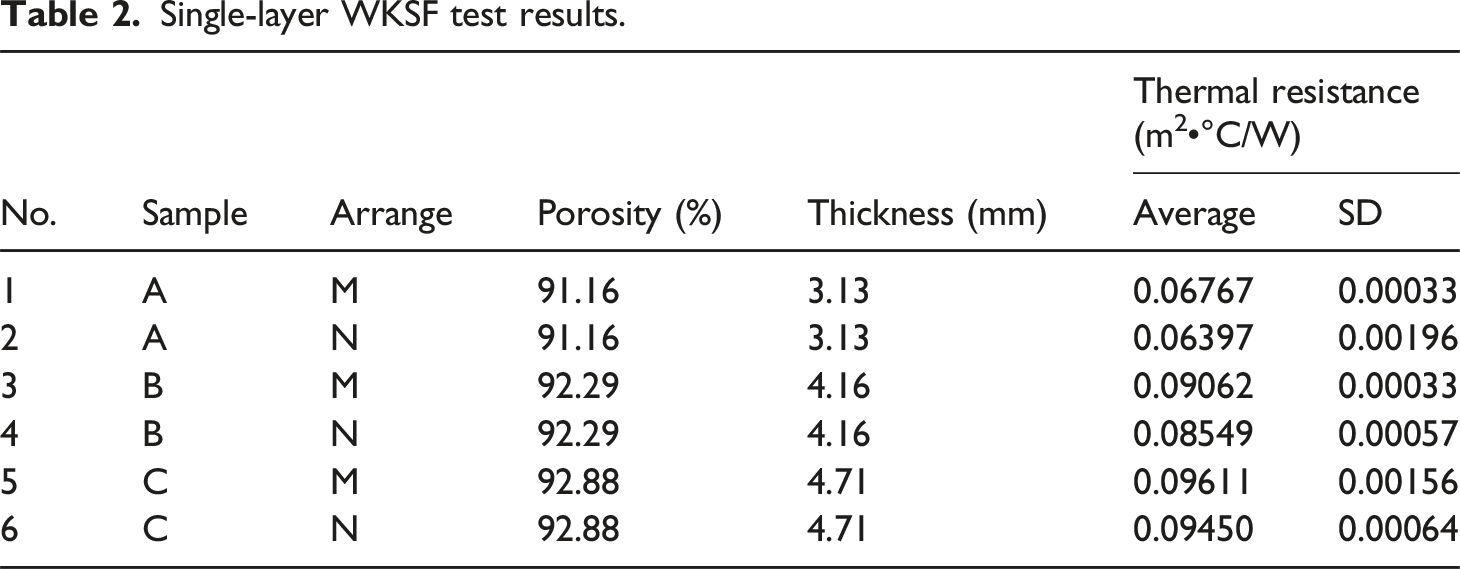
Single-layer WKSF test results.
Multi-layer WKSFs test results when mesh surface heated.

Multi-layer WKSFs test results when locknit surface heated.

*heated on locknit surface.
Supplemental experimental test results.

Areal density measurements
The experimental instrument used for the fabric areal density measurements is the fabric density mirror. Measure the number of horizontal columns and vertical rows of loops of the fabric in the range of 5 cm × 5 cm separately. The mesh side has a horizontal density of 58 WPC and a vertical density of 116 CPC, while the dense side has a horizontal density of 56 WPC and a vertical density of 115 CPC (Tables 2–5).
Porosity measurements
The porosity of the fabrics has a non-negligible effect on their insulation properties, which can be specified as a percentage. The standard equation for the fabric porosity is given in Formula (1) (Tables 2–5).
Heat transfer performance measurement
The test method used in this test is the flat plate method, and the test standard is described in the national standard ASTM F 1868-17. All data were acquired on YG606 E (China, WENZHOU FANGYUAN INSTRUMENT CO., LTD). In this method, the fabric to be tested is laid flat on the test plate to ensure that the fabric is not under tension and has no obvious folds. The heat transfer performance test was repeated three times for each sample and the average value was calculated (Tables 2–5).
Modeling of multilayer WKSFs system
To better predict the thermal resistance of the multilayer WKSFs system and analyze its heat transfer mechanism from a microscopic perspective, a geometric model was developed to simulate WKSFs and FEA was performed to calculate the thermal resistance of the WKSFs model with the support of ANSYS Workbench. Geometric modeling of fabrics is a crucial aspect of textile material simulation. The accuracy of the modeling results and the response to external loads depend on the geometry of the fabric prepared for the simulation. For this purpose, a series of multilayer WKSFs models are constructed in Design Modeler (DM). ANSYS Workbench is a powerful FEA software that can perform analysis such as structural, fluid, and acoustic fields and is widely used in civil, bridge, and mechanical fields. DM is a modeling software provided by ANSYS Workbench that allows the construction of solid models.
The parameters of the model are shown in Figure 3(a). The measurement accuracy of WKSF is 0.01 mm for thickness and 0.1 mm for surface parameters. After determining the datum surface a 2D sketch of the model is made according to the geometric parameters of the WKSFs used in this study, and then the solids are generated according to the thickness requirements. The comparison graphs of the fabric and the model are shown in Figure 3(b)–(d). According to the actual fabric thickness, the WKSF models were set to 3 mm, 4 mm, and 4.7 mm, and 13 sets of models with different numbers and arrangements of layers were built based on the experimental arrangement in Table 2. The interlayer heights of the multilayer WKSFs are shown in Figure 3(e). Furthermore, the combined system requires a model of the air, taking into account the influence of air factors. The combined model of air and fabric is shown in Figure 3(f). The thermal conductivity of the fabric part is 0.084 W/(m·°C), and the gas part is 0.026 W/(m·°C).
24
For the geometric model of the multilayer WKSFs, the following assumptions are made: (1) The surfaces of the WKSF are considered to be honeycomb and porous plates having the same thickness. (2) The spacer filaments are considered to be solid cylinders having the same diameter. (3) Fabric structure and air structure are considered to be homogeneous structures. (4) Multilayer spacer fabric without direct contact between layers. Details of the geometric model of WKSFs: (a) geometric parameters of the WKSF model (for a 3 mm fabric); (b) comparison of the mesh surface between the physical and the model; (c) comparison of the dense surface between the physical and the model; (d) comparison of the side views of the physical and the model; (e) interlayer height of multilayer WKSFs; (f) finite element model of the fabric and air combination; (g) meshing of the fabric; (h) meshing of the air.

Delineating the physical mesh is a very critical step in FEA, and the quality of the mesh delineation determines the computational speed and simulation accuracy of the model. The smaller the mesh division, the smaller the error in the simulation results, but also the longer the computation time. In this study, a computer-aided design-based approach is used for meshing the fabric model. For this purpose, the mesh generator in ANSYS is used. The meshing method adopted in this project is adaptive meshing. This meshing method is able to assess the adequacy of the mesh density by energy error estimation based on the geometry of the model and is able to refine the mesh automatically to reduce the error. With the adaptive meshing technique, better thermal distribution results can be obtained. The schematic diagram of the meshing of the spacer fabric and the system is shown in Figure 3(h) and (g).
Based on the experimental conditions, the process of measuring the thermal resistance of the fabric is simulated in this project. Since the thermal performance tests of the WKSFs were conducted in a closed environment and the experiments were long enough, the steady-state thermal analysis mode was selected to calculate the solid model’s temperature and heat flux density distribution. The steady-state thermal analysis module is an analytical calculation module that calculates the physical parameters such as thermal gradient and heat flow density of a system or a part through FEA based on the heat balance equation of the first law of thermodynamics. Based on the test principle, only consider the heat transfer along the fabric thickness direction when setting the boundary conditions. Convective heat transfer only occurs in the outermost layer. The four sides of the fabric do not exchange any heat with the outside world. The boundary conditions for the steady-state thermal analysis of the spacer fabric model are set as follows: (1) Initial Temperature is set to 20°C; (2) Temperature is set to 35°C; (3) Convection is set to 5 W/(m2·°C).
25
According to Fourier’s law, the formula of thermal resistance is as follows:

Experiment 1: thermal resistance of single-layer spacer fabrics
Design of experiments
The experimental results on the thermal resistance properties of single-layer WKSFs are the basis for the design of subsequent experiments on the thermal resistance properties of multilayer WKSFs. The three WKSFs designed in this project differ in thickness and two surface tissues. Their effects on the thermal resistance of WKSFs were explored through full factorial experiments. The experimental approach design and test results are shown in Table 2. M and N denote the arrangement of the mesh and locknit surfaces, respectively, when heated.
Results and discussion
The test results of thermal resistance are shown in Table 2 and Figure 4(c). As shown in Figure 4(c), for single-layer WKSF, the thermal resistance of the fabric increases with increasing thickness. Due to the large gap between the air molecules, it is relatively difficult for the air to transfer the heat. As the thickness of WKSF increases, the thickness of the air in the spacer layer, which plays a dominant role, increases, and the thermal resistance of WKSF increases. Different heating surfaces also affect the thermal resistance for the same thickness of WKSF. The test results show that for WKSF with one side of the large mesh and one side of locknit when the mesh side faces the hot plate, the thermal resistance of WKSF is greater than that of the other side facing the hot plate. Two factors contributed to this result. As shown in Figure 4(a) and (b), two factors lead to this result. One is that when the mesh side is in contact with the hot plate, the contact area between the fabric with better thermal conductivity and the hot plate is smaller than the other case. At this point, the WKSF (consider air) receives less heat from the heat source. On the other hand, as the radiation surface is in contact with the external atmospheric environment, the porosity of the locknit is smaller. It is able to isolate the spacer air from the external environment, keep the internal air relatively static, and reduce the convective heat transfer with the external environment. Overall, the impact of thickness on the thermal resistance of single-layer WKSF is more significant. Schematic diagram of single-layer WKSF (a) mesh face (b) locknit face heated; (c)Single-layer WKSF thermal resistance test results.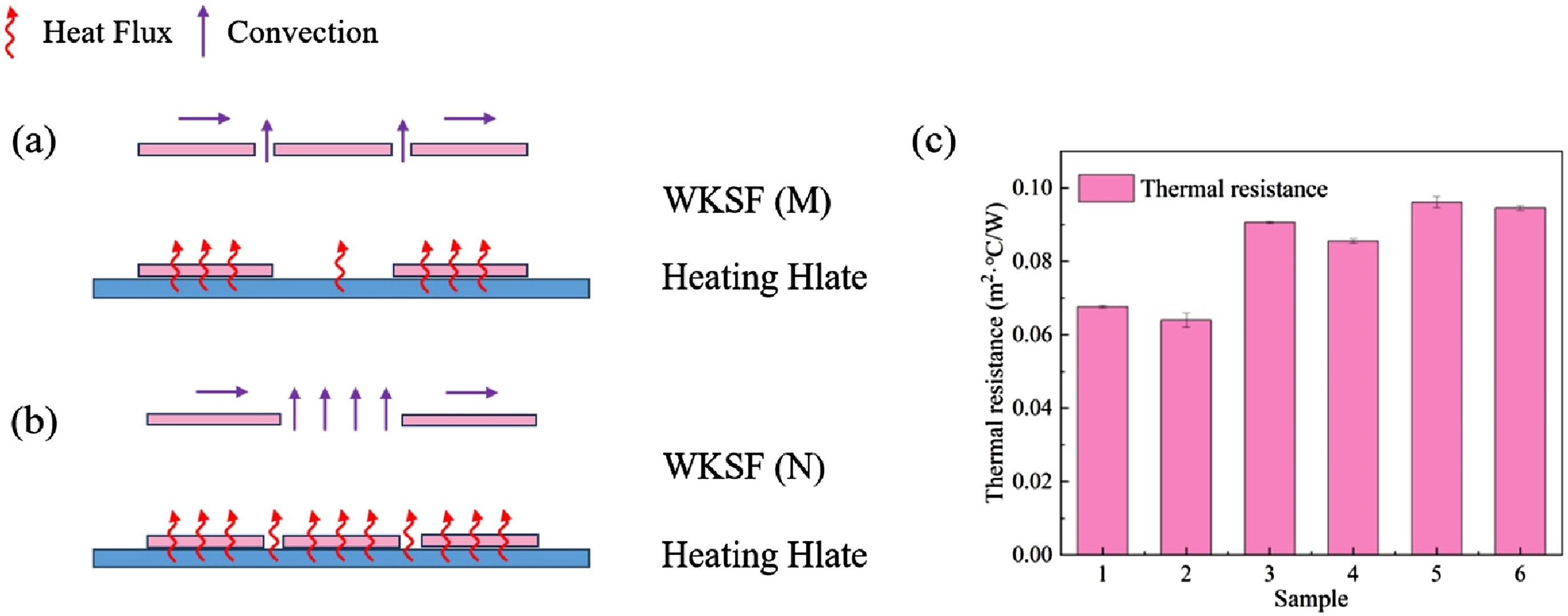
Experiment 2: thermal resistance of multilayer spacer fabrics
Design of experiments
This part aims to explore the factors affecting the thermal resistance of multilayer WKSFs, building on the research in Part 3, considering the influence of the thickness and heating surface of single-layer WKSFs, and optimizing the design to improve the efficiency of the experiment and focus on the key variables. Fixing the two influencing factors of fabric thickness (3 mm) and heating surface, two variables, namely, the number of layers and the contact method between layers, were selected for orthogonal design according to the structural characteristics of fabrics and experimental conditions. Stacked layers include 2, 3, and four layers. The interlayer contact methods were set as locknit-locknit dominant, locknit-meh dominant, and mesh-meh dominant, labeled as x, y, and z. When the heated surface was fixed, the interlayer contact methods were also fixed. Two groups of L6 (31×21) orthogonal experiments were designed with locknit-meh as the control group for mesh surface heated and locknit surface heated, respectively, as shown in Tables 3 and 4 Further simplifying the number of experiments, the contact between the two layers was set as mesh-mesh. Furthermore, a supplementary experiment was set up in this part to study specifically the effect of the number of layers. The experimental design with the total thickness and interlayer contact mode fixed is shown in Table 5. The arrangement of multilayer WKSFs dominated by different contact methods is shown in Figure 5. Arrangement of multilayer WKSFs.
Results and discussion
The thermal resistance of the multilayer WKSFs system increases with the increase of the number of layers (Figure 6(e)). Moreover, the thermal resistance of the multilayer system is greater than the sum of the individual layers of fabrics that make it up. Heat exchange occurs when two WKSFs with different temperatures are in contact. However, as shown in Figure 6(a), the gap between two nominally touching surfaces of fabrics is often filled with voids. Heat will be transferred from the upper surface of WKSF2 to the air layer and then to the lower surface of WKSF1. It adds an additional transfer resistance to the multilayer system compared to the case where the fabric surfaces are in complete contact. (a) Interlayer heat transfer mode in WKSFs; thermal convection within WKSFs in (b) locknit-locknit (c) locknit-mesh (d) mesh-mesh case; Thermal resistance diagram of (e) different layers of spacer fabrics; (f) different arrangements of multi-layer spacer fabrics; (g) similar total thickness multi-layer spacer fabrics with different layers.
Figure 6(f) shows the thermal resistance of WKSFs with the same number of layers varies at different arrangements. Differences in internal airflow caused by the structure of the contact surfaces at different arrangements are attributable to this. There are three types of heat transfer, conduction, convection, and radiation. Solids rely mainly on conduction to transfer heat, while fluids such as air have more convection to transfer heat. Figure 6(b)–(d) show the thermal convection within three different interlayer contact modes, in order of locknit-locknit, locknit-mesh, and mesh-mesh. Although the air volume is the same in all three cases, the air mobility and thermal convection in (b)-(d) increase sequentially, deteriorating the overall system insulation performance. In samples 8, 9, 13, and 14, where only one interlayer contact pattern was changed, this law applied perfectly. When more interlayer contact methods were changed, the thermal resistance of sample 16 was still slightly larger than that of 15 even with two mesh-mesh contact surfaces, which implies that the effect of locknit-locknit contact surfaces on the thermal resistance of multilayer WKSFs is much larger than that of the other two contact methods.
The results of Figure 6(g) also proved the above analysis. For samples 10 (12.10 mm, four layers) and 17 (12.09 mm, three layers), and for sample 8 (9.16 mm, three layers) and sample 18 (9.51 mm, two layers), the thermal resistances of the former, which has similar or even thinner thickness but more layers, are obviously larger than the latter. The strength of convective heat transfer plays a more significant role in the thermal resistance of the WKSFs system than the air thickness.
Finite element analysis of thermal resistance
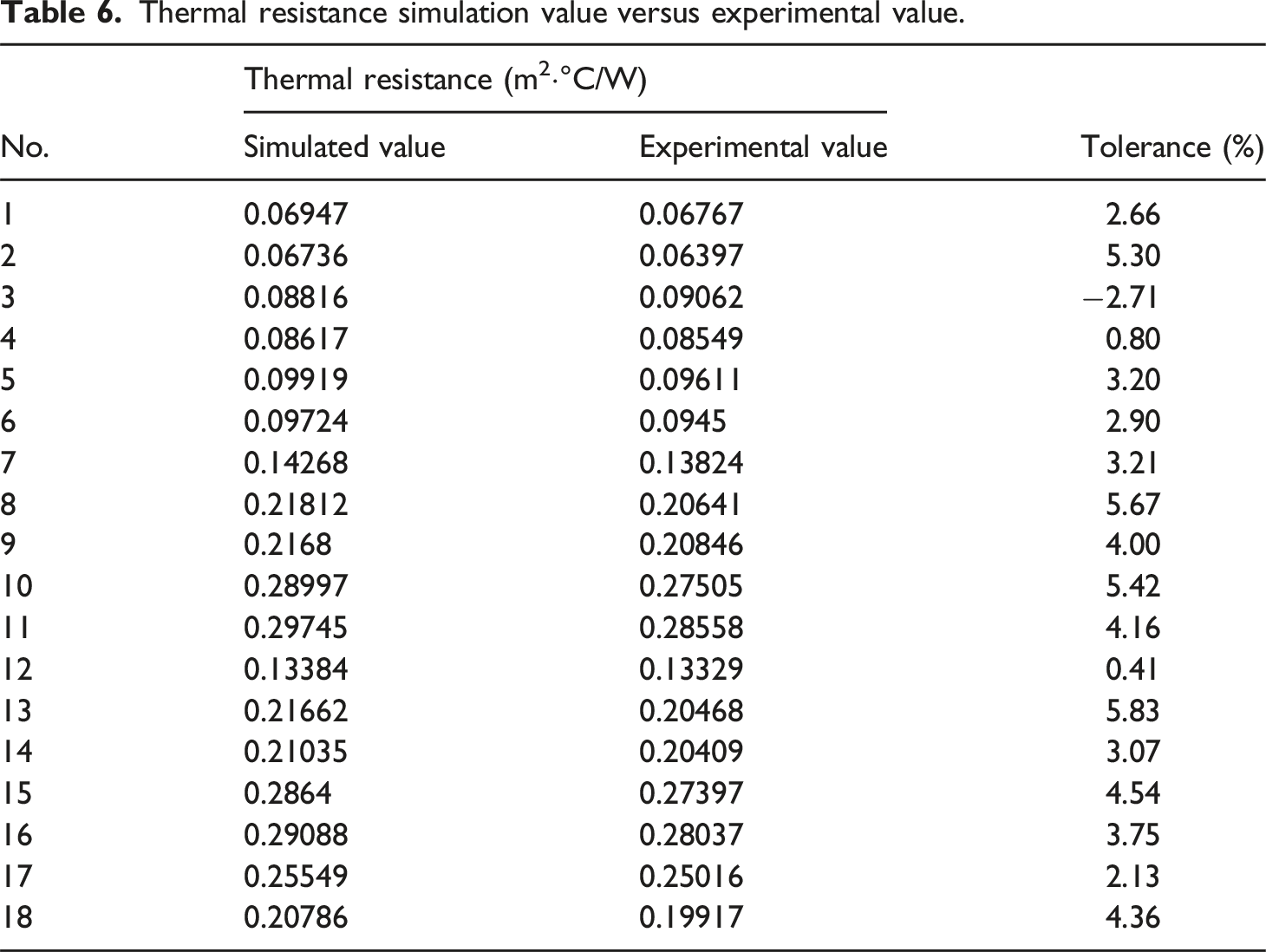
Finite element simulation results
Thermal resistance simulation value versus experimental value.
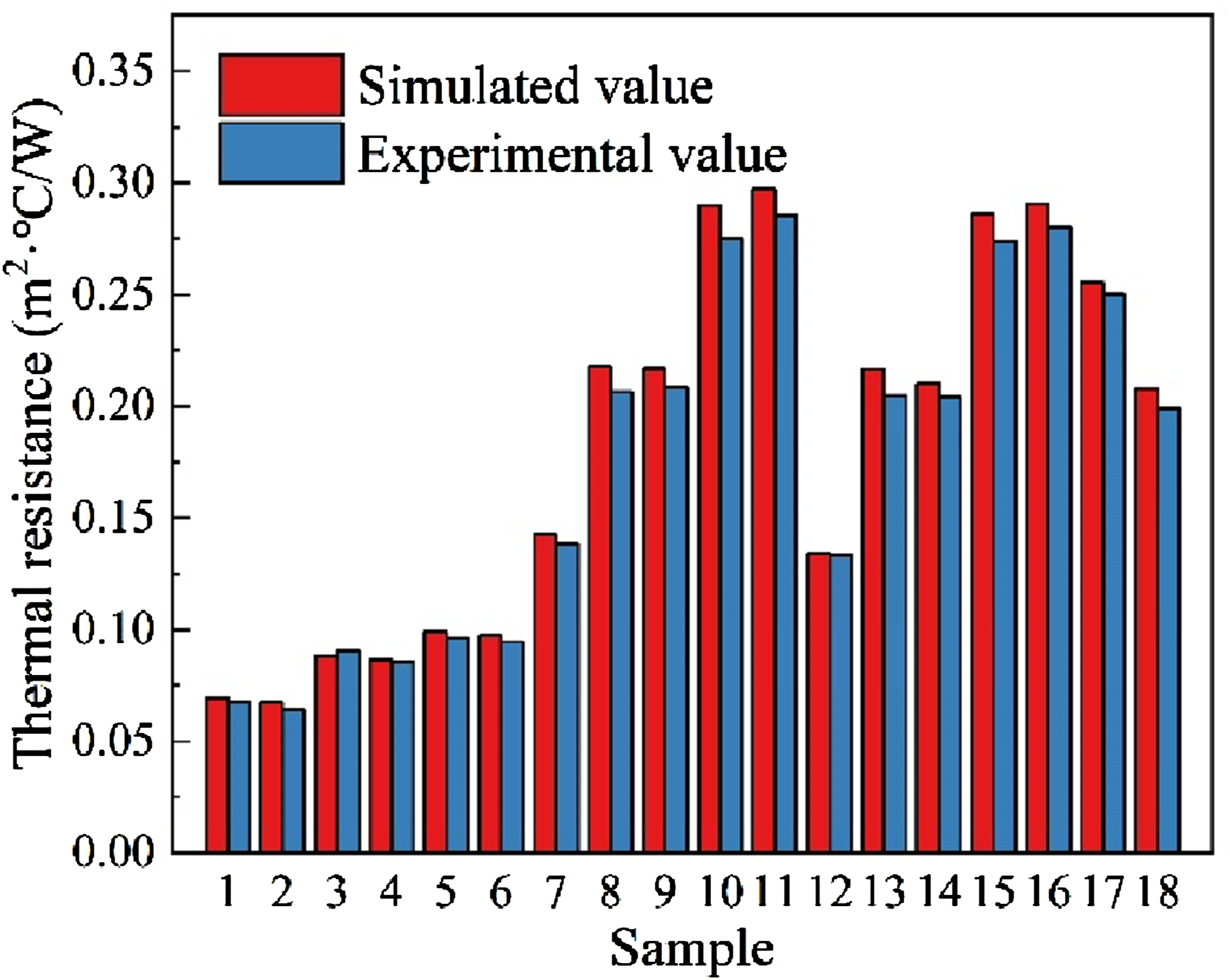
Thermal resistance simulation value versus experimental value.
Heat transfer mechanism
The simulation results of FEM visualize the internal heat transfer behavior of WKSFs. The color distribution pattern of the temperature contour plots and heat flow contour plots allows us to explore the microscopic heat transfer mechanism of the WKSFs. Temperature distribution and heat flux are two important aspects of heat transfer phenomena. Figure 8 is a temperature contour plot of the WKSFs, reflecting the temperature distribution within the WKSFs. Red color indicates the highest temperature interval and dark blue color indicates the lowest temperature interval. From Figure 8(a)–(c) it shows that as the thickness of the fabric increases, the temperature of its heat dissipation surface decreases. Figure 8(d) shows the sectional view of the model in (a) along OO’ and (e) shows the corresponding sectional view of the WKSF model. It shows that there are localized properties of heat transfer inside the non-homogeneous WKSF. When the mesh surface is heated, the temperature at A (air) is lower than that at B (fabric), implying more significant heat loss. This verifies the previous conjecture in section 3.2 that the greater the porosity of the heated surface of WKSFs, the less heat is transferred by the fabric. Temperature contour plot of (a) No.1; (b) No.2; (c) CNo.3; (d) the sectional view of the model in (a) along OO’. (e) the sectional view of the WKSF model in (a) along OO’.
Figure 9 shows the heat flux contour plots for the WKSFs. The heat flux density scale ranges from 0 to 220 W/m2, with red color indicating the highest value and dark blue color indicating the lowest value. The heat flux can reflect the local heat transfer rate of the non-homogeneous WKSFs model. Figure 9(a) shows the contour plot of heat flux for a single-layer WKSF model (with air). It shows that at the surface of the fabric, the heat transfer rate of the fabric is high and that of the air is low. This coincides with the temperature distribution pattern at the surface layer shown in Figure 8. And at the middle air layer, the heat flux of spacer filaments further increases, which indicates that in non-homogeneous mass heat tends to be transferred more along the component with high heat transfer rate. Figure 9(b) shows another view of the single-layer WKSF model, which shows that in the same horizontal plane, heat is not only transferred along the vertical direction but also exchanged horizontally for the non-homogeneous model. Total heat flux contour plots of: (a) a single-layer WKSF model (with air); (b) another view of the single-layer WKSF model; (c) the multilayer WKSFs model (with air); (d) the air model of multilayer WKSFs.
Figure 9(c) shows the heat flux contour plots of the multilayer WKSFs containing the air model, while (d) corresponds to (c) with the heat flux contour plots of the air model. Figure 9(c) and (d) show the contact region of the locknit-mesh surface. It can be seen that when heat is transferred from one fabric to the other, due to the hindering effect of the interface on the heat flow, there is an abrupt change in the heat flux at the air layer between the two facings, which generates heat transfer resistance and affects the heat transfer efficiency. The larger the contact area between the two layers of fabric, the greater the heat transfer resistance. Therefore, sample 11 with two dense-dense contact surfaces has the greatest thermal resistance. Meanwhile, Figure 9(d) also verifies the analyses in 4.2, that is, the air heat flux density at the large mesh is high, the convection effect is obvious, and the heat transfer is strong, and the opposite is true for the locknit surface.
Conclusions
In this paper, a series of WKSFs with different side layers and different thicknesses were fabricated, and the corresponding fabric geometry models and heat transfer physical models were established. The factors affecting the heat transfer performance of the multilayer WKSFs system were investigated experimentally. The heat transfer characteristics of WKSFs were explored from a microscopic perspective using FEA. In comparison, it is found that the simulation model established in this topic has strong practicality and the following core results are obtained. (1) The number of layers and the contact mode between layers affect the thermal resistance of the system by changing the thermal convection inside the WKSFs, and the air volume also has a significant effect on the thermal resistance of the system. (2) A multilayer WKSFs model was established using ANSYS and the simulation calculation of heat transfer performance was realized, and the simulation results have high accuracy. (3) From the simulation results, local heat transfer characteristics exist inside the inhomogeneous WKSF, and the heat tends to be transferred along the components with high thermal conductivity.
Footnotes
Declaration of conflicting interests
The author(s) declared no potential conflicts of interest with respect to the research, authorship, and/or publication of this article.
Funding
The author(s) disclosed receipt of the following financial support for the research, authorship, and/or publication of this article: This work was supported by National Key Research and Development Program of China under Grant (2022YFB4700600), The Ministry of Education's Industry and Academy Cooperative Education Project (220706429061416) and National Natural Science Foundation of China (61902357).
