



Abstract
Risk management is an essential component of effective campus recreational sport programming. However, research on risk management policies, procedures, and practices within recreational sports is both limited and outdated. As such, this study provides an overview of current risk management policies, procedures, and practices across North American collegiate recreational sports departments. Specifically, the results emphasize current training practices for both part-time and full-time staff, practices in establishing and updating emergency action plans, and contents covered in emergency action plans. The results suggest that while the vast majority of recreational sport programs have established risk management procedures and engage in risk management training, they diverge in best practices related to emergency action plans and in terms of contents covered in such plans. Applications of these results for practitioners and institutions are emphasized, including discussions around best practices in risk management.
Introduction
Risk management and preemptive risk mitigation are key administrative components of professional recreational sport program administration. Indeed, legal liability and risk management represent one of NIRSA's stated core competencies (NIRSA, 2023a). However, while collegiate recreation practitioners are acutely aware of the role and importance of risk management, this has largely evaded exploration among recreational sports scholars. For example, a review of the “legal liability and risk management” subsection of the Recreational Sports Journal yields only seven peer-reviewed articles, the majority of which were published prior to 2010.
Of the studies that have been published under the “legal liability and risk management” subsection of the journal, none have systematically studied the current scope of risk management policies and practices across institutions. Instead, previous studies have demonstrated the effectiveness of risk management procedures in specific program areas, including intramural sports (Lee et al., 2010; McElveen et al., 2014) and club sports (Schneider et al., 2008), while others have questioned the relationship between liability and specific recreational sport risk management practices (Katz & Seifried, 2012; Miller, Young & Martin, 2009).
The findings from this early research discovered a range of risk management policies and procedures, with Mulrooney et al. (2002) arguing that only 29% of institutions have a functioning risk management plan, while Lee (1999) conversely found that 61% of institutions believed their risk management plan to be functioning. Years later, Stier et al. (2008) found that 58% of intramural sport programs have a designated risk management employee, 63% require participants to sign waivers, 90% require professional staff to be CPR/first aid certified, 75% require graduate assistants to be certified, and 79% require student employees to be certified. The most recent data on risk management practices found that 95% of intramural sport programs provide risk management employee training (Lee et al., 2010). Specific to risk during the height of the COVID-19 pandemic, one recent study explored the role of COVID-19 risk mitigation policies and procedures, participant risk assessment, and participation in campus recreation (Anderson et al., 2022), while a second study reviewed the risk management planning in the reopening of campus recreation facilities after the initial COVID lockdowns (Lower-Hoppe et al., 2022).
Given the limited nature of risk management research within campus recreation, providing a closer and more thorough investigation into the current state of risk management practices and policies is an undertaking that can prove useful to practitioners and scholars alike in determining risk management best practices. Additionally, while limited recreational sport research exists discussing risk management as it pertains to accidents and liability, research discussing incident response/reporting and public safety measures is virtually nonexistent within the recreational sports canon. While a study conducted back in 2001 reviewed recreational sport security procedures (Veltri et al., 2001), such research has not been updated or expanded to include discussions of incident procedures and responses more generally. As such, this research provides a broad overview of campus recreational sport risk management practices. This adds to recreational sport literature in two important ways. Firstly, it provides an update to existing research that is long overdue. Secondly, this study explores campus recreational sports as a whole, rather than specific program areas, which is a limitation of early risk management research. Importantly, this updated data will allow recreational sport practitioners to scope their risk management policies, procedures, and practices in comparison to those of other institutions.
Framework
Risk management can be understood as the process of identifying, assessing, and eliminating/managing/mitigating risk (Spengler et al., 2006). Within the fitness, recreation, sport, and leisure industries, risk is inherent. Indeed, leisure facilities are subjected to numerous lawsuits each year (Goodman, 2021). As such, mitigating risk and reducing liability are core priorities for recreation administration (NIRSA, 2023a). Systemic risk management frameworks suggest that there are three levels of stakeholders in risk management decision-making (Rasmussen, 1997). The top level consists of government regulations, through which public policies are set and shared with the organization (the intermediary level). Organizations put these regulations into place through the implementation of policies and risk management frameworks. Finally, supervisors implement the risk management policies and procedures at the final level. Although this framework is seemingly a top/down approach to risk management, its success is dependent on the flow of communication occurring from both a top/down and bottom/up perspective. For example, laws from government agencies need to be communicated to organizations, while organizations need to lobby for risk management needs based on what is happening on the ground. For example, during the COVID-19 pandemic, fitness and recreation facilities would provide transmission data to government agencies (Lower-Hoppe et al., 2022). While the top level of this framework necessarily informs the other levels, the focus of this study emphasizes the creation and implementation of policies by recreational sport organizations—levels two and three.
Importantly, the effective implementation of a risk management plan necessitates knowledge, expertise, and evidence from stakeholders within organizations. Indeed, risk management implementation is variable because it is based on the decision-making of humans (Hochrainer-Stigler et al., 2020). Thus, while risk management is a core component of recreation administration, its effective implementation is determined by the expertise of those in charge of implementing such policies, which, without industry standardization (which does not exist for campus recreational sports), can vary greatly. For example, research has found that knowledge of risk management standards can be higher in some areas, such as aquatics, than in others, such as group exercise (Finch et al., 2009). Furthermore, knowledge of industry standards, namely those from government agencies, is often lacking. As such, additional training for recreation staff is required internally, while direct connection to public policies is helpful externally (Finch et al., 2009). This is particularly important, as leisure professionals themselves cite poor staff training, supervision, and knowledge as key risks (Keyzer et al., 2014). One way in which knowledge and competence can be increased is through training initiatives. While not specific to recreational sport administrators, educational initiatives have been found to significantly increase the risk management knowledge and implementation of risk management procedures among youth coaches (Mirsafian et al., 2022) and thus might have an impact on broader leisure professionals. However, a recent review of educational training within sport and recreation management higher education programs found that risk and legal concepts are not always covered in depth. Indeed, while almost all programs of study included certain legal frameworks, such as Title IX and negligence law, not all covered the aspects of practical risk management (DeMartini & Koo, 2023). As such, this study starts from the premise that risk management policies and procedures within collegiate recreational sports require scoping due to the diversity of knowledge, expertise, training, and regulations.
Relatedly, industry standards within campus recreational sports are limited. While certainly laws and regulations exist, at the top of the systemic risk management framework, industry standards for organizations to implement at the other levels remain fairly piecemeal. The American College of Sports Medicine (ACSM) offers some codes of practice (American College of Sports Medicine, 2012); however, less than 60% of fitness facilities (inclusive of but extended beyond campus recreation) comply with these standards by having an accessible emergency action plan (EAP) (Eickhoff-Shemek & Deja, 2002). More frequently utilized are the guidelines set forth by the National Athletic Trainers’ Association (NATA), which emphasize the creation and maintenance of EAPs for athletic facilities (Andersen et al., 2002). EAPs form the foundation of risk management planning as they “outline the step-by-step procedures that should take place in the event of a serious injury or acute medical concern” (Scarneo et al., 2019, p. 99). The suggested implementation of EAPs includes committing the plan to writing, the education/training of staff based on EAP components, the rehearsal of the plan and in-service practicums, and an annual review of the plan. Specifically, the position of NATA (Andersen et al., 2002) is that (1) every athletic organization must have an EAP, (2) EAPs must be written and distributed to institutional administrators and safety personnel, (3) EAPs outline specific staff risk management responsibilities and qualifications, (4) EAPs outline required risk management equipment, (5) standards of communication with emergency care are established, (6) EAPs are made specific to each recreation venue, (7) emergency care facilities are identified in the EAP, (8) EAPs specify documentation processes, (9) EAPs are reviewed annually, (10) all employees share risk management responsibilities, (11) all personnel share responsibility for the development, implementation, and evaluation of emergency plans, and (12) EAPs should be reviewed by legal counsel.
However, while the guidance on EAPs is established within athletic training, it is not required that they be implemented within a campus recreation context. To our knowledge, there is no recent research indicating the extent to which EAPs are implemented in said environment. However, research from high school athletics indicates that while 89% of school athletic departments had a functioning EAP, only 9.9% met all 12 components set forth by NATA, while 54.4% met 9/12 of the components (Scarneo et al., 2019). Similarly, physical education research has suggested that EAPs focus on personnel and equipment in their initial implantation (Popp et al., 2018). As such, the focus of this study is to understand the components of existing EAPs within campus recreational sports.
Methods
Participants and Procedures
Data for this survey were collected using the Qualtrics online survey tool (Provo, UT). The survey was distributed through email to NIRSA member institutions, which were estimated at the time to be 125. The NIRSA Research and Assessment Committee received a recruitment email, which they subsequently forwarded to member institutions per their policies for research-related communication. The participants in this study included either (a) directors at NIRSA member institutions or (b) those in an administrative position designated to oversee risk management at NIRSA institutions (at the request of the institution director). These individuals responded to an online survey related to their institution's risk management policies and procedures, with the aim of only one administrator per institution being sampled. The participants received a $10 gift card for their participation. The Institutional Review Board of Adelphi University approved this study.
Survey Instrument
A quantitative survey was developed using the Qualtrics survey tool. The survey was developed by sampling components of the SportRisk (2023) assessment of EAPs, namely via an inventory of EAP components and practices. Specifically, the survey was developed using a number of yes/no items to determine the frequency of EAP components. In addition, questions were developed to ascertain which certifying agencies were being used for risk management certifications for programs that responded yes to requiring such training. The first section of the survey instrument was designed to collect demographic information about the participant's campus (including population size, geographic location, public/private institution, etc.). The second section measured current policies and practices in place related to accident response within EAPs (including current staff training and competencies, designated personnel responding to accidents, departmental priorities in accident response, and attitudinal constructs of best/worst practices in accident response). The third section measured policies and practices in place for incident response within EAPs (including current staff training and competencies, designated personnel responding to incidents, departmental priorities in incident response, attitudinal constructs of best/worst practices in incident response, and procedures in responding to specific incidents). For example, Table 4 reflects responses to the question, “emergency action plans cover the following issues…” while Tables 2 and 3 reflect questions such as, “do you require your hourly staff to be certified in CPR?” and “if yes, which certification agency is used?” with a selection of the common certification providers.
The instrument was developed by the lead and third authors and reviewed/revised by the other authors. Specifically, the third author has expertise in the legal aspects of recreation and risk management specific to aquatic spaces. The lead author adapted the checklist for EAP components. The survey tool was tested by a subset of industry professionals across five institutions for clarity and validity.
Data Analysis
A descriptive analysis was conducted for the frequencies of policies/practices and EAPs, given the purpose of this study. While attitudinal constructs were analyzed, the results of these attitudes are not presented here, given the emphasis on updating the scope of practice within campus recreational sports. All analyses were run using SPSS 28.0.1.1 (IBM, Armonk, NY).
Results
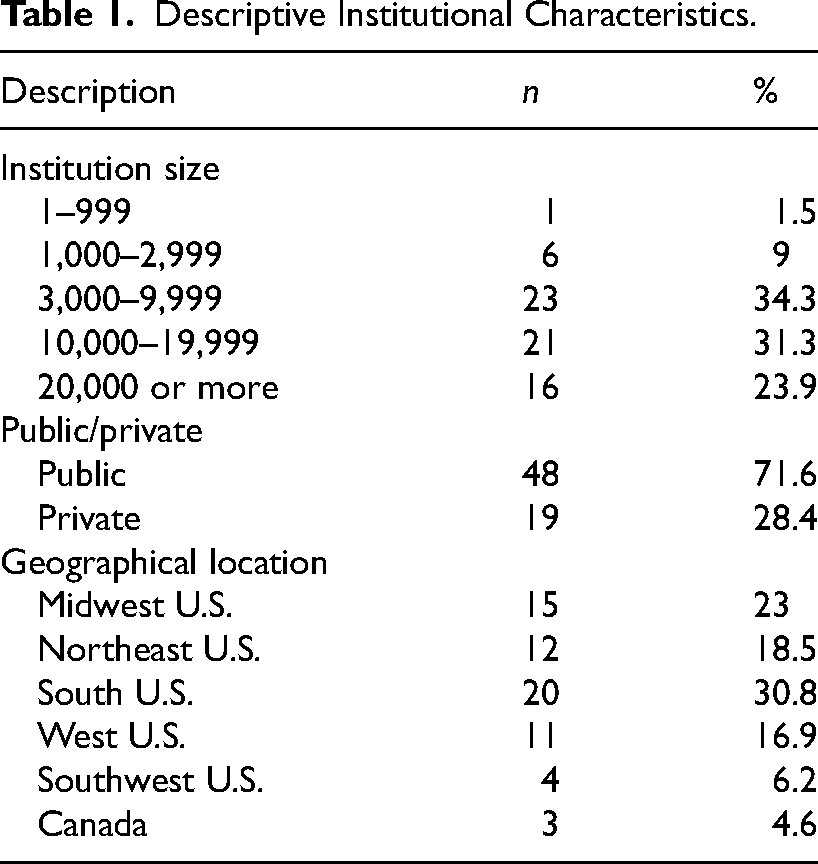
The responding institutions (n = 67) were located in the United States (U.S.) and Canada, with the majority of the respondents from the Southern Region of the United States. Over half of the responding institutions had a student population of 10,000 or more, and the majority were public institutions. See Table 1 for institutional demographic information. (Table 1).
Descriptive Institutional Characteristics.
The majority of institutions required their staff to be certified in CPR (95.5%) and first aid (98.5%). Regarding certifying agencies, the American Red Cross was the most frequently used agency for both CPR (70.3%) and first aid (71.6%). Furthermore, the majority of institutions (86.6%) required their staff to attend risk management in-service training beyond certification, most frequently occurring on a semesterly basis. Refer to Table 2 for an overview of training practices. (Table 2).
Overview of Risk Management Practices.
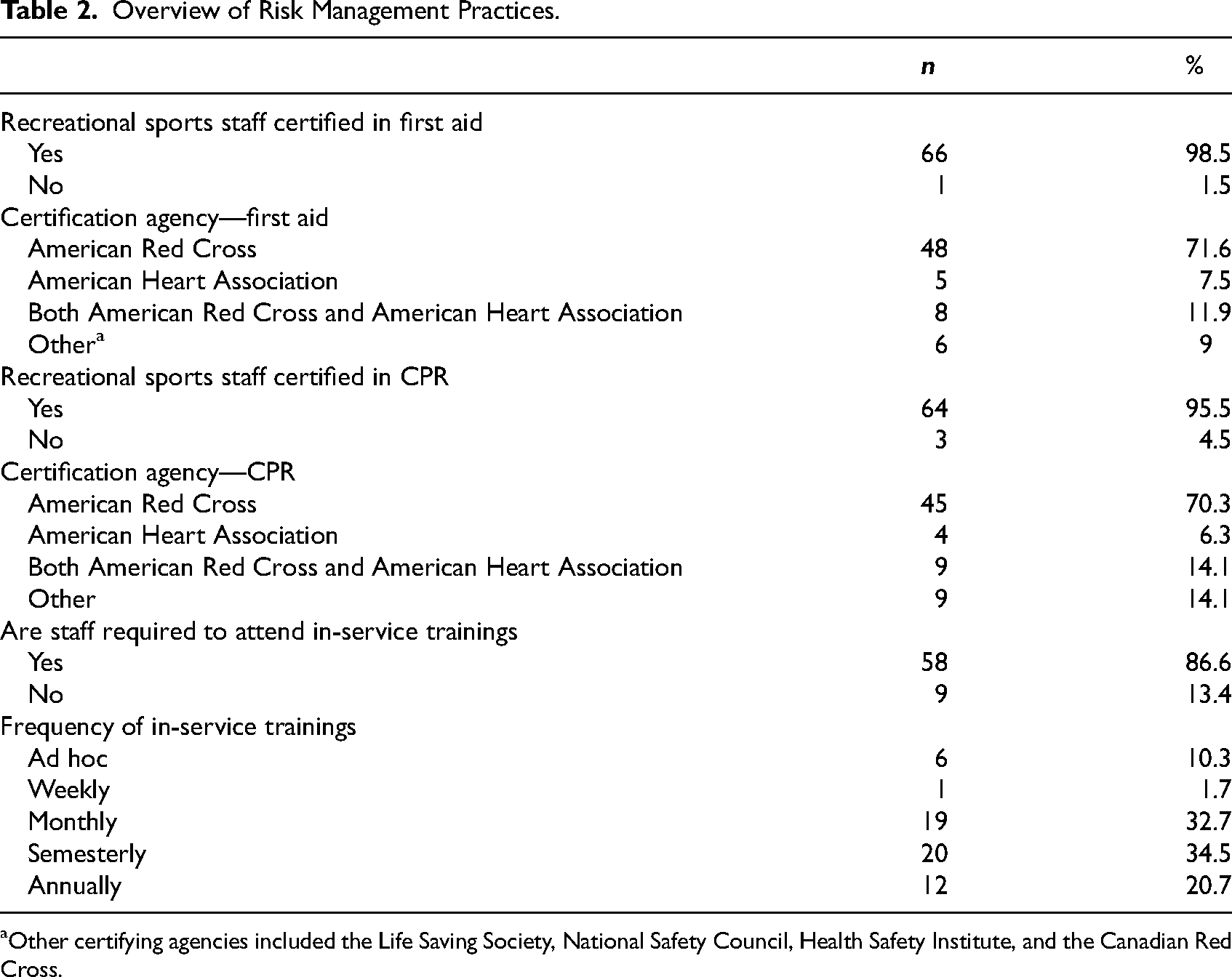
Other certifying agencies included the Life Saving Society, National Safety Council, Health Safety Institute, and the Canadian Red Cross.
Beyond training, the usage of emergency action plans (EAP) was analyzed. The majority of the responding institutions have an EAP in place (97%). Of those that have an EAP, almost half have updated it within the past year (49.4%). The Director or Associate Director of Campus Recreation is typically responsible for reviewing the EAP for accuracy (44%). Additionally, the majority of institutions indicated that full-time (89%) and part-time (84%) staff are trained specifically on the contents of the EAP. Refer to Table 3 for an overview of EAPs. (Table 3).
Emergency Action Plan.
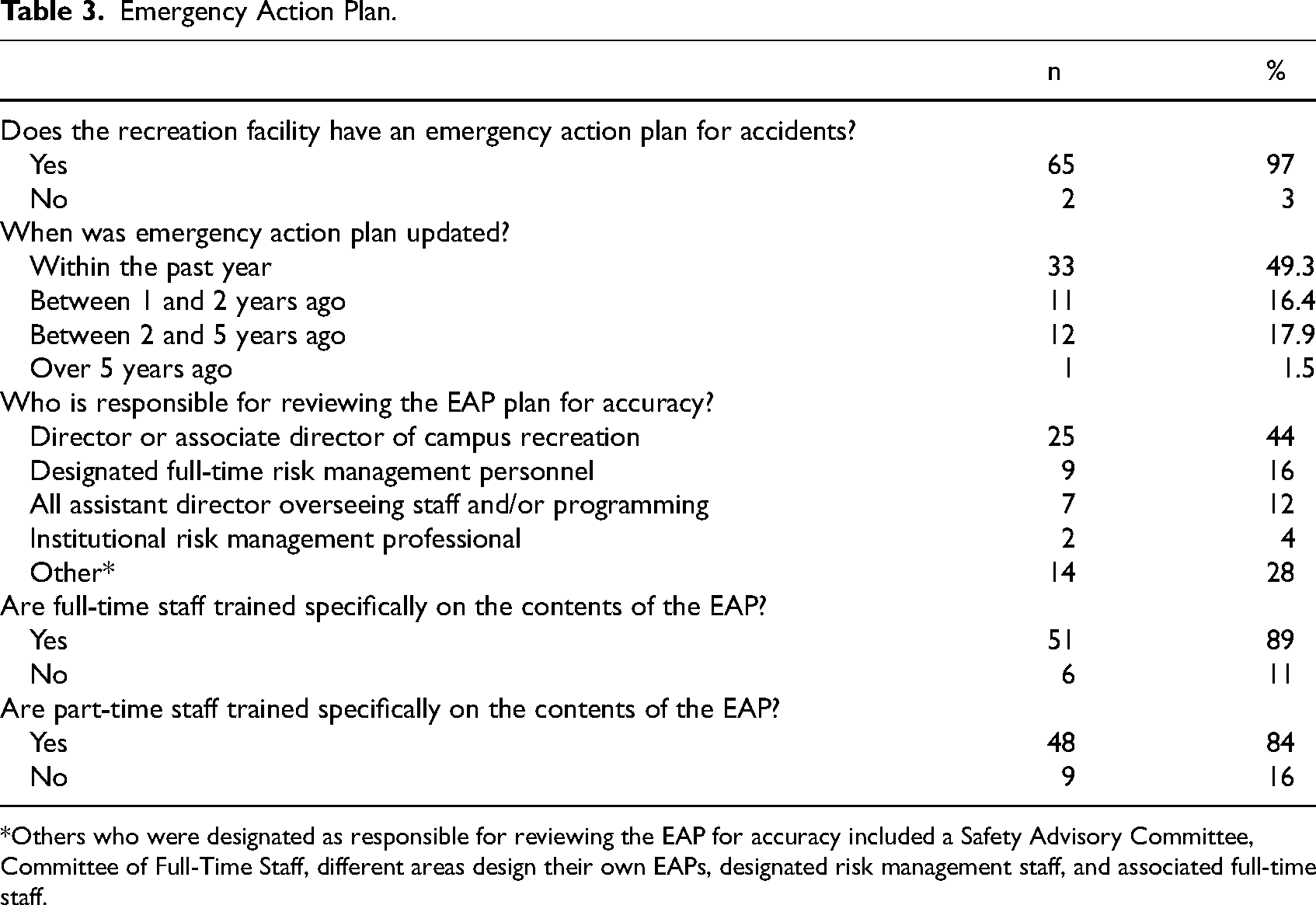
*Others who were designated as responsible for reviewing the EAP for accuracy included a Safety Advisory Committee, Committee of Full-Time Staff, different areas design their own EAPs, designated risk management staff, and associated full-time staff.
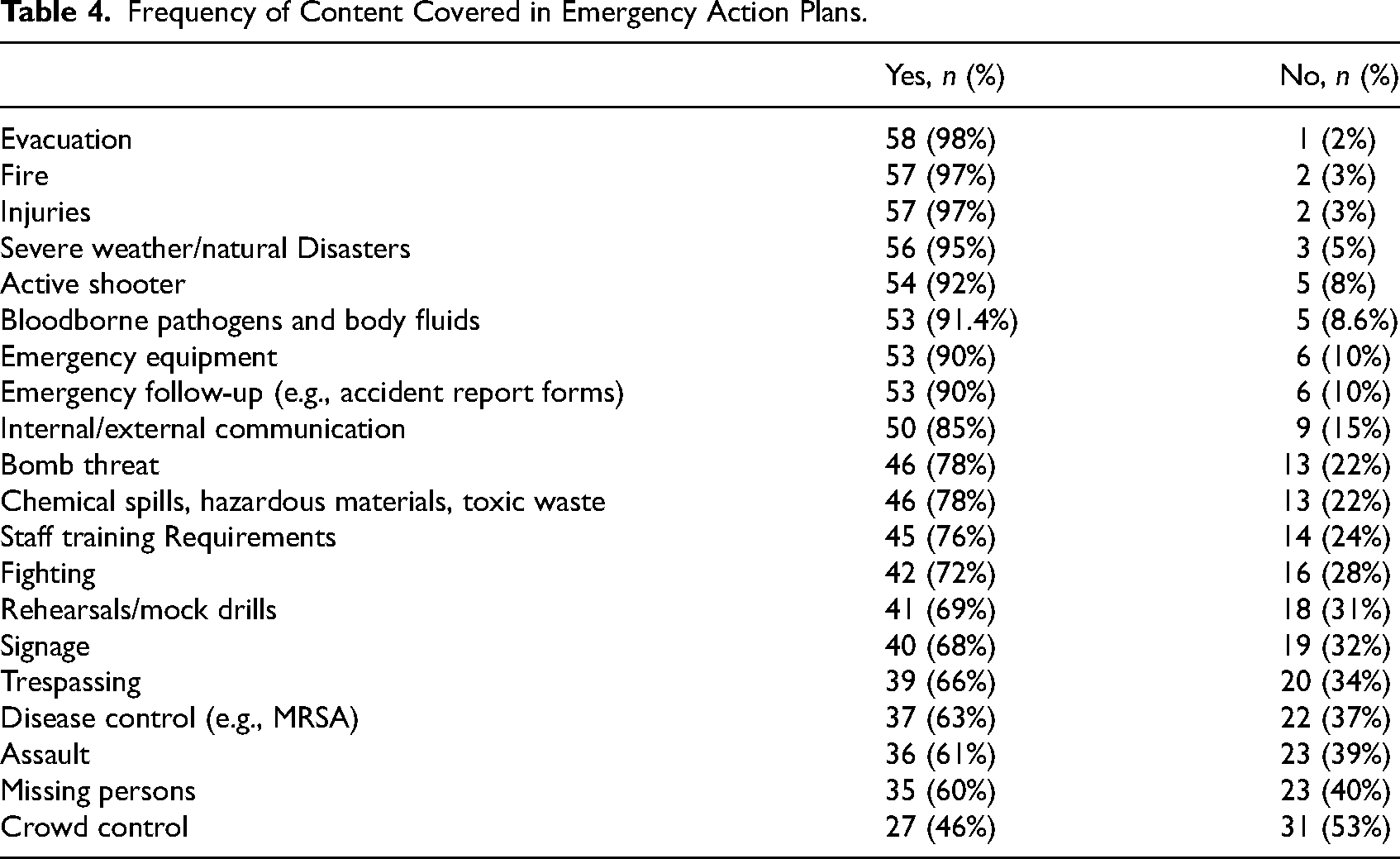
Lastly, the contents specifically included in EAPs were analyzed. The top three issues covered in the emergency response policies and procedures included evacuations (98%), fire (97%), and injuries (97%). The issues that were covered the least included assault (61%), missing persons (35%), and crowd control (27%). Refer to Table 4 for an inventory of content covered in EAPs. (Table 4).
Frequency of Content Covered in Emergency Action Plans.
Discussion
As alluded to earlier in the manuscript, the effective management of risk and actions taken during an event are the cornerstones of delivering quality programming in a campus recreational sports setting. As such, this study aims to scope out the risk management policies and practices for campus recreational sport programs across North America. The results from this study show both sides of the coin regarding what risk management activities are currently taking place and what gaps can be addressed by campus recreational sports administration to improve the effectiveness of risk management.
We can see from the results that the vast majority of those surveyed have an EAP in place, which is encouraging since this is well in line with professional standards (Andersen et al., 2002). In fact, more programs indicated having an EAP in this study than in previous collegiate recreation research, although the metrics for comparison are unequal. As stated earlier, this study is the first to scope risk management practices across all program areas, with previous research reviewing risk management programs within a specific program area. In addition, while EAPs are acknowledged as essential for emergency response, EAPs themselves have not been specifically studied in previous research. However, earlier studies found that either 29% (Mulrooney et al., 2002) or 61% (Lee, 1999) of institutions self-reported having a functioning risk management plan. Comparatively, 97% of institutions in this study report having an EAP, demonstrating the potential for improvement in risk management practices over the past 25 years.
An area of concern is the frequency with which EAPs are reviewed. Although the results revealed that almost half of the respondents review their EAP each year, the remaining half only did a review somewhere between 2 and 5 years. According to Andersen et al. (2002), it is recommended that an athletics-based EAP be reviewed not only at least once per year but also with ongoing fluidity to adjust as unforeseen situations occur. A solution may be to have someone within the organization with a more direct role in the creation, implementation, and review of the EAP, which is in line with recommendations from NATA (Andersen et al., 2002; Scarneo et al., 2019). With only 16% of campuses reporting that they have someone designated in a full-time risk management personnel role and almost half (44%) relying on this role to be at the director or associate director level, one could see how a more intense focus could be lost in this area. Comparatively, research in intramural sports has previously reported that 58% of programs have a designated risk management employee (Stier et al., 2008), demonstrating little movement, or potential regression, in this area. Solid risk management oversight requires not only someone to review a plan in a consistent and ongoing manner but also a person designated to ensure that it's implemented effectively as well (Andersen et al., 2002). With this being a paramount strategy within professional risk management, it is recommended that the role be designated to a full-time employee as a primary task or at least as part of a set of primary tasks to help keep it from becoming lost among all that has to be done within a recreational sport delivery system (Popp et al., 2018).
Overall, campus recreation programs appear to be doing well when it comes to requiring reputable and well-established safety-based certifications in the areas of first aid and CPR (expected to also include the use of an AED), showing more institutions requiring staff certifications (98.5% CPR; 95.5% first aid) than previous research in campus recreational sports, which was 90% (Stier et al., 2008). Departments that indicated that they do not require these certifications for their recreational sports staff (CPR: 1.5% and first aid: 4.5%) are of concern since these skills are essential in the event of any accidents/injuries that can occur in our settings. What is not known from this study is whether these facilities have adopted an alternative strategy such as outsourcing emergency response or creating other systems that would make it unnecessary to have all staff obtain these types of certifications. If that is the case here, we can still see from the responses that staff certification continues to be the standard model. Certifying and keeping staff up to date can be a challenge for organizations from the standpoints of both resources and funding, but it still remains an essential element of most operations. This provides on-site staff the opportunity to deliver the quickest appropriate response until more advanced care can arrive and take over. Furthermore, from a student development standpoint, acquiring these certifications can act as important transferrable skills for student employees (Anderson et al., 2018).
Finally, we looked at what topics were being covered within emergency action plans for campus recreation. It appears that programs are including those topical areas that have long been considered staples in risk management. One area that was particularly encouraging was that of “active shooter” (92%), also called “active aggressor” today. It would be considered a critical mistake for a program to not have this type of information and related training needed for staff. In the last decade, we have seen an exponential increase in these types of actions on university/college campuses in the United States (Silva, 2021). What was once considered rare is now deemed necessary to address through professional risk management planning. Although the topic may be uncomfortable to talk about, there are many programs available to assist in the design and delivery of the concept. The most recognizable is the “run, hide, fight” model, which is adopted widely as the best practice (Martin, 2020). Many institutions of higher education already have these programs in place campus-wide, and it may just be a matter of adapting them for the campus recreational sports environment in cases where it has not yet been done.
Emerging highest on the list of content not covered in emergency action plans in campus recreation is crowd control (53% lacking), missing persons (40% lacking), assault (39% lacking), disease control (37% lacking), and trespassing (34% lacking). Although these may appear to some as items that would be left to the police or other authorities to handle, they are still critical due to the time element, where lost response time can have critical consequences. As such, these should be addressed as part of a professional risk management plan. As mentioned above, being able to act in the moment is a key piece to supporting positive outcomes in risk management.
For example, in the case of missing persons, it would be vital to secure an area immediately to reduce the risk of a missing person leaving or being taken off-site; this could also include the immediate need to search aquatic spaces as a potential location for drowning. Additionally, the Blue Campaign, a group that works closely with the Department of Homeland Security to raise awareness around human trafficking in the United States, has identified college students as a particularly vulnerable population group as they are often living away from home for the first time, experience economic instability, commonly use alcohol, and campuses often contain large, concentrated immigrant populations (Blue Campaign, 2020).
Physical and sexual assault is also an alarming issue on college campuses throughout the United States. According to the Rape, Abuse, & Incest National Network (RAINN), 26.4% of undergraduate females and 6.8% of undergraduate males experience rape or sexual assault through physical force or violence, and 23.1% of transgender, nonbinary, or gender-nonconforming college students have been sexually assaulted (RAINN, 2020). Given the extraordinarily high incidence levels of this type of assault and the presence of intimate, private, physical spaces within campus recreation centers, an EAP inclusive of proactive and reactive assault intervention and reporting mechanisms is imperative.
Additionally, a striking 37% of emergency action plans in the sample did not address disease control. Given the study took place after the height of the COVID-19 pandemic, which largely shut down college campuses and recreation centers across North America, this finding is worth emphasizing. The pandemic closures of 2020 have undoubtedly changed the expectations and awareness levels of users within recreational facilities with regard to disease prevention, cleanliness, and sanitation (Anderson et al., 2022; Lower-Hoppe et al., 2022). While emergency action plans have historically dealt with the transmission of bloodborne pathogens and other more dramatic forms of disease prevention (i.e., MRSA), care should now be taken to include more holistic and encompassing plans and procedures toward disease prevention of all types. This is particularly the case as students are considering such actions when determining whether to engage with campus recreation programming (Anderson et al., 2022).
Relatedly, the most recent risk management-focused research within campus recreational sports reviewed recreation facility reopening plans after the pandemic lockdown (Lower-Hoppe et al., 2022). This research asserted that campus recreational sport professionals act as key stakeholders in implementing and adapting risk management policies in an uncertain situation (a pandemic). The findings emphasized the role of COVID-19 screening, mask mandates, social distancing, facility design, cleaning, and communication as common policy touchpoints for reopening plans. While specific to pandemic-related risk mitigation, Lower-Hoppe et al.'s (2022) research emphasizes the importance of having solid mechanisms for risk planning. Certainly, a strong risk management foundation, and extensive EAP, would serve institutions well in making ad hoc revisions as required by the pandemic. Each of the reopening components discussed by Lower-Hoppe and colleagues should have preexisting policies that could have been adapted for the pandemic (i.e., social distancing measures likely did not exist pre-pandemic, but policies on crowd management could have been adapted to assist with the new distance requirements). However, our study finds that this is not always the case; indeed, crowd control was the least covered topic in EAPs in our study. Additionally, with cleaning acting as an obvious essential service in reopening plans, it is troubling that this study found only 37% of EAPs to touch on this topic. Similarly, while signage was essential in the post-lockdown reopening plans, only 68% of institutions in our study included this in their EAP. These examples demonstrate not only the continued importance of a systemic, comprehensive EAP but also the necessity for risk management to act as a paramount aspect of recreation programming not only under extraordinary circumstances (such as the pandemic) but also during regular operations.
Application to Practice
While it is clear that risk management is a core competency for campus recreational sport administrators (NIRSA, 2023a), standardized risk management practices and tools remain lacking. As such, this study aimed to provide a review of ongoing risk management practices and procedures across NIRSA institutions. This, we believe, provides an essential first step for recreational sport professionals to establish their practices in relation to those of peer institutions. In other words, the results here provide a basis for an institutional-level comparison, allowing institutions to see what practices they are engaging in that others are not and what other institutions are doing that should be adopted. Indeed, the discussion emphasizes specific areas of emphasis for recreational sport administrators to consider in their risk management planning. For example, by reviewing the common contents of an EAP (Table 4) and comparing them with the contents of an organization's specific EAP, professionals can determine and fill existing gaps in their current plan. Regarding specific EAP results, responses to incidents—namely crowd control, missing persons, and assault—are less likely to be included in EAPs than responses to injuries, fires, and evacuations. Given the nature of recreational activities and the collegiate social environment, it seems prudent that institutions lacking plans in any of these areas should consider how to adopt and implement policies to handle such incidents in their EAP. Furthermore, the results here demonstrate a large range of frequencies in updating EAPs (Table 3). Given this and industry best practices, it is recommended that EAPs be treated as living documents, with annual formal reviews and ad hoc revisions.
Beyond EAPs, it is suggested that practitioners engage more directly in risk management discussions within NIRSA. A review of the annual conference programs for the past three years shows limited risk management sessions, particularly outside of aquatic settings. Indeed, it appears that risk management conversations within NIRSA have tended to be program-specific (i.e., risk management within club sports or aquatics). While such conversations are essential, especially given the elevated risk associated with club travel or aquatic environments, more general risk management conversations are needed. It is our hope that the data presented here provides a foundation for such conversations, providing a first step in establishing best practices for risk management in campus recreational sports. To be clear, we do not suggest that a one-plan-fits-all approach is appropriate. Rather, we argue that a recognition of the current nature of practices across institutions can assist in establishing best practices that can be adopted for individual institutional contexts.
Conclusion
Rasmussen (1997) suggested there are three levels of stakeholders in risk management decision-making: (a) government regulations, (b) organizations, and (c) supervisors. While recognizing the importance of the top level of this framework in guiding risk management practices, indeed, NIRSA (2023b) includes a legislation update on its website, this study scopes the policies and practices within recreational sport organizations. We believe this is important for four reasons. Firstly, previous research has found that the implementation of risk management plans is influenced by the varied decision-making of humans (Hochrainer-Stigler et al., 2020) and thus requires attention to variations among institutions. Secondly, previous research within campus recreational sports has looked at risk management practices by program area instead of as an entity itself. Given that knowledge of risk management standards can be higher in some program areas than others (Finch et al., 2009), it is important to review recreational sport departments as a whole. Thirdly, risk management guidelines specific to campus recreational sports remain limited. However, affiliated organizations, such as NATA, have set forth standards for adequate risk management within the sport and fitness industry (Andersen et al., 2002). Central to these standards is the creation and implementation of a strong EAP. Here, we scope the contents of and practices for creating/maintaining such plans within campus recreational sports departments. Lastly, outside of pandemic-related risk management research, this study is the first to review risk management practices specific to campus recreation in over 20 years and is thus long overdue. Because of this gap, this study provides an initial overview of the scope of EAP policies and practices.
Footnotes
Declaration of Conflicting Interests
The authors declared no potential conflicts of interest with respect to the research, authorship, and/or publication of this article.
Funding
The authors disclosed receipt of the following financial support for the research, authorship, and/or publication of this article: This work was supported by the NIRSA Foundation.
