




Abstract
This study determined the prevalence of home accidents among elderly people living in Mersin and the factors affecting their occurrence. The data of 609 elderly people were analyzed. The people referred to a family health center for any reason were included in the study. The frequency of having a home accident in the previous month was 9.9%. The prevalence of home accidents was 3 times higher in females, 2.7 times higher in people living with their children, 2.3 times higher in elderly who have visual impairment, and 2.7 times higher in elderly who have poor health status. Also, increase in age was a risk factor for home accidents. Home accidents constitute a significant problem for elderly people in Mersin. Environmental factors that may cause accidents within the home should be determined and the household should be arranged according to the elderly. Health problems that may pose a risk for accidents should be identified and treated.
Keywords
Introduction
Prolonged human life increases the elderly population in society. In 2016, 8.7% of the world population and 8.3% of the Turkish population consisted of elderly people. It is projected that this rate will increase up to 10.2% in 2023, 22.6% in 2060, and 25.6% in 2080 in Turkey. The expected lifetime at birth is 78.0 for the entire population: 75.3 for males and 80.7 for females (T. C. Prime Minister Turkey Statistical Institute, 2016, 2018).
Prolonged lifetime raises the issue of staying healthy and maintaining a good quality of life at advanced ages. The physical, sensory, and cognitive changes and the chronic diseases that appear with advanced age pose significant risk factors for accidents among elderly people and negatively affect their quality of life (Güner & Güler, 2002; World Health Organization [WHO], 2018).
Accidents are unplanned, unexpected, preventable events that suddenly occur and may result in injuries and damages (Aydın, 2016). In 2013, the Global Burden of Disease study estimated that 973 million people received health services due to injury and 4.8 million people died. Injuries account for 10.1% of global disease burden. Disability-adjusted life year (DALY) rates in the 50 to 79 age group were higher in the high-income regions than in the other regions and in men compared with women (Haagsma et al., 2016). Elderly people encounter home accidents more frequently than other age groups because they spend most of their time at home. Home accidents are defined as accidents that occur in or around (garden or garage) the house. They are the second most frequently encountered type of accident after traffic accidents, constituting 18% to 25% of all accidents (Aydın, 2016). However, they constitute 82% of accidents among elderly people. Along with the personal characteristics of the elderly people, home environment is also a determinant for accidents. Houses contain many factors that may cause accidents (WHO, 2018; Zorlu, 2017).
Home accidents are categorized as falls, cuts, burns, drowning, foreign body aspiration, electric shock, and carbon monoxide and other types of intoxication (Aydın, 2016). Falls are the most frequently observed accident type among elderly people. Approximately 30% of people older than 65 years of age fall each year. This rate increases to 50% among those older than 75 years of age. The rate of falling again among those who have fallen once is 60%. Of the falls, 20% to 30% result in injury, which reduces an elderly people’s ability to move independently and increases the risk of premature death (Fuller, 2000; Haagsma et al., 2016; Todd & Skelton, 2004; WHO, 2018).
The factors that increase the risk of home accidents include advanced age, chronic diseases, and low socioeconomic level. Home accidents are observed more frequently among elderly people who live alone than those who live with their family (Akyol, 2007; Aydın, 2016; Naharcı & Doruk, 2009; Ping & Xiaohua, 2012; Todd & Skelton, 2004; WHO, 2007). Home accidents mostly occur among females in the elderly people’s own houses in the living room, lounge, or kitchen (Aydın, 2016; Keskinoğlu, Giray, Pıçakçıefe, Bilgiç, & Uçku, 2004; Yeo, Lee, Lim, Quek, & Ooi, 2009).
Studies in Turkey show that the frequency of home accidents among elderly people ranged between 27.7% and 59.4% in the previous year, between 23.7% and 38.3% in the previous 6 months, and 34.3% in the previous 3 months (Atman, Dinç, Oruçoğlu, Oğurlu, & Ecebay, 2007; Erkal, 2005; Keskinoğlu, Giray, et al., 2004; Keskinoglu, Picakciefe, et al., 2008; Şahbaz & Tel, 2006; Şahin & Erkal, 2016; Tortumluoğlu, Akyıl, & Özer, 2005). In other countries, the frequency of home accidents or falls is 15.3% in the previous month and between 25.1% and 31.3% in the previous year (Carter, Campbell, Sanson-Fisher, & Gillespie, 2000; Prato et al., 2017; Rizawati & Mas Ayu, 2008).
The risk of a home accident among the elderly constitutes an important public health problem that has a negative effect on them and their families. This study aims to determine the prevalence of home accidents among people older than 65 years of age living in Mersin. The study also determined whether sociodemographic characteristics, lifestyles, health problems, the features of their houses, and other potential risk factors were associated with accidents.
Materials and Method
The data of this cross-sectional study were collected between March 1 and May 15, 2017. The 2015 data from the Turkish Statistical Institute showed that the population older than 65 years of age is 66.711 in the four central districts in Mersin. By using the data derived from the other studies conducted in Turkey, which reported a frequency of having a home accident between 23.7% and 59.4% (we accepted it to be 50%) and taking into consideration a 95% confidence interval and a 3% margin of error, the minimum sample size for our study was estimated to be 595 participants. The researchers attempted to reach 610 participants. The analysis was performed on the data of 609 participants, excluding one participant.
The sample size was determined based on the population older than 65 years of age in each district. In addition, stratification was made for each district based on age group and gender.
The data of the study were collected by the questionnaire created by the researchers. The survey questions were prepared by adapting the results in similar studies in the literature (Carter et al., 2000; Erkal, 2005; Güner & Güler, 2002; Keskinoğlu, Giray, et al., 2004; Keskinoglu, Picakciefe, et al., 2008; Rizawati & Mas Ayu, 2008; Şahin & Erkal, 2016; Todd & Skelton, 2004). The pilot test was conducted in 10 older people. As a result of the pilot test, the questionnaire was finalized. The survey was conducted by seven interviewers. The interviewers were trained on the implementation of the questionnaire. Participants were older than 65 years of age who consulted to the family health center due to any health problem. After explaining the purpose of the study, the questionnaire was applied to the elderly who volunteered to participate in the study. Questionnaire was administered by face-to-face interview.
The questionnaire had both closed and open-ended questions. The questionnaire included information about the participants’ sociodemographic characteristics such as age, sex, education level, occupation, marital status, lifestyles, health problems, the features of their houses, status of having a home accident in the previous month, and the characteristics of this accident. After the questionnaire was administered, the participants were provided with an education material on measures they can take to reduce the risk of home accidents.
The dependent variable was having a home accident in the previous month and the independent variables were the participants’ sociodemographic characteristics, lifestyle, health status, and the features of their house.
The data were summarized using mean ± standard deviation, median, frequency, and the minimum–maximum values. The Kolmogorov–Smirnov test indicates that the data were not normally distributed; therefore, non-parametric test was used. Categorized data were compared using the chi-square test. The continuous variables were compared using the Mann–Whitney U test. This was followed by multiple logistic regression analysis pooling factors with p values of <.05 to determine their relative associations with home accident. Two different multiple logistic models were analyzed to investigate the effect of demographical factors and health problems/lifestyle-related variables on home accident. The first model included age, gender, education level, marital status, and social security, and the second model included people they live with, visual and hearing impairment, balanced disorder, health status, person doing housework, and person cooking the meals. The statistical significance threshold was p < .05.
Results
The study included 609 elderly people aged 65 and older. The average age of the participants was 72.1 ± 6.0 years, and 40.7% of them were in the 65 to 69 age group (Table 1). The median monthly income was 1,400 TL (range = 200-7,000 TL). Participants’ sociodemographic characteristics and features of their house are shown in Table 1.
Participants’ Sociodemographic Characteristics and Features of Their House.
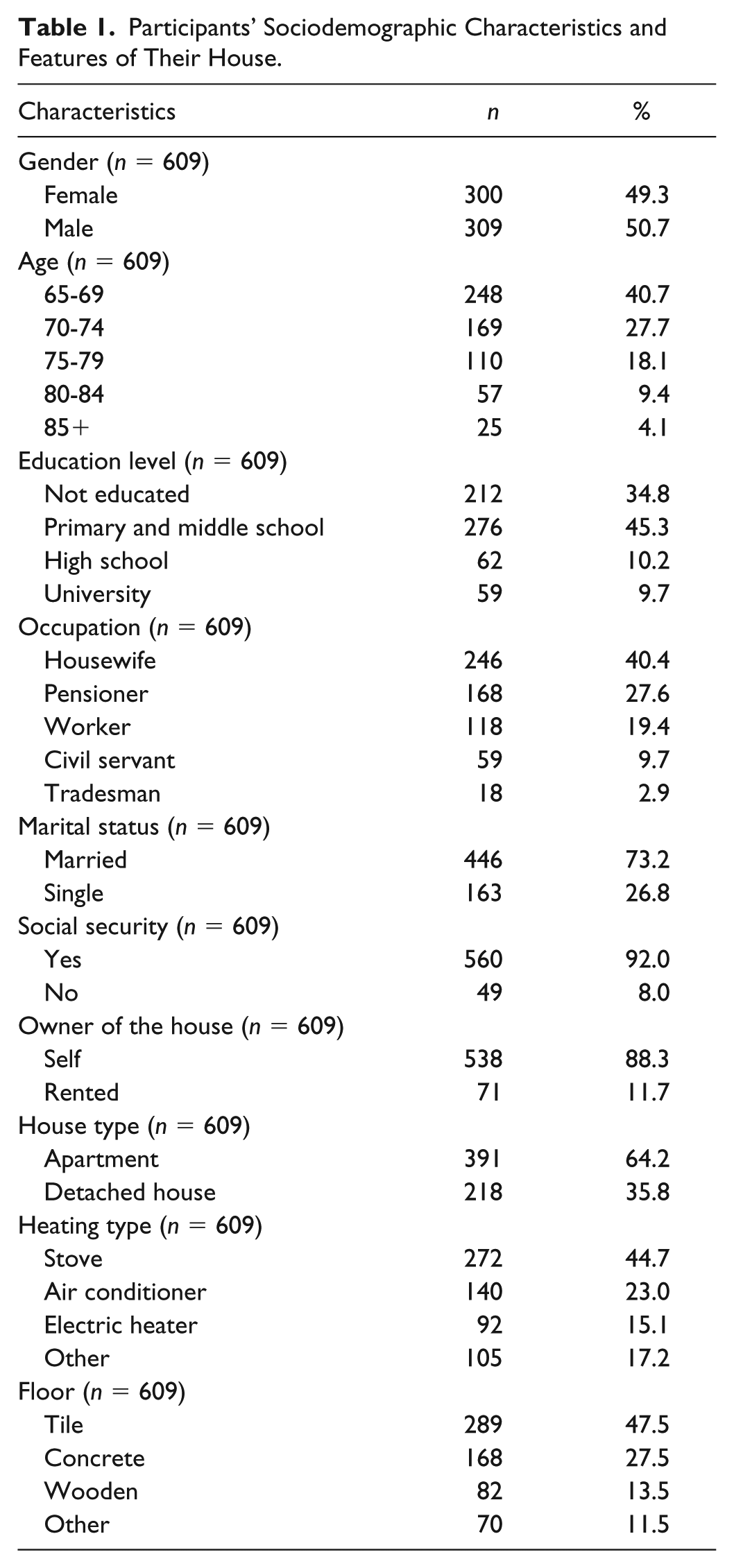
The participants had been living in the same house for a median of 21 years (range = 1-90 years). A median of two people (1-8 persons) was living in the houses and the nearest health institution was at a median distance of 500 m (range = 10-6,000 m) from the houses. Participants’ lifestyles and health status are shown in Table 2.
Participants’ Lifestyles and Health Status.

More than one option was selected.
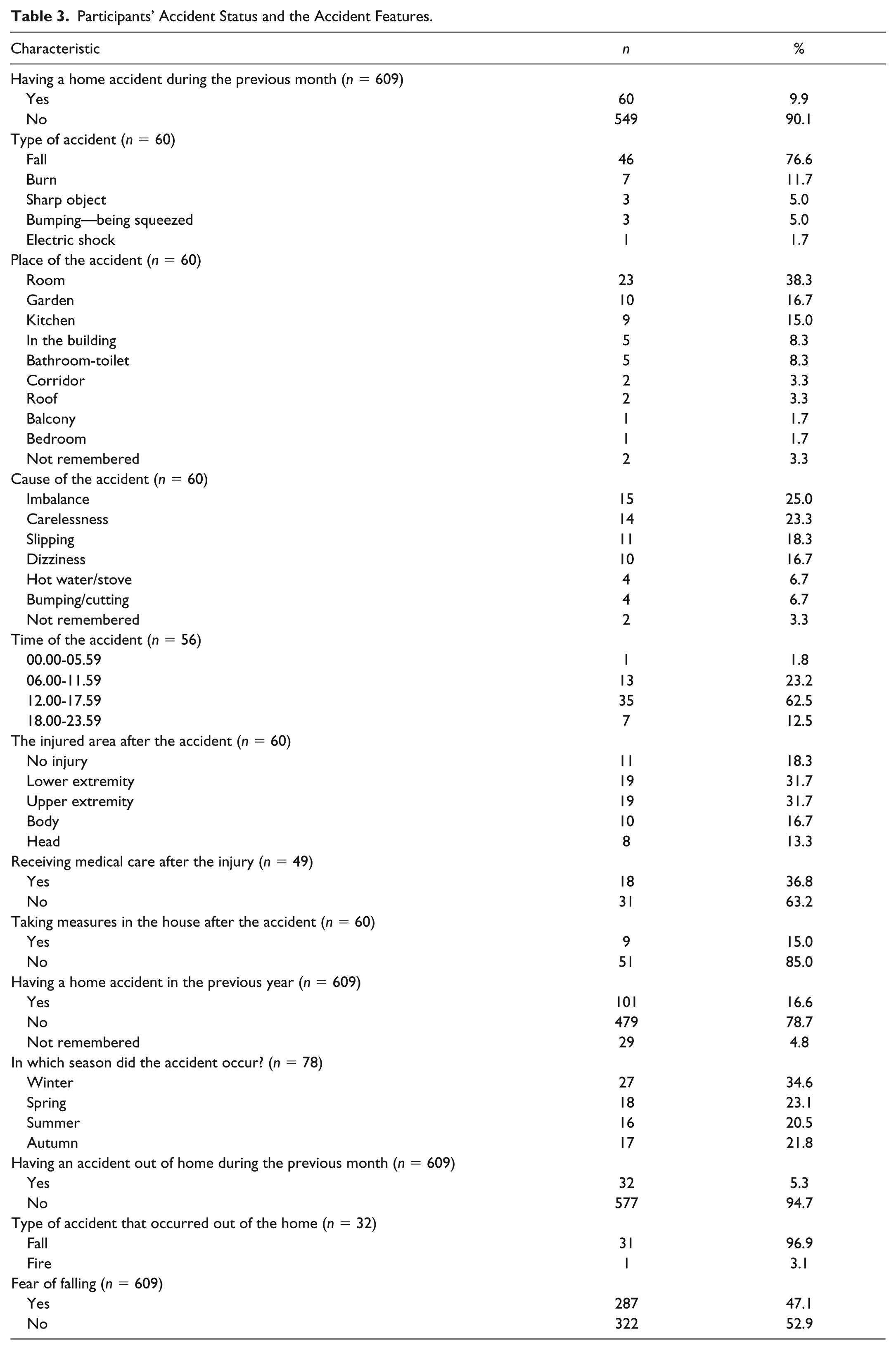
Of the participants, 60 (9.9%) had a home accident in the previous month and the most commonly reported type of accident was falling (76.6%). Of the elderly people who had a home accident, eight (13.3%) had another accident (1-4 times) (Table 3). The information about the accident and the accident-related status of the participants are shown in Table 3.
Participants’ Accident Status and the Accident Features.
The univariate analyses showed that female and single participants had home accidents more frequently in the previous month. The participants with an education level of high school and university had home accidents less frequently than those with lower education levels. The participants who lived alone or with their children had home accidents more frequently than the other participants did. The frequency of having home accidents was higher among the participants who reported a poor health status, who had visual or hearing impairment or balance disorder, and who used two or more medicines. The participants who stated that their children did not visit them had home accidents more frequently than those who were visited. In addition, the frequency of having home accidents was higher among the participants who did housework and cooked meals by themselves. The researchers found that the participants who had a home accident in the previous month had another accident out of home. The frequency of having a home accident increased with age (Table 4).
Factors Related to Home Accidents During the Previous Month.

Characteristic that caused a significant difference.
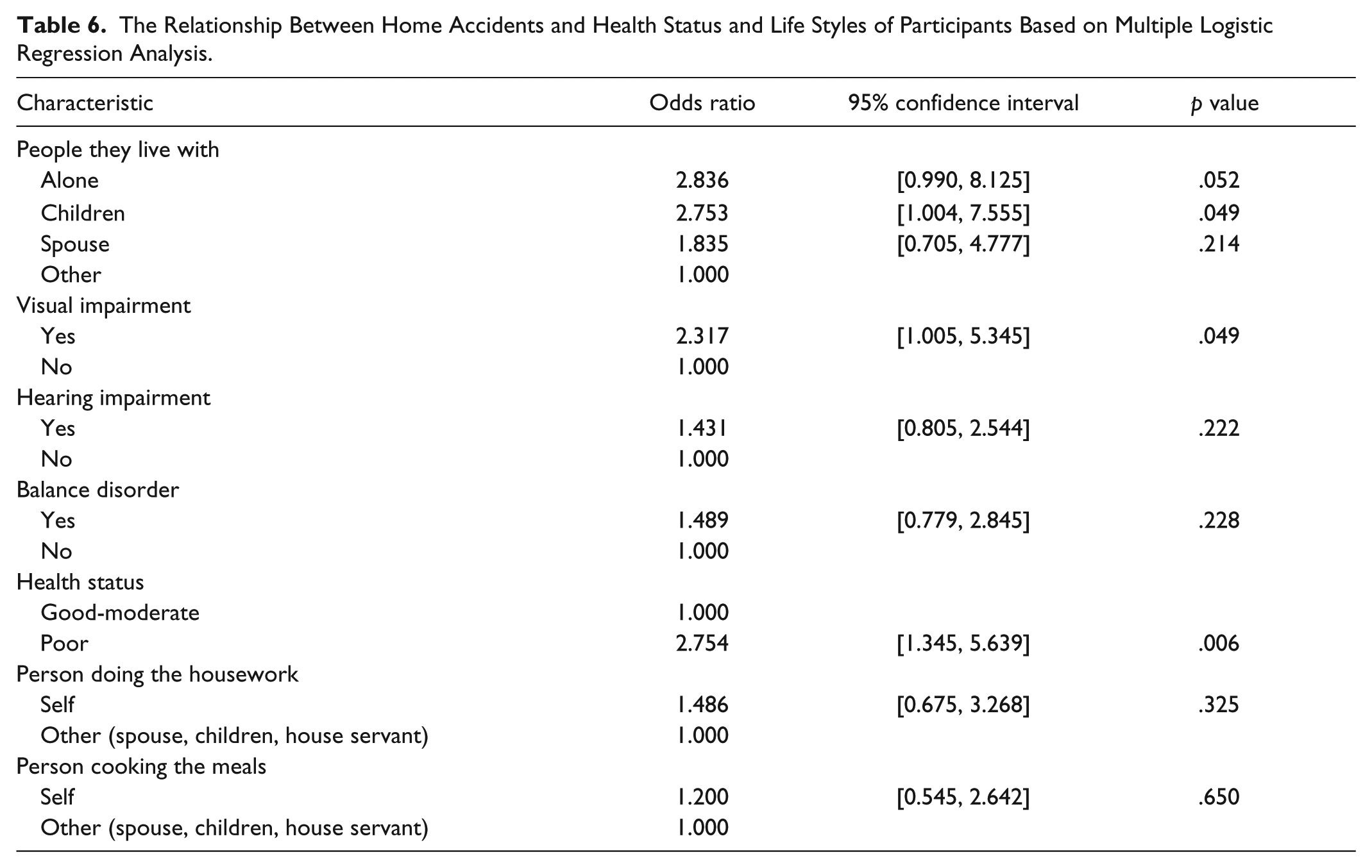
Individual factors with p value of <.05 were then included in the multiple logistic regression analysis to determine the factors independently associated with home accident (Table 4). Being a woman, having a poor health condition, having a vision defect, living with children, and increase in age were risk factors for home accidents (Tables 5 and 6).
The Relationship Between Home Accidents and Sociodemographic Characteristics Based on Multiple Logistic Regression Analysis.

The Relationship Between Home Accidents and Health Status and Life Styles of Participants Based on Multiple Logistic Regression Analysis.
Discussion
This study showed that one out of 10 elderly people living in Mersin had a home accident during the previous month. Studies showing the prevalence of home accidents among elderly people in various cities in Turkey assess accidents that occur over different time intervals. No studies have shown the prevalence of home accidents during the previous month in Turkey. The studies investigating 3 months or longer periods have reported the home accidents rates of between 23.7% and 59.4% (Atman et al., 2007; Erkal, 2005; Keskinoğlu, Giray, et al., 2004; Keskinoglu, Picakciefe, et al., 2008; Şahbaz & Tel, 2006; Şahin & Erkal, 2016; Tortumluoğlu et al., 2005). A study by Carter et al. (2000) indicated a higher prevalence (15.3%) of home accidents in the previous month than the prevalence found in the present study (Prato et al., 2017; Rizawati & Mas Ayu, 2008). Both in the present study and in the literature, the incidence of accidents to older people was learned based on self-report. People may not remember the accidents they had in detail due to their advanced age. Therefore, in this study, the researchers carried out a detailed analysis regarding the home accidents that the participants had during the previous month as well as asked the participants if they had an accident in previous years.
Our study was carried out during spring season (March-May). If the study had been done during winter time, we could expect to see more of the falls and burn accidents due to slippery surfaces in garden, lack of light due to shorter day time, uncomfortable to perform functional activities, and wearing thick clothes or footwear in the house or use of the stove to warm up.
In this study, accidents more frequently occurred in living rooms. Atman et al. (2007) reported similar results to those of the present study. Older people spend most of their time in the living room during the day, hence, home accidents are seen more frequently in these places. The second most frequent place of accident was determined as garden. The activities in the garden may cause the elderly to fall or cause a sharp injury. In many studies (Erkal, 2005; Şahin & Erkal, 2016; Tortumluoğlu et al., 2005), most of the household accidents are seen in the kitchen, but in our study, kitchen was identified by taking the third place where accidents occurred.
In the present study, three fourths of the elderly people who had a home accident fell. Previous studies also reported that falling was the most frequently observed type of accident among elderly people who had a home accident (Atman et al., 2007; Erkal, 2005; Keskinoğlu, Giray, et al., 2004; Keskinoglu, Picakciefe, et al., 2008; Şahbaz & Tel, 2006; Tortumluoğlu et al., 2005). The annual rate of falling is 30% to 40% per person among people aged 65 and older who are healthy and live in society, and the frequency of falling increases with age due to physiological and pathological changes (Ambrosea, Paul, & Hausdorff, 2013; Erkal, 2005; Fuller, 2000; Işık, Cankurtaran, Doruk, & Mas, 2006; Keskinoglu, Picakciefe, et al., 2008; Naharcı & Doruk, 2009; Rao, 2005; Romli et al., 2017; WHO, 2007). This study also showed an increased frequency of home accidents with advanced age, as in the literature (Erkal, 2005; Fuller, 2000; Işık et al., 2006; Keskinoglu et al., 2008; Rao, 2005; Romli et al., 2017). Conversely, Romli et al. (2018) showed that age was inversely associated with the number of hazards. The authors state that the younger older people may be at greater risk of falling because they are more active and want to perform more powerful activities.
This study showed that female participants had home accidents 3 times higher than men. Previous studies also report that women had all type of home accidents and fell at home more frequently (Ambrosea et al., 2013; Atman et al., 2007; Erkal, 2005; Işık et al., 2006; Kaymak Karataş & Maral, 2001; Keskinoğlu, Giray, et al., 2004; Keskinoglu, Picakciefe, et al., 2008; Romli et al., 2017; Şahbaz & Tel, 2006; Şahin & Erkal, 2016; Tortumluoğlu et al., 2005). This result is attributed to women spending more time at home than men and performing housework by themselves.
In this study, it was found that the prevalence of home accidents was 2.7 times higher in the participants who lived with children. Some studies indicate the frequency of having accident is higher among participants who live alone (Atman et al., 2007; Keskinoğlu, Giray, et al., 2004; Romli et al., 2017; Şahin & Erkal, 2016). Tortumluoğlu et al. (2005) reported that those who live with their spouse had accidents more frequently. In Turkish society generally, if one of the spouses died, the other survivor lives with their children. Especially the mothers who live with their children may have accidents more frequently as they undertake both housework and other tasks such as looking after their grandchildren.
In the present study, the prevalence of home accidents was 2.7 times higher in people who reported their health status to be poor. Keskinoğlu, Giray, et al. (2004) also indicated a similar result.
Regular participation in moderate physical activity is important for good health and independent living contributing to lowering risk of accidents. Exercise can improve balance, mobility, and reaction time (WHO, 2007). Also regular health checks of elderly people and treatment or rehabilitation of the identified problems are important to reducing home accidents.
Previous studies report weakened sensory functions facilitate encounters with environmental hazards for elderly people and increase the risk of an accident (Ambrosea et al., 2013; Fuller, 2000; Naharcı & Doruk, 2009; Ping & Xiaohua, 2012; Rao, 2005; Romli et al., 2017). Romli et al. (2018) reported that impaired vision was associated with an increased number of hazards. Similarly, this study showed that home accidents more frequently occurred among elderly people with visual impairments. Environmental factors in the home play an important role in accidents (such as carpets, articles, or toys thrown on the floor, wearing inappropriate shoes). Failure to arrange the house according to the elderly may increase the risk of accidents. In-house arrangements of the elderly should be done to prevent accidents.
Of the participants who had home accidents, 81.7% reported injuries, but only 36.8% received medical care. Of the participants, 92% had social security. The reason for not visiting any health institution might be that the participants had small injuries that can be treated at home. Previous studies reported that fractures or soft tissue injuries, which can be defined as serious injuries, occurred in 10% to 25% of the elderly people who fell (Naharcı & Doruk, 2009). Atman et al. (2007) indicated that half of the participants did not receive any intervention, and 21.3% visited a health institution or asked for help from health care personnel. Şahin and Erkal (2016) reported that approximately half of the participants who had an accident did not refer to any health institution and 76% healed by themselves. Keskinoğlu, Giray, et al. (2004) indicated that 23.5% of the participants who had accidents visited a health institution.
In conclusion, this study showed that home accidents are an important public health problem for the elderly people living in Mersin. It was found that one out of 10 elderly people living in Mersin city center had at least one home accident, and one out of 20 elderly people had at least one accident outside of the home during the previous month. The participants that were female and participants who lived with children had home accidents more frequently. Also people who reported their health status to be poor and having visual impairment increased the risk of home accidents. In this study, it was determined that the risk of accidents increased with age. Most of the accidents are preventable through increased awareness and improvements in the home environment. Social services should be developed to ensure that work such as cleaning, laundry, dishwashing, cooking, or shopping are done to facilitate elderly people’s daily life, as well as providing home health care and treatment services. Required arrangements should be made to reduce the risk of home accidents considering the chronic diseases and physical incapabilities that develop due to biological aging. It is thought that giving education to the elderly and the people living with them about home accidents and prevention will be useful in reducing accidents.
Footnotes
Acknowledgements
The authors would like to thank the family physicians and family health staff working for providing the appropriate environment for conducting the questionnaire. In addition, thanks to Samet Gümüşer, Orhan Yetkin, Ömer Koyuncu, Fazıl Koçaş, Fatih Cemal Tekin, Esra Güzel Ersoy, and Okan Bulgan for their assistance with data collection.
Ethical Approval
Ethical approval and official permission were obtained from the Clinical Research Ethics Committee of Mersin University (State the number: 2011/44) and Mersin Provincial Directorate of Health.
Declaration of Conflicting Interests
The author(s) declared no potential conflicts of interest with respect to the research, authorship, and/or publication of this article.
Funding
The author(s) received no financial support for the research, authorship, and/or publication of this article.
