




Abstract
With the breakout of the COVID-19 pandemic, health risks are common, while trepidation over physical harm risks during travel has emerged, notably anti-Asian violence. Tourists tend to avoid traveling, and their perceived risks related to these harms may hinder their travel decision-making. This research aims to explore the inter-relationships among destination image, perceived risk perceptions, and behavioral intention of Chinese international students visiting San Francisco. Drawing from 252 survey responses, findings highlighted that perceived risk did not affect destination image in general; however, the levels of student traveller’s perceived risk influence the destination image’s relationship to behavioral intentions. The group with low perceived risk relies more on their affective image to determine their behavioral intention. Furthermore, this study validated that affective image could serve as the antecedent to cognitive image despite being firmly held as the cognitive image’s consequence. Managerial implications were provided for destination marketers in the post-pandemic era.
Keywords
Introduction
Since early 2020, the COVID-19 pandemic’s prevalent impacts have extended more than 2 years, with new variants such as Delta and Omicron spiking case rates in late 2021 and early 2022 (A. Park, 2022). The tourism industry was greatly affected, and extensive closures of international borders halted inbound tourist arrivals. The UNWTO (2022) reported that international travel in 2020 plunged to 73%, lower than the previous year’s arrivals, while 2021 showed signs of recovery at a 4% increase but remained far below the pre-pandemic levels. Tourism and traveling during the pandemic are considered high-risk activities due to unprecedented public fears (Zheng et al., 2021). Governments of different countries implemented various public health measures and travel restrictions to reduce disease transmission from overseas (Studdert et al., 2020). In response, domestic tourism is foreseen as the main force to resuscitate the tourism economy (OECD, 2020). Many countries provided tourism stimulus packages and travel vouchers to boost the domestic tourism economy to encourage interstate and intrastate tourism activities (see Foo et al., 2021; NSW Government, 2021).
International students have piqued tourism researchers’ interest due to their unique contributions to the economy (M. T. Lin & Liu, 2022), with host countries considering them important stakeholders and benefiting from their expenditure on tourism (King & Gardiner, 2015; Tomasi et al., 2022). International students are considered educational and quasi-domestic tourists (Dey, 2020; K. Li, 2014; Weaver, 2003), while some perceive them as international tourists. This is partly due to the fact that they stay longer as temporary residents of their host countries with different income sources, lifestyles, and financial commitments (Gardiner et al., 2013). In the United States, approximately 914,095 international students were reported to be studying during the 2020 to 2021 academic year, and 317,299 of these students originated from China, making it the largest source country (Open Doors 2021, 2021). International Chinese students are likened to Europe’s 18th-century “Grand Tourists” who travel to enhance their social capital, and they put the same emphasis on traveling and learning Western culture while obtaining western degrees (R. Huang, 2008). Additionally, parental financial support to Chinese international students allows them to travel, especially on school breaks (Ryan & Zhang, 2007). Therefore, the Chinese youth travel market is an important travel segment for their host countries (M. T. Lin & Liu, 2022), representing a profitable target market in destinations (Burt, 2022; M. T. Lin & Liu, 2022).
Despite the ability to travel after pandemic restrictions have gradually eased, several factors still influence student travelers’ destination decisions. For example, destination image plays a crucial role in determining students’ travel decision-making (P. J. Chen & Kerstetter, 1999; Phau et al., 2010), while destination’s reduced safety concerns are a paramount influencer in reaching students’ travel goals (Babin & Kim, 2001). Along with the surge in health risks, anti-Asian violence against Asian descent and Chinese nationals also surged in many parts of the Western world, particularly in metropolitan areas of the United States (Miller, 2022; Wen et al., 2020; J. Xu et al., 2021). Chinese tourists generally perceive U.S. destinations as highly urban, with advanced economies and big cities (X. Li & Stepchenkova, 2012), but traveling to metropolizes during the pandemic may pose potential safety risks, and hazards for Chinese nationals and people with Chinese heritage in the U.S. Increased malicious anti-Asian attacks have prompted Asian-American organizations to share their concerns after the World Health Organization’s official reports on COVID-19 origins, which indicated that virus circulation in Wuhan, China, since late November 2019 (AAPI Equity Alliance, 2021). Without valid scientific proof, the disease has been mistakenly profiled as the “Chinese virus” (Lantz & Wenger, 2023). According to a national survey, about 73% of Asian Americans in the United States feared becoming victims of hate crimes (CBS News SF Bay Area, 2021). The increased incidents have prompted the Chinese government to issue warning advisories for citizens living overseas to pay close attention to their safety (Reuters, 2022). Chinese students’ perceived risks have been exacerbated by news reports on both hate crimes and health risks during the pandemic (Shi, 2021; Wen et al., 2020), triggering the public’s negative risk perception and negative image perceptions toward destinations (Rittichainuwat, 2006; Shi, 2021). Therefore, by the same token, the danger of hate crimes can strongly influence students’ destination perceptions and decision-making (J. Xu et al., 2021; Y. Xu et al., 2021).
Despite the increasing literature on the relationship between behavioral intentions and perceived risk perception, there is a limited discourse on perceived risks on destination image and travel behavioral intentions during the COVID-19 pandemic. Along with the health risks, the pandemic also posed an emerging travel risk in the presence of hate crimes, and few studies, if none, have discussed its ramification on tourism. Moreover, studies related to international students’ risk perceptions are often neglected (Deng & Ritchie, 2018), and often, educational tourists (students) are excluded as tourists due to their long duration in the host countries (R. Huang, 2008; S. Huang & Gross, 2010). As international tourists are considered a source of destination referrals (R. Huang & Tian, 2013), understanding the impact of risk perceptions on the students’ destination image and behavioral intention can convey important marketing messages for destination management organizations (DMOs).
The present study attempts to fill in these research gaps and explore the inter-relationships among destination image perceptions, perceived risk perceptions, and behavioral intention within the context of Chinese international student travelers during the pandemic, as justified by the abovementioned characteristics. This research seeks to answer the main research question: will students’ perceived risk affect their destination image perceptions and behavioral intention? This research aims to: (1) propose a theoretical framework for understanding the inter-relationships among perceived risk perceptions associated with COVID-19 and anti-Asian hate violence, destination image, and behavioral intention in the context of Chinese international students; (2) probe whether students’ levels of perceived risk will alter their destination image perceptions and behaviors, and (3) provide managerial implications for marketers to comprehend better this consumer segment’s mindset and travel behavior.
The next section provides a literature review and the hypotheses development. The outline of the methodology, presentation of findings, and discussion of implications, limitations, and future studies follow. The last section concludes the study.
Literature Review
Destination Image Components and Their Relationships
Destination image is described as individuals’ beliefs, feelings, and multi-sensory representations of a travel destination (Son & Pearce, 2005). Tourists heavily rely on extrinsic cues of a destination when making destination choices (S. H. Park et al., 2017). A destination image is a multi-dimensional construct with interrelated components determining a destination’s characteristics (Gartner, 1994). Prior research has identified bi-dimensional models of cognitive and affective images to capture destination images (Baloglu & McCleary, 1999; Martín & Bosque, 2008). Cognitive destination image refers to the physical destination features and elements that attract tourists (Baloglu & McClearly, 1999; Wang & Hsu, 2010), including climate, infrastructure, and accommodation facilities (Gertner, 2010). On the other hand, affective destination images refer to the tourist’s general feelings and emotions related to destinations (Tan & Wu, 2016). A tourist’s evaluation of a destination is usually emotional and subjective (Song et al., 2013); the more appealing the destination, the better and higher the affective evaluation of the destination (Sahin & Baloglu, 2011).
In addition to the cognitive and affective destination image, some scholars have proposed the concept of overall destination image (Beerli & Martín , 2004; Wang & Hsu, 2010). The overall destination image can be evaluated positively or negatively according to the attributes engendered by the destination (Baloglu & McCleary, 1999). Empirical research has also shown that the cognitive and affective image perceived by tourists can positively influence the overall destination image (C. H. Lin et al., 2007; P. Sharma & Nayak, 2019). Accordingly, the following hypotheses were proposed:
The theoretical consensus was established that cognitive destination image is the antecedent of affective destination image (Agapito et al., 2013; Baloglu & McCleary, 1999). However, the relationship between cognitive and affective destination images can be bi-directional rather than uni-directional causation (Ko & Park, 2000). For instance, Zajonc (1980) stated that affect and cognition are partially independent and separate systems that can influence each other. A tourist’s first emotional response to a destination may be affective (Woosnam et al., 2020). Affect may precede cognition since the affective system can facilitate individuals’ decision-making by filtering and organizing future information before one’s decisions (Walls et al., 2011). Hence, this study hypothesized:
Destination Image and Behavioral Intention
Prior research held that destination images influence tourism decision-making (C. F. Chen & Tsai, 2007; Tasci & Gartner, 2007), and it can result in a positive evaluation and likelihood of visitation (Wang & Hsu, 2010). S. H. Park et al. (2017) revealed that the destination image of Japan could influence Chinese college students’ visit intention to the country. A similar result is echoed in the research of Irfan et al. (2022), finding that the country’s image can influence consumers’ purchase decisions. A meta-analysis study conducted by Afshardoost and Eshaghi (2020), which synthesized 87 papers, found that different components of destination image played a significant role in predicting tourists’ travel behavior, particularly in travel intentions.
Previous studies have validated that affective and cognitive images can influence tourists’ visit intention (Noh & Vogt, 2013; Tan & Wu, 2016), while attitudinal affect and cognition contributes to tourists’ travel motivation (Gnoth, 1997). However, the ability of cognitive and affective images to predict destination visit intention has remained inconsistent (Woosnam et al., 2020). For instance, M. Li et al. (2010) found that only affective destination image had a causal relationship with tourists’ revisit intention rather than cognitive destination image. Nevertheless, Tan and Wu (2016) found that tourists’ future visit intention is first influenced by cognitive aspects and subsequently by the tourists’ affective feelings. More research is warranted to investigate the predictability of cognitive and affective destination images on tourists’ travel behavioral intention. The following hypotheses were formulated:
The overall destination image is a combination of cognitive and affective images that serves as a strong proxy to capture the destination image (Beerli & Martín, 2004). The overall destination image can directly influence tourists’ future behavioral intentions, destination preferences, and loyalty (Baloglu et al., 2014; C. H. Lin et al., 2007; Zhang et al., 2014). However, previous literature has not thoroughly substantiated the impact of overall destination image on tourists’ travel intention. Wang and Hsu (2010) found only an indirect influence of overall destination image on behavioral intention, while Baloglu et al. (2014) found that U.S. tourists’ perception of Jamaica’s overall destination image could positively influence their behavioral intention. Based on the above evidence, the following hypothesis is formulated:
Previous research revealed that overall image could play a mediating role between attitudes and behavioral intention in a study conducted among hotel consumers by H. Han et al. (2009). In the same vein, the overall destination image may mediate the relationships between tourists’ cognitive and affective destination image on behavioral intention. Hanzaee and Saeedi (2011) discovered that tourists’ overall destination image mediates the relationship between destination brand image and tourists’ behavioral intention. Therefore, the following hypothesis is proposed:
Perceived Risk Perception on Destination Image and Behavioral Intention
Perceived risk is critical in shaping travelers’ decision-making (Hsieh et al., 2016; Qi et al., 2009). Perceived risk refers to the likelihood of an event occurring if the danger is beyond one’s ability to control and influence tourists’ travel decisions (Mansfeld, 2006). “The negative outcomes associated with perceived risk are the barriers that obstruct consumers’ decision-making (D. J. Kim et al., 2008); influence tourist destination selection (J. Y. Han, 2005); and unsafe destinations affect intentions to return and recommend (George, 2003). Hsieh et al. (2016) further illustrate that when tourists’ perceived risk increases, their travel intention will decrease accordingly.
Perceived risk can be divided into different dimensions. Dolnicar (2005) categorized young travelers’ perceived risks into political, environmental, health, planning, and property risks. Health risk refers to the possibility that tourists become sick or contract life-threatening diseases (Dolnicar, 2005; Sönmez & Graefe, 1998), which is considered the most significant concern during trips (Deng & Ritchie, 2018; Dolnicar, 2007; Reisinger & Mavondo, 2006). Chua et al. (2021) found that the COVID-19 pandemic significantly influenced tourists’ perceived risk and mental well-being, inducing uncertainty in travel decision-making. Famous tourist destinations were perceived as risky sites regarding the active spread of COVID-19 (Zaman et al., 2022). In a recent study, Zheng et al. (2021) found that the COVID pandemic triggers Chinese tourists’ protective motivation and fear of the possibility of getting infected.
Physical risks, the possibility that travelers are exposed to the danger of injury, crime, and violence (Roehl & Fesenmaier, 1992; Sönmez & Grafe, 1998), can also potentially deter tourists from visiting a destination. Reichel et al. (2007) found that physical harm is one of the apparent destination risk factors among student backpackers. Floyd et al. (2004) studied people’s perceived risk perception in the aftermath of September 11 and found that people with safety concerns were less willing to travel within a year. Anti-Asian hate violence is categorized as a physical risk since many anti-Asian incidents entail physical assaults in public spaces (Lantz & Wenger, 2023). Reisinger and Crotts (2009) also discovered that tourists’ health and terrorism risks were closely associated with their safety concerns and travel anxiety. Research has also shown that a destination’s potential travel risks can create adverse image perceptions toward the destination (Becken et al., 2016; Kozak et al., 2007; Law, 2006). In turn, perceived risks could change tourists’ cognitive and affective appraisal of a destination and travel intentions (Khan et al., 2017; Noh & Vogt, 2013). Based on the review, the following hypotheses were proposed:
Individuals’ levels of risk perceptions differ based on their respective interests and concerns about a destination (Cheron & Ritchie, 1982). Previous research indicated that consumers’ perceived risk could be a moderator among various variables, such as satisfaction and willingness to pay, tourists’ perceived crowding and revisit intention (Casidy & Wymer, 2016; Yin, 2020). Consumers with lower perceived risk tend to have higher behavioral intentions than those with higher perceived risk. For example, consumers tend to cancel or change their travel plans once the perceived travel risks of COVID-19 increase (Minh & Mai, 2021). Tavitiyaman and Qu (2013) found that tourists with lower risks of the tsunami and SARS outbreaks had better image perceptions regarding travel satisfaction and behavioral intention than individuals with higher perceived risks.
Furthermore, Law (2006) suggested that travelers with lower risks have a higher travel preference than travelers with higher risks. Based on the abovementioned evidence, this study postulates that students with lower perceived risks may achieve different predictive results regarding the relationships between destination image and behavioral intention than students with higher perceived risks. Thus, it was hypothesized as follows (Figure 1):

Conceptual model.
Methodology
Study Context
The context selected for this research is San Francisco Bay Area, California, based on the following characteristics. Firstly, San Francisco is a popular tourist destination in California; and is one of the favorite destinations among Chinese tourists (China Daily, 2015; Qu & Im, 2002). Secondly, along with New York, San Franciso is one of the early epicenters of COVID-19 cases and early implementers of aggressive pandemic measures in the United States (Studdert et al., 2020). Lastly, San Franciso is reported to have a high frequency of anti-Asian incidents and violence during the pandemic (Fuller, 2021). Therefore, traveling to the San Francisco metropolis may pose certain risks for Chinese international students.
Measures
The constructs for this research were measured on the seven-point Likert scale, regarded as informative, precise, and highly acceptable for social studies (Alwin, 1997; Spector, 1992). The cognitive destination image measure was adopted from S. H. Park et al. (2017) to measure students’ cognitive image of San Francisco. The measure was adopted to suit the context; for example, “San Francisco has good quality of life; San Francisco has a prosperous tourism infrastructure, and San Francisco is a good place for shopping.” Respondents were asked about their level of agreement from 1 (strongly disagree) to 7 (strongly agree) with six items.
The affective destination image measure was adopted from Song et al. (2013) to measure students’ affective feelings toward San Francisco. Respondents were asked about their level of agreement from 1 (strongly disagree) to 7 (strongly agree) with five items (i.e., “San Francisco is a pleasant place, an arousing place; an exciting place; a relaxing place, and the tour makes me feel relaxed”).
The overall destination image scales were adopted from C. H. Lin et al. (2007) and Wang and Hsu (2010). Respondents were asked to indicate their overall perceptions of San Francisco via two items (i.e., “ San Francisco’s overall image is…”) using a seven-point Likert scale from 1 (strongly negative) to 7 (strongly positive).
Regarding student travelers’ perceived risks related to COVID-19 risks such as health risks and anti-Asian hate violence, four items were adapted from previous studies (Hsieh et al., 2016; Tavitiyaman & Qu, 2013) and were modified to fit the research context. For example, “Given the risks of being exposed to COVID-19, travelling to San Francisco is., Given the potential anti-Asian hate violence has happened in the U.S., travelling to San Francisco is.” Respondents were asked to indicate their levels of risk perception from 1 (extremely low risk) to 7 (extremely high risk). Since this study mainly concerns respondents’ health and physical risks, other perceived risks (i.e., political, environmental, and financial) were not included.
The behavioral intention was measured by four items adopted from S. H. Park et al. (2017), asking respondents’ likelihood to visit and recommend San Fransisco to others from 1 (very unlikely) to 7 (very likely). Items include “I intend to make time and save money to travel to San Francisco within 24 months, and I am willing to recommend San Francisco to others.”
Procedure
This research utilized an online survey to capture the students’ risk perception of traveling during COVID-19 pandemic, despite an initial plan of conducting a face-to-face intercept survey. During the full-scale data collection period, which is between December 2021 and January 2022, cases of COVID-19 have surged in the United States, and any outdoor activities bear the risk of contracting COVID-19; hence, an online survey posed as an alternative method to capture respondents’ perceptions which are not easily observed (Creswell & Creswell, 2017). The questionnaire was presented in English and contained several components, respondents’ perceptions of cognitive destination image, affective destination image, and overall destination image of San Francisco. Subsequently, respondents were asked to rate their perceived risks and likelihood of visiting the destination. Demographics and general questions were asked toward the end of the survey.
The data collection process began with creating and programming the online questionnaire through wjx.cn, a popular Chinese survey site (Miao et al., 2020). Before launching the full-scale data collection, a pilot test was conducted at a U.S. southwestern University with 30 Chinese university students to ensure the accuracy of the measurement items. The questionnaire was reworded and revised to improve face and content validity based on the pilot testing. The online survey program generated a survey link distributed electronically through WeChat, a social networking application in China, to the screened respondents. Subsequently, each respondent forwarded the survey link to other potential participants. Participation in the study was voluntary, and respondents’ information was kept confidential. However, participants opt to receive a 2 RMB WeChat Red Packet (an e-currency utilized in China) as an incentive after completing the survey.
Sampling
For this research, prospective respondents were screened using three criteria: (a) mainland Chinese nationals currently holding international student visas living in the USA for their study, (b) currently enrolled in U.S. institutions, and (c) have experienced traveling domestically within the United States. The sample was recruited using a non-probability purposive sampling technique to obtain target respondents who were willing and available during the given time (Etikan et al., 2016). More specifically, snowball sampling was employed to recruit respondents. Although non-probability sampling can lead to limited generalizability, it fits the scope of this study since snowball sampling is useful to secure a list of the unknown population (Daniel, 2011).
Using the WeChat application, an invitation to participate in the study by answering a survey was initially forwarded to one of the authors’ peers who qualified for the respondent’s criteria. The first batch of respondents then further distributed the invitation among their peers. Willing potential respondents were screened to match the criteria. After filtering two unusable data (i.e., straight-lining answers), a total of 252 usable and completed questionnaires were retained, which is adequate for Partial Least Square (PLS-SEM) analysis.
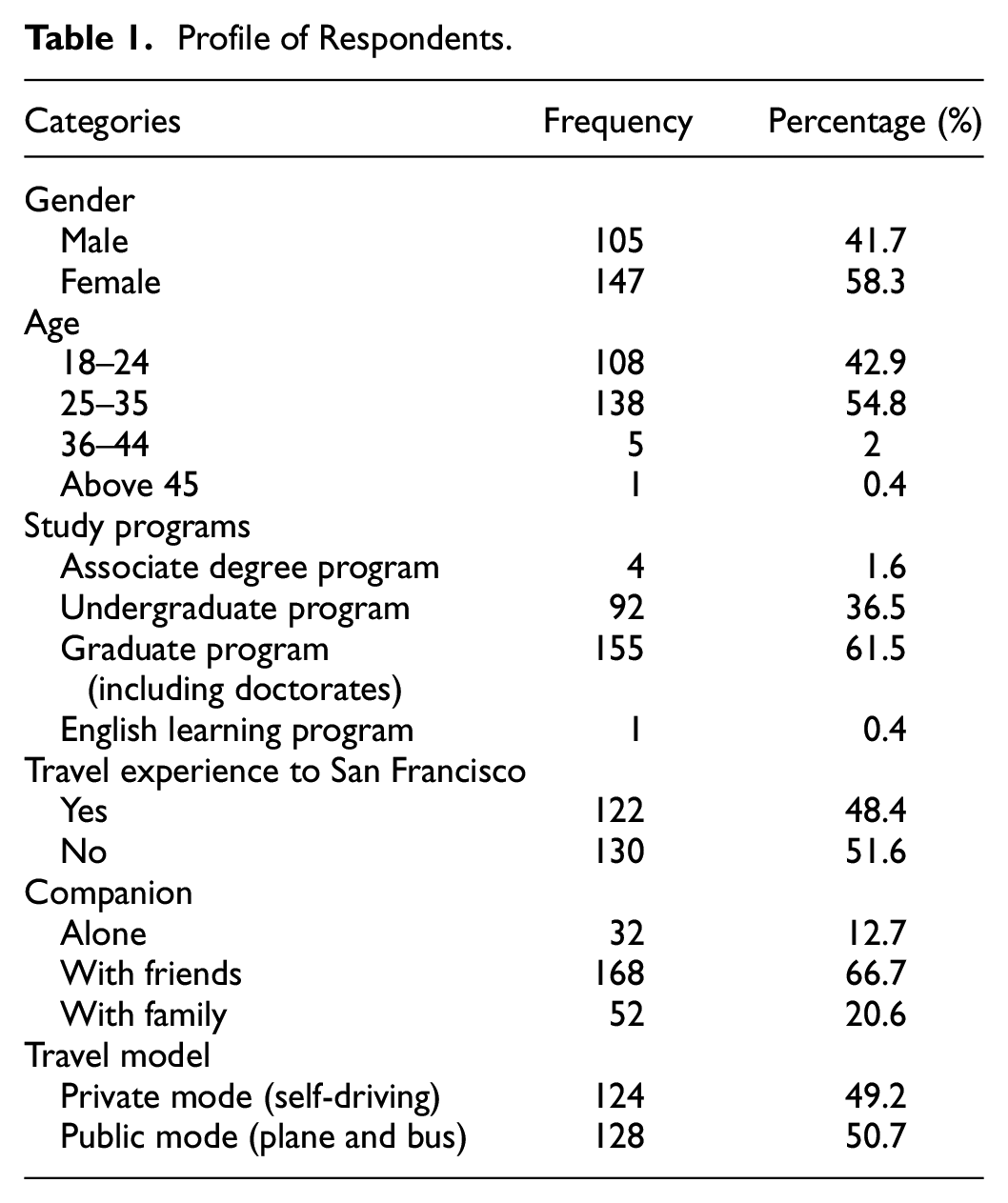
Of the 252 respondents, 58.3% accounted for females (n = 147), 54.8% were between 25 and 35 years old (n = 138), and 61.5% were enrolled in post-graduate programs (n = 155). About 48.4% of the respondents (n = 122) had previous travel experiences in San Francisco. Around 50.7% of the respondents preferred self-driving (n = 124), and 47.2% preferred taking the plane (n = 128) as their preferred mode of travel. Furthermore, 66.7% of respondents preferred to travel with friends (n = 168), while only 12.7% preferred to travel alone (n = 32). Among respondents with travel experiences (n = 134), 78.4% (n = 105) traveled two nights and 3 days more. The respondents’ demographic information is presented in Table 1.
Profile of Respondents.
Common Method Bias
To minimize response bias, the questionnaire was carefully worded, reviewed, and revised repetitively. Respondents’ identities were kept confidential and anonymous to reduce the comprehension of responding to survey items (Chang et al., 2010). Since the data collection made use of a single source, common method bias was assessed using Harman’s single-factor approach (Podsakoff & Organ, 1986). Factor analysis via principal component analysis showed a 40.34% variance for the first factor, which is below the cut-off of 50% (Harman, 1976). Hence, the common method bias was not detected in this study.
Findings
Measurement Model Evaluation
A confirmatory factor analysis (CFA) was conducted using a maximum likelihood approach to assess the measurement model’s overall model fit. The model fit for the conceptual model has reached an acceptable level with SRMR at 0.06, less than the cut-off value of 0.08 (Hu & Bentler, 1999). Table 2 shows the mean, standard deviation (SD), and factor loadings for each measurement item in the study. Factor loadings of the measurement items were all above the required threshold at 0.7 (Chin, 2010), ranging from 0.72 to 0.98. Cronbach’s α and composite reliability (CR) all exceeded .7, demonstrating reliability for the constructs (Nunally & Bernstein, 1994). Moreover, the average variance extracted (AVE) exceeded the cut-off threshold at .5, demonstrating convergent validity of the internal relationships for a given factor (Hair et al., 2019). Furthermore, discriminant validity was accessed by the Fornell-Larcker criteria, confirming that the squared value of AVE for each construct was more significant than any correlations between the variables (Fornell & Larcker, 1981). See Table 3, which depicts the constructs’ reliability, validity, and correlations.
Mean, Standard Deviation, and Factor Loadings of Measurement Items.

Reliability, Validity, and Correlations.

Note. The bold and italic values represent the square root of AVE for the discriminant validity.
Hypotheses Testing
The PLS-SEM was conducted to examine hypotheses and test the proposed relationships using Smart PLS 3.3, a common tool for prediction-driven tourism and hospitality research studies. Compared with covariance-based SEM, PLS-SEM can produce valid results with a small sample size (Rasoolimanesh & Ali, 2018). To calculate the minimum sample size for PLS-SEM analysis, G*Power 3.1.9 software was utilized (Ringle et al., 2014). As a result, the results of G*Power recommended a sample of 170 as the minimum sample size for this study’s model to achieve a statistical power of 0.8 (Ringle et al., 2014). Hence, the sample in this study has achieved adequate statistical power.
The results of the PLS-SEM analysis are shown in Table 4 and Figure 2. Bootstrapping with 1,000 samples was utilized to test the significance of the hypotheses. A t-value greater than 1.96 indicates the significance of a hypothesized path (Hair et al., 2020). Proposed hypotheses in this research projected that cognitive destination image (H1) and affective image (H2) positively influence the overall destination image. Results indicated that cognitive destination image with β = .18 at p < .05 and affective destination image with β = .54 at p < .001 both positively and significantly influence the overall destination image, consequently supporting H1 and H2. Additionally, results strongly supported H3, which proposes that affective destination image positively influenced cognitive destination image with β = .72 at p < .001.
The Results of the Hypothesized Path (H1–H6; H8–H11).

p < .05. **p < .01. ***p < .001.

Results of PLS-SEM analysis.
H4, H5, and H6 propose that behavioral intention is influenced by cognitive destination image, affective destination image and overall destination image, respectively. Results found that cognitive destination image had an insignificant effect on overall destination image with β = .01, at p = .94; thus, H4 was not supported. Moreover, behavioral intention is positively and significantly influenced by affective destination image with β = .28 at p < .05; and overall destination image with β = .21 at p < 0.01, supporting H5 and H6.
This research proposes that perceived risk will negatively influence student’s influences students’ perceptions of the cognitive destination image (H8) and affective destination (H9) of San Francisco. The results showed that perceived risk posed to have positive effects instead of negative effects, cognitive destination image with β = .09 at p = .04, and affective destination image with β = .16, at p = .03; hence, H8 and H9 were not supported. In terms of respondents’ perceived risk negatively influenced students’ overall destination image perceptions toward San Francisco (H10) and travel intention (H11), the results supported both hypotheses showing negative and significant relationships with β = −.10 at p < .05 and β = −.14 at p < .05, respectively.
Mediation Analysis
The Sobel (1982) test was used to examine the mediation effects of cognitive and affective destination image on behavioral intention through overall destination image (Table 5). A mediation effect is present when the indirect effect between the predictor and dependent variables is significant by the Sobel Z test (Baron & Kenny, 1986). The absolute value of the Sobel Z test score greater than 1.96 indicates a significant mediating effect at α = .05 (Baron & Kenny, 1986). For cognitive destination image, the indirect effect was statistically non-significant with Z value of 1.59. Therefore, overall destination image cannot indirectly affect cognitive destination image and behavioral intention. However, the indirect effect was statistically significant for the affective destination image with Z value of 2.48. Thus, overall destination image partially mediated affective destination image on behavioral intention due to the positive relationship between affective destination image and behavioral intention. Thus, the result of the mediation analysis partially supported H7.
Mediation Analysis: Sobel Test Result.

p < .05.
Multi-Group Analysis: Low and High Perceived Risk Groups
As a post-hoc analysis, a multi-group analysis (MGA) was conducted to analyze further whether the levels of perceived risk can influence students’ image perceptions and behavioral intention to any extent. The sample was divided into low and high-perceived-risk groups. The median split method was used to determine the grouping (Iacobucci et al., 2015). The mean score of the four perceived risk items (based on the seven-point Likert scale) was first calculated to determine the median score. Then, the median score (5.5) was used as the dividing point to categorize the sample into low and high-perceived-risk groups. The mean of the low-perceived-risk group (n = 147) and high-perceived-risk group (n = 105) were 4.47 and 6.26, respectively. MGA was conducted to measure the conceptual framework’s configural differences by comparing the proposed variables’ parameter estimates and directional paths. The structural model with path coefficients for low and high perceived groups are depicted in Figures 3 and 4, respectively. According to the result, the significance of the path coefficients was not the same for the two groups. For low perceived risk groups, both cognitive (β = .22, p < .05) and affective destination (β = .54, p < .001) images positively influenced overall destination image; affective destination image positively influenced cognitive destination image (β = .72, p < .001) and behavioral intention (β = .27, p < .05). However, cognitive destination image (β = .07, p = .56) and overall destination image (β = .15, p = .10) did not significantly affect behavioral intention.

Structural model for the high-perceived risk group.

Structural model for the low-perceived risk group.
In contrast with the low perceived risk group, only two hypothesized paths were significant for the group with high perceived risk. Affective destination image positively influenced cognitive destination image (β = .77, p < .001) and overall destination image (β = .50, p < .001). Neither cognitive destination image (β = −.11, p = .50) nor affective destination image (β = .29, p = .09) influenced people’s behavioral intention. The cognitive destination image did not influence the overall image (β = .12, p = .48). Moreover, overall destination image did not significantly influence behavioral intention (β = .29, p = .06).
Through comparison, there was an apparent difference between low and high-perceived-risk groups regarding parameter estimates and the significance of the hypothesized paths. The comparison of parameter estimates between the two groups is considered a special case of moderating effects (Henseler & Fassot, 2010). Therefore, H12 was supported. For the group with low perceived risk, student tourists’ perceptions of affective destination image could influence their behavioral intention; cognitive and affective destination images can form international students’ overall destination image perception of San Francisco. On the other hand, for the group with high perceived risk, the affective destination was not a significant predictor of behavioral intention. Yet, their cognitive destination image could not form this group’s overall destination image perception of San Francisco.
Discussion
This study aims to ascertain the inter-relationships among perceived risk perceptions associated with COVID-19 and anti-Asian hate violence, destination image constructs, and behavioral intention in a conceptual model to understand better Chinese international students’ travel decision-making in the U.S. The objectives of this study were all achieved. Subsequently, this study conducted a multi-group analysis to test how perceived risk plays a role in determining tourists’ destination image perceptions and behavioral intention. The findings revealed that individuals with higher perceived risk are less likely to use destination images to influence their travel decisions. This result is consistent with a recently published study by Chi et al. (2022), which demonstrated that consumers’ higher COVID-19 risk perceptions could increase their hesitation in travel planning. Chinese international students’ hesitancy may be compounded by the potential anti-Asian violence. Examining tourists’ destination image through risk perceptions can add substantial value to understanding the linkage between these concepts (Becken et al., 2016).
One of the findings in this research is the influence of affective image on cognitive destination image, despite the commonly held beliefs that cognitive destination image is the antecedent of affective destination image (Beerli & Martín, 2004; C. H. Lin et al., 2007). Conventional beliefs indicate that affective image is based on cognitive image; however, the affective reaction is the very first reaction that may be independent of individuals’ cognition (Zajonc, 1980). Individuals’ emotional experiences can influence their mental pictures (Nyer, 1997), and their emotional feelings can influence objective attributes of the cognitive image (P. Sharma & Nayak, 2019).
Moreover, in line with prior studies (C. H. Lin et al., 2007; Wang & Hsu, 2010), this study validated that cognitive destination and affective destination images can form overall destination images. Combining cognitive and affective images can reveal San Francisco’s complete destination image (Hoang, 2016). This study also revealed that overall destination image can positively influence behavioral intention and mediates the effect of affective destination image on behavioral intention. Thus, overall destination image as the third component of a destination image intervening with tourists’ behavioral intention should be recognized. This finding supports Chi and Qu (2008) that the overall destination image of a destination can affect tourists’ destination selection, evaluation, and future travel intentions.
Unlike many previous studies (Beerli & Martín, 2004), this study found that affective destination image positively relates to behavioral intention rather than cognitive destination image. This result aligns with M. Li et al. (2010). Affective destination image is tourists’ first automatic reaction to travel decisions (Walls et al., 2011). A positive affective association with the destination can stimulate travelers to visit the destination; in contrast, a negative affective association deters visit intention (Woodside & Lysonski, 1989). The direct effect of cognitive destination image on behavioral intention is non-significant. The result of a non-significant relationship may be due to the mediating effect of the overall destination image that reduces the strength of cognitive destination image. It can be explained that tourists’ affective emotions are more important in evaluating destinations than their cognitions (S. Kim &Yoon, 2003). The results of the multi-group analysis further revealed that cognitive destination had no effects on behavioral intention in either low or high-perceived groups. However, individuals with lower perceived risk tend to rely more on their affective evaluations to determine their behavioral intention than those with higher perceived risk. Hence, this current study signals that affective destination image may be more important than cognitive destination image in determining educational tourists’ travel decision-making, especially when those tourists are not risk-averse traveling to a destination laden with risks.
The study results showed that perceived risk could negatively impact students’ behavioral intentions, which is in line with the findings of Qi et al. (2009). When potential risks are presented, tourists cognitively evaluate the likelihood and severity of exposure and their ability to handle the situation (Qi et al., 2009). This result is also consistent with Mitchell (1999) that consumers’ purchase intention and perceived risk are negatively related. However, contrary to Khan et al. (2017) and Noh et al. (2013), the study results revealed that perceived risk could not negatively influence the cognitive and affective destination image. One possible explanation is that students’ impressions of San Francisco may have already been formed through external information sources before the global pandemic and hate crime incidents. Establishing a tourism destination image requires a long-term and stable process, and tourists’ destination perceptions may not be easily altered by short-term stimulation (Hao et al., 2019).
Moreover, tourists’ destination image can only change slowly over time and tend to have resiliency during a crisis (Nadeau et al., 2022). Therefore, Chinese international students’ specific perceptions of the tangible and psychological aspects of San Francisco’s destination image may not be easily altered directly by incidents reported on the news. This result may suggest that despite a destination laden with potential risks, the image of a destination can still be perceived positively by tourists; however, they may not necessarily set out their foot to visit the destination at the time being if they feel threatened by the perceived risks (George, 2003; Noh & Vogt, 2013). This study’s authors argued that Chinese students’ risk perceptions may tarnish San Francisco’s reputation as a safe metropolis to live in or travel to but may not necessarily hinder its image as a tourism destination. San Francisco’s tourism and scenic spots are generally rated positively and exceed Asian tourists’ expectations (Qu & Im, 2002); hence San Francisco’s destination image remains stable.
Theoretical Implications
This research has theoretical implications. Firstly, this research contributes to the literature by incorporating cognitive, affective, and overall destination images and perceived risk simultaneously in the same conceptual framework, which was not carried out by many studies (Noh & Vogt, 2013; Promsivapallop & Kannaovakun, 2017). Second, this research has empirically corroborated that affective image can also strongly influence cognitive destination image, despite the commonly held beliefs that cognitive destination image is the antecedent of affective destination image (Beerli & Martín, 2004; C. H. Lin et al., 2007). To the authors’ knowledge, no research has investigated the reversal effect of affective destination image on cognitive destination. This study provides a starting point for future research to validate further the directional relationship between affective destination image and cognitive destination image.
Practical Implications
Safety concerns are damaging to a tourism destination (George, 2003). The continued impact of COVID-19 virus variants and anti-Asian violence in the U.S. metropolitan areas can still pose potential risks for certain groups of tourists. Incidents directed at Asians during the pandemic have occurred in many U.S. cities, including San Francisco, Los Angeles, and New York (Lantz & Wenger, 2023; D. Lin, 2022). Even if the pandemic is settled in the near future and tourism activities return to normalcy in the post-pandemic era, safety and health measure should still be implemented.
This research’s findings have several practical implications for the tourism industry. Firstly, tourists with lower levels of perceived risk rely on their affective evaluation to decide their behavioral intention. Hence, DMOs and tourism operators can enhance tourists’ emotions and feelings toward the destination by providing good safety measures. Promoting an affective destination image is a strategically important technique in tourism businesses (J. Xu et al., 2017). Second, destination marketers need to establish an excellent overall destination image, which can help the destination strategize its tactics to determine its target audience, branding, and positioning.
Third, DMOs need to understand international students’ travel characteristics to ensure their safety and meet their needs. It is not only for the international students’ benefit but also for the prosperity of the post-pandemic tourism industry. International students travel during school breaks to experience local culture and history, and their travel expenses can generate significant revenue for the host country (Payne, 2009; Sung & Hsu, 1997). Chinese students often embark on tourism activities with friends and families, especially during graduations, holidays, and school breaks (M. T. Lin & Liu, 2022; Liu & Ryan, 2011). However, attention needs to be paid since Asian students have higher risks than students from other countries (Deng & Ritchie, 2018).
Lastly, city tourism operators and DMOs need to continuously implement health and safety protocols to alleviate the impact of the potential spread of COVID-19 variants and simultaneous incidents of Asian-hate crimes. Tourism operators can coordinate with law enforcement agencies to ensure the safety of the destinations (George, 2003). Local governments need to enhance patrols in popular attractions for tourists in general (i.e., Chinatown). Good communication plans need to be implemented to update information about risky areas for tourists. Tourism operators can reduce travel risks and assist in tourists’ decision-making (Tavitiyaman & Qu, 2013).
Limitations and Future Research
This research has a few limitations that need to be recognized. Firstly, limitations are found surrounding the sample and the sampling method of this research. The data was collected with a small sample size (252 respondents) on its explorative nature. Although the sample produced 80% statistical power, the small sample size may still have effects to deflate or inflate the statistical estimates (Royall, 1986). Additionally, respondents were collected from four major U.S. states- New York, Connecticut, Missouri, and Texas. Therefore, this study’s use of snowball sampling likely hinders the generalizability of the findings to the population (G. Sharma, 2017). Future studies can increase the sample size with a more diverse population since the result of this study may not reflect other international students’ perceptions of U.S. cities. Asian students have different perceptions than students from other parts of the world. A country-by-country analysis may be required to understand better different student tourists’ perceptions (Son & Pearce, 2005).
Secondly, this study only assessed participants’ perceptions of San Francisco. Therefore, the findings of this research are limited to the area of San Francisco, and there should be caution when generalizing findings to other U.S. destinations with similar situations and conditions to San Francisco. This research suggested that future studies can investigate students’ perceptions toward different U.S. destinations with different conditions and conduct comparison studies. Lastly, this study was cross-sectional; tourists’ perceptions may change as the world returns to normalcy. Future research can conduct longitudinal studies to compare tourists’ behavior toward the destination during the pandemic with the post-pandemic period.
Conclusion
This study examined Chinese international students’ behavioral intention in the U.S. by integrating destination image and perceived risks. Given the potential risks of exposure to COVID-19 and encountering anti-Asian hate crimes, Chinese students’ protective motivation may be aroused, which can deter them from making travel decisions. In urban tourism destinations such as San Francisco, tourism scholars and practitioners need to recognize that perceived risk can obstruct tourists’ future travel intentions (Tavitiyaman & Qu, 2013). However, tourists such as Chinese students’ destination image of a destination may not necessarily be altered by their risk perceptions. Furthermore, it is worth noting that Chinese students may continue to be the main source of the international student population in the United States and other English-speaking nations (Hegarty, 2014). Young travelers are not necessarily deemed budget travelers who tend to have longer stays and higher travel expenditures (Lo & Cheng, 2011). Thus, DMOs in the United States and other western countries alike need to implement proper strategies to relegate young travelers’ perceived risks and fears.
Supplemental Material
sj-docx-1-sgo-10.1177_21582440231183435 – Supplemental material for The Influence of Perceived Risks and Behavioral Intention: The Case of Chinese International Students
Supplemental material, sj-docx-1-sgo-10.1177_21582440231183435 for The Influence of Perceived Risks and Behavioral Intention: The Case of Chinese International Students by Dimin Wang, Ying Chen, Jovanie Tuguinay and Jessica J. Yuan in SAGE Open
Footnotes
Declaration of Conflicting Interests
The author(s) declared no potential conflicts of interest with respect to the research, authorship, and/or publication of this article.
Funding
The author(s) received no financial support for the research, authorship, and/or publication of this article.
Ethics Statement
This research was approved by Human Research Protection Program of Texas Tech University (IRB 2021-917).

Supplemental Material
Supplemental material for this article is available online.
References
Supplementary Material
Please find the following supplemental material available below.
For Open Access articles published under a Creative Commons License, all supplemental material carries the same license as the article it is associated with.
For non-Open Access articles published, all supplemental material carries a non-exclusive license, and permission requests for re-use of supplemental material or any part of supplemental material shall be sent directly to the copyright owner as specified in the copyright notice associated with the article.
