




Abstract
Fifth-generation wireless communications provide several benefits, including high throughput, lower latency, massive connectivity, considerable improvement in the number of users, higher base station capacity, and achieved quality of service. Non-orthogonal multiple access, an effective approach for sharing the same radio resources, has been highlighted as a viable technology in the fifth-generation wireless networks to achieve the demands of available bandwidth, user connectivity, and application latency. Non-orthogonal multiple access and heterogeneous networks have recently emerged as promising network infrastructures for enhancing the spectrum capacity and accommodating more users by sharing the same resources with high throughput. This potential capability has made the non-orthogonal multiple access–enabled heterogeneous networks a new research topic in the modern era. In this survey, the concept of non-orthogonal multiple access and its significance in different emerging technologies has been well explored. Furthermore, this survey covers a systematic overview of the state-of the-art techniques based on non-orthogonal multiple access–enabled heterogeneous networks and devising taxonomy for uplink non-orthogonal multiple access–enabled heterogeneous networks. In addition, this survey provides critical insights and identifies several open research challenges considering the uplink non-orthogonal multiple access–enabled heterogeneous networks.
Keywords
Introduction
The rapid increase in communication devices with stringent quality of service (QoS) requirements has put forth some significant challenges for fifth-generation (5G) systems, such as low latency, ultra-reliability, enhanced mobile broadband, and massive connectivity. However, the existing homogeneous networks cannot fulfill these requirements. 1 Therefore, heterogeneous networks (HetNets) are being considered a potential solution to meet these demands since the densification of the network can boost the capacity and coverage of the network while reducing the capital and operational expenses of mobile operators. 2
The HetNets involve deploying various types of small base stations (SBSs) and macro base stations (MBSs) in a multi-tier hierarchical structure. This architecture can provide seamless coverage to all the base stations that reuse frequencies for achieving higher data rates. 3 In the classic orthogonal multiple access (OMA) schemes used in the existing HetNets, resources are dedicated to a specific user in code, frequency, or time domain. However, it is not an effectively spectral-efficient approach considering the massive rise in the number of users. Recently, NOMA has come forth as a promising multiple access (MA) scheme that can instantly serve several users using the same radio resource by multiplexing them either in code or power domain. 4
NOMA has lately earned substantial importance due to its capability of fulfilling massive connectivity and high spectral efficiency (SE) targets of future networks. Notably, in the power-domain NOMA (PD-NOMA), a specific reception power is ensured for all users in such a way that some users transmit at higher power levels at the cost of limited interference cancellation (IC) opportunity while some others operate at lower power levels for canceling the dominant interference through successive interference cancellation (SIC). According to the protocol followed by NOMA, less power is assigned to the users having better channel state information (CSI) than the users with worse CSI. 5 This NOMA protocol ensures access to weaker users through successive decoding of the received signals in the decreasing order of power. NOMA schemes can attain higher data rates and SE than classic OMA schemes. 6 Notably, in the case of 5G, there are more stringent latency requirements because of the HetNet framework. OMA schemes are not appropriate for such architectures since they are dependent on access-grant requests, thereby adding to signaling overhead and transmission latency. However, NOMA techniques support grant-free transmissions, particularly in the uplink (UL) scenarios. In addition to this, NOMA also offers flexible scheduling among several users according to the QoS and application requirements. 7
Thus, the combination of NOMA and HetNets is believed to exhibit excellent potential for satisfying the 1000-fold increase in mobile broadband data for the 5G and beyond fifth-generation (B5G) communications. 8 However, the severe intra-tier and inter-tier interferences are a significant challenge in achieving NOMA-enabled HetNets. Effective management of resources can play a vital part in alleviating such interference. 4 Some studies emphasized sum-rate maximization and depicted that NOMA can achieve higher SE while considering inter-cell interference.9,10 Moreover, energy efficiency (EE) is another essential metric considered for allocating resources in NOMA-assisted HetNets.4,11 EE has become an important performance metric owing to environmental, operational, and economic reasons. 12
Furthermore, the importance of EE is more for UL NOMA-enabled HetNet than downlink because the devices involved in UL communication are mostly battery-limited. Over the past few years, there has been a prolonged improvement in battery capacity, which cannot be scaled with the high energy consumption resulting from the growing traffic requirements. 13 Thus, it is important to work on EE improvement for UL transmission in NOMA-enabled HetNets and other essential metrics, such as the maximization of throughput, QoS, fairness, and sum rate as the reduction in cost, complexity, and interference. 8
Motivation
NOMA has recently become an important research topic in 5G and B5G technologies. Considering this, several researchers have put in efforts to investigate its significance in the next-generation wireless communications by integrating NOMA with the latest technologies, including HetNets, millimeter-wave communication, multiple-input multiple-output (MIMO), mobile edge computing (MEC), simultaneous wireless information and power transfer (SWIPT), cognitive radio (CR), visible light communication (VLC), cooperative communication, and massive MIMO. However, only a few studies in the existing literature have thoroughly investigated the concept of NOMA in HetNets.
The authors discussed the NOMA dominant condition (the condition where the SE gains of NOMA are more ensured than classic OMA) for every user in a two-user NOMA cluster. They also provided insights regarding the appropriate user selection in such NOMA clusters. 14 Furthermore, the future applications and significant challenges of NOMA communication were also covered. However, this survey did not encompass the developments regarding the integration of NOMA with HetNets and the taxonomy of NOMA-enabled HetNets.
In another survey paper, 15 a thorough study has been carried out regarding the deployment of NOMA in HetNets to meet the extraordinary latency and capacity requirements. The authors reviewed the high-tech applications of NOMA in wireless sensor networks (WSNs), device-to-device (D2D) communications, and cellular networks for generalizing the concept of user grouping optimization. However, more than one radio access technology (RAT) in the same network for testing the interference mitigation methods and user grouping algorithms was not covered in this survey.
Besides that, Basharat et al. 16 addressed the challenges in 5G systems, including low latency, support a large number of devices, and effective bandwidth utilization. They thoroughly discussed using NOMA in 5G networks and a detailed NOMA taxonomy. Moreover, they identified a few research challenges toward generalizing NOMA usage in any 5G network, especially HetNets. However, this survey did not thoroughly cover the recent developments in NOMA-enabled HetNets.
One more survey paper 17 provided an overview of the latest NOMA research and its state-of-the-art applications in wireless systems, including HetNets. The authors also identified the future research challenges regarding NOMA in 5G and B5G systems. However, they did not devise a taxonomy for NOMA-enabled HetNets, which may serve as a reference for future works. Furthermore, in Akbar et al., 18 the authors highlighted the main problems and constraints of practical implementation and resource allocation in NOMA systems. Moreover, they discussed the incorporation of NOMA with the latest wireless technologies, including MEC, VLC, SWIPT, millimeter-wave communication, CR, cooperative communication, MIMO, massive MIMO, and HetNets. However, due to the broader scope of the research, the authors could not thoroughly cover the significance of NOMA in HetNets.
Therefore, considering the shortcomings in the above-discussed review papers and the anticipated benefits of NOMA-enabled HetNets, it seemed essential to perform a comprehensive review of the recent studies exploring the performance enhancement of NOMA for HetNets. Moreover, the existing literature seemed deficient in a thorough study that discusses the taxonomy, user clustering, and power allocation (PA) approaches, particularly for UL scenarios in NOMA-enabled HetNets, identifying research gaps and potential research directions for future works.
Contribution
Over the past few years, researchers have proposed novel ideas for effective resource allocation techniques, such as user grouping and PA, to attain SE and EE maximization in NOMA-assisted HetNets. Different solutions have been presented in the literature involving machine learning (ML) techniques, graph theory, matching theory, game theory, and optimization. This article reviews the significant constraints and issues related to integrating NOMA techniques with HetNets. It thoroughly assesses the proposed solutions and significant insights, focusing on their viability and achieved results. Table 1 represents all the acronyms used in this review article.
List of acronyms.

To the best of our knowledge, we are the first to present a thorough analysis of the recent developments on NOMA-enabled HetNets in UL transmission. Table 2 represents the comparison between this article and other existing review articles, which shows the novelty of our contributions compared to the available studies. The key contributions of this work are summarized below:
A discussion on the recent developments regarding incorporating NOMA with the HetNets, predominantly in the UL scenario.
Analysis of the user clustering and PA approaches proposed for UL systems and interference mitigation as an essential attribute of NOMA applications in HetNets.
Formulation of the taxonomy for UL NOMA in HetNets based on different parameters such as key performance evaluation metrics, system requirements, and resource allocation approaches.
Identification of several open research challenges and possible future directions for the deployment of UL NOMA in HetNets.
Summary of existing literature.

PD: power domain; NOMA: non-orthogonal multiple access.
The rest of the article is arranged as follows. The research methodology adopted for this review is provided in section “Research methodology.” Section “Background” includes an overview of the NOMA scheme. Section “A survey of recent advances of NOMA in HetNets” discusses the recent developments regarding the integration of NOMA with HetNets. The taxonomy of UL NOMA in HetNets based on different parameters is presented in section “Taxonomy of UL NOMA in HetNets.” Section “Summary and insights” highlights this study’s key observations and findings. In addition, the research gaps and possible solutions are covered in section “Open research challenges,” followed by the survey’s conclusion in the final section.
Research methodology
The most relevant articles published in journals and conference papers regarding the integration of NOMA technology with HetNets are first collected from databases, including the association for computing machinery (ACM) Digital Library, IEEE Xplore, Springer, Science Direct, Google Scholar, Web of Science, and Scopus. The target keywords including “uplink NOMA,”“IoT,”“5G,”“heterogeneous network,”“user grouping,”“resource allocation,” and “power control” are searched using the “AND” Boolean operator. Only the papers published in the English language from 2017 onward and addressed user clustering, resource allocation, and optimization problems in NOMA-enabled HetNets are eligible for inclusion in the review.
After identifying articles through target keywords, the duplicate articles obtained from different databases are removed. Following the deduplication step, further irrelevant articles are excluded after carefully reviewing the remaining articles’ titles, abstracts, and conclusions. After the screening phase, the full text of the remaining papers is studied, and only the 20 most relevant and recent articles are shortlisted for inclusion in the systematic review. Figure 1 shows the procedure followed in the selection of studies for this review article.
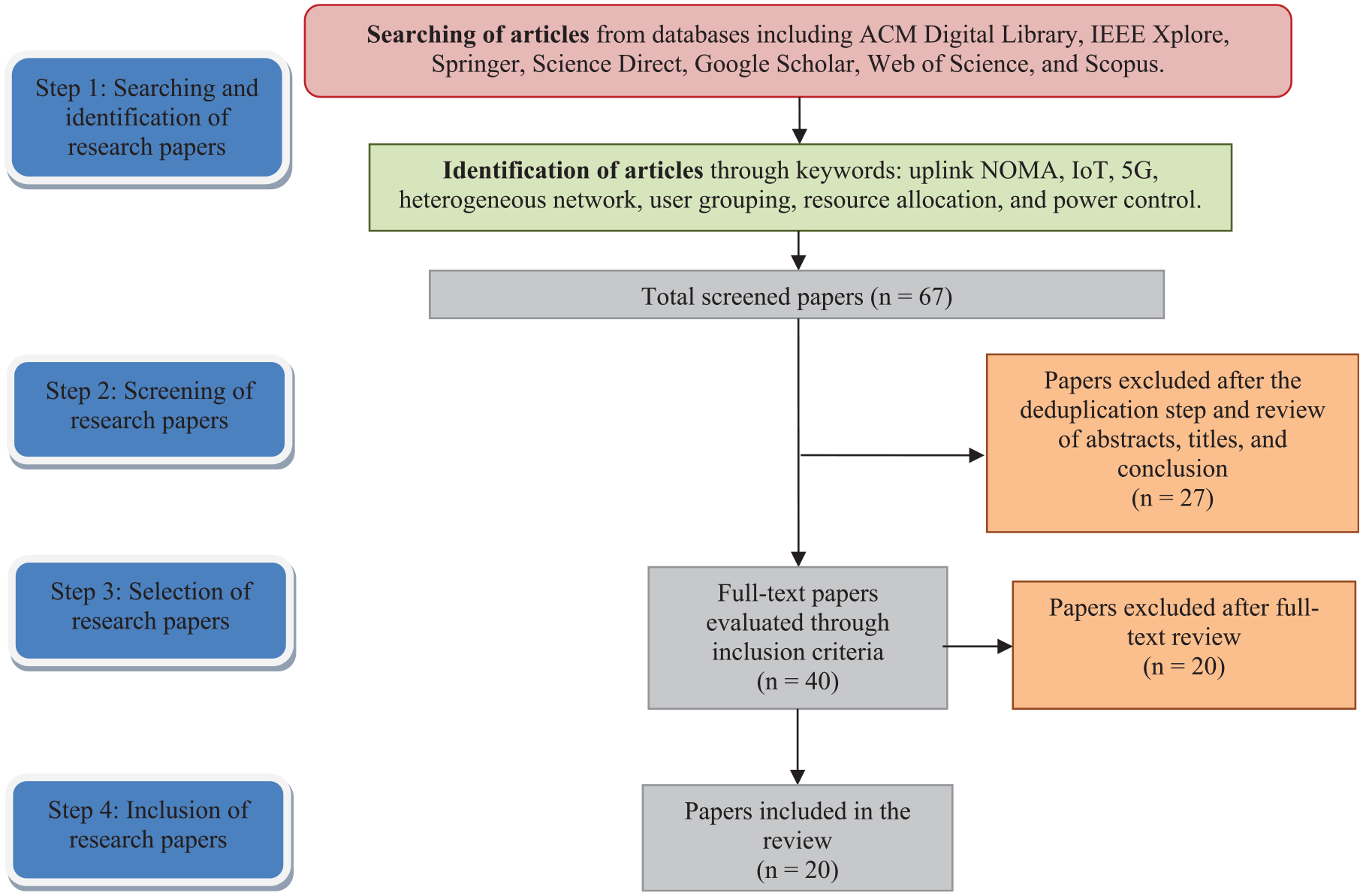
Shortlisting of research articles for systematic review.
Background
This section discusses the review of NOMA and NOMA-enabled HetNets in detail as follows.
NOMA overview
Over the past two decades, a paradigm shift has been witnessed in the development and utilization of wireless technology. 15 From an implementation viewpoint, the progression of various wireless communication systems spans around using different MA schemes in different generations. Each of these generations required a new MA technique to allow spectrum reuse for attaining higher capacity by allocating available bandwidth among multiple users while maintaining the QoS.
Primarily, the frequency-division multiple access (FDMA) technique was employed in the first generation that involved dividing frequency bands into many channels, while every channel was allocated to multiple users. In the second generation, time-division multiple access (TDMA) was involved, in which all the users were allowed transmissions using the same frequency band. However, they were given channel access for a particular time slot only. Besides that, the second generation supported code-division multiple access (CDMA) technology, named as CDMAOne or interim standard 95 (IS-95) as well. The third generation used CDMA for coordinating bandwidth with the equivalent transmitted power. The users were allowed to use a standard frequency band for transmitting the data simultaneously, but with a particular pseudo-random code to quickly retrieve data at the receiving end by the specific user. 17
The orthogonal frequency-division multiple access (OFDMA) was introduced in the fourth generation, which involved the allocation of subsets of subcarriers to individual users. Hence, all users could communicate concurrently through the same channel using MIMO technology and space-division multiple access (SDMA). The elimination of co-channel interference and simplification of transceiver design are the prime benefits of the OMA scheme. However, a significant shortcoming in OMA adoption is its incapability to support a large number of connections or users, which eventually results in spectral inefficiency. This limitation makes OMA techniques practically unfeasible for supporting the Internet of Things (IoT) and massive connectivity, deemed the significant attributes in 5G systems. Considering the stringent requirements of 5G networks, the ingenious idea of NOMA has emerged recently. In NOMA, multiple users access the channel in a non-orthogonal manner and simultaneously share the same radio resources. 15
Moreover, the users in the NOMA system can sequentially extract the required signals from the combined received signals by applying the SIC technique to the receivers. In comparison to OMA, NOMA has turned out to be a better approach for receiver layout, joint power optimization, and resource block (RB) allocation. Besides that, the non-orthogonal nature of NOMA also curbs the precise channel requirement and scheduling of multi-user multiplexing. 8 All the above-discussed MA techniques are illustrated in Figure 2.

Different MA techniques implemented in different mobile generations. 7
NOMA in HetNets
In the context of 5G demands, HetNet is a promising solution for achieving low-cost networks, effectively utilizing limited resources, and notable capacity enhancement. 19 In the HetNet architecture, a macrocell is overlaid by numerous small cells, such as femtocells, picocells, and microcells, to substantially improve the system’s SE and throughput. For HetNets, it is a viable option to share the frequency band between small cells and the macrocell, and the frequency band reuse within a macrocell is also more efficient. However, these benefits of HetNets are accompanied by some significant challenges, such as resource scheduling and cross-tier interference. 4 The wireless transmission quality can be severely degraded due to cross-tier interference; therefore, mitigation needs considerable investigation. Resource management and precoding technique are a few possible solutions found in the existing literature. 20
In the case of NOMA-enabled HetNets, a macrocell with an MBS is overlaid by numerous small cells, where the NOMA technique is applied in all small cells. In this framework, small cell user equipment (SUE) and macrocell user equipment (MUE) can simultaneously serve on the same sub-frequency band to achieve SE. Specifically, the overlay frequency band sharing model entails that the macrocell users can efficiently and freely access the sub-frequency band under the minimum data rate requirements determined by QoS. The allocation of more power to the UEs can result in high data but at the cost of higher power consumption. Therefore, it is crucial and inevitable to find a trade-off between power consumption and data rate improvement in the 5G and B5G wireless communication systems. 4
Variants of NOMA in HetNets
In 5G, HetNets are used for enhancing the capacity and coverage in ultra-dense networks through the deployment of low-power base stations, such as pico base station (PBS) and femto base station (FBS) under MBS. 21 The presence of low-power base stations close to the UE also makes the EE better because of the reduced battery power consumption. However, the severe cross-channel and co-channel interference in these networks have an adverse impact on the SE. Therefore, NOMA has been incorporated with HetNets to exploit the advantages of these networks. Different variants of NOMA in HetNets have been presented over the past few years that are summarized below.
Topological interference management NOMA
It is a hybrid arrangement where the intra-cell interference and inter-cell interference in HetNets are mitigated by NOMA and topological interference management (TIM), 22 respectively. The Kronecker Product representation and user pairing are used for applying this scheme to HetNets. For higher SNR values, this hybrid scheme offers twice the sum rate than TDMA and boosts the performance of femtocell edge users in terms of QoS and fair PA.
Generalized frequency-division multiplexing NOMA
This scheme involves a combination of the NOMA technique and generalized frequency-division multiplexing (GFDM). Here, GFDM covers the single carrier frequency domain and OFDM, whereas NOMA is used to serve multiple users using the same RB to improve system capacity. In Mokdad et al., 9 the authors employed this technique while presenting a joint sub-channel and PA method to manage two kinds of heterogeneous traffics, that is, streaming and elastic. The primary target of this technique was the maximization of elastic traffic users’ weighted sum rate for minimizing the streaming users’ sum rate subjected to transmit power and sub-channel allocation constraint. The results showed that the proposed approach achieved about a 31% improvement in sum rate to OMA.
Multimedia broadcast/multicast service NOMA
A critical study investigated how NOMA enhances the multimedia broadcast/multicast service (MBMS) system performance in HetNets. 23 Two transmission techniques, that is, non-orthogonal multi-service MBMS transmission (NOMSMT) and non-orthogonal multi-rate MBMS transmission (NOMRMT) are investigated. Furthermore, the authors proposed stochastic geometry and then devised a tractable model for analyzing asynchronous and synchronous transmission performance. The statistical results showed that the proposed MBMS-NOMA scheme outdoes the MBMS-OMA.
Joint transmission NOMA
The impact of PA on NOMA users within multi-cellular networks was analyzed. 6 In joint transmission (JT)-NOMA, all base stations, in each other’s coordination, carry out the JT for far users (FUs) in a specific cell using the same RB. The SIC technique is used in this scheme for separating and decoding the signals for FUs. This approach helps in the inter-cell interference mitigation and performance enhancement of all users of NOMA. The numerical analysis demonstrated that the throughput and coverage for each user in HetNet are enhanced through this scheme.
NOMA-heterogeneous cellular networks
Swami et al. 24 presented NOMA-heterogeneous cellular network (HCN), in which the first tier comprised MBS while the second one has several FBS employing NOMA. Furthermore, this strategy is used for offloading traffic from MBS. The main target of this strategy was to boost the performance gain and fairness of the cell-edge users of FBS. According to the statistical analysis, the proposed approach achieved improvements in user fairness and ergodic rate.
Comparison of different NOMA schemes for HetNets
A simulation graph between the total users within a network and the sum rate is provided in Figure 3. The graph shows that JT-NOMA depicts better performance than NOMA-HCN, MBMS-NOMA, GFDM-NOMA, and TIM-NOMA due to the channel fading and reduction of inter-cell co-channel interference. 6 Moreover, this approach allowed all void BSs to perform JT to enhance the farthest cell user’s signal power, enhancing the users’ throughput in dense networks with moderate user intensities. Therefore, JT-NOMA is the most appropriate scheme than the rest of the above-discussed approaches.

Comparison of different NOMA schemes for HetNets. 7
UL NOMA in HetNets
The NOMA-enabled HetNets are more explored for downlink systems in the existing literature. Hence, considering that, this article focuses on the UL scenario. The UL NOMA design in HetNets is illustrated in Figure 4, where the small cells, including the picocells and femtocells, are densely placed over the entire network area. This arrangement can significantly enhance the capacity of the system. In the UL NOMA-enabled HetNets, the NOMA technique is implemented in all small cells to allow spectrum sharing among multiple users.

UL NOMA-enabled HetNets.
In contrast, the users with higher power relate to the macrocell. For instance, User 1 and User 2 relate to the BS for a scenario depicting transmission in picocell. The PBS will carry out SIC detection and the interference mitigation procedure for canceling the interference coming from the other SUEs and MUEs. As the macrocell has a higher power reference, the interference mitigation problem must be considered together with the optimization of user association and resource allocation, as discussed by Choi and Noh. 25
Generally, the optimization characteristic classifies the design objective and requirements of the system. A single objective optimization is suitable when system design emphasizes only optimizing a single performance metric, such as QoS, EE, and SE. In contrast, other metrics are considered optimization problem constraints. In the case of NOMA-enabled HetNets, there are multiple trade-offs among different optimization targets due to limited resources; for instance, the trade-off between energy-transfer efficiency and SE and the trade-off between EE and SE. 2 Therefore, it is quite impossible to attain a reasonable trade-off through single objective optimization as it overemphasizes the significance of a single metric. 26 However, multi-objective optimization may offer a good trade-off among contradictory objectives. Therefore, it is more suitable for NOMA-enabled HetNets, where multiple objectives must be optimized jointly.
Besides that, the non-robust optimization indicates the formulation of optimization problems assuming that it is possible to ideally obtain all the CSI in the network. 27 Though this assumption is not practical, studies on non-robust optimization are substantial because the results derived through non-robust optimization may provide the theoretical limit analysis in the system design. Moreover, robust optimization techniques can obtain a robust design for NOMA-HetNets. For NOMA-enabled HetNets, the optimization can be solved by various techniques and algorithms that have been presented over the past few years and reviewed in the next section.
A survey of recent advances of NOMA in HetNets
The exquisiteness and strength of the NOMA concept lie in its exceptional compatibility with the existing and emerging wireless communication technologies, which allows easy integration of NOMA with cutting-edge systems, including HetNets. 15 To handle the massive number of IoT connections in mobile networks with multi-RAT network configurations, several researchers have recently applied NOMA with HetNets as the resource-sharing method for improving spectrum efficiency.
The integration of NOMA with HetNets was first proposed by Zeng et al. 28 who pointed out that the average throughput could be enhanced by the joint deployment of NOMA with HetNets. Several studies in the existing literature have investigated the use of NOMA in HetNets and discussed user pairing, decoding order, and resource allocation between small cells for downlink NOMA systems. 29 The evolved NodeB (eNB), in the case of downlink NOMA, has details about the users to whom the signal will be transmitted. Thus, it sets up several users on the same RBs to whom it plans to transmit signals. Contrary to this, the formation of clusters in UL NOMA is quite different from downlink NOMA. Cluster formation (CF) is complex in UL NOMA since individual users do not have details regarding other users’ simultaneous transmissions and thus cannot be grouped in a cluster. Therefore, every user is taken as a distinct individual unit in the UL that independently transmits power, thereby suppressing the NOMA transmission performance. Hence, CF in UL is an open research challenge that needs further investigation.
Furthermore, the cell-edge users mostly undergo the worst channel gains and thus transmit at maximum power, making these users the primary source of interference that degrades NOMA performance. Therefore, the PA issue also needs to be addressed to improve NOMA performance in the UL scenario. 30 However, presently, the UL scenario is not well-researched, and very few studies have explored UL NOMA with decoding order, user grouping, and resource allocation in HetNets for maximizing the throughput and network capacity. Therefore, studies addressing the effective interference mitigation and user grouping are indispensable for enhancing throughput of all the users in the network, particularly the edge users in case of UL NOMA in HetNets.
Considering this, some researchers have recently attempted to address the user clustering and power control problem in NOMA-enabled HetNets for UL scenarios. In this regard, Ahmad and Bahadar 30 proposed a new HetNet-inspired user clustering and PA approach for UL NOMA transmission, wherein the users in a cell are clustered based on the geographical location and channel gain threshold, and just one transmitting node is defined for every cluster. They analyzed the sum rate and outage probability and compared the performance of the proposed approach with the NOMA random pairing approach and classic OMA approaches. The idea of one transmitting node with the maximum transmit power and maximum channel gain leads to better outage performance and a high sum rate. The analysis demonstrated that the proposed approach obtained improved outage performance with a more excellent power back-off value. However, an improved sum rate is obtained with a lesser power back-off value. This study validated the efficacy of the proposed approach by obtaining lower outage probability and higher sum rate than OMA schemes.
The power channel allocation and user clustering are the two main problems in UL NOMA in HetNet. Sun et al. 31 believed that implementation and simplification of NOMA-based resource management problems might help in this regard. They proposed the QoS-aware resource management for the NOMA to jointly optimize PA and user grouping to reduce the total wireless channels and satisfy users’ data rate demands. The same problems of user grouping and PA encouraged to fully exploit the EE-SE trade-off for systems with multiple-cluster multiple-user applications. 32 They used the bisection method and the function’s monotonicity to find the trade-off between SE and EE for each cluster and user. Simulation results showed that their approach achieved a considerably higher EE-SE trade-off than the existing approaches.
Furthermore, utilized the viability of a hybrid power-domain sparse code multiple access (PD-SCMA) for developing a hybrid NOMA to limit the multiplexed users’ interference. 33 In this scheme, both code-domain and power-domain MA are integrated on a UL network of MUEs and SUEs. The proposed hybrid technique involved different optimization algorithms, such as particle swarm optimization (PSO), ant colony optimization (ACO), and hybrid adaptive particle swarm optimization (APSO) algorithms. The outcome showed that the APSO algorithm outperformed both the ACO and PSO algorithms in throughput and EE maximization when applied to the HetNets based on PD-SCMA.
Celik et al., 2 in their work, consider the imperfections in the UL NOMA scheme because of the receiver’s sensitivity and excessive interference due to non-ideal SIC detection. They proposed a distributed resource allocation and CF design to reduce the interference and imperfection in the NOMA system. They optimized the size, the bandwidth of the NOMA cluster, and the users’ QoS demands. The simulations indicated a trade-off between proportional fairness and maximum throughput. Moreover, they achieved a higher SE and EE than conventionally implemented primary NOMA clusters of size two.
Qian et al. 34 investigated the joint optimization of base station association and PA to maximize system-wide utility while minimizing the total transmitted power in the UL small cell network (SCN) or HetNets using NOMA with SIC. This work first transformed a two-step optimization problem into a single-step problem. Afterward, the power-controlled system-wide utility maximization (PCSUM) algorithm, based on the coalition formation game theories, is introduced to solve the transformed optimization problem efficiently. The simulation results showed the improved efficacy of the proposed algorithm in terms of total power consumption and system-wide utility.
Simon and Walingo 35 came up with a novel idea and investigated and developed a codebook (CB) resource assignment to SUEs and MUEs in a UL HetNets system to achieve an optimal sum rate. It involved the grouping of SUEs and MUEs in different clusters with varying power levels and the formulation of the system as a sum-rate maximization CB assignment problem in the underlying small cells. A sub-optimal yet fast CB assignment algorithm was proposed considering the on-hand CSI.
Moreover, a combined multi-user detection (MUD) and SIC scheme based on a simple log-domain message-passing algorithm (MPA) is employed at the receiver to reduce the system cost. The simulation results showed the improvements in the sum rate and link-level performance of the presented resource allocation algorithm for the UL CB-based NOMA-HetNet system. 35
Recently, Baidas 36 also studied the problem of joint relay assignment and EE maximization in UL NOMA-HetNets. The authors mainly aimed at devising a joint optimization technique of user pairing to maximize EE over each relay through multi-objective optimization to satisfy the users’ QoS constraints. They achieved effective user grouping and resource allocation, satisfying users’ QoS constraints while reducing the computational complexity.
Wang et al. 37 mainly addressed interference mitigation in their work, in which inter-user interference (IUI) coming from the other SUEs in the network is considered. They came up with a novel idea of using sub-bands assignment algorithms for a joint optimization problem based on user clustering and power control. The main idea is that the edge users cannot be termed weak users due to the starvation prevention method that limits the maximum number of sub-bands that each user can use. However, in this work, only such scenarios are considered when the number of users is much higher than the sub-bands for supporting the demands of massive connectivity, which is not always available.
In recent work, Zhang et al. 38 investigated the concept of joint optimization of user clustering, decoding order, and PA for UL NOMA for maximizing each user’s throughput. They also proposed a sub-optimal user clustering algorithm with linear complexity to attain the trade-off between computational complexities and system performance. However, the mitigation of interference due to other users is not considered, which has a considerable effect on the system’s performance, particularly in dense networks.
Another critical study 39 also proposed a generalized user grouping (GuG) algorithm based on overlapping perspectives for UL NOMA, where each user is allowed to be a part of multiple groups, however, subject to individual maximum power constraints. The overlapping coalition formation (OCF) game architecture allows every user to manage their requirements. It facilitated improving the user’s throughput due to self-organization but at the expense of increased computational complexity. To address this limitation, the comprehensive study by Chen et al. 40 proposed an ML-based GuG approach to effectively obtain the best possible power control. The exploitation of specified ML-based models, that is, support vector machine (SVM) and random forest (RF), considerably reduced the computation cost compared to an exhaustive search. The obtained results depicted the improvement in sum rate compared to the existing techniques and a reduction in the computation complexity.
Liu et al. 41 also investigated joint user association and power control in D2D-enabled HetNets with NOMA for maximizing the ergodic sum rate of the near users (NUs) in the small cells while ensuring the QoS demands of MUEs and the remote users. A two-stage method is developed for solving the joint optimization problem by dividing the original problem into two sub-problems, that is, the user scheduling problem and the PA problem. After that, they obtained closed-form expressions of the optimal solution for the PA problem. Moreover, they formulated the user scheduling problem as a three-sided matching problem and proposed a less complicated matching algorithm for obtaining a near-optimal solution to this problem. The simulations showed that the two-stage approach depicted close to optimal performance and can considerably enhance the SE of D2D-enabled HetNets.
Furthermore, an optimal PA scheme in a UL heterogeneous cognitive network is proposed with NOMA. 42 They considered the cross-tier interference control between the femtocell and macrocell tier and adopted SIC to improve the femtocell tier’s SE. The simulations demonstrated that the proposed PA scheme outperformed the existing PA schemes in sub-channel spectrum efficiency and cognitive femtocell transmission rate. Moreover, it showed that in comparison to OMA, NOMA could offer improved SE under inevitable cross-tier interference in the cognitive HetNet.
Besides that, Zhang and Kang 8 proposed a new PA and user grouping scheme for the machine to machine (M2M)-enabled HetNets with NOMA. They formulated a problem for EE maximization in which power control and mobile user (MU) association were combined. A matching game-based MU association algorithm was proposed for solving the problem. Furthermore, several power control algorithms were provided for acquiring sub-optimal solutions based on sequential optimization. The proposed approach depicted improved EE than the available methods.
Another new idea of exploiting the benefit of sectorization to address the complication of interference control associated with NOMA-HetNets. 43 This study considered three types of interference, including co-channel interference, cross-tier interference, and inter-sector interference. It mainly aimed at maximizing the EE of all small cells in a UL two-tier NOMA-HetNet using sectorization. As EE maximization is a mixed-integer non-linear programming (MINLP) problem that is quite tricky, therefore, it is divided into two sub-problems. At first, the Karush–Kuhn–Tucker (KKT) optimal conditions and Lagrange dual method are employed for obtaining the closed-form PA solution. After that, a simple greedy strategy-based sub-channel allocation algorithm is presented. The obtained results depicted the supremacy of the presented scheme in terms of EE gain over the existing approaches.
In UL NOMA, sophisticated power control and user clustering approaches are needed for discriminating the arriving power to ensure successful SIC operations on the receiver end.4,9 It is, therefore, necessary to transfer user clustering and transmitted power details to the UE for power multiplexing. However, this requires higher signaling supplies that lead to considerable computational overhead. It also adversely affects the suitability of SIC-based NOMA approaches in UL HetNets. Moreover, to reduce the receiver load in such NOMA schemes, a maximum of two or three users is usually permitted to share the same RB. Therefore, it is crucial to formulate for NOMA-HetNets without employing SIC. In this regard, QR decomposition 44 is used to develop a novel NOMA scheme that can be applied to the multi-antenna base station in UL HetNet. This strategy overcomes the shortcomings of classic SIC-based NOMA schemes since it does not require any power controlling and user grouping information exchange between the base station and UE for decoding its data. It can significantly reduce the computational and signaling overheads as well. The proposed scheme improved the sum rate and bit error rate (BER) over the SIC-based scheme. However, the authors only focused on minimizing interference power in this study.
This work is carried out further in Najlah and Sameer, 44 where the researchers employed a projection operator for devising a new NOMA scheme for UL HetNets. Similar to Najlah and Sameer, 45 it did not need an exchange of information between FBS and MUEs for acquiring MUE’s CSI at the receiver (CSIR) and also between FUs and FBS for acquiring CSI at the transmitter (CSIT) thereby eradicating the added computational and signaling overheads incurred otherwise. In Najlah and Sameer, 45 only the interference power reduction was considered, while in Najlah and Sameer, 44 the authors considered the minimization of Additive white Gaussian noise (AWGN) power along with cross-tire interference without boosting the desired FUs signal.
Considering the popularity of NOMA-enabled HetNets, this combined approach can serve as an excellent option for implementing next-generation wireless systems to support users and offer a higher data rate. However, this scheme demands the second-order statistics details of the desired FUs’ transmitted message signal, which might not be essentially known to the FBS always.
Moreover, Najlah and Sameer 44 assumed that a perfect FU-CSI is present on the FBS receiver. Najlah and Sameer 46 proposed a novel NOMA approach for UL HetNets employing oblique projection (OP) that considered both imperfect and perfect CSIR. The results showed that the proposed approach performed well for both imperfect and perfect CSIR scenarios.
A combined scheme of graph theory and ML 47 has been presented for finding an optimal solution for the joint user grouping and resource allocation issue in UL HetNets. The proposed joint flow/power control and throughput optimization algorithm achieved optimum EE and ensured user throughput constraints. It also highlighted the significance of involving ML approaches in the resource allocation process of NOMA-enabled HetNets.
A summary of the above-discussed recent studies addressing NOMA integration with HetNets is provided in Table 3.
NOMA in HetNets .
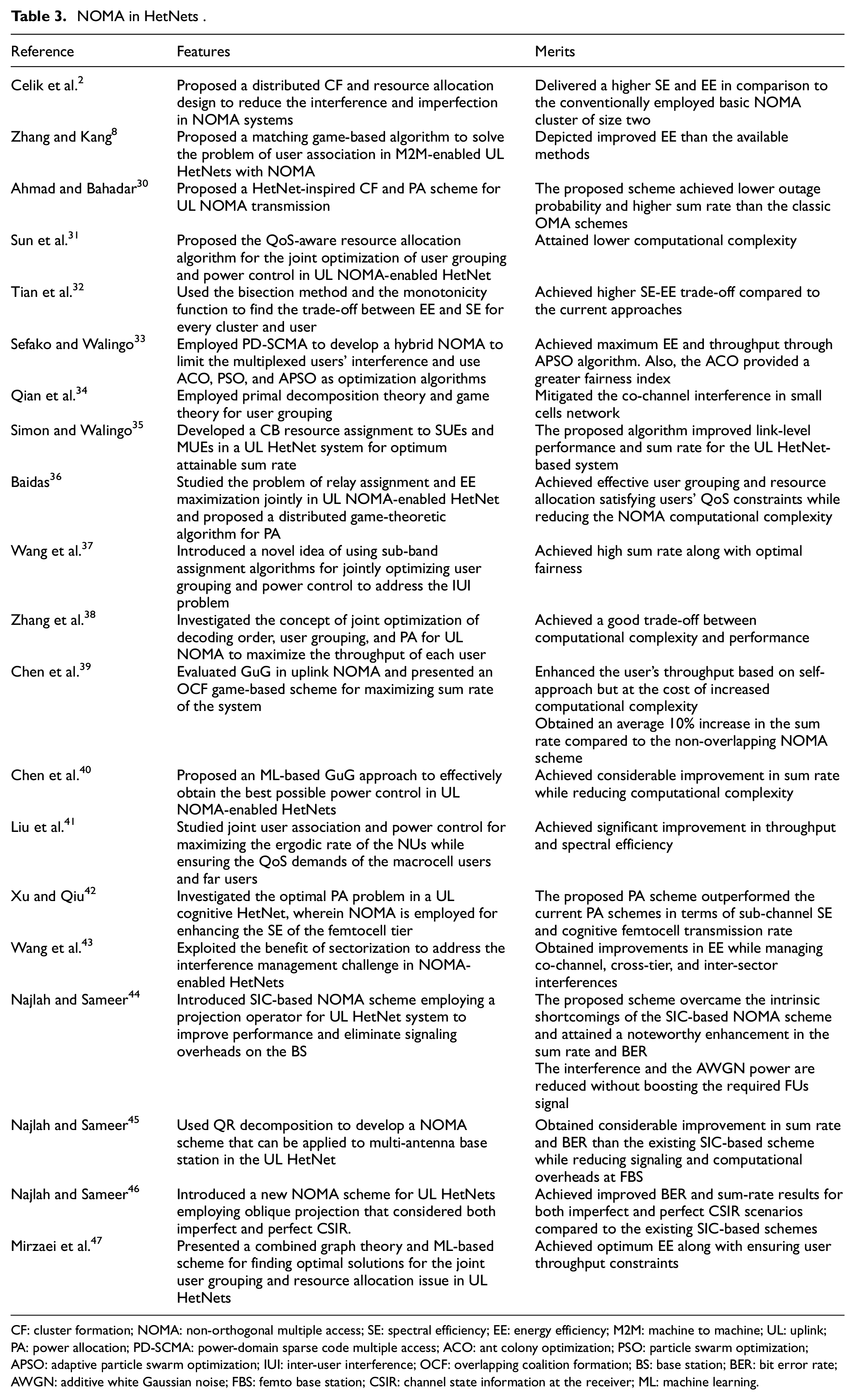
CF: cluster formation; NOMA: non-orthogonal multiple access; SE: spectral efficiency; EE: energy efficiency; M2M: machine to machine; UL: uplink; PA: power allocation; PD-SCMA: power-domain sparse code multiple access; ACO: ant colony optimization; PSO: particle swarm optimization; APSO: adaptive particle swarm optimization; IUI: inter-user interference; OCF: overlapping coalition formation; BS: base station; BER: bit error rate; AWGN: additive white Gaussian noise; FBS: femto base station; CSIR: channel state information at the receiver; ML: machine learning.
Taxonomy of UL NOMA in HetNets
Based on the literature reviewed in this study on UL NOMA in HetNets, a taxonomy (shown in Figure 5) is devised in this section considering the key metrics used in the literature for evaluating performance, the primary system requirements, and the techniques used for user grouping and resource allocation in NOMA-enabled HetNets.

Taxonomy of UL NOMA in HetNets.
Key metrics for performance evaluation
SE and EE are the two significant performance metrics evaluated in 5G communications, especially for NOMA-assisted HetNets, where users are randomly located in the small cells. 15 The EE can be determined in two ways, that is, (1) by calculating the ratio between the total data rate and the total consumed energy 48 and (2) by using a specific algorithm to directly present the achieved energy-saving. 6
Besides EE and SE, the outage probability, the computation of the impact of co-channel interference imposed on radio links, is another critical attribute in the planning and evaluation of wireless networks. 5 It is crucial for standardizing a randomly chosen user’s throughput that might serve as a primary metric for optimizing and analyzing network performance. The outage problem may be considered with problems, such as user grouping, decoding order, and PA. Besides that, outage probability can be used to calculate the outage capacity. However, currently, the outage in NOMA is an important but less researched area, and very few studies have emphasized it.14,41
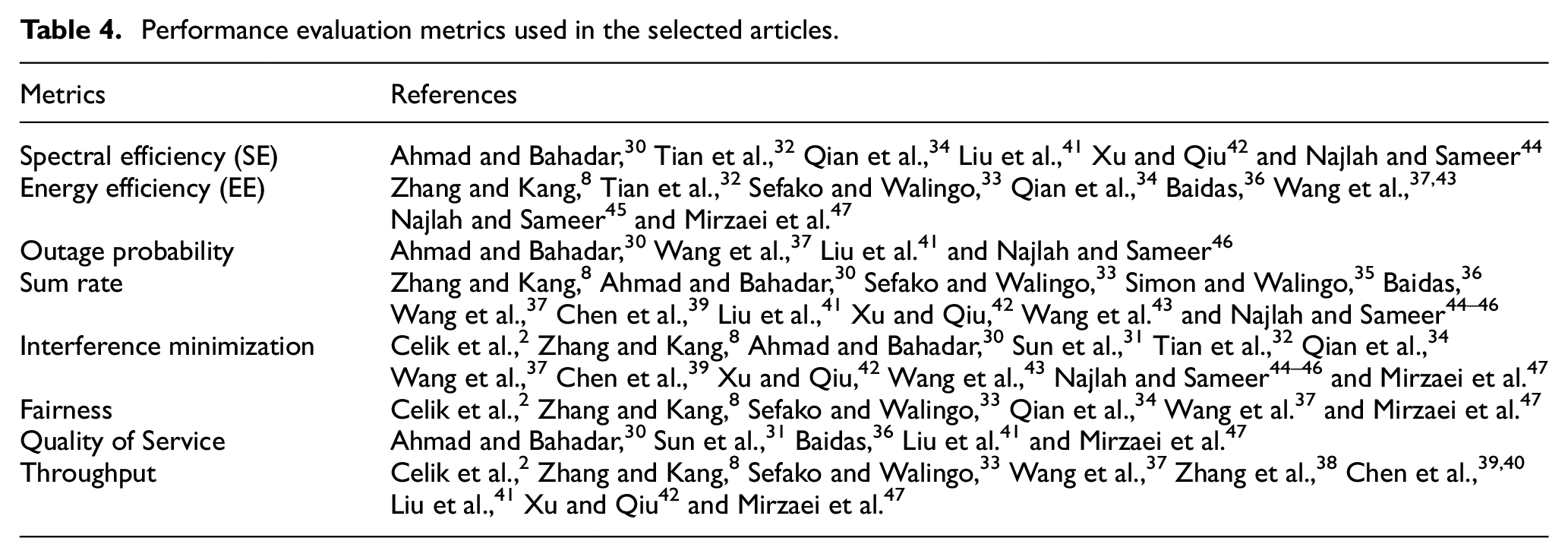
Other evaluation metrics include interference minimization, sum-rate maximization, fairness, and QoS of SUE.49,50 The interference minimization is focused on reducing the interference caused by MUE to the SUE while considering the QoS of each user. 42 Moreover, fairness refers to being fair among users while considering the QoS of macro and small users. To date, different fairness criteria have been proposed, such as harmonic, proportional, and max-min fairness. 51 Another critical performance evaluation metric is QoS improvement, which improves the overall acceptability of a service or application from the SUEs’ perceptive. Besides that, throughput is also a key metric whose maximization is an essential parameter for improved UL NOMA performance in HetNets. 52
The different metrics used in the shortlisted studies for evaluating the performance of NOMA-enabled HetNets are summarized in Table 4.
Performance evaluation metrics used in the selected articles.
Requirements
Low latency, massive connectivity, user fairness, and high reliability are among the essential requirements of 5G communication networks, particularly for dense networks.35,36,47,53,54 The reduction in power consumption34,35,47 and computational complexity34–36,44,46,47 along with the increase in scalability 34 and some other essential requirements are identified in the literature regarding UL NOMA in HetNets.
Resource allocation approaches
Game theory is a mathematical modeling tool having unique advantages in examining multiple players’ interactions. 55 It is a powerful tool that can also address user association issues. In the case of NOMA-enabled HetNets, the players can be the users or base stations, or both, and the strategies are made up from the analogous user association decisions. 36 Game theory is appropriate in designing distributed algorithms with adaptable self-configuration attributes, despite just imposing a little communication overhead. 56 However, one notable point is that game theory assumes that all the players are rational and act in their best interests. However, in 5G systems, it cannot be ensured that the players (users or BSs) will always act rationally. Moreover, selecting suitable utility functions that accurately capture the perception of satisfaction for different players is quite challenging. 57
Besides game theory, combinatorial optimization, graph theory, matching theory, heuristic algorithms, and monotonic optimization are other essential approaches employed for user grouping and PA in NOMA systems. 58 Table 5 represents the different approaches employed for resource allocation in the articles selected for this survey article.
Resource allocation schemes.

Summary and insights
This article evaluated the cutting-edge developments in using NOMA in modern wireless systems for attaining spectrum and EE while meeting QoS requirements for SUEs in HetNets. Furthermore, taxonomy is devised for UL NOMA in HetNets, and the optimization techniques for user clustering and resource allocation are discussed. The following major findings/lessons are deduced from this study:
An increase in the consumer devices and density of small cells in HetNets may result in severe intercarrier interference (ICI) in multi-cellular networks. Moreover, the problem of interference mitigation can be trickier for HetNets. Therefore, it is essential to determine such approaches that integrate viable interference management and mitigation techniques with NOMA.
A further increase in the data rates of the intended users can be achieved by integrating carrier aggregation (CA) with the NOMA systems.
User grouping and PA, along with sub-band assignment are discussed in this survey. It is found that the development of less complex resource allocation algorithms is important since they play a pivotal role in optimizing NOMA performance.
SE and EE in addition to the QoS of the network are the main three parameters that need to be considered when designing NOMA in HetNets. Besides that, outage probability, sum rate, interference mitigation, user fairness, and throughput are also the key performance indicator (KPI) in NOMA-enabled 5G systems.
Unlike the conventional resource management approaches, such as cooperative and game-theoretical approaches, heuristics-based methods, optimization, deep learning, and ML techniques are promising solutions for automated decision-making and resource management, particularly for distributed, complex, large-scale and dynamically changing IoT applications environment.
The existing literature has a considerable volume of research studies individually addressing HetNets and NOMA technology; however, the research on NOMA-enabled HetNets is still in its infancy and needs further developments, particularly for UL scenarios.
Open research challenges
A few open research challenges in NOMA-enabled HetNets have been identified, which require further investigation to effectively enhance SE and support massive connectivity in 5G networks. These are discussed below.
EE in NOMA-enabled HetNets
One primary potential application of NOMA-enabled HetNets is the IoT for smart cities involving the connectivity of many devices. The NOMA-enabled HetNets offer a practical framework for providing significant access chances for these devices, particularly for those cases where every device must send a minimal amount of data from time to time. However, such devices have restrictions in terms of power consumption since these are normally battery-powered. Therefore, the battery life needed to be extended to keep these IoT devices active for a longer time, which indicates the significance of EE. Especially, transmission at high data rates leads to shorter airtime but higher power consumption. The airtime is extended due to the lower transmission rate with less power consumption. Thus, the trade-off between airtime and data rate needs to be investigated thoroughly to maximize the lifetime of these devices. 17
Less-complex/optimal receiver design
The optimization schemes covered in this article offered solutions for addressing varied challenges, such as the maximization of SE and EE. However, a less complex/optimal receiver design might help to fully exploit NOMA benefits. For instance, an MPA might be employed for designing a NOMA receiver, but its complexity is the main hindrance to the massive connectivity in 5G systems. Moreover, some users’ performance might be deterred by error propagation while utilizing SIC-based receivers. Therefore, a less complex/optimal receiver design for NOMA is needed for supporting massive connectivity in 5G systems. A possible option is to consider a reconfigurable receiver design for precise detection with minimal complexity. 59
Testbed for NOMA-enabled HetNets
Though a lot of efforts are now being made on the algorithm design and performance analysis of NOMA-enabled HetNets, there are still many challenges for practically implementing NOMA in HetNets. Thus, test-beds are required to demonstrate the efficacy of the proposed solutions for the proof of concept. Moreover, software-defined radio (SDR) can be adopted to facilitate BSs’ intelligent selection of appropriate NOMA techniques for varied application scenarios. 17
Big data-assisted adaptive NOMA in HetNets
The processing capability of IoT devices is generally limited, though a few devices such as mobile phones can perform more complicated tasks. Moreover, it has been observed that different levels of complexity are required at the user end for different NOMA schemes. For example, the SIC receiver is comparatively uncomplicated, making PD-NOMA more appropriate for IoT devices. Thus, a software-defined NOMA framework is needed to achieve adaptive NOMA having the complex understanding to cater to varied user scenarios. ML is a promising paradigm that can be brought to play for predicting the data traffic for varied scenarios. It could be achieved in two ways, either through real time or predefined settings. Predefined setting refers to the assignment of the MA technique under the past social media data, for instance, the number of users in a specific region in some months/years. The real-time setting involves adjusting MA techniques according to the feedback taken from the social media in real time. 17
Imperfect SIC modeling
Most nodes in 5G and B5G networks are IoT devices with limited capability. Therefore, there might be decoding errors during the interference mitigation process. Notably, the decoding error probability is relatively high because of the involvement of small packets in IoT communications. Thus, in imperfect SIC, the residual interference is very severe because of error propagation. The impact of imperfect SIC can be alleviated through multiple-antenna techniques, for instance, user clustering, PA, and spatial beamforming. To effectively alleviate imperfect SIC impact, it is crucial to design a precise imperfect SIC model. A linear model is used in multiple-antenna NOMA systems that may not be adequately precise. Therefore, the imperfect SIC modeling for multiple-antenna NOMA systems is still an open challenge that needs further investigation. 60
Cell-free NOMA
The 5G and beyond networks have to offer broad coverage to massive devices/users. Nevertheless, the existing centralized-cell framework results in intense far-near effects. The edge users transmit weaker signals and stronger interference, while the central users transmit stronger signals and weaker interference. Consequently, the quality of the received signal at edge users might not be enough to satisfy the QoS demands, thus leading to limited cell coverage. The employment of cell-free architecture seems to be a feasible method for solving this issue. In particular, the base stations, connected with a central processing unit, are spread over the complete area. Thus, it can help broaden the coverage and shorten the access distance. However, the design of cell-free NOMA remains an open research area. 61
Artificial intelligence techniques in NOMA
Artificial intelligence (AI) techniques, including ML and deep learning, are considered possible solutions to complex and common issues in future wireless networks that were previously hard to solve. 62 ML may not only improve situational awareness and overall network operation of wireless networks by analyzing data but it can also drive wireless network optimization. Furthermore, ML has the potential to play an essential role in the physical layer of wireless networks. ML has been introduced regarding wireless communication, with research findings and tutorials published. 63 The multi-constrained functions based on AI are used to optimize numerous parameters simultaneously in both UL and downlink scenarios. Moreover, in downlink NOMA, AI models were introduced as an alternative to computationally intensive optimum power algorithms. 64
UL NOMA in vehicle-to-everything
NOMA, with its high SE, is one of the prospective candidate technologies for the next wireless communication systems. Vehicle-to-everything (V2X) has been highlighted as a promising issue in the third-generation partnership project (3GPP) in the new radio. 65 Also, it has been suggested that the long-term evolution (LTE) network is a viable option for supporting V2X applications. However, the conventional OFDM-based LTE network faces congestion issues due to its low efficiency of orthogonal access, resulting in significant access delay and posing a significant challenge, especially to safety-critical applications, when more of devices access the V2X network in the future. 66 Hence, the deployment of UL NOMA in V2X applications is another potential direction for enhancing the performance of edge vehicles.
Conclusion
NOMA in HetNets has emerged as a promising scheme to meet the rapid growth of mobile data in the modern era. This article comprehensively studies the opportunities, potential benefits, and challenges associated with integrating NOMA with an advanced communication paradigm—HetNets. The review shows that user clustering optimization in small cell networks, mainly when a massive number of users are deployed within a network, is crucial for allocating resources effectively between MUEs and SUEs. In UL NOMA-enabled HetNets, the efficient resource allocation algorithms can mitigate interference due to the other cell users and enhance the system throughput overall. The evaluation of the most recent studies showed that the deployment of NOMA with HetNet enhances the EE and SE of the network; however, the severe cross-channel interference and co-channel interference are significant challenges that still need further consideration. Moreover, the taxonomy of UL NOMA in HetNets in terms of critical metrics, requirements, user clustering, and resource allocation approaches has been devised to reference future research. Hence, the NOMA-enabled HetNets are projected to play a critical role in future wireless communication systems that provide massive connectivity and low latency.
Footnotes
Handling Editor: Miguel Acevedo
Declaration of conflicting interests
The author(s) declared no potential conflicts of interest with respect to the research, authorship, and/or publication of this article.
Funding
The author(s) received no financial support for the research, authorship, and/or publication of this article.
