




Abstract
Non-orthogonal multiple access is an essential promising solution to support large-scale connectivity required by massive machine-type communication scenario defined in the fifth generation (5G) mobile communication system. In this article, we study the problem of energy minimization in non-orthogonal multiple access–based massive machine-type communication network. Focusing on the massive machine-type communication scenario and assisted by grouping method, we propose an uplink cooperative non-orthogonal multiple access scheme with two phases, transmission phase and cooperation phase, for one uplink cooperative transmission period. Based on uplink cooperative non-orthogonal multiple access, the machine-type communication device with better channel condition and more residual energy will be selected as a group head, which acts as a relay assisting other machine-type communication devices to communicate. In the transmission phase, machine-type communication devices transmit data to the group head. Then, the group head transmits the received data with its own data to base station in the cooperation phase. Because the massive machine-type communication devices are low-cost dominant with limited battery, based on uplink cooperative non-orthogonal multiple access, we propose a joint time and power allocation algorithm to minimize the system energy consumption. Furthermore, the proposed joint time and power allocation algorithm includes dynamic group head selection and fractional transmit time allocation algorithms. Simulation results show that the proposed solution for uplink cooperative non-orthogonal multiple access–based massive machine-type communication network outperforms other schemes.
Keywords
Introduction
The deployment scenarios of the fifth generation (5G) system are grouped into three general categories: enhanced mobile broadband, ultra-reliable and low latency communications, and massive machine-type communications (mMTC). Among these three scenarios, machine-type communication (MTC) is known as machine to machine (M2M) communication, which is a form of data communication among several connected entities and does not necessarily need human interaction. 1 With the ever-increasing amount of connected devices and Internet of things (IoT) applications, the new services supported by MTC will sprout and promote the development of future 5G networks. However, there are challenges in enabling mMTC in 5G era.
Different from assumptions in current cellular networks for the conventional human-type communication (HTC) services, mMTC mainly focuses on uplink communications. 2 As machine-type communication devices (MTCDs) usually have small packets, low data rates, low cost and battery constrained, limited resources will become more precious when massive MTCDs access the network. Moreover, since current mobile networks are optimized to serve HTC, the optimizations may dissatisfy MTCDs’ requirement. There are several requirements and key performance indicators of mMTC should to be considered: coverage enhancements of 20 dB, 10 years device battery life, low device complexity and a few million devices per square kilometer.3,4
To solve the aforementioned challenges, assisted by grouping, we propose an uplink cooperative non-orthogonal multiple access (UC-NOMA) scheme including transmission phase and cooperation phase for one uplink cooperative transmission period. Moreover, based on UC-NOMA, we propose a joint time and power allocation (JTPA) algorithm to minimize the system energy consumption, including dynamic group head selection and fractional transmit time allocation algorithms. The main contributions of this article are summarized as follows:
Exploiting the characteristic of NOMA technique that multiple MTCDs share the same subcarrier at the same time with different power levels, we propose an UC-NOMA scheme for mMTC networks. Furthermore, we characterize the total energy consumption of UC-NOMA–based mMTC networks, with transmission time and power allocation being taken into consideration.
The proposed UC-NOMA is based on a grouping method, where the distinctive channel gains of MTCDs are exploited. The MCTD with better channel condition and more residual energy will be selected as group head, which receives the data from member of MTCDs in the transmission phase and transmits the received data with its own data to base station (BS) in the cooperation phase.
Based on UC-NOMA, we propose the JTPA algorithm to minimize the energy consumption and prolong the lifetime of massive MTCDs. The dynamic group head selection and fractional transmission time allocation schemes are designed. The dynamic group head selection scheme enables the MTCDs with more residual energy and closer to BS to be the group head, and the fractional transmission time allocation scheme balances the transmission time allocated to each group.
The remainder of the article is organized as follows. The “Related works” section presents the review of the related works. The system model based uplink NOMA is described in section “System model.” The proposed dynamic group head selection and fractional transmission time allocation scheme are introduced in section “Joint Time and Power Allocation in UC-NOMA.” Section “Performance evaluations” provides the performance simulation results and section “Conclusion” concludes the article.
Related works
Instead of communicating with BS directly, MTCDs can associate with equipment functionally similar to relay and perform uplink multi-hop communication. Via uplink multi-hop communication in mMTC, not only intense competition against radio resources can be alleviated but also the energy consumptions of MTCDs with poor channel conditions can be reduced. The authors propose that the MTCDs first establish a link with machine-type communication gateway (MTCG), and then the MTCG communicates to BS with received data. 5 Furthermore, considering that user equipment (UE) have more power and storage space than MTCDs, UE are configured as intermediate equipment.6,7 But, the above schemes proposed are not appropriate for some scenarios without intermediate equipment.
The massive MTCDs’ accessing in 5G networks is one of the most challenges in mMTC networks. Some researchers focus on random access, 8 while other researchers turn their attentions to NOMA instead of orthogonal multiple access (OMA). Although NOMA multiplexes multiple users in the same radio resource with increased co-channel interferences (CCIs), NOMA technology with employing power domain schedules more MTCDs to share the limited available resources. 9 In addition, compared with conventional OMA, NOMA improves the overall system throughput and supports lower transmission latency and less signaling cost. 10 These attractive characteristics drive NOMA to be a potential access technology for 5G system. And based on NOMA, massive connectivity per coverage with limited radio resources could be realized. Since massive MTCDs directly communicating with BS costs much overheads, grouping of MTCDs plays a key role in reducing the complexity. By modeling the system as a cooperative game in partition formation, two schemes are proposed to divide the users in a hybrid NOMA system. 11
In uplink NOMA system, the BS receives the multiplexed signals in power domain from different users and applies the successive interference cancelation (SIC) technology to decode each signal. The MTCD with highest channel gain is likely the strongest signal at the receiver and its signal will be decoded first. Then, the MTCD signal with the second highest channel gain is decoded and moving forward. Since NOMA systems depend on efficient SIC, the intra-group interference model needs to be adapted according to the level of SIC cancelations. 12 In particular, the use of SIC in NOMA facilitates MTCDs with better channel conditions to decode the messages of the other MTCDs, and furthermore, they also serve as relays to make the MTCDs with poor channel conditions access the cellular networks and reduce the energy consumption. To fully utilize the prior information about other users’ messages of the users with better channel conditions in downlink NOMA systems, a cooperative NOMA transmission scheme is proposed. 13
Currently, most of researches focus on the downlink NOMA scenarios, while NOMA can serve general uplink and downlink scenarios with more than two users. 14 The authors stand in different points to investigate the downlink NOMA, for example, fairness,15,16 energy-efficient,17,18 and sub-channel allocation. 19 For uplink NOMA, an enhanced proportional fair (PF)-based scheduling scheme, 20 a suboptimal algorithm with single-user water-filling performed over all available sub-channels 21 and a power back-off scheme based on fractional transmission power control 22 are proposed.
MTCDs with limited battery have to serve for quite a long period, thus energy consumption becomes an urgent to be solved issue in mMTC networks. To save energy or extend service lifetime, each MTCD independently transmits its own signal with controlled transmission power. Power and energy efficiency about MTC are investigated in cellular networks and Long-Term Evolution (LTE) networks.23,24 Based on traditional OMA schemes, the problem of minimizing the power consumption to prolong MTCDs’ lifetime is studied. 25 Furthermore, an uplink energy minimization problem to efficiently use the radio resources and support the mMTC is investigated for MTC with NOMA. 7
System model
Consider an uplink NOMA system consisting of

System model of an uplink cooperative NOMA single-cell network.
In NOMA, multiple MTCDs are multiplexed into transmission power domain and scheduled for transmission on the same spectrum resources non-orthogonally. In order to control the massive access and reduce the complexities of SIC, an MTCD grouping method is applied. The distinctness channel gains of different MTCDs is one of the key issues considered in minimizing CCI in a NOMA group. Moreover, to perform SIC at BS, we need to maintain the distinctness of the received signals. Thus, we divided the set of MTCDs
The group-k set is denoted as
In one UC-NOMA transmission period, there are two phases in time domain, transmission phase and cooperation phase, as shown in Figure 2. In the transmission phase, the transmission time allocated to group-k is denoted as

During the transmission phase of UC-NOMA for the group-k, MTCDs in group-k transmit their payloads to group head

where
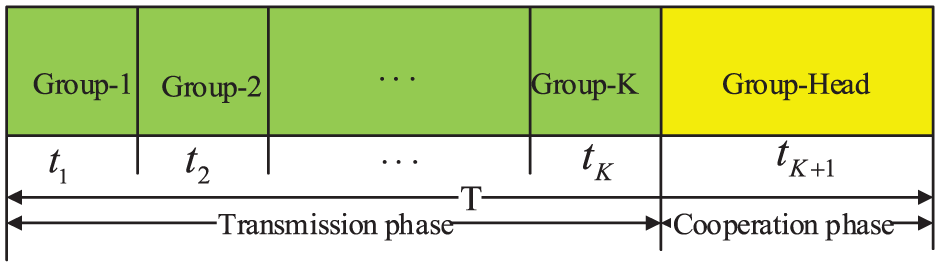
One uplink cooperative NOMA transmission period.
Joint Time and Power Allocation in UC-NOMA
Problem formulation
In uplink NOMA, the receiver exploits the SIC technology to decode the multiplexed signals in power domain. The channel gains of MTCDs in group-k are sorted as

where
In the cooperation phase of UC-NOMA, during transmission time
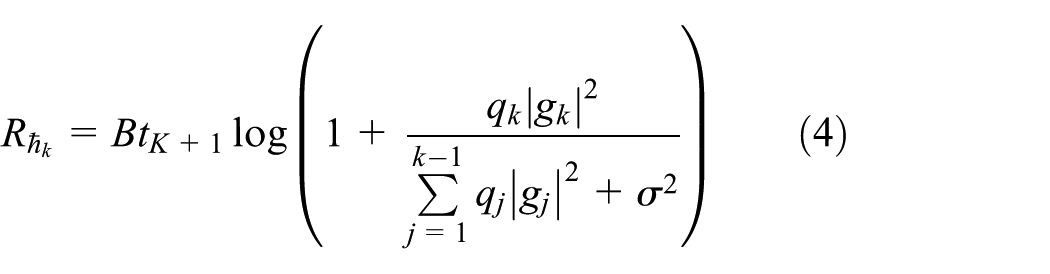
Unlike traditional maximization of spectral efficiency for HTC, due to the features of mMTC, new principles are added to cellular networks. Consider that the battery lifetime is important for massive MTCDs and the uplink data transmission consumes a large portion of energy, we minimize energy consumption with a given payload

where
In mMTC scenario, a large number of MTCDs with delay-tolerant transmit-limited size packet in low achievable rate extending the transmission time as long as possible will have benefits to the energy saving.
6
In order to take full use of time and save energy, the total transmission time should be equal to

Furthermore, to save energy consumption, the (Co.5) and (Co.6) in equation (5) degenerate into

According to equations (3), (4), and (7), we obtain

With the help of recursion method

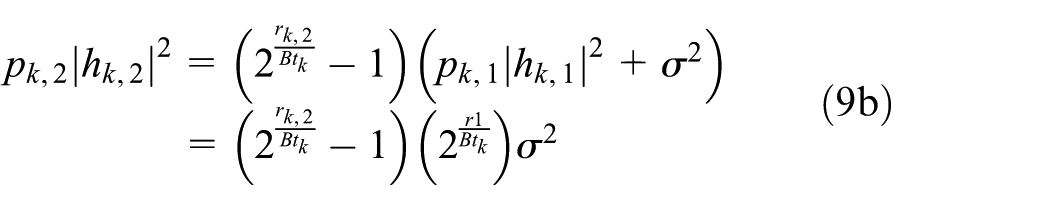

we have


where
Thus, the original problem (5) can be converted as minimizing the energy consumption subjected to transmission time

Problem (11) is proved to be a convex function in Appendix 1. And, we can employ Lagrangian function to minimize the energy consumption in equation (11). 28
Resource allocation algorithm
In equation (10), the transmission power is a monotonically decreasing function with transmission time. Although the original problem is proved to be convex and the globally optimal solution can be obtained via interior point method, the complexity is high. To save energy, we trade off the transmission time between the transmission phase and the cooperation phase in the UC-NOMA. Assuming that the transmission time of cooperation phase is

In practical conditions, MTCDs with limited computing ability and battery constrained have to process some complex operations without other equipment assisted. The more residual energy remains, the longer lifetime MTCD has. Therefore, based on the residual energy and geographic information of MTCD, we dynamically selected the group head to extend its lifetime in different transmission periods. To reduce the energy consumption and guarantee the information upload from the remote location MTCDs, the MTCD close to the BS is easy to be chosen as group head. The normalized function consisted of distance and residual energy is

where

where
As shown in equation (3), the transmission time is inversely proportional to channel gain with given transmission power of MTCDs in group-k. In addition, the transmission time also has an impact on the residual energy, which determines the lifetime of one group. Thus, with taking channel gain and residual energy into consideration, we proposed fractional transmit time allocation strategy to balance the energy consumption of the MTCDs group
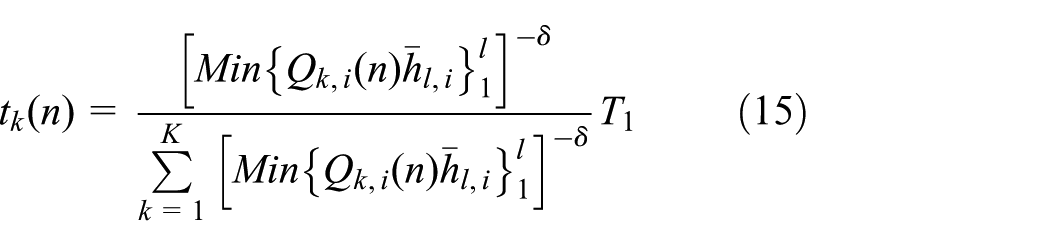
where

Performance evaluations
In this section, we provide simulations to evaluate the performance of JTPA in the proposed UC-NOMA–based mMTC scenario. The details of simulation parameters are given in Table 1. We refer to the proposed algorithm as JTPA-NOMA and take two other schemes, optimal power allocation based on TDMA (OPA-TDMA) 6 and the power back-off scheme in uplink NOMA (PBO-NOMA), 22 for comparison. The transmission power of MTCD will exceed the maximum transmission power limit, under heavy payload, poor channel condition, and severe CCI. The JTPA-NOMA, PBO-NOMA, and OPA-TDMA schemes will block the MTCD that exceeds the maximum transmission power. If an MTCD is blocked, the energy consumption of the MTCD is set to 0.
Simulation parameters.

MTCD: machine-type communication device.
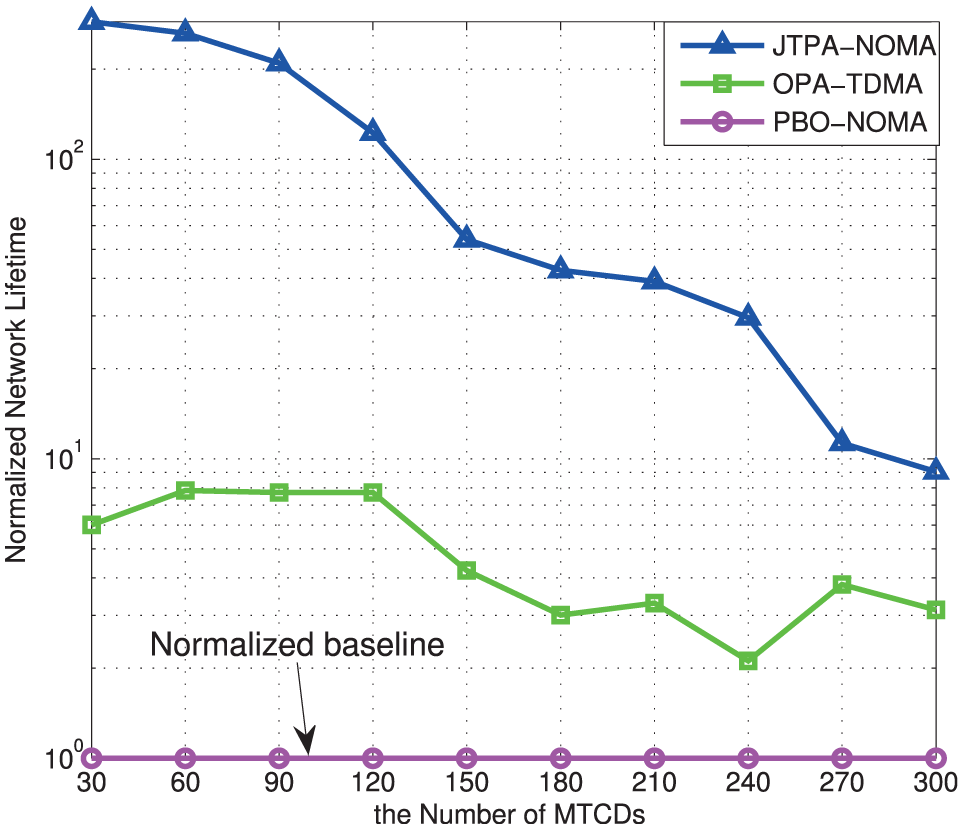
Besides PBO-NOMA, both JTPA-NOMA and OPA-TDMA minimize the energy consumption and prolong the network lifetime; thus, we set PBO-NOMA as a baseline to illustrate the relationship between network lifetime and the number of MTCDs. With the same total energy of each MTCD, the network lifetime is evaluated by the period the first MTCD runs out of its energy. The Y-axis of Figure 3 depicts the normalized network lifetime, which is defined as the ratio of network lifetime of JTPA-NOMA and OPA-TDMA to network lifetime of baseline PBO-NOMA. The number of group is set as 50 and the time factor of cooperation phase in UC-NOMA is set as 0.05 to simulate a worse case.
The normalization network lifetime of baseline versus the number of MTCDs.
In Figure 3, it can be clearly seen that the lifetime of JTPA-NOMA is few or hundred times to that of PBO-NOMA. With the number of MTCDs increasing, the MTCDs in each group will increase. MTCDs have to increase transmission power to successfully upload their payloads under server CCI; this directly leads to the increase in energy consumption and decrease in mMTC networks’ lifetime.
Figure 4 shows the average energy consumption and the average power consumption for different MTCDs within total time

Average energy and power versus different MTCD numbers.
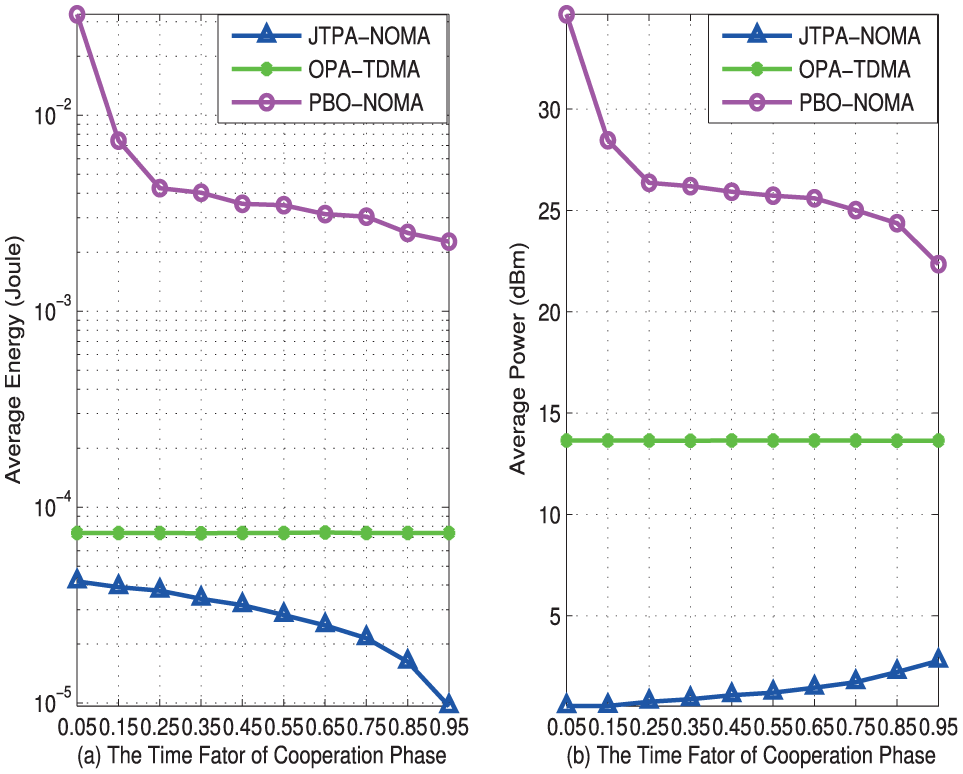
Figure 5 shows the average energy consumption and the average power consumption of all MTCDs in the UC-NOMA within total time
Average energy and power versus different time factors.
Figure 6 shows the average energy consumption and average power consumption versus different number of groups within total time

Average energy and power versus different group numbers.
Finally, in Figure 7, we illustrate the average energy efficiency versus different number of groups within total time

Average energy efficiency versus different group numbers.
Conclusion
In this article, the time allocation and power control problems in UC-NOMA–based mMTC network were jointly studied, with the aim of minimizing the energy consumption and prolonging the network lifetime. By exploiting the distinctive channel gains of MTCDs, an MTCD grouping method is introduced to control the massive MTCDs’ access. Furthermore, a UC-NOMA scheme is proposed, where the MTCD with poor channel condition transmits its data to the group head in the transmission phase; then, the group head transmits its own data and received data to the BS in the cooperation phase. Based on the proposed dynamic group head selection scheme, the MTCD with more residual energy and closer to BS is selected to be the group head. In addition, fractional transmission time allocation scheme is proposed to solve the problem of JTPA. Simulation results have shown that the proposed JTPA outperforms the PBO-NOMA and OPA-TDMA in terms of energy minimization.
Footnotes
Appendix 1
This part aims to prove problem (9) ia a convex function. Problem (9) can be written as follows
Assuming that
Equation (16) is rewritten as follows
where
With the first derivation of
Furthermore, given that
we have
With the second derivation of
The same can be obtained
Thus, Problem (9) is convex function of transmission time.
Handling Editor: Wei Ni
Declaration of conflicting interests
The author(s) declared no potential conflicts of interest with respect to the research, authorship, and/or publication of this article.
Funding
The author(s) disclosed receipt of the following financial support for the research, authorship, and/or publication of this article: This paper is supported by National Key R&D Program of China no. 2017YFB0801702, Beijing Natural Science Foundation no. L172033, National Natural Science Foundation of China no. 61471068, and 111 Project of China B16006.
