




Abstract
The explosive demands for mobile broadband service bring a major challenge to 5G wireless networks. Device-to-device communication, adopting side links for user-direct communication, is regarded as a main technical source for offloading large volume of mobile traffic from cellular base station. This article investigates the joint power and subcarrier allocation scheme for device-to-device communication in 5G time division duplex systems. In time division duplex system, instead of utilizing an exclusive portion of the precious cellular spectrum, device-to-device pairs reuse the subcarriers occupied by cellular users, thus producing harmful interference to cellular users in both uplink and downlink communication, and strongly limiting the spectrum efficiency of the system. To this end, we focus on the maximization of device-to-device throughput while guaranteeing both uplink and downlink channel quality of service of cellular users as well as device-to-device pairs. The problem is formulated as a mixed integer non-linear programming (MINLP) problem. To make it tractable, we separate the original MINLP problem into two sub problems: power allocation and sub-carrier reusing. The former is to develop optimal power allocation for each device-to-device pair and each cellular user, with the constraints of maximum power and quality of service. It is solved by geometric programming technique in convex optimization method. The latter is derived as a one-to-many matching problem for scheduling multiple subcarriers occupied by cellulars to device-to-device pairs. It is solved by Hungarian method. Simulation results show that the proposed scheme significantly improves system capacity of the device-to-device underlay network, with quality of service of both device-to-device users and cellular users guaranteed.
Introduction
To meet the future societys crave for high data rate and capacity requirements, academia and industry propose the next generation of wireless networks,1,2 namely 5G, who can support 1000 times higher mobile data volume per area and 10 to 100 times higher data rate per user than today.3,4 Such challenging requirements necessitate the scarce resources to be utilized more efficiently. Device-to-Device (D2D) communication is recognized as a promising technology in 5G mobile networks that provides an insight into tackling this challenge. 5
With D2D technology, mobile users in proximity can directly communicate among themselves by reusing the resources of cellular users (CUs), without having to send data through a base station, thereby offloading the network infrastructure, providing increased spectral efficiency, decreasing the delay and energy consumption, and extending the battery lifetime of mobile terminals.6–8 In addition, 5G is envisioned to cover a broad range of use cases with diverse requirements. On one side, there is the classical challenge of supporting the demand for higher data rates, such as enhanced mobile broadband (eMBB). On the other hand, there is a new class of services which has emerged with different challenges. For example, ultra low latency is required in some use cases of machine type communications (MTC), such as factory automation. The other use cases include extremely high reliable V2V communications. Other use cases include extremely high reliable V2V communications. Such different applications and diverse requirements make the uplink (UL)/downlink (DL) traffic asymmetry more and more serious. 9 So time division duplex (TDD) systems play an important role in 5G networks due to its capability to support asymmetric services by adjusting the fraction of time dedicated to UL and DL transmissions as well as reduce signaling and radio frequency front-end complexity by exploiting channel reciprocity.10,11 In addition, D2D communication and TDD system have the same characteristics that each transmitter–receiver pair has the freedom to schedule its time and frequency resources, which not only can minimize the interference between simultaneously transmitting radio entities but also support diverse services.
Due to the potential advantages of D2D communication and the TDD, the D2D communication under-laying TDD cellular networks has attracted great attention among researchers. For example, vehicle-to-vehicle communication utilizes the ultra-reliable low latency communications (URLLC) link to deliver safety-relevant messages to the vehicles in its vicinity through a D2D wireless link. However, D2D links share the same subcarriers with cellular UL and DL, which results in a new complicated interference relationship among the communications links. In addition, previous resource allocation schemes for D2D communication either considering reusing cellular UL or DL resources in frequency division duplex (FDD) system are unlikely to optimize the network performance,8,12 and these literatures consider the D2D pair shares channel with only one CU, it also limits the spectrum usage of the D2D communication. 13 As opposed to previous work, this article focuses on resource allocation of D2D communication under-laying spectrum sharing in both UL and DL phases and each D2D pair can reuse channels of multiple CUs while each CU shares channel with only one D2D pair.
Related work
To improve network performance, integrating D2D communications in cellular systems with flexible TDD has only recently gained attention in the literature. Frameworks for D2D enhanced TDD networks are proposed in Venkatasubramanian et al. 14 and Sun et al. 15 ; it mainly concentrates on the adaptive UL/DL slot allocation to D2D links. Accounting for minimizing energy consumption, an optimal mode selection is provided in Chu et al. 16 for D2D enhanced two-tier heterogeneous cellular network with a dynamic TDD scheme. An adaptive mode selection between D2D relaying and multi-beam reflection in TDD mmWave network is proposed in Feng et al., 17 whose objective is maximizing the sum logarithm rate and a two-stage solution algorithm is used to solve the issue of resource sharing. A novel graph modeling approach for optimizing the order of UL and DL transmission slots of bidirectional D2D communication under-laying cellular TDD Networks is investigated in Uykan and Jntti 18 to minimize the network interference. Huynh et al. 19 propose an interference management algorithm to maximize the performance of the D2D communication while satisfying the quality-of-service (Qos) requirements of the cellular communications in both UL and DL phases. Penda et al. 20 investigate joint mode selection, UL/DL transmission period, and power allocation for D2D communication in TDD cellular systems to improve energy-efficiency while satisfying a traffic requirement. Based on instantaneous signal-to-interference-plus-noise ratios (SINRs), mode selection of D2D and device-infrastructure-device communication is presented in Moya et al. 21 for multi-cell D2D with dynamic UL/DL TDD scheme. To coordinate the interference relationship, a novel interference-aware TDD scheme and a joint subcarrier assignment and power allocation are investigated in Liu et al.,22,23 respectively.
The performance of D2D communications in TDD networks have been widely discussed, such as mode selection, merit analysis, UL/DL configuration, interference coordinate, and energy cost reduction. However, considering maximizing D2D throughput, joint power allocation and subcarrier sharing for D2D communications under-laying 5G TDD cellular networks are still missing.
Contribution
In this article, we consider a novel resource allocation for D2D communications under-laying 5G TDD cellular networks. We formulate a joint power allocation and subcarrier sharing problem with the objective of maximizing the sum rate of D2D and propose a two-stage solution algorithm. First, we calculate their optimal transmit power of each D2D pair according to the SINR requirements for each D2D pair and each CU and subsequently determine whether D2D pair is allowed by power constraints. Second, one to many matching model is used to allocate subcarriers in order to maximize the D2D throughout, which is solved by Hungarian method. Our contributions are summarized as follows:
We propose a novel resource allocation for D2D communication under-laying spectrum sharing in both UL and DL stages, and a mix-integer optimization problem is formulated.
In order to effectively solve the optimization problem, a two-step resource allocation scheme is designed. Then the original problem is decomposed into two low-complexity subproblems: power allocation and subcarrier sharing.
Finally, a standard geometric programming technique in convex optimization theory is utilized to solve power allocation and subcarrier assignment is constructed as one-to-many matching model, and solved by Hungarian algorithm.
The remaining of this article is organized as follows. Section “System model and problem formulation” introduces the system model of D2D communication under-laying TDD cellular network and the problem formulation. Section “Resources allocation” demonstrates resource allocation including power allocation and subcarrier allocation. Section “Simulation result” explains the simulation results to evaluate the performance of proposed scheme. Section “Conclusion” provides conclusions together with future work.
System model and problem formulation
System model
As illustrated in Figure 1, we consider a fully loaded cellular network, in which only one evolved NodeB (eNB) is located at the center. We assume that there are

System model device-to-device (D2D) communication: (a) D2D communication in uplink stage and (b) D2D communication in downlink stage.
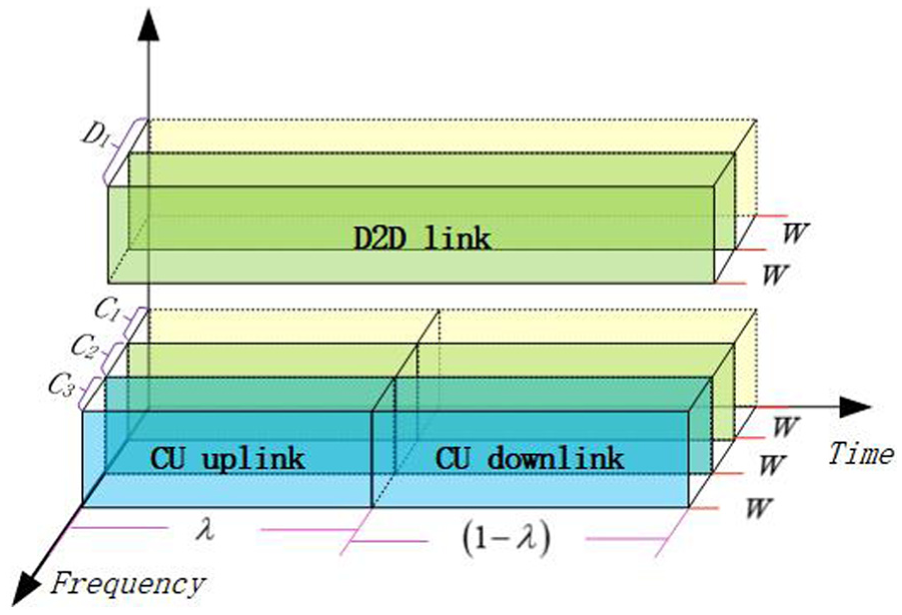
Frequency–time resources configuration in TDD cellular network: D2D links can use the full frame duration
In this system, we consider cellular communication with the dynamic TDD scheme, where the UL and DL transmissions for a user pair occur on the same frequency subcarrier but alternate in time. The portioning of resources for UL and DL can be configured in time frame, but it is assumed to be the same for all communications. Since each CUs are allocated different frequency subcarriers with bandwidth
To solve the massive access challenge in 5G, non-orthogonal multiple access technology is considered for D2D communication, where each D2D pair uses the full frame duration consisting of UL stage and DL for its transmission (Figure 2). So there exist a complex interference in this system. As shown in Figure 1(a), D2D receivers suffer interference from CUs and eNB also suffer interference from D2D transmitter in UL stage. Correspondingly, D2D receivers suffer interference from eNB and CUs also suffer interference from D2D transmitter in DL stage, see Figure 1(b).
As in Yu et al.,
24
we further assume the number of CUs in the system is usually larger than that of D2D pairs and then spectrum utilization is very low when one D2D pair only shares the subcarrier resource of one CU. Therefore, we consider that one D2D pair can reuse the subcarriers of more than one CU and the subcarriers of one CU can only be shared by one D2D pair in order to avoid interference between D2D pairs. As shown in Figure 1,
Problem formulation
In this section, we will show the important parameters and variables used in the problem formulation and derive the transmission rate for CU and D2D pair in both UL and DL phases.
Define a binary variable


We denote


Optimization model
Our objective is to maximize the D2D throughout while guaranteeing QoS requirements for CUs and D2D pairs. The optimization problem can be formulated as follows
P1





The objective function is shown in equation (5). Constraints (6) and (7) denote the minimum channel quality requirement, which
The process of resource allocation is shown in Figure 3; the eNB can detect potential D2D pairs and obtain the channel state information of all involved links. This proposed scheme can be carried out in a semi-centralized manner. First, the eNB collects the mobile information of all users, such as channel gain and geographical position. This process can be done during the special sub-frame period in 5G TDD system. Then, the eNB broadcasts this information to all users. After that, the CU and D2D pairs execute power control in section “Power allocation”; D2D pair executes subcarrier assignment in section “Subcarrier assignment” to find the CU that shares the same frequency subcarriers.
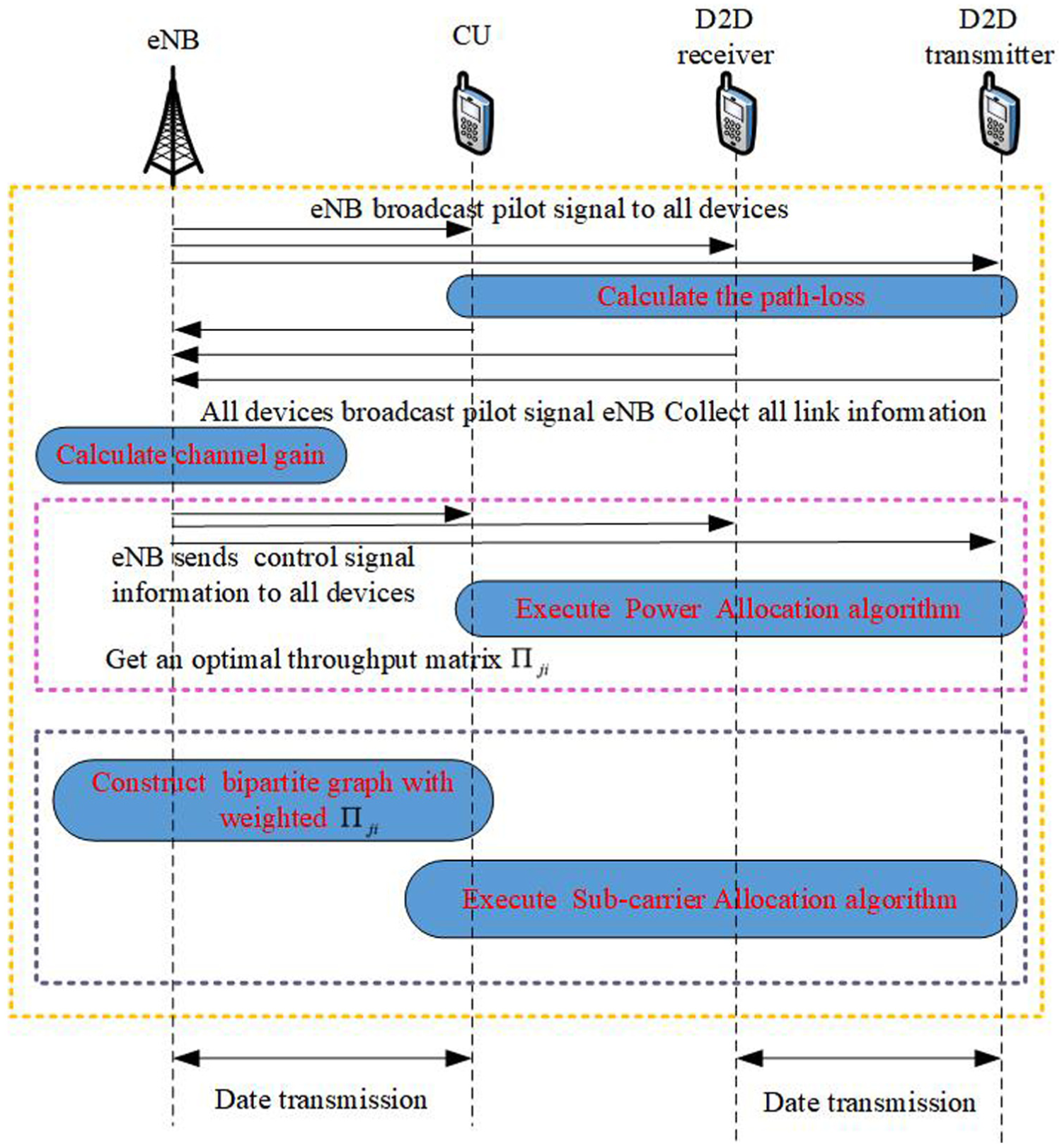
The procedure of the proposed resource allocation.
Resources allocation
In this section, we will solve the original optimization problem in
Power allocation
As far as we known, the MINLP problem in

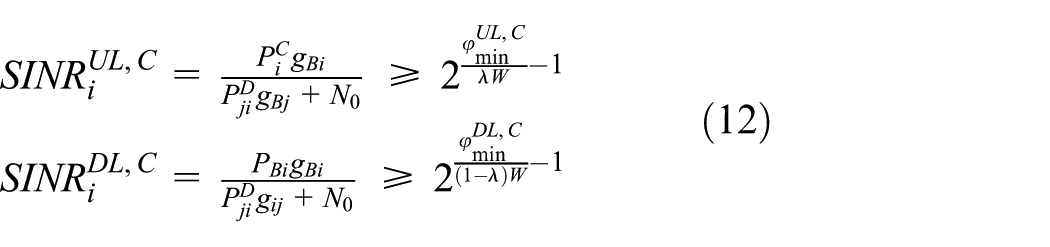


Since

Possible feasible regions with different situations (PDyA<PMAXD, PDyB<PMAXD, PCXA<=PMAXC, PCXB<=PMAXB):(a)PDyD<PMAXD <PDyC, PCi<=PMAXC, PBi<=PMAXB, (b)PDyD>PMAXD > PDyC, PCi<=PMAXC, PBi<=PMAXB, (c)PDyD<PMAXD < PDyC, PCi<=PMAXC, PBi<PMAXB, (d)PDyD<PMAXD < PDyC, PCi<=PMAXC, PBi<=PMAXB, (e)PDyC<PDyD< PMAXD, PCi<=PMAXC, PBi<=PMAXB, (f)PDyD< PMAXD<PDyC, PCi<=PMAXC, PBi<PMAXB, (g)PDyD> PDyC>PMAXD, PCi<PMAXC, PBi<=PMAXB, (h)PDyD>PMAXD > PDyC, PCi<PMAXC, PBi<=PMAXB, and (i)PDyD> PDyC>PMAXD, PCi<PMAXC, PBi<PMAXB.
Points
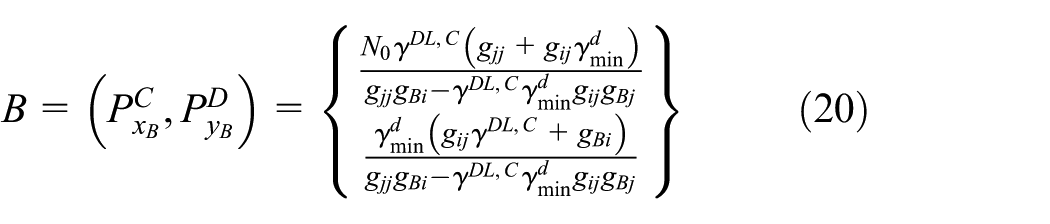
After that, we will derive optimal power solution of a given D2D pair


Substituting equation (12) into the objective function (11), we have equation (17). Since the objective function (17) is logarithm, function, it is monotonically increasing with

We traverse the set of D2D pair



Subcarrier assignment
In this section, the optimal assignment is found for D2D pair
Because each D2D pair has more than one reusable CU partners the same CU may be the best partner for different D2D pairs. We may need to M! permutations and combinations to find the optimal solution and the complexity grows exponentially with the increasing of the number of UEs, so this enumeration method is not feasible in practice. Therefore, we construct the maximum-weight bipartite graph matching model to find the subcarrier assignment, thus reducing the complexity.


From

Illustration of bipartite matching between D2D clusters and cellular users: (a) bipartite matching in the case of
According to Kuhn
25
and Munkres,
26
Hungarian algorithm is a typical method to solve one to one bipartite matching problem. In order to solve one to many bipartite matching problem, we need to transform the original non-symmetric bipartite graph into an absolute symmetric one. It can be achieved (1) if M is ∂ times of
Step 1: Build the input cost matrix
Step 2: Find out the minimum value
Step 3: Search sub-graph
Step 4: Let
Step 5: Find the edge set of
Step 6: Restore the copied D2D vertexs in
From above, we can get the optimal solution of resources allocation, which is also shown in Scheme 1. Note that the Hungarian method is based on Theorem 1 that is proved in Kuhn. 25
Optimal resource allocation algorithm.

Theorem 1
If a constant is added (or subtracted) to every element of any row (or column) of a given K-by-K cost matrix in an assignment problem, then the assignment which minimizes the total cost for the new matrix will also minimize the total cost matrix.
Simulation result
In this section, we perform a series of experiments to evaluate the performance of the proposed algorithm. The simulations are carried out in a single-cell scenario, where the eNB located in the network center of a 500 m × 500 m area. The CUs and D2D pairs are randomly distributed in the eNB coverage area and the maximum distance between D2D transmitter and D2D receiver is 25 m. Unless specified otherwise, the simulation parameters are set as Table 1.
Parametes of system.
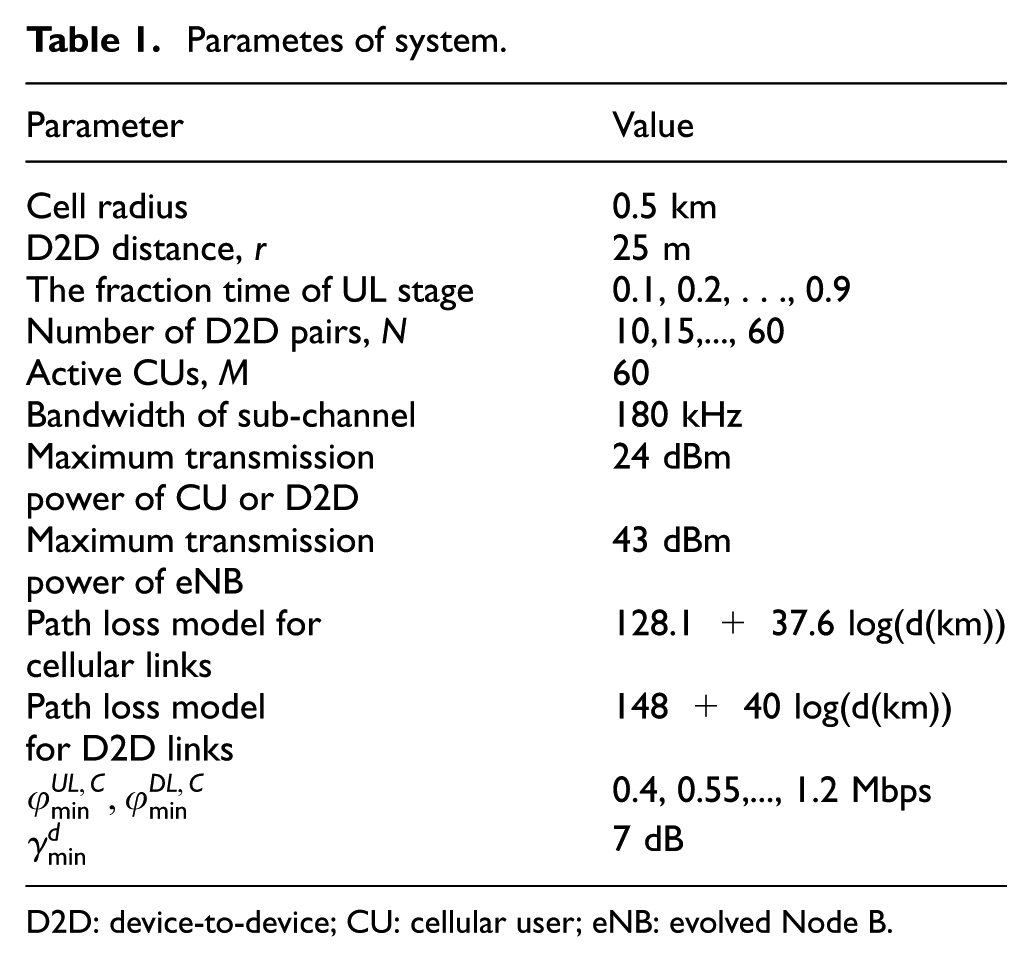
D2D: device-to-device; CU: cellular user; eNB: evolved Node B.
In the simulation, we use D2D throughput and the admission rate of D2D pairs as performance metrics. The admission rate is the ratio between the number of D2D pairs allowed to share channel with CUs and the number of D2D pairs, that is,
Effects of UL/DL configuration
Figures 6 and 7 depict the throughput and the admission rate of D2D pairs for different fraction times of UL stage under three algorithms. There are very interesting characteristics from the result. It is obvious that the throughput of the D2D and the number of admitted D2D pairs are maximum in our proposed algorithm when the fraction time of UL stage from 0.4 to 0.6. If the fraction of UL stage is too small (or too big), the transmission rate of the CU is small in UL stage (or DL stage). The D2D pair might not be able to reuse the channel of the CU without violating throughput requirement of CU. By comparing Figures 6 and 7, we observe that the D2D admission rate in CHA is more than that in our algorithm, but its throughput is still lower than our method. The reason is that the D2D pairs in our algorithm are allowed to reuse multiple CUs’ frequency subcarrier; conversely, the D2D pairs in the heuristic only have at most one CU’s frequency subcarrier to reuse. So more spectrum is provided for D2D pairs in our proposed algorithm but its D2D admission set is smaller due to sharing spectrum in both UL and DL phases. The D2D throughout in OUA increases as the fraction time of UL stage, but it is still smaller than that of our algorithm except

D2D throughput versus the fraction of CU uplink time.

D2D admission rate versus the fraction of CU uplink time.
Effects of the number of D2D pairs
Since the D2D throughput strongly depends on the number of D2D pairs, we evaluate the impact of the number of D2D pairs on the performance of D2D throughput and D2D admission rate in Figures 8 and 9, respectively. We set the number of CUs to be 60 and the fraction time for UL to be 0.5, then vary the number of D2D pairs in the range of [10, 60]. It can be seen from Figure 8 that the throughput of D2D increases as the number of D2D is increased for all schemes. However, there exists saturated points (

D2D throughput versus the number of D2D pairs.

D2D admission rate versus the number of D2D pairs.
Different from the above phenomenon, it can be seen that the admission rate of D2D pair in Figure 9 does not increase proportionally to the throughput in Figure 8, that is, the admission rate decreases while the throughput increases. Although the admission rate of D2D pairs in our algorithm is lowest, the throughput is maximal. This is because our method not only uses one to many resource reuse mode, but also makes full use of the UL and DL time slots.
Effects of the QoS requirement of CU
Figure 10 shows the influence of D2D throughput with different QoS requirements of CU. We set the number of CUs and D2D users to be 60 and 50, respectively, and vary QoS requirements of CU from 300 to 1200 Kbps. It can be seen that D2D throughput is greatly influenced by QoS requirements of CU. From Figure 10, the D2D throughput decreases with increasing QoS requirements of CU for all algorithms. In order to preserve QoS requirements of CU, more power is allocated to them, causing more interference to its reused D2D pair. Correspondingly, the D2D link quality is poor. Due to the SINR requirements of D2D, it limits the number of admitted D2D pair, which results in reduced D2D throughput. Moreover, the throughput of our proposed algorithm and that of CHA algorithm are gradually equal. This is because our proposed algorithm loses the opportunity for a D2D pair to reuse multiple CU resources as the number of D2D increases. The throughput of the OUA algorithm is the worst because it only reuses the resources in UL time slots. Figure 11 illustrates the impact of the QoS requirements of CU on the performance of D2D admission rate. Obviously, the access rate of D2D decreases as the QoS requirement of CU increases. Although the throughput of CHA algorithm is not best, its access rate performs best. The reason is that CHA algorithm utilizes one to one resource reuse mode, and it has more chances to reuse CU resources. Moreover, the admission rate of the OUA is higher than our proposed algorithm. This is because the OUA considers the QoS requirement in only UL stage. As a result, more D2D pairs are allowed to share channel with CU. However, D2D only uses uplink resources in OUA algorithm, so the throughput of D2D in this algorithm is relatively low.

D2D throughput versus CU QoS threshold.

D2D admission rate versus CU QoS threshold.
Conclusion
In this article, we have investigated resource allocation for D2D communications in TDD system. It consists of power allocation and subcarrier assignment. To maximize the D2D throughput while guaranteeing the QoS requirements of both CUs and D2D pairs, we formulate the optimization problem as a MINLP problem and find the optimum solution using a two-step scheme. First, optimal power allocation is solved by geometric programming method for each D2D pair and CU. Next, one to many maximum-weight bipartite matching method is developed to select suitable CU partners for each admissible D2D pair with maximizing D2D throughput. In this work, multiple CUs’ subcarriers can be allocated to one D2D link and each admitted D2D pair shares CUs’ spectrum in both UL and DL phases. Thus, the spectrum resources are efficiently utilized. Simulation results show that our scheme always performs best in terms of D2D throughput. In future work, we will investigate scenarios where multiple D2D links are allowed to share the same resource with the CUs as long as D2D transmissions are not harmful to the cellular transmissions.
Footnotes
Handling Editor: Daniel Gutierrez-Reina
Declaration of conflicting interests
The author(s) declared no potential conflicts of interest with respect to the research, authorship, and/or publication of this article.
Funding
The author(s) disclosed receipt of the following financial support for the research, authorship, and/or publication of this article: This work was supported by the National Natural Science Foundation of China under grant no. 61271187 and China Postdoctoral Science Foundation funded project 2017M610827.