




Abstract
Orthogonal multiple access schemes based on assignment of communication resource blocks among multiple contenders, although widely available, still necessitate an upper limit on the number of concurrent users for minimization of multiple-user interference. The feature thwarts efforts to cater for pressing connectivity demands posed by modern-day cellular communication networks. Non-orthogonal multiple access, regarded as a key advancement towards realization of high-speed 5G wireless communication networks, enables multiple users to access the same set of resource blocks non-orthogonally in terms of power with controllable interference, thereby allowing for overall performance enhancement. Owing to the combinatorial nature of the underlying optimization problem involving user pairing/grouping scheme, power control and decoding order, the computational complexity in determining optimal and sub-optimal solutions remains considerably high. This work proposes three novel alternative approaches (Randomly, 2-Opt and Hybrid) for arriving at a near-optimal solution for the problem of user pairing/grouping. The algorithms not only offer reduced computational complexity but also outperform orthogonal multiple access and existing schemes reported in the literature for uplink non-orthogonal multiple access systems.
Introduction
The exponential increase in traffic originating from wireless communication networks has sparked interest at the end of several researchers. Spurring from both academic and industrial contributors, the efforts have primarily been focused towards developing next-generation (5G) Wireless Communication Networks, aimed at substantial enhancements in user-performance as well as coverage. 1 The above-mentioned enhancements are set to overcome the constraints posed by existing communication networks. The transition to 5G networks is posited to address the challenges related to spectral efficiency, massive connectivity and superior coverage.2,3 Broadly speaking, multiple access schemes are categorized into two main categories: non-orthogonal multiple access (NOMA) and orthogonal multiple access (OMA), with the choice to select either depending upon the resource allocation strategy assigned to multiple users 4 In the OMA scheme, resources are allocated to each user in a cell exclusively, without inter-cell interference. In this arrangement, however, low-complexity decoding techniques can be readily employed at the receiver for recovery of user information. In current conditions, a hefty majority of existing mobile communication standards including Long-Term Evolution (LTE) and LTE Advanced 5 draw heavily from OMA. More recently, NOMA has managed to grab significant attention as a potential candidate for deployment in 5G technology for wireless communication networks. Although NOMA allocates identical resources in the power domain to all users, inter-user interference remains inevitable. Consequently, a more complex technique known as multi-user detection (MUD) has been recently introduced for recovering user information at the receiver, even in the presence of inter-user interference.
Spectral efficiency obtained using the NOMA scheme has been demonstrated to be greater than that for OMA.6–8 In essence, differentiating user signals as distinct entities requires adoption of an approach based on power control at the transmitter. Furthermore, a multitude of approaches aimed at power allocation 9 has been introduced for a typical single-cell NOMA system. Owing to co-channel interference from different cells, the method for power allocation corresponding to a single cell remains much simpler than that encountered in a multi-cell configuration. With the intent to overcome co-channel interference, a distributed power allocation method for downlink has been proposed for mitigation of total transmitted power in the multi-cell scenario. 10
Due to the stark difference in the sequence following which user information is encoded and decoded at the transmitter and receiver for encoding and decoding information, the mechanism for uplink and downlink NOMA remains considerably distinct. Decoding at the receiver is based upon the application of successive interference cancellation (SIC) and remains a function of power allocation strategy. 11 To compensate for the path loss propagation, a scheme known as fractional power control (FPC) is introduced for uplink LTE-A. 12 That said, decoding different user signals at the receiver by exploiting the existing FPC is a difficult ordeal. Addressal of this constraint via an advanced power control scheme that draws heavily from game theory for reduction of interfering-cells thereby lowering the total consumption of power. 13
To enhance the network capacity, the concept of Small Cell Networks (SCNs) has been introduced for future-centric mobile communication networks.14,15 For uplink NOMA, a novel detection method is proposed for small cell 16 wherein both near- and far-signal users are facilitated while leveraging dual path loss compensation factors (PLCFs). An analytical framework for power allocation accompanied by the concept of user clustering for hybrid downlink NOMA 17 networks is presented. The basics of uplink NOMA system and downlink NOMA system, their significant dissimilarities, detection, decoding, implementation complexity, and inter and intra cell interferences are discussed while illustrating the concept of two-user clustering strategy 18 for uplink/downlink NOMA systems. A power control method 19 is proposed for uplink multi-cell with two-user clustering strategy based on stochastic geometry along with a discussion on a novel model for inter-cell interference based on the Laplacian transformation. User-pairing and power allocation are the key factors for increasing the capacity of uplink NOMA. A detailed lookup table 20 is provided for efficient user-pairing and power allocation. In addition, a joint interference cancellation method 21 is suggested for uplink NOMA to solve the issue of error-propagation and time delay in SIC utilizing a combination of parallel-interface cancellation (PIC) and SIC.
For uplink NOMA systems, a framework elucidating joint user association, power control and user grouping 22 is introduced for multi-cell environment for reduction of inter-user interference. A technique for the allocation of resource block (RB) and clustering for uplink multi-carrier NOMA communication networks has also been proposed to provide time-based proportional fairness. 23 Yet another power allocation scheme is proposed to increase the sum rate and reduce interference using a water-filling technique. The approach is a composite of two techniques, namely, interference filling and conventional power filling. 24 The key differences in the operation of uplink/downlink 25 for cellular communication networks have been discussed. Moreover, a power allocation scheme for user clustering in NOMA has also been introduced to increase the overall system performance. With the intent to increase spectral efficiency of a network, an iterative technique for uplink NOMA based on shifted-gamma strategy 26 in the existence of inter-user has also been put forward. Maintaining fairness among users in terms of data rate is a long-standing challenge, especially in scenarios where the inequality is exhibited in data rates over a huge scale, for which a thorough discussion has been carried out concluding that NOMA service, at times, can be crucial when it comes to avoiding strict fairness 27 in certain conditions. A power allocation scheme is proposed for uplink multi-cell networks to increase the spectral efficiency in the presence of co-channel interference. 28 Moreover, an optimum and sub-optimum algorithm for efficient user-pairing and power allocation scheme for uplink NOMA is formulated to enhance the overall system performance. 29
Recent research studies focused on NOMA transmission have unearthed two major limitations encountered during implementation of uplink NOMA systems. First and foremost being interference mitigation among small cells which has not been taken into consideration. 30 Severe instances of inter-cell interference leads to pronounced degradation of system level efficiency. The second limitation, centred around a power allocation scheme 31 with full channel-inversion, is also discussed. The optimal performance of a network due to fact that PLCFs of different signal users are not jointly formulated to obtain the highest spectral efficiency. A novel approach based on game theory 32 is deployed to increase the capacity of the network for uplink NOMA clustering. In addition, an iterative algorithm has also been proposed by assuming Karush Khun Tucker (KKT) conditions for effective addressal of challenges related to power allocation, system throughput and fairness in the context of user clustering in NOMA. Yet another technique is proposed for user clustering and power consumption in multi-cluster multi-input single-output (MISO) NOMA network. 33 A combinatorial joint problem is formulated and solved to obtain the closed form global optimal solution for user pairing/grouping in order to achieve sum rate. 34 Both OMA and NOMA techniques are discussed for downlink scenario, 35 by considering the order of decoding, sum rates, and power allocation techniques and are used to determine the throughput and outage analysis for two users. A framework 36 has also been presented for wireless communication networks including the fractions of energy harvesting and evaluates the ergodic rate and outage performance for attaining optimal solution. For each user, efficient energy resource allocation 37 with quality of service (QoS) constraint for uplink NOMA is considered.
A joint power allocation and user association scheme is postulated based on the swap-matching algorithm to improve system coverage. Furthermore, an algorithm has been suggested to accentuate the sum rate capacity for uplink multi-carrier NOMA system wherein the number of sub-carriers assigned to each user is not limited. 38
Research on power control and user pairing/grouping, particularly for uplink NOMA systems, remains a crucial aspect improving upon which is of paramount importance. With the said as the core motivation, user pairing/grouping in NOMA for uplink case is investigated by examining specific predetermined power control approaches with near-perfect SIC. In this article, we examine a combinatorial optimization problem for uplink NOMA system and propose three algorithms (Randomly, 2-Opt and Hybrid) for user pairing/grouping problem to enhance the system performance and reduce the computational complexity. The obtained results are compared with those for conventional OMA scheme and existing NOMA approaches reported in the literature for uplink scenario. Simulation results indicate that the proposed algorithms achieve a significant improvement in spectral efficiency.
The rest of the article is organized into the following sections. The uplink NOMA system is described in section ‘System model’. The problem formulation is discussed in section ‘Spectral efficiency maximization’. In section ‘Solution of proposed model’, the solution of the research problem is presented. Results are described in section ‘Simulation results’, and finally, the conclusion of this research is provided in section ‘Conclusion’.
System model
Consider a single-cell
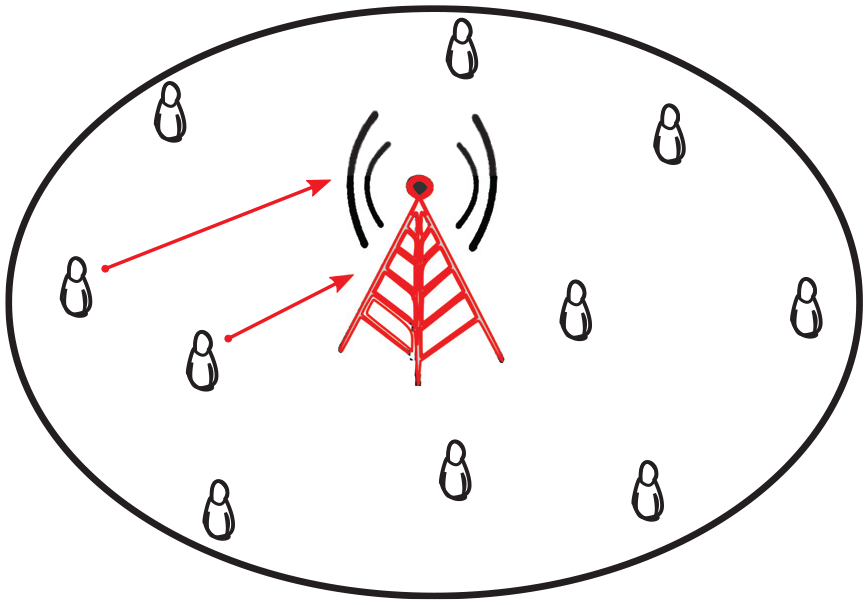
NOMA uplink transmission.
To perform NOMA transmission, all users in the same group maintaining same PRB while in OMA transmission, different users group allotted different PRB. Therefore, the received signal

where


where

where


It is clear from equation (6) that the spectral efficiency in each group has not affected by the order of decoding but the spectral efficiency of each user is not same as a result of different decoding order.
Spectral efficiency maximization
In this article, an efficient approach for power control, decoding order and user grouping is proposed to increase the spectral efficiency of each uplink NOMA users in a single cell. Therefore, a joint combinatorial problem of power control, decoding order and user pairing/grouping is formulated to maximize the spectral efficiency. The minimum spectral requirement of each user in the network is


where
Solution of proposed model
To acquire the global optimal solution of the Problem (7a). Hence, optimization variables
Noted that, for any fixed user-pairing/grouping approach,



where
Decoder design for user grouping
In order to apply SIC and decoding order for

where

It implies that the user in a cell with larger value of
Power control
The proposed power control approach is a mixed integer non-linear programming (MINLP) and the nature of the problem is combinatorial. Therefore, it is required to find all the possible group of combination for user pairing/grouping. Consider a single-cell
Assume that, the users in a


where
As indicated, equation (11a) is increasing for the power control variables

where

which signifies that the spectral efficiency requirements are equal to the sum of spectral efficiencies of all the users. If

where

In reference to equations (14) and (15), the optimal power control variables
Optimal user grouping
A low computational time algorithm for efficient user-pairing/grouping is one of the primary concerns for successful uplink NOMA systems. For uplink NOMA system, a low-complexity algorithm is proposed for user-pairing/grouping as a result to enhance the spectral efficiency of the network and reduce the complexity.
For uplink NOMA scheme, we propose three alternative algorithms for user pairing/grouping that exploits the channel-gain difference among different users and the objective is to increase the spectral efficiency. To determine the optimum user pairing/grouping, a specific approach of solving user pairing/grouping problem is using exhaustive search approach. For fixed user-pairing/grouping scheme, the optimal solution is obtained. Then, list all the users in the decreasing order of


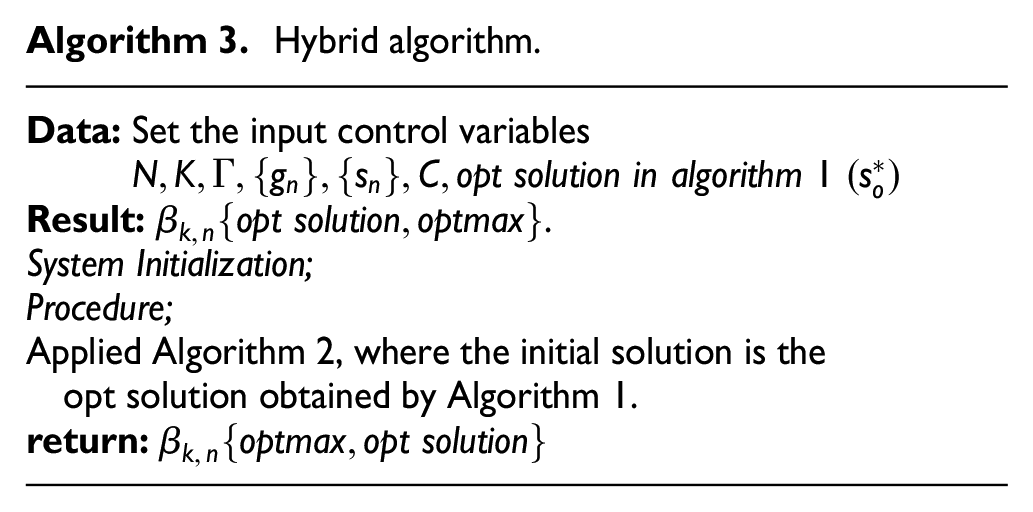
Definition
A feasible solution of the user pairing/grouping can be defined by the following matrix

where

The same solution can be represented as a form of quasi permutation matrix as following

where it can be expressed in mathematical form as

Complexity of Algorithms 1, 2 and 3
The generator of feasible solution is complexity order
Consider a quasi permutation matrix




Then, the total number of operations executed in Algorithm 3 is given as


where
Simulation results
This section evaluates the proposed algorithms (namely, Random, 2-Opt, and Hybrid) for their performance considering user-pairing/grouping scheme for uplink NOMA system. Parameters characterizing the simulation are summarized in Table 1.
Parameters for proposed uplink power domain multiple access.

Both channel of the users and location are allocated randomly in the simulation. Therefore, the range between the user and BS are uniformly distributed and the channel response is assumed to be a Gaussian distribution. 34
Figure 2 shown above compares the spectral efficiency of NOMA systems with that for OMA systems under varying transmission power-to-noise ratio for different

Illustration of spectral efficiency of NOMA with varying

Illustration of spectral efficiency of NOMA with increasing
Conclusion
This work jointly investigates decoding order, power control and user grouping to enhance network performance. An optimal solution for determination of appropriate decoding order and power control is formulated. Thereafter, three distinct algorithms for sub-optimal user-grouping solutions are proposed which bring about significant improvement in spectral efficiency while offering lowered complexity and ease of implementation. Simulated results validate the efficacy of the proposed computationally efficient approach for uplink NOMA system by demonstrating improvement in performance when stacked against conventional OMA scheme. Moreover, the performance surpasses the existing approaches reported recently in the literature, making the proposed strategy a good candidate for addressing the demand posed by 5G wireless communication networks.
Footnotes
Handling Editor: Peio Lopez Iturri
Declaration of conflicting interests
The author(s) declared no potential conflicts of interest with respect to the research, authorship and/or publication of this article.
Funding
The author(s) disclosed receipt of the following financial support for the research, authorship and/or publication of this article: This research was supported by Taif University Researchers Supporting Project Number (TURSP-2020/216), Taif University, Taif, Saudi Arabia.
