



Abstract
Micahel Hout reviews How College Works and Degrees of Inequality.
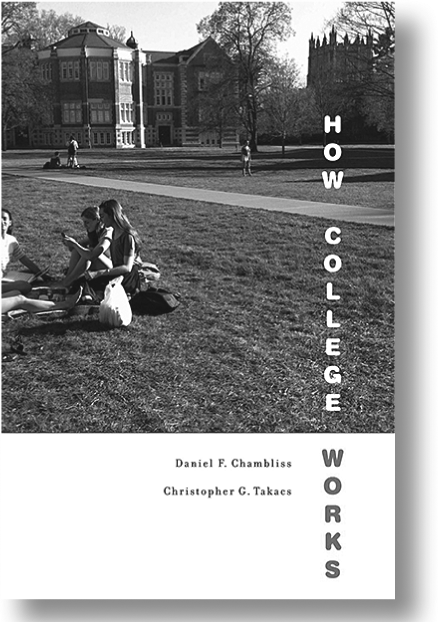
How College Works Daniel F. Chambliss and Christopher G. Takacs Harvard University Press, 2014 224 pages
Degrees of Inequality: How the Politics of Higher Education Sabotaged the American Dream Suzanne Mettler Basic Books, 2014 272 pages
Scholars and journalists have dissected American higher education, from the admissions crunch to the tuition spiral, team sports excesses, and administrative corruption—to say nothing of student debt, dropout, and drift. Attention to these problems is both timely and welcome. Unfortunately, however, many academics mistake their immersion in the university for expertise in all aspects of campus life. They often pass judgment on problems prematurely. We need to slow down and take to heart something that Leo Goodman once told me, “It’s remarkable what you can learn if you study a subject.”
In their brilliant book, How College Works, Daniel Chambliss and Christopher Takacs scientifically studied their campus. They selected a random sample of 100 freshmen at Hamilton College (where Chambliss teaches and where Takacs earned his BA) and followed them over a period of eight years. Sequence matters, so they lined up the transitions: admission to adjustment to choosing a major, then graduating or pursing an advanced degree. Through questionnaires, face-to-face interviews, and participant observation, they studied students making each of these transitions.
From their careful observations, Chambliss and Takacs concluded that, on college campuses, people make the institution. Face-to-face encounters among students and between students and faculty create the college experience. They do not deny that courses, lectures and seminars expose students to knowledge and ideas. However, these experiences hardly differ from watching television unless students somehow acquire the motivation to take an active part in their education. Showing up is not enough. Learning takes active engagement.
Therein lies what may be called a nudge theory of how college works. With a little help from some friends and a few motivating words from a couple of good teachers, students can make the necessary connections that allow them to transition from being at college to being in college. Once these primary attachments are in place, lectures and readings make sense in a way that they did not before. Learning thus follows from connection.
Chambliss and Takacs dispel the perception that a college is some kind of team pursuing a big, shared goal. They reveal, instead, a collection of cells pursuing a variety of goals. These cells bump into each other in dorms, in classes, and in common spaces, drawing on a collective identity. Contact along these lines can result in fun, information, and encouragement; but it may also lead to indifference or conflict. From the point of view of nudge theory, the more fun, information, and encouragement there is on college campuses, the better; by contrast, indifference undermines community, and conflict outright destroys it. Without commitment, learning does not occur.
All this should be good news for campus financial officers: fun, information, and encouragement are relatively inexpensive. But it is also a stern warning: administrators must be mindful of some recent policies, such as attempts at making dorms seem like private apartments, that are not only costly but also breed indifference.
Chambliss and Takacs believe that bigger and less selective universities can learn a great deal from how Hamilton College works: What higher education needs right now is not a revolution, but a nudge. More nudges.
Will nudges suffice? Not if the goal is to bridge barriers of social inequality.
In Degrees of Inequality Suzanne Mettler rightly brings money back into the discussion by focusing on public investments in higher education. Hers is an exposé of how politics sabotaged educational opportunity between 2008 and 2011. Yet the story she tells is not all glum. She notes that recent changes in student aid policy have made college work better for many students. More scholarship money, simpler application forms, a new GI Bill, and eliminating banks (and bank charges!) from student loans have all promised to lower barriers to college attendance for those who cannot pay out-of-pocket.
Regrettably, though, Congressional attempts to regulate for-profit colleges have made an opportunity agenda harder. The for-profit colleges actually depend more on public investment in higher education than do public colleges and universities. The $20 billion for-profit sector receives over 90% of its revenue from Pell Grants and federally subsidized loans to students. Federally funded students have gotten their foot in the door of these for-profit colleges, but they do not fare well once inside.
For Chambliss and Takacs, showing up is not enough. Learning takes active engagement.
With very few exceptions, for-profits have significantly worse student outcomes than non-profit schools: they have lower graduation rates and higher rates of unemployment. Some of these bad outcomes may reflect selection: few students attending the for-profits could get into selective non-profits. The consensus among educational researchers, however, is that the problem with for-profits is that they give their students a light-weight education, when their students actually need the heaviest educational treatments. Most of their courses are online, and students seldom meet their peers. The nudges needed to connect and motivate seldom occur there.
Again, we learn something because a scholar studied a subject closely. Mettler gets well beyond the broad generalizations regarding the corruption of money in politics to show where, when, and for whom money matters.
For all the good Mettler does with her close observations of Congressional hearings, debates, and votes, however, she falls into the trap of speaking about opportunity and inequality before studying them directly. She holds up today’s tuition dependent public and private non-profit colleges and universities against their own, lower-tuition pasts, implying that low tuition once guaranteed universal access to higher education. She seems to be unaware that, even when tuition was just a nominal fee, the sons and daughters of the working class did not get university degrees. In fact, the correlation between parents’ educations and that of their offspring was as high when tuition was low as it is now (as Alex Janus and I have shown in a recent paper).
Keeping college as open as ever will not suffice to foster social mobility, unfortunately. Social mobility depends on the product of the correlation between family background and educational attainment and the correlation between educational attainment and labor market success. And that second correlation has risen dramatically as the pay gap between high school and college graduates has grown wider.
To offset the inegalitarian implications of the success of America’s college graduates, we need to look beyond low tuition. We need policies and practices that will actually lower the correlation between family background and college. We need more research and less opinion.