



Abstract
Debbie Warnock reviews Paying the Price.
Paying the Price: College Costs, Financial Aid, and the Betrayal of the American Dream by Sara Goldrick-Rab University of Chicago Press 368 pages
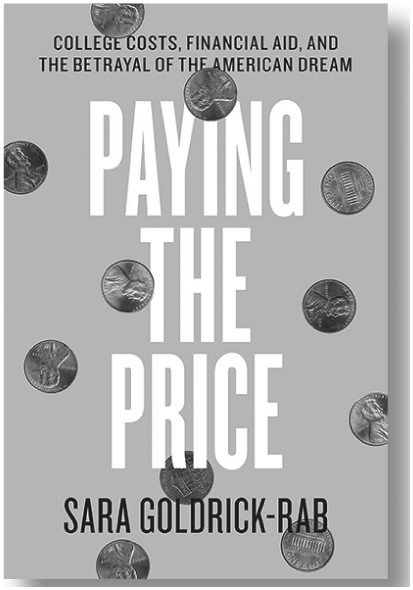
College prices have risen dramatically as state and federal funding for higher education has decreased. Without increases to Pell grants, many students must rely on student loan debt to finance their degrees, and that means student loans top the list of the largest forms of personal debt in the United States. Today, 90% of Pell recipients graduate college with an average debt of over $30,000. Rather than address these troubling trends in higher education, many observers question the value of a college degree, framing access to this credential as being a privilege as opposed to a right—and as a private, rather than a public, good.
All this leaves little to no sympathy for college students who complain about the rising costs and associated difficulties of completing a degree. We live in a neoliberal age of personal responsibility, and befuddled Baby Boomers question why today’s youth can’t just work their way through college the way so many of them did. Others suggest students’ real problems rest on a lack of work ethic, financial literacy, or both. Some conservatives even argue that Pell recipients are undeserving scammers akin to the mythical “welfare queens” of the 1980s.
Sara Goldrick-Rab is unconvinced.
Rather, her work, which she argues depicts #RealCollege, demonstrates that a staggering percentage of today’s college students struggle not only to pay for college, but also to afford food and housing. These insecurities exacerbate other issues hindering their pursuit of a college degree. A self-described scholar-activist, Goldrick-Rab founded the Wisconsin Hope Lab, has advised the U.S. government on issues of education and affordability, has spoken at the White House and testified before Congress, and has worked with the U.S. Department of Education on Pell grant experiments.
In her new book Paying the Price: College Costs, Financial Aid, and the Betrayal of the American Dream, Goldrick-Rab draws on the rigorous Wisconsin Scholars Longitudinal Study (WSLS), a mixed-methods study of 3,000 college students. Participants were randomly chosen from the total pool of students eligible for the Fund for Wisconsin Scholars Grant program. In order to be eligible, a student must be a Wisconsin public high school graduate enrolled full-time in a Wisconsin public college, a Pell grant recipient, and have at least one dollar of remaining unmet need in their financial aid package. Of these students, 1,200 were randomly selected to receive a Wisconsin Scholars Grant and the remaining 1,800 students composed the control group.
Goldrick-Rab and her team collected administrative records, along with extensive survey and interview data, to examine the extent to which additional financial grants from the Fund affected students’ rates of success and completion. In the end, money matters—for every additional $1,000 in grant aid students received, their likelihood of completing a bachelor’s degree in four years or less rose four points. However, Goldrick-Rab notes that, often, even the additional funds were unable to surmount the much larger financial obstacles students faced.
The first hurdle needy students must clear when seeking to finance a college degree is the FAFSA, or Free Application for Federal Student Aid, a notoriously clunky and complicated instrument filled with class bias. Goldrick-Rab demonstrates that the middle-class assumption of parent-child financial transfers on which the financial aid system is largely based is a fallacy for many low-income and first-generation students. Indeed, many students are expected and desire to financially help their parents and family members—a dedication that so many of us from working-class communities share. Yet the work of students who contribute to family expenses by paying rent, buying food, or providing care goes unrecognized by the FAFSA. For students from the lowest earning families, the expected family contribution FAFSA returns may be $0, but, realistically, these families lose income when their students reduce work hours or leave home to attend college. The ensuing pressure of this loss is borne by students, financially squeezed between family expectations and the dream of earning a college degree. Further, colleges and universities often count living at home with family as costless—baldly untrue for many low-income students, in that it assumes a degree of financial stability found only among higher-SES families.
College costs for students who live independently are also underestimated. Goldrick-Rab and her collaborators found the estimated costs of living off-campus provided by colleges and universities varied widely, even within the same metropolitan area. One-third of colleges and universities underestimate the annual costs of living off-campus by at least $3,000, often resulting in inadequate student aid packages. Indeed, Goldrick-Rab reports that a quarter of students in the WSLS reported food insecurity and nearly 20% reported housing insecurity.
Students worked to make ends meet. Goldrick-Rab writes about growing impatient with a young woman who fell asleep in her class, assuming she was out too late partying. Instead, the woman explained that she worked the night shift at a local grocery store. Most undergraduates work during college, and approximately 20% work full-time. The vast majority of this work is off-campus. Goldrick-Rab’s data back up the growing sense that low-income students work too many hours at inflexible, off-campus jobs that greatly challenge their ability to succeed in college.
Only about 10% of Pell recipients in the WSLS received federal work study, allowing students to hold on-campus jobs, remaining connected to campus and prioritizing their studies over possible off-campus work situations. Yet many of even these relatively “lucky” work-study eligible students are unable to secure jobs due to inequities in the institutional allocations of federal funds. Low-income students are overrepresented at community colleges and regional state universities, which receive less work-study funding than private colleges and flagship universities (where those students are underrepresented). That is, low-income students are more likely to attend institutions that are comparatively under-resourced, with financial and academic consequences.
So, what can we do? Goldrick-Rab concludes Paying the Price with several suggestions for addressing these inequalities. Colleges must clearly communicate the price of attendance and requirements of financial aid. As I and many others have also argued, students need more information about financing college earlier in their schooling. Colleges should coordinate with social benefits programs and offer emergency aid programs to support struggling students and their families. The federal free and reduced lunch program should be extended to college students. Targeting increased work-study funds to institutions serving a higher percentage of Pell recipients is also important. At the state level, building incentives to increase funding of higher education and replacing merit-based aid programs with need-based scholarships are other possible avenues of mediation. And finally, Goldrick-Rab argues that the first two years of college should be free, lifting a heavy financial burden from students and their families.
Goldrick-Rab does not detail her policy plan for free college in Paying the Price, though she does point to the Lumina Foundation report “Redefining College Affordability,” which she co-authored with her University of Wisconsin colleague Nancy Kendall. In it, they propose ending all federal financial aid to private colleges to free up funds to finance two years of higher ed for all. They acknowledge concerns that “low-income students will lose opportunities” and point out that these institutions are already less likely to serve low-income populations. The authors also acknowledge that wealthy families will have even more incentive to enroll their children in private colleges.
While I deeply admire Goldrick-Rab’s work and agree with the majority of her policy prescriptions, I am troubled by this solution. She and Kendall are correct that higher education is already incredibly stratified, yet I fear their proposal would effectively set up a two-tier system in which low-income students enroll in public colleges and the rich in private colleges. Effectively, it’s an even more precise system of socioeconomic segregation. Goldrick-Rab and Kendall are right to call on private colleges to dig into their own pockets to attract and fund low-income students, and many have started doing just that. However, low-income students remain woefully underrepresented on elite private campuses and cutting federal aid is no solution—it would likely exacerbate the issues facing these students on such campuses.
Studies show that many low-income students excel at elite private colleges and we know that degrees from these colleges generally carry more weight on the job market. As much as the system of stratification within higher education is worth questioning and contesting, I am not convinced that further limiting access is a viable solution. Notably, a low-income student participant in one of my studies suggested that because elite, private colleges contribute to a system that “disenfranchises poor people, universities like this shouldn’t even exist.” A powerful point, but these institutions do exist. And there is evidence to suggest that low-income students like me who are able to attend elite private colleges (I graduated from Vassar College) with the help of federal financial aid benefit greatly.
I also agree with Goldrick-Rab that the first two years of college should be free, yet I do not believe it should come at the expense of overall access to private and public institutions. Higher education needs to become more integrated by social class, not less. In a society with a growing divide between the haves and have-nots, all institutions must be held accountable for increasing access and socioeconomic diversity. This policy prescription unfortunately detracts from what is otherwise an outstanding and necessary study about social class inequalities in higher education.
In Paying the Price Goldrick-Rab shares her dreams for reforming higher education. They are grounded in high-quality longitudinal research that tells a convincing story of the betrayal of the American Dream. As she continues to advocate for increased access to higher education and works with colleges and governmental bodies to improve their policies, Goldrick-Rab’s work serves as a superlative model of public sociology in action.