



Abstract
Aaron M. Pallas reviews Excellent Sheep and Paying for the Party.
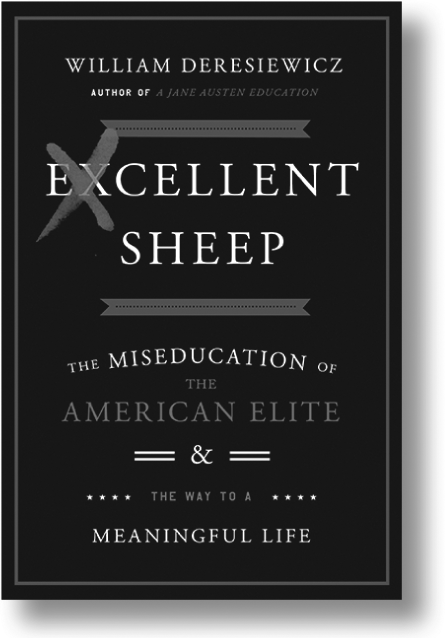
Excellent Sheep: The Miseducation of the American Elite and the Way to a Meaningful Life William Deresiewicz Free Press, 2014 256 pages
Paying for the Party: How College Maintains Inequality Elizabeth A. Armstrong and Laura T. Hamilton Harvard University Press, 2013 344 pages
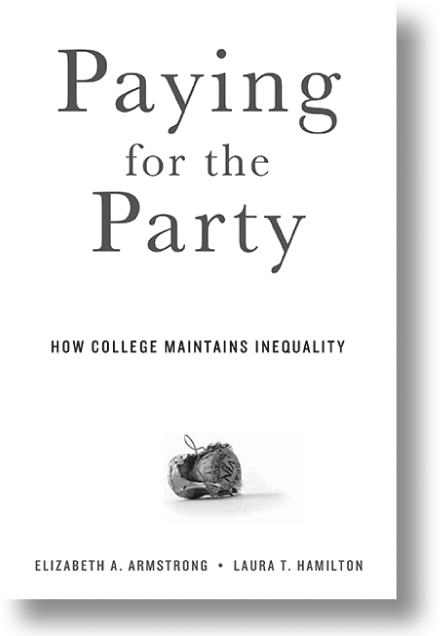
Armstrong and Hamilton’s is an important book, but it’s a wonder that the marketing whizzes at Amazon haven’t already bundled it with Prozac.
U.S. higher education has been taking it on the chin lately. As enrollments in four-year institutions reach record highs, policymakers are concerned about what college students are learning and whether going to college is a good deal. President Obama has issued a call for all students to attend at least one year of postsecondary schooling or training after high school, and his administration is developing new ways of holding institutions accountable for the money they receive and the graduates they produce. Just as it seems that higher education is exerting more and more influence over daily life—channeling individuals into occupational roles, defining what counts as legitimate knowledge, and representing the sacred space that all must pass through on the road to upward mobility—its legitimacy is challenged by high costs, questionable returns on investment, and the emergence of alternative producers of knowledge and credentials.
William Deresiewicz’s Excellent Sheep: The Miseducation of the American Elite and the Way to a Meaningful Life and Elizabeth A. Armstrong and Laura T. Hamilton’s Paying for the Party: How College Maintains Inequality are a pretty powerful one-two punch, although there’s little danger that U.S. higher education will be knocked out by these books. Deresiewicz, an Ivy-educated former Yale English professor, argues that elite institutions select and socialize students for conformed knowledge, skating the surface of the deep meaning and understanding that a true liberal education might provide. In the hypercompetitive status games played by elite families and elite institutions, means become ends and everyone plays it safe, following the path of least resistance. For students, this means choosing majors and careers that are external to the moral principles and values that define the self (and are thus forgettable). At Harvard, Yale, and Princeton, the most common undergraduate major is economics; only at Stanford is economics trumped by human biology, computer science, and engineering, the latter of which are careerist fields of study.
Deresiewicz’s story is intensely personal; he is writing to and for a generation he seeks to rescue from lives of anxiety and dissatisfaction. What college should be, he argues, is a site for taking big risks, perhaps most especially the risk of breaking with experience in the form of non-academic knowledge and even family and community. The spirit of skepticism that is central to a liberal arts education, he believes, demands that students challenge everything they know and have learned, freeing them from the expectations and influence of others in the project of creating a self.
It’s an extreme notion, perhaps workable for those who come to elite institutions with an arsenal of economic, social and cultural resources, but strangely out of touch with the realities of disadvantaged students who, more often than not, need all the help they can get from others. The ability to put everything at risk is a luxury of the rich—they are buffered from the consequences of most economic and political shocks. For the rest, risk aversion is rational behavior.
Many readers, I suspect, will be sympathetic—who besides a shepherd wants excellent sheep?—but the form Deresiewicz’s ideas take is off-putting. Apparently, we are to trust his parade of anecdotes because he swears freely, reveals his own personal frailties, and advocates eating the rich. One paragraph near the end of the book yields four “shoulds,” two “oughts,” and a “have to.” It’s not social science, but it doesn’t pretend to be.
What can today’s youth do to avoid becoming an “out-of-touch, entitled little shit? I don’t have a satisfying answer,” Deresiewicz writes, “short of telling you to transfer to a public university” (pp. 221-222).
Uh-oh.
Armstrong and Hamilton’s study of a flagship state research university in the Midwest is, if anything, more damning, this time backed up with a careful analysis of the experiences and post-college destinations of a cohort of freshman women followed over five years. The graduates of elite institutions invariably land on their feet, but the hopes and dreams of the women at “Midwestern University” are routinely dashed. Some only begin to thrive after they transfer to other, less-selective institutions. It’s an important book—and it’s a wonder that the marketing whizzes at Amazon haven’t already bundled it with Prozac.
At the heart of the project is an analysis of the fit between different pathways through college and the attributes and resources of the women who pursue each path. Armstrong and Hamilton identify three key pathways. The “party” path is a conveyor belt moving affluent students through college with minimum academic effort and regulating the relative status of students on campus. The university’s support of the party pathway is not passive: the institution facilitates the expansion of a large and exclusive fraternity and sorority system and creates easy majors for the party pathway students to pursue. For these students, post-collegiate success depends more on social networks and personal charisma than on academic performance.
What can today’s youth do to avoid becoming an “out-of-touch, entitled little shit? I don’t have a satisfying answer,” Deresiewicz writes, “short of telling you to transfer to a public university.”
The “mobility” pathway serves lower-income, often first-generation college students who seek to transcend their parents’ socioeconomic success. This path offers majors that lead directly to respectable, practical, middle-class occupations, providing need-based financial aid and academic supports to facilitate the transition into a setting with more academic challenges than high school. If a student loses her bearings and finds herself on the party pathway, she is surely lost; all of the supports essential to her mobility chances evaporate.
The third path the authors identify, the “professional” track, most closely resembles the patterns described by Deresiewicz in elite institutions. It relies on the intake of a small cohort of well-heeled and well-prepared students who arrive ready for academically rigorous coursework. These students benefit from small seminars and other institutional resources, such as access to renowned faculty. But at Midwestern University, these resources are in short supply, and the pathway is highly competitive. It is also a conveyor belt, with family resources buttressing those of the university, but it’s precarious: one step off the belt and a student can never get back on.
Overlaid on these three pathways are six types of students. The party pathway is made up of socialites and wannabes; the mobility pathway by strivers who stay and strivers who leave; and the professional pathway by achievers and underachievers. Within each pathway, one group of women has a gratifying college experience and is primed for post-college success, and the other, at least in the early post-collegiate career, struggles. The labels of these categories largely telegraph their destinations; socialites are better off than wannabes, and achievers more so than underachievers. The one surprise, perhaps, is that the strivers who left Midwestern University for other, less-prestigious regional institutions had better outcomes than those who remained.
A key weakness of these categories is that they describe the experiences of women after they enter their respective pathways, only partly capturing the social and academic resources that the women bring with them to college. A second step is needed to realize that the successful student categories are those in which the women began with social and economic advantages. This mutes what may be the key point of the book: wittingly or unwittingly, the university has organized a set of pathways through college that are minefields for students from modest economic and academic backgrounds. The pathways are unforgiving, working best for those who are already advantaged.
Armstrong and Hamilton are clear-eyed in their recommendations: social engineering to reduce the social segregation of students and the ability of the Greek system to drive the status system on campus; better academic advising and more fluid on-ramps for career-oriented and pre-professional majors; and the obligatory finger wagging at the inequalities produced at lower levels of the education system. But they note that even if the university did not set out to create an institutional structure that systematically maintains social and economic inequality, the particular forms the various pathways assume did not emerge by accident. Rather, they reflect an institution’s efforts to survive in a less predictable and supportive external environment than in days past. Colleges and universities of modest means are as risk-averse as their students—and as at-risk.