



Abstract
Purpose:
Acupuncture has been used for managing cancer-related symptoms. However, there are still few studies concerning the overall trends in acupuncture therapy on cancer based on bibliometric analysis. This study aims to demonstrate the current status and trends in this field over the past 2 decades.
Methods:
Articles were retrieved from the Web of Science from 2000 to 2019. CiteSpace was used for co-authorship network of countries/institutions, dual-map analysis, and detecting the keywords with citation bursts. VOSviewer was used to construct networks based on co-authorship and co-citation analysis of authors, and co-occurrence of keywords.
Results:
A total of 927 articles and reviews were included in the final analysis. The number of publications has steadily increased with some fluctuations among years. The country and institution contributing most to this field are the USA and Memorial Sloan Kettering Cancer Center. Mao JJ was the most productive author and Molassiotis A ranked first in the cited authors. The co-occurrence analysis revealed 5 clusters (including “clinical trials,” “clinical studies on chemotherapy/radiation-induced symptoms,” “CAM therapy for cancer,” “clinical studies on vasomotor symptoms,” and “systematic reviews”). Most recent keyword bursts were “neuropathic pain,” “arthralgia,” “prevention,” “supportive care,” and “integrative medicine”.
Conclusions:
The annual publication output would increase rapidly in the next decade, which shows a promising future in this research field. Future research hotspots would focus on the role of acupuncture in neuropathic pain, arthralgia, prevention, supportive care, and integrative medicine.
Introduction
Cancer is a major public health problem worldwide and is the leading cause of death, which increases the economic and social burdens. In 2020, it is estimated that 1,806,590 new cancer cases and 606,520 cancer deaths will occur in the United States. 1 Currently, the cancer treatment modalities are surgery, radiation therapy, and systemic treatment (chemotherapy, targeted therapy, hormonal therapy, and immunotherapy). 2 Majority of cancer patients experience several symptoms associated with cancer and side effects of conventional treatments. Acupuncture has been used for managing cancer-related symptoms. An increasing number of trials reveal acupuncture’s effectiveness in improving cancer-related symptoms including nausea, vomiting, fatigue, lymphedema, hot flashes, postoperative ileus, and pain.3-7
Bibliometrics is a quantitative analysis of published academic literature. Based on mathematical and statistical tools, bibliometrics is used to measure the inter-relationships, impacts of publications, and trends in a certain research field. A network analysis using bibliometric tools can identify and visualize established and emerging research areas through co-authorship, co-citation, and co-occurrence analyses. Recently, the bibliometric analysis was used for investigating overall trends in acupuncture research.8,9 The status and trends concerning the global use of acupuncture for pain management, low back pain, insomnia, cerebral infarction, and stroke rehabilitation have been determined.10-14 However, there are still few studies concerning the overall trends in acupuncture therapy on cancer based on bibliometric analysis.
In the present study, a bibliometric analysis was conducted to map the research landscape in terms of year, countries, journals, research areas, authors, keywords, and explore hot topics and emerging trends in the field of acupuncture therapy on cancer.
Methods
Data Source and Search Strategy
All data were collected from the Web of Science (WoS) including SCI-EXPANDED, SSCI, A&HCI, CPCI-S, CPCI-SSH, BKCI-S, BKCI-SSH, and ESCI on August 13, 2020. The search strategy was TS = ((*acupuncture* OR moxibustion*) AND (tumor* OR tumour* OR cancer* OR carcin* OR oncolog* OR neoplas* OR malignan* OR chemotherap* OR chemo-therap* OR radiotherap* OR radio-therap* OR radiation*)). The publication timespan considered was from 2000 to 2019. Two authors (Guo J and Pei LX) conducted the search and screened the articles independently. Any discrepancy was resolved by discussion or seeking assistance from a third author (Sun JH). Literatures that were not articles or reviews (n = 254) and were not related to the research topic (n = 722) were excluded. A total of 927 records were included in the final analysis.
Data Collection
The following information was extracted from eligible articles: author names, nationalities and affiliations, article title, year of publication, name of publishing journal, keywords, and abstract. All records were downloaded as a .txt file from the WoS and then imported into Microsoft Excel. Two authors (Guo J and Pei LX) extracted data from the selected publications independently. If the disagreements remained unsolved, the result mediated by the third author (Sun JH).
Bibliometric Analysis
Publication features, including the distribution of countries/regions, years of publication, research areas, institutions, journals, authors were classified and analyzed by the intrinsic function of WoS. The impact factor of each journal was collected from the 2019 journal citation report (JCR) (Clarivate Analytics, Philadelphia, USA).
CiteSpace (Version 5.6.R4, Drexel university, Chaomei Chen) is widely regarded as an excellent scientific econometric analysis tool, which is a good option for bibliometric analysis of the literature.15,16 CiteSpace was used for co-authorship network of countries/institutions, dual-map analysis, and detecting the keywords with citation bursts. A citation burst indicates increased attention to the underlying work over a certain period, which is a key indicator for determining emerging trends. The parameters of CiteSpace were as follows: time span (2000-2019), year of slice (1), selection criteria (Top 50), link retaining factor (LRF = 3), look back years (LBY = 8), e for top N (e = 2), pruning (Pathfinder).
VOSviewer (Version 1.6.14, Leiden University, van EckNJ) was used.17,18 Networks in this study were constructed based on co-authorship of authors, co-citation analysis of authors, and co-occurrence of keywords. Keywords, which occurred more than 20 times, were also included in the co-occurrence network analysis to identify important terms in research about acupuncture therapy on cancer.
Results
Publication Outputs and Time Trend
From 18 articles in 2000 to 182 articles in 2019, the number of publications related to acupuncture therapy on cancer has steadily increased over the past 20 years, with some fluctuations among years (Figure 1(A)). The logistic regression model was used to create the time curve of the number of publications that can predict future trends (Figure 1(B)). This time curve suggests that the field is currently in a phase of steady growth in global publication outputs. Furthermore, the rate of growth is expected to increase rapidly in the next decade.

Global trends in publications about acupuncture therapy on cancer. (A) The single-year publication numbers over the past 20 years. (B) Model fitting curves of growth trends in publications and prediction of future publication numbers.
Distribution of Country and Institution
A total of 55 countries and regions made contributions to publications on acupuncture therapy for cancer was analyzed by CiteSpace (Figure 2(A)). The USA (332 papers), China (200 papers), England (76 papers), South Korea (73 papers), and Germany (61 papers) were the top 5 productive countries and regions. The top 3 countries in terms of centrality (purple round) were the USA (0.35), China (0.19), England (0.15).

(A) A network map of co-authorship between countries/territories engaged in acupuncture therapy on cancer. (B) A network map of co-authorship between institutions. In the network map, a point represents a country/territory/institution and a line between 2 points represents the cooperation relationship. A wider line indicates a stronger relationship.
CiteSpace was used to analyze the 1165 institutions made contributions to this field (Figure 2(B)). Memorial Sloan Kettering Cancer Center (46 papers), Kyung Hee University (28 papers), University of Texas MD Anderson Cancer Center (27 papers), Beijing University of Chinese Medicine (17 papers), and University of Pennsylvania (15 papers) were the top 5 productive institutions. The top 3 institutions in terms of centrality were the Memorial Sloan Kettering Cancer Center (0.17), Hong Kong Polytechnic University (0.13), and University of Pittsburgh (0.12).
Distribution of Journal and Research Area
A total of 927 articles were published in 325 journals. Table 1 shows the top 10 most popular journals for publishing articles on acupuncture therapy for cancer. The Integrative Cancer Therapies had the largest number of published articles (51 records, 5.50% of all articles), followed by Supportive Care in Cancer (45, 4.85%), Evidence Based Complementary and Alternative Medicine (37, 3.99%), Acupuncture in Medicine (36, 3.88%), and Journal of Alternative and Complementary Medicine (27, 2.91%).
The Top 10 Popular Journals and Cited Journals.

A total of 74 journals of the references for all publications that were co-cited in more than 80 publications were analyzed by VOSviewer (Figure 3). The top 10 cited journals were shown in Table 1. The Journal of Clinical Oncology had the largest number of citations (1800 citations), followed by Supportive Care in Cancer (849 citations), Acupuncture in Medicine (740 citations), Journal of Alternative and Complementary Medicine (639 citations), and Journal of Pain and Symptom Management (606 citations).

A network map of co-cited journals with more than 80 publications.
A dual-map overlay with citing and cited matrices of journals was constructed by CiteSpace (Figure 4). 16 Most of the papers were published in the field (“Medicine, Medical and Clinical”) shown on the left and these were mainly influenced by the field (“Molecular, Biology, Genetics” and “Health, Nursing, Medicine”) shown on the right. Two main citation paths visualized as green curves with journal topics labeled were shown in Figure 4.
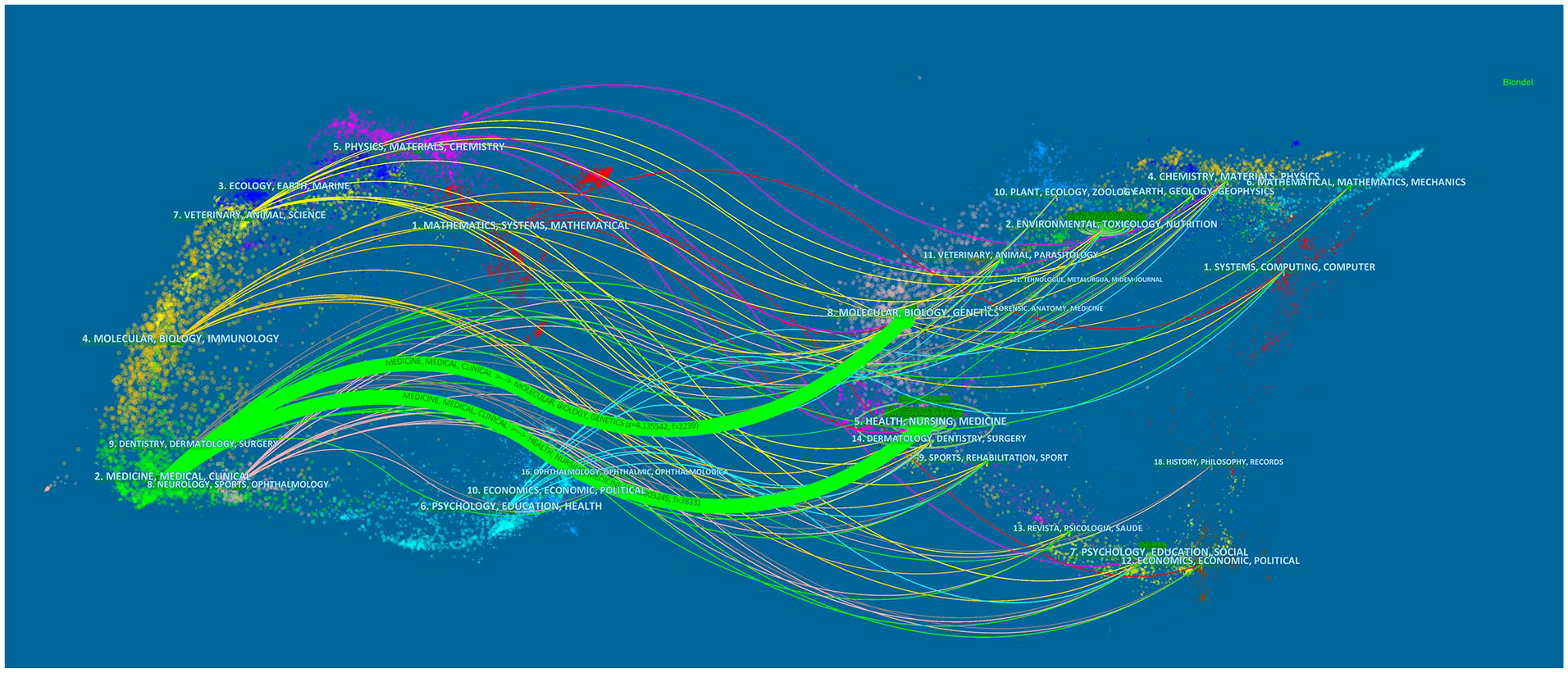
A dual-map overlay of journals related to acupuncture therapy on cancer.
In total, 74 research areas were identified in the present study. Table 2 shows the top 10 well-represented research areas. The most well-represented research area was Integrative Complementary Medicine (332 records, 35.81% of all articles), followed by Oncology (325, 35.06%), Medicine General Internal (88, 9.49%), Health Care Sciences Services (73, 7.87%), and Rehabilitation (52, 5.61%).
The Top 10 Well-Represented Research Areas.

Analysis of Authors
A total of 56 authors that were co-authored in more than 5 publications were analyzed by VOSviewer (Figure 5(A)). The top 10 most active authors were shown in Table 3. Mao JJ (27 documents) ranked first, followed by Cassileth BR (18), Cohen L (17), Bao T (16), Garcia MK (15), Ben-arye E (13), Rosenthal DS (13), Deng G (10), Lao LX (10), and Lee MS (10). By exclusion of 25 items that were not connected to each other, the collaborations of 31 authors were shown in Figure 5(B).

(A) A network map of co-authorship between authors with more than 5 publications. (B) Co-authorship between 31 authors that were connected to each other. Dots represented authors and larger dot indicated a higher number of publications, the links represented author collaborations. (C) A network map of co-citation between authors with more than 50 publications.
The Top 10 Active Authors and Cited Authors.

VOSviewer was used to analyze a total of 50 authors that were co-cited in more than 50 publications, identified from all publications included in this study (Figure 5(C)). The top 10 cited authors were shown in Table 3. Molassiotis A (266 citations) ranked first, followed by Ernst E (254 citations), Mao JJ (163 citations), Vickers AJ (159 citations), Deng G (153 citations), Cassileth BR (139 citations), Omura Y (139 citations), Dundee JW (135 citations), Garcia MK (135 citations), and Macpherson H (130 citations).
Analysis of Keywords
The keywords in the 927 publications assessed in the present study were analyzed using VOSviewer (Figure 6(A)). A total of 72 keywords were identified as having occurred more than 20 times. These keywords across all publications in this research were classified as 5 clusters: “clinical trials,” “clinical studies on chemotherapy/radiation-induced symptoms,” “CAM therapy for cancer,” “clinical studies on vasomotor symptoms,” and “systematic reviews.” The identified keywords were color-coded by VOSviewer based on average publication year (Figure 6(B)). CiteSpace was used to detect burst keywords which were identified as indicators of emerging trends (Figure 7). The keywords with the strongest citation bursts after 2016 in this field were “neuropathic pain,” “arthralgia,” “prevention,” “supportive care,” and “integrative medicine.”

Analysis of keywords. (A) Mapping of keywords of studies (categorized into 5 clusters). (B) Distribution of keywords according to average publication year (blue: earlier, yellow: later).

Top 35 keywords with the strongest citation bursts. The red bars mean the keywords occurred frequently; the green bars mean the keywords occurred infrequently. A greater strength indicates a higher frequency of occurrence.
Discussion
General Trends in the Research Field From 2000 to 2019
More and more attention has been paid to acupuncture therapy on cancer. The total number of publications increased steadily over the past 20 years. Furthermore, the annual publication output was predicted to increase rapidly in the next decade, which shows a promising future in this research field. Countries that made great contributions to the publications of articles were the USA, China, England, South Korea, and Germany. The USA, China, and England were in collaboration with various countries in this field. Top 5 productive institutions accounted for 133 articles, among them, 3 were universities and 2 were hospitals which were specialized in cancer treatment. The Memorial Sloan Kettering Cancer Center ranked first, followed by Kyung Hee University, University of Texas MD Anderson Cancer Center. The Memorial Sloan Kettering Cancer Center with the highest centrality (0.17) suggested its close cooperation with many institutions. Coauthor-ship analyses in country and institution showed that international cooperation is becoming a trend in this field.
Top 10 performing journals published 282 articles, accounting for 30.42% of all articles. The impact factors in 2019 of these journals range from 1.552 to 3.077. The Integrative Cancer Therapies (IF, 2019 = 2.379) and Supportive Care in Cancer (IF, 2019 = 2.635) focus on a comprehensive model of integrative cancer treatment and supportive care in cancer patients. The remaining 8 journals were within a scope in complementary and alternative therapy. Besides, a co-citation analysis revealed the influential studies in this field with high citations. The Journal of Clinical Oncology (IF, 2019 = 32.956) with the largest number of citations (1800 citations) published high-quality related clinical studies. Hence, published clinical trials on acupuncture therapy for cancer in this journal are reasonable to be considered as landmark researches. There will be a big challenge for researchers to publish papers in Journal of Clinical Oncology. The most well-represented research areas were Integrative Complementary Medicine and Oncology, accounting for 70.87% numbers of articles.
Co-authorship and co-citation analyses in authors could reveal influential authors in this field and potential collaborates. Mao JJ, Deng G, Cassileth BR, and Garcia MK are all included in the top 10 active and cited authors. When Mao JJ was at the University of Pennsylvania, his clinical trials suggested that acupuncture was effective in managing hot flashes and cancer-related arthralgia related to aromatase inhibitors in breast cancer patients.4,5 During recent years, as the chief of Integrative Medicine Service in the Memorial Sloan Kettering Cancer Center, Mao JJ revealed that acupuncture could produce improvements in sleep disturbs and prevent the incidence of chemotherapy-induced peripheral neuropathy (CIPN) in cancer patients.19,20 Deng G and Cassileth BR were both from Memorial Sloan Kettering Cancer Center, they conducted a randomized controlled trial. The result showed that acupuncture could significantly reduce pain, dysfunction, and xerostomia in cancer patients with a history of neck dissection. 21 Garcia et al22,23 from the University of Texas MD Anderson Cancer Center has published systematic reviews on acupuncture in cancer care and control of hot flashes. Clinical data from his research suggested that patients who received inpatient acupuncture at a major cancer center experienced significant improvement in pain, sleep disturbance, anxiety, drowsiness, nausea, and fatigue. 24 Molassiotis et al25-27 with the highest citations was from the University of Manchester. He has conducted a series of randomized controlled studies on acupuncture for patients with cancer-related fatigue.
From the co-authorship analysis network map, the red cluster indicated that Cohen L et al from the University of Texas MD Anderson Cancer Center collaborate with Meng ZQ et al from Fudan University Shanghai Cancer Center. The green cluster suggested the collaboration between Mao JJ et al from the Memorial Sloan Kettering Cancer Center and Garland SN from the Memorial University of Newfoundland. The yellow cluster suggested that Bao T from the Memorial Sloan Kettering Cancer Center collaborates with Lao LX from the University of Hong Kong and Greenlee H et.al. from the Columbia University Medical Center.
Keywords as Indicators of Emerging Trends
Five recent emerging trends in acupuncture therapy on cancer-related symptoms were determined according to the most recent keyword bursts; these keywords are listed as follows:
Neuropathic pain: Neuropathic pain is associated with an increased analgesic consumption and negative impact on the quality of life. In cancer patients, it is usually caused by nerve injury or tissue destruction by the tumor, mostly due to oncologic treatments such as surgery or chemotherapy. 28 The main symptom of CIPN is neuropathic pain. The American Society of Clinical Oncology (ASCO) clinical guideline mentioned that acupuncture may be used for the treatment of CIPN. 29 A recent meta-analysis indicated that acupuncture could provide a relief in CIPN pain and functional limitation. 30 Besides, 2 clinical trials showed a reduction in the use of analgesics and improvement in the quality of life.31,32 However, the efficacy and safety of acupuncture for CIPN should be tested by well-designed and high-quality reported randomized controlled study. Further studies in investigating the mechanism of acupuncture for neuropathic pain are also needed.
Arthralgia: Aromatase inhibitors are recommended as routine adjuvant endocrine therapies for postmenopausal women with hormone-sensitive breast cancer. 33 However, approximately 50% of patients experience arthralgia or joint pain after aromatase inhibitor administration.34,35 A meta-analysis showed that acupuncture could relieve joint pain in patients with aromatase inhibitor-induced arthralgia. 36 A recent randomized clinical trial involving 226 patients indicated that compared with sham acupuncture or with waitlist control, true acupuncture resulted in a statistically significant reduction in joint pain at 6 weeks. 37
Prevention: The therapeutic effects of acupuncture therapy on cancer-related symptoms are evident. In recent years, the prevention effect attracted more attention of researchers. Nausea and vomiting are highly distressing symptoms for cancer patients undergoing chemotherapy or operation. A meta-analysis showed that compared with sham treatment, acupoint stimulation could significantly reduce the incidence of nausea, vomiting, and the need for rescue antiemetics. 38 CIPN is a common adverse effect of cancer treatment. A recent study showed preliminary evidence of effectiveness in reducing the incidence of CIPN. A follow-up randomized controlled trial with a larger sample size is needed to determine definitive efficacy in CIPN prevention. 20
Supportive care: Supportive care focuses on the prevention and management of the adverse effects of cancer and its treatment. Acupuncture is widely used in cancer-related symptom management in supportive and palliative care. Acupuncture could be considered as a complementary form of palliative care for cancer, especially for clinical problems with limited options of conventional treatments. 39 Another overview suggested that clinical trials with adequate interventions, appropriate outcome measures and adherence to reporting standards are required to evaluate the efficacy of acupuncture in cancer supportive and palliative care in the future. 40
Integrative medicine: Integrative medicine focuses on a collaborative approach to patient care, which combines conventional therapies with complementary approaches in a coordinated way. Integrative medicine including acupuncture, massage, yoga, music therapy has been used for the management of symptoms and adverse events in cancer patients. 41 The ASCO practice guideline recommended acupuncture for reducing chemotherapy-induced nausea and vomiting. 42
Strengths and Limitations
This is the first bibliometric analysis to investigate the research trend in acupuncture therapy on cancer. We used 2 well-known scientometric software tools (VOSviewer and CiteSpace) to construct and visualize the bibliometric networks through analyses of co-authorship, co-citation, co-occurrence, and citation burst. Nevertheless, there are some limitations in this study. First, this study focuses mostly on quantitative analysis but less qualitative analysis. Second, the searches were mainly conducted in the WoS database. It would be better if the results combined with other databases, such as PubMed and Scopus. However, it is noted that WoS is the most commonly used database for scientometrics. In addition, the China National Knowledge Infrastructure (CNKI) database was searched. The result represented in the Supplemental file also indicated the benefit of acupuncture in managing cancer-related symptoms and adverse events, and improving quality of life.
Conclusion
This bibliometric study may help researchers discover current status and emerging trends in the field of acupuncture therapy on cancer over the past 2 decades. The co-occurrence analysis revealed 5 clusters (including “clinical trials,” “clinical studies on chemotherapy/radiation-induced symptoms,” “CAM therapy for cancer,” “clinical studies on vasomotor symptoms,” and “systematic reviews”). Recent keyword bursts indicated that “neuropathic pain,” “arthralgia,” “prevention,” “supportive care,” and “integrative medicine may be the latest research frontiers. More rigorous clinical trials and more researches exploring related mechanisms are needed in the future.
Supplemental Material
Supplementary_file_20200715 – Supplemental material for Research Trends of Acupuncture Therapy on Cancer Over the Past Two Decades: A Bibliometric Analysis
Supplemental material, Supplementary_file_20200715 for Research Trends of Acupuncture Therapy on Cancer Over the Past Two Decades: A Bibliometric Analysis by Jing Guo, Lixia Pei, Lu Chen, Hao Chen, Dongmei Gu, Chen Xin, Yongjun Peng and Jianhua Sun in Integrative Cancer Therapies
Footnotes
Declaration of Conflicting Interests
The author(s) declared no potential conflicts of interest with respect to the research, authorship, and/or publication of this article.
Funding
The author(s) disclosed receipt of the following financial support for the research, authorship, and/or publication of this article: This study was supported by the State Administration of Traditional Chinese Medicine “Evidence-based capacity Building Project of Traditional Chinese Medicine” (Reference number 2019XZZX-ZJ008).

Supplemental Material
Supplemental material for this article is available online.
References
Supplementary Material
Please find the following supplemental material available below.
For Open Access articles published under a Creative Commons License, all supplemental material carries the same license as the article it is associated with.
For non-Open Access articles published, all supplemental material carries a non-exclusive license, and permission requests for re-use of supplemental material or any part of supplemental material shall be sent directly to the copyright owner as specified in the copyright notice associated with the article.
