



Abstract
Objective
With the widespread use of artificial intelligence (AI) in medical imaging, research on AI-powered echocardiography has gained increasing attention. However, a systematic study of global research trends and key developments in this area remains limited. The study aims to explore the current research hotspots of AI-driven echocardiography by bibliometric methods, providing data support and academic insights for future research.
Methods
The Web of Science Core Collection database was utilized to search articles in this area from 1997 to 2024. The filtered data were analyzed and visualized by VOSviewer and CiteSpace software.
Results
In total, 605 documents were involved, since 2020, there has been an exponential increase in the publications. The United States held the top position in both the volume of publications and citation counts. And the top organization in citations was Stanford University. Three authors with the most publications were Lovstakken Lasse, Ouyang David, and Sengupta Partho P. The journal with the most citations was the Journal of the American Society of Echocardiography. Based on keyword analysis, the current research hotspots were mainly focused on image segmentation, heart failure, deep learning, and pulmonary hypertension.
Conclusion
Research on the application of AI in echocardiography is currently flourishing, with broad prospects. In the future, it is crucial to promote interdisciplinary collaboration on an international scale, especially between countries and research institutions. Future research will focus on developing large language models that can integrate multimodal information, while also addressing key issues such as improving model interpretability.
Introduction
As a noninvasive, real-time imaging tool, echocardiography has been extensively used for diagnosing, assessing, and monitoring cardiovascular diseases. And its advantages of being easy to use, cost-effective, and radiation-free made it become one of the preferred cardiac imaging methods in clinical practice.1,2 However, echocardiography faces many difficulties and challenges, such as the large number of echocardiographic views with multiple modalities, and the long training cycle for novices. Additionally, the quality of echocardiogram is often influenced by the operator's experience, and their interpretation may carry a degree of subjectivity. As cardiovascular diseases become more common and complex, the workload for doctors to analyze ultrasound images has significantly increased.3,4
In recent years, the rise of artificial intelligence (AI) has brought new opportunities to echocardiography. By utilizing deep learning models, AI can automatically analyze large volumes of ultrasound images and identify cardiac anatomical structures and pathological features. This not only simplifies complex procedures but also significantly improves the diagnostic efficiency. Also, it helps to reduce variability and the risk of misdiagnosis caused by the differences in operator experience.5–7
As research on AI in echocardiography continued to expand, more and more studies have started to explore the vast potential of AI in areas such as automatic view recognition, image segmentation, cardiac function measurement, and the diagnosis of heart diseases. Additionally, numerous studies have reported how AI can assist in guiding novice physicians to obtain standard imaging views, thereby improving image quality control.8–10 However, as the number of studies in this field increased year by year, there have only been several reviews that summarized the relevant research, and systematic bibliometric analysis has not yet been carried out to explore the current research hotspots in this area. Especially, the rapid surge in recent years has made it more challenging for many researchers to stay updated on the latest advancements. From now on, only a few bibliometric analyses have summarized specific aspects of AI-based cardiovascular disease,11,12 while the important field of echocardiography has been overlooked.
Therefore, our study aims to perform a quantitative analysis of the publications on AI-based echocardiography by using bibliometric methods. It seeks to trace the development and research trends in this area, identify the contributions of key scholars and institutions, and help to explore future research directions.
Methods
Data extraction and retrieval strategies
As the most influential database for bibliometric research, the Web of Science Core Collection (WoSCC) dataset is the most widely recognized and commonly utilized database currently.13,14 On 19 September 2024, we gathered relevant publications from it, including data from the Science Citation Index Expanded and the Social Sciences Citation Index. 15 The two primary indices covered peer-reviewed journals that meet rigorous editorial standards, have high impact factors, and are widely recognized in their respective fields. This selection criterion ensures that the data are derived from reputable sources, thereby enhancing the representativeness and validity of the study. Three independent researchers conducted the literature search to guarantee the accuracy of the results.
The search strategy was developed based on prior research and the formula used as follows: topic = (“artificial intelligence” OR “deep learning” OR “machine learning” OR “intelligent learning” OR “deep network*” OR “neural network*” OR “artificial neural network” OR “neural learning” OR “bayes* network” OR “neural nets model” OR “big data” OR “supervised learning” OR “unsupervised clustering” OR “image* segmentation” OR “semantic segmentation” OR “feature* mining” OR “feature* learning” OR “feature* extraction” OR “data clustering” OR “graph mining” OR “data mining” OR “expert*system*” OR “robotic*” OR “knowledge graph”) (13) AND topic = (“echocardiography” OR “echocardiogram” OR “cardiac ultrasound” OR “cardiovascular ultrasound”). The document type was only for Article or Review and the language is only for English. The period was 27 years, from 1 January 1997 to 19 September 2024, resulting in the amount of 1612 publications. Also, we conducted an additional screening process to ensure the relevance of the literature. Titles and abstracts of all retrieved records were manually reviewed. Publications were excluded if their content clearly fell outside the scope of our research topic. Such records were categorized as “irrelevant to the study.” After a rigorous screening process, articles that clearly deviated from the theme were excluded, leaving 605 articles to be further investigated (Figure 1). All records were saved in plain text formats.

The flowchart of the search stage.
Data visualization
Bibliometric research is a scientific study of literature using metrological concepts and methodologies. 16 CiteSpace and VOSviewer are popular bibliometric software tools commonly used in academic research. 17 They can visualize large amounts of literature data and provide analysis based on countries, institutions, authors, cited references, and keywords. Additionally, they offer an intuitive display of network relationships and evolutionary processes, revealing the hotspots and potential trends in the topic.18,19
Therefore, we utilized the Citespace (Version 6.4.R1) and VOSviewer (Version 1.6.20) software, alongside a deep literature evaluation to thoroughly analyze the topic of AI in echocardiography. VOSviewer is adept at constructing and visualizing network relationships. This study used VOSviewer to analyze institutional co-occurrence, author collaboration networks, and keyword co-occurrence.20,21 CiteSpace, developed by Chen et al., is another powerful bibliometric analysis software that focuses on detecting dynamic changes in scientific fields.22–24 Its time-slicing functionality makes it especially useful for monitoring field developments. 25 Therefore, it places greater emphasis on analyzing the history of research fields and identifying research trends and frontier changes. In this study, we utilized CiteSpace to perform the national and journal co-occurrence networks, the references and authors cocitation networks, as well as keyword timeline analysis, and citation burst detection of references. Pajek is a software developed by Vladimir Batagelj and Andrej Mrvar at the University of Ljubljana, Slovenia. And it can be downloaded from the official website: http://mrvar.fdv.uni-lj.si/pajek/. It is designed for the analysis and visualization of large-scale networks. In our bibliometric analysis, we used Pajek to automatically lay out the institutional co-occurrence network generated by VOSviewer.
Additionally, several key terms are used in this study, and their definitions are provided below. Centrality refers to the importance or influence of a node relative to other nodes in a network. The higher the centrality, the more crucial it is in the field, with greater potential to drive academic development or serve as a key bridge. Total Link Strength (TLS) is a metric used in bibliometric analysis to quantify the overall strength of links between a given item (such as an author, institution, keyword, or publication) and other items within a network. It reflects the overall connectivity and significance of the item within the research field. For example, in a coauthorship network, an author's TLS represents the total strength of their collaborative links with other authors, indicating their degree of collaboration. “Modularity Q” value is used to evaluate the significance of the clustering structure. Q value greater than 0.3 generally indicates a meaningful cluster structure. The “mean Silhouette S” value assesses the compactness and separation of clusters. S value above 0.5 suggests reasonable clustering, while a value above 0.7 indicates convincing clustering.
Results
International publication trend
Based on the above search formula and screening process, 605 documents were included in the analysis, containing 56 reviews and 549 articles, respectively. The amount of research on AI-based echocardiography has been growing steadily each year (Figure 2). Exponential growth in the number of researches was started in 2020. In 2023, the number of annual publications was even higher, reached 132 papers, and has shown continued growth this year, which indicated the great potential of AI-based echocardiography.
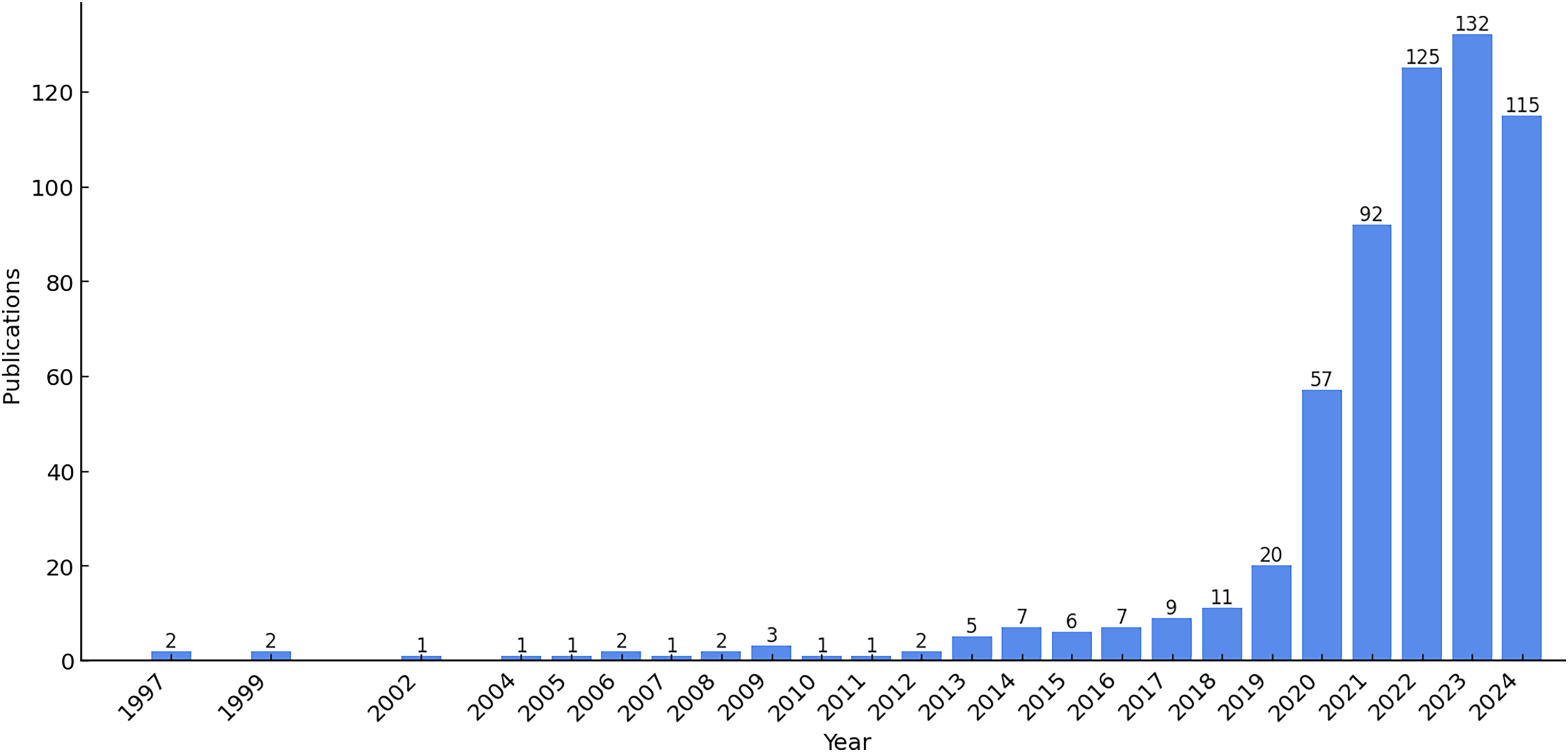
The annual publications of AI applications in echocardiography.
From 1997 to 2024, the total citations for the publications in this area amounted to 10,600, with an average citation of 17.52 and an H-index of 47. The H-index is an integrated metric used to assess both the quality and quantity of scientific output. 26
Analysis of countries/regions
Between 1997 and 2024, 64 countries/regions made contributions to the field. The top 10 most productive countries are displayed in Table 1, with the United States leading with 184 papers (30.4%), followed by China with 173 papers (28.6%). These two countries contributed to over half of the total studies, indicating a strong interest in this area. Additionally, the United States significantly outpaced the others in terms of H-index, centrality, and total citations, with scores of 33, 0.74, and 5,510, respectively, underscoring its leading position in this field.
The top 10 most productive countries in the area of AI-based echocardiography.

The co-occurrence network map of countries is displayed in Figure 3(a). As seen in the figure, the United States and China dominated in publication volume within this topic. There were six countries/regions with centrality greater than 0.1, namely the United States, Canada, the United Kingdom, Italy, France, and India, suggesting that these countries played a vital role. Figure 3(b) presents the analysis of international collaboration. The United States maintained closest collaborations with multiple countries, especially China, Canada, and Italy, as the leading contributor in this field. As the second-ranked country in publication volume, China has strong interactions with the United States and the United Kingdom.
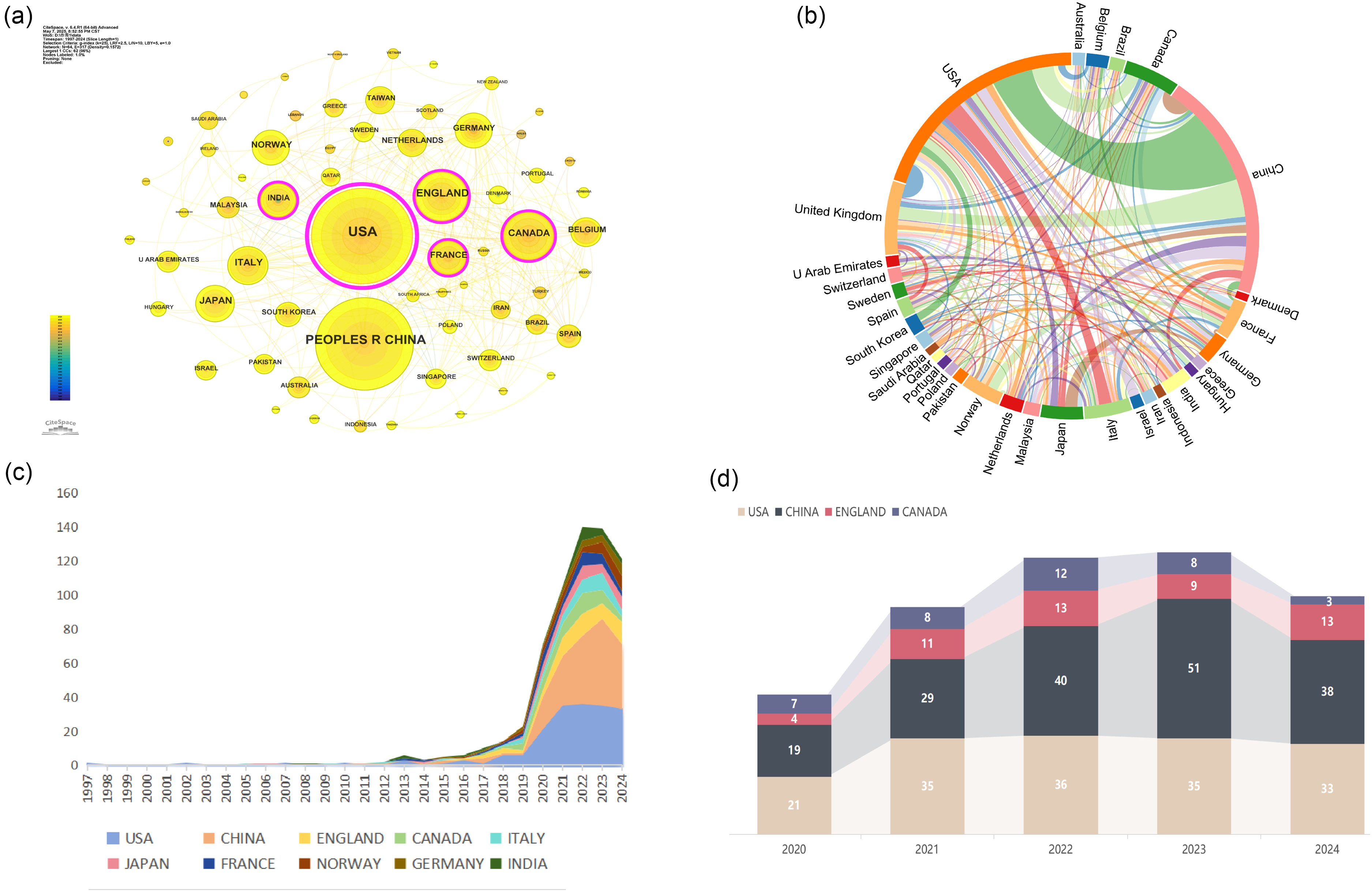
(a) The co-occurrence network map of countries for the CiteSpace network. The size of each node reflects the publication volume of each country, with larger nodes indicating higher publication volumes. The purple-circled nodes represent the centrality greater than 0.1. (b) The visualization map of cross-country/region collaborations. The length of the bars represents the publication volume, while the lines between them indicate the frequency of collaboration between countries, thicker lines signify higher collaboration frequencies. (c) The evolution of the number of publications in the top 10 countries between 1997 and 2024. (d) The annual publication volume of the top four countries over the past five years.
The evolution of the number of publications in the top 10 countries between 1997 and 2024 is shown in Figure 3(c). Over the past five years, the top four countries’ annual publication volume is displayed in Figure 3(d). It could be observed that, after 2021, the publication volume of China has steadily increased each year, gradually surpassed that of the United States.
Analysis of research institutions and journals
In total, 1204 institutions have participated in this field. Table 2 shows the top 10 institutions in the area of AI-based echocardiography according to citations. It can be seen that most of these institutions come from the United States. Specifically, the top three most cited organizations were Stanford University (1319), University of California San Francisco (1115), and Northwestern University (893). Among them, Stanford University held the top position in both total citations and number of publications. In terms of TLS, Cedars-Sinai Medical Center, Stanford University, and the University of California San Francisco occupied the top three positions with scores of 32, 30, and 30, respectively. The visualization network of institution coauthorship analysis is shown in Figure 4(a). We used VOSviewer software to perform a coauthorship analysis of the collaborative relationships among institutions involved in the study. In the network, each node represents an institution, with the size of the node indicating the number of publications by that institution. The thickness of the edges reflects the strength of collaboration between institutions. The shorter the distance between nodes, the closer the collaborative relationship. A clustered layout was also applied to identify major collaboration groups within the network. The same color indicates the major collaborating institutions. In addition, we used Pajek to automatically lay out the institutional co-occurrence network generated by VOSviewer. Specifically, we applied the association strength (a clustering algorithm) to classify institutions based on the strength of their interconnections. This approach enhances the clarity of the visualized network and helps reveal the structural relationships between institutions.

(a) The visualization network of institution coauthorship analysis. Based on the closeness of interagency links, VOSviewer classified institutions into different clusters. The layout of the view was adjusted by Pajek software. (b) The cocitation network diagram of journals generated by CiteSpace. The journals marked with purple circles indicate the centrality value greater than 0.1.
The top 10 institutions in the area of AI-based echocardiography according to citations.
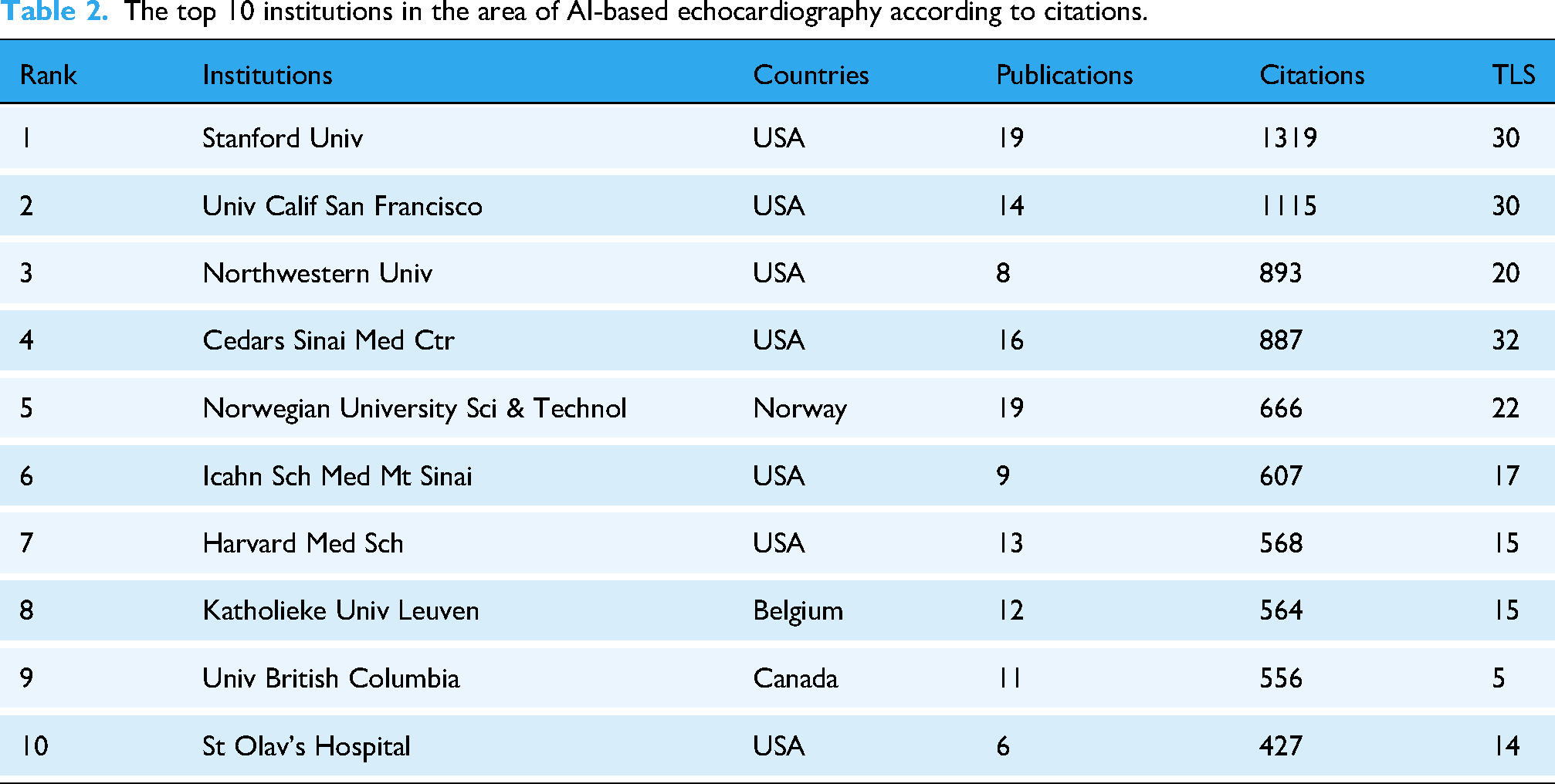
As of the retrieval date, studies on AI-based echocardiography have been published in 197 academic journals. Table 3 lists the top 10 medical journals in terms of publication volume. Frontiers in Cardiovascular Medicine had the largest number of publications, followed by the Journal of the American Society of Echocardiography (JASE) and IEEE Transactions on Medical Imaging. Furthermore, the majority of the top 10 productive journals were classified as Q1/Q2 based on the 2023 Journal Citation Reports. Cocitation is an important indicator of a journal's influence. We used the CiteSpace to create the journal cocitation map (Figure 4(b)). The journals with the greatest volume of total citations were the JASE (931), Journal of the American College of Cardiology (854), IEEE Transactions on Medical Imaging (829), and Circulation (746). Among them, the journals marked with purple circles indicated the centrality value greater than 0.1, such as Circulation (0.33), JASE (0.18), and the American Journal of Cardiology (0.18), demonstrating the importance role of these journals played in this field.
Top 10 productive medical journals in the area of AI-based echocardiography.

Contribution of coauthors and cocited authors
We retrieved the authors with the largest number of publications from our database and analyzed their collaborative network, highlighting those who participated as coauthors. Currently, 3650 authors published papers in this area. Tables 4 and 5 present the summary of the top 10 productive and most cited authors. By analyzing author cocitations, we discovered that Lang Roberto M, Jeffrey Zhang, and Leclerc Sarah ranked among the top three in total citation counts, with 216, 158, and 149 citations, respectively. Among the authors, three authors with the greatest volume of publications were Lovstakke Lasse, Ouyang David, and Sengupt Partho P. Each of them had published 14 papers. Among them, those who ranked in the top 10 both in publication and citations included Ouyang David, Sengupta Partho P, Lang Roberto M, and He Bryan. Moreover, the majority of these authors came from the US, Norway, and other European countries.
Top 10 productive authors in the application of AI in echocardiography.

Top 10 cocited authors in the application of AI in echocardiography.

Figure 5(a) was an author cocitation analysis map generated by CiteSpace, showing the top 14 authors by citation count. Figure 5(b) reflects the network of mutual cooperation between authors generated by VOSviewer. From the figures, it can be observed that Lovstakken Lasse, Ouyang David, and Lang Roberto M were the key authors that connected the other research clusters. However, collaboration between the different research clusters was limited in all.

(a) The map of author cocitation analysis generated by CiteSpace. (b) The network of author coauthorship analysis created by VOSviewer.
Analysis of highly impact publications
This study included a total of 605 papers. Table 6 lists the top 10 references in terms of citations. The most cited article was Jeffrey Zhang's paper published in 2018, 27 titled “Fully Automated Echocardiogram Interpretation in Clinical Practice,” with a total of 149 citations. It was followed by an article titled “Video-based AI for beat-to-beat assessment of cardiac function” written by Ouyang Dv, 2020, Nature. 28 Figure 6(a) illustrated a visualization of cocited references from CiteSpace analysis, which clearly highlighted the information about several highly cited papers within the field. The main content of the first two articles is summarized below.

(a) The co-occurrence view of cocited references analyzed by CiteSpace. (b) The map of the 23 references with the highest bursts of citation.
Top 10 references in terms of citations in the area of AI in echocardiography.

“Fully Automated Echocardiogram Interpretation in Clinical Practice”: This study proposed a fully automated pipeline for interpreting echocardiograms, utilizing convolutional neural networks (CNN) to perform view recognition, image segmentation, quantification of cardiac structure and function and disease detection in a single workflow. It emphasized the potential of AI algorithms applied to echocardiography to enhance clinical workflows, especially in nonspecialized or resource-limited settings.
“Video-based AI for beat-to-beat assessment of cardiac function”: This study addressed the common clinical issue in the field of ultrasound that “observer variability in LVEF quantification.” It retrospectively included 10,030 cases of apical four-chamber echocardiography, input complete cardiac cycle sequences, and sparse labels of ED and ES frames. Using a semisupervised training strategy, an AI model was developed to automatically quantify left ventricular ejection fraction (LVEF). The AI model was then compared with expert evaluations to demonstrate the reliability of it. This achievement held promise for advancing real-time cardiac disease diagnosis and laid the foundation for future AI research based on medical video analysis.
Figure 6(b) summarizes the 23 references that exhibit the strongest citation bursts. The earliest burst reference was “Knackstedt C, 2015, J Am Coll Cardiol,” 36 which burst in 2016. And the years 2018 and 2019 saw the highest number of citation bursts. The most recent burst began in 2022 and has continued to the present, specifically for “Madani A, 2018, NPJ Digit Med 37 ” and “Arnaout R, 2021, Nat Med 38 .” The “Strength” value in the figure indicates the intensity of the citation burst, with higher values representing more significant bursts in citation frequency. In the horizontal bar chart, the light blue line represents the period before the article was published. The dark blue segments depict the time period after the article was published. The red line segments indicate the start and end of the citation burst period. This visualization helps us identify the time periods during which these references experienced citation bursts, thereby reflecting their influence and highlighting research hotspots in this field.
The research topics of these two studies focused on the accurate classification of echocardiography views and the automatic diagnosis of heart diseases through deep learning, suggesting that research on view classification and disease diagnosis was likely to remain a hotspot in the future.
Keyword co-occurrence analysis
Through analysis of the most frequently cited keywords, the study examined the research hotspots and trends. A total of 2064 keywords were included. As shown in Figure 7(a), the keyword co-occurrence map was analyzed by VOSviewer. The leading three keywords were “echocardiography,” “deep learning,” and “machine learning.” Additionally, “heart failure,” “myocardium,” and “coronary artery disease” are the most studied heart disease currently. Also, the keywords were displayed in different colors according to their appearance timeline and reflected the progression of the research trend. It is evident that since 2022, keywords such as “deep learning,” “artificial intelligence,” “coronary heart disease,” “global longitudinal strain,” and “hypertrophic cardiomyopathy” have shown a gradually increasing trend in this field.

(a) The keyword co-occurrence map was analyzed by VOSviewer. The keywords were displayed in different colors according to their appearance timeline, reflecting the evolution of research trends. (b) Keyword co-occurrence clustering map. (c) Keywords co-occurrence timezone analysis conducted by CiteSpace.
Figure 7(b) revealed the keyword clustering map, which highlighted the key research areas and emerging trends. The Modularity Q value is used to evaluate the significance of the clustering structure. Q value greater than 0.3 generally indicates a meaningful cluster structure. And the mean Silhouette S value assesses the compactness and separation of clusters. S value above 0.5 suggests reasonable clustering, while a value above 0.7 indicates convincing clustering. In our study, the mean Silhouette S was 0.724, and the Modularity Q was 0.463, which meant the excellent clustering effect and network homogeneity. It could be seen that keywords were divided into nine clusters, namely #0 image segmentation, #1 heart failure, #2 deep learning, #3 pulmonary hypertension, #4 artificial intelligence, #5 bayesian network, #6 stress echocardiography, #7 ejection fraction, #8 trypanosoma cruzi, and #9 left atrial/left atrial appendage thrombus.
Subsequently, a timezone analysis of keyword co-occurrence was conducted by CiteSpace (Figure 7(c)), which helped to identify the keywords at different time points and illustrated the development of the research keywords over time. It could be observed that the earliest keywords mainly focused on “image segmentation,” “ejection fraction,” and “quantification.” Over time, “artificial intelligence” became a major keyword around 2003. Additionally, starting in 2005, “classification,” “diagnosis,” “echocardiography,” and “coronary artery disease” became the primary keyword. Also, “machine learning” and “deep learning” emerged as key terms in 2014 and 2017, respectively. Besides these, keywords such as “heart failure,” “convolutional neural network,” and “prediction” were also included. The keywords “deep learning,” “convolutional neural network,” and “disease diagnosis and prediction” continued to be research hotspots for future study.
Discussion
At present, bibliometric analysis is extensively utilized in scientific research and academic evaluation. It helps researchers quickly identify the hotspots, frontier trends, and dynamic changes in the development of research areas. This was the first to utilize bibliometric methods to analyze research on AI-based echocardiography, highlighting development trends in such topic over the past 27 years. It focused on the analysis of countries/regions, institutions, journals, authors, and keywords as well as references and predicted future research hotspots. More importantly, it will provide valuable guidance, especially for nonultrasound medicine professionals, noncardiac-focused ultrasound physicians, and beginners in echocardiography.
Summary of the main findings
In our study, the number of publications related to AI-based echocardiography has grown exponentially since 2020, with the increasing number of publications year by year. The number of published papers reached 132 in 2023. The United States led with the highest total number of publications and citations and was ahead of other countries in the H-index, centrality, and the total citations, indicating its leading role in this area. After 2021, the publication volume in China steadily increased each year and gradually surpassed that of the United States. Three institutions with the greatest citations were Stanford University, UC San Francisco, and Northwestern University. Among them, Stanford University held the top position in both total citations and number of publications. Frontiers in Cardiovascular Medicine had the largest amount of publications. The journals with the highest citations were JASE, Journal of the American College of Cardiology, IEEE Transactions on Medical Imaging, and Circulation. The top three authors with the greatest amount of publications were Lovstakken Lasse, Ouyang David, and Sengupta Partho P. And Ouyang David, He Bryan, and Zou James Y had the highest number of citations. Moreover, Lovstakken Lasse, Ouyang David, and Lang Roberto M collaborated more closely with others. The most cited article was by Jeffrey Zhang, 2018, Circulation, 27 followed by articles written by Ouyang Dv, 2020, Nature 28 and Roberto M Lang, 2015, Eur Heart J-card Img. 39 Also, the three most frequent keywords were “echocardiography,” “machine learning,” and “deep learning.” In addition, “heart failure,” “myocardium,” and “coronary artery disease” were the most researched heart conditions.
Key focus areas and emerging frontiers
Highly cited literature and frequently used keywords highlight key focus areas within specific research fields. 40 We utilized co-occurrence analysis, cluster analysis, burst detection, and time-zone analysis to explore the main directions of AI-based echocardiography, which were mainly focused on the following areas.
View classification and image segmentation
The identification of standard echocardiographic views is critical for the subsequent measurements and disease diagnosis. However, the wide variety of ultrasound views and the heavy reliance on equipment and expert experience are common challenges faced by ultrasound physicians.
The article published in Circulation in 2018 was the first to integrate multiple tasks into one model, demonstrating the feasibility of completing the entire workflow from image acquisition to disease diagnosis through deep learning. By training a CNN, 14,000 echocardiograms were classified into 23 clinical views. Among them, the classification accuracy of the parasternal long-axis view was as high as 96%. 27 Additionally, an article published in NPJ Digital Medicine in the same year used CNN to successfully classify 15 standard views and 12 video views, achieving an overall test accuracy of 97.8%. 30 Also, researchers developed a video-based deep learning model that used a large, cross-national dataset to classify echocardiographic views in both 2D and Doppler modalities, and then proceed to the subsequent left heart segmentation and measure parameters such as LVEF. 41
For image segmentation, in addition to classic methods such as U-Net and DeepLabv3, there have been more significant breakthroughs in recent years. Lyon University proposed a multistage attention network, LU-Net, which used the open-source dataset CAMUS to segment the left ventricular (LV) endocardium and epicardium, enhancing the robustness of LV segmentation. 42 The research team at Shenzhen University proposed a segmentation network based on appearance and shape learning (CLAS). Compared to the U-Net network, CLAS can segment the entire echocardiography sequence and offer better temporal consistency. 43
Measurement of cardiac parameters
Echocardiographic parameter measurement is fundamental to the diagnosis of heart diseases and is one of the earliest and most extensively studied areas. The 2020 article published in Nature introduced EchoNet-Dynamic, which accurately segmented the left ventricle, estimated ejection fraction, and assessed cardiomyopathy, achieving performance on par with human experts. This work will lay a vital foundation for the automation of cardiovascular disease diagnosis in the future. 28 In 2023, the team conducted the first prospective, randomized, double-blind trial in the field of AI-related echocardiography. It compared the differences between AI models and ultrasound physicians in analyzing transthoracic echocardiograms in real clinical settings. The results showed that AI assessment was noninferior or even superior to that of ultrasound physicians, marking a significant step toward the clinical translation of AI models. 7
An increasing number of studies revealed that AI can be used to automatically measure LVEF, assess cardiac structure and function, and predict cardiovascular outcomes. Researchers trained and validated a 3D-CNN model to automatically measure the structure and function of left atrial and LV and accurately predicted the adverse cardiovascular events. 44 For the evaluation of right ventricular (RV), research in this area is relatively limited due to the complexity of RV shape and motion patterns. Researchers have found that deep learning–based analysis of 2D echocardiographic videos can accurately assess RV function, offering diagnostic and prognostic capabilities similar to 3D imaging. 45 In the area of myocardial strain measurement, Ouyang's team further utilized the previously developed EchoNet-Dynamic algorithm to automatically segment echocardiograms and calculate myocardial strain. This method was more efficient, offered higher reproducibility and was not limited by the type of imaging equipment used. 46
Disease diagnosis and prognostic assessment
Coronary artery disease (CAD) is a leading cause of death and morbidity worldwide, and stress echocardiography remains one of the most commonly used imaging tests. Researchers used supervised machine learning models to analyze the stress echocardiograms automatically and identify the patients with severe CAD effectively. 47 Additionally, the incidence of heart failure continues to rise, making it a significant global public health issue. Researchers used unsupervised machine learning to phenotype groups of heart failure patients by analyzing their baseline clinical and echocardiographic data (including LV volume and strain trajectories) and identified patient groups that were likely to respond well to cardiac resynchronization therapy. 48 In the field of valvular heart disease, researchers at Yale University discovered a new AI-based video biomarker, known as the cross-modal AI biomarker DASSi. It can identify patient groups with rapidly worsening aortic valve stenosis and predict their disease progression. 49
Research outlook
Currently, the development of AI large models using multicenter, large-scale standardized data and multimodal data resources has emerged as a cutting-edge area of research. For example, Visual Language Models can achieve more accurate diagnosis and prediction in complex medical scenarios by integrating multidimensional data such as imaging, text, and clinical information.50–52 It can not only enhance the automation of data interpretation but also enable cross-modal interaction, demonstrating great potential in applications such as medical image analysis and diagnostic report generation. In the future, it is expected to play a crucial role in early disease diagnosis, personalized treatment, and clinical decision support.
Strengths and limitations
Through bibliometric analysis, clinicians and scholars can gain comprehensive guidance on the research history and emerging trends, particularly for noncardiac ultrasound specialists. Additionally, they can highlight the clinical issues that have not been adequately addressed in research and may provide valuable guidance for future research.
However, there are several notable limitations to this study. Firstly, this study's analysis relies solely on articles from the WoSCC database, which may result in missing relevant papers from other databases. 53 Secondly, bibliometric analysis tools (such as CiteSpace and VOSviewer) may have algorithmic limitations when handling complex networks and relationships, potentially leading to less precise clustering results.54,55 Lastly, bibliometric analysis focuses on quantitative metrics such as the volume of publications and citations, therefore it may not provide a deep analysis of the quality or scientific contribution of the literature. As a result, recently published high-quality papers may be undervalued due to their lower citation rates.56,57 However, these limitations had a minor impact on the results. All in all, this work lays a foundation for understanding the key focus areas and progressive trends in the application of AI in echocardiography.
Conclusion
To conclude, this study represents the first comprehensive bibliometric analysis of AI-based echocardiography literature spanning from 1997 to 2024. Our results indicate that the application of AI in echocardiography is rapidly advancing, suggesting that research in this topic is likely to expand further. So far, the United States remains dominant in this field, with Professor David Ouyang from Stanford University playing a particularly prominent role. Additionally, research in this area is rapidly developing in China. Both institutions and countries should strengthen international cross-disciplinary collaboration.
Additionally, “heart failure,” “myocardium,” “coronary artery disease,” “deep learning,” and “convolutional neural networks” are currently the most popular keywords in this research area. The main research directions in this field include view classification, image segmentation, parameter measurement, cardiac structure, and function evaluation, as well as disease diagnosis and prognosis prediction. Future research on AI-based echocardiography will focus on the development of large language models that integrate multimodal information as well as enhance the interpretability of deep learning models. Both areas are critical and warrant further exploration by scholars.
Supplemental Material
sj-docx-1-dhj-10.1177_20552076251351201 - Supplemental material for Global research landscape on artificial intelligence in echocardiography from 1997 to 2024: Bibliometric analysis
Supplemental material, sj-docx-1-dhj-10.1177_20552076251351201 for Global research landscape on artificial intelligence in echocardiography from 1997 to 2024: Bibliometric analysis by Leichong Chen, Wenwen Chen, Ye Zhu, Zisang Zhang, Tingting Liu and Li Zhang in DIGITAL HEALTH
Footnotes

Ethical considerations
Ethics committee approval was not required because this study was a retrospective bibliometric analysis of existing published studies.
Author contributions
ZL conceived the study. CL collected the literature and drafted the manuscript. CW and LT participated in structural analysis and revised the manuscript. ZY and ZZ prepared the figures and participated in writing. All authors read and approved the final manuscript.
Funding
The authors disclosed receipt of the following financial support for the research, authorship, and/or publication of this article: This work was supported by the National Key Research and Development Program of China, Hubei Provincial Key Research and Development Program, National Natural Science Foundation of China, (grant number 2022YFF0706504, 2024BCB013, No.82171964, 82151316).
Declaration of conflicting interests
The authors declared no potential conflicts of interest with respect to the research, authorship, and/or publication of this article.
Data availability statement
The data analyzed in this study are available from the authors on reasonable request.
Guarantor
ZL, CL, and CW
Supplemental material
Supplemental material for this article is available online.
References
Supplementary Material
Please find the following supplemental material available below.
For Open Access articles published under a Creative Commons License, all supplemental material carries the same license as the article it is associated with.
For non-Open Access articles published, all supplemental material carries a non-exclusive license, and permission requests for re-use of supplemental material or any part of supplemental material shall be sent directly to the copyright owner as specified in the copyright notice associated with the article.
