




Abstract
Background
Artificial intelligence (AI) applications in prosthodontics has increased significantly in recent years, including diagnosis, maxillofacial prosthesis, and implantology. However, there is no bibliometric analysis in this research field. This study aims to provide a comprehensive overview of the knowledge structure and research hotspots of AI in prosthodontics through bibliometrics.
Methods
As of August 26, 2024, articles on AI and prosthodontics in the Web of Science Core Collection (WoSCC) were collected. VOSviewer 1.6.20, and CiteSpace 6.3.R1 and R 4.3.3 were used to conduct this bibliometric analysis.
Results
Totally, 214 articles published in 97 journals from 1061 authors were included in our study. The top contributors to this field were the United States, China, and Italy. Harvard University and Peking University are the main research institutions. The journal with the most publications was International Journal of Oral & Maxillofacial Implants, and Wismeijer Daniel had the highest H-index. The most common keywords were “accuracy,” “placement,” “surgery,” and “dental implants.” Analysis of keywords bursts indicated that “dentistry,” “3d printing,” and “system” have recently been used, indicating that future research will focus on these keywords.
Conclusions
The study conducted a bibliometric analysis of over 20 years of AI and prosthodontics research, identifying the countries, institutions, authors, and journals, involved in this field. The current major topics were the accuracy of AI in diagnosis, and the AI and dental implants placement. AI is further useful for prediction of implant success and fabrication of digitally smart maxillofacial prosthesis.
Introduction
Prosthodontics is a specialized branch of dentistry dedicated to replacing missing teeth and oral tissues with artificial restorations. 1 Conventional prosthodontic practice relies primarily on the clinician's expertise and visual-tactile methods for diagnosis, treatment planning, and prosthesis fabrication. 2 However, these traditional methods can be limited by subjectivity and may not always provide individualized treatment plans.
In recent years, artificial intelligence (AI) has emerged as a transformative tool in dentistry, including the field of prosthodontics.3–5 AI refers to computer systems capable of performing tasks that typically require human intelligence. Its advantages—such as objectivity, accuracy, time efficiency, and the ability to process large datasets—make it well suited to enhance clinical workflows, optimize resource utilization, and improve patient outcomes.
AI technologies are increasingly being integrated into various dental specialties, including prosthodontics, oral and maxillofacial surgery, orthodontics, endodontics, and periodontics. 4 Within prosthodontics, AI has been instrumental in the fabrication of both removable and fixed restorations, margin delineation, color selection, digital implant planning, maxillofacial prosthesis design, and establishment of a stable maxillomandibular relationship.1,6
Specifically, AI-based image analysis enables the automatic detection of fractured dental implants on radiographs, allowing for earlier intervention and improved prognosis. 7 AI algorithms can assess marginal bone loss with high accuracy, supporting clinicians in the early identification of peri-implantitis and related complications. 8 Computer vision systems have been used to identify misfits in implant-supported prostheses, thereby improving the fit and longevity of restorations. 9 Other applications include automated detection of caries beneath prosthetic restorations, computer-aided design of crowns and bridges, prediction of prosthesis failure, and optimization of occlusal relationships. 10
Beyond diagnostics and planning, AI-driven decision models assist less experienced dentists in selecting appropriate restorative options, achieving high accuracy in clinical scenarios. 11 The speed and precision of AI facilitate early disease detection, workflow optimization, improved time management, and reduced labor costs. 12 Furthermore, AI-based systems can support real-time monitoring during prosthesis fabrication, ensuring high precision and minimizing manual errors. In maxillofacial prosthetics, AI assists with sensory integration and the creation of lifelike prostheses by considering patient preferences, ethnicity, and facial dimensions.13,14 As digital dental technology continues to advance, the role of AI in prosthodontics is expected to expand further.15,16 Overall, the integration of AI is anticipated to improve diagnostic accuracy, treatment precision, and clinical reliability, ultimately enhancing patient outcomes.17,18
Despite these advances, comprehensive bibliometric analyses summarizing the development, research hotspots, and trends in AI applications in prosthodontics remain scarce. Bibliometrics is a quantitative and qualitative method for mapping the literature and understanding the evolution of research topics within a field.15,19 While bibliometric studies have provided insights into various dental specialties, a focused analysis on AI in prosthodontics is still lacking.
Therefore, the objective of this study was to conduct a bibliometric analysis of research on AI in prosthodontics from 1995 to 2024. This analysis aims to identify the main contributors, summarize the current research landscape, and highlight emerging trends and future directions in this rapidly evolving field.
Methods
Data sources and search strategies
Our study conducted a literature search on August 26, 2024 on the Web of Science Core Collection (WoSCC) database. The full search string was as follows: TS = ((“artificial intelligence” OR “machine learning” OR “deep learning” OR “neural network” OR “convolutional neural network” OR “AI”) AND (“prosthodontics” OR “prosthesis” OR “dental prosthesis” OR “maxillofacial prosthesis” OR “implant prosthodontics” OR “dental implant*” OR “removable denture*” OR “fixed denture*” OR “crown*” OR “bridge*”))**. No publication year restriction was applied. The search was limited to articles written in English. Inclusion criteria were as follows: (a) original research articles focusing on the application of AI in prosthodontics or related prosthetic dental fields; (b) Published in peer-reviewed journals; (c) articles written in English. (d) Exclusion criteria were as follows: (i) review articles, letters, editorials, conference abstracts, and book chapters; (ii) articles not related to prosthodontics or not involving AI; (iii) non-English publications. The detailed search strategy and step-by-step selection process are described in Table S1. Our approach to constructing the search string and eligibility criteria was based on recommendations from recent bibliometric analyses in dental and medical domains.19,20 Full records and cited references were extracted from relevant publications and saved in plain text format for further analysis. Detailed data were independently extracted from WoSCC, including title, keywords, year of publication, country and region, author, institution, journal of publication, number of citations, and H-index.
Bibliometric analysis
R (version 4.3.3), VOSviewer (version 1.6.20), and CiteSpace (version 6.3.R1) as the software tools were used to performing this bibliometric analysis. In our study, R 4.3.3 was used to calculate the frequency of collaboration between countries. VOSviewer calculated the number of publications, citations, and keyword frequency. Co-occurrence networks of important keywords in the scientific literature were constructed and visualized using the software's embedded clustering algorithm. Co-authorship and co-occurrence analyses were the primary focus of this study. VOSviewer was used to analyze the collaboration of countries, institutions and authors. CiteSpace (version 6.1.R1) is another software developed by Prof. Chen C for bibliometric analysis and visualization. In our study, CiteSpace was used to map the biplot overlays of journals and analyze references using citation bursts. In addition, the number of publications was analyzed using the exponential growth function in Excel.
The size of nodes represents the number of publications, the thickness of lines symbols the strength of the link, and the color of nodes stands for different clusters or times. Our study employed H-index to quantify the academic impact of individuals and journals, respectively. H-index is a vital indication to evaluate the academic contribution of researchers and could predict their future scientific achievements.21,22 In this study, H-index of each author was obtained from WoSCC.
Results
Quantitative analysis of publication
Figure 1 reported that 214 articles on AI and prosthodontics were included in our study. As presented in Figure 2(a), these articles were published in 97 journals from 1061 authors, citing a total of 6480 references. In addition, there were 652 author's keywords. Figure 2(b) indicates the annual and cumulative publication counts related to the application of AI in prosthodontics from 1995 to 2024. Judging from the growth rate of the number of publications each year, the time span can be divided into two distinct phases: Phase I (1995–2009), characterized by a relatively small number of annual publications, and Phase II (2010–2024), during which there was a significant increase in publication output. The number of publications in Phase I was relatively small, with an average annual publication number of about 1.9, representing the initial stage of research on AI in prosthodontics. In Phase II, the number of publications began to increase significantly, with an average annual number of about 14.4. The number of relevant publications published in 2009 was 5, while in 2010 it rose to 13, more than doubling the previous year's total. In 2024, the number of publications of AI in prosthodontics reached 24. Besides, an exponential growth function was then used to assess the relationship between the cumulative number of publications and the year of publication, and the results matched the trend in the cumulative number of publications (R2 = 0.7661). This correlation suggests that the application of AI in prosthodontics has experienced significant growth and development.
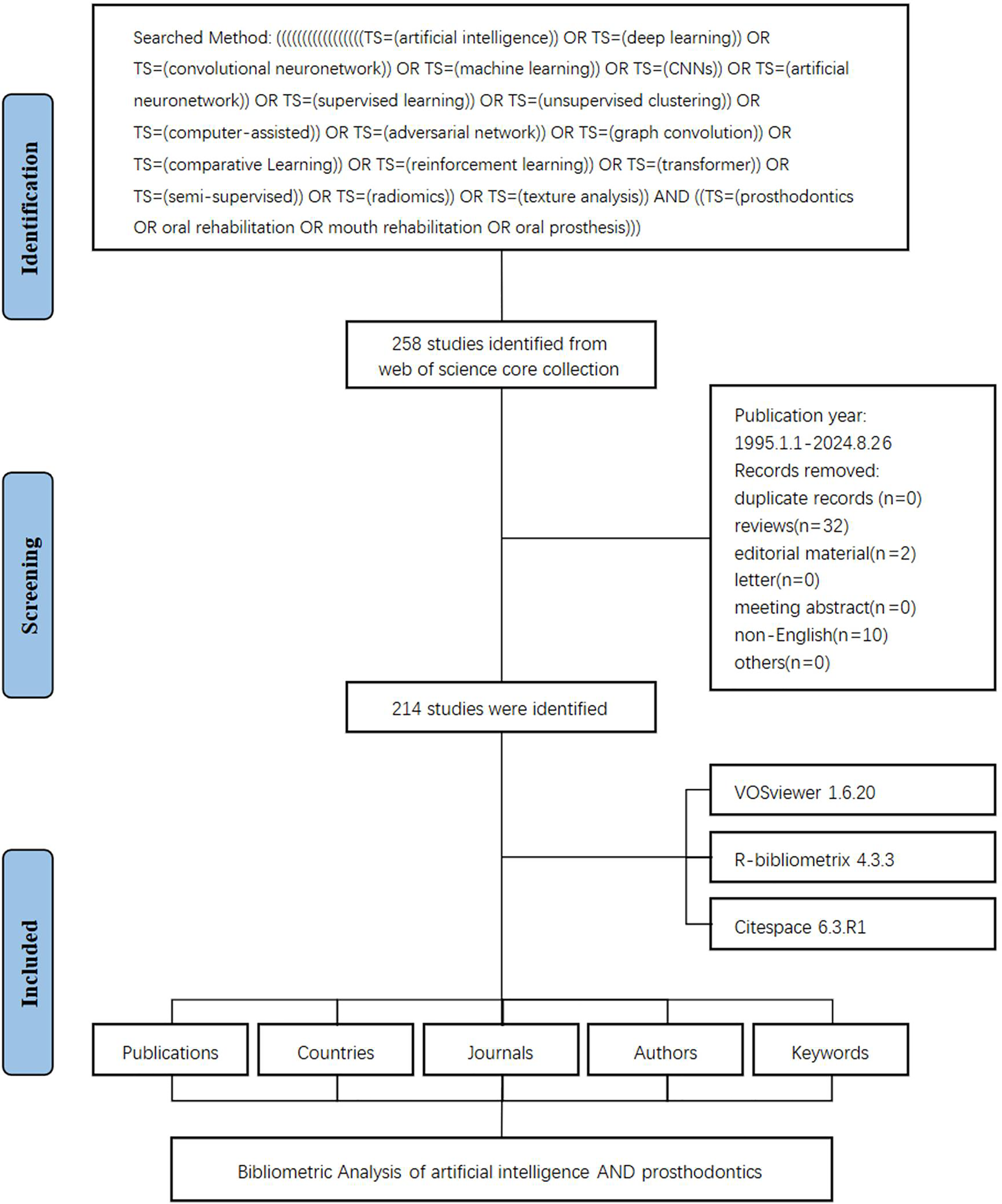
Flow diagram of the bibliographic retrieval process.

Analysis of general information. (a) Summary information of the included studies. (b) Annual number of publications.
Analysis of countries/regions publication counts
These publications came from 679 institutions across 107 countries/regions. The top 20 countries are mainly distributed in Asia, North America, and Europe (Table 1). Among the countries, the country with the largest number of publications is the United States (n = 35, 16.4%), China followed by (n = 27, 12.6%), Italy (n = 22, 10.3%), and Germany (n = 20, 9.3%). According to total publications (TP), the United States ranks (110) the first position, followed by China (90), Japan (68), and Italy (66). In terms of total citations (TC), the top three countries were the United States (1061), Italy (604), and Germany (575). The United Kingdom was the highest average citation (121.7). Notably, these findings suggest that the United States and China are the primary drivers of research output in this field, likely reflecting their significant investments in dental technology and AI. The high average citation rate in the United Kingdom, despite a lower number of publications, may indicate a focus on high-impact or collaborative studies.
Top 20 countries with the most published research on AI and prosthodontics research.
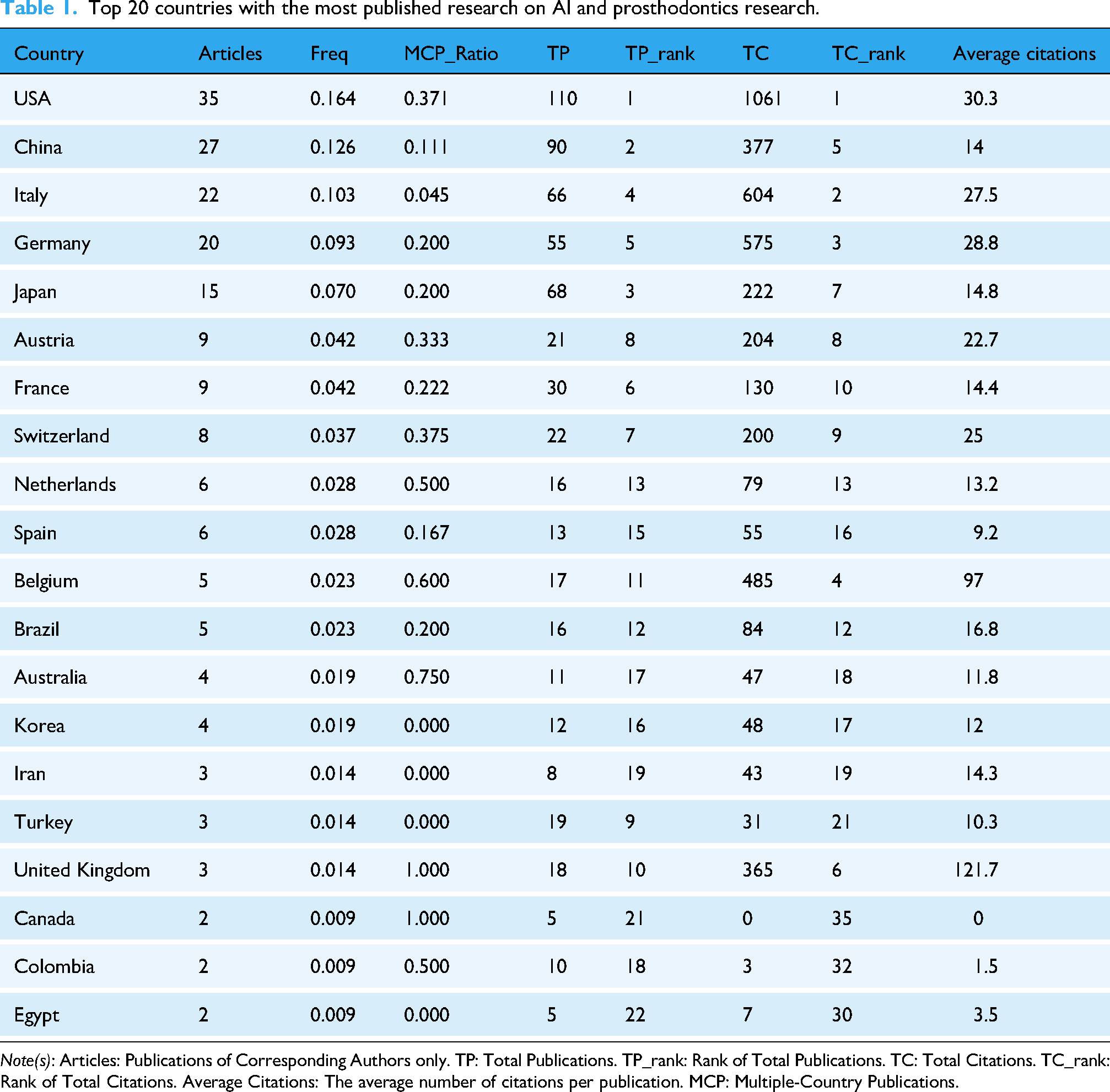
Note(s): Articles: Publications of Corresponding Authors only. TP: Total Publications. TP_rank: Rank of Total Publications. TC: Total Citations. TC_rank: Rank of Total Citations. Average Citations: The average number of citations per publication. MCP: Multiple-Country Publications.
From the statistics of the single-country publications (SCP) and multiple-country publications (MCP) (Figure 3(a)), among the top 20 countries, most research consists of single-country studies, with the Belgium, Australia, United Kingdom, Canada being the only exception. This pattern indicates that, while international collaboration exists, research in this field still tends to be domestically concentrated, possibly due to language, resource, or regulatory barriers. Countries with higher MCP ratios may serve as international hubs for AI innovation in prosthodontics.

Analysis of countries. (a) Distribution of corresponding author's publications by country. (b) Visualization map depicting the collaboration among different countries.
Subsequently, we screened and visualized 46 countries based on the number of publications of at least 1 article, and constructed a collaborative network based on the number of publications and relationships for each country (Figure 3(b)). It is noteworthy that there has been much positive cooperation between different countries. For instance, the United States has close cooperation with Switzerland, Serbia, and China. Germany has close cooperation with Belgium and Norway. Such collaborations could facilitate the exchange of advanced technologies and methodologies, potentially leading to more robust and innovative research outcomes.
Analysis of institution publications
The top 10 institutions are located in the United States (n = 2), China (n = 2), Japan (n = 2), Switzerland (n = 1), Netherlands (n = 1), Austria (n = 1), and France (n = 1) (Figure 4(a)). The five institutions that published the most relevant papers are: Harvard University (17), Peking University (15), Sichuan University (12), Medical University of Innsbruck (11), and University of Bern (11). This distribution shows that leading research institutions are geographically diverse, spanning North America, Europe, and Asia. The dominance of institutions from the United States and China mirrors the country-level data and may be influenced by greater funding opportunities and infrastructure for digital health research in these regions. Subsequently, our study selected 407 institutions for visualization based on the minimum number of 1 and constructed a collaborative network based on the number of published papers and relationships between institutions (Figure 4(b)). The cooperation between University of Bern has the highest number of collaborations with other countries (23), followed by University of Zurich (22) and University of Belgrade (18). For example, University of Zurich had an active cooperation with University of Michigan and Tufts University. University of Belgrade had an active cooperation with Boston University and Nippon Dent University. These strong institutional collaborations may contribute to higher research quality and innovation, as multi-institutional studies often benefit from shared expertise and resources.
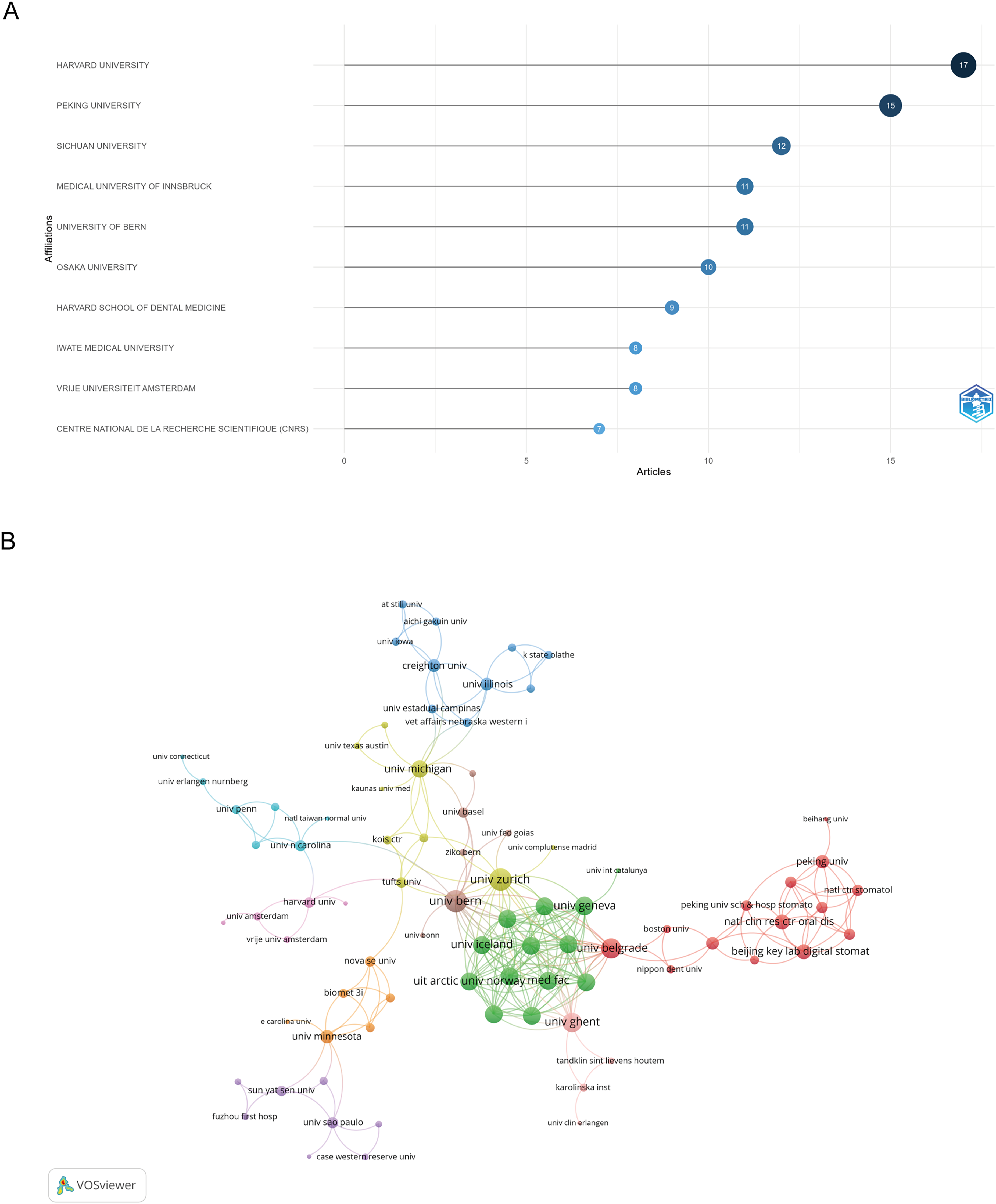
Analysis of institutions. (a) Top 10 institutions by article count and rank. (b) Visualization map depicting the collaboration among different institutions.
Analysis of journals
Publications related to AI in prosthodontics were published in 97 journals. According to the statistics (Table 2), the leading journal with the highest TP was International Journal of Oral & Maxillofacial Implants, with 26 records (IF = 1.7, 2024), followed by Journal of Oral and Maxillofacial Surgery (IF = 2.3, 2024) with 12 records, and Journal of Dental Education (IF = 1.4, 2024) with 9 records. According to TC, Journal of Prosthetic Dentistry was the highest citations (509), followed by Clinical Oral Implants Research (400). Among the top 20 journals, the journal with the highest IF is Journal of Dental Research (IF = 5.7, 2024), followed by Clinical Oral Implants Research (IF = 4.8, 2024). Eight top 20 journals were in the first quartile (Q1, 2024) of the Journal Citation Reports (JCR). Regarding H-index, International Journal of Oral & Maxillofacial Implants ranks the first position (19), followed by Journal of Oral and Maxillofacial Surgery (9). The presence of multiple journals with high-impact factors and H-indices among the top publishers suggests that research on AI in prosthodontics is being disseminated in both specialized and general dental science outlets. This may reflect the interdisciplinary and rapidly evolving nature of the field, attracting attention from a broad academic audience.
The top 20 journals that contributed to publications in the field of AI and prosthodontics.

Note(s): H-index: The h-index of the journal, which measures both the productivity and citation impact of the publications. IF: Impact Factor, indicating the average number of citations to recent articles published in the journal. JCR: The quartile ranking of the journal in the Journal Citation Reports, indicating the journal's ranking relative to others in the same field (Q1: top 25%, Q2: 25%-50%, Q3: 50%-75%, Q4: bottom 25%). TP: Total Publications. TP_rank: Rank of Total Publications. TC: Total Citations. TC_rank: Rank of Total Citations. Average Citations: The average number of citations per publication. PY_start: Publication Year Start, indicating the year the journal started publication.
Subsequently, our study screened 97 journals based on the minimum number of 1 and mapped the journal network (Figure 5), and the International Journal of Oral & Maxillofacial Implants has active citation relationships with Clinical Implant Dentistry and Related Research, and Clinical Oral Implants Research. Such citation networks indicate the central role of certain journals in shaping the discourse and knowledge base of AI applications in prosthodontics.

Visualization networks of journal collaborations.
Analysis authors
A total of 1061 authors participated in research of AI in prosthodontics. Table 3 shows Wismeijer Daniel to be the most productive author, with 4 articles published and a 4 H-index. Among the top 20 authors, 8 authors each published 3 papers, and 11 each published 2 papers. Researchers’ collaborative relationships are illustrated in Figure 6. Nodes size represents the number of publications. Wismeijer Daniel has the highest number of collaborations with other countries (27), followed by Wolfart Stefan (22) and Maeda Keisuke (20). Besides, the present study observed close collaboration among multiple authors, including Jokstad Asbjorn, Muhleman Sven, Milinkovic Iva, and so on. Wismeijer Daniel has active cooperation with Fehmer Vincent, Aartman Irene, and so on. The relatively small number of highly productive authors suggests that the field is still developing, with contributions spread across a broad base of researchers. However, the presence of tightly-knit collaborative networks may signal the emergence of leading research groups that will shape future advances in AI-assisted prosthodontics.
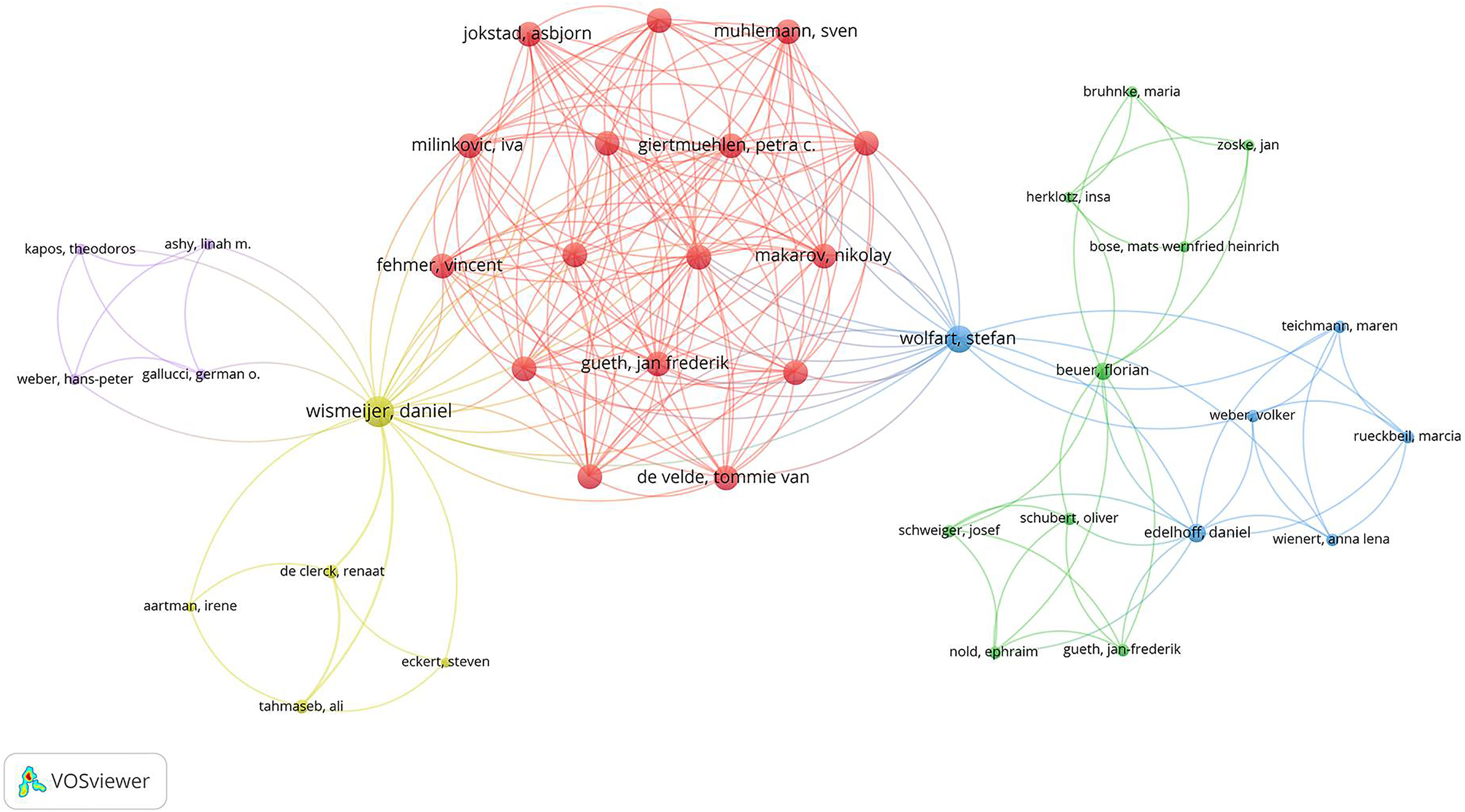
Visualization networks of author collaborations.
The top 20 authors and co-cited authors in AI and prosthodontics research.
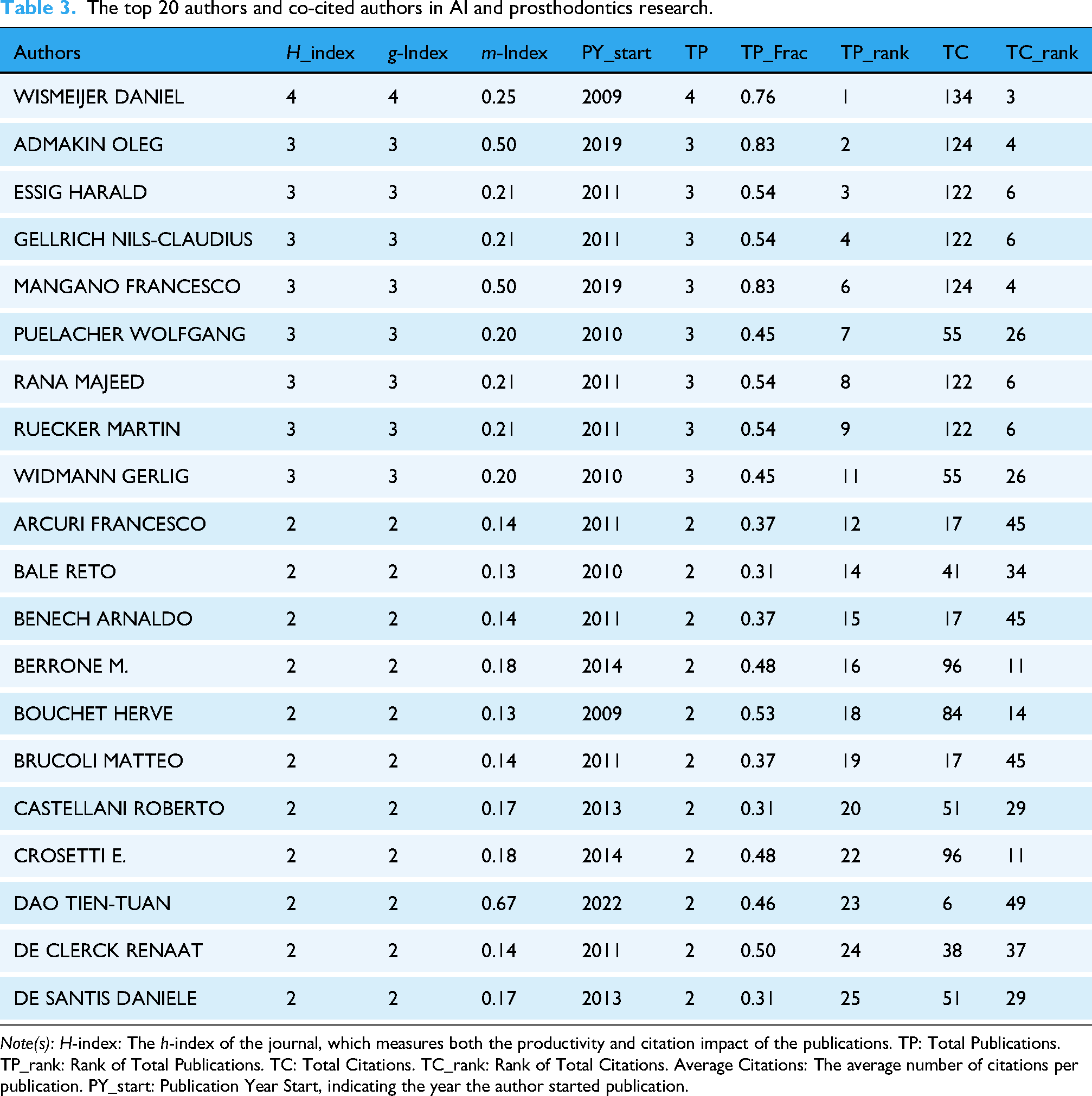
Note(s): H-index: The h-index of the journal, which measures both the productivity and citation impact of the publications. TP: Total Publications. TP_rank: Rank of Total Publications. TC: Total Citations. TC_rank: Rank of Total Citations. Average Citations: The average number of citations per publication. PY_start: Publication Year Start, indicating the year the author started publication.
High-frequent citation articles
Most of the top-10 most cited articles came from Europe and the USA (Table 4). The most frequently cited article was published in Acta Orthopaedica by Wainwright TW et al. (328 citations) in 2020,23 followed by Journal Clinical Periodontology by Van Assche N et al. (217 citations) in 2007,24 and Clinical Implantation Dental Related Research by D’haese J et al. (204 citations) in 2012.25
Top 50 most cited articles.

Note(s): TC: Total Citations.
Frequency and clustering analysis of keywords
A total of 94 keywords with at least 5 occurrences were identified and analyzed using CiteSpace. The keyword co-occurrence network (Figure 7(a)) revealed eight distinct clusters, each representing a thematic focus within AI applications in prosthodontics. In the network map, larger nodes indicate higher keyword frequency, while thicker interconnecting lines represent stronger co-occurrence relationships.

Visual analysis of keywords co-occurrence network analysis. (a) Keyword co-occurrence network map of AI in prosthodontics research. (b) Timeline overlay of keyword co-occurrence in AI and prosthodontics.
Figure 7(b) presents a timeline overlay of keyword co-occurrence, showing the evolution of research topics. Early themes (2012–2016) included “in vitro,” “titanium,” and “survival,” focusing on material studies and foundational outcomes. From 2017 onward, there is a notable shift toward “accuracy,” “placement,” and “technology,” reflecting the growing integration of digital and AI-driven methods. Recent years (2020–2022) highlight keywords such as “fit,” “rehabilitation,” and “computer-technology application,” indicating emerging interests in digital workflow optimization and patient-centered outcomes.
In addition, Figure 8 displays the top 15 keywords with the strongest bursts. The blue line represents the time interval, and the red line represents the duration of the burst. During the period from 1995 to 2024, “in vitro” (2.94) had the highest burst strength, followed by “dentistry” (2.89), and “system” (2.08). The earliest keyword bursts were “clinical report” (2006–2007) and “branemark system implants” (2006–2008). However, keywords such as “dentistry” (2022–2024), “3d printing” (2022–2024), “system” (2022–2022), and “ability” (2022–2024) have recently been used, indicating that future research will focus on these keywords.

Top 20 keywords with the strongest citation bursts.
Discussion
General information
Our bibliometric analysis reveals a dynamic and rapidly evolving field in which AI is increasingly integral to prosthodontics. From 1995 to 2009, research activity was limited, likely due to the infancy of digital dental technologies and restricted access to computing resources. Since 2010, however, the annual output has increased dramatically, mirroring broader digitalization trends in healthcare and the accelerated deployment of AI worldwide, especially in economically advanced countries.26 This growth is not only quantitative but also qualitative, as evidenced by the diversification of research themes and the evolution toward integrated digital workflows.
The United States and China stand out as the most prolific contributors to AI research in prosthodontics, a trend attributable to several factors. Both countries have established national strategies to promote AI, with significant funding and policy initiatives such as the U.S. Executive Order on AI and China's government-led investments.27–31 The presence of leading institutions like Harvard University and Peking University further amplifies output and innovation, leveraging robust research infrastructure, interdisciplinary collaboration, and access to large datasets. Additionally, academic-industry partnerships in these countries foster technological transfer and accelerate clinical translation. However, the pattern of collaboration remains uneven: while the United States and China each dominate domestically, countries such as Belgium, Australia, and the United Kingdom show higher ratios of multiple-country publications, driven by participation in cross-national consortia and EU-funded research networks. Barriers to international collaboration include language, regulatory differences, data privacy concerns, and disparities in digital infrastructure, which constrain truly global studies.29,31 Overcoming these will require harmonized standards, secure data-sharing frameworks, and coordinated funding models. 30
As for contributing authors, Wismeijer D from the Netherlands published the highest number of papers on AI and prosthodontics and ranked third in total citations among authors in this field. This author mainly focused on implant-assisted mandibular removable partial dentures.32,33 Based on citation metrics such as the H-index, Wismeijer D demonstrated notable productivity and influence within the field. Admakin O and other authors34,35 have applied AI in fixed implant prosthodontics, reporting that AI appears to be a promising tool for the restoration of single implants with monolithic zirconia crowns (MZCs) cemented on customized hybrid abutments via a fully digital workflow. In addition, the second most cited article, published by Van Assche N et al., reported on the accuracy of implant placement based on pre-surgical planning of three-dimensional cone-beam images. 16
Hotspots and frontiers
Keyword co-occurrence and burst analyses revealed not only the central research themes within AI applications in prosthodontics, but also the temporal evolution of these topics. Each cluster reflects a unique research focus, allowing for a nuanced understanding of current hotspots and emerging directions in the field.
Prosthetic materials and restoration techniques
Cluster 1, characterized by keywords such as “cad/cam,” “zirconia,” “cast,” “crowns,” and “restoration,” highlights the digital transformation of prosthetic material science. The integration of CAD/CAM and advanced ceramics like zirconia has enabled more precise, reproducible, and biocompatible restorations.1,2,6 AI algorithms now assist in the automated design and optimization of prosthetic components, improving both the fit and longevity of restorations.11 The burst of keywords such as “in-vitro” and “fit” in earlier years reflects foundational work on assessing the mechanical and clinical performance of these materials, while recent studies are increasingly leveraging deep learning for digital workflow optimization. 11
Rehabilitation and quality of life
Cluster 2 includes terms such as “rehabilitation,” “quality-of-life,” “cancer,” and “system,” emphasizing the patient-centered outcomes of prosthodontic treatment. AI is increasingly used to tailor prosthetic solutions for complex cases, such as post-tumor resection rehabilitation, through simulation and predictive analytics.13,14 The expansion of digital systems—reflected in the recent burst of the keyword “system”—suggests a move toward integrated, data-driven care models that can optimize functional and psychosocial outcomes for patients with extensive oral and maxillofacial defects.13,14
Clinical outcomes and dental technology
Cluster 3, with keywords like “dentistry,” “complication rates,” “frameworks,” and “follow-up,” reflects the increasing role of AI in tracking and improving long-term clinical outcomes. AI-driven image analysis and predictive modeling have been adopted for early detection of complications such as peri-implantitis, as well as for monitoring prosthetic survival.3–5,8 The ongoing shift from single-point diagnostics to continuous, technology-enhanced follow-up is evident in the burst of keywords like “observation period” and “tomography,” indicating the adoption of advanced imaging modalities and AI-based monitoring solutions.7,8
Implant placement and validation
The fourth cluster, containing “implant placement,” “validation,” and “technology,” underscores the critical role of AI in surgical planning and intraoperative guidance. Numerous studies have demonstrated that AI can support precise virtual planning and robot-assisted implant placement, reducing human error and improving outcomes.24,25,36 The burst of keywords such as “validation” and “technology” in recent years reflects the growing emphasis on validating these digital workflows through clinical trials and multi-center studies.36,37
Surgical guidance and diagnostic accuracy
Cluster 5, anchored by the central keyword “accuracy” along with “surgery,” “placement,” and “guides,” represents the core research focus on AI-enabled diagnostic and surgical precision. AI-based image analysis has demonstrated high accuracy in detecting dental pathologies and planning surgical interventions.38,39 For example, convolutional neural networks have achieved detection accuracies exceeding 99% for missing teeth and over 93% for restoration categorization.38,39 The continued burst of “accuracy” and “placement” as keywords highlights the ongoing drive to enhance the reliability and safety of dental procedures through AI integration.36,39,40
Design and fabrication processes
Cluster 6, featuring keywords like “design,” “fabrication,” and “reconstruction,” reflects advances in AI-assisted prosthesis modeling and digital manufacturing. Recent literature emphasizes the use of deep learning for automatic margin detection, design optimization, and additive manufacturing.11 AI is being leveraged to personalize prosthesis design, reduce fabrication errors, and accelerate workflow efficiency, particularly in complex maxillofacial reconstruction.2,13
Performance and reliability
Cluster 7 includes “fit,” “performance,” “precision,” and “reliability,” centering on the mechanical and clinical evaluation of prosthetic devices. AI-driven assessment tools have been shown to provide objective metrics for evaluating the fit and durability of crowns, bridges, and implant-supported prostheses.6,35 The burst in these keywords corresponds to a period of rapid development in mechanical testing, automated quality control, and validation of new materials and workflows.6,35
Surgical guidance and workflow
The final cluster, with terms such as “guided surgery,” “oral rehabilitation,” and “surgical guides,” highlights the increasing adoption of AI-powered navigation and planning tools in clinical practice. Studies have demonstrated that AI and robotic systems can improve surgical guidance, reduce complications, and enhance patient outcomes.37,41 The recent burst in these keywords reflects both technological advances and the diffusion of AI systems into broader clinical workflows.36,37,41
In contrast to earlier systematic reviews that primarily summarize clinical applications and AI performance in dentistry,3–5 our bibliometric approach maps the temporal and thematic evolution of the field. Notably, keyword clustering and burst analyses highlight a progression from early technical studies to more holistic, patient-centered, and system-integrated approaches. During 2012–2016, research focused on material science and foundational outcomes, with frequent keywords such as “in vitro,” “titanium,” and “survival.” This reflects widespread investigation into the mechanical properties and longevity of restorations fabricated using digital and AI-supported methods.1,6 From 2017 onward, attention shifted to “accuracy,” “placement,” “technology,” and “CAD/CAM,” paralleling the growing adoption of AI-based diagnostic tools, surgical planning, and automated design of prosthetic components.11,13,14 The rapid emergence of terms like “dentistry,” “3D printing,” and “system” from 2022 to 2024 signals a field-wide move toward comprehensive digital workflows, additive manufacturing, and the use of system-level solutions for personalized prosthodontic care.
This timeline of research focus reflects not only technological progress but also changing clinical needs. The integration of AI into prosthodontic diagnosis, planning, and fabrication addresses longstanding challenges of subjectivity and variability in treatment, offering the potential for greater accuracy, efficiency, and individualized care.2,17,18 For example, AI-driven image analysis and computer vision enable earlier detection of complications such as peri-implantitis, while deep learning-based design optimizes crown and bridge fit, as previously reported.8,9,11
Despite these advances, our analysis underscores that collaboration remains concentrated within certain networks. The dominance of single-country publications suggests that many studies are still localized, potentially due to restrictive data-sharing regulations (such as GDPR in Europe and HIPAA in the United States), inconsistent data annotation standards, and differing national funding priorities. Countries with higher international collaboration, such as Belgium and the UK, may serve as future hubs for global multi-center studies.
Comparisons with prior reviews and knowledge syntheses17,18 reveal that our findings are consistent with the broader trajectory of digitalization in dental specialties, including orthodontics, radiology, and endodontics.3–5,15,16 The convergence of AI, 3D printing, and robotics is facilitating a transition toward more efficient, minimally invasive, and patient-specific dental care. However, previous reviews often lack the quantitative mapping of research development, author impact, and collaboration networks provided here.
Looking ahead, several trends are expected to shape AI research in prosthodontics beyond 2025. First, federated learning and privacy-preserving AI will enable collaborative research across institutions without compromising patient data privacy, thus addressing one of the main barriers to international collaboration.19 Second, real-time AI guidance in clinical settings, such as intraoperative navigation and digital prosthesis fabrication, will likely become routine, further improving precision and reducing manual errors.36,37 Third, explainable AI (XAI) will gain prominence, as clinicians demand transparent, interpretable models for regulatory compliance and clinical trust. Fourth, the integration of prosthodontic data with genomics, biomechanics, and behavioral analytics is expected to advance the development of more personalized approaches in dentistry. 17 Lastly, harmonized data standards and increased international collaboration may facilitate well-designed multi-center studies, further supporting evidence-based innovation on a global scale.
Strengthens and limitations
This study has several strengthens. First, our study systematically analyzed the research on AI in prosthodontics for the first time using bibliometric methods, providing scholars concerned with related studies with a comprehensive. Second, our study used three bibliometric tools simultaneously in our survey, two of which (VOSviewer and CiteSpace) have been widely used in the field of bibliometrics, so our data analysis process was likely to be objective. Finally, bibliometric analysis provides a more comprehensive picture of hotspots and cutting-edge issues than traditional reviews. Nevertheless, there are several limitations in the present study. First, it includes only articles written in English and indexed in the WoSCC database. WoSCC was chosen because it provides comprehensive coverage of high-impact, peer-reviewed literature and is widely used in bibliometric studies. However, the exclusion of other databases such as Scopus and PubMed may have led to the omission of some relevant publications, particularly those published in non-English languages or in journals not indexed by WoSCC. Despite this, we believe the overall trends observed in our findings are unlikely to be substantially affected, as previous studies have shown considerable overlap among major bibliographic databases. Second, recently published studies may not yet have received sufficient citations due to time lag, and their impact will need to be reassessed in future analyses. Additionally, the types of studies included were limited to research articles; reviews, letters, conference papers, and books, which may also have academic value, were excluded.
AI have important research value and application prospects in prosthodontics. The significantly increase in the number of published papers indicates that the study of AI in prosthodontics is receiving increasing attention from scholars around the world. The leading countries are the United States and China. International Journal of Oral & Maxillofacial Implants is the most active journal, and Wismeijer Daniel is the most influential author. The current major topics were the accuracy of AI in diagnosis, and the AI and dental implants placement. AI is further useful for prediction of implant success and fabrication of digitally smart maxillofacial prosthesis.
Conclusion
This bibliometric analysis provides a comprehensive overview of the development and current landscape of AI in prosthodontics over the past three decades. Our findings highlight the rapid growth of research in this area, with the United States and China leading in both productivity and influence. Major research hotspots have evolved from material science and digital fabrication to the integration of AI-driven workflows, diagnosis, and personalized treatment planning. Despite the significant progress, international collaboration remains limited, and several barriers—such as data privacy and regulatory differences—persist. Looking ahead, the integration of federated learning, real-time AI guidance, and explainable AI models is expected to further enhance both research and clinical outcomes in prosthodontics. These advances will promote more accurate, efficient, and patient-centered care, while also encouraging broader multi-center and interdisciplinary collaborations. Our study provides a valuable reference for researchers, clinicians, and policymakers, and underscores the need for ongoing innovation and cooperation to fully realize the potential of AI in prosthodontic practice.
Supplemental Material
sj-docx-1-dhj-10.1177_20552076251365830 - Supplemental material for Knowledge mapping of artificial intelligence in prosthodontics during 1995–2024: A bibliometric analysis
Supplemental material, sj-docx-1-dhj-10.1177_20552076251365830 for Knowledge mapping of artificial intelligence in prosthodontics during 1995–2024: A bibliometric analysis by Wenqi Hu in DIGITAL HEALTH
Supplemental Material
sj-docx-2-dhj-10.1177_20552076251365830 - Supplemental material for Knowledge mapping of artificial intelligence in prosthodontics during 1995–2024: A bibliometric analysis
Supplemental material, sj-docx-2-dhj-10.1177_20552076251365830 for Knowledge mapping of artificial intelligence in prosthodontics during 1995–2024: A bibliometric analysis by Wenqi Hu in DIGITAL HEALTH
Footnotes
Acknowledgments
The author wants to thank CiteSpace and VOSviewer for free access by researchers.

Ethics approval
Not applicable.
Consent to participate
Not applicable.
Consent for publication
Not applicable.
Funding
The author received no financial support for the research, authorship, and/or publication of this article.
Declaration of conflicting interests
The author declared no potential conflicts of interest with respect to the research, authorship, and/or publication of this article.
Availability of data and materials
All data generated or analyzed during this study are included in this published article and its supplementary information files. The raw dataset used for bibliometric analysis (Bibliometrix-Export-File.xlsx), which contains the list of included articles and relevant metadata, is provided as a supplementary file to enhance transparency and replicability.
Supplemental material
Supplemental material for this article is available online.
References
Supplementary Material
Please find the following supplemental material available below.
For Open Access articles published under a Creative Commons License, all supplemental material carries the same license as the article it is associated with.
For non-Open Access articles published, all supplemental material carries a non-exclusive license, and permission requests for re-use of supplemental material or any part of supplemental material shall be sent directly to the copyright owner as specified in the copyright notice associated with the article.
