



Abstract
Introduction
Alzheimer’s disease (AD) is a neurodegenerative disease characterized by progressive episodic memory decline with significant worsening impact on the daily life. 1 So far, the pathogenesis underlying AD remained unknown but genetic factors were thought to play an important role. 2 Approximately 1% to 5% AD are early-onset and some of them are associated with mutations in 3 genes: amyloid precursor protein (APP), presenilin 1 (PSEN1), and presenilin 2 (PSEN2). 2 For late-onset sporadic AD (LOAD), APOEε4 is a risk factor and predicts approximately 50% of LOAD. 3
Recently, many genome-wide association studies have identified risk genes other than APOE in caucasian LOAD populations which include clusterin, CR1, PICAM, GAB, and so on. 4 -6 Clusterin, also named as APOJ, is a lipoprotein expressed abundantly in central nervous system. The genetic association of clusterin with LOAD have been commonly tested on 3 single-nucleotide polymorphisms (SNPs; rs9331888, rs11136000, and rs2279590), and rs11136000 association with LOAD has been replicated in several cohorts with caucasian origin. 7 -11 This association is confirmed in a Chinese cohort, 12 and borderline association identified in another study from China. 13 In addition, rs11136000 was found associated with schizophrenia in another Chinese cohort, raising the possibility that rs11136000 might be pathogenic in Chinese population. 14
The slight differences of Clusterin rs11136000 association with LOAD in Chinese populations might be due to small genetic effect. 12,13 Replicate genetic studies from other Chinese cohorts and meta-analysis of these studies derived from the same population are required to overcome small sample size bias. Therefore, we investigated the distribution of rs11136000 in our LOAD cohort.
Materials and Methods
Patients
A total of 127 patients with AD were enrolled from Department of Neurology in Ruijin Hospital affiliated to Shanghai Jiao Tong University School of Medicine from 2008 to 2010. All probable AD diagnosis was made based on the criteria revised in 2007. A total of 143 individuals matched for age, sex, and ethnical origin without any neurological disorders were enrolled from local community as controls with Mini-Mental Status Examination (MMSE) ≥29. This study was approved by ethical committee and informed consents for the participation were also obtained from all individuals.
Genomic Sequence
Genomic DNA from peripheral blood was extracted using the standardized phenol/chloroform extraction method. The SNP rs11136000 genotype (intron region of clusterin, NC_000008.10:g.27464519 T>C) was determined by polymerase chain reaction–restriction fragment length polymorphism (PCR-RFLP) assays. A 259-bp fragment was PCR amplified using forward primer 5′-CCCTGAATCTTACCTTTCTATTGC-3′ and reverse mismatched primer 5′-ATGGAGTTTCACCATGTTAGCC-3′. The amplification products, digested overnight with Apo I (R0566L; NEB, Ipswich, MA, USA) at 37°C, were separated by electrophoresis in 2% nondenaturing polyacrylamide gel and visualized by silver staining. The homozygote TT and the heterozygous TC were expected to yield 2 fragments (169 and 90 bp) and 3 fragments (259, 169, and 90 bp), respectively, whereas CC remained uncut as a 259-bp fragment. APOEε4 was genotyped as Zivelin A. 15
Statistical Analysis
Statistical analysis was performed with SPSS 11.5 (SPSS Inc, Chicago, Illinois). Chi-square test was adopted to analyze the genotype and allele frequencies in LOAD and controls. A t test was performed to compare the demographic features between LOAD and controls. Goodness-of-fit method was used to test Hardy-Weinberg equilibrium (HWE) in controls for population stratification. Association study was performed by binary logistic regression to generate P value and odds ratios (ORs) for the association of age, gender, APOEε4 status, and rs11136000 minor allele (T) with LOAD. Pooled OR analysis was performed using STATA software (version 10.0, StataCorp LP, USA). The OR was demonstrated along with the corresponding 95% confidence interval (CI). A P value of <.05 was considered as statistically significant. Post hoc power estimation was performed by Gpower (G*Power 3.1.2, Germany)
Results
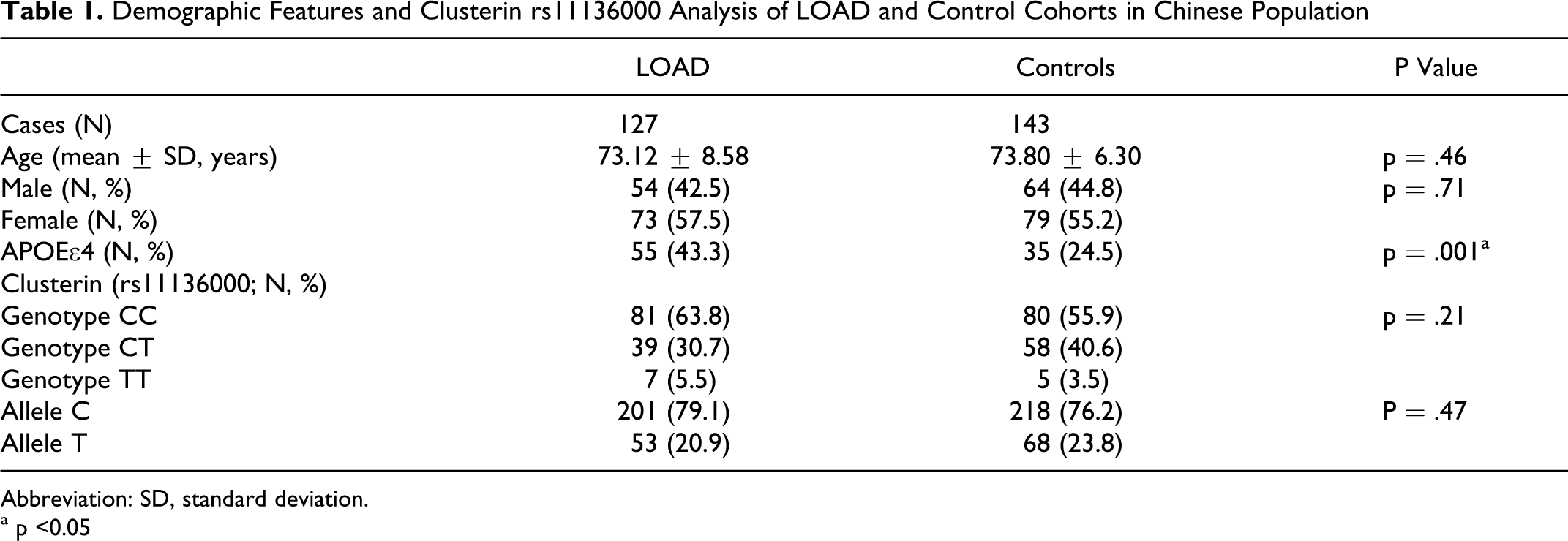
No difference was found in age and sex distribution between LOAD and controls (Table 1 ). APOEε4 was identified in 55 LOAD and 35 controls and further chi-square analysis revealed significant difference in terms of APOEε4 frequency between LOAD and controls (χ 2 = 10.734, degrees of freedom [df] = 1, P = .001; Table 1).
Demographic Features and Clusterin rs11136000 Analysis of LOAD and Control Cohorts in Chinese Population
Abbreviation: SD, standard deviation. a p <0.05
The distribution of clusterin polymorphism (rs11136000) was in HWE in our sample. Population stratification was not detected by testing HWE in controls in Yu’s study and ours (P = .199) and Chen’s study and ours (P = .216). The frequency of minor allele (T) was 20.9% in LOAD group and 23.8% in control group but further analysis did not reveal any significant difference (χ 2 = .655, df = 1, P = .47; Table 1). Genotype frequency was calculated as C/C in 63.8% of LOAD and 55.9% of control, C/T in 30.7% of LOAD and 40.6% of control, and T/T in 5.5% of LOAD and 3.5% of control. But again there was no statistical difference among genotype distribution in our sample (χ 2 = 3.124, df = 2, P = .21; Table 1).
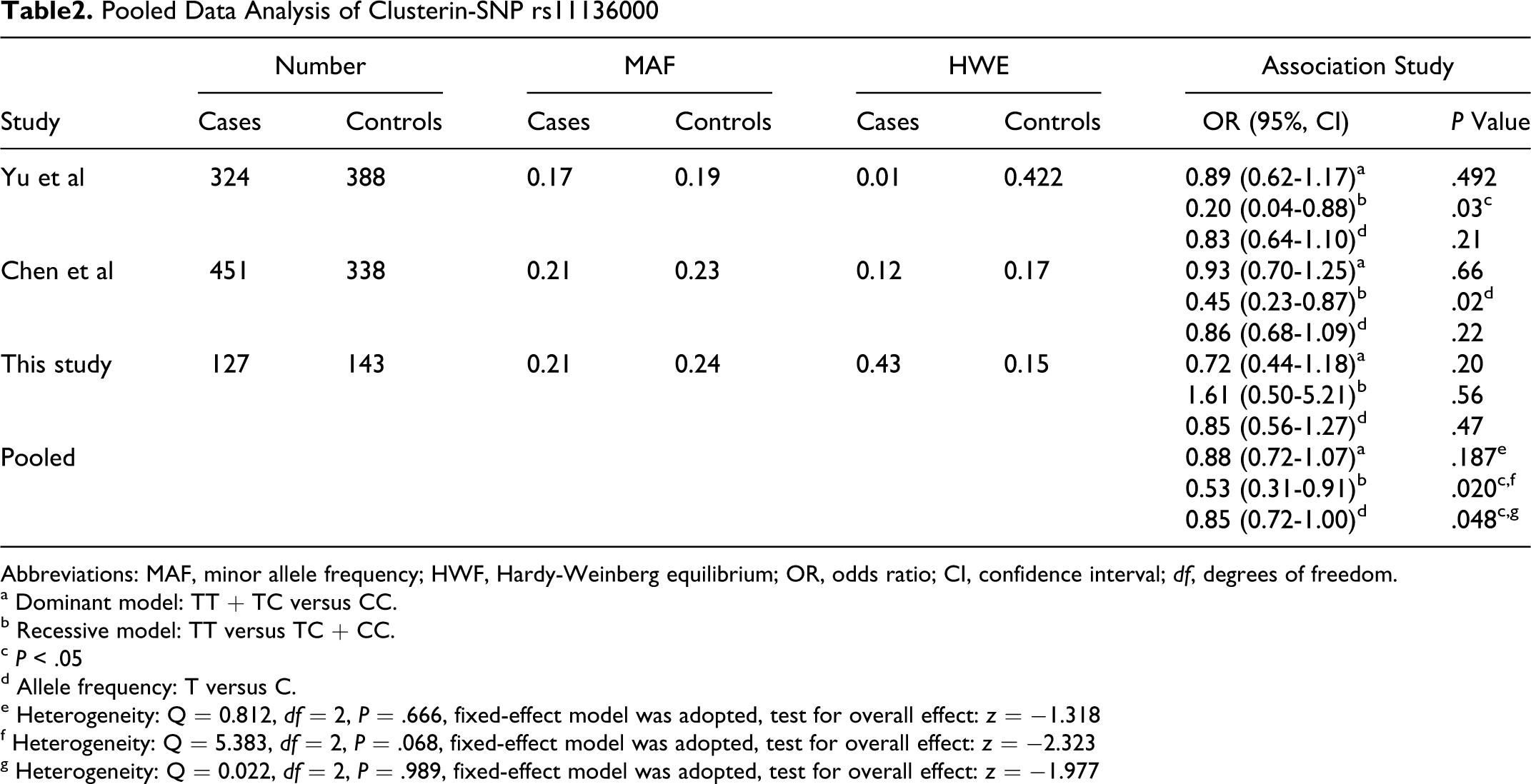
Binary logistic regression revealed that APOE (OR = 2.35, 95% CI: 1.40-3.96, P = .001), but not rs11136000 (OR = 0.72, 95% CI: 0.44-1.19, P = .197), was significantly associated with LOAD in our cohort. Pooled data of 3 rs11136000 association studies revealed that T allele (OR = 0.85, 95% CI: 0.72-1.00,
Pooled Data Analysis of Clusterin-SNP rs11136000
Abbreviations: MAF, minor allele frequency; HWF, Hardy-Weinberg equilibrium; OR, odds ratio; CI, confidence interval; df, degrees of freedom.
a Dominant model: TT + TC versus CC.
b Recessive model: TT versus TC + CC.
c P < .05
d Allele frequency: T versus C.
e Heterogeneity: Q = 0.812, df = 2, P = .666, fixed-effect model was adopted, test for overall effect: z = −1.318
f Heterogeneity: Q = 5.383, df = 2, P = .068, fixed-effect model was adopted, test for overall effect: z = −2.323
g Heterogeneity: Q = 0.022, df = 2, P = .989, fixed-effect model was adopted, test for overall effect: z = −1.977
Discussion
Recently, Lambert et al and Harold et al both performed genome-wide association studies from 2 different case–control samples and published that clusterin polymorphism (rs11136000) was associated with LOAD in caucasian population. 4,5 Later, several studies confirmed the findings in different samples. 7 -11 Furthermore, Mengel-From et al reported that this polymorphism was associated with cognitive function measured by MMSE and cognitive composite score in a Danish cohort sample with elderly individuals between the age 16 of 92 and 93. Additionally, plasma clusterin level was also demonstrated to be associated with the prevalence and severity of LOAD in Schrijvers’ study. 17 Interestingly, even before the findings of positive connection between rs11136000 and LOAD, it was already shown that clusterin was involved in the Aβ clearance or acted as chaperon for protein degradation. 18 -20 Based on all of these findings, it was suggested that clusterin might play an important role in LOAD. 21
Our sample included LOAD based on the revised diagnosis criteria which emphasized on the typical and early impairment on episodic memory with at least one of the supportive features which included medial temporal atrophy, and/or cerebrospinal fluid biomarker changes (low Aβ42 or high t-tau or p-tau), and/or special neuroimaging changes (positron emission tomography or single-photon emission computed tomography). 1 This revised diagnosis criteria was established with the inclusion of more advanced progress on AD and aimed to provide the researches and clinical trials with criteria with more reliable periodicity in LOAD. We confirmed the contribution of APOE ε4 to LOAD in our cohort, but not clusterin (rs11136000), indicating that genetic influences of clusterin (rs11136000) were not as strong as APOEε4.
Minor allele frequency (MAF) of clusterin rs11136000 (T allele) varies between 0.17 and 0.43 in Chinese population. While as in caucasians, MAF was running from 0.35 to 0.43. Despite the differences in MAF among different populations, consistent association of clusterin (rs11136000) with LOAD is observed. In pooled data from Chinese cohorts, this association follows a recessive inherited model with TT genotype carriers have reduced LOAD risk. Due to low MAF in Chinese, a larger sample is required to identify such an association. The molecular function of clusterin (rs11136000) variants is warrant to investigate further.
Footnotes
The authors declared no conflicts of interest with respect to the research, authorship, and/or publication of this article.
The authors disclosed receipt of the following financial support for the research, authorship, and/or publication of this article: supported by grants from Doctoral Fund of Shanghai Jiao Tong University School of Medicine (2007), Shanghai Health Bureau (2009050), State Key Basic Research Program (2006CB500706, 2010CB945200), Shanghai Key Project of Basic Science Research (07DJ14005, 09DZ1950400) and Program for Outstanding Medical Academic Leader (LJ 06003).