



Abstract
Objective
To examine the association between the circadian locomotor output cycles kaput (CLOCK) gene rs1554483 G/C polymorphism and susceptibility to Alzheimer's disease in Chinese people.
Methods
This case–control study determined apolipoprotein E (APOE) and CLOCK rs1554483 G/C genotypes using polymerase chain reaction restriction fragment length polymorphism.
Results
Unrelated patients with Alzheimer's disease (n = 130) and healthy controls (n = 188) were analysed for an association between the CLOCK gene rs1554483 G/C polymorphism and susceptibility to Alzheimer's disease. In the whole sample and in APOE ɛ4 isoform noncarriers, the prevalence of CLOCK gene rs1554483 G allele carriers was significantly higher in patients with Alzheimer's disease than in controls. Among APOE ɛ4 carriers, the prevalence of CLOCK rs1554483 G allele carriers was not significantly different between patients with Alzheimer's disease and controls.
Conclusion
Among APOE ɛ4 noncarriers, but not APOE ɛ4 carriers, the CLOCK rs1554483 G allele was associated with increased susceptibility to Alzheimer's disease.
Keywords
Introduction
Alzheimer's disease is an age-associated neurodegenerative disease caused by multiple factors, including genetic factors,1–4 with over 200 genes thought to be involved in its pathogenesis. 5 Functional genomic studies reveal that lipid metabolism dyshomeostasis and sleep/wake disorders are associated with Alzheimer's disease-related genes.6,7 Biological, genetic and epidemiological data support the link between the apolipoprotein E (APOE) gene, located on chromosome 19q13.2, and susceptibility to Alzheimer's disease.8–10 The presence of the allele for the APOE ɛ4 isoform, which is the only confirmed genetic risk factor for Alzheimer's disease, increases the risk of developing this condition in a dose-related fashion, and is associated with ∼40–70% of cases. 10
The key gene involved in the regulation of circadian rhythm is the circadian locomotor output cycles kaput (CLOCK) gene.11,12 Both the CLOCK and APOE genes are involved in lipid metabolism pathways, with the APOE ɛ4 allele and CLOCK rs1554483 G carrier polymorphism both being associated with a high susceptibility to obesity.12–14 Sleep disorders and other disturbances of circadian rhythm are also confirmed to be risk factors for Alzheimer's disease. The CLOCK rs1554483 G/C polymorphism is related to sleep disorders, suggesting that CLOCK may be potential candidate gene for therapy and a marker for increased risk of Alzheimer's disease.15,16
The present case–control study examined the association between the CLOCK rs1554483 G/C polymorphism and susceptibility to Alzheimer's disease.
Patients and methods
Study population
Between January 2010 and September 2011, consecutive patients with Alzheimer's disease were recruited from a primary care setting by specialists in geriatrics, according to the National Institute of Neurological and Communicative Disorders and Stroke and the Alzheimer’s Disease and Related Disorders Association criteria. 17 The primary care setting was a section of the Department of Geriatrics of The Third Hospital of Mianyang, Mianyang, Sichuan Province, China. Normal healthy controls, without Alzheimer's disease but similar to the patients in terms of age, sex, daily activities, sleep quality and health status, were volunteers selected from patients attending the Third Hospital of Mianyang for routine examination.
Medical examinations (including liver and renal function tests, abdominal ultrasound examination and cardiac colour Doppler ultrasound) were carried out on all participants. Cognitive function was measured by the Mini Mental state examination (MMSE). 18 Daily activities were reported by participants and their family members, and sleep quality was measured using the Pittsburgh Sleep Quality Index. 19 In addition, health status was evaluated according to medical records. Patients with a prior diagnosis of cardiovascular, cerebrovascular or peripheral vascular disease, sleep apnoea syndrome, or chronic renal failure were excluded from the study.
Written informed consent was obtained from all participants (as well as their legal proxies). The Research Ethics Committee of Sichuan University approved the study.
Genotyping
Genotyping for the APOE and CLOCK genes was carried out as described previously.20,21 Fasting whole blood was drawn from the antecubital vein at 07:00 h am in all subjects to control for diurnal variation. The blood samples were then anticoagulated using 35 µg/ml warfarin and stored at −80°C until analysis. Total RNA was isolated from 2 ml of venous blood using a RNA isolation kit from QIAGEN (Valencia, CA, USA). RNA samples were purified using an RNeasy™ Kit (QIAGEN) and treated with DNase I (30 Kunitz units) to remove any trace of genomic DNA, according to the manufacturer's instructions. cDNA was reverse transcribed (RT) from RNA using the FastQuant RT Kit (TIANGEN Biotech [Beijing], Beijing, China). PCR amplification of the cDNA was performed in a 25 -μl reaction volume containing 1 × QIAGEN polymerase chain reaction (PCR) buffer, 1 × QIAGEN Q-solution, 0.6 µm primers, 0.2 mm of each deoxynucleotide triphosphate (Invitrogen, Carlsbad, CA, USA), and 0.6 U HotStar Taq DNA polymerase (QIAGEN). PCR primers for the APOE and CLOCK genes were designed, based on the human gene, using primer sequences that have been reported previously.20,21 The PCR conditions were as follows: initial incubation at 95°C for 15 min, followed by 36 cycles of denaturation at 94°C for 30 s, annealing at 56°C for 1 min and elongation at 72°C for 40 s. PCR products were sequenced and characterized to confirm their identity, and the genotypes of APOE and CLOCK gene rs1554483 G/C were determined.20,21
Statistical analyses
All statistical analyses were carried out using the SPSS® software package, version 11.5 (SPSS Inc., Chicago, IL, USA) for Windows®. Allele frequencies and genotype distribution for the APOE and CLOCK genes in patients with Alzheimer's disease and control subjects were determined by an allele-counting method and analysed using Pearson's χ2-test. Between-group baseline characteristics were compared using the χ2-test for categorical variables and unpaired Student's t-test for continuous variables. A power analysis was carried out using the Genetic Power Calculator (http://pngu.mgh.harvard.edu/purcell/gpc/cc2.html) to determine the sample size, in accordance with a previous study. 22 A P-value < 0.05 was considered to be statistically significant; all P-values were two sided.
Results
Demographic and clinical characteristics of patients with Alzheimer's disease and age-matched healthy controls.
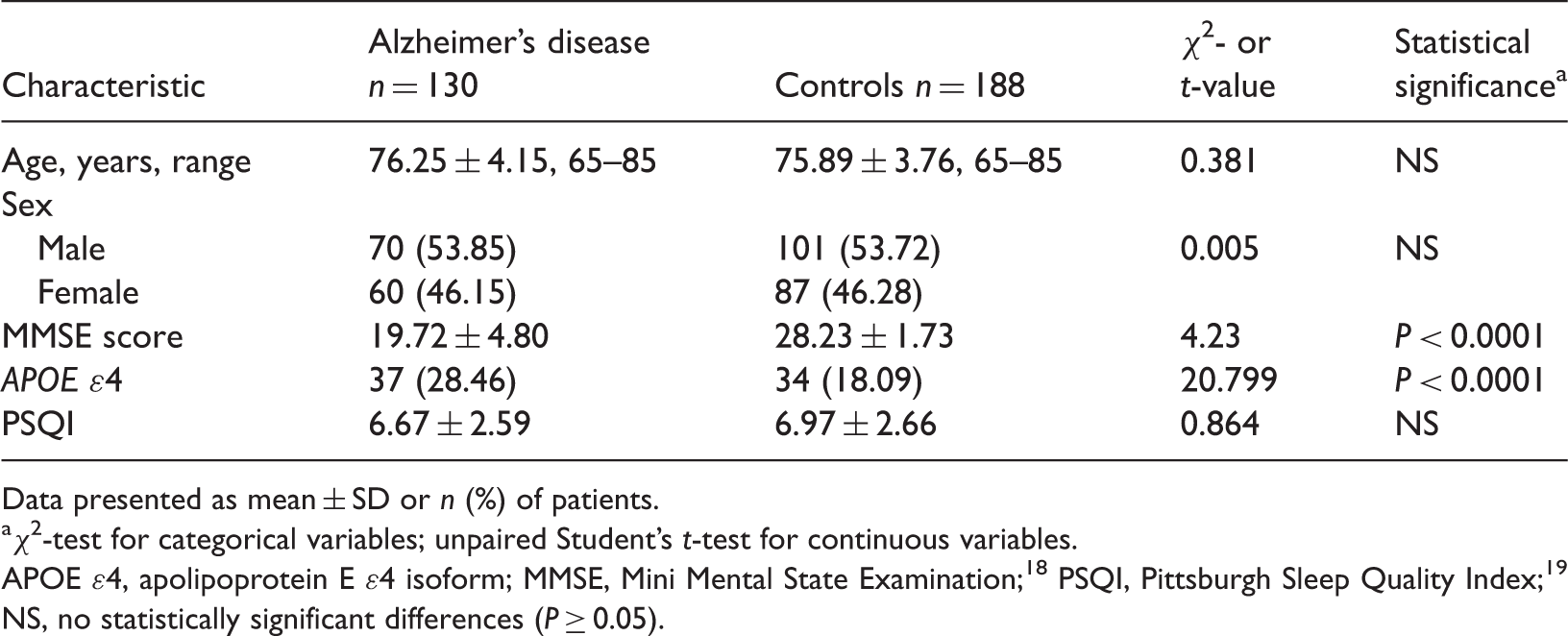
Data presented as mean ± SD or n (%) of patients.
χ2-test for categorical variables; unpaired Student's t-test for continuous variables.
Comparison of allele and genotype frequencies of CLOCK rs1554483 C/G polymorphism and APOE ɛ4 isoform in patients with Alzheimer's disease and age-matched healthy controls.

Data presented as n (%) incidence.
Allele frequencies and genotype distribution of patients with Alzheimer's disease and control subjects were determined by an allele-counting method and analysed with Pearson's χ2-test.
APOE ɛ4, apolipoprotein E ɛ4 isoform; CLOCK, circadian locomotor output cycles kaput; NS, no statistically significant differences (P ≥ 0.05).
Among APOE ɛ4 noncarriers, there was a significant between-group difference in the prevalence of the CLOCK rs1554483 G/C genotype (χ2 = 11.702, P = 0.003). In addition, patients with Alzheimer's disease had a higher prevalence of G carriers (χ2 = 12.347, P < 0.0001) compared with controls. Among APOE ɛ4 carriers, there were no significant between-group differences in CLOCK rs1554483 G/C genotype or allele prevalence (Table 2).
Discussion
The present study demonstrated a significantly higher proportion of APOE ɛ4 carriers in the Alzheimer's disease patient group than in the control group (28.46% versus 18.09%, χ2 = 20.799; Table 1). There was a difference between APOE ɛ4 noncarriers and carriers in terms of the CLOCK rs1554483 G/C polymorphism and an association with Alzheimer's disease. In the whole study population, there were three times more APOE ɛ4 noncarriers than APOE ɛ4 carriers. In APOE ɛ4 noncarriers and in the whole study population, the CLOCK rs1554483 G allele appeared to be associated with an increased risk of Alzheimer's disease, with a stronger association observed in APOE ɛ4 noncarriers. No significant association between the CLOCK rs1554483 G allele and Alzheimer's disease was seen in APOE ɛ4 carriers, however. The association of CLOCK rs1554483 G allele with an increased risk of Alzheimer's disease was only observed in APOE ɛ4 noncarriers. Thus, it would appear that the link between the CLOCK rs1554483 G allele and an increased risk of Alzheimer's disease is only relevant in APOE ɛ4 noncarriers.
To the best of the authors' knowledge, the present study is the first to evaluate an association between the CLOCK rs1554483 G/C polymorphism and Alzheimer's disease, and to show a link between the two. To date, the presence of the APOE ɛ4 allele has been the only confirmed genetic risk factor for Alzheimer's disease.8–10 The APOE gene is involved in the regulation of metabolism, and the APOE ɛ4 allele has been related to an increased risk of metabolic syndrome, which is also a known risk factor for Alzheimer's disease. 23 The CLOCK gene rs1554483 G allele is also linked with increased metabolic syndrome. In terms of increased risk of Alzheimer's disease, therefore, the CLOCK rs1554483 G allele and APOE ɛ4 allele may share the same mechanism, which may involve metabolic disruption.12,24,25 Further investigation is required, to confirm such an association.
There was a difference between APOE ɛ4 carriers and noncarriers in terms of the association between the CLOCK rs1554483 G/C polymorphism and Alzheimer's disease, in the present study. Among the APOE ɛ4 carriers, no association between the CLOCK gene rs1554483 G allele and an increased risk of Alzheimer's disease was observed. Both APOE ɛ4 noncarriers and CLOCK rs1554483 G carriers showed an increased risk of Alzheimer's disease. When the two factors were present simultaneously, the risk of Alzheimer's disease did not significantly increase over the risk observed for each individual factor. Possible explanations for this include: (i) that, as the prevalence of Alzheimer's disease was already high in the APOE ɛ4 carrier or CLOCK rs1554483 G allele carrier groups, when they existed simultaneously the increased prevalence was small and did not achieve statistical significance; (ii) the increased risk of Alzheimer's disease in the CLOCK rs1554483 G allele and APOE ɛ4 carriers occurs via the same mechanism, so that the presence of one factor would be sufficient to start the disease process, and when the other also existed, the increased risk for Alzheimer's disease was negligible.
Finally, CLOCK is a key gene regulating circadian rhythm and CLOCK rs1554483 G/C polymorphisms are related to the risk of Alzheimer's disease, suggesting that circadian rhythm may also related to Alzheimer's disease.12,24 Circadian rhythm disorders (including sleep/wake cycles, blood-pressure rhythm and thyrotropin-stimulating hormone rhythm) have been confirmed to be risk factors for Alzheimer's disease.15,16 The present study suggested that circadian rhythm was related to the risk of Alzheimer's disease at a genetic level, and point to a genetic locus that could be related to the development of the disease.
In conclusion, the present study indicated that the CLOCK gene rs1554483 G/C polymorphism may be associated with Alzheimer's disease, that CLOCK rs1554483 G allele carriers may have a higher risk of developing Alzheimer's disease than noncarriers, and that this association may differ between APOE ɛ4 noncarriers and carriers.
Footnotes
Acknowledgements
The authors thank the staff of the Key Laboratory of Chronobiology of Health Ministry in the Basic and Forensic School of Sichuan University, and the Department of Geriatrics of the Third Hospital of Mianyang, and all study participants (as well as their legal proxies) for their contributions.
Funding
This work was supported by the Science and Technology Graveness Project of Sichuan Province (2010FZ0061) and the Illustrious Youth Specialist Project of Sichuan Province (2012JQ0050).
Declaration of conflicting interest
The Authors declare that there are no conflicts of interest.