




Abstract
Air filtration is one of the most effective solutions for reducing exposure to particles that threaten human health. Various methods of nanofibers surface modification lead to optimizing the filter structure, and improved filter performance while balancing filtration efficiency and pressure drop. This research examines the conventional methods of nanofiber surface modification and the advantages and disadvantages of each. In the present study, it was determined 70% of the studies are related to the use of self-charging materials. Two studies (4.8%) involved the use of aerogels and another two studies (4.8%) employed physical and chemical methods including plasma and hydrolysis. Additionally, 21.4% of studies used different methods to produce composites, incorporating materials such as nanoparticles, functional protein groups, metal-organic-framework (MOF), and microbeads. The findings showed that each of the surface modification methods improves the filters by creating different properties, such as reducing the diameter of the fibers, increasing the surface area, creating roughness on the surface of the fibers, increasing the surface charge, etc. In addition, in some studies, other properties such as biodegradability and mechanical strength have been added to the filter. In general, using different methods of nanofiber surface modification improves filters and increases their efficiency in trapping particles in the air.
Keywords
Introduction
Due to the expansion of urbanization and industrialization worldwide, air pollution caused by suspended particles has become a major threat to human health; Fine particles with a diameter of 2.5 microns or less (PM2.5), due to their large surface area, can absorb toxic substances and easily penetrate the bronchi, lungs and bloodstream, causing significant health issues such as cardiovascular diseases, respiratory diseases and allergies. 1 Morever, bacteria constitute more than 80% of inhalable microorganisms in polluted air, which may lead to respiratory diseases and allergies. 2 Therefore, the control of pollutants has a special importance and air filtration is one of the most effective solutions for reducing exposure to air pollutants. 3
In air filtration, several criteria are vital to assess the performance of filters. Filtration efficiency is one of the main criteria and indicates the filter’s power to remove particles. 4 Another key criterion in air filtration is pressure drop, which relates to the amount of energy required to purify polluted air. 5 The quality factor is the third important criterion in air filtration, which is obtained by integrating pressure drop and efficiency. 6 Fiber filters are particularly effective in addressing these criteria. Compared to membrane filters, fiber filters are widely used in various air filtration devices such as indoor air purification systems, vehicle exhaust filters, and masks due to their cost-effectiveness, lightweight nature, and ease of use.3,7 Also, compared to microfiber filters, the unique features of nanofiber filters, such as controllable morphology, tunable porosity, and high surface-to-volume ratio, enable them to have excellent filtration performance. 6
Various methods can be used to manufacture nanofibers, such as stretching, self-assembly, template synthesis, and phase separation. However, electrospinning is the most accepted method, enhancong filter performance by creating fibers in the nano range.8,9 Particle filtration occurs through mechanismslike gravitational sedimentation, inertial collision, direct collision, and electrostatic attraction. 10 Large particles trapped by mechanical filtration,, while electrostatic interactions are more effective for particles under 0.3 microns or less (PM 0.3). 1 So, optimizing filter structure and electrostatic interactions improves efficiency and balances filtration efficiency with pressure drop. 4
Various studies have shown that one way to achieve high efficiency for particulate and chemical pollutants is to combine different filter layers with different functions, 11 However, this strategy increases energy consumption and pressure drop, so solutions must be sought to upgrade filters without negatively affecting their pressure drop. Among the various approaches, using polymer blends and creating a composite composition is the most practical and simple way to upgrade filters, in which different materials with different properties can be combined into a new composite with properties rarely found in the individual components. Agasthiyaraj Lakshmanan et al. produced a nanocomposite membrane using a polyacrylonitrile/polyvinylpyrrolidone mixture that had 6 times the efficiency of HEPA while having a low-pressure drop. 12 Ali Jahanbakhsh showed in her study that the use of composite materials not only improves air filtration efficiency but also has applications in the treatment of water and wastewater pollutants. 13 Mostafavi et al. also designed and constructed a nanocomposite-based polyurethane filter to improve the quality of urban wastewater and remove organic pollutants, which resulted in achieving optimal filtration repeatability. 14 In addition, it is possible to develop cost-effective and high-efficiency filters by using a single material with multifunctional filtration properties such as soy protein. 15 In his study, Hamid Souzandeh developed a multifunctional filter by denaturing soy protein, which has many functional groups, including polar, non-polar, hydrophobic, and hydrophilic groups. 16
To further enhance air filtration, several methods aim at creating or maintaining electrostatic interactions on filter surfaces. Techniques include coating microfibers with a metal layer, functionalizing nanofibers with nanomaterials, modifying the surface of fibers with various treatments, or using self-charging materials and materials with different functional groups.7,17–20 Surface modification methods improve the filter’s performance in trapping fine particles by changing the structure or surface area, creating roughness, creating electrostatic forces on the filter surface, and ultimately increasing the interaction between fibers and contaminant particles.21,22 Most of the aforementioned mechanisms are only temporarily effective during the first use of the filter, and then the surface potential is severely reduced by exposure to air Consequently, sustaining electrostatic charges without altering the filter geometry requires continuous electrical energy supply. 1
In response, self-charging strategies long-term filtration efficiency of nanofiber filters Self-charging enable persistent surface electric charge that continue attracting particles during filtration. 20 Various energy sources such as light, thermal changes, and mechanical movements, can drive self-charging processes through piezoelectric, triboelectric, photovoltaic, and thermoelectric effects. 23 The triboelectric effect, for instance, results from contact electrification between two surfaces, even when made of the same material. The direction and amount of charge transfer depend on the electron affinity of the contact materials. 24 The other hand, piezoelectric materials are crystalline compounds exhibiting spontaneous polarization along one of the crystal axis, utilizing a large internal electric field to trap fine dust and prevent particulate matter (PM) inhalation. 25
Recently, the use of piezoelectric materials or triboelectric effects in fiber filters has been studied to increase filtration performance by including quasi-permanent electric charge or polarization on the fiber surfaces without external forces. However, most studies have focused on polyvinylidene fluoride, a fluorine-containing polymer with limited toxicological data.1,26 Meanwhile, various surface modification methods, such as the plasma treatment, the use of aerogels, or self-charging materials, have attracted increasing attention, each with specific advantages and disadvantages. Therefore, this study reviews conventional methods for creating electrostatic interactions in filters, analyzes their performance improvements, and , discusses the benefits and drawbacks of each approach.
Method
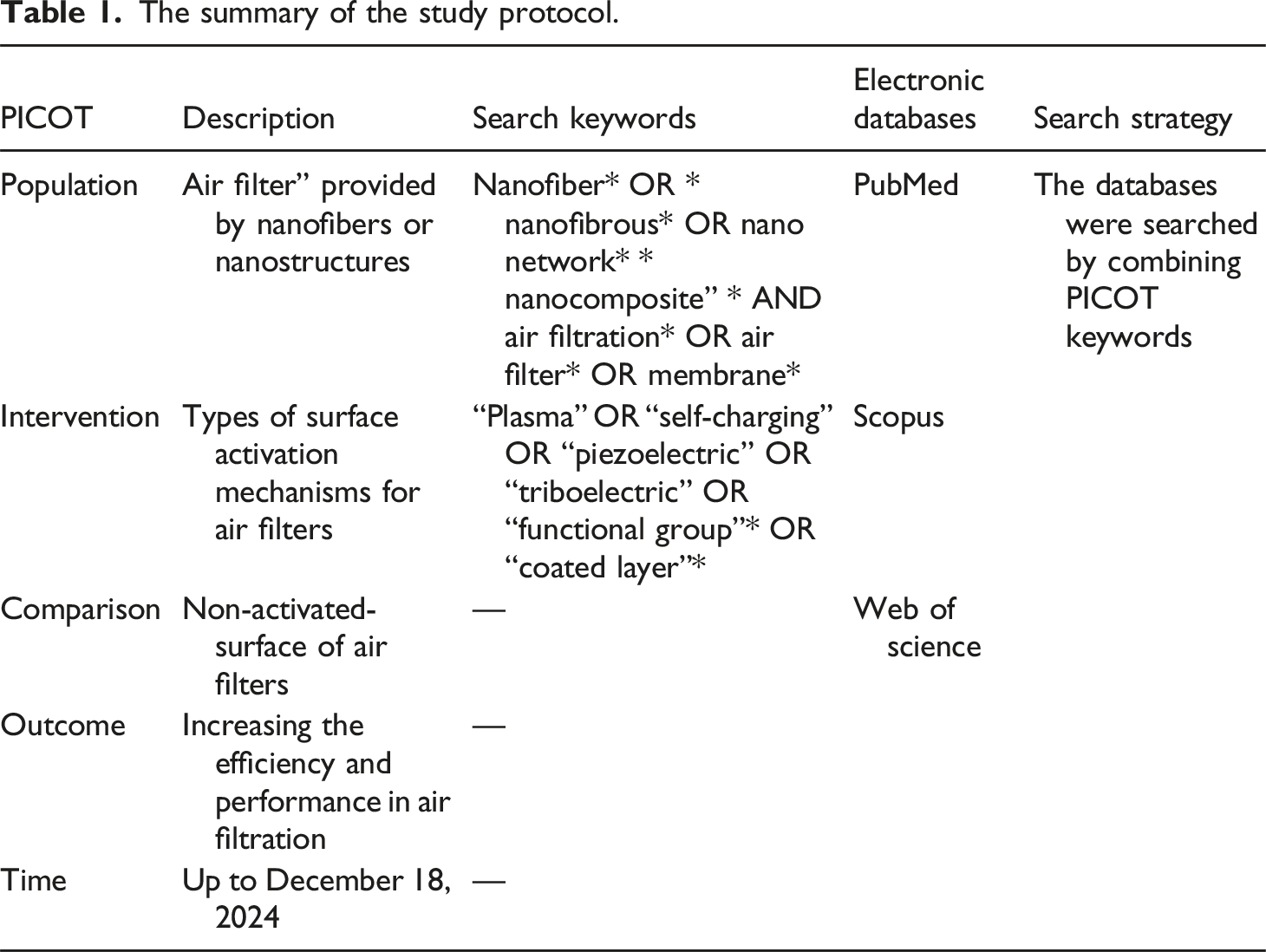
Search strategy
The summary of the study protocol.
Study selection
Figure 1 demonstrates that the titles and abstracts of the acquired records from the specified databases were examined after eliminating duplicate entries. Studies that examined the impact of surface modification methods on air filter criteria (inclusion criteria) were selected. Flow chart of the systematic review procedure.
Also, given that non-English articles can be challenging to translate into, the main meanings or specific details of studies may be mistranslated and non-English articles are often stored in limited scientific databases, which can be difficult for international researchers to access, only English articles were reviewed in the present study. Subsequently, the complete text of the selected records was acquired. After thorough analysis, studies that did not report the impact of surface modification methods on air filter criteria were excluded. Ultimately, review, editorial, and conference papers were eliminated. Additionally, the references of the included research were examined to identify any studies that may not have been located through searches in the electronic databases.
Data collection
The extracted information included the study year, the type of raw material used to produce the filter, the filter surface modification method, the type of media application (Use of mask or air filter), and the key filtration criteria such as pressure drop, efficiency, and quality factor, as well as the possibility of creating additional characteristics in the filter, such as biodegradation.
Study synthesis process
Surface modification methods
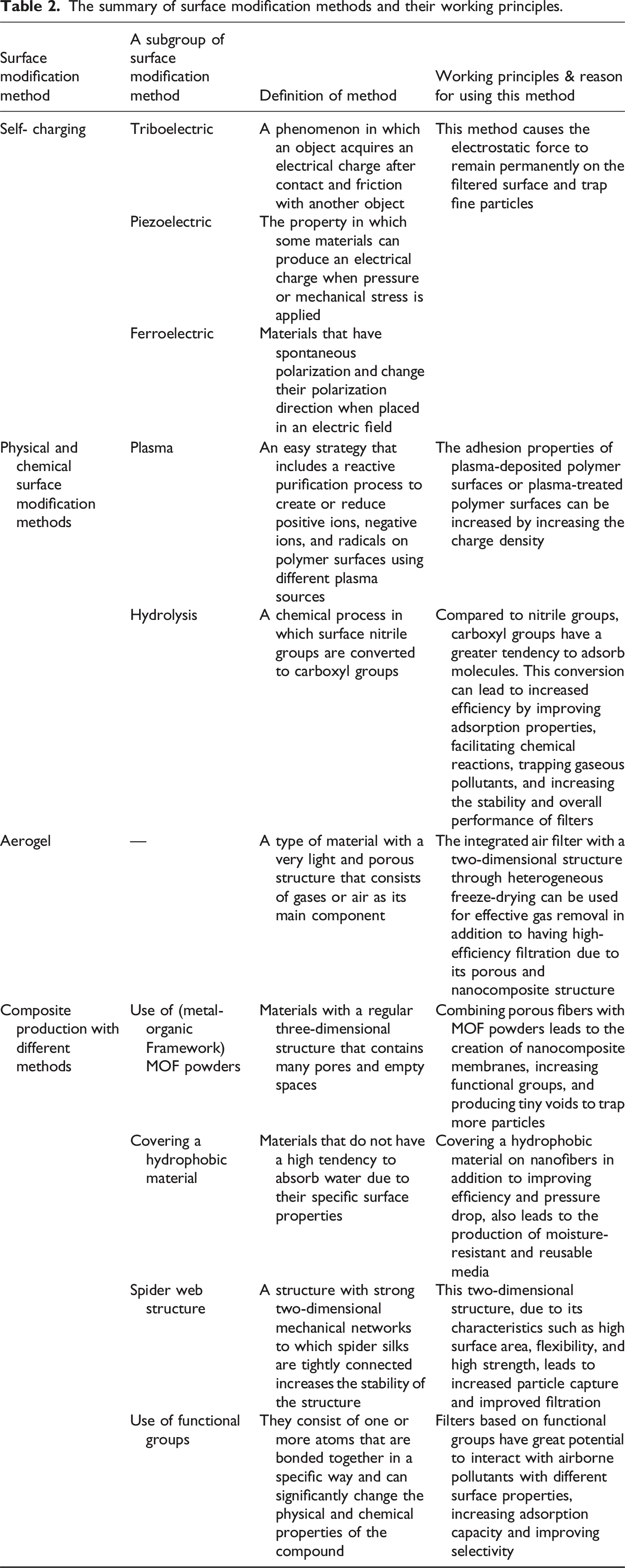
Initially, we examined the nanofiber surface modification methods separately, which are outlined in Figure 2. In addition, we described the working principles of each method and the reason for its use, which are presented in Table 2. Schematic classification of surface modification methods. The summary of surface modification methods and their working principles.
Test conditions and equipment
Summary of the equipment used for FE and pressure drop testing, particle size range, and airflow.

Findings
1. Study selection
Figure 1 illustrates the flow chart of the systematic review procedure. The search in the specified databases yielded 1657 results, of which 1615 were excluded due to being unrelated to the purpose of the study, repetitiveness, letters to the editor, non-English studies, non-access to the entire text, etc. Ultimately, 42 published articles were included in the analysis. In these studies, various methods have been used to activate the surface of the filters, the types of methods, and their frequency distribution. The findings showed that the studies have been included since 2016. Since 2021 a lot of attention has been paid to filter surface modification. Also, over 80% of the studies were conducted since 2021, which shows the increasing importance of filter upgrades in terms of use for air purification.
Study characteristics
As shown in Figure 3, 50% of the studies are related to the use of the triboelectric effect, 11.9% the piezoelectric effect, 4.8% the piezo/triboelectric combination, and 2.4% the ferroelectric effect. All these methods are self-charging and collectively account for approximately 70% of the studies. 4.8% of the studies were related to the use of aerogel materials. Physical and chemical methods, including plasma and hydrolysis, also accounted for 4.8%. In addition, 21.4% of the studies used various methods to produce composites, which included materials such as nanoparticles, functional protein groups, metal-organic frameworks (MOFs), and microbeads. Frequency distribution diagram of studies based on filter surface modification method.
The summary of reviewed studies.

aReduced pressure drop compared to reference filter.
Discussion
Pressure drop, efficiency, and quality factor
There are several important criteria in air filtration, the most important of which include efficiency, pressure drop, and quality factor. 6 Filtration efficiency is a key indicator for evaluating the performance of a filter, indicating the filtration capacity of the filter material and reflecting the changes in particle concentration in the air stream before and after filtration. 27 Pressure drop represents the pressure difference before and after the airflow passes through the filter material. 27 Filters have various applications, which can be referred to as commercial respirators and masks, furnace filters, vacuum cleaner filters, and common household materials. 63 Different materials and methods are used to manufacture these filters, which have different efficiencies and pressure drops. In the study conducted by Kwong et al. to review the breathability and filter efficiency of common household materials for masks, it was shown that among the tested fabric materials and material combinations with sufficient breathability, most single-layer and multi-layer combinations had filter efficiencies of less than 30%. 64 Also, in a review conducted by Pei et al. to examine the efficiency and pressure drop of various filters, it was found that most of them have efficiencies in the range of 40 to 80%. 63 Therefore, this issue shows the importance of investigating filters with improved particle-trapping capabilities. In filters, improving filtration efficiency does not necessarily result in a decrease in pressure drop, and in some cases, an increase in pressure drop is observed. This is because the relationship between filtration efficiency and pressure drop is complex and influenced by multiple factors. Therefore, a comprehensive evaluation of a filter cannot be made by considering filtration efficiency or pressure drop alone. 27 High-efficiency filters such as HEPA (high-efficiency particulate air) and ULPA (ultra-low particulate air) filters, which capture fine particles with filtration efficiencies of ≤99.97% and ≤99.999%, respectively can be used to remove particles, especially fine particles. However, these filters have a higher pressure drop compared to woven filters and experience rapid clogging due to their limited specific surface area. Smaller fiber diameters can increase the specific surface area of the filter medium and improve filtration performance. Therefore, nanofibers have attracted more attention in air filtration applications. 65 It has been established that nanofiber membranes, compared to microfibers, exhibit higher efficiency for removing submicron particles at the same pressure drop. 58
Filtration efficiency is affected by various parameters, including the raw materials used to make the filter, the manufacturing method, and the physical properties of the fibers such as diameter, packing density, and thickness, as well as external factors like airflow velocity, steady or unsteady flow pattern, particle load status, and relative humidity.56,66 For example, the effect of airflow rate on removal efficiency is strongly dependent on particle size. Particles larger than the filter pore size do not show flow-dependent behavior because it is not affected by air flow rate and are adsorbed by the filter through a sizing mechanism, while particles smaller than the filter pore size are more affected by flow rate because the filtration of small particles is carried out by a chemical reaction that depends on the flow rate. By using different surface modification methods, these characteristics can be changed and the filter performance can be improved. Utilizing different surface modification methods not only increases efficiency but also affects pressure drop. 33
One of the surface modification methods for filters involves utilizing self-charging properties, which is mentioned in 70% of the studies in this research. These methods include the use of piezoelectric, triboelectric, and ferroelectric properties. The incorporation of triboelectric nanogenerators into the structure of filters leads to an increase in particle removal efficiency, and this feature remains stable even after prolonged use of the filter. 42 Many studies have shown that self-charging materials, by increasing surface charge, can enhance electrostatic filters and improve filtration efficiency. The use of self-charging materials can enhance surface charge density, leading to the removal of more particles through electrostatic interactions under vibrations. In fact, under the influence of air slip effects, a secondary electret is generated in the membrane, which results in higher filtration efficiency.
In the study by Song et al., the use of triboelectric properties not only leads to increased efficiency but also reduces the pressure drop of PLA (Polylactic acid) nanofibers at different air flow rates and ultimately improves the quality factor. 48 The addition of various nanoparticles such as ZIF8 (thermally treated zeolitic imidazolate framework-8) or BTO (barium titanate) nanoparticles to the piezoelectric polymer leads to an increase in the beta phase of the nanofibers and consequently to an improvement in their self-charging properties, as mentioned in the studies of Su et al.31,50 The addition of nanoparticles not only increases the beta phase of the piezoelectric nanofibers but also reduces the fiber diameter and increases the specific surface area, thus improving both mechanical sieving and electrostatic adhesion. Due to the significant effect that self-charging materials have on the stability of electrostatic forces and the improvement of the efficiency and quality factor of filters, the use of this method in modification studies has been assigned a high level of statistics. However, the use of this method also has limitations. Electrostatic force is the dominant mechanism in trapping PM 0.3 particles, while airborne pollutants are a mixture of particles with different diameters, and as their diameter increases, other mechanisms such as interception and Settling force are needed to trap them. 1 Also, there are limited polymers for producing self-charging fibers, which may not be economically viable. Furthermore, different electrospinning conditions affect their self-charging power, and this requires various optimizations and expertise of the electrospinning operator. Thin showed in his study that the piezoelectric performance and porosity of electrospun PLLA (Poly-L-lactic acid) nanofiber mats (which directly affect filtration performance) are regulated by 1. Macroscopic fiber alignment (controlled by the collector rotation speed), 2. fiber diameter, and 3. Molecular velocity (alignment). Specifically, higher fiber alignment (orientation) leads to improved piezoelectric response but may reduce membrane filtration efficiency due to increased porosity. On the other hand, higher jet velocity can increase the electrostatic charge on the fiber surface (by increasing the piezoelectric effect) but reduce macroscopic and molecular alignment, as well as affect membrane porosity. 34
Composite materials are another surface modification method used to increase filter efficiency, which also affects pressure drop. In the study conducted by Y. Luo et al., a comparison was made between pure PPS (polyphenylene sulfide) fabrics and SiO2 (silicon dioxide)composites. It was found that the composite filter exhibited superior efficiency due to PTFE (polytetrafluoroethylene)-modified layers. These layers played a dual role: they increased the specific surface area and pore volume of the composite filter material, and they narrowed the spaces between the fibers, leading to the rapid formation of a filter cake. This, in turn, more effectively trapped fine particles. 38
Additionally, adding nanoparticles and functional groups can increase filtration efficiency by altering the surface structure or creating roughness. Ju et al. demonstrated the creation of a polyamide six nanofiber filter with a multi-level structure and uneven surfaces by establishing hydrogen bonds between silver nanoparticles and the nanofibers, resulting in enhanced adsorption capacity. 21 The use of nanoparticles with functional groups not only increases the surface area, thereby improving the capture of fine particles, but these functional groups also help trap other pollutants, such as toxic gases, through interaction mechanisms. 22 The presence of various functional groups, such as hydroxyl, carboxyl, and amincan potentially interact with different particles or organic pollutants. 60 Furthermore, if a composite material with functional groups is used, the adsorption mechanism is further enhanced. For example, A. Lakshmanan et al. showed that the presence of both polar and non-polar groups in PAN/PVP (polyacrylonitrile/polyvinylpyrrolidone) composite nanofibers not only significantly increased the electrostatic adsorption and filtration efficiency under airflow but also led to a reduction in pressure drop, which was attributed to the structural and chemical properties of the nanofibers and the generated dipole interactions, leading to a six-fold increase in the quality factor compared to a standard HEPA filter. 12
Various studies have demonstrated that the use of composite materials, such as adding MOF (metal-organic frameworks) or different nanoparticles, can effectively improve filters. However, a notable concern is the release of these added nanoparticles. In general, the life cycle of any filter can be divided into three stages: production and processing, useful life, and disposal. During these stages, there is a possibility of releasing nanoparticles into the environment due to mechanical impact and chemical degradation of the nanofiber environment. 67 Therefore, the potential release of nanomaterials embedded in these filters is a significant limitation of these studies and should be evaluated before commercialization to ensure their safety for both the environment and humans. 68
Studies have shown that the use of aerogels is another method that can enhance filtration efficiency by modifying the surface structure. An integrated air filter with a bifunctional structure, created through heterogeneous freeze-drying, can provide high-efficiency filtration and effective gas removal. 58 The mechanism by which aerogels affect filtration efficiency is related to changes in fiber properties such as pore diameter, porosity, the addition of functional groups, or the creation of a multi-faceted structure. These modifications can lead to higher efficiency, reduced pressure drop, and consequently an improved quality factor. 33
When materials are converted into filters through the freeze-drying process, specific porous structures are formed that can increase efficiency. Furthermore, if functional groups are present in the raw materials, strong interactions in the air are generated through various interaction mechanisms including hydrogen bonding, chemical bonding, charge transfer, and others.33,58 In general, cellulose-based aerogels are ultra-light three-dimensional porous materials with high specific surface area, low density, low thermal conductivity, and good mechanical strength. These properties enable them to adsorb particulate matter and gaseous pollutants by creating very fine networks, while being biocompatible, resulting in a filter with a high-quality factor. However, nanocellulose aerogels are easily flammable, which is a main limitation of their widespread use in many commercial applications. 69
Physical and chemical interactions are another method for modifying surface structure, with plasma treatment and hydrolysis being key examples. During plasma treatment, various functional groups are introduced onto the surface of the fibers, which is a primary factor in increasing efficiency. In addition, plasma treatment can reduce fiber diameter, increase surface contact area, and increase surface roughness—each of which positively impacts filtration efficiency. The longer the exposure time to plasma, the greater the improvement in efficiency. 43
The plasma method provides good control over regulating the mechanical, morphological, and surface-chemical properties of electrospun fibers and, by creating deep porosity in the fibers, leads to better contact with air pollutant molecules. However, this method may result in a small number of oxidized compounds with low molecular weight remaining on the oxidized surfaces, which, given their low concentration, are unlikely to be cytotoxic, but may require further studies. 70 Nanofibres surface modification through hydrolysis is also performed to create a better substrate for tissue engineering applications. In the hydrolysis method, surface modification can also be performed by using solutions with different concentrations and at different times, leading to changes in the surface properties of nanofibers and ultimately their efficiency. The hydrolysis method mainly changes the surface properties of nanofibers without negatively affecting their bulk properties. However, in severe cases, chemical treatments led to minor morphological changes and a moderate decrease in mechanical performance. 71 In the study by Gobi et al., where hydrolysis was used to convert surface nitrile groups to carboxyl groups using NaOH (sodium hydroxide)for surface modification, it was observed that in addition to electrospinning time, solution concentration and filtration temperature also affected the efficiency. It was shown that higher NaOH concentration led to larger pores and greater destruction of the surface layers, which reduced the filtration efficiency. 35
Studies have shown that the duration of fiber preparation and growth affects efficiency. This can include factors such as electrospinning time, plasma treatment duration, etc., which ultimately affect the fiber thickness and surface structure. In a study by Gobi et al., it was found that the shorter electrospinning times resulted in thinner filters with higher air permeability due to the reduced number of nanofibers. 35 In general, regardless of the surface modification method, increased electrospinning time leads to a rise in pressure drop due to the increase in fiber thickness.37,40,44,61 In addition to the preparation and fabrication time of nanofibers, the effect of concentration on efficiency and pressure drop can also be investigated. It has been observed that different concentrations have little effect on the removal efficiency of large particles but are more significant for fine particles. Liu et al., which used the triboelectric method for surface modification of PVDF nanofibers, showed that as the concentration of the solution increased, the removal efficiency decreased. 42 In contrast, Lan et al., using the same method and nanofibers, found that increasing the solution concentration led to an increase in efficiency. 53 The issue of concentration is important from two perspectives. One of these is the fiber diameter: for fine particle removal, the dominant mechanism is electrostatic adsorption, and charges typically focus on the smaller-scale nanofibers. When the solution concentration increases, the fiber diameter also increases significantly, which in turn reduces the removal efficiency of fine particles. 42 On the other hand, increasing the solution concentration leads to higher packing density and membrane thickness of the nanofibers, which reduces porosity and consequently improves the filtration efficiency. 53
The concept of packing density has also been addressed in various studies, where it was shown to have a positive impact on particle removal efficiency. It was found that if the surface packing density of the medium is high, the reduction in removal efficiency over time is smaller. 16 However, on the other hand, the pressure drop increases with the surface packing density. Any method that increases surface packing density through surface modification negatively affects the pressure drop.16,51 In the study by Wang et al., where the triboelectric method was examined, it was found that increasing the electrospinning drum speed led to a higher fiber accumulation frequency on the collector, which resulted in fiber stacking, and an increase in surface packing density, thereby increasing the pressure drop. 51
Other created properties
In general, three main indicators are used to evaluate the filtration performance of the materials used in filters: filtration efficiency, pressure drop, and quality factor. In addition to these, depending on the type of filter application, other characteristics can also be considered. One of the most important properties is moisture resistance, which has been highlighted in many studies.1,12,24,28,30,32–34,47,50,54,55,62
The moisture present in the air not only exacerbates PM 2.5 pollution but also increases the filter’s resistance to the surrounding air, leading to permanent deformation and a reduction in filtration performance.72,73 Additionally, the effectiveness of masks can weaken in humid conditions and become difficult to clean. Therefore, some studies have reported the development of reusable masks that are resistant to moisture and maintain excellent particle removal efficiency. 34 Among the methods that can help maintain the mask’s performance after becoming wet is the use of self-charging materials, which have been referenced in many studies. For example, Kang et al. utilized the triboelectric properties of PVDF and nylon demonstrating that the designed mask could able to maintain its performance in a humid breathing environment. This was due to the retention of electrostatic charges when the filter interacted with human breathing cycles. 1
Peng et al. also stated that self-charging filters perform well in maintaining charge even under the adverse effects of moisture due to the proportional relationship between surface charge density and electrical output in the electrostatic induction process. This can be attributed to the synergistic effect of injecting the initial electrostatic charge into the filter environment and the continuous electrical contact between the layers of the piezoelectric material and nylon, stimulated by respiratory movement. 24 Additionally, Sepahvand et al. examined cellulose nanofiber aerogels and found that the produced filters exhibited excellent resistance to temperature and humidity. The aerogel created had higher efficiency than HEPA filters in various humidity levels, which was due to the hydrophobic properties of the filter and surface modification, creating smaller pore diameters and surface functional groups. 33 In the composite filter developed by Lakshmanan et al., it was also found that the presence of functional groups and increased dipole moment resulted in higher energy on the surface of these nanofibers, which could lead to higher adhesion for capturing suspended particles on their surface, even in humid conditions. 12
Furthermore, studies have shown that the materials used in the construction of conventional air filters, typically made from non-biodegradable polymers or fiberglass, pose significant challenges for environmental protection. For example, nanofibers produced through electrospinning technology offer outstanding advantages and are widely used for air filtration. However, electrospun filters are often difficult to biodegrade, leading to secondary environmental pollution. 74 Additionally, medical masks are often single-use and made from non-degradable materials, which raises serious environmental concerns and contributes to plastic waste production.34,75 Therefore, materials with high biodegradability can be used in the preparation of air filters, making them biodegradable. Biodegradable nanofiber filters, which have attracted considerable attention, can include natural fibers such as chitosan and cellulose, synthetic fibers like polyvinyl alcohol and polylactic acid, and combinations of these 6 ), as mentioned in several current studies.12,16,22,24,28,30,33,34,46–51,59,60,62
Another important aspect in the construction of a filter is the creation of antibacterial properties, which can be achieved by selecting the appropriate base polymer or adding nanoparticles to impart this feature.21,24,28,31,34,37,44,47,50,56,59,60,62 In a study by Cho et al., adding CTAB (cetyltrimethylammonium bromide) to a polybutylene adipate terephthalate composite and montmorillonite resulted in the creation of a multifunctional triboelectric filter membrane. The CTAB in the membrane retained its antibacterial properties even after binding to MMT. 59 Furthermore, the use of other antibacterial materials such as ε-PL, ZIF-8, and AG (Argentum) with various methods can lead to the development of antibacterial filters.21,47,53
The ability of a filter to withstand environmental factors such as temperature, tension, or chemical resistance is also a characteristic that can be imparted to a filter by using appropriate raw materials. In some studies, incorporating this property has led to the development of filters with multiple characteristics.28,30,41,53 For example, in a study by Chen et al., by adding graphene oxide to PVDF, a composite nanofibrous membrane was produced that not only enhanced air filtration performance compared to pure PVDF but also increased the mechanical strength of the nanofibrous membrane and its reusability. 41
Conclusion
The reviewed studies have shown that the efficiency and quality factor of commercial masks or ordinary filters can be improved through various nanofiber surface modification methods. All applied methods, by changing the properties of the fibers, such as reducing the fiber diameter, increasing the surface area, increasing the roughness and porosity, and also creating an electrostatic charge, lead to improved particle capture by the filter. Using different polymers and test conditions limits the comparison of methods and makes it challenging to identify a single best method. To determine the most effective surface modification method, future studies should be conducted with consistent conditions across all variables, from polymer selection to testing, while varying only the surface modification method. Additionally, existing various studies have not discussed access to equipment and cost evaluation. For example, the plasma method requires specialized equipment which can negatively affect its selection as a modification method. Moreover, exploring the feasibility of combining different nanofiber surface modification methods to develop hybrid approaches presents another area for future studies.
Footnotes

Funding
The authors received no financial support for the research, authorship, and/or publication of this article.
Declaration of conflicting interests
The authors declared no potential conflicts of interest with respect to the research, authorship, and/or publication of this article.