




Abstract
Cayratia trifolia L. Plant can also be employed and it can be good encouragement in protecting forests; thus, it can also be a good option to protect more trees. As of the present time the demand for the material body used in the production of pulp and paper material to produce products such as writing paper, toilet paper, napkins, newspapers, food serving disposable etc. is accordingly rising. The feasibility of Cayratia trifolia L. fiber incorporation into the pulp and paper industry is analyzed in this work. Process of bleaching was carried out on a paper sheet of 60 GSM. Then chemical composition, fiber morphology, optical, and pulp properties of Cayratia trifolia L. fiber were analyzed so as to evaluate its feasibility for this use. Other the other hand, we observed the holocellulose content of 84.4%, cellulose content of 64.92% and lignin content of 15.3%, the observed fiber length of 1.67 mm, fiber width range of 12.8 – 15.4 µm, and cell wall thickness of 3.2 µm. Tensile index, burst index and tearing index obtained were equal 42.8 Nm/g, 2.87 kPa·m2/g and 8.7 mN·m2/g respectively, brightness 82.22%, yellowness - 0.26, whiteness 87.29%. Indeed, the FTIR and SEM techniques were used to fine tune paper characterization. Paper produced from the hemp fiber is also found to be as good as paper from the paper fiber. Given this, this study found that Cayratia trifolia L. fiber made suitable for pulp making.
Keywords
Introduction
The furniture and garment industry are one of the oldest and biggest industries in India, along with pulp paper. Pulp and paper have been the most common benchmarks for the standard of civilization and development of a lot of societies. 1 Usage, the pulp will be used in applications such as education where information is stored, advertising and communications to protect goods in transit, many forms of security of the paper library contents themselves, health & hygienic application like disinfectant usage and tissue papers and also various sanitary papers. The wood and non-wood products are currently used for the making of pulp, paper and soft boards that has poles chemical structures but not similar and in different compositions. 2 Hardwood represents one of the most significant operational costs for manufacturers of cellulosic fibers used in the pulp and paper industries as a premium raw material. However, the demand for hardwood has significantly increased in recent times, despite its potential to harm the environment through deforestation, leading to imbalances in ecology and climatology. 3 The need of the hour in a cleaner environment eminently brought attention to variety of strategic factors and) fresh thinking within our invisible think-tanks as Wood resource depletion, consumption habit and paper-wise even non-availability of raw-materials renewed some beneficial aspects on more readily available and cheaper substitution: products from fiber plants other than wood yield vis-a-vis agricultural residues-products. 4 Biotechnology opens a door of opportunity through which, save energy and chemical inside pulping, bleaching is not only escaped but pollution is reduced for the environment without having to bear huge capital expenditure. Even in such an era the pulp and paper industries are solely depending on renewable resources, fiber, as well as non-wood raw materials. These resources are highly valuable for pulp production and are less detrimental to forests and green lands. Additionally, cultivation waste and crops such as grass can be effectively utilized. The involvement of new technologies in production, combined with the rising cost of wood, has compelled pulp and paper manufacturers to adopt conservationist practices and aggro/farm forestry approaches. This shift has aimed to address the ecological disparities arising from the reliance on wood-based paper. Furthermore, the scarcity of hardwood and softwood in pulp and paper deficit nations has prompted mills to consider non-wood fiber resources as a viable alternative for paper production. 5
According to the National Forest Service Web site, approximately 85% of the trees used in the production of paper and paper products are sourced from forests. Currently, the paper manufacturing industry primarily utilizes raw materials derived from various tree species, including pine, poplar, oak, and Eucalyptus globulus. In the paper production process, trees serve as the most critical raw material. It is estimated that 24 trees are required to produce 1 ton of standard office paper. Research indicates that approximately 40% of the global tree harvest is allocated exclusively to the paper industry. In contemporary paper manufacturing, hardwood-producing trees such as pine, poplar, oak, and Eucalyptus globulus are converted into pulp through processes that require significant treatment with sodium hydroxide (NaOH). These processes also involve extensive recycling steps, leading to considerable water consumption and environmental impact. Each tree, once harvested, requires a minimum of 6 to 8 years to regrow, which is a lengthy and resource-intensive process.
These factors present substantial challenges on a global scale. The primary goal of our research is to protect natural resources by identifying sustainable alternatives. In our research, novel fibers have been developed from Cayratia Trifolia L plant, which have been successfully utilized to produce high-quality paper sheets. This approach has the potential to reduce reliance on trees, thereby protecting forests and conserving natural resources. These fiber-producing plants are highly adaptable, requiring minimal water and thriving in diverse environmental conditions. Once harvested, the plants regenerate within 3 to 6 months a significantly shorter cycle compared to traditional tree species thereby offering a sustainable solution to environmental and resource management challenges.
The research was conducted to explore the potential utilization of fibers derived from Cayratia trifolia L. as an alternative source for the production of hand sheets and paper pulp. This plant is cultivated with ease, without the requirement for harmful chemicals or fertilizers. The paper produced from this plant has been shown to meet high-quality standards, exhibiting favorable properties suitable for paper manufacturing. It has been identified as a potentially viable, albeit limited-scale, alternative to non-wood materials in the pulp and paper production process. In this study, comparisons were performed to evaluate the chemical, physical, and optical properties of the paper manufactured from Cayratia trifolia L. fiber, with additional analyses carried out using FTIR and SEM techniques.
Material and methods
Sample preparation and use of chemical
According to standard test method details.

The optical properties of the pulp pad were analyzed using the L&W Elrepho 071 instrument.
Beating
The pulp beating process was conducted using a Valley Beater, which is widely recognized for its precision in laboratory-scale pulp refining. The beating time was maintained between 30 and 35 min, with a beating load ranging from 5 to 7 kg. The process was carried out at room temperature to minimize any thermal impact on the fibers. Further, after squeezing the pulp is directly converted into paper sheet. The freeness of the pulp samples was tested in accordance with the T 227 om-17 method. It was observed that both the post beaten pulp was freer (360 ± 10 CSF) of the range. 6
In this study, we produced paper and subjected it to a bleaching treatment.
Hand sheets from bleached pulps, with a basis weight of 60 GSM, were prepared using a KCL-type automated hand sheet former in accordance with the standard method T 205 sp-02.
A standard 60 GSM paper sheet was developed with the assistance of the Central Pulp & Paper Research Institute, Saharanpur, India. The objective of this study was to explore the potential future utilization of this fiber in the pulp and paper industry. To achieve this, all fundamental parameters of the fiber were thoroughly examined as part of an initial study, and the findings were compared with previously available data. The results indicated that this fiber is suitable for the development of high-quality paper sheets (Figure 1). Illustrative representation of the paper process.
The manual process for producing Cayratia trifolia L. fiber involves several steps
Tank retting/water retting
Water retting is employed for fiber extraction, wherein the stems are immersed in water for 5 days to dissolve the gum binding the fibers. Periodic observation is conducted after 2, 4, and 6 days to monitor the retting process.
Harvesting and pre-treatment
The stems of Cayratia trifolia L. are harvested manually and thoroughly cleaned to remove dirt. The cleaned stems are then cut into smaller portions and bundled into approximately 1 kg packages.
Separation and drying of fiber
Following retting, the stems are removed from the water, and fibers are separated manually from the outer stem. The extracted fibers are dried under sunlight. This process results in a high-quality Cayratia trifolia L. fiber, characterized by a golden-yellow color resembling lotus and silk fibers in Figure 2(b). The single fiber strength of Cayratia trifolia L fibers was found to range between 489 and 765 MPa, with an elongation percentage ranging from 1.6% to 2.4%. (a) Cayratia Trifolia L. plants (b) Cayratia Trifolia L. fibre (c) cross section view (d) Cayratia Trifolia L. paper sheet.
The cross-sectional view of Cayratia trifolia L. fiber, as depicted in Figure 2(c), is characterized by a hollow wall structure. This structural feature is anticipated to enhance the absorbency properties of the fiber, surpassing those of other bast fibers.
Paper characterizations analysis
Scanning electron microscopy (SEM)
This research is used for using Hitachi, Japan FlexSEM 1000 II at an acceleration voltage of 10 kV with a working distance of 5 mm. These tubes were then chopped into piece with razor blade after 48 h and the sections pasted on carbon tape and placed in SEM stage for further analysis. Since Hitachi SEM microscope which used in this research work with low vacuum approach, we will not be requiring sputter coating to make the surfaces of these non-conductive specimens conductive. 7
FTIR spectrophotometer
Shimadzu - FTIR spectrophotometer (Model – IRAffinity-1S - Compact Fourier, Japan was used for the recording of the wedged form FTIR spectrum in the range 4000–400 cm−1 from paper samples made up by using plant (Cayratia Trifolia L. fibre). The paper samples milled using a mortar and pestle to produce very fine particle sizes; 4 cm−1 in the spectral resolution and scanning rate of 2 mm/s. The FTIR spectra of the paper sample were also used to qualitatively determine free functional groups (Figure 3). Treated Cayratia Trifolia L. paper sheet.
Results and discussion
Cayratia trifolia L. pulp & paper from chemical characteristics
Chemical composition characteristics and pulp yield and kappa values of non-woods.

However, the lignin content of Cayratia Trifolia L. is equivalent to banana & jute fibre, higher than Hemp fiber and lower than that of all other entries in table, but remarkably less when compared with wood (26–30%). 10 All non-woods holocellulose is less than that of Cayratia Trifolia L., Hemp and jute fiber are just as good cellulose as and other remaining all non-woods in Table 2. However, when alpha cellulose >34%. 11
All non-wood materials stated in Table 2 have less alcohol-benzene solubility than Cayratia trifolia L. Compared to bagasse and bamboo, its hot water solubility is higher than that of any non-wood material listed in the table and lower than those other materials. The ash content of Cayratia trifolia L. was equivalent to that of bagasse, cassava stalks and higher than bamboo, banana fiber, cotton stalks, eggplant stalks, hemp fiber, jute fiber; mulberry stalks and okra stalks, respectively. However, it is smaller than all those other non-wood materials in the table. Extractives are chemical constituents of raw materials that soluble in alcohol benzene.
The results indicate increase in demand in the cooking chemicals and increased pulping time as the raw materials contain more amount of the extractives which lead to the deployment of pitch, decline of strength of the pulp and the water holding capacity. 11 More depressing ash situations occur during the pulp refining and the chemical recovery operation, they noted. Furthermore, it also acts as trace element interfering with both the bleaching process as hydrogen peroxide and oxygen and in the pulp, alters its physical i.e. reduction toughness and strength properties are negative.12–14
Cayratia trifolia L. paper hand sheets from physical characteristics
Morphological properties of raw materials and papermaking properties of the pulp.
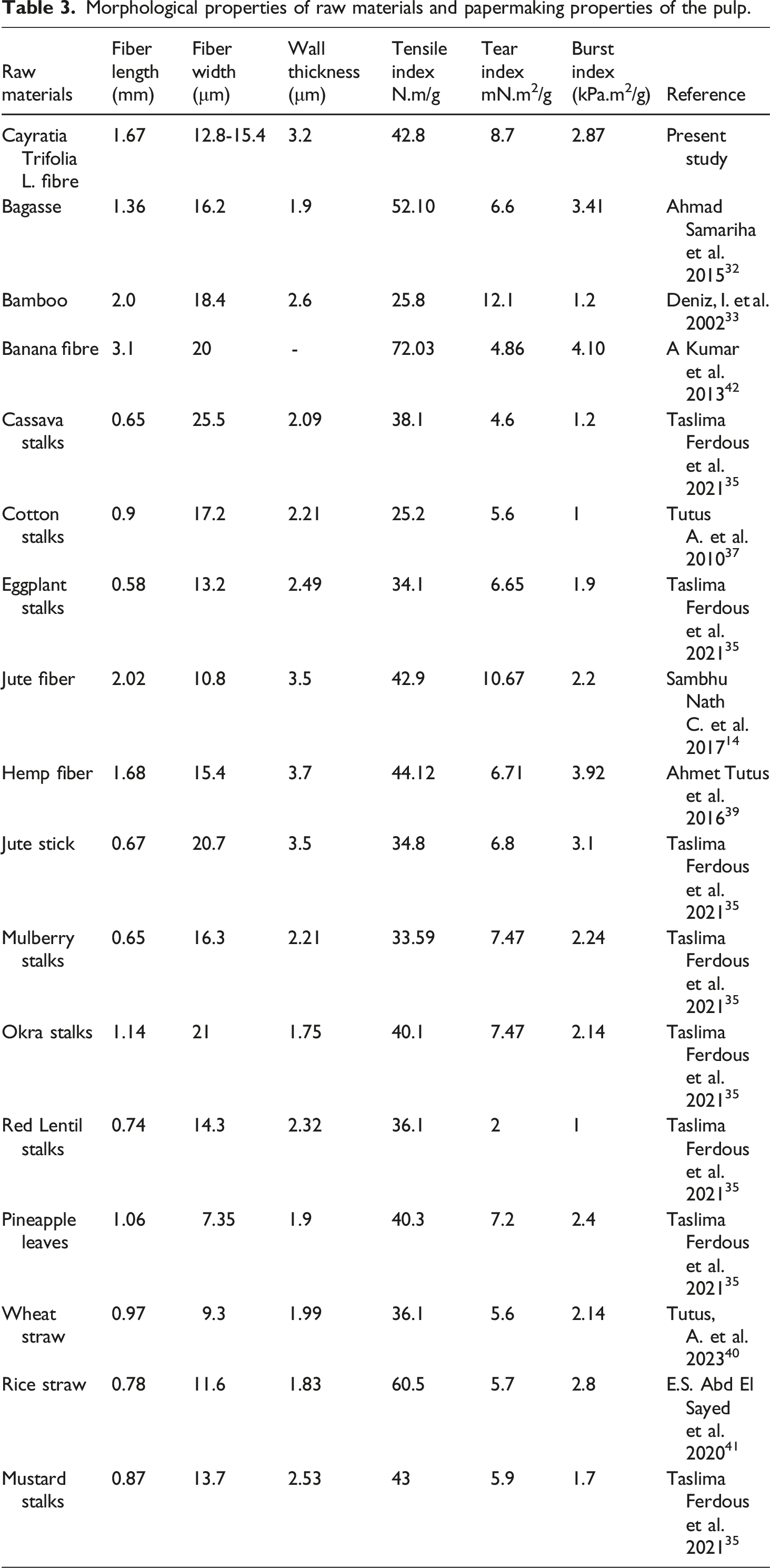
The pulp made from Cayratia trifolia L. exhibited a fiber length of 1.61 mm and a fiber width ranging from 12.8 to 15.4 μm. The fiber length of Cayratia trifolia L. is good, though shorter than jute, bamboo, and banana fibers, but comparable to hemp fiber. Its fiber length is longer than all other non-wood fibers mentioned in Table 2. The fiber width of Cayratia trifolia L. is similar to that of eggplant stalks, red lentil stalks, mustard stalks, and hemp fiber, but greater than that of jute fiber, pineapple leaves, wheat straw, and rice straw. However, its fiber width is lower than all other non-wood fibers mentioned in Table 3.
The optical properties of the after chemical treatment papers sheet.

Basically, are tear index of pulp paper directly correlated to the fibre length. Some of the investigators stated that log-fibered wood species gave desirable paper strength characteristics.19,20 In addition, certain works demonstrated that the production of paper with declare adequate strength appeared not dependent in the fiber length.21,22 Interventions of fibre component assembly on identically can be expected to affect tensile and burst strengths of handsheets of hardwood and softwood similarly. This is the case; however, I am not sure how well non-wood pulp works. e.g., fibers from straw, banana waste fibers, corn stalks etc., so it is well understandable that the present bonding potential of existing in unrefined state was high tensile and burst index.13,23
Cayratia trifolia L. has a higher tensile index than bamboo, cassava stalks, cotton stalk, eggplant stalk, jute sticks, mulberry stalks, okra, red lentil stalk, pineapple leaves and wheat straw. And it’s similar to jute, hemp fiber, and mustard stalks but less than that of rice straw, banana fiber and bagasse. In this mention Table 3, lower, than the tearing index of bamboo, than of Jute fiber but higher than the rest all non-woods in the mention Table 3. Cayratia trifolia L. is found to have a burst index similar to rice straw but lower than Bagasse, Banana, fiber, Hemp, Jute stick. Cayratia trifolia L, burst index is greater than rest all such non–woods mentioned in Table 3.
Cayratia trifolia L. pulp & paper from optical characteristics
It was found that the paper sheet made from Cayratia trifolia L. exhibits superior brightness compared to sheets made from hemp, jute, banana, and bagasse fibers. In terms of whiteness, the Cayratia trifolia L. paper sheet performs better than the jute fiber sheet but is slightly lower than the hemp fiber sheet. Additionally, the Cayratia trifolia L. paper sheet shows significantly lower yellowness compared to all other fiber sheets mentioned in Table 4. Overall, this paper sheet demonstrates excellent potential for future use in the pulp and paper industry.
SEM and FTIR analysis
SEM analysis
The SEM analysis was performed on Cayratia Trifolia L. diet fibres and other cellulosic components spread and spread over bleached pulps-based hand sheets, which exhibited the surface morphology better than any information available so far regarding their distribution and dispersions/arrays. Figure 4(a) and (b) demonstrate that the paper hand sheets are characterized by a multi-network of fibres bonded to each other as a result of inter fibre-fibre bond and also due to water removal during paper making process. The depolymerization of lignin and hemicelluloses led to the alterations plant fibre surface morphology. With the exception of fibre and select other pulp constituents, relatively little variation was observed in pulp yields using these pulping processes. (a) SEM images of paper hand sheets at 100x and 200x magnification (b) SSEM images of paper hand sheets at 500x magnification.
FTIR analysis
FTIR, however, is arguably the most potent equipment for functional groups, i.e., identifying the types of chemical bonds. FTIR analysis of the handmade paper from Cayratia Trifolia L. fibre samples. The FTIR spectra were recorded for the handmade paper obtained from recycled Cayratia Trifolia L. fibre samples in order to elucidate the structural changes following preparation of the papers. The FTIR spectrum of a typical sample Cayratia Trifolia L. is presented in Figure 5. Characteristic peaks of cellulose were presented as 3300 cm−1, 2924–2362 cm−1and 1033 cm−1 assigned to the – OH, C – H and C – O–C stretching.24–27 FTIR spectrum of Cayratia Trifolia L paper.
It is the broadband between 3400 cm−1 and 3000 cm−1 that is related to moisture content, which can be involved in hydrogen bond formation, where O–H vibrations in phenolic groups. 28 Figure 5 shows the optical spectrum of Cayratia Trifolia L., which displays chemical groups due to cellulose, hollocellulose and lignin-like components. The first peak was detected at frequencies 3331.07 cm−1 in cellulose composition of the Cayratia Trifolia L., which is associated to calcium-OH stretching vibrations of cellulose. 29 It indicated that wax appeared in the rid at 1460 cm−1 and the peak around 2895.15 cm−1 was attributed to CH stretching vibration of cellulose.18,30 The peak 1028.06 cm−1 was co-related to the C–O of stretching in cellulose.16,30 While the peak 1315.45 cm−1 corresponds to the CH2 wagging of cellulose and hollocellulose31,30,29 and the top curve pointing to 661.58 cm−1 depicts the C–C stretching. 29
Conclusions
So, it is to evaluate practicability of Cayratia Trifolia L. fibre for pulp and paper production industry this study was conducted in past days. The characteristic of chemical composition, morphology and pulp and paper properties obtained in the fibre of Cayratia Trifolia L. from the present work was accordance with another non-woods resource results described in literature about application in pulping since all indicated that Cayratia Trifolia L. fibre could be an establish raw material for pulp and paper industry. The present research demonstrated that the fibre of Cayratia Trifolia L has potential to be used as a source of raw for pulp and paper manufacture however also these reduces the extensibility of unsustainability, mainly by reducing consumer mills on their requirements on timber. The concept was raised from the study that the wood and plant samples contain alpha cellulose contents which are quite acceptable to be considered as pulping raw material. It is good that today’s fibres are wasting after harvesting of a cellulosic source and has low lignin content. The chemical structure of Cayratia Trifolia L. fibre and others aspects depicted in this study indicate that these are correct raw pulp and paper making industry material. Thus, the using crop residues assist us in protecting our forest through the following reasons and consequently, reduce emerging environmental problems. The outcome of this study, therefore, indicates that these papers can be applied in areas such as a shopping bag, book cover, packaging material, and the like. For the shop shopping and grocery purpose, packaging material for food products, for the cover page of a book, a magazine etc. Therefore, the properties of hand-made paper prepared from Cayratia Trifolia L. fibre and others shows its suitability. The newly developed Cayratia Trifolia L fiber is expected to find extensive applications in the future across various sectors, including nonwoven sheets, battery separators, solar plants, automotive industries, rope manufacturing, geotextiles, green composite materials, disposable items, and biodegradable bags. This fiber’s unique hollow wall structure, compared to existing fibers in the market, contributes to its distinctiveness. Furthermore, the fiber exhibits a fine structure and a lustrous appearance comparable to that of silk and lotus fibers. Its potential in the textile sector is anticipated to be significant, with promising prospects. Additionally, the development of this fiber is expected to generate substantial employment opportunities in the textile, pulp and paper, and green composite industries.
Footnotes
Declaration of conflicting interests
The author(s) declared no potential conflicts of interest with respect to the research, authorship, and/or publication of this article.
Funding
The author(s) received no financial support for the research, authorship, and/or publication of this article.
