




Abstract
Electric heating gloves are essential for people working in severe cold environments which could protect their hands warm efficiently. Existing electric heating gloves, however, tend to restrict the movement of the fingers and have limited thermal protection, affecting the working efficiency of the wearers. Here, we report on the development and evaluation of carbon nanotube film (CNTF) and metal fiber based electric heating gloves. The electric heating elements were placed in the back of the gloves, and we tested the electric heating properties of the gloves. They showed great electrothermal performance and it had a certain repeatability and stability through multiple experiments. Then the electro-thermal and ergonomic performance of the gloves were evaluated under the severe cold outdoor environment of −20 ± 2°C. In comparison with conventional single layer polar fleece gloves and carbon fiber electric heating gloves that purchased from the market, CNTF based gloves and metal fiber-based gloves demonstrated outstanding advantages in terms of faster heating speed, great warmth retention, and enhanced finger agility, which is attributed to the electrothermal properties of CNTF and metal fiber as well as the structural design of the gloves.
Introduction
Personal thermal management, mainly including warming, cooling, and adaptive thermoregulation of human body. 1 It is critical to the comfort, performance of individuals and building energy in daily life. 2 A variety of thermal management materials and wearable devices have been developed to cope with different living conditions. 3 Electric heating belts, cooling vests, air-conditioning masks, 4 etc. are all for better protection of the human body.
In the recent years, with the continuous expansion of human exploration of nature, human protection requirements are increasing.5,6 For example, human activities have extended to the extreme cold conditions of North and South Poles, as well as mountain peaks. In such a cold environment, electrically heated gloves are essential for people to perform outdoor work, such as assembling nut and electrical maintenance operations. Past studies have shown that cold environments affect blood flow in human hands. When the ambient temperature is low, the blood flow of hands is reduced, affecting the flexibility of hand activities directly.7,8 It can even cause harm to the hands. Studies have also shown that, when the skin temperature of the finger drops to 15.0°C, the dexterity and sensitivity of the fingers are reduced significantly. When it drops to 4.4°C, almost all subtle functions of the fingers will be lost.9,10 Therefore, in severe cold environments, it is very important to protect our hands. Besides keeping warm, glove flexibility is also important, because it will affect the ability of human hands to perform fine work.
Traditional thermal gloves are manufactured using thermal insulation materials, but such gloves are only suitable for ordinary cold environments. It is necessary to increase the thickness of the glove fabric for use in a severe cold environment.11,12 Such gloves, however, tend to be bulky and less flexible. And they are not suitable for delicate work. To provide both warmth and flexibility, active heating gloves have been developed according to the electrical heating materials, gloves materials, structure of gloves, flexibility and so on. 13 Hunt et al. compared ordinary rubber work gloves, cotton-padded fabric gloves, fleece fabric gloves and gloves with disposable heating pads in a walk-in chamber at −20°C for 45 min. The subjects put on the experimental gloves to measure the maximum grip force, skin temperature, and personal subjective evaluation. They found that gloves with fleece fabric had better warmth retention and comfort. 14 Ann et al. considered the effect of glove body structure and electric heating element position on heat retention and flexibility. They suggested the incorporation of a windproof outer layer could be used to prevent heat loss and protect the electric circuit. 15 Kim et al. designed two different circuit shapes for electrically heated gloves. They were stripe-pattern (SP) and horse-shoe-pattern (HP) types which be made of graphene/poly (vinylidene fluoride-co-hexafluoropropylene) composites. Through the experiments, it showed that the electrical heating performance of curved circuits was preferable. 16
At the same time, in the actual performance test of electric heating textiles, scholars mostly used the subjective experiment methods of human body in dress to evaluate the heating performance and wearing comfort of electric heating textiles through the subjective feelings of the human body. Wang et al. used a human body thermal model to simultaneously explore the heating efficiency of electrically heated vests at different temperatures (0°C and −10°C) and different wind speeds (0.4 ± 0.1 m/s).17,18 Song et al. studied the influence of electric heating clothing on improving the comfort of the human body in a cold indoor environment through human perception. For electric heating gloves, ergonomics also needed to be evaluated. At present, there were more researches in the aerospace field. 19 O’Hara et al. proposed the use of six indicators to characterize the ergonomic performance of gloves, including range of motion, strength, fatigue, perception, flexibility, and comfort. These indicators were originally derived from research for astronauts’ extravehicular suits, but have been applied to people working in special conditions, such as electrical maintenance, mountaineering, and Antarctic prospecting. 20 Hunt et al. conducted ergonomic experiments on work gloves for power line maintenance personnel, such as maximum grip strength and the number of screws, to a certain extent judged the influence of the type of gloves on the work of the human body in a cold environment. Mohamed et al. conducted an experimental study on whether different hand skin temperatures (5°C, 25°C and 45°C) and wearing different industrial gloves (chemical protection glove, rubber insulating glove, anti-vibration impact glove, cotton yarn knitted glove, and RY-WG002 working glove) affect grip strength. The results showed that wearing gloves had a significant effect on the maximum grip strength. Under different temperatures, cold temperature had a greater impact on grip strength. 21 Geng et al. investigated four types of gloves with different material combinations, including cotton/rubber gloves, pig leather/cotton, goat leather/cotton, and single-layer goat leather. Based on the grip strength and bolt picking experiments conducted in a cold environment, the goat leather/cotton combination gloves exhibited the best working flexibility. 22
Although considerable research has been directed to the development of electrically heated gloves, existing gloves provide limited thermal protection, which makes them only suitable for moderately cold conditions such as winter cycling and outdoor activities, or they are too bulky or inflexible for fine work in relatively cold environments. Considering the great potential of carbon nanotube film (CNTF) and metal fiber as electrical heating material for gloves due to their excellent thermal properties, when they are supplied with an external voltage, they will generate heat quickly.23–25 At the same time, it has the characteristics of light and thin, the present study considered the optimal design of CNTF-based and metal fiber-based electrically heated gloves, then compared their performance with conventional single layer polar fleece gloves and carbon fiber electric heating gloves that purchased from the market. In this study, the choice of constituent fabrics and the position of the electrical heating elements were considered in the design of CNTF-based and metal fiber-based electrically heated gloves for optimal performance with respect to thermal comfort sensation and fine work flexibility. At the same time, an ergonomic experiment of assembling nuts was used to evaluate the thermal performance and flexibility of electrically heated gloves.
Experiments
Design of electric heating gloves
Carbon nanotube film electric heating elements were produced by Suzhou JerNano Technology Co., Ltd. The CNTF was cut into strips that were covered with polyester on their top and lower surfaces to form a “sandwich” structure. The strips were 0.5 cm wide, 1.5 m long and were arranged on the five fingers in a U-shape. The U-shaped ends were respectively bonded to the polyimide-conductive metal foil composite film, forming a parallel circuit as a whole. The electrical resistance of each U-shaped finger segment CNTF strip was 16 Ω, and the total electrical resistance was 3.2 Ω, as shown in Figure 1. The tensile strength of CNTF is 100 MPa. In the CNTF electric heating element, the total CNTF length was 1.5 m, the total area was 1.5 × 10⁻⁴ m2, and the total mass was 2.84 × 10⁻⁴ kg. The CNTF strips and the polyimide-conductive metal foil composite film were combined with polyester on both sides by hot pressing through factory hot press. The thickness of the final electrical heating element was 0.340 mm with excellent softness. The structure of the CNTF electrical heating element is shown in Figure 1(a). Design of electrically heated gloves and experiments. (a) Structure of CNTF electrical heating elements. (b) Structure of metal fiber electrical heating elements. (c) Structure of the electrical heating gloves. (d) Picture of six gloves. (e) Schematic diagram of test environment and experimental steps.
The metal fiber electric heating element was obtained commercially to manufacture electric heating gloves. The gloves in this work were produced by Dongguan Warm Electric Heating Technology Co., Ltd. It is composed of two metal fibers with a diameter of 500 μm and a length of 0.9 m. The material of metal fiber is stainless steel, which type is 316 L. The tensile strength of metal fiber is 1960 MPa. It was distributed over the five fingers and the palm forming a circle. The total mass of the metal fiber was 1.704 × 10⁻³ kg, and the electrical resistance of a single fiber was 11.8 Ω. The metal fiber was distributed between two layers of non-woven fabrics to form a “sandwich” structure of the assembly. The thickness of the final electric heating element was 0.340 mm. Its total electrical resistance was 5.9 Ω. The structure of the metal fiber electric heating element is shown in Figure 1(b).
The electric resistance of the electrically heated materials was measured by DT9205 A digital multimeter. Then the total resistance of elements was calculated according to the principle of the parallel circuit because the CNTF and metal fiber distributed among the elements in a parallel manner.

R 1 , R 2 …R n —— The electric resistance of each branch, Ω;
The CNTF electric heating element and the metal fiber electric heating element were used as the heating layer of the electrically heated gloves. The main structure of glove was designed in three parts: thermal insulation layer, electric heating layer, and windproof and waterproof outer layer. The main function of the thermal insulation layer was to prevent heat loss generated by the electric heating layer, so that heat would be retained in the gloves as much as possible. Therefore, grain velvet fabric with high content of static air layers was chosen as the thermal insulation layer. The Jack Wolfskin gloves were chosen as the main body of electric heating gloves which were purchased from market. The thickness of grain velvet fabric was 1.349 mm. A soft, windproof and waterproof polyester fabric was used as the outer layer to prevent the penetration of cold external air and water. PU coated polyester fabric was chosen which thickness is 0.156 mm.
Two types of structures were designed for the palm area. One was a single fleece insulation layer, which ensures finger flexibility while retaining heat. The other was the same as the back of the hand, with a thermal layer, an electric heating layer, and a windproof and waterproof outer layer to increase the warmth of the palm. The glove structure is shown in Figure 1(c).
Parameter information of glove samples.

Electrothermal property of electrically heated gloves
The electrothermal property of gloves was tested in the 25°C normal environment and −20°C cold environment. Glove N, glove FH, glove NH were chosen to carry out this experiment. GSJ-100B high and low temperature climate box was used to set up the ambient temperature of testing. GPRS (General Packet Radio Service) four probe temperature recorder was used to monitor and record temperature of gloves. At the same time, Tis 75+ Infrared Thermal Camera was used to observe the change of temperature on the surface of gloves after connecting to the power visually. The thermal images would be obtained.
The ambient temperature of high and low temperature climate box was set to 25°C and −20°C respectively. The sensor probes were put in the same place of three gloves. The center of the palm was chosen to place the sensors because the electrically heated material in that part is evenly distributed. Before setting up the temperature, the gloves with sensors were put in the box together. When the temperature in the climate box was stable, the data of temperature started to be recorded. After connecting to the power, the heating time was 20 min, then cutting off the power to stop heating. When the temperature returned to initial temperature, starting heating again. The same experimental operation was repeated 6 times to observe the cyclicity of electrothermal heating performance.
Ergonomic evaluation of electrically heated gloves
In this study, an ergonomic experiment of assembling nuts was used to evaluate the performance of electrically heated gloves.
The ergonomic experiment was conducted in a −20 ± 2°C cold outdoor environment. Two female and one male college students was recruited for the experiment, all of them were around 25 years old with good health. The participants were required to wear warm clothing, ordinary fleece warm gloves on their left hand, and designed gloves on the right hand. Before entering the climatic test chamber to start the ergonomic experiment, the participants were surveyed about the feeling of wearing the different electrically heated gloves, such as comfort, softness, elasticity, messiness, fitting, breathability and foreign body sensation. Each glove was rated on a scale of 1–4, the lower the score, the better. For example, comfortable (1) – uncomfortable (4), soft (1) – hard (4), good stretchability (1) – bad stretchability (4), light (1) – heavy (4), good fit to hand (1) – bad fit to hand (4), good breathability (1) – poor breathability (4), no foreign body sensation (1) – foreign body sensation (4).
Each time the participant entered cold outdoor environment from indoor, four stages of ergonomic experiments were performed, each lasting 20 min. The conditions of the four stages were as follows: 0–5 min, the experimenter sat quietly; 5–10 min, the experimenter performed the first nut assembly task, unscrewed the nut of a row of 10 bolts on a wooden board from the bottom end, and then installed the nuts from the top back to the original positions. The number of assembled nuts within 5 min were recorded; 10–15 min, the experimenter performed a stepping exercise in the climatic test room to relieve the body’s cold sensation; 15–20 min, the participant performed the second nut assembly task, and the data were recorded. The schematic diagram of the stages is shown in Figure 1(e).
During the experiment, each time the participants entered the outdoor environment, it was necessary to ensure that the participant’s body had reached the same thermal equilibrium state. After each experiment, the subjective thermal sensation of the participants at various stages in the outdoor test were recorded. The subjective thermal perception was divided into nine levels (4 – extremely hot, 3 – very hot, 2 – hot, 1 – slightly warm, 0 – neither hot nor cold, −1 – somewhat cold, – 2 – cold, −3 – very cold, – 4 – extremely cold).
Results and analysis
Electrothermal property of electrically heated gloves
When a voltage of 7.4 V was provided to the CNTF and metal fiber electrically heated gloves, the temperature of the gloves increased with time obviously. Figure 2(a) shows the curve of temperature change of glove N, glove FH, glove NH with time in the 25°C normal environment. Figure 2(b) shows the curve of temperature change of them with time in the −20°C cold environment. Figure 2(c) shows the thermal images of the electrically heated gloves when the power was applied in the 60 s. From the thermal images, it shows that CNTF electrically heated gloves and metal fiber electrically heated gloves had excellent electrothermal property as evidenced by the quick temperature increase caused by the action of voltage. The gloves also had quick heating response. In the beginning 5 s of heating, their temperature rose quickly. (a) Electrothermal performance of CNTF and metal fiber electrically heated gloves in the 25°C normal environment. (b) Electrothermal performance of CNTF and metal fiber electrically heated gloves in the −20°C cold environment. (c) the thermal images of the electrically heated gloves in the 60 s.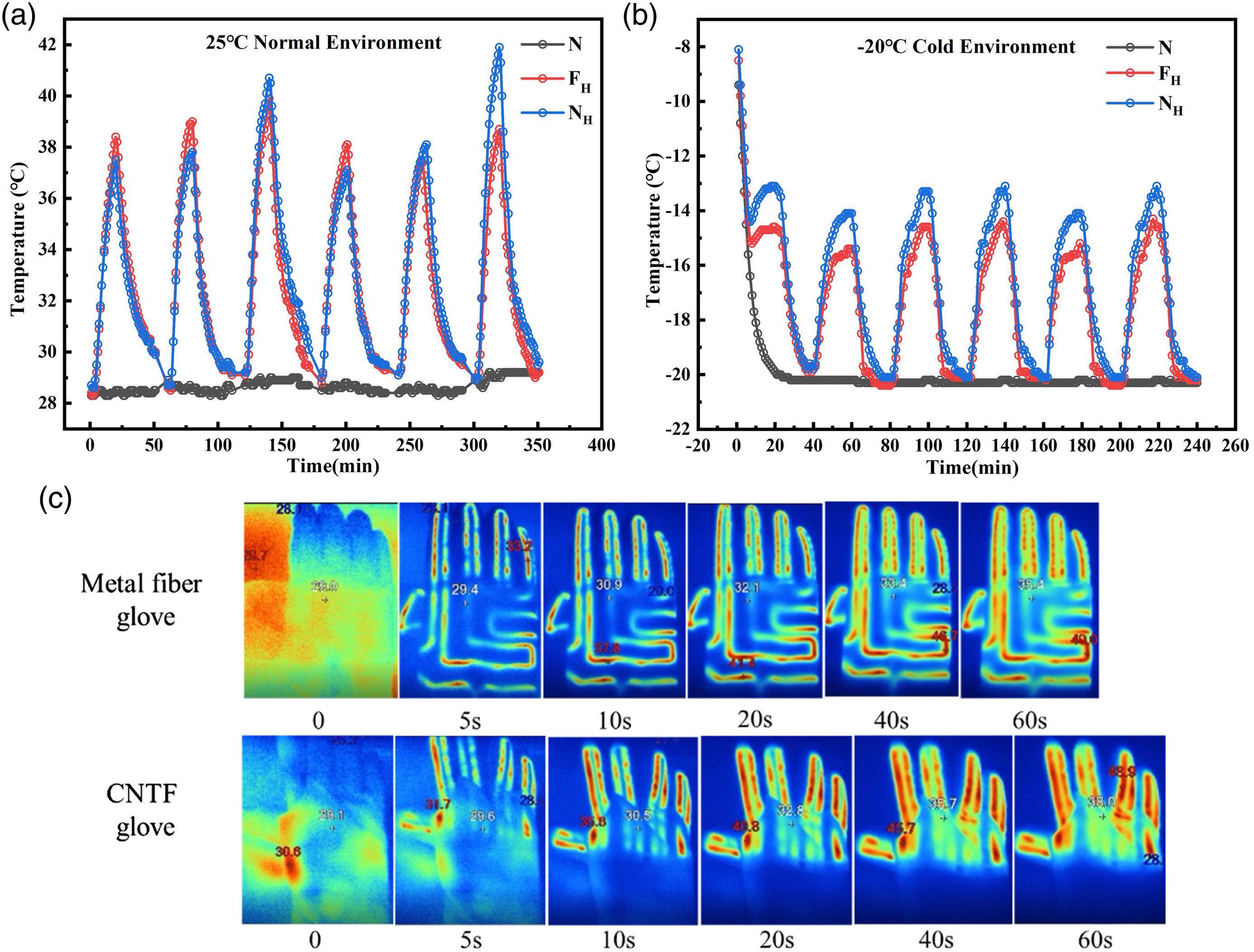
In the 25°C normal environment, glove N maintain a temperature of 28°C all the time. The CNTF and metal fiber electrically heated gloves reached 38–42°C eventually after each heating. In the −20°C cold environment, the temperature of glove N always dropped until the same as the ambient temperature. While glove FH and NH, when they were applied to the voltage, the temperature would rose quickly and reach −13 to −15°C. They could provide a certain amount of heat to the hand in the cold environment. From the curves of graphs, it could be observed that the electrothermal property of the glove FH and NH was repeatable and stable, which could be heated multiple times.
Ergonomic evaluation of electrically heated gloves
Evaluation of glove comfort index.

S - Standard deviation of comfort values for three participants.
Figure 3 shows the average number of nuts assembled for each electrically heated glove by the three participants in two attempts. Table 3 shows the subjective sensation of heat of the participant’s left and right hands during the experiment. The average number of assemble nuts for six gloves by three participants in two attempts. Subjective recording of the heat perception for participant’s hands. S - Standard deviation of thermal perception values for three participants.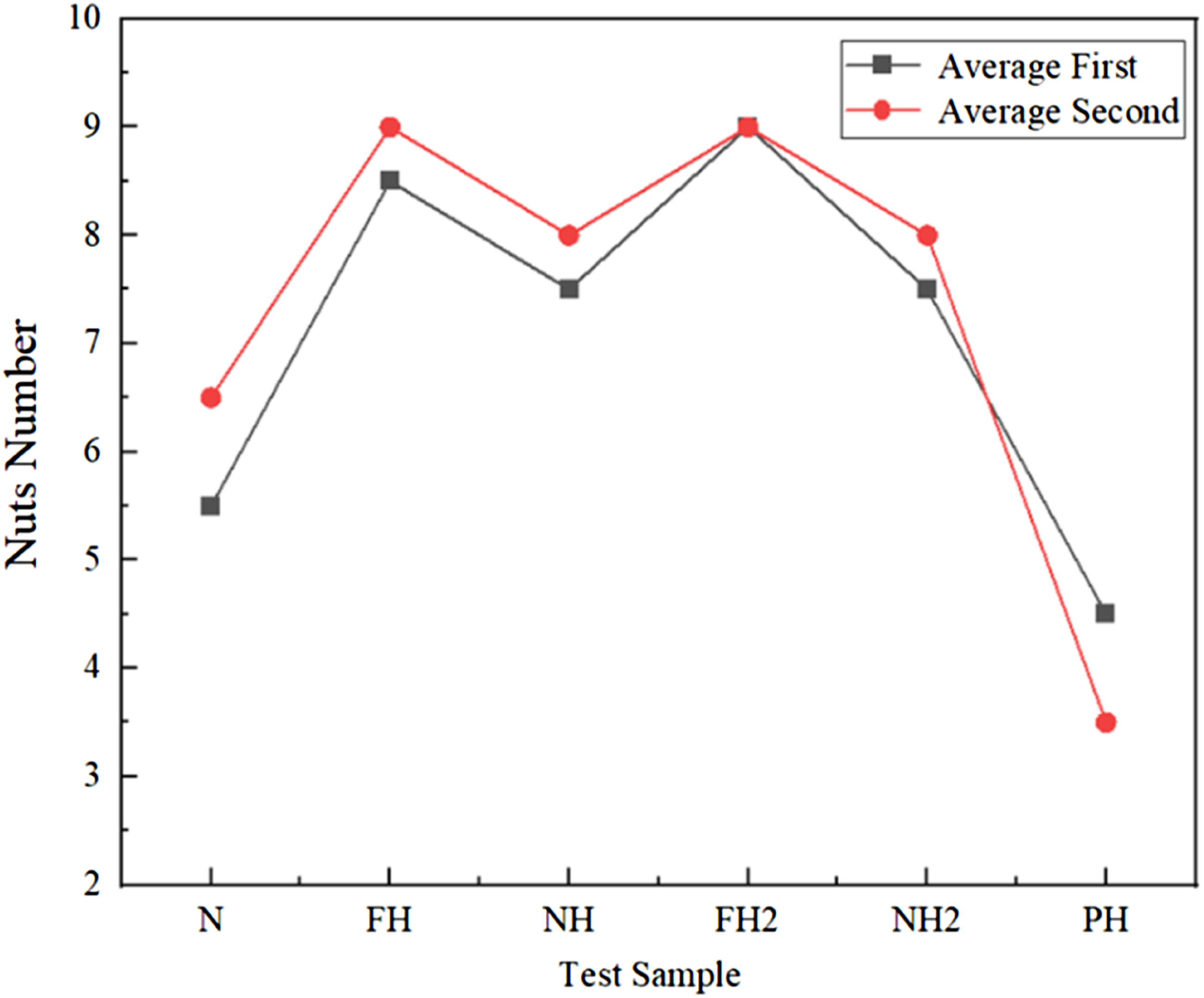

The line figure in Figure 3 clearly shows the following phenomena. ➀ For the electrically heated gloves with a single and double electric heating layer, the number of assembled nuts for the metal fiber electrically heated gloves was higher than that of the CNTF electrically heated gloves, but just a little. For example, the numbers of FH and NH for participant A about first assembling nuts were 7.5 and seven respectively, the numbers of FH and NH for participant B about assembling nuts were 10 and 9 respectively. ➁ When the single and double layers were both metal fiber electric heating elements, there was little difference in the number of assembled nuts between these two gloves.➂ The number of assembled nuts for electrically heated gloves is more than that of ordinary polar gloves and carbon fiber gloves commercially, the differences in the numbers were relatively significant. Meanwhile, the number of assembled nuts for the carbon fiber gloves commercially was the least among all gloves.
According to the above results, conclusions are drawn and the analysis is as follows. ➀ In an very cold outdoor environment (−20 ± 2°C), the electrothermal property of the metal fiber electrically heated gloves was a little better than that of the CNTF electrically heated gloves. Notably, the perception of heating was reduced in the fourth stage when the CNTF electrically heated gloves were worn on the right hand. This illustrates that the electrothermal property of the CNTF electrically heated gloves weakened in the second part of the experiment. ➁Although the ordinary polar fleece gloves were not electrically heated, they had a simple structure and they fit well on human hands, making them suitable to perform certain tasks in a short time, e.g. for 10–20 min. ➂Although the electrically heated gloves purchased commercially could provide heat, their structure and materials were relatively heavy, resulting in poor flexibility that hindered fine work such as assembling nuts. ➃ The warm-up movement performed between the two nut assembly tasks effectively provided heat to the participant’s body; therefore, the number of assembled nuts in the second round is greater than that in the first round. ➄ Judging from the subjective heat perception records of the left and right hands, it was discovered that the heat perception of the metal fiber electrically heated gloves was more significant than that of the CNTF electrically heated gloves, and the heat perception of the double-layer electrically heated gloves was more significant than that of the single-layer ones. ➅ The thermal sensation of the double-layer heating element is more obvious, but this structural design has a negative impact on the flexibility of the hand, so the number of double-layer electrically heated gloves is not much different from the number of single-layer electrically heated gloves.
According to the experimental results in Tables 1–3, although the metal fiber electrically heated gloves had better heating performance in the cold environment, the CNTF electrically heated gloves were more comfortable to wear and had a significant heating effect. Therefore, the heating property of CNTF electrically heated gloves can be further improved in the future.
Conclusions
Carbon nanotube film and metal fiber are both materials with excellent electrical heating performance. The design of the newly developed CNTF electrically heated gloves and metal fiber electrically heated gloves, as well as conventional single-layer polar fleece gloves, and carbon fiber electrically heated gloves obtained on the market were compared through ergonomic experiments. Through the electrothermal experiments, it was found that both the metal fiber and CNTF electrically heated gloves had excellent heating performance in an ordinary environment (−25°C) and severe cold outdoor environment (−20 ± 2°C). At the same time, the heating temperature of the designed gloves had a quick reponse. However, based on the overall participant feedback, the CNTF electrically heated gloves demonstrated outstanding overall performance in terms of heating, heat retention, comfort, softness, and stretchability, which are important for people to perform fine work (e.g. assembling nuts) in a cold environment.
Footnotes
Declaration of conflicting interests
The author(s) declared no potential conflicts of interest with respect to the research, authorship, and/or publication of this article.
Funding
The author(s) disclosed receipt of the following financial support for the research, authorship, and/or publication of this article: This research received financial support from Natural Science Foundation of Shanghai (21ZR1400100), Fundamental Research Funds for the Central Universities (2232020 D-45 and 2232020 E-06), Shanghai style fashion design and value creation knowledge service center (ZX201311000031), Arts & humanities Research Council of UK (AH/T011483/1).
