




Abstract
Particulate matter and spread of viruses, including COVID-19 caused by severe acute respiratory syndrome coronavirus 2 (SARS-CoV-2), are two of the most serious problems because of their significant threat to human health. Here, we fabricate ultrafine and bimodal structured polyamide-6 nanofiber/nets (PA-6 NFN) membrane via one-step electrospinning/netting. The PA-6 NFN membranes include ultrafine (∼70 nm) nanofibers and two-dimensional (2D) ultrathin (∼20 nm) nanonets. These membranes are optimized by facilely regulating the solution concentration, incomplete phase separation by adding NaCl, and also applying a high voltage of 22 kV. With integrated properties of small pore size, high porosity, high specific surface area of 108.8 m2/g, and robust tensile strength of 13.70 MPa, the resultant PA-6 NFN membranes exhibit high filtration efficiency of 99.11%, low pressure drop of 81 Pa, and higher quality factor compared to the two standard commercial masks which consist of three-ply surgical mask and respirator face mask. It can include bacteria, fungi, and also viruses including SARS-CoV-2 (with a diameter of about 100 nm). Additionally, after 24 h of operation of the filtration process in a simulated living environment, the obtained air filter still displayed a high filtration efficiency and a less variation pressure drop that shows the long-term performance of PA-6 NFN membranes. In addition, the R2 value was 0.99, which indicates that the calculation results are in good agreement with the measured results. The fabrication of PA-6 NFN membrane makes it a promising candidate for PM0.3 governance at applications including face mask, protective clothing, clean room, and engine intake.
Keywords
Introduction
In recent years, air pollution by particulate matter (PM) has become a major problem that endangers the environment and human health.[1–3] PM, which is composed of solid particles and liquid droplets, can penetrate lungs and even migrate to other organs, leading to fatal conditions and increased mortality after prolonged exposure. [4] PM particles can be classified based on their aerodynamic equivalent diameter, which varies from one hundred nanometers to tens of micrometers. [5] To reduce the problems caused by PM pollution, the capture of PM particles is an effective and relevant method, especially the capture of hazardous PM2.5 particles (with an aerodynamic diameter lower than 2.5 μm) composed of inorganic components (such as SiO2, SO4, and NO3) and organic materials (organic carbon and elemental carbon).[6–7]
On the other hand, the rapid and unprecedented outbreak of coronavirus in 2019 has become a major global health concern in recent years.[8–10] SARS-CoV-2 may lead to severe pulmonary inflammation, acute damage to heart muscle tissue, and chronic damage to the cardiovascular system, [11] with a mortality rate ranging from 3–5%. [12] As of 24 September 2020, the SARS-CoV-2 epidemic has infected a large number of people and has caused significant number of deaths in various countries around the world. Some early studies suggest that 10–20% of people with COVID-19 will experience symptoms lasting longer than a month. A majority of those who were admitted to hospital with severe disease report long-term problems, including fatigue and shortness of breath. Older people and those with underlying medical problems like cardiovascular disease, diabetes, chronic respiratory disease, and cancer are more likely to develop serious illness. SARS-CoV-2 can be strongly transmitted from human to human mainly through inhalation or contact with infectious droplets. [13] Since, before and even after discovering, an effective vaccine can be developed and is widely available to the public, the use of masks in the community is one of the most effective measures to reduce the prevalence of viruses. [14]
There are two types of commercial air filters: porous membranes and fiber membranes. Fiber air filters have received more attention due to their larger porosity than porous membrane filters. [15] However, to achieve high filtration efficiency, commercial fiber air filters (e.g., melt-blown fibers and spun-bonded fibers) are usually made of large layers of thick fibers with different diameters from a few to 10 μm, which results in airflow resistance. Making lightweight air filters with high efficiency and low airflow resistance is still a great challenge. Nanofibers have attracted research interest due to their potential use in air filters with high filtration efficiency and low airflow resistance. Theoretically, nanofibers with a diameter of less than 500 nm show a slip-flow effect, which is suitable for simultaneous low resistance and high filtration efficiency to airflow. [16] Also, the high specific surface area of nanofibers can improve filtration efficiency compared to microfibers.
At present, various methods have been developed for the fabrication of nanofiber-based membranes for the separation of fine particles, including template synthesis, phase separation, melt-blown method, and plasma treatment.[17–21] Unfortunately, most of these methods still suffer from relatively low filtration efficiencies and high energy consumption and are also unsuitable for practical applications due to their low stability and poor reusability.
As we all know, electrospinning is known as a simple and effective technique to fabricate polymer nanofibers. [22] Polymer nanofibers have attracted the attention of many researchers in recent decades due to their high specific surface area, small pore size, and special features that are interesting in advanced applications.[23–25] Electrospun nanofibers have potential applications in tissue engineering scaffolds, [26] air filters,[27,28] wound dressings, [29] drug delivery materials, [30] electronics, [30] and catalytic carriers, [31] among others.
Polymeric solutions or melts have fabricated the fiber membranes through electrically charged jets. Although nanofiber membranes have been widely used as air filters, many of their problems such as low filtration efficiency, high resistance, and short service life still exist, all of this can be attributed to the limited structural control of thick-diameter fibers (not real nanoscale of <100 nm) and their easy-collapsed cavity structure and stop the widespread use of these membranes.[32,33] Many parameters, such as fiber diameter, pore size distribution, porosity, and nanostructure or microstructure of fiber membranes, affect the filtration performance of nanofiber membranes.[34,35]
Electrospinning/netting, [36] which is an evolution of the electrospinning technique, has become increasingly attractive due to fabrication capacity for fabricating 2D ultrathin (∼20 nm) “nanonets” with large quantities and uniform sizes. This kind of nanonetwork structure is made of ultrafine nanofibers and has many outstanding characteristics, such as ultrafine fiber diameter (<50 nm), high specific surface area, high interconnection, high porosity, and so on, which has attracted extensive attention in the fields of energy, biomedicine, and air filtration. [37]
In addition, the formation mechanism of the nanonets is also proposed. When the spinning solution is injected into the air, the rapid evaporation of the solvent causes the polymer solution to change from a homogeneous steady state to a metastable and unstable two-phase state. Addition of sodium chloride (NaCl) to the polymer solution causes incomplete phase separation which leads to the formation of a rich polymer phase and a solvent-rich phase and the “Steiner tree” is formed. [37]
Previously, the novel PA-66 nanofibers/nets (NFN) membranes were prepared and showed a relatively high filtration efficiency of 99.9%. However, its air resistance was very high (200 Pa) due to the limited coverage rate of the nanonets, along with the inadequate and unstable cavity structures. [38] Ding’s group fabricated an ultralight weight PA-6-Polyacrylonitrile (PA-6−PAN) electrospun nanofiber nets for efficient capture of ultrafine aerosol particles. The results showed that the nanofibrous membrane with nanonets structure can still maintain high filtration performance (99.99%, QF = 0.1163 PA−1) for PM0.3 aerosol particles at a high airflow velocity (90 L min−1). [39] According to previous researches, and considering the original theory that larger void in the medium can significantly reduce the air resistance due to friction, [40] the combination of 2D ultrathin nanonets and stable cavity structures can be an effective strategy to increase the filtration performance of the filter material.
Moreover, Fibers with nanonets structure provide significant experience for the design and development of high-performance fiber materials, since they have good long-term stability to pathogenic organisms and remarkable biological protection activity. [37] Generally, the ultrafine diameter fiber filters are very effective in capture of viruses such as human influenza H1N1, avian influenza H5N1, SARS-Cov-1, etc. [41] This may be equally valid for SARS-CoV-2.
Polyamide 6 (PA-6) nanofibers used in air filtration are known to have the ability to form superior fibers with robust tensile properties and good filtration performance. The diameter of PA-6 nanofibers is thinner than other polymer fibers used in other studies.[23–25]
The aim of this study was to fabricate ultrafine electrospun nanofibers from PA-6 with the nanonets structure that acts as a filter media for the highly efficient removal of nanoparticles present in the air. The goal of this work is to fabricate a high-performance NFN Structured membrane for highly efficient removal of nanoparticles present in the air. Actually, the aim is to fabricate membranes that are prepared in one step and simultaneously benefit from various features including fine fiber diameter, small pore size, high porosity, and low packing density. In addition, the morphology, pore structure, tensile properties, and filtration performance of nanofiber membranes have been carefully investigated and a filtration simulation based on pore structure has been proposed.
Experimental section
Materials
PA-6 granules (Mn = 18,000) were obtained from UBE INDUSTRIES, LTD. Formic Acid (98 wt.%) was obtained from Sigma-Aldrich. Sodium chloride (NaCl) was analytical grade and purchased from Merk Chemical Co. The traditional three-ply surgical mask and respirator face mask (80 g/m2) as two kinds of standard face mask were purchased from the commercial market. Three-ply surgical mask (also known as a surgical mask) is composed of three layers of synthetic nonwoven materials (Polypropylene), configured to have a filtration layer sandwiched in the middle, available in 1.24 mm thicknesses and 0.63 kPa.s/m air resistance. This mask has spunbond layers in the inside and outer layers and a meltblown layer in the middle layer. Respirator face mask is a respiratory protective device designed to achieve a very close facial fit and very efficient filtration of airborne particles. This mask has a breathing valve. Note that the edges of the respirator are designed to form a seal around the nose and mouth. Respirator face mask is made of synthetic nonwoven materials (Polypropylene), available in 2.42 mm thicknesses and 1.56 kPa.s/m air resistance. An active carbon layer is also used in respirator face mask structure.
The polyethylene terephthalate (PET) nonwoven fabric mesh with negligible filtration capacity (filtration efficiency of ∼3.5% and pressure drop of ∼0.5 Pa for 300 nm particles under the air flow of 32 L/min) for nanofiber substrate was purchased from the commercial market. More details of substrate included mass density of 0.9 g/cm3, porosity percent of 78%, and its thickness is 0.4 mm. All chemicals were used without further purification.
Preparation of nanofiber membranes
20 wt% (note that wt1% is equal to 1 g of PA-6 granules in 100 g of formic acid) solution was prepared by the dissolution of PA-6 granules in formic acid with a magnetic stirring process for 24 h at room temperature and then 2.5% (w/w) NaCl was added to the initial solution and homogenized by the magnetic stirring process.
The fabrication of nanofiber membranes was performed by using the DXES-3 spinning equipment (Shanghai Oriental Flying Nanotechnology Co,, Ltd, China).
Typically, homogeneous solutions are loaded into 5 mL plastic syringes and injected through 24-gauge metal needles at a feed rate for electrospinning. The stainless-steel roller covered with a non-woven polyethylene terephthalate substrate rotates at a speed of 80 r/min and keeping a tip-to-collector distance of 20 cm. In order to ensure the uniformity of properties in nanofiber membrane, which include thickness and basis weight, we placed plastic syringe on the injection pump which horizontally traveled backward and forward with the speed of 250 cm/min within a fixed distance using a mechanical slide unit. During the electrospinning process, flow rates of PA-6 were controlled at 0.2 mL/h, by a peristaltic pump. The high voltage applied to the needle of the PA-6 solutions syringe was 22 kV and the relevant temperature and humidity were 25°C and 33%, respectively. All samples were vacuum-dried at 70°C for 1°h to remove the residual solvent and charges. Schematic of the experimental setup in electrospinning/netting process is shown in Figure 1. Schematic illustration of the experimental setup in electrospinning/netting process to fabricate the nanofiber/nets membranes from PA-6 solutions dissolved in formic acid and adding 2.5% (w/w) NaCl ionic liquid.
Characterization and measurements
The morphology of the composite membranes was examined by field emission scanning electron microscopy (FESEM; Hitachi Ltd, Japan). The fiber diameters in the membrane were measured at 100 different points by the image analyzer (digimizer software).
The Fourier transform infrared spectra of the membranes were obtained using a Paragon 1000 Spectrometer (Perkin Elmer) at a signal resolution of 1 cm−1 within the range of 400–4000 cm−1; the thickness of membranes was measured by a microscrewmeter (0–25 mm).
The tensile properties of the different samples were measured with a testing machine (Instron 3345, UK) at a crosshead speed of 20 mm/min at room temperature, the membranes tested had a length of 30 mm and a width of 5 mm. To measure the tensile properties of the material, at least 10 samples have been tested. The average results of the tensile strength, elongation at the break, and tensile modulus were reported.
The contact angle of the membrane with a drop of water (3 μL) was measured by a contact angle analyzer (Kino Industry Co,, USA). To benefit the authenticity of the test results, the contact angle was measured 10 times, and the average of the values were recorded. The surface areas of the pure PA6 were measured by a surface area tester (KuBo-X1000, Beijing Builder Technology Co,, Ltd, China). N2 adsorption–desorption isotherms were examined at 77 K after the samples were vacuum-dried for 8 h at 120°C and under the pressure of 0.1 MPa.
The schematic of the filtration process is shown in Figure 2. Atmospheric aerosol was used as experimental particles. A pump (Model DING HWA Co) assures the air circulation in the device. The upstream and downstream aerosol concentration was determined by a condensation nucleus particle counter (Model 5.412, GRIMM Co). The membrane pressure drop was obtained by a pressure manometer device (Model 202, KIMO Co). At the beginning of all tests, the air in the system is filtered by a high efficiency particle air (HEPA) filter in order to ensure no leakage in the system by measuring the concentration of aerosol particle in upstream and downstream of the sample. 2 wt% NaCl aqueous solution was employed to generate the NaCl aerosol particles using the QRJ-1 NaCl atomizer. 300,000–500,000 charge-neutralized monodisperse solid sodium chloride (NaCl) aerosol particles (charge neutralized by electrostatic neutralization device), with mass mean diameter of 50–500 nm and geometric standard deviation less than <1.86, were released through the membrane, which was pinned by a filter holder with an effective area of 100 cm2. Then, the number of NaCl particles in the upstream and downstream of the airflow can be accurately measured via condensation nucleus particle counter, and the filtration efficiency can be calculated via the data processing system. Similarly, the air resistance can be examined by the manometer that might detect the air pressure before and after the filter under a controlled airflow velocity. The Quality Factor (QF) could be determined by the following equation to exhaustively assess the filtration performance of the PA-6 NFN membranes were presented. Schematic of filtration process.

Results and discussion
Morphology and properties of the polyamide-6 nanofiber/nets membrane
Fiber diameter and morphology play an important role in filtration efficiency in application. Compared to conventional microfiber filters, filters containing ultrafine fibers significantly increase the possibility of particulate matter deposition. These benefits can prevent secondary contamination originating from the particle shedding/leaking. Therefore, ultrafine diameter fiber filters are able to physically block ultra-small particles and viruses without limiting static electricity loss.
[41]
Figure 3 shows that the PA-6 membrane exhibits a bimodal structure, consisting of common 1D electrospun nanofibers and 2D “spider-web-like” structures, which are called “nanonets” with topological Steiner-tree structures. Common electrospun fibers exhibited an average fiber diameter of about 70 nm. On the other hand, nanonets composed of ultrafine 1D interconnected nanowires supported by common electrospun nanofibers exhibited an average diameter of about 20 nm. The diameter of the viruses is about 100 nm[41,42], so given the diameter of common nanofibers (about 70 nm) and interconnected 1D nanowires (about 20 nm), the resulting ultrafine NFN membrane has the potential to simultaneously removes the PM0.3 and viruses including SARS-CoV-2 through various mechanisms including interception (aerosol followed by streamline which gets intercepted by fiber) and diffusion (random walk). Based on the above, the ultrafine polyamide-6 fibers fabricated with NFN structure and its morphology is shown in Figure 3 with two different magnifications with fiber distribution involved of common electrospun and nanonets composed of nanowires. After some of the particles were fed into the air filters, the nanofiber/nets, specifically the nanonets, could sieve practically every one of the particles; small pores sieved the larger particle while the smaller ones were solidly followed by the ultrafine nanowires. In the meantime, benefiting from the high surface potential of 2D nanonets, both the adhesion and sieving impact were significantly improved, which can result in avoiding the shedding/leaking of particles that cause secondary pollution. Other properties of PA-6 NFN membranes are listed in Table 1. (a) and (b) FESEM images of PA-6 with different magnification, (c) diameter distributions of common electrospun nanofibers and (d) diameter distributions of interconnected nanowires. Some properties of PA-6 NFN.

In general, the tensile properties of membranes in severe operating conditions such as high air flow and working pressure have some weaknesses in the filtration applications. The PA-6 NFN membranes fabricated at 20 wt % exhibited a relatively high tensile strength of 13.7 ± 3.8 MPa, an elongation at break value of 31.6 ± 6.2%, and a tensile modulus of 116.7 ± 26.2 MPa. The results of tensile properties in NFN membranes show improvement in tensile properties compared to conventional PA-6 nanofibers (tensile strength; 7.2 ± 0.5 MPa, elongation at the break; 16 ± 1.5%, and tensile modulus; 33.9 ± 2.4 MPa) [43] The common electrospun fibers act as support and the nanonets interact strongly with the common electrospun fibers through the entanglement and the bonding points, resulting in the progress of the tensile properties.
The contact angle of the PA-6 NFN was 61.2°, which indicates the hydrophilic nature of the PA-6 NFN, which originates from the structure of PA-6 and its related hydrophilic functional groups. In air filtration, almost always due to its antifouling properties, it is preferable to use hydrophobic filters in air filtration. We examined the properties of hydrophilic filters here for air filtration applications, and the filtration results show the good performance of the filter. However, there is still a concern about virus-bearing droplets being absorbed by the hydrophilic nature of PA-6, and we mention it as a limitation in this study.
The nitrogen adsorption–desorption isotherm and pore width distribution curves of the PA-6 NFN fabricated to study their porous structure, as shown in Figure 4. It can be seen from Figure 4(a) that the sample has an isotherm of type IV from the Brunauer–Deming–Deming–Teller (BDDT) classification, revealing the properties of mesopores (pore size 2–50 nm) within the as-prepared PA-6 NFN membrane.[44,45] Significantly, the sudden uptake of N2 that occurs at P/P0 > 0.9 indicates the presence of significant slit-shape pores and the narrow loop of hysteresis along the overall pressure zone indicated that the pores are open, so there may be no remarkable interruption between the capillary evaporation and condensation for N2.[46,47] The Brunayer–Emmett–Teller (BET) surface area of the as-prepared sample was shown in the table inset of Figure 4(a). (a) Nitrogen adsorption–desorption isotherms of PA-6 NFN. (b) Differential pore volume of PA-6 NFN as a function of the pore width.
Generally, the membrane specific surface area is related to its adsorption capacity and the adsorption capacity of the resulting membrane increases with expansion of specific surface area.
By means of the BET theory, the amount of adsorbed gas, which build up one monolayer on the surface, can be calculated from the measured isotherm. The number of molecules in this monolayer multiplied by the required space of one molecule gives the BET surface area. The process of measuring the specific surface area is performed by surface area tester. The BET surface area of the PA-6 NFN was calculated 108.8 m2/g, which indicated an obvious increase of the relevant surface area compared to other electrospun nanofibers membranes in similar researches.[48,49] The reason seems to be related to the specific structure of the resulting membrane and its ultrafine diameter.
Moreover, the detailed pore size distribution analysis of relevant PA-6 NFN was carried out by employing the Barrett–Joyner–Halenda (BJH) method, as shown in Figure 4(b). It can be found that PA-6 NFN membranes exhibited a typically polydisperse porous structure and the sizes of pores in the membranes were mainly in the range of 1–40 nm, the range of pores being related to mesopores. The mesoporous membranes prompted high-performance filtration for ultrafine particulates; this is defined as the mesoporous effect. [50] The results of the BJH method show the total pore volume and the average pore sizes are 0.22 cm3 g−1 and 22.46 nm, respectively. Also, PA-6 NFN membranes exhibited a high porosity of 73.4%. It should be noted that fiber diameter and pore diameter both play an important role in the final performance of the resulting filtration membrane.
Filtration performance evaluation
The overall filtration performance of the PA-6 NFN membranes with different basis weights under the industrial standard air flow of 32 L/min is shown in Figure 5(a). The filtration efficiency of PA-6 membranes against the gained basis weight of 0.256, 0.392, 0.521, 0.664, 0.742, and 0.864 g/m2 were 77.511, 86.215, 92.110, 98.145, 99.012, and 99.148%. Additionally, the related pressure drops were 13, 19, 25, 48, 64, and 81 Pa, respectively. The gained basis weight were prepared with extending electrospinning/netting time. (a) Filtration performance of PA-6 NFN membranes with various basis weight. (b) Filtration efficiency of PA-6 NFN (0.864 g/m2), Respirator Face Mask and three-ply surgical mask in various particle size. (c) Pressure drop versus face velocity of the PA-6 NFN (0.864 g/m2), respirator face mask and three-ply surgical mask with 100 nm particle size of aerosol. (d) Quality factor of PA-6 NFN (0.864 g/m2), Respirator Face Mask and three-ply surgical mask in various particle size and (e) the filtration efficiency and the pressure drop of the PA-6 NFN membrane after 24-h PM0.1 filtration test.
Obviously, the filtration efficiency shows a significant increase, then reaches an almost steady state when the basis weight reaches 0.742 g/m2. Therefore, it can easily attain the standard of N95 filters (>95%) when the basis weight reached 0.664 g/m2 and higher, which is not available for conventional filters. These results emphasize the importance of the nanonets structure and ultrafine fiber for air filtration applications especially the breathable face mask.
To demonstrate the outstanding properties of PA6 NFN membranes, further investigations were performed on the filtration properties. For this purpose, filtration efficiency and quality factor with different particle sizes were evaluated. On the other hand, pressure drop of filters under different face velocities were analyzed. In the study of filtration properties, samples of conventional three-ply surgical mask, respirator face mask, and the PA-6 NFN medium were used for comparison, as shown in Figures 5(b)–(d).
As can be seen in Figure 5(b), the filtration efficiency of these three kinds of filters mentioned above showed almost similar behavior while increasing the particle size. In all three filters, it was observed that as the particle size increases, the filtration efficiency first decreases to reach the minimum filtration efficiency and then increases. Nevertheless, it is interesting to note that PA-6 NFN is more effective in trapping the particles. The filtration efficiency is 99.38, 98.85, and 98.67% for the 50, 150, and 300 nm aerosol particles, while the filtration efficiency for the Respirator Face Mask is 86.15, 83.78, and 82.01% and in three-ply surgical mask is 52.11, 50.37, and 47.85% in 50,150, and 300 nm aerosol particles, respectively. The higher filtration efficiency in PA-6 NFN compared to the other two membranes seems to be related to ultrafine fiber diameter, small pore size, and the nanonets specific structure of PA-6 NFN that improved filtration efficiency based on physical sieving manner. Therefore, PA-6 NFN membrane has a greater ability to remove aerosol particles. It should be noted that the filtration efficiency of filters in 50–150 nm aerosol particles is important, because the diameter of viruses is about 100 nm. Therefore, it could be concluded that filter with high filtration efficiency in 50–150 nm aerosol particles is effective against airborne particles including of viruses.
Under experimental conditions, the air flow in the medium is normally a low Reynolds number regime (Re < 1), so the Stokes flow regime prevails in all three membranes. This shows that Darcy’s law governs viscous resistance in which the pressure drop is directly proportional to the face velocity, [51] which is consistent with experimental results obtained in this article.
Figure 5(c) shows the pressure drop versus face velocity curves, the slope of which can be used to assess the air permeability of filters. Compared to the other two filters, the slope of the PA-6 NFN membranes was 3.11, which is higher compared to them due to the ultrafine fiber diameter and small pore size, which reduces the air permeability of this filter compared to the other two commercial products. It is clear that a lower pressure drop is desirable as it translates to increased breathability and thus comfort. We welcome any factor that can reduce the pressure drop without sacrificing filtration efficiency.
The trade-off parameter of quality factor (QF) values that could be determined by equation (1) were presented versus different aerosol particle sizes in Figure 6d. The trade-off parameter of quality factor (QF) values that could be determined by equation (1) versus different aerosol particle sizes is presented in Figure 6(d). This parameter is used to comprehensively evaluate the filtration performance of PA-6 NFN membranes. The total filtration efficiency of PA-6 NFN membrane based on results of interception and diffusion mechanisms.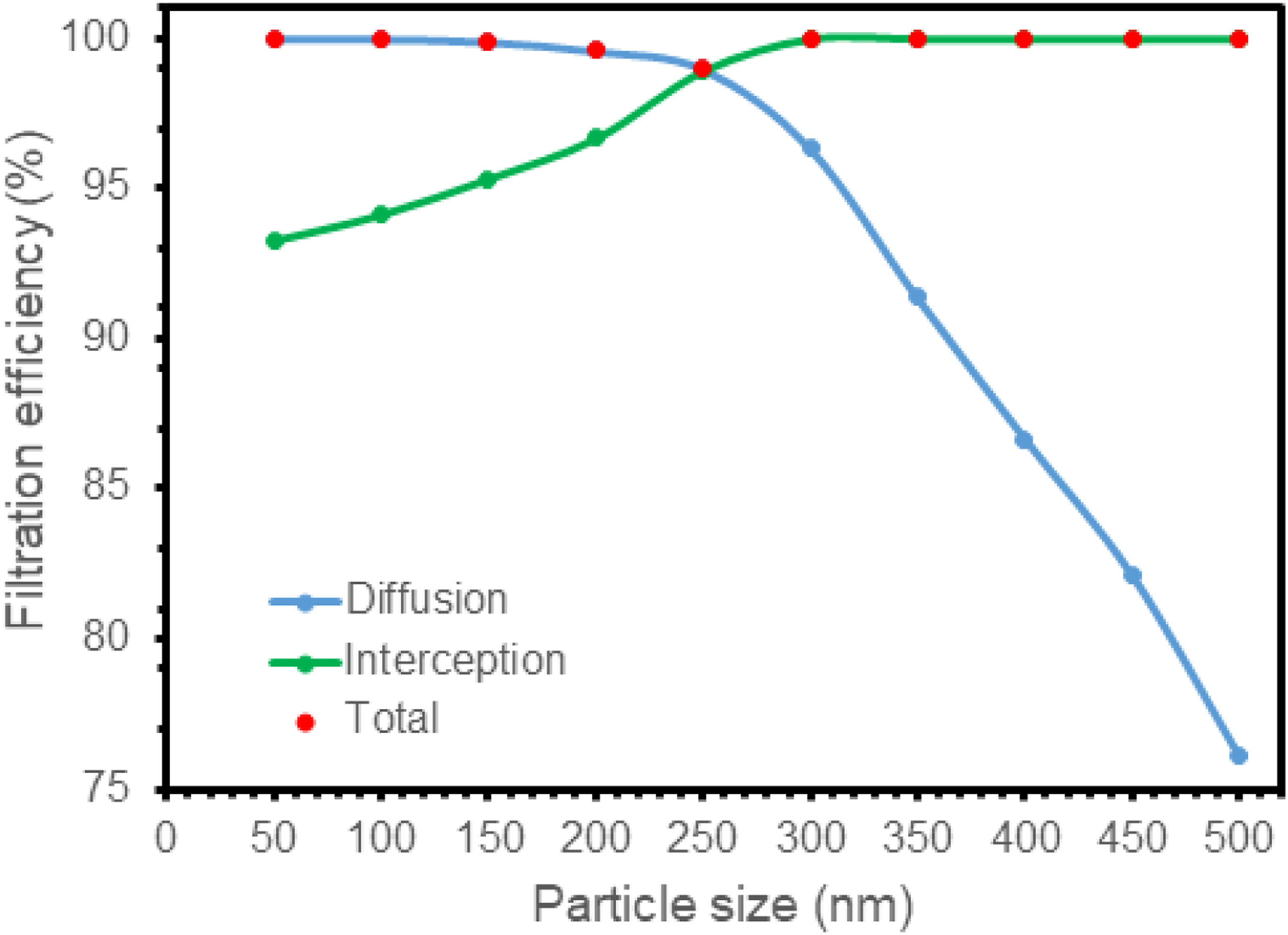
Filter with a better filtration performance should have a higher efficiency and a higher QF. It is observed that PA-6 NFN membrane quality factor is better in contrast to other filtration media, which could be attributed to the nanonets structures, and ultrathin fiber shows the more effective application of this filter against airborne pollutants.
Figure 5(e) shows that the PA-6 NFN membrane still maintains a high filtration efficiency (99.11 ± 0.67%) and less variation of pressure drop (83 ± 2 Pa) after 24 h of operation of the filtration process, fully indicating their robust adaptive capacity and long lifetime for a variety of practical applications.
Theoretical calculation of filtration efficiency and comparison with experimental results
In order to evaluate the theoretical calculation, experimental measurement, and to determine their agreement, the equations related to filtration efficiency must first be mentioned.
The total filter efficiency η can be expressed as a function of the single fiber efficiency ηs, filter thickness Z, fiber packing density α, and the fiber diameter df
[52]

The mechanical capture is through interception (aerosol followed by streamline which gets intercepted by fiber) and diffusion (random walk) with respective single-fiber efficiency for interception 
The single fiber efficiency for interception is given by
[52]

The theoretical single fiber efficiency for diffusion is given by
[53]

The total filtration efficiency of PA-6 NFN membrane based on results of interception and diffusion mechanisms are shown in Figure 6.
It is observed that in the particle size range of 50–250 nm, the filtration efficiency is a decreasing process in which the diffusion mechanism is dominant. It occurs because air molecules are always in a state of random motion. As air molecules impact contaminants in the air stream, they move them in different directions, and this movement of the contaminants is known as Brownian motion. It is observed that MPPS (maximum penetrating particle size) is present in the 250 nm particle size. As a result, the filtration efficiency at this particle size is minimal. Furthermore, at 250–500 nm particle sizes, the dominant mechanism is the interception. In this mechanism, when the particles are larger than the filter media pore size or flow path, particles are removed by the filter media. Therefore, as the particle size increases, the filtration efficiency increases. The filtration efficiency of PA-6 NFN membrane based on calculation results and measured results are shown in Figure 7. The R2 value was 0.99, which indicates that the calculation results are in good agreement with the measured results. The filtration efficiency of PA-6 NFN membrane based on measured and calculated results.
Conclusions
In summary, designed and fabricated PA-6 NFN membrane has a bimodal structure consisting of ultrafine nanofibers and 2D ultrathin nanonets to capture the nanoparticles and bioaerosols via one-step electrospinning/netting.
The PA-6 NFN membranes are systematically optimized via promoting nanonets formation which is achieved by tuning the solution concentration, incomplete phase separation, which leads to the formation of a rich polymer phase and a solvent-rich phase by adding NaCl and applying a high voltage of 22 kV.
With integrated properties of ultrafine diameter, small pore size, high porosity, and high specific surface area, the resulting PA-6 NFN membranes exhibit robust tensile strength, high filtration efficiency of 99.11% for the 100 nm aerosol particles, less pressure drop of 81 Pa under the industrial standard air flow of 32 L/min, and higher filtration efficiency and higher quality factor for ultrafine airborne particles compared to the two standard commercial masks including three-ply surgical mask and respirator face mask. After 24 h of operation of the filtration process in a simulated living environment, the obtained air filter still displayed a high filtration efficiency and a less variation pressure drop. In addition, the R2 value was 0.99, which indicates the calculated filtration efficiency results are in good agreement with the measurement results. It is anticipated that the PA-6 NFN membranes will have broad applications, including face mask, protective clothing, clean room, and engine intake.
Footnotes
Acknowledgments
The work was supported by University of Guilan, Rasht, Iran. Also the authors are grateful to Safety and Environmental Laboratory, Nuclear Fuel Cycle School, Nuclear Science and Technology Research Institute, Tehran, Iran, for providing their lab facilities for the Filtration Media Quality Test.
Declaration of conflicting interests
The author(s) declared no potential conflicts of interest with respect to the research, authorship, and/or publication of this article.
Funding
The author(s) disclosed receipt of the following financial support for the research, authorship, and/or publication of this article: Also the authors are grateful to Safety and Environmental Laboratory, Nuclear Fuel Cycle School, Nuclear Science and Technology Research Institute, Tehran, Iran, for providing their lab facilities for the Filtration Media Quality Test.
