




Abstract
This study introduces a comparative approach to integrating natural and synthetic antibacterial agents into electrospun nanofiber media for face masks, aiming to reduce health and environmental concerns associated with synthetic compounds. Polyacrylonitrile (PAN) nanofibers incorporating thyme extract (5, 20, 40, 60 wt%) and ZIF-8 (5, 7, 10, 15 wt%) were fabricated and evaluated. Structural analyses confirmed uniform bead-free nanofibers with average diameters ranging from 207.5 to 234.2 nm and membrane thicknesses around 150 µm. FTIR and XRD data verified successful incorporation and chemical bonding of additives within the PAN matrix. Performance testing demonstrated that thyme-based nanofibers (40 wt%) achieved a particle filtration efficiency (PFE) of 96.83% (0.3 µm), 100% bacterial filtration efficiency (BFE), and a pressure drop of 20.33 Pa. ZIF-8 nanofibers (7 wt%) achieved 96.58% PFE and 96.06% BFE with a pressure drop of 25 Pa. Time-kill assays showed superior antibacterial activity of thyme compared to ZIF-8 over a 4-h period. Compared to melt-blown media, nanofiber samples provided significantly higher filtration performance with acceptable breathability. The findings highlight that thyme-loaded nanofibers offer a biodegradable, non-toxic, and efficient alternative to synthetic agents such as ZIF-8. This work provides new insights into structure–property–performance relationships in functional nanofibers and suggests natural compounds as promising candidates for safer and more sustainable face mask technologies though further research on scalability, long-term stability, mechanical durability, biodegradability, and breathability is warranted.
Keywords
Introduction
Bioaerosols have been a significant health threat, especially in recent years. Face masks play a crucial role in limiting exposure to airborne pathogens; however, concerns exist regarding microbial viability on mask surfaces, re-aerosolization of deposited particles, and improper disposal. The materials used in masks can provide a favorable environment for microbial growth, particularly under warm and humid conditions created by respiration and saliva. Studies have shown that microorganisms, including bacteria and fungi, can persist and even proliferate on mask surfaces, especially when worn for extended periods. This microbial accumulation may compromise the protective efficiency of masks, pose secondary infection risks, and contribute to fomite transmission. Additionally, the extracellular polymeric matrix formed by microorganisms can trap pathogens and facilitate their re-release into the air during sneezing or coughing.1,2 Conventional masks, which lack antimicrobial properties, leading to a surge in hazardous waste, particularly during pandemics. To address these concerns, researchers have investigated the integration of antimicrobial agents into face masks to enhance their protective efficacy while reducing microbial proliferation on mask surfaces. 3 While these materials can enhance microbial inactivation and extend mask usability, concerns remain regarding the potential detachment and environmental fate of synthetic antimicrobials. Studies have demonstrated that antimicrobial agents such as silver nanoparticles, copper-based compounds, quaternary ammonium salts, and metal-organic frameworks (MOFs) can be incorporated into mask media to inhibit microbial growth.3,4 However, there can always be concerns about their release. Specifically, zeolitic imidazolate framework-8 (ZIF-8) is a prominent MOF known for its exceptional properties, including high thermal stability, chemical durability, large surface area, permanent porosity, and excellent adsorption capacity. 5 More importantly, ZIF-8 has been confirmed to show excellent antibacterial performances because of the released metal ions and the corresponding chemical damage to the bacteria liquid membrane. 6 On the other hand, there have always been health concerns regarding the potential release of nanoparticles and synthetic compounds from functionalized textiles such as face mask media, which could lead to exposure of the users and environment. Additionally, the absence of a standard method for evaluating the release of these compounds has increased these concerns, which have been addressed in various studies.3,5,7–9
Synthetic antimicrobial compounds, despite their strong antibacterial properties, have several drawbacks, including potential side effects, unintended impacts on non-target bacteria, and environmental concerns such as water pollution. These chemicals can detach from textiles and other treated materials during use, entering water sources and leading to the death of aquatic life or the degradation of crops irrigated with contaminated water. Additionally, some synthetic agents may cause allergic reactions or skin irritation in humans or respiratory exposures. There is a growing demand for natural antimicrobial alternatives that are environmentally friendly and safer for human health. These compounds not only reduce the risk of adverse effects but also help prevent water contamination and antibiotic resistance. Recent studies highlight the effectiveness of plant-derived antimicrobial agents, which disrupt bacterial membranes, inhibit biofilm formation, and exhibit strong antioxidant activity, making them promising candidates for use in personal protective equipment (PPE). Among these, essential oils such as thymol, carvacrol, eugenol, and cinnamaldehyde have been widely studied for their antimicrobial properties in textiles and filtration media. In particular, thyme (Thymus vulgaris) is notable for its strong antibacterial and antiviral effects, attributed to its high thymol and carvacrol content. Given their safety and efficacy, plant-based antimicrobial agents offer a viable alternative to synthetic compounds and warrant further investigation.10,11
Therefore, the functionality and composition of materials with antibacterial properties are critically important. 12 As a result, researchers have focused on developing advanced technologies and innovative materials to create highly efficient masks. These designs prioritize features such as good particle filtration, antibacterial, breathability, resistance to fluid penetration, lightweight construction, user comfort, scalability for mass production, and cost-effectiveness. In recent years, nanofibers have gained significant attention in personal protective equipment (PPE), such as face masks and respirators, due to their outstanding filtration capabilities. To optimize both filtration efficiency and breathability while preventing clogging, they are often combined with microfibers. Among nanofiber fabrication techniques, electrospinning has shown great promise, producing fibers with minimized pore size and a remarkably high surface-to-volume ratio. 6 Electrospun membranes effectively capture submicron particles and contaminants, serving as both physical barriers and functionalized filters. Their surfaces can be modified with antimicrobial agents, further enhancing protection. 13 Studies have demonstrated that electrospun membranes offer superior filtration performance while maintaining breathability and mechanical durability.7,14 For instance, Ullah et al. (2020) reported that electrospun nanofiber filters provided enhanced efficiency against viral aerosols compared to traditional melt-blown materials. 7
Medical face masks are classified as medical devices and must meet specific criteria outlined by relevant standards. 15 Bacterial Filtration Efficiency (BFE) is a commonly used approach for assessing the effectiveness of face masks. This method involves capturing bacteria that pass through the mask, cultivating them, and counting the resulting colony forming units (CFUs) to quantify the mask’s filtration capability. 16 Since BFE tests require specialized expertise, specific equipment, and considerable time, facemask performance is instead evaluated using non-biological particle filtration efficiency (PFE) tests, which are relatively simpler to conduct. PFE quantifies a mask’s ability to trap particles within a defined size range. It is expressed as the percentage of particles passing through the mask compared to the initial particle concentration. 17 The EN 149 and ASTM 2299 standards outline multiple performance criteria, including particle filtration efficiency (PFE). While EN 14683 focuses on BFE for medical masks, ensuring protection against biological aerosols, EN 149 and ASTM 2299 appliy to face masks and respiratory protective devices, emphasizing particle filtration efficiency PFE for fine airborne particulates. 18
While numerous studies have explored synthetic antibacterial agents such as silver nanoparticles, copper ions, and metal-organic frameworks (e.g., ZIF-8), research on integrating plant-derived compounds like thyme into electrospun nanofiber membranes remains limited. Most existing work has focused primarily on the antibacterial or antiviral activity of natural agents under laboratory conditions, often overlooking filtration performance parameters such as PFE, BFE, and pressure drop. Furthermore, very few studies have conducted side-by-side comparisons between natural and synthetic antibacterial agents in functional nanofiber mask media, using standardized performance testing methods. By bridging this gap, our study provides new insight into the feasibility of replacing synthetic compounds with natural alternatives in respiratory protection systems.
This study employs a conceptual model linking nanofiber composition, structure, and filtration performance. It hypothesizes that incorporating natural (thyme extract) and synthetic (ZIF-8) antimicrobial agents alters both the physical (fiber morphology, porosity) and chemical (pathogen interactions) properties of the electrospun nanofibers, affecting their filtration efficacy. Additionally, the model examines how the potential release of these agents relates to environmental and health risks, providing a comprehensive basis for comparing natural and synthetic antibacterial strategies. This study aims to investigate and compare the particle filtration efficiency (PFE) and bacterial filtration efficiency (BFE) of nanofiber media incorporating natural (thyme) and synthetic (ZIF-8) antibacterial agents that can be used in face masks and respirators. Specifically, we seek to determine whether thyme-based antibacterial masks can serve as a suitable alternative to synthetic compounds. Our hypothesis is that masks containing natural antibacterial agents may provide comparable or filtration performance while eliminating concerns related to the release of synthetic compounds from the face mask media due to improper use or other factors, thereby reducing human exposure.
Materials and methods
Materials
PAN (MW = 150,000) was obtained from Sigma-Aldrich chemical company. N, N-Dimethyl formamide (DMF) (Mw = 73.095 g·mol−1), methanol (Mw = 32.04 g/mol), ZN (NO3)2. 4H2O (Mw = 261.44 g/mol), 2-methylimidazole (HmIM) (Mw = 82.11 g/mol) were supplied from Merck. Thyme Liquid Extract (A+++), an ethanol-based extract, was purchased from GIYAH KALA.
Synthesis of ZIF-8
Initially, ZIF-8 was synthesized to prepare the PET/ZIF-8 electrospinning solution. For this, 2.582 g of zinc nitrate hexahydrate (ZN(NO3)2·4H2O) was dissolved in 200 mL of methanol, while simultaneously, 3.242 g of 2-methylimidazole (HmIM) was dissolved in another 200 mL of methanol. The two solutions were thoroughly mixed and stirred to ensure complete dissolution of the compounds. The resulting solution was left at room temperature for 24 h. Subsequently, the precipitated powders were separated using a centrifuge and thoroughly washed with methanol. Finally, the collected powder was vacuum-dried at 100°C for 12 h in an oven. 19 Field emission scanning electron microscopy (FESEM, MIRA III, TESCAN, Czech Republic) and X-ray powder diffraction (XRD, PW 1730, Philips CO, Netherlands) were employed to analyze the morphology and structure of the synthesized ZIF-8 MOF, using Cu Kα radiation (40 kV and 30 mA). The data was collected over a range of 10° to 80° with a scanning rate of 0.05° (2θ) s−1. 19
Preparation and electrospinning of polymer solutions
To prepare a 10 wt% PAN/DMF solution, a specific amount of PAN powder was added to DMF and stirred at 60°C for 4 h. PAN was chosen for fiber preparation due to its excellent mechanical strength, thermal stability, and chemical durability, which ensure long-lasting and high-performance filtration media. Unlike degradable polymers, PAN maintains its structural integrity over time, is easy to surface modify, and is cost-effective for large-scale industrial production. 20 To obtain PAN/ZIF-8, PAN/thyme, ZIF-8, and thyme at different concentrations (5, 7, 10, 15 wt% for PAN/ZIF-8 and 5, 20, 40, 60 wt% for PAN/thyme, relative to PAN weight), these components were added to the PAN solution and stirred for 4 h at 60°C. The specific concentrations were selected based on a thorough review of existing literature and preliminary tests.10,12,19 Higher and lower concentrations were also tested, but the optimal results in terms of filtration efficiency and antibacterial performance were observed within these ranges. The resulting solutions were transferred into a syringe with a stainless-steel needle (needle gauge: 23 G). The electrospinning process was carried out under the following conditions: a 15 cm distance between the needle tip and collector, 15 kV voltage, 800 rpm drum rotation, and a 0.5 mL/h feeding rate (electrospinning device specification: ESDP30, Fanavaran Nano-Meghyas, Iran).21,22 Each experiment was performed three times, and the mean value of all tests was reported.
Characterization of nanofiber media
The surface morphology of the nanofibers was examined using field emission scanning electron microscopy (FESEM, MIRA III, TESCAN, Czech Republic). To avoid the accumulation of electrical charge on the nanofibers, the samples were coated with a thin gold layer, after which the images of the nanofibers were taken. Fourier Transform Infrared Spectroscopy (FTIR) was carried out using a FTIR spectrometer (AVATAR, Thermo, USA) in the wavenumber range of 500–4000 cm−1 and the resolution of 4 cm−1.
Performance evaluation PFE and pressure drop of nanofiber media
Particle filtration efficiency (PFE) testing was conducted using a mask and filter media testing device (PS200FT, Nanofanavaran Meghyas, Iran). This device is equipped with a four-channel particle counter for particle sizes of 0.3, 0.5, 3, and 5 microns. In this test, sodium chloride particles generated by an aerosol generator (Dust Generator) were used. Based on the EN 149 and ASTM 2299 standards, as well as previous studies, nanofiber media were tested at flow rate 30 L/min.23,24
Pressure drop in face masks actually represents the resistance to the airflow passing through the mask surface. To examine the pressure drop of the nanofiber media under investigation, a cross-sectional area of 100 cm2 of the nanofiber media was tested at a flow rate of 30 L/min according to the EN 149 standard. The differential pressure upstream and downstream of each of the media was measured with a manometer using a filter media testing device (PS200FT, Nanofanavaran Meghyas, Iran), and the pressure drop was calculated using formula 1)
23
:

Additionally, several layers of melt-blown media were also tested following the same method to compare its PFE and pressure drop performance.
Time kill test
The antibacterial properties of ZIF-8 and thyme were analyzed by a time-kill assay. To conduct this test, the Staphylococcus aureus microbial strain was first cultured in a liquid medium. The bacterial concentration was adjusted to a density equivalent to 5 × 10⁵ CFU/ml using the McFarland standard. Then, a specific amount of thyme extract and ZIF-8 were separately added to the prepared solution. At designated time intervals (0, 2, 4 h), a fixed volume of 100 µL of the solution was sampled and spread onto a culture medium. The plates were incubated at 37°C for 24 h.25,26
Performance evaluation BFE of nanofiber media
For this test, the EN 14683:2019 standard was followed. Initially, a bacterial suspension of Staphylococcus aureus ATCC6538 with a concentration of 5 × 10⁵ CFU/mL (maintained consistently for each test run) prepared and transferred to a ultrasonic nebulizer (80 NB, Rossmax, Taiwan) that produced aerosol droplets with a mean size of 3.0 ± 0.3 μm. Subsequently, a 100 × 100 mm diameter sample of the nanofiber media was securely mounted between the first stage of a six stage cascade impactor (Cat. No 225-370, SKC Ltd, USA) and its inlet cone. Agar plates containing soybean casein digest agar were placed in each stage of the impactor. To conduct this test according to Figure 1, the Staphylococcus aureus aerosol was introduced into the aerosol chamber and drawn through the nanofiber media and cascade impactor under vacuum (test flow rate of 28.3 L per minute). At the end, all the plates were removed from the impactor, numbered, and incubated at a temperature of 37°C (±2) for 20 to 52 h. In accordance with the standard 14683, the bacterial filtration efficiency (BFE) of the nanofiber media was determined by the number of colony-forming units that passed through media and was expressed as a percentage of the total colony-forming units in the aerosol. Additionally, for each media, two positive control samples (one at the beginning of the test and one at the end, when no media was in the setup and only the vacuum pump was running) were conducted. A negative control sample was also performed by passing air through the cascade impactor without adding the bacterial suspension. The duration of this test for each mask was 2 min according to the standard. Finally, the bacterial filtration efficiency (BFE) was determined as a percentage using formula (2)
27
: BFE test apparatus.

Results
Characterization of synthesized ZIF-8
The FE-SEM image and size distribution of ZIF-8 are shown in Figure 2. ZIF-8 SEM image showed that the synthesized ZIF-8 nanoparticles have a relatively uniform shape, and their average size was determined to be 246.95 ± 48.54 nm. Figure 2 shows that the particle size of ZIF-8 ranges from 150 to 350 nm, with the most frequent distribution centered at approximately 250 nm. SEM image and size distribution of ZIF-8 (19).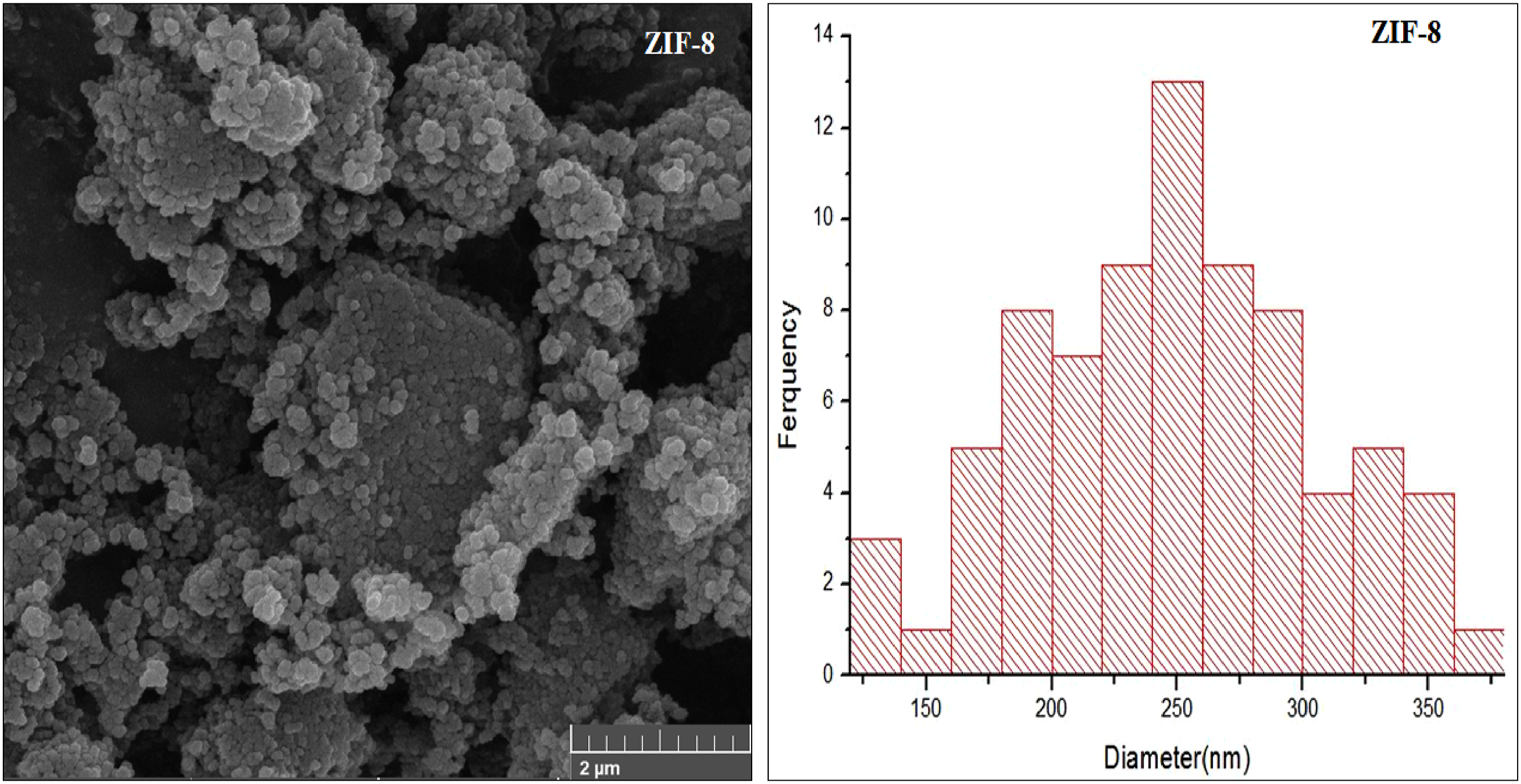
Structure of composite ZIF-8 and nanofiber media
The XRD analysis was conducted to determine the crystal phase of the synthesized samples. The appearance of strong diffraction peaks indicates the high crystallinity of the prepared ZIF-8, aligning well with previous studies.28,29 In this study, peaks observed at 2θ = 7.33, 10.38, 12.72, 14.71, 16.45, and 18.04° correspond to planes (110), (200), (211), (220), (310), and (222), respectively (Figure 3). These diffraction peaks match well with reported data for ZIF-8 in previous literature.
28
The dominant peak at 7.338° with a d-spacing of 12.03791 Å confirms the presence of a well-defined sodalite (SOD) framework, which is a characteristic crystalline structure of ZIF-8.
30
Additionally, the Full Width at Half Maximum (FWHM) of the peaks suggests high crystallinity, indicating well-formed and defect-free nanocrystals. The results demonstrate that the synthesized ZIF-8 retains its unique porous structure and crystallographic integrity, further validating its successful fabrication.
31
XRD peaks of ZIF-8 powder.
The FTIR spectra of PAN, PAN/ZIF-8 and, PAN/thyme, are presented in Figure 4. The spectrum of PAN media indicate specific peaks attributed to CH stretching in CH and CH2 groups at 2926 cm−1, C≡N v stretching at 2243 cm−1, C = O stretch vibrations of the aliphatic ketone and the conjugated ketone at 1735 and 1665 cm−1, CH2 bend at 1450 cm−1.32–34The FT-IR spectra of PAN/ZIF-8 displayed the distinct peaks associated with ZIF-8, alongside the characteristic peaks of PAN. The peaks observed at 1144 cm−1 correspond to the stretching vibration of the C-H bond in 2-Methylimidazole. The peak at 1234 cm−1 1 could be ascribed to the stretching vibration C–H in the structure of imidazole ring.35,36 The FTIR spectrum of the PAN/thyme nanofiber membrane revealed that peak at 3549 cm−1 represents stretching vibrations (O-H) associated with hydroxyl groups, which likely originate from the phenolic compounds in thyme extract. The peak at 2929 cm−1 corresponds to stretching vibrations (C-H) in alkane groups (CH2 or CH3), which may relate to either PAN or organic compounds in thyme. Additionally, the peak at 1736 cm−1 represents stretching vibrations (C=O) from carbonyl groups, potentially due to the presence of ketones or esters in thyme extract. The peak at 1665 cm−1 could indicate vibrations (C=C) in the aromatic groups found in thyme. Other peaks, such as 1449 cm−1 and 1233 cm−1, correspond to bending vibrations (CH2 or CH3) and stretching vibrations (C-O) in the thyme extract. In total, the peaks primarily correspond to phenolic compounds (O-H), carbonyl groups (C=O), and aromatic compounds (C=C) in thyme, while the nitrile peaks (C≡N) and C-H stretching peaks suggest the presence of PAN in the composition.
37
FTIR- PAN, PAN/Thyme and PAN/ZIF8.
Particle filtration efficiency and pressure drop of nanofiber media
Particle filtration efficiency and pressure drop of nanofiber media.

According to EN 149, FFP2 face masks must achieve a minimum filtration efficiency of approximately 94%, while FFP3 masks require around 99% efficiency for 0.3 µm particles. Additionally, the maximum allowable pressure drop under standardized conditions at 30 L/min is typically between 60 and 100 Pa, ensuring adequate breathability without compromising protection. Given these requirements and the potential application of the fabricated nanofiber media in different mask types (FFP2, FFP3, and medical face masks), the highlighted samples in Table 1 were selected for further bacterial performance evaluation. 23
Morphology of the optimized nanofiber media
To observe and examine the structure of the selected and optimized nanofiber media, SEM images were used, as shown in Figure 5. SEM images of all nanofiber media revealed a bead-free structure with a round cross-section. The average fiber diameters for PAN, PAN/ZIF-8 7%, PAN/ZIF-8 10%, PAN/Thyme 20%, and PAN/Thyme 40% shown in Table 2. The diameters of 20 different nanofibers were determined using Image J software (1.54 k). The average thickness of the nanofibrous layers was approximately 150 µm, as determined using by a digital micrometer with 0.001 mm accuracy (Mitutoyo 293-340-30, Japan) SEM image and size distribution of nanofiber media. Average diameters and size distribution of nanofibers.

Antibacterial properties
Bacterial filtration efficiency of nanofiber media.

The findings from the time kill test are also presented in Figure 6. The time-kill assay was performed at 0, 2, and 4 h to evaluate the antibacterial properties of ZIF-8 and thyme. The World Health Organization recommends the use of face masks for up to 4 h, so this test was performed over a time range of 0 to 4 h to determine whether these compounds can maintain their antibacterial effect during this period.
15
As shown in the Figure 6, both ZIF-8 and thyme exhibited strong antibacterial activity over the 4 h period. However, thyme demonstrated significantly better performance compared to ZIF-8, with more substantial reductions in bacterial counts. These results highlight the effective antibacterial potential of thyme, which was more pronounced at 4 h time point compared to ZIF-8. The antibacterial activity of thyme and ZIF-8 at different time intervals.
Discussion
In recent years, the use of nanofibers in masks has gained popularity, and the electrospinning technique has demonstrated its ability to produce nanofibers with high filtration efficiency for capturing submicron particles and bioaerosols.38,39 However, one major challenge in adopting nanofiber-based filtration media is scalability. While electrospinning offers enhanced filtration and antibacterial properties compared to melt-blown fibers, scaling up production remains a bottleneck. Recent advancements, such as needleless electrospinning and industrial-scale electrohydrodynamic processes, have improved production rates while maintaining fiber uniformity. Additionally, centrifugal spinning provides a cost-effective, high-output alternative. Together, these techniques offer promising solutions to the scalability challenge in filtration applications. 40 Electrospun nanofibers, known for their excellent filtration efficiency, can be further enhanced by incorporating metallic and non-metallic nanomaterials, enabling the development of advanced membranes with antibacterial, antiviral, and self-sterilizing properties.31,41 Recent progress, particularly in multi-layered hybrid electrospun membranes, has significantly improved filtration performance. 42 One of the primary concerns with synthetic antibacterial agents is the potential release of nanoparticles during use, which may pose health and environmental risks. Studies have shown that prolonged use of face masks containing nanomaterials can lead to nanoparticle detachment and unintentional inhalation exposure. For example, metal-organic frameworks (MOFs) like ZIF-8 have recently gained attention for their tunable porosity and antimicrobial activity, offering advantages in hybrid functional materials for respiratory applications 43 ; however, their stability under real-world conditions remains a concern. Similarly, the integration of natural antimicrobial agents, such as plant-derived compounds and essential oils, has emerged as a viable alternative to synthetic biocides in antimicrobial textiles. This shift toward bio-based antimicrobial agents aligns with global efforts to develop safer, non-toxic, and environmentally friendly protective equipment. By integrating these recent advancements into nanofiber media, this study contributes to the growing body of research on high-performance, sustainable, and safe filtration solutions. 2 Previous research using ZIF-8 or thyme in filtration applications reported high antibacterial activity but rarely evaluated performance using both PFE and BFE standards. For example, Givirovskaia et al. (2022) and Mahdavi Zafarghandi1 et al. (2024) demonstrated good filtration efficiency for ZIF-8-based media, but did not compare with natural alternatives or assess long-term antimicrobial persistence.44,45 Our study expands on this by systematically comparing thyme and ZIF-8 in terms of structure, performance, and antibacterial activity under realistic testing conditions
Unlike melt-blown fibers or microfibers, which have a wide diameter range of 1 to 10 μm and are challenging to control, electrospun fibers can achieve diameters 10 to 100 times smaller. This results in a larger surface area and smaller inter-fiber pore sizes. Numerous reviews highlight the potential of electrospun media in developing next-generation face masks and respirators.5,7,8 The results of this study also indicated that nanofiber media, compared to melt-blown samples (microfibers), achieved more acceptable results while maintaining desirable pressured drop (Table 1).
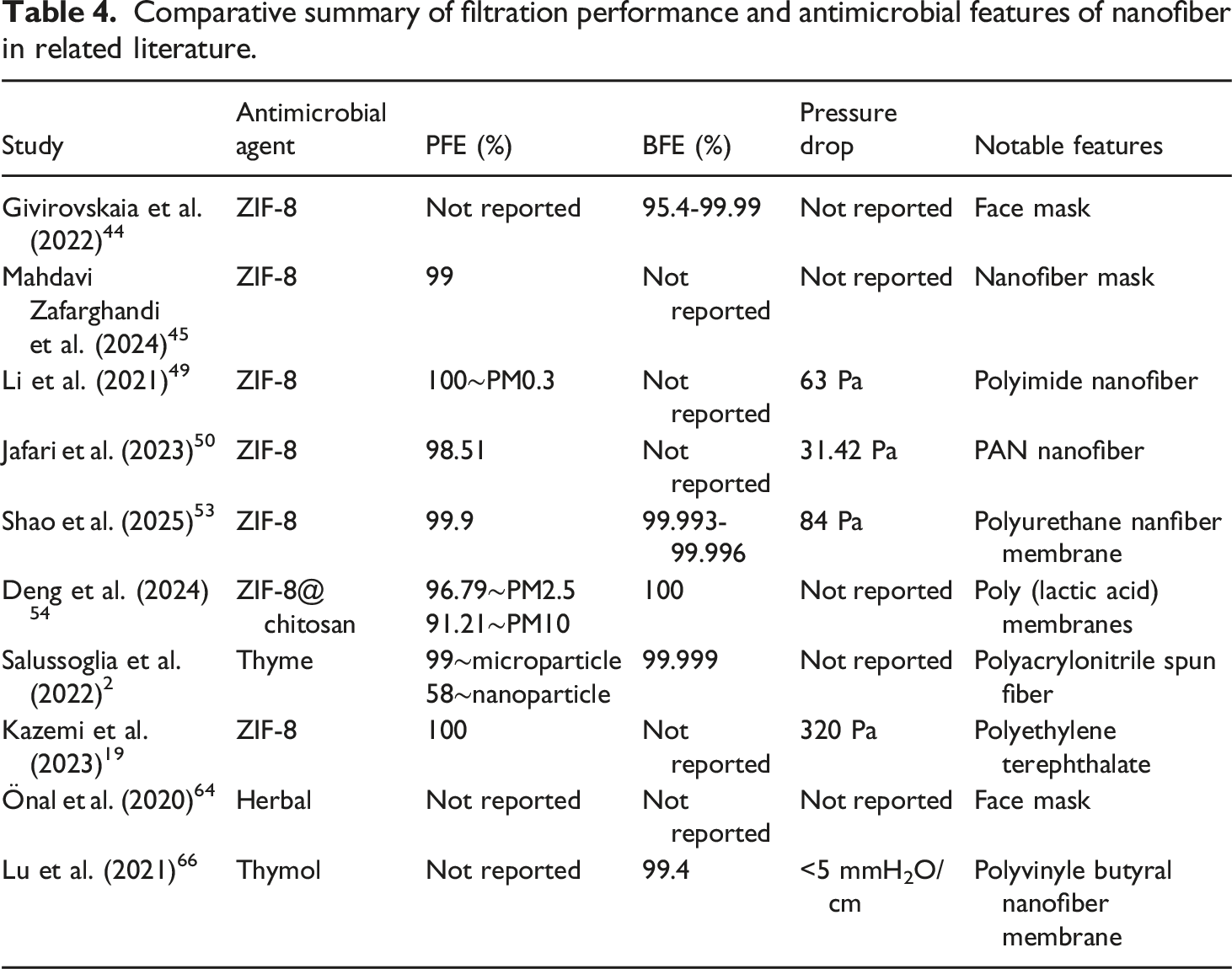
In addition, loading different compounds onto the nanofiber structures of the table leads to a change in its diameter. In this study, SEM images and fiber diameter analysis also show that the addition of thyme and ZIF-8 can lead to a change in the fiber diameter (Figure 5 and Table 2). These changes are typically due to the effects that the added compounds (thyme and ZIF-8) have on the surface forces and the viscosity of the polymer during the electrospinning process. Studies show that incorporating natural materials like thyme into polymer nanofibers typically produces a more compact structure with smaller diameters than pure polymer nanofibers. This is attributed to thyme’s ability to increase conductivity, leading to fiber thinning. The observed reduction in PAN nanofiber diameter with thyme suggests a positive interaction with the PAN structure, enhancing fiber dimensions and surface properties.46,47 This finding aligns with Aras et al. (2019). 48 In the case of ZIF-8, when added to PAN nanofibers, specific properties such as increased stiffness or changes in the mechanical and physical properties of the fibers are typically observed. These changes, particularly in the fiber diameter, arise due to alterations in the viscosity of the electrospinning solution or the tensile forces during the process. The While ZIF-8 generally increases solution viscosity, leading to thicker fibers, a higher weight percentage of ZIF-8 has been shown to reduce fiber diameter, consistent with Li et al. (2021). 49 These findings align with Jafari et al.’s study (2023), which showed ZIF-8/PAN substrates had the highest filtration efficiency compared to PAN substrates and three-layer masks. The improved performance is attributed to the smaller nanofiber diameter in the ZIF-8/PAN substrates. 50 This result could be linked to the reduced diameter of the nanofibers in the ZIF-8/PAN substrates compared to the PAN substrates. 50 Additionally, increasing the percentage of thyme and ZIF-8 has further enhanced this performance. The addition of ZIF-8 to the polymer solution increases its surface tension, causing a smaller volume of polymer to be delivered to the collector in a constant time period, which ultimately results in smaller fiber diameters and improved filtration performance. 50 Since one of the particle capture mechanisms relies on electrostatic interactions and the potential difference between the nanofibers and particles, the inability of ZIF-8 to supply positive charges may strengthen these electrostatic interactions and increase the potential difference between the nanofibers and particles, thus providing a possible explanation for the higher filtration efficiency of the ZIF-8/PAN substrates.51,52 Shao et al. (2025) demonstrated that polyurethane nanofibers containing ZIF-8 exhibit excellent filtration performance (filtration efficiency: 99.9%, pressure drop resistance: 84 Pa) and outstanding antibacterial properties, offering a novel strategy for indoor air purification applications. 53 The study by Deng et al. (2024) is also in line with these results. 54
The results of the study by Salussoglia et al. (2022) indicate that electrospun nanofibers with thyme have a high particle filtration efficiency, which is consistent with the results of the present study. 2 Salussoglia et al. (2020), Salussoglia et al. (2022), and Kazemi et al. (2023) showed that reducing the average fiber diameter can notably increase the filtration efficiency.2,19,55 This improvement occurs because smaller fibers facilitate particle removal through the mechanisms of impaction, interception, and diffusion. 55 In nanofiber-based filters, particle capture is governed not only by interception and diffusion but also by electrostatic interactions and slip flow effects. For ultrafine particles (<100 nm), Brownian motion enhances diffusion-based capture, particularly in nanofibers with diameters comparable to the mean free path of air, where slip flow further reduces pressure drop without sacrificing efficiency. 14 Additionally, residual surface charges in electrospun PAN fibers can contribute to electrostatic attraction. While thyme may influence surface polarity, ZIF-8 has been reported to enhance the potential difference between fibers and particles, thereby supporting electrostatic capture. 53
Moreover, nanofibers help reduce airflow resistance by creating a slipstream effect, which lowers the pressure drop across the nanofiber media. These results are consistent with the findings of the present study. All of the nanofiber media in this study exhibited a desirable pressure drop (less than 60 Pa) according to EN 149. When fiber diameters are comparable to the mean free path of air, a slip flow regime occurs, further decreasing the pressure drop in electrospun membranes. A key factor influencing the filtration performance of electrospun nanofibers is porosity, which determines air permeability and pressure drop while directly affecting particle capture efficiency. High-porosity structures facilitate airflow, reducing breathing resistance while maintaining effective filtration through Brownian diffusion and electrostatic attraction. 56 Studies indicate that electrospun nanofiber membranes with controlled porosity achieve an optimal balance between high filtration efficiency and low pressure drop.56,57 Additionally, inter-fiber spacing plays a crucial role in defining the cut-off size for airborne particles, as smaller pores enhance interception and diffusion-based capture. 58 Due to the small inter-fiber spacing, the minimum filtration efficiency shifts to a smaller particle size range, enhancing the capture of submicron particles compared to commercial face mask filters. These findings align with the data in Tables 1 and 3, demonstrating that nanofiber media outperform commercial melt-blown media by offering higher filtration efficiency, significantly lower pressure drop, and superior particle filtration and antibacterial performance. 58 The study by Zhao et al. demonstrated that when the fiber diameter becomes comparable to the mean free path of air, a slip flow regime occurs for the nanofibers, resulting in a low-pressure drop in electrospun membranes. 59
As can be seen from Table 3, the thyme nanofiber media based on EN 14683 exhibit acceptable antibacterial performance (at least 95% for Type 1 masks and 98% for Type 2 and 3 masks). In contrast, among the ZIF-8 nanofiber media, only the 7% sample demonstrates the desired performance for application in Type 1 mask structures. The performance observed at 7 wt% ZIF-8 can be attributed to an optimal balance between fiber morphology and porosity. At lower ZIF-8 concentrations (<5 wt%), the ZIF-8 distribution is sparse, leading to insufficient surface area and minimal effect on filtration performance. Conversely, at higher concentrations (>10 wt%), excessive ZIF-8 aggregation increases solution viscosity, causing irregular fiber formation negatively affecting on ltration efficiency. The 7 wt% loading achieves a uniform zif-8 distribution while maintaining an interconnected pore structure, which enhances particle capture efficiency through diffusion and interception mechanisms (Tables 1 and 3).49,52 Similarly, the 20 wt% thyme concentration appears to optimize the electrospinning process by improving fiber conductivity and reducing surface tension. Lower concentrations (≤5 wt%) fail to provide sufficient antibacterial coverage on the nanofiber surface, leading to reduced bacterial filtration efficiency (BFE). In contrast, higher thyme concentrations (>40 wt%) result in excessive polymer conductivity, leading to thin and fragile fibers with reduced mechanical stability. The 20 wt% concentration achieves a balance by improving fiber uniformity, enhancing surface interactions with airborne contaminants, and maintaining structural integrity (Tables 1 and 3). 60
Comparative summary of filtration performance and antimicrobial features of nanofiber in related literature.
Compared to earlier works that either focused solely on antibacterial effects or particle filtration, our study provides a comprehensive evaluation framework encompassing structural characterization, multiple performance metrics (PFE, BFE, pressure drop), and antibacterial stability. This multidimensional approach highlights the potential of natural agents like thyme as sustainable and effective alternatives to synthetic compounds in functional PPE materials. This study highlights the potential of natural and synthetic antimicrobial agents in enhancing the performance of nanofiber-based face masks. While thyme-based formulations demonstrated desirable antibacterial effects, future research should focus on long-term stability (investigating the antimicrobial durability of plant-based additives under extended use conditions and repeated exposure to environmental factors), safety and biocompatibility (such as cytotoxicity assessments and release of additives), scalability and industrial adaptation, and modeling limitations (refining computational models to better predict real-world performance and interactions between antimicrobial agents and nanofiber structures). Additionally, thermal stability testing and resistance to high humidity conditions were not explored in this study. These factors could significantly impact the long-term effectiveness of antimicrobial agents in real-world applications. Future investigations should include such assessments to provide a more comprehensive understanding of the performance and durability of nanofiber-based face masks. These future directions will help bridge the gap between lab-scale research and real-world implementation, ensuring the development of next-generation, sustainable PPE.
Conclusion
The use of nanofiber media in antimicrobial face masks has increased due to their enhanced filtration efficiency and ability to incorporate active agents. However, the widespread use of synthetic antimicrobial compounds raises concerns regarding health risks, environmental impact, and regulatory compliance. In contrast, plant-derived antimicrobials, such as thyme essential oil, offer a biodegradable, non-toxic alternative while maintaining efficient particle (96.83% PFE at 0.3 µm) and bacterial (100% BFE) filtration with low airflow resistance (20.33 Pa). These findings suggest that such natural compounds could serve as viable options for sustainable mask production. However, challenges related to long-term antibacterial stability, mechanical durability, large-scale manufacturing, and compliance with medical device regulations should be further explored to assess their feasibility for widespread adoption in respiratory protection.
Footnotes

Author contributions
S.K and F.G contributed to the study conception and design. Material preparation, data collection and analysis were performed by Z.SH and M.R.P, E.M, M.M, S.H. and K.A The first draft of the manuscript was written by Z.SH and S.K commented on previous versions of the manuscript. All authors read and approved the final manuscript. All presentations have been consented for publication.
Funding
The authors disclosed receipt of the following financial support for the research, authorship, and/or publication of this article: This work was supported by the Tehran University of Medical Sciences & Health Services Grant under Grant [number 1403-1-294-69982].
Declaration of conflicting interests
The authors declared no potential conflicts of interest with respect to the research, authorship, and/or publication of this article.
Data Availability Statement
The datasets used and/or analyzed during the current study are available from the corresponding author on reasonable request.