




Abstract
The compact construction of fire-resistant woven clothing designed for radiant heat flux protection limits the air permeability from the skin to the environment that risks thermal stress to the wearer. Knitted fabric is well known for its comfort and transmission properties. The inevitable porosity of the knitted fabric has restrained its application in fire-protective clothing. This study attempts to apply tuck and miss elements of a knitted structure to produce a compact yet comfortable flame-retardant fabric with maximum air permeability. The effect of radiant heat exposure at the intensity of 40 kW/m2 and 61 kW/m2 is analyzed for the designed sample. The tuck and miss stitches are used to modify rib-knitted structure and the second-degree burn time estimated using Stoll’s curve. The findings of this research show that a simple modification of rib structure with incorporation of miss stitch can enhance the second-degree burn time to 30 s at the radiant heat exposure of 40 kW/m2.
Keywords
Introduction
From the ancient ages, clothing has been considered as an extension to the wearer’s body as a second skin of the human being. In terms of adornment and social status, it can offer psychological comfort, simultaneously serving as a barrier between wearers and their external environments, providing thermal and weather protection. However, the technological advancement in industrial sector has increased the risk of humans to the various occupational hazards such as chemical, biological, nuclear, and thermal risk. Thus, technical textiles are gaining relevance in the market since such perilous exposure demands specialized protective clothing that confers additional protection against occupational hazards. 1 Thermal protective clothing has a specific significance since fire continues to be an inherent part of our everyday lives and the likelihood of fire hazards occurring is high. A survey conducted by FICCI revealed fire is the 5th highest risk to human lives as well as to the economy of the country losing nearly 25,000 lives every year due to negligence and inadequate safety provisions. 2 In such events of fires, effective fire extinguishing systems by firefighters are very crucial to avoid any kind of human or economic loss. Thus, efficient thermal protective clothing is becoming essential for the safety of firefighting personals.
Fire fighter’s clothing usually consists of three layers: outer heat resistant fabric, middle moisture barrier, and the innermost layer which acts as a thermal barrier. 3 There are many forms of thermal exposures such as flash/flame, 4 radiant heat, hot liquid, 5 steam, 6 and hot surface. 7 Among various thermal exposures, radiant heat has proven to be more severe than a mixture of flame and radiant heat exposures. The two main issues that need to be addressed while designing thermal radiation proof fabric are thermal resistance and protection time of the fabric, which are seldom improved simultaneously. Protective clothing performance varies with the form of exposure, type of material, fabric structural specifications, and fabric characteristics. 8 Depending on the exposure intensity of 5–160 kW/m2, the extent of thermal hazard may differ from the frequent, day-to-day low intensity and less duration exposure to rare intense exposure during explosions. 9 The severity of burn injuries is reliant on the thermal exposure intensity and the duration of exposure. The human skin is susceptible to burn within 1 sec after exposure to a heat flux intensity of 40 kW/m2. 10 However, fire-protective fabric protects the skin and delays this time. This is quantified by second-degree burn time/protection time defined as the time taken by the fabric exposed to thermal radiation of a particular intensity to initiate second-degree burn on the wearer’s skin. According to the NFPA 1971 standard, the clothing assembly consisting of three layers exhibiting protection time of 17.5 s and the thermal protective performance (TPP) rating of 147 J/cm2 (35 cal/cm2) is characterized as fire-protective clothing. 11 Protection time was found proportional to fabric thickness and weight, and air permeability did not significantly affect TPP. Thus, multilayer fabric structures owing to their high weight have been explored extensively; however, their utilization is limited by the low air permeability. Hence, it is difficult to achieve higher TPP in a single-layered woven fabric due to its low fabric weight and thickness.
Heat accumulation in the garment is another problem encountered that causes critical burnout after fire exposure. Thus, acquiring optimal thermal resistance of the fabric is still a challenge, which is dependent on the chemical and physical attributes of the fabric. 12 Song et al. 13 reported the role of air gaps in the fabric and between the thermal protective layer and skin during intense fires. The air gaps acted as an insulating medium to retard the heat transfer directly to the skin surface. 14 Mandal et al. 8 too reported the role of air volume in the fabric barring the heat energy transfer between the fabric and wearer during radiant heat exposure. A fabric structure that provides optimum thermal protection, with sufficient porosity to prevent heat trap, is of significant importance. In this direction, knitted fabric design constructed using inherently fire-resistant fibers with limiting oxygen index greater than 21 such as Nomex, Kevlar, polyamide-imide, and polybenzimidazole is of significant interest. The use of knitted fabric without finishing/coating remains a challenge in the field of fire-protective clothing. Knitted fabric in fire-protective clothing is mainly found in applications like gloves, socks, and inner garments. The design possibilities in the knitted fabric are unlimited, but none of the research explored the impact of structural elements of single-layered knitted fabric on fire-protective clothing performance. The knitting structure opens the possibility to fine tune the porosity, weight, and thickness using the same material and manufacturing technique. Research in the knitted fabric has shown that the use of tuck and miss stitches exhibited a range of alterations in terms of fabric properties.15–18 The yarn count, knitted fabric structures, stitch density of the knitted fabric, and pore size of fabric are the main factors affecting the porosity and air permeability of knitted fabrics. The thermal resistance of 1 × 1 rib-knitted fabric decreases with increasing loop length, porosity, and air permeability.19–21
Herein, we developed fire-protective knitwear using an inherent fire resistance Nomex fiber. The current research shed light on the effect of variation in structural parameters of knitted fabric and radiant heat exposure intensity on thermal protection performance, and transport properties such as thermal resistance and air permeability. It is envisioned that fire-protective knitwear could be utilized as the inner layer of fire-protective assembly for gloves and socks used by the firefighter.
Experimental section
Materials

Sample preparation
The fabric samples were produced with a latch needle using a V-bed flat hand knitting machine. The samples were prepared on a double bed (V-bed) having a 12-gauge knitting machine. A standard atmospheric condition of 27°C and 65% relative humidity was maintained while producing the samples to avoid any variation in the physical properties of the material. In general, knitted fabrics are dimensionally unstable after manufacturing. Hence, sufficient relaxation is necessary to avoid any type of shrinkage or extension of fabric, which creates problems in measuring the dimensional properties of samples. The fabrics were allowed to relax in a standard atmosphere for a minimum of 24 hours.
Structural features
Constructional and physical properties of prepared fabric samples.

Characterization techniques
Fabric characterization
The prepared fabric samples were analyzed for physical properties. The areal density of the fabric is measured using American Society for Testing Material (ASTM) standard D3776.
25
The thickness measurement is done by the Essdiel thickness gauge at a pressure of 100 Pa as per the ASTM D1777-96 standard.
26
The tightness factor of the knitted fabric determines the structure’s closeness. The higher tightness factor indicates fabric compactness and it is defined by the following relation27,28
The air volume contained in the textile fabric is defined by porosity (equation 2), which is calculated using the GSM and thickness of the fabric29,30
Thermal resistance
The heat transfer properties of a fabric depend on its thermal resistance or thermal conductivity, which in turn depends on the fiber properties, fabric bulk, thickness, structure, compressibility, and the air gap between the constituent layers of clothing. Heat transfer is also affected by fabric latent heat transfer relating to liquid water transport and water vapor transfer. The higher the thermal resistance, the lower will be the metabolic body heat transfer through the fabric. The knitted fabric thermal resistance is analyzed using a Kawabata Evaluating System-Fabric (KES-F) II thermolab tester.31,32 The instrument works on the principle of the guarded hot plate method in which a fabric sample is kept between two plates. The fabric sample of 20 cm × 20 cm is placed over a cold plate which is maintained at room temperature by the water arrangement. The temperature-controlled hot plate is placed over a fabric that has a constant power supply to maintain its temperature. During the setting of machine, temperature of the bare plate is controlled at 35°C and temperature of the ambient temperature is kept 10 °C less than the bare plate temperature (20°C–30°C) and ambient relative humidity is controlled at 50%–70%. The heat loss through the plate is calculated from the electric power supplied to the heater. The thermal resistance of the clothing (Rclothing) is given by equations 3 and 4.
33


Air permeability
Air permeability is the volume of air passing through a defined area of fabric under pressure difference over a known period. Air permeability determines the fabric comfortability and TPP of fabrics for fire fighter’s clothing. It is defined as the volume of air in cubic centimeters (cm3) which is passed in one second through 100 mm2 of the fabric at a pressure difference of 10 mm head of water. Air permeability was tested according to ASTM D737 standard using a paramount air permeability tester at a constant pressure of 125 Pa. 34 The sample was clamped between the two circular flat plates of a known exposed area. The vacuum system sucked the air through the placed sample and an airflow monitoring unit measures the pressure drop on the opposite side of the fabric sample. For each fabric structure, five samples were tested and the volume of air per unit time passing through the fabric is recorded in cm 3 /cm.
Thermal protective performance
A lab-based testing apparatus for evaluating TPP was used to perform a lab simulation of high-level radiant heat exposure to analyze second-degree burn time specifically for inherently fire-resistant fabric (Figure 1). The instrument uses the quartz tube as a radiant heat source as stated in ASTM F1939 for radiant heat resistance measurement.
35
The apparatus consists of a quartz tube, fabric sample holder, and sensor for measurements and software for data recording as shown in Figure 1. The quartz tube vertically oriented in the instrument produces radiant heat flux. The instrument contains five quartz tubes each producing 1500 watts of heat flux. The intensity of heat flux is controlled by a voltage variation in the range of 10–270 V. The sample is clamped with an exposure area of 9 cm × 9 cm in the center. The fabric sample is kept between quartz tube and copper calorimeter sensor in such a way that the sensor just touches the fabric and quartz tube fixed at 25 mm from the face of the fabric. A copper calorimeter sensor is used to measure the heat flux which consists of a copper disk having 1.6 mm thickness and 40 mm diameter. Schematic representation of the experimental setup to evaluate thermal protective performance.
The emitted thermal energy is absorbed by the sensor and an increase in temperature of the sensor is being recorded by the processor. The recording processor ADAM collects data from the sensor and compares it with Stoll’s and Chinta’s values, which estimates second-degree burn time. The test method is performed with 40 kW/m2 and 61 kW/m2 with an exposure time of 10 s. An increase in temperature of the calorimeter is recorded by the software and the cumulative thermal energy (J/cm2) curve is calculated according to equation 4
The accumulated thermal energy for a specific exposure time is also calculated using equation 6, where t
i
is the elapsed time (in seconds) from the commencement of radiant energy exposure. The time value where experimental energy cut the calculated energy represents second-degree burn time which is obtained from the Stoll’s and Chianta’s curve. By using this second-degree burn time value, TPP (J/cm2) is obtained using equation 7

Results and discussion
The present research is done to analyze the effect of different structural parameters of knitted fabric on TPP. Factors such as areal density, thickness, thermal resistance, and air permeability of the fabric affect the radiant heat resistance which in turn relies on the fabric structure. Stitch density, thickness, loop length, and areal density values of different structural combinations are given in Table 2. Significant change in properties of the knitted fabric was observed after the incorporation of tuck and miss stitches. Both miss and tuck stitches have shown an increase in thickness as well as areal density. Miss makes adjacent wales close together forming a compact structure which is proved from the increase in wales density. Incorporation of tuck stitch increases thickness due to overlapping loops at the same position. The wales density reduces due to the expansion of loop legs, causing less accumulation of loops.
Thermal resistance
Thermal resistance is an inherent property of a textile material that measures the resistance to the flow of heat and plays a crucial role in the determination of the heat insulation property of the fabric.
35
The metabolic heat produced by the body during fire exposure must be dissipated from the skin to provide comfort to the wearer. It thus accounts for the internal to external thermal transport property of the fabric. Figure 2 depicts the variation of thermal resistance with different rib structural combinations. The thermal resistance of rib fabric showed an upward trend with sequential inclusion of miss stitches and reduced with the insertion of tuck stitches. The higher thermal resistance of 0.064 m2KW−1 was achieved with the 1R3M structure due to the maximum thickness of the fabric that is able to entrap more still air inside the 1R3M structure. However, rib structure with tuck variation 1R3T has shown lower thermal resistance of 0.041 m2KW−1 than miss inspite of their highest thickness. This is because the tuck loop is characterized by an inverted V- or U-shape due to unrestricted side limbs at their feet by the previous loop; hence, they can open sideways.
36
Therefore, a comparatively open structure created by the tuck stitch increases the porosity or void volume of the fabric (Table 2). There is marginal variation in the porosity of rib-knitted fabric with the insertion of miss and tuck. However, the porosity increases with the sequential insertion of tuck as well as miss stitches but predominantly higher in 1R3T (86.37%). As a result, heat is easily passed from the fabric through the opening of the loop and trapped air is less dominated in tuck structure. Hence, the rib structure with higher tuck stitches indicates low thermal resistance. The thermal resistance of different rib-knitted fabric structures.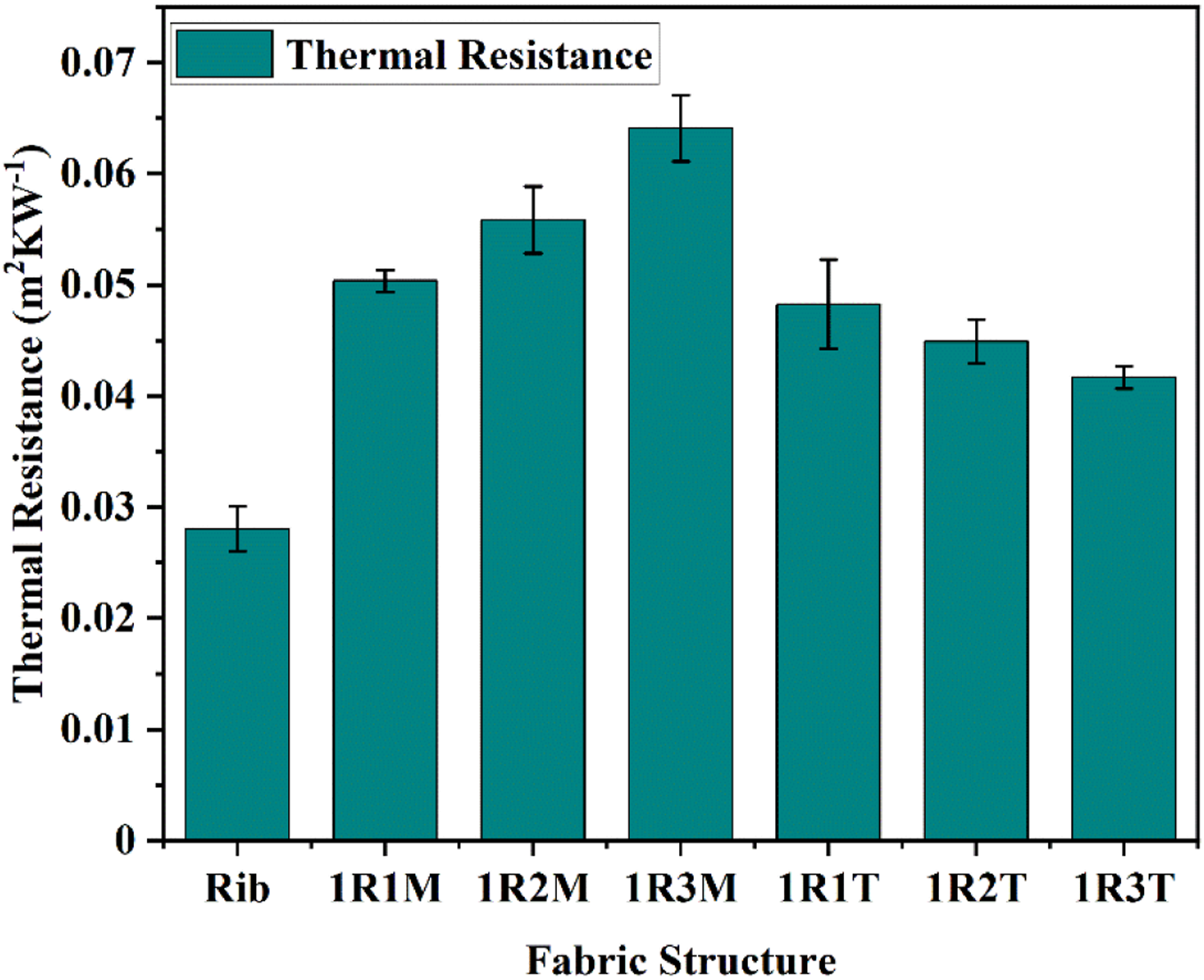
Air permeability
The air permeability and tightness factors of the knitted fabric samples with the varying structure are depicted in Figures 3(a) and (b) Variation of (a) air permeability and (b) tightness factor with the insertion of miss and tuck stitches in rib-knitted structure. Air permeability, porosity, and tightness factor of various rib structures.

Second-degree burn time/protection time
Fabrics were rated by the time required for second-degree burn on the exposed side of the fabric from the Stoll’s curve data. Stoll and Chianta quantified the degree of damage caused by the dermal injury upon thermal irradiation.
37
It is defined by second-degree burn time or the protection time which is obtained from the Stoll’s curve as a point where the experimental curve intersects with the Stoll’s curve as shown in Figure 4. In the current study, TPP is evaluated at two different radiant heat exposure conditions of 40 kW/m2 and 61 kW/m2. The effect of miss and tuck stitches is subsequently analyzed according to their second-degree burn time. Prediction of protection time from Stoll’s curve.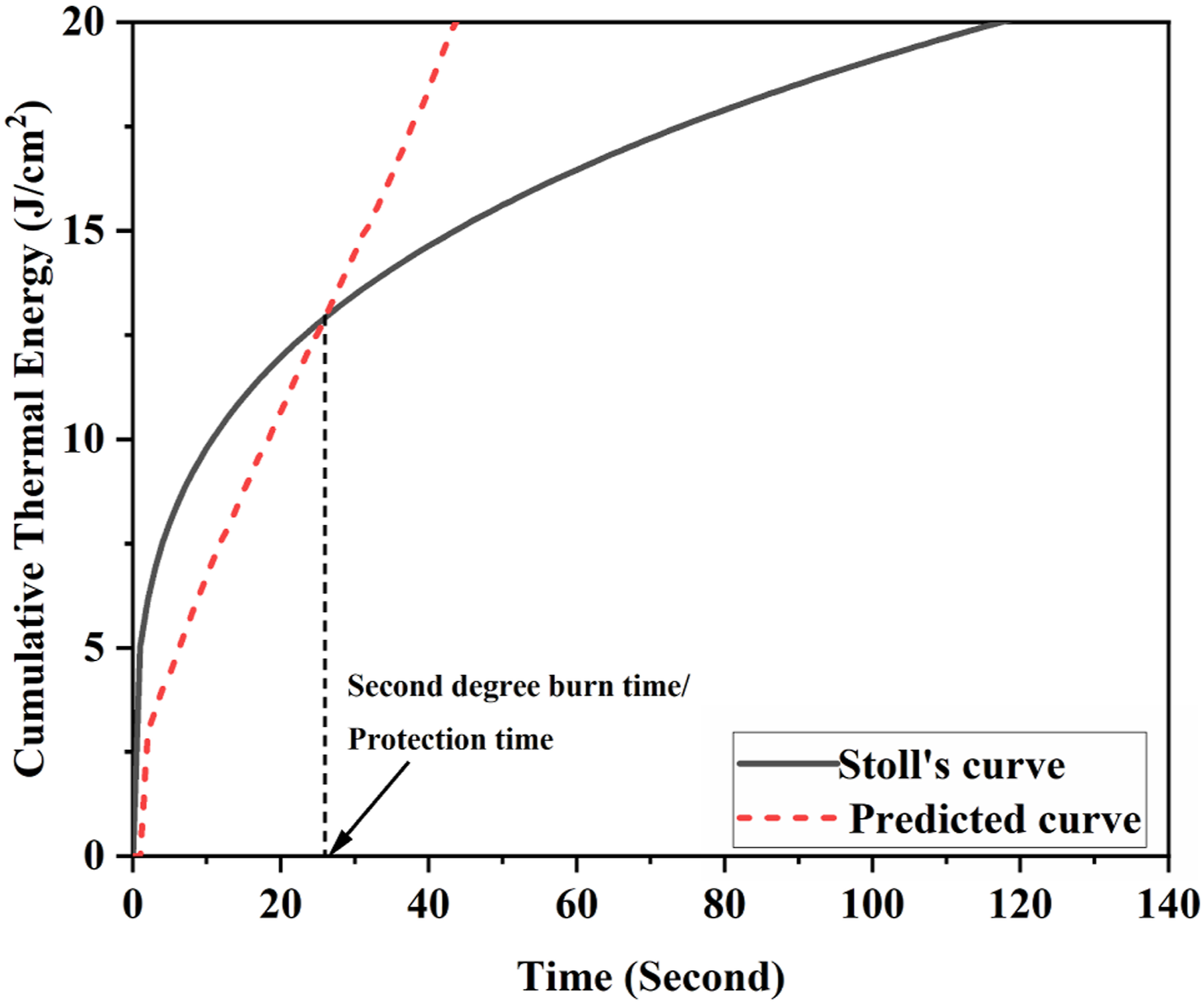
Effect of tuck and miss stitches on second-degree burn time/protection time
Rib structures with three different tuck and miss stitch combinations were analyzed and compared with full rib-knitted structures. Figures 5(a) and (b) depict the influence of tuck- and miss-knitted structure on protection time. Among all these structures, fabric with the maximum number of tuck stitches (1R3T) shows the least protection time at 40 kW/m2 and 61 kW/m2. The rib structure has shown protection time of 13.2 s and 5.15 s for 40 kW/m2 and 61 kW/m2 heat flux, respectively, whereas 1R3T structure has shown 9.3 s and 5.11 s for 40 kW/m2 and 60 kW/m2 exposure, respectively. Protection time of varied rib structures at (a) 40 kW/m2 and (b) 61 kW/m2 radiant heat exposure.
The protection time after insertion of three consecutive miss observed 30.14 s and 6.8 s at 40 kW/m2 and 61 kW/m2 radiant heat flux, respectively, as shown in Figures 5(a) and (b). When miss increases from single to triple miss in rib structure, 66% thermal protection time increased for 40 kW/m2 and 36% increased for 61 kW/m2 radiant heat flux. Kothari et al. 38 reported protection time of three-layered fabric (constructed using woven outer and inner layers, and nonwoven Nomex-based middle layer) in the range 29 s–55 s at 30 kW/m2 heat flux intensity. Udayraj et al. 39 too achieved a very low protection time of 3.6 sec in single-layer satin-weaved fabric at 40 kW/m2. In this study, 1R3M has shown drastic improvement in protection time with single-layered knitted fabric. This is justified by the contraction and expansion behavior of the knitted fabric. When the number of miss stitches replaced the loop stitch from the structure, the absence of a complete loop in a unit area causes the adjacent loops to come closer increasing stitch density and fabric compactness. It has been observed that insertion of a higher number of miss stitches in consecutive courses from 0 to 3 increases the fabric contraction from 20% to 31% (supplementary data). The tightness factor of the miss-knitted structure shows maximum value as compared to the rib- and tuck-knitted structure. Due to the highly packed structure, more amount of radiant heat gets reflected from the surface causing improved protection time.
The TPP of tuck structure observed a considerable decline since on increasing the tuck in rib structure, the legs of the yarn loop open wide, and fabric became loose and width-wise extended (Figure 6). Consequently, the tightness factor for the tuck-knitted structure is low. Thus, radiant heat during exposure is easily passed from the fabric through loop opening and trapped air is less dominated in tuck structure. Inspite of higher thickness and porosity of the tuck structure, it has not shown any improvement in second-degree burn time and TPP. The open and porous configuration of the tuck-knitted structure causes a higher rate of radiant heat flow during testing of the TPP of fabric through the loop opening; hence, protection time reduces. Thermal protective performance of rib-knitted fabric samples with variation of miss and tuck.
Effect of radiant heat flux on second-degree burn time/protection time
The protection time is found to decrease significantly with the increased heat flux intensity. Although the protection time is maximum for the 1R3M structure, however, the decrease is more pronounced in 1R3M, that is, 77.4%. While 1R3T showed less decrement of 45.05% in protection time during testing on more heat flux, that is, 61 kW/m2, there is less distinction in protection time for tuck- and rib-knitted structure, but the lower heat flux 40 kW/m2 showed some difference in protection time for tuck- and rib-knitted fabric. It has been proven numerically in previous studies that the thermal resistance is the deciding factor in medium radiant exposure, while combined effect of porosity, tightness factor, and thermal resistance justify the TPP in high-level radiant exposure.
40
The miss stitches have been inserted on the back bed of the knitting machine during fabric formation creating different fabric appearances on both sides. Consequently, the front side became more compact than the reverse side of the fabric as depicted in Figure 7. During exposure at low radiant heat exposure (40 kW/m2), the compact front face resists the transmission for a longer duration. As the exposure intensity increased to 61 kW/m2, the compact front face failed to restrict heat transmission and the opening of reverse side does not contribute to resisting the exposure. Hence, reduced protection from exposure face and opening on back face cause a higher rate of heat transmission showing low second-degree burn time. The (a) front and (b) back view of rib fabric with miss stitches.
Comparison of woven and knitted fabric thermal protective performance
Sample specification of knitted and woven fabric.


Stoll’s curve comparison for woven and knitted fabric.
Conclusion
Thermal protective performance of different fabric prepared in the literature.

thermal protective performance.
Supplemental Material
sj-pdf-1-jit-10.1177_15280837211042680 – Supplemental Material for Thermal protective performance of single-layer rib-knitted structure and its derivatives under radiant heat flux
Supplemental Material, sj-pdf-1-jit-10.1177_15280837211042680 for Thermal protective performance of single-layer rib-knitted structure and its derivatives under radiant heat flux by Sandeep K Maurya, Viraj Uttamrao Somkuwar, Hema Garg, Apurba Das and Bipin Kumar in Journal of Industrial Textiles
Footnotes
Declaration of conflicting interests
The author(s) declared no potential conflicts of interest with respect to the research, authorship, and/or publication of this article.
Funding
The author(s) disclosed receipt of the following financial support for the research, authorship, and/or publication of this article: The author would like to acknowledge financial support from the Indian Institute of Technology Delhi.

Supplemental Material
Supplemental material for this article is available online.
References
Supplementary Material
Please find the following supplemental material available below.
For Open Access articles published under a Creative Commons License, all supplemental material carries the same license as the article it is associated with.
For non-Open Access articles published, all supplemental material carries a non-exclusive license, and permission requests for re-use of supplemental material or any part of supplemental material shall be sent directly to the copyright owner as specified in the copyright notice associated with the article.
