




Abstract
This study aims to introduce a novel protocol to characterize the thermal protective performance of fabrics used in firefighters’ clothing under hot-water exposure. For this, new and improved test methods were developed to evaluate the performance of a set of fabrics under exposure to hot-water splash and hot-water immersion with compression. The thermal energy transmission through the fabrics tested was thoroughly investigated, and the physical properties that affect the performance of fabrics were statistically identified. It has been found that mainly mass (hot-water) transfer occurs through fabrics in a hot-water splash; whereas, both conductive heat and mass transfer predominate in a hot-water immersion with compression. The compression applied in the exposure of hot-water immersion changes the physical properties of fabrics, thereby reducing fabrics’ performance. The structural configuration and physical properties (e.g., air permeability, thickness) of fabrics are crucial to their heat and mass transfer and therefore to overall fabric performance. This study’s findings may contribute to developing new fabric testing standards, as well as improved thermal protective clothing to provide better occupational safety and health for firefighters.
Keywords
Introduction
As a result of the extensive use of combustible substances in recent years, fire hazards have become more complicated, which has subsequently increased the demand for better safety for firefighters. U.S. fire reports confirm that every year over 30,000 firefighters suffer injuries on the job, and many of them lose their lives while fighting fires, rescuing people, or responding to hazardous material incidents [1]. The best way to mitigate burn injuries and reduce the risk of death from fire hazards is the use of thermal protective clothing by firefighters. The performance of thermal protective clothing varies with the types of thermal exposures faced by firefighters [2]. It has been found that firefighters are often exposed to hot water when the hot-water pipelines burst in structural fire hazards and/or the water in fire extinguishers reaches high temperatures. This hot-water exposure may affect clothing performance and can cause firefighters’ burns and deaths [3].
Recently, a great deal of research has been conducted with the purpose of characterizing the thermal protective performance of fabrics used in firefighters’ clothing under hot-water exposure [3–7]. Lu et al [4]. developed a hot-water splash tester to evaluate the performance of fabrics under hot-water exposure; Mandal et al [5]. also used this tester to evaluate and analyze the performance of fabrics. Results indicated that the air permeability and thickness of a fabric can affect the performance of the fabric [4–6]. Lu et al [7]. also suggested that the temperature and angle of impingement of hot-water splash can significantly influence the performance of fabrics.
Based on the above discussion, previous researchers characterized the thermal protective performance of fabrics used in firefighters’ clothing under the hot-water splash [3–7]. However, these researchers primarily focused on the performance of fabrics that were aligned at an angle of 45°. To date, very little research has been conducted on the performance of fabrics that are aligned at different angles. Furthermore, firefighters’ hot-water exposures are not limited only to the hot-water splash. They often have to kneel or crawl on the ground or floor to extinguish fires and/or rescue fire victims. While performing these activities, their clothing may become compressed and/or immersed in hot water, specifically in the areas around their elbows, knees, and lower legs [8]. This hot-water immersion with compression can cause skin burns on firefighters’ arms–hands and legs–feet; for example, nearly 38% of skin burns occurred on firefighters’ arms–hands and legs–feet from 2007 to 2011 [9–11]. Nevertheless, no research has been performed to characterize the performance of fabrics under the hot-water immersion with compression.
It can be inferred from the preceding paragraph that in order to comprehensively determine the thermal protective performance of fabrics under hot-water exposure, it is necessary to consider both hot-water splash as well as hot-water immersion with compression. Considering this point, the aim of the present study is to introduce a novel protocol to characterize the performance of fabrics under hot-water exposure. To this purpose, new and improved test methods were developed to evaluate the performance of a set of horizontally aligned fabrics (i.e., fabrics aligned at an angle of 180°) under exposures of both a hot-water splash and a hot-water immersion with compression. Subsequently, the performance provided by the fabrics and nature of heat and mass transfer through the fabrics was statistically and theoretically analyzed. This analysis may help build an understanding on the performance of fabrics, which could assist material–textile scientists to develop high-performance thermal protective clothing. This type of clothing can provide improved protection and comfort for firefighters.
Materials and methods
Materials
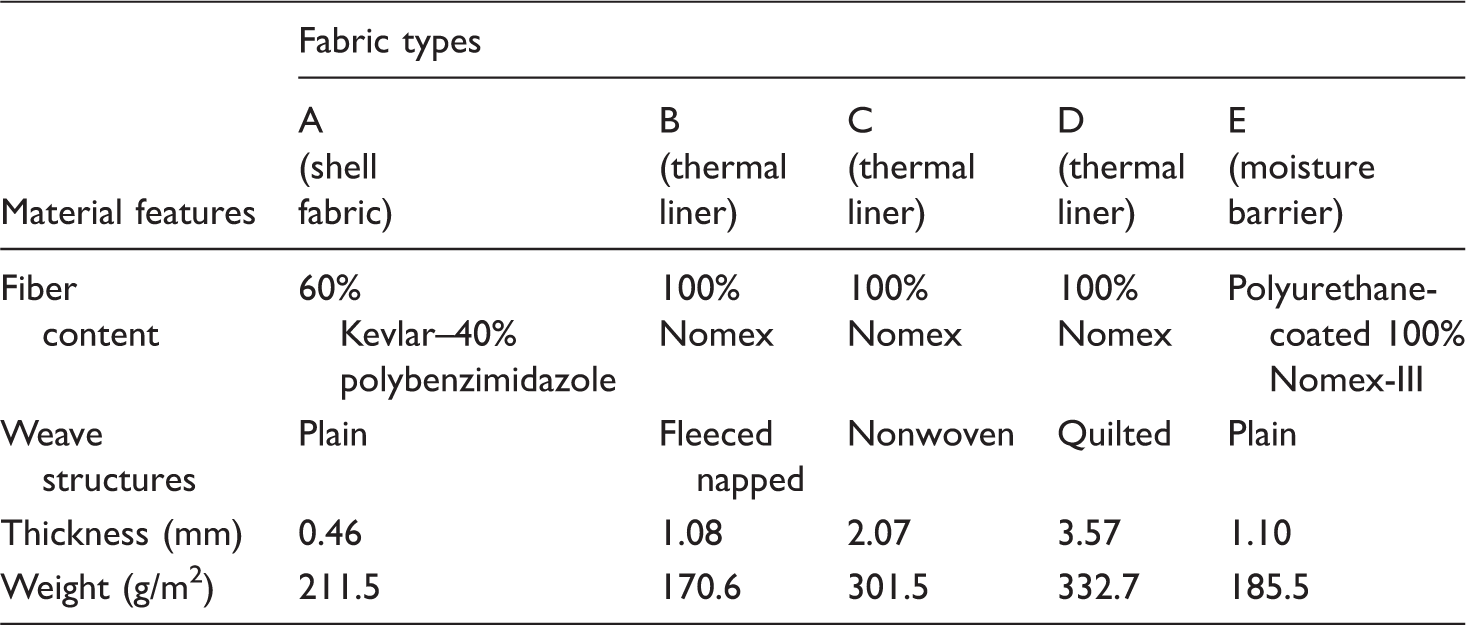
The selected fabric types and their material features.
The configured fabric systems and their physical properties.

Note: OL, outer layer; IL, inner layer; ML, middle layer.
Methods
Three specimens of each configured fabric system were tested under hot-water exposure to evaluate their thermal protective performance. For testing, these specimens were preconditioned for 24 h at 21 ± 1℃, 65 ± 2% relative humidity. Next, these specimens were subjected to 85℃ hot-water splash and hot-water immersion with compression exposure for a duration long enough to generate second-degree burns on wearers’ skin (details are explained in the next two subsections). Here, specimen performance was measured in terms of time required to generate the second-degree burns. The mean deviations of performance values of three specimens of each fabric system, calculated in terms of second-degree burn times, were maintained within the ± 2.5% for further data analysis.
In order to measure the second-degree burn time, the modified ASTM F 1930:2013 standard method was used. In the original ASTM F 1930:2013 standard, the burn percentage on a human body for 20 s of flame exposure (at the heat flux of 84 kW/m2) is evaluated using 100 sensors [16]. However, in the modified ASTM F 1930:2013 standard, the time required to generate a second-degree burn on human skin upon hot-water exposure was measured using a skin simulant sensor. During the hot-water exposure, thermal energy transmitted through the specimen every 0.1 s was processed by the skin simulant sensor. Here, the skin simulant sensor worked according to the skin model (Figure 1). Based on this model, the thermal energy transmitted within the sensor is represented as a transient, one-dimensional heat-diffusion problem in which the temperature within the human skin (epidermis layer) and under the human skin (dermis, subcutaneous layers) varies with skin depth and exposure time [17]. Using the epidermis skin temperature measured from this sensor, the time for a second-degree skin burn was calculated by the Henriques Burn Integral (HBI) equation (presented in equations (1) and (2)) [18,19]. In these equations, Ω = burn injury parameter (dimensionless), P = frequency factor (2.185 × 10124 s−1 at T < 50℃ and 1.823 × 1051 s−1 at T > 50℃), ΔE = activation energy (J/kmol) and R = universal gas constant (8.315 J/kmol K) (i.e., ΔE/R = 93534.9 K at T < 50℃ and ΔE/R = 39109.8 K at T > 50℃), T = temperature (K) at epidermis skin depth of 75 × 10−6 m, and t = time for which T is above 317.15 K (44℃). The time at which Ω reaches a value of 1 in equation (2) is called the “second-degree burn time.”
Skin model.

Mathematical integration of equation (1) yields

Hot-water splash test
The modified ASTM F 2701:2008 test standard was used to evaluate the thermal protective performance of the specimens (30 × 30 cm) under the hot-water splash (Figure 2). In the original ASTM F 2701:2008 standard, hot water can be hand poured on the specimen through a funnel to create a hot-water splash exposure of 10 s [20]. However, this pouring procedure is inefficient and can affect the hot-water flow rate and repeatability of the experiment. Thus, in the modified tester, the funnel was replaced with a small pipe that is directly fed by a circulating hot-water bath via a small pump through a hose and valve system; this modification allows maintaining a consistent quantity of water application at a uniform temperature and flow rate. Furthermore, a skin simulant sensor was used instead of a copper slug sensor (used in the original ASTM F 2701:2008 standard) to measure the performance of specimens. The skin simulant sensor board (made up of nonconductive, liquid- and heat-resistant material) was horizontally aligned and a specimen was horizontally placed on the board. The specimen was cut larger than the size of the sensor board with its ends folded and clamped onto the edges of the board using binders, preventing the hot water from reaching from the specimens’ ends and focusing it toward the sensor. Hot water was prepared at 85℃ in the circulating bath using a temperature control device (Figure 2). The hot water was initially circulated through the circulation valve attached with a flow control valve in order to regulate the water temperature within the pipe at 85℃. Next, the hot water was passed through the water outlet using a tap, and the specimen was continuously exposed to the hot-water splash. The thermal energy transferred through the specimen, at the direct contact point between the hot-water splash and specimen, and was processed at every 0.1 s using the skin simulant sensor. Here, the epidermis skin temperature measured by the sensor was used to calculate the second-degree burn time using the customized HBI software.
Schematic diagram of the hot-water splash tester.
Hot-water immersion with compression test
In order to evaluate the thermal protective performance of the specimens under the hot-water immersion with compression, a new test apparatus was developed in the Protective Clothing and Equipment Research Facility (PCERF) at University of Alberta, Canada (Figure 3). For this, a metal platform with a perforated top surface was positioned at the bottom center of a hot-water bath. Then, water was poured into the bath up to a level 2.25 inches above the perforated top surface, and the temperature of the water was controlled at 85℃ using a temperature control device. Next, a specimen (30.5 × 30.5 cm) attached with a skin simulant sensor (mounted on a cylindrical weight) was immersed into the hot water (85℃) using a pneumatic device to rest the whole assembly (sensor + specimen) horizontally at the center of the perforated surface. Here, the pressure on the compressed (between sensor and perforated surface) specimen was pneumatically controlled at 8.0 psi. During the hot-water immersion with compression exposure, thermal energy transmitted through the compressed specimen was processed at every 0.1 s using the skin simulant sensor. Next, the epidermis skin temperature measured by the sensor was used in the customized HBI software to calculate the time required for a second-degree burn.
Schematic diagram of the hot-water immersion with compression tester.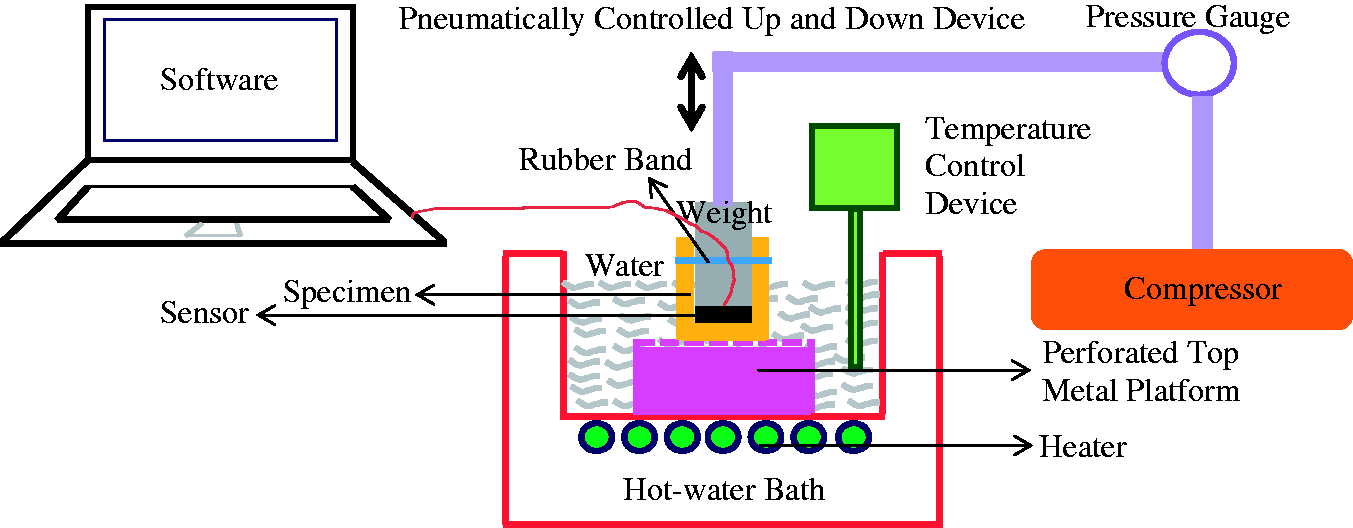
Procedure for data analysis
For data analysis, the physical properties and performance values of the fabric systems obtained from the above tests were normalized between −1 and +1, with an average value set to zero. This normalization process decreases redundancy in the data by pulling out abnormal factors. This normalized data set was further statistically analyzed using the t-test, significance test, and 95% confidence interval test; these tests were carried out using the StatCrunch software (developed by programmers and statisticians led by Webster West of Texas A&M University). The sign of T-stat value (+ or − T-stat value) obtained from the t-test was used to indicate the association between fabric systems’ physical properties and performance. Here, the significance test (at P value < 0.05) was used to identify the key physical properties that affected the performance of fabric systems. Also, the confidence interval (+ or − interval) test was carried out to establish the significant differences in performance of two different types of fabric systems.
Results and discussion
The thermal protective performance of the fabric systems.

Table 3 shows that the performance of fabric systems is significantly lower under hot-water immersion with compression than under hot-water splash (P value = 0.03). In hot-water immersion with compression, a great deal of force acts on fabric systems. This force generally reduces the dead air trapped inside fabric systems, which changes their physical properties. This situation results in enhanced conductive-heat transfer through the fabric systems based on equation (3) and lowers their performance (in equation (3), q = conductive-heat transfer (W), Δ
HF
= temperature difference between the hot metal platform (used in the hot-water immersion with compression tester shown in Figure 3) and a fabric system (K), ΔXH = thickness of the hot metal platform (m), kH = thermal conductivity of the hot metal platform (W/m K), A = contact area between the hot metal platform and fabric system (m2), 1/hHF = thermal contact resistance between the hot metal platform and fabric system depending upon their surface roughness (m2K/W), ΔXF = thickness of the fabric system (m), VA = fabric system’s air volume (m3), VF = fabric system’s volume (m3), kγ = thermal conductivity of the fabric system’s solid fiber phase (W/m K), and kα = thermal conductivity of the fabric system’s gaseous air phase (W/m K)). The added force or compression creates a close contact between the hot metal platform and fabric system; eventually, the thermal contact resistance between the hot metal platform and fabric system reduces, and the performance of the fabric system decreases. Table 3 further shows that double- or triple-layered fabric systems have very close performance results under the hot-water immersion with compression versus the hot-water splash. This is because the conductive-heat transfer through these fabric systems and/or the reduction in the thermal contact resistance between the hot metal platform and these fabric systems is quite similar, due to the same added force during hot-water immersion with compression. Additionally, the performance of triple-layered fabric systems is higher than that of single- and double-layered fabric systems in both exposures. This is probably due to more insulated air layers and dead air trapped inside triple-layered fabric systems, compared to single- and double-layered fabric systems [3,5,21,22].

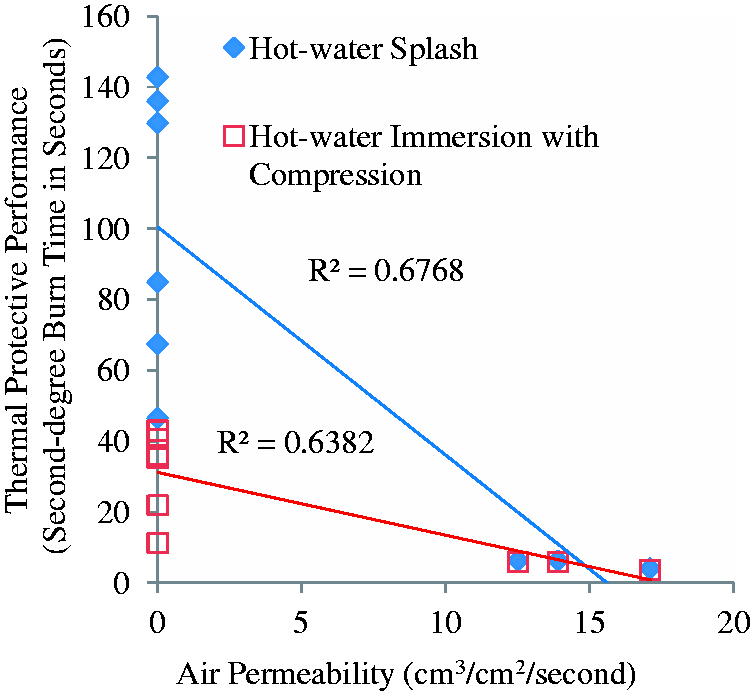
It is also evident from Table 3 that fabric AE (or fabric AEC) and fabric EA (or fabric EAC) have the same physical properties. However, the performance of fabric EA is higher than fabric AE. This is because the moisture barrier present in the OL of fabric EA can immediately stop the mass (hot-water) transfer through the fabric, which results in enhanced performance of fabric EA. Based on the statistical t-test between the fabric systems’ physical properties and performance, it is evident that air permeability has a significant negative relationship with the performance of fabric systems (−T-stat value), whereas, thickness, weight, and thermal resistance have positive relationships with the performance of fabric systems (+T-stat value). A highly air-permeable fabric system allows significant mass transfer through its pores, which can strongly (coefficient of determination (R2) > 0.60) lower the performance of the fabric system by generating quick burns on wearers’ bodies (Figure 4). This phenomena can be explained by Darcy’s law shown in equation (4), where, Q = the total discharge of mass per unit time (m3/s), K = fabric system’s air permeability (m2), A = the cross-sectional area of mass flow (m2), Px = pressure of the mass before passing through the fabric system (Pa), Py = pressure of the mass after passing through the fabric system (Pa), μ = viscosity (Pa s), and L = fabric system’s thickness (m) [3]. Sometimes, this hot-water mass can be absorbed and/or spread within the fabric system depending upon the hygroscopic nature and/or horizontal alignment of the fabric system [23,24], which can also lower the performance of the fabric system. Through confidence interval testing, it is further evident that a significant difference exists between the performance of air-impermeable and air-permeable fabric systems (P value = 0.01), and this difference is positive in 95% cases in favor of air-impermeable fabric systems. Overall, an air-impermeable, weighty, and thick fabric system can trap dead air within its structure [3,5,21]. This trapped dead air can enhance the thermal resistance of the fabric system and improve its performance.
A relationship plot between fabrics’ air permeability and performance.
Conclusions
In order to introduce a new protocol to characterize the thermal protective performance of fabrics used in firefighters’ clothing, this study developed new and improved test methods to conveniently evaluate the performance of a set of fabrics under exposure to hot-water splash and hot-water immersion with compression. Furthermore, the thermal energy transmission through these fabrics is analyzed, and the key physical properties affecting the performance of fabrics are recognized.
It has been found that mass (hot-water) transfer occurs in fabrics exposed to hot-water splash. In contrast, both conductive heat and mass transfer occur in fabrics exposed to hot-water immersion with compression. Consequently, fabrics show lower performance under hot-water immersion with compression. Generally, an air-impermeable, multilayered, weighty, and thick fabric can provide better protection for firefighters depending upon the location of a moisture barrier in the fabric. The presence of a moisture barrier in the OLs of fabrics allows negligible mass transfer, which can enhance their performance. Notably, this moisture barrier should be vapor permeable (e.g., GORE-TEX®) to dissipate the metabolic heat and sweat vapor generated from firefighters’ bodies in order to prevent them from heat stress [3,25,26].
The present study introduces novel protocol to characterize the thermal protective performance of fabrics under hot-water exposure. This protocol can advance the field of fabric testing and can also contribute to develop new clothing for providing better thermal protection and comfort for firefighters. By implementing this protocol in future, a focused systematic study can be carried out on the performance of fabrics, especially under hot-water immersion with compression. As the parameters of this study are limited to a particular water temperature (85℃) and compression (8.0 psi), an extensive parametric study can also be conducted at a range of water temperatures and compression pressures.
Footnotes
Acknowledgements
The authors appreciate the technical support from Mark Ackerman (adjunct professor, Department of Mechanical Engineering, University of Alberta, Canada) and Stephen Paskaluk (research engineer, PCERF, Department of Human Ecology, University of Alberta, Canada).
Authors’ note
Caution should be taken in drawing conclusions about safety benefits from the results. The fabric performance data obtained in this research are from laboratory-simulated hot-water exposures. These data do not represent clothing performance in actual field conditions, where the nature of thermal exposure, clothing condition, and human body response can be complicated and unqualified. We wish to emphasize that it is not our intention to recommend or predict the suitability of any commercial fabric for a particular end use.
Declaration of Conflicting Interests
The author(s) declared no potential conflicts of interest with respect to the research, authorship, and/or publication of this article.
Funding
The author(s) disclosed receipt of the following financial support for the research, authorship, and/or publication of this article: This research was funded by the Natural Sciences and Engineering Research Council of Canada (grant number: RES0008159). Sumit Mandal thanks the University of Alberta, Canada, for providing him the Alberta Innovates Graduate Student Scholarship and Izaak Walton Killam Doctoral Scholarship.