




Abstract
Different factors should be considered for designing fire protective clothing. Constructional parameters, air gap, and proper fibers selection are critical, which need to be investigated thoroughly. In this work, the effect of the number of layers of the thermal liner on the thermal protection properties of thermal protective clothing has been studied. An experiment has been conducted using the three-level three-factor Box-Behnken designing method; factors used are the number of layers of the thermal liner, the areal density of the thermal liner, and intensity of radiant heat flux. Analysis of Variance study has been performed to analyze the significance of the structural and test parameters and their interaction. Second-degree burn time or protection time has been observed to increase with the increase in the areal density of thermal liner and decrease with increased heat flux. As the number of layers increases, protection time also increases. The effect of the number of layers is more prominent at a lower level of heat flux than a higher level of heat flux.
Keywords
Introduction
During firefighting, fire-fighters mainly confront intense heat flux, hot liquid, gases, hot surfaces, and molten metals. Lawson 1 pointed out that fire-fighter protective clothing is mainly developed to provide some degree of protection from the thermal environment created by fire. It is challenging to characterize and define thermal hazards due to the many physical and environmental factors involved. These thermal environmental conditions are mainly classified into routine, hazardous, and emergency classes.2–4 The heat energy can be transmitted from these thermal environments by radiation, conduction, convection, or combined form through the protective garments and absorbed by the wearer’s body. In this process, the wearer’s body temperature and the clothing temperature increase. Absorbed heat results in skin burn. F C Henriques Jr and A R Moritz 5 studied burn injuries and divided them into four categories: first degree, second degree, third degree, and fourth-degree burn, depending upon the depth of the damage. An excessive amount of studies has been performed to predict the time taken for the occurrence of different degrees of skin burn.6–9
Protective clothing for proximity and structural firefighting consists of three layers: The outer layer or outer shell, the middle layer or moisture barrier, and an inner layer or thermal liner. The outer shell mainly restricts the heat hazard and wear; the moisture barrier is developed to shield the wearer from the vapor, water, and hot oil. The thermal liner acts as a thermal barrier to restrict heat flow through the thermal liner. EN 469:2005 10 stated the necessities of fire protective clothing, describing the minimum properties of fire-fighter protective clothing for all European countries. These requirements are heat transfer by radiation and flame, limited flame spread, the residual strength of the fabric, dimension change after exposure to heat, heat resistance of the fabrics, and penetration of liquids. The outer shell is mainly a woven fabric made of meta or para-aramid and or a blend of another heat-resistant fiber with rip-stop or twill fabric construction.11–14 Moisture barriers can be developed by woven or nonwoven fabric laminated or coated with chemicals like polyvinyl chloride, neoprene, polyurethane, or woven or nonwoven fabrics bonded with membrane to develop a moisture barrier.11,15,16 Reischl and Stransky 17 found that polytetrafluoroethylene (PTFE) breathable membranes allow moisture vapor to penetrate the membrane but do not transmit external water toward the wearer’s body. The thermal liner is mainly a nonwoven fabric of heat-resistant fiber produced by needle punch or spunlace technique. 12
The constructional parameters of the woven outer shell fabric and the nonwoven thermal liner are the most affecting features on the protection value of heat-protective clothing. The most critical parameters of woven shell fabric that affect the thermal protective performance are yarn twist, type of composite yarn, fabric thickness, cover, and crimp of the fabric. The factors which influence the thermal insulation properties of the nonwoven inner layer are porosity, fiber denier, mean pore size, areal density, thickness, etc. The fibers used to produce woven and nonwoven fabric should be flame retardant or heat-resistant and should not melt, trickle, ignite, or form char when heated. Various studies have been done to characterize fire and heat-protective clothing; some early works have been done by Singleton, Krasny, and Pettengil, 18 Barker and Lee, 19 Barker and Shalev. 20 In their work, Krasny et al. 21 evaluated single layer and multi-layer fabric of different fibers and design construction and reported the effect of areal density and thickness of the fabrics. Lee and Barker 19 tested the thermal protective performance (TPP) of woven, nonwoven, and knitted fabric made of PBI, aramid, FR viscose and blend with areal density ranging from 140 to 300 g/m2 by high-intensity exposure to the convective and radiant heat source. They found that nonwoven fabrics give better protection than other constructions because of higher air volume.
Dead air or still air gap is an essential factor for the thermal protection performance of a cloth. The dead air gap can be added to a clothing system by adding layers into the clothing system. Various studies investigated the effect of air gaps between layers in a multilayered clothing system.14,22–25
Ming Fu, Wenguo Weng, and Hongyong Yuan 22 studied the effect of multiple air gaps presented in multi-layer fire-fighter clothing on its thermal condition. They found that the protective performance of the clothing system decreases if there is no air gap and the time to get burn injury increase with the increase in air gap size. Hualing He, Zhi-Cai Yu, and Guowen Song 23 studied the TPP of wild fire-fighter clothing. They found that TPP is highly affected by air gap between layers of multi-layer fabric and moisture present in the fabric. They found that the air gaps had a positive effect on the TPP rating of the multi-layer fabric. Hualing He and Zhicai Yu 24 investigated the effect of air gap on thermal resistance and evaporative resistance of fire-fighter clothing. They found that the presence of air gap in multi-layer fabric system decreased heat and water vapor transfer abilities under normal wear. These studies indicate that the air gap greatly influences the TPP rating of multi-layer protective clothing.
The thermal protective performance of a fabric also depends on its areal density. R M Perkins 26 found from his work that the amount of total heat transferred through a fabric inversely related to its weight. Itzhak Shalev and Roger L Barker 20 observed that the heaviest fabric from their used samples gave the highest thermal protection.
However, very few studies have been accomplished on a thermal liner with different layers and areal density used in a multi-layer thermal protective clothing system. This study aims to investigate the effect of areal density, number of layers, and intensity of radiant heat flux on TPP of an inner layer that is thermal liner in a multi-layer clothing system. The regression analysis has been performed to analyze the relationship between areal density and the number of layers of a thermal liner with its protection time at different heat flux.
Materials and methods
Materials
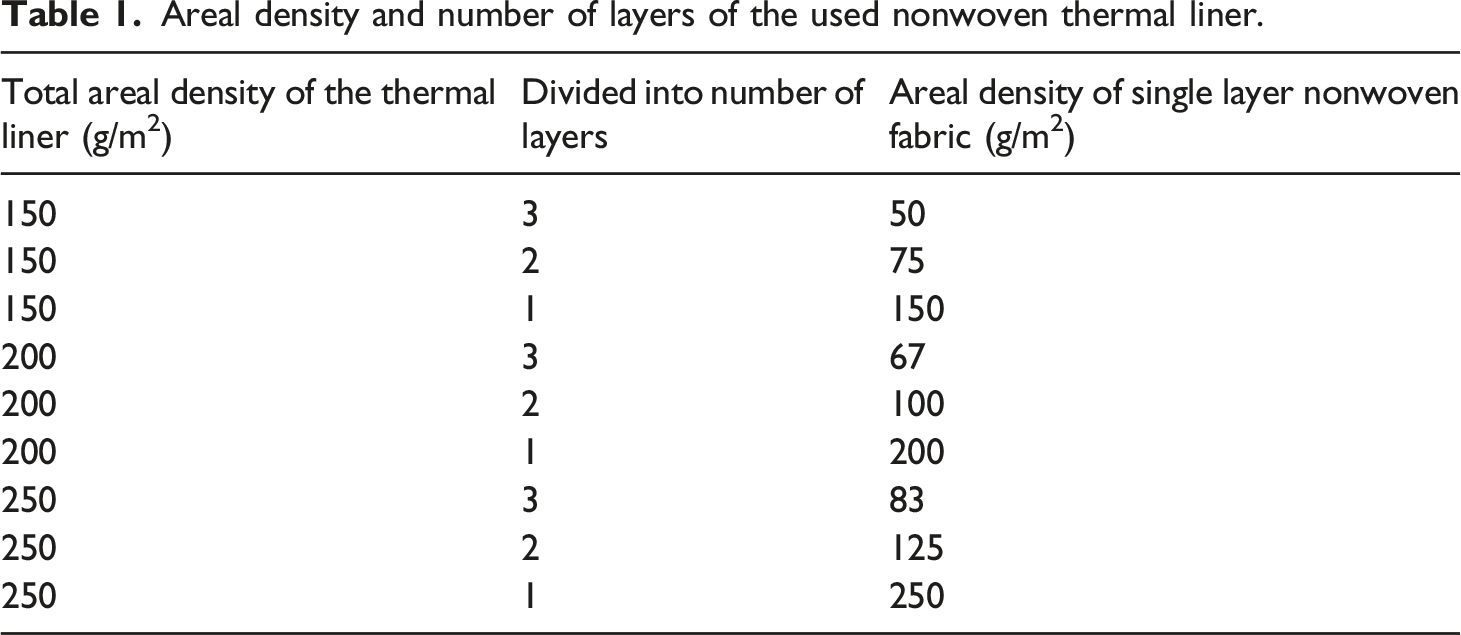
Extreme heat-protective clothing contains three layers: outer shell, moisture barrier, and thermal barrier. In this study, a multi-layer fabric system has been selected, with outer shell fabric, moisture barrier, and an inner layer or thermal liner. The thermal liner is divided into one, two, and three layers, and the areal density is also varied in this study. The same outer shell and moisture barrier have been used for every sample. A schematic presentation of the multi-layer fabric system has been shown in Figure 1, and Figure 2 represents the different components of the multilayered sample. A Nomex plain-woven fabric procured from industry with 14 ends per cm, nine picks per cm, and an areal density of 155 g/m2 has been used for the outer layer. Bi-component PTFE membrane with an areal density of 40 g/m2 has been used as a moisture barrier between the outer shell and the inner layer. Nomex IIIA fiber of 1.5 denier and 38 mm lengthy has been utilized to develop needle punch nonwoven samples as a thermal barrier. Nomex IIIA is a blend of 93% Nomex (meta-aramid), 5% Kevlar (para-aramid), and P14 (antistatic) fibers developed by DuPont highly used as fire-resistant fibers because aramid fibers have very high glass transition temperature (275°C) and degradation temperature (480°C) with high LOI (28–31%).27,28 Schematic diagram of test samples. Components of multilayered test samples. (a) outer layer, (b) moisture barrier, (c) thermal liner, (d) sample with single layer thermal liner, (e) sample with two-layer thermal liner, (f) sample with three layer thermal liner.

Areal density and number of layers of the used nonwoven thermal liner.
Methods
Experimental method



Selected parameters and their levels for Box-Behnken experiments.
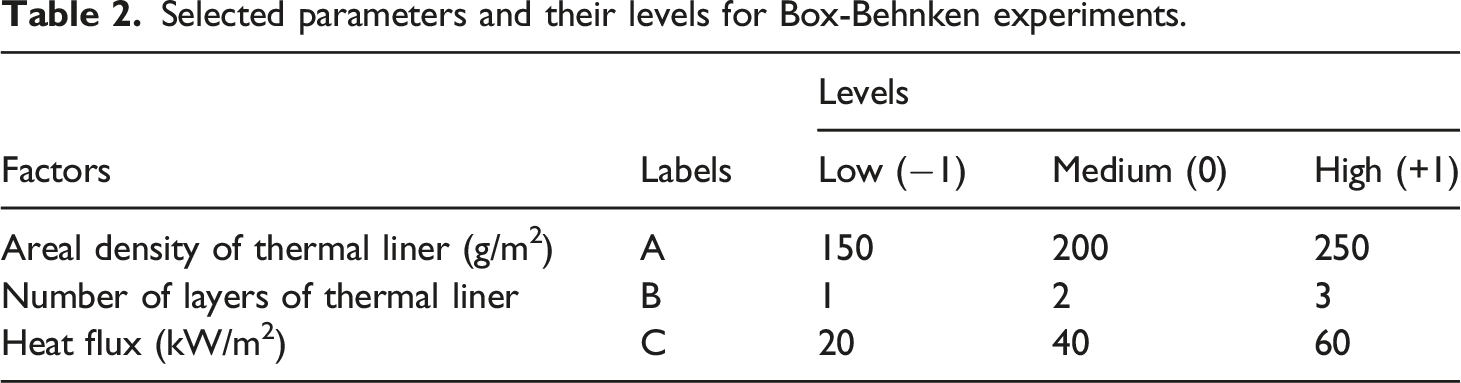

Plan of experimental runs.

Testing methods
The samples were tested for radiative heat-protective performance. The device employed to test the fabrics was developed following the ASTM F 1939 (2008) standard principles. The samples were exposed to a heat flux produced by a heating lamp. A copper calorimeter detected the temperature of the opposite side of the fabric. A thin film RTD sensor was coupled at the backside of the calorimeter, which sent the temperature data through an ADAM processer to a computer that stored the temperature value. This software can note the signal from the thin film sensor. The schematic presentation of the instrument is given in Figure 3. Schematic representation of the testing instrument.
When the cumulative heat flux curve for a sample intersects the Stoll Curve is considered the response value for the incident heat flux and named protection time or second-degree burn time. Figure 4 illustrates the interaction of cumulative heat flux curve for the first three samples and Stoll curve and their relative second degree burn time. Stoll and Chianta proposed an empirical equation based on their experimental data: Cumulative heat flux = 5.0204 × t0.2901 (t = time in seconds). From this equation, the Stoll curve can be generated. Heat flux (in kW/m2) generated on the testing device was evaluated by the following formula Stoll curve with result of first three samples.

SDLATLAS thickness gauge is used to determine the thickness of every sample at 20 gf/cm2 pressure. From the thickness value, bulk density of thermal liner is determined by the following formula
From the bulk density, the porosity of the inner layer is calculated from the following formula
Air permeability of the thermal liners was tested by Paramount air permeability master at 98 Pa pressure difference across the fabric.
The thermal resistance of the thermal liner at 30°C was determined by KES-F7-II Thermolabo tester from the following formula

Results and discussion
Basic properties of thermal liner.

Figure 5 shows the relation between porosity and number of layers, areal density. The figure shows that porosity decreases with an increase in areal density at a constant punch density. As areal density increases, the fiber content also increases, resulting in a decrease in porosity. On the contrary, as the layers increase, the porosity value also increases. This may be due to the increase in number of layers the areal density of single layer of the thermal liner decreases, which results lower fiber content in single layer and higher porosity of fabrics. Figure 6 shows the air permeability values of the thermal liner. The graph reveals that the air permeability value increases with the increase in the number of layers and decrease in areal density. This may be because as the layer increases in the multilayered thermal liner where the final areal density remains the same, the individual layer’s areal density decreases. This results in lowering the fiber content in the individual layers. At a given punch density and needle penetration, if the fiber content is less in a needle punch nonwoven fabric, the entanglement between the fibers will also be less, which provides free paths for air penetration through the fabric, hence the air permeability increases. As the areal density of the thermal liner increases, the fiber content and the entanglement between the fibers also increase, resulting in a reduction in accessible paths for air penetration and air permeability. Figure 7 indicates the thermal resistance values of the thermal liners. The figure demonstrates that thermal resistance increases with increase in number of layers and areal density of the thermal liner. This may be due to with increase in areal density; subsequently the fiber content and the thickness of the fabric increase. This reduces the heat flow through the fabrics, hence the thermal resistance increases. With the increase in number of layers, additional air gaps incorporate between individual layers of the thermal liner. For single layer fabric, the heat conduction in fiber content and air content of the fabric will occur in parallel. Then the thermal conductivity of the nonwoven fabric will be like thermal conductivity of a porous media and follow the following formula
29
Porosity value as a function of number of layers. Air permeability as a function of number of layers. Thermal resistance value as a function of number of layers.


Equations (10) and (11) indicate single layer fabric possesses higher thermal conductivity than multilayered fabric. Layered fabrics also have higher thickness than single layer fabric; due to these reasons, the thermal resistance increases with an increase in number of layers. The same trend can be found in the work of Mary Ann Morris 30 and Helen H Epps. 31
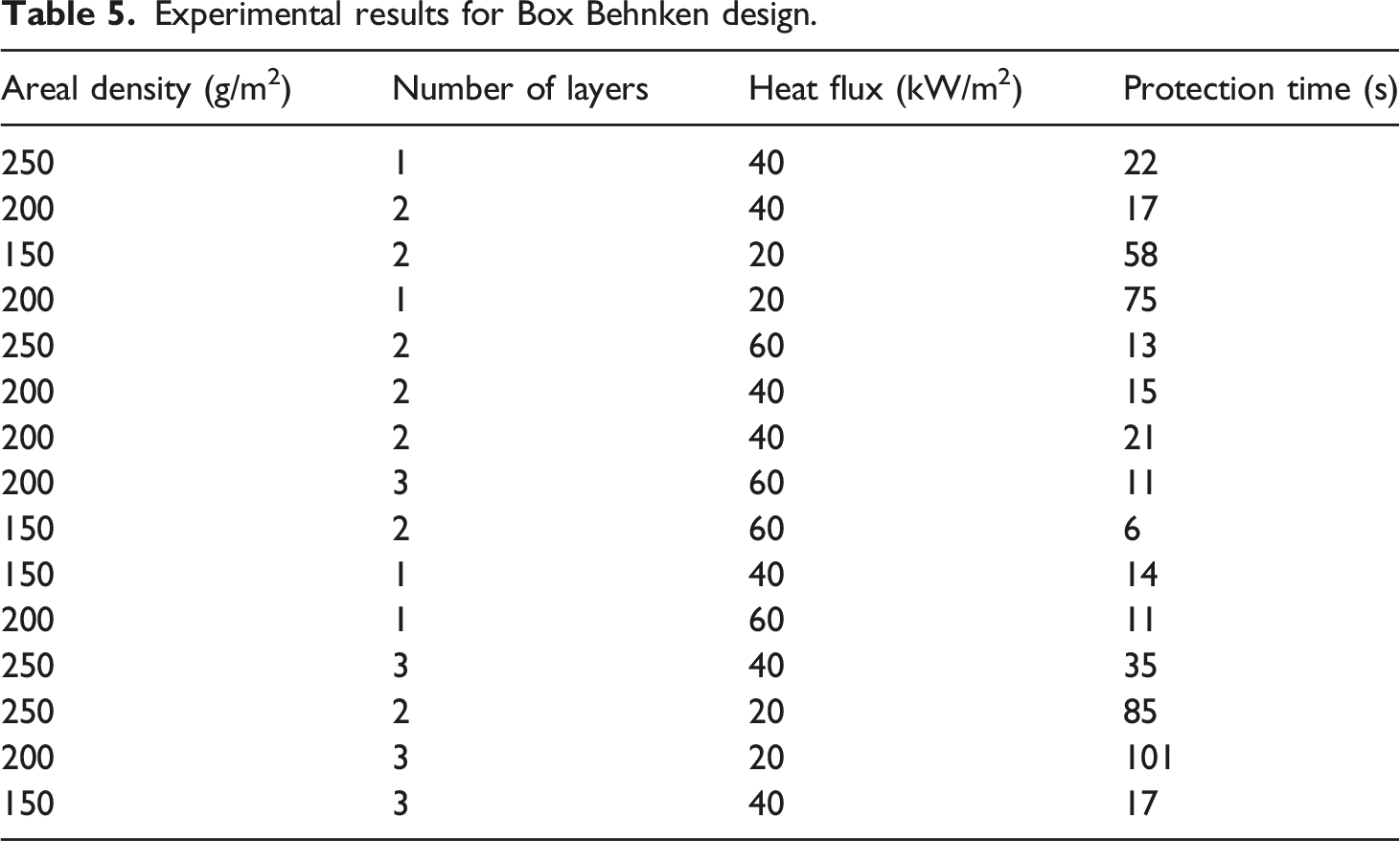
Experimental results for Box Behnken design.

ANOVA table of protection time.

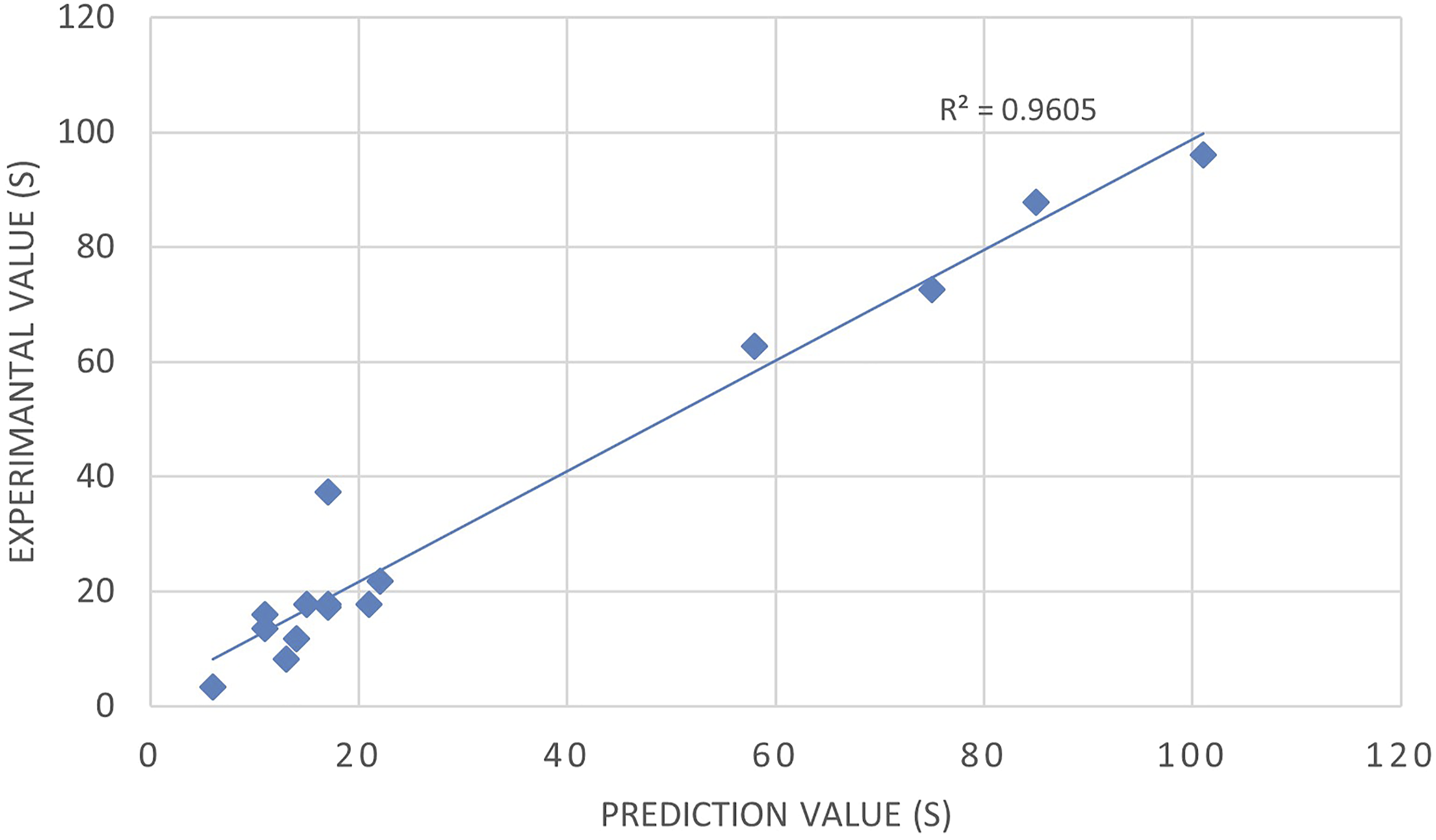
Plot of experimental second-degree burn time and predicted second-degree burn time results.
The second-degree burn time for the different samples has been observed to increase from the lowest 6 s to the highest∼101 s. Carbonaceous chars were created at every level of heat flux on the outer layer of Nomex woven fabric. At 60 kW/m2 heat flux, the carbonaceous char formation is very rapid, along with fabric shrinkage and emission of gases. A regression equation represented the model, where the high value of the coefficient of determination of 0.97 and a very low p value of .0003 (<.05) indicates the goodness of fit of the model. From this model, it can be observed that A (areal density), B (number of the layer), C (heat flux), and C2 are the significant parameters, as the p-values are less than 0.05 which indicates than 95% significance. On the contrary, two-factor interaction and quadratic parameters except C2 do not significantly affect the protection time.
Effect of areal density and heat flux on protection time
The combined effect of areal density and heat flux when the number of layers value is constant (medium level) has been presented in Figure 9. It can be observed at the lower level of heat flux; protection time increases with the increase in areal density (58–85). This may be because a higher areal density fabric contains more fibers than a lower one, which can reflect and absorb more incident radiant heat as radiant heat transmits by electromagnetic wave.
13
From Table 4, it can be seen that fabric with higher areal density has higher thermal resistance; for this reason, conductive heat transfer is also less in higher areal density fabric. Therefore, it takes more time to get second-degree burn wound on the wearer’s body. At the higher level of heat flux, the protection time also increased (6–13), but the increase rate is meager than at lower heat flux. In this case, we can hypothesize that a huge amount of heat energy incidents on the outer layer of the clothing system and transmits through the fabric assembly at high heat flux. This results in a rapid second degree burn at the wearer’s body which reduces the protection time than low heat flux condition. The same trend can be seen in the study done by Udayraj et al.
32
At the lower level of areal density, as the heat flux increases, the protection time decreases (58–6). At the higher level of areal density, as the heat flux increases, the protection time also decreases (85–13). This may be because as the heat flux increases, more amount of heat energy transports from the outer shell to the inner layer rapidly and the wearer’s body gets burned,
26
hence the protection time decreases. Effect of areal density and heat flux on protection time.
Effect of areal density and number of layers on protection time
The combined effect of areal density and the number of layers of the thermal liner at a constant heat flux (medium level) has been shown in Figure 10. At the lower level of number of layers with the increase in areal density, the protection time increases (14–22). This can be attributed to the higher amount of fiber present in the higher areal density fabric, which absorbs and reflects the radiant heat wave and reduce the amount of heat penetrating through the fabric. With the increase in areal density, thermal resistance of the fabric also increases which results less amount of conductive heat move towards the wearer body. This allows more time to get burned. At the higher level of numbers of layers, the protection time also increases (17–35) with increased areal density. This can be occurred due to the exact reason for the lower level of number of layer. For both levels of number of layers, there is an increasing trend in protection time with an increase in areal density. But the amount of protection time increases 57% and 105% for lower level of number of layers and higher level of number of layers, respectively; hence the higher level of number of layers provides better result. This can be ascribed, at higher level of number layers, there are two additional air gaps present between the thermal liner, whether there is no air gap between thermal liner at lower level of number of layer. These additional air gaps provide more insulation with the increase of areal density. For this reason, the increase in protection time with the increase in areal density is more at higher level of number of layer.
33
At the higher level of areal density, with an increase in number of layers the protection time increases (22–35). This may be because of as the number of layers increase the thermal resistance of the fabric also increases, which reduce the heat flow and improve the thermal protective performance. Same kind of trend can be seen in the work of Wilk E, Swaczyna P, Witczak E, et al.
34
At the lower level of areal density, with the increase in number of layers, protection time also increases (14–17) but not as prominent as the higher areal density fabric. This may be due to the reduction of fiber content in lower areal density fabric; more amount of radiant heat energy transmits through the fabric than the higher areal density because of less fiber content absorbs or reflects less amount of radiant heat. The effect of number of layers is not prominent at two-layer thermal liner but the effect can be visible at three-layer thermal liner fabric. This may be the effect of porosity. In Figure 5, it can be observed that the porosity curve makes a dip in two-layer fabric. As the porosity value is low for two-layer thermal liner, the protection time value is also less. Effect of number of layers and areal density on protection time.
Effect of heat flux and number of layers on protection time
The combined effect of heat flux and number of layers at a constant areal density of the inner layer (medium level) has been shown in Figure 11. At the low heat flux, the protection time increases with the increase in number of layers (75–101). This can be attributed to the amount of dead air trapped between the layers which increases with the increase in number of layers. This increment in amount of dead air results higher thermal insulation of the multilayered fabric and improved thermal protective performance of the fabric system.
34
In case of one-layer thermal liner, there is no air gap between thermal liner, but air gaps are present between the outer shell and moisture barrier, the moisture barrier and thermal liner, and the thermal liner and the wearer’s skin. These air gaps provide insulation to the fabric along with the air gaps created when the thermal liner is divided into layers. At a higher level of heat flux, the protection time remains the same (11) with the increase in number of layers. In this case, we can hypothesize that at a higher level of heat flux, the temperature of the fabric highly increased, thus consequences in the increase in heat transmission by radiation and conduction between adjacent layers of the fabric and the natural convection and the radiation between the neighboring layer of the fabric and the air gaps.
33
At higher level of number of layers, with the increase in heat flux the protection time decreases (101–11). This may be because as the heat flux increases, more amount of heat energy is transmitted from the outer layer to the inner layer, which causes second-degree burn in the wearer’s body very fast.
26
At lower level of number of the layer, the protection time also decreases (75–11) with the increase in heat flux. This is due to a high amount of radiant heat transmission through the fabric assembly. Effect of number of layers and heat flux on protection time.
Conclusion
Box-Behnken experiment has been completed to analyze the effect of the areal density of the inner layer, the number of layers of the thermal liner, and heat flux on time (protection time) when the cumulative heat flux at the sensor intersects the Stoll curve. A regression model equation signifying the correlation between independent variables (areal density of inner layer, number of layers of inner layers, and applied heat flux) and the dependent variable (time) has been obtained. It has been observed that protection time decreases with increased heat flux at all areal densities and number of layers. The effect of areal density and number of layers is highly prominent at lower value of heat flux. As heat flux increased, the dependency of protection time on number of layers and areal density decreased. This may be due to changes in fabric properties at higher heat flux as it forms carbonaceous chars and shrinks occur very quickly. This study mainly focused on the correlation between protection time of multi-layer clothing and areal density and number of layer of the clothing. Along with the protection time, another comfort property such as evaporation resistance presents an important parameter determining the transmission of evaporated water vapor through the multi-layer clothing system, thus causing the body cooling of the clothing wearer. A detailed additional study is required to investigate the effect of number of layers and areal density of multi-layer clothing systems on this important thermophysiological property of the analyzed clothing.
Footnotes
Declaration of conflicting interests
The author(s) declared no potential conflicts of interest with respect to the research, authorship, and/or publication of this article.
Funding
The author(s) disclosed receipt of the following financial support for the research, authorship, and/or publication of this article: This work was supported by the Defence Research and Development Organisation (DRDO), Ministry of defence, Govt. of India (Project code- RP03456).
