



Abstract
The increasing use of wireless communication technologies has led to increasing electromagnetic pollution and the development of effective shielding materials. Knitted fabrics offer a flexible, lightweight, and cost-effective solution for electromagnetic shielding applications. This study investigated the electromagnetic shielding effectiveness (EMSE), reflection, and absorption of hybrid knitted fabrics, such as 1 × 1 rib knit, single piqué knit, full cardigan rib knit, and Milano rib knit fabrics integrated with copper conductor wire in the X-band frequency range. The measurements were made using a through, reflect, and line (TRL) calibrated waveguide measurement system. The results show that different fabric structures distinctly affect the shielding performance at various frequency ranges. The findings indicate that knitted fabric structures can be optimised for specific frequency bands and provide an effective and adaptable shielding solution. Due to their lightweight, breathable, and stretchable nature, these fabrics are suitable for wearable electronic systems, such as smart clothing, health monitoring devices, and electromagnetic protective garments. Additionally, their cost-effectiveness and ease of integration make them advantageous for indoor electromagnetic shielding solutions, including shielded enclosures, curtains, or wall linings used in medical facilities, military communication centers, and sensitive laboratory environments. In the automotive and aerospace sectors, these fabrics can also be applied to cabin insulation materials to reduce electromagnetic interference that affects navigation or communication systems. Their tunable shielding properties across the X-band frequency range further enhance their adaptability in environments where frequency-selective shielding is critical.
Keywords
Introduction
The rapid development of technology has increased our quality of life and significantly increased the intensity of electromagnetic fields. Due to the use of wireless communication systems such as smartphones, Wi-Fi networks, base stations, and radio and television transmitters, electromagnetic waves surround us every moment of the day. 1 This electromagnetic pollution poses an invisible threat to the environment and potentially affects human health. In particular, the impact of long-term and intense exposure on the nervous system, sleep patterns, and cellular structures is being discussed and researched in the scientific world. 2
Various materials are employed to block or attenuate incident electromagnetic radiation to mitigate these effects. Metals are traditionally preferred for electromagnetic shielding due to their high electrical conductivity and strong reflection capabilities. They are commonly used in sheets, meshes, foams, or integrated into textiles.3 –6 However, metal-based shielding materials often have limitations such as rigidity, high density, corrosion susceptibility, and processing difficulties. 7
Textile materials utilize various materials to provide effective EMSE protection while preserving flexibility, durability, and comfort. These materials generally fall into three categories: metal-based, polymer-based, and carbon-based composites, each offering distinct advantages and application potentials. Metal-based features are the most used for EMSE due to their high cellular conductivity. Silver (Ag), Copper (Cu), Nickel (Ni), and Zinc/Zinc Oxide (Zn/ZnO) are commonly used materials in this category. 8 Silver stands out with its highest electrical conductivity among other conductive metals. The tarnishing of silver over time can form a semiconducting layer on the surface. Copper has an electrical conductivity similar to silver but is more economical and easier to handle during production. 9 Nickel is an important metal material due to its highly conductive structure, magnetic permeability, ductility, and resistance to oxidation/chemical agents. The main advantage of these metals is their ability to reflect and absorb electromagnetic waves due to their high electrical conductivity. 10 Polymer-based materials and carbon-based materials are also widely used in EMSE textiles. Polymer-based materials are generally lightweight and flexible. They are easy to process, corrosion-resistant, and have low thermal expansion. 11 The main advantages of these materials are that they are lighter, more flexible, and easier to process than traditional metal shielding materials. Conductive polymers are attractive due to their high conductivity-to-weight ratio and tunable properties. However, disadvantages include difficulties such as uniform distribution and dense loading of fillers. In addition, some conductive polymer-coated textiles may have disadvantages such as low solvent solubility, sustainability issues, and non-reproducibility. 12 Carbon-based materials (such as graphene sheets, carbon fibers, carbon black, and nanotubes) have unique properties such as strong chemical stability, mechanical strength, superior electrical conductivity, large surface area, lightweight, low density, and environmental friendliness.13,14 Carbon fiber offers low density, exceptional chemical/thermal stability, flexibility, corrosion resistance, and mechanical strength. Carbon black is low-cost, chemically stable, and has increased conductivity and antistatic properties. Graphene is notable for its flexibility, chemical/thermal stability, high conductivity, and surface area. 15 Disadvantages of carbon-based materials include difficulties such as poor dispersion of carbon nanotubes in the matrix and insufficient bonding of carbon fiber to the matrix. 16
Coating techniques play a vital role in further enhancing the EMSE of textiles. One of the most critical factors determining the performance of EMSE shielding textiles is that the effect can be increased by coating methods and incorporating the materials used into the weave. Coating methods have advantages and limitations and require selection according to the application area. 17 While the dip coating method is widely preferred due to its simplicity and low cost, conductivity and shielding efficiency can be increased in multilayer applications; however, achieving the desired performance in a single layer may be difficult. 18 Electroless coating stands out because it can form a homogeneous, highly conductive metal layer, even on complex surfaces. Still, it is costly due to the use of chemicals and processing time. 19 The in situ polymerization method provides lightweight and flexible structures, enabling conductive polymers to be synthesized directly on the textile. Still, the reaction conditions are difficult to control and take a long time. 20 Spray coating is advantageous in controlling layer thickness and creating multiple layers, and can work with low-viscosity solutions; however, surface roughness plays a critical role in uniform coating. 18 Screen printing is suitable for industrial-scale use due to its speed and repeatability, but thick coatings can reduce flexibility. Inkjet printing effectively creates high-resolution, thin, and controlled layers but is prone to technical problems such as nozzle clogging and droplet spreading. 21 Among all methods, electroless coating achieves the highest EMSE values. In contrast, in situ polymerization and immersion methods provide flexibility, lightness, and low-cost advantages. As a result, the most suitable method should be selected by considering the targeted shielding performance, application environment, and cost-effectiveness balance.
Research in this field has shown that different material compositions and structural designs effectively achieve various performance levels from recent studies in X-band, graphene fiber (GF) textiles obtained by directly weaving high conductivity GF roving exhibits outstanding EMSE of over 90 dB and over 120 dB in two layers due to its high electrical conductivity of 8.5 × 10⁵ S/m. 15 Superhydrophobic electronic fabric (NPMMSP) material obtained by coating transition metal carbide or nitride (MXene) and multi-walled carbon nanotubes (MWNTs) on a polydopamine (PDA) layer has a good EMSE of 47 dB. 22 Flexible conductive composite textile (CCT) modified with Ag nanoparticles (AgNPs) formed on the weft-mesh structure via in situ chemical Ag deposition exhibited outstanding stretchable EMSE performance of over 80.1 dB in the unstretched state and 56.2 dB at 100% strain, demonstrating its shielding potential in flexible devices. 23 Conductive cotton fabric (AgCF) decorated with in situ reduced AgNPs achieved a high EMSE of 102.32 dB at the X-band and 107.62 dB at the K-band (18–27 GHz frequency range). The multifunctional polypyrrole-modified cotton fabric (MFPP)/carbon fabric (CC) composite of magnetic MXene/magnetite (Fe3O4)/poly(3,4-ethylenedioxythiophene) (PEDOT): poly(styrene sulfonate) (PSS) coated CC exhibited a remarkable EMSE performance of 86.19 dB with only 0.465 mm thickness. 24 Hierarchical polypyrrole nanotubes (PNTs)/ Polydimethylsiloxane (PDMS) structures constructed by in situ polymerization and surface coating on cotton fabric reported SET values of 28.2 dB at 0.5 mm thickness. 10 Natural fiber-based materials, such as woven ramie fiber with electroless nickel-phosphorus (NiP)/graphene (Gr) coating, also showed total EMSE values up to 51 dB EMSE values can vary depending on the application area. 25 For general or less sensitive applications, a shielding level of 20 dB and above is generally considered sufficient, or commercially acceptable.10,26 However, for more demanding applications such as wearable devices, health monitoring systems or protection of other sensitive electronics, textile materials that exhibit EMSE well above 50 dB and even above 100 dB are being developed.23,27 As the complexity of the textile structure increases, the EMSE value increases, and production costs increase accordingly. This high performance is usually achieved by optimizing the material’s conductivity, its thickness, coating technique, and layered structure or by adding conductive and/or magnetic fillers.10,23,28
Knitted fabrics, frequently used in the textile and fashion industries, offer a range of structural and functional advantages such as elasticity, softness, and breathability. 29 Among these, 1 × 1 rib knit, single piqué knit, full cardigan rib knit, and Milano rib knit fabrics are prominent for their unique properties. Rib-based knitted structures, such as 1 × 1 rib and full cardigan rib, are highly elastic and suitable for stretch-demanding applications, 30 while single piqué knit fabrics offer breathability and texture. 31 Full cardigan rib knit fabrics provide thermal insulation and comfort, 32 whereas Milano rib knit fabrics deliver a denser, more structured form ideal for formalwear.33,34 These fabric types affect wearability and influence the arrangement and integration of conductive elements, thereby impacting EMSE performance.
The X-band frequency ranges from 8 to 12 GHz and is widely used in radar, satellite communications, and wireless networking due to its balance between resolution and penetration capabilities. Its advantages include high data transfer rates, relatively low interference, and the ability to support compact antenna designs, making it suitable for applications requiring precise signal control. For wearable technology operating in the X-band, electromagnetic shielding is critical to prevent interference from external signals and to minimize radiation exposure to the user. Effective shielding ensures device reliability, protects sensitive electronics, and maintains signal integrity, essential for wearable devices’ safe and efficient operation in this frequency range.35,36
Developing new materials and structures to provide high-frequency electromagnetic shielding and a cost-effective solution for advanced electronic applications, communication technologies, and security systems is necessary. This study produced easy-to-produce and low-cost traditional hybrid 1 × 1 rib knit, single piqué knit, full cardigan rib knit, and Milano rib knit fabrics by adding copper conductive wire with a high conductivity value. The hybrid knitted fabrics produced were aimed to be an alternative, cost-effective solution for high-frequency applications used in X-band frequencies. EMSE values for hybrid fabrics were measured in a waveguide measurement system operating at X-band frequencies. The waveguide measurement setup was calibrated using the TRL calibration technique to obtain accurate results. In addition to the easy-to-produce and cost-effective nature of the study, the effect of hybrid knitted fabric structures on EMSE values with similar fabric parameters (copper content, cotton yarn count, hybrid yarn thickness, course density, wale density, fabric thickness, fabric weight, and stitch length) in X-band was measured and analyzed experimentally.
Materials and method
Shielding mechanism
Electromagnetic protection is a method used to protect against the harmful effects of incident electromagnetic waves or to prevent the electromagnetic waves generated by the device from spreading into the environment. The protection material prevents the passage of electromagnetic waves by absorbing or reflecting their energy. The main reason for reflection is that the material and free space impedance differ. The electromagnetic wave passes through the material by creating surface currents and converting them into heat energy; this phenomenon is called absorption.
The total reflection coefficient of the electromagnetic wave incident on the material surface and the total transmission coefficient exiting the material can be explained using the multiple reflection theory. High-frequency measurements cannot be made directly, so a network analyzer is used. This device’s measurements can be taken as S-parameters depending on frequency. The electromagnetic shielding effectiveness parameters used in this study are derived from fundamental electromagnetic wave interaction theory using scattering parameters (S-parameters). These formulations are applicable to all material systems and are independent of the specific nature of the material, including textiles. S11 represents the reflection coefficient, indicating the portion of incident electromagnetic waves reflected at the material interface, while S21 represents the transmission coefficient, corresponding to the transmitted wave through the material. The squared magnitudes of these parameters are directly related to reflected and transmitted power, respectively. The total reflection coefficients and transmission coefficients can be explained using the multiple reflection theory. 37 The first interface medium reflects a part of the incident electromagnetic wave and transmits the other part of the incident electromagnetic wave. The last interface reflects and transmits some of the waves transmitted from the first interface. This phenomenon continues until it disappears inside the material. An illustration of this phenomenon is given in Figure 1.

Multiple reflection theory.
The absorption of the material from the incident electromagnetic wave is expressed by (A) and its reflection by (R). With the S-parameters obtained from the measurement system established with the network analyzer, R and A can be calculated as in equations (1) and (2).38 –40


As in equation (3), the electromagnetic shielding material equation is calculated as the sum of the absorption (A) and reflection (R) in dB. Based on these parameters, the reflection loss, absorption loss, and total shielding effectiveness are calculated by energy conservation, accounting for the distribution of incident electromagnetic power into reflected, absorbed, and transmitted components.

Knitting and structural features of hybrid fabrics
Knitted fabric is a textile made of interlocking stitches of yarn, which gives it a unique stretchiness and flexibility compared to woven fabrics. It is produced using hand or machine knitting, with the two primary types being weft knitting and warp knitting. The production process involves interconnecting stitches, creating elasticity, and softening the texture. The advantages of knitted fabrics include comfort, breathability, and their ability to stretch, making them ideal for activewear, casual wear, and baby clothing. However, they also have drawbacks, such as losing shape over time, less durability than woven fabrics, and vulnerability to snagging and pilling.30,41
In this study, the term ‘knit–purl structure’ is used to describe rib-based weft-knitted fabrics formed by the alternating arrangement of knit and purl loops on opposite needle beds. This loop configuration is a characteristic feature of conventional rib and rib-derivative structures, including 1 × 1 rib, full cardigan rib, and Milano rib fabrics. Such structures differ from plain weft-knitted fabrics by their three-dimensional loop geometry, increased thickness, and enhanced elasticity, which directly influence conductive pathway continuity and electromagnetic wave interaction within the textile.
The hybrid fabric structure was created by preparing cotton yarn and 50 µm thick copper wire with a conductivity value (σr) of 5.8 × 10⁷ S/m and a magnetic permeability (µr) of 1. The 50 µm thick copper wire with high conductivity can be easily shaped and does not break during knitting. The 50 μm diameter copper wire is coated with a thin polymer insulation layer, which prevents oxidation and improves durability without significantly affecting electromagnetic shielding performance. Therefore, there is no oxidation during washing, irritation, or damage to human skin during wearing. Previous studies investigated the effects of different conductive materials and wale density changes on EMSE on a hybrid 1 × 1 rib knit fabric structure.40,42 As a result of the analyses, it was determined that copper wire material was the most suitable solution in terms of both performance and cost. Since the best EMSE value was obtained with the wale density 12.5, hybrid single piqué knit, full cardigan rib knit, and Milano rib knit fabrics were also produced in line with these parameters. This selection was an important criterion for providing effective shielding and cost-optimization. Fabric samples were fabricated with minimum dimensions of 10.16 × 22.86 mm, strictly adhering to the cross-sectional requirements of the waveguide measurement setup to ensure precise alignment and data accuracy. The hybrid yarn does not have a wrapped or core-spun structure; instead, the copper wire and cotton yarn are mechanically combined during the knitting process. The hybrid knitted fabrics were produced using two flatbed knitting machines: the Falcon CKM-01-S and the Passap Duomatic 80. The knitted fabrics were produced using E5 and E7 English gage flat knitting machines, where the gage defines the needle spacing of the machine. The Falcon CKM-01-S is a semi-automatic flat knitting machine with a gage of 5 needles per inch (E5), suitable for thicker yarns and coarse knits. The Passap Duomatic 80 is a double-bed domestic knitting machine with a gage of 7 needles per inch (E7), enabling the production of denser and more refined fabric structures such as Milano rib knit fabrics and full cardigan rib knit fabrics. These machines allow precise stitch formation and consistent integration of copper wire into the fabric structure without damaging the wire or affecting its conductivity. The knitting machine parameters were adjusted to produce balanced knitted structures, resulting in similar wale and course densities under relaxed fabric conditions. In this way, knitted fabrics were produced. The parameters presented in Table 1 were determined using standardized textile characterization and gravimetric measurement methods. The copper content (%) was calculated based on the mass ratio of the copper wire to the total mass of the hybrid yarn, measured using a precision analytical balance. The number of cotton yarns corresponds to the number of cotton yarn ends fed together with the copper wire during knitting and was directly controlled by the yarn feeding system of the knitting machine. The thickness of the hybrid yarn was measured using a digital micrometer by averaging multiple measurements taken along the yarn length under slight compression. The fabric thickness was determined according to standard textile thickness measurement procedures by taking three independent measurements at different locations on each fabric sample and calculating the mean value. Fabric weight was measured as grams per square meter (g/m2) using a precision balance, based on the mass and known area of each fabric specimen. Fabric thickness and fabric weight values presented in Table 1, therefore, represent mean values obtained from repeated measurements. The associated measurement variability was quantified using standard deviation; the standard deviation for fabric thickness measurements was within ±0.05 mm, while for fabric weight measurements, it did not exceed ±5 g/m2 across all fabric types. The wale density and course density were determined by counting the number of wales and courses per unit length (expressed per 1/10 cm) using an optical magnifier. The wale density was experimentally measured on relaxed fabric samples by counting the number of wales per unit length. For knitted structures containing tuck stitches, including single piqué knit and full cardigan rib knit, the stitch length was defined as the average yarn length consumed per stitch. The stitch length was controlled by the knitting machine settings and verified by measuring the yarn length consumed per stitch. All measurements were conducted under laboratory ambient conditions, and the reported values represent mean values obtained from repeated measurements.
Fabric properties.

In knitted structures, the stitch length represents the total yarn length consumed in forming one loop. Since copper wire is integrated into the hybrid yarn, stitch length directly determines the amount of conductive material incorporated into the fabric. As the stitch length increases, the copper wire content per unit area also increases, leading to higher fabric weight and greater potential for electromagnetic shielding. For instance, 1 × 1 rib knit fabric with a stitch length of 4.7 mm contains relatively shorter conductive stitches compared to Milano rib knit fabric with a stitch length of 6.0 mm, which incorporates the highest copper length per stitch. This variation explains the differences in both fabric density and shielding performance, as longer conductive paths enhance wave interaction and internal dissipation mechanisms. Therefore, stitch length is a decisive structural factor that correlates with copper distribution in the fabric and significantly contributes to the electromagnetic shielding effectiveness.
The appearance of the hybrid 1 × 1 rib knit, single piqué knit, full cardigan rib knit, and Milano rib knit fabrics produced as cotton/copper and the image of the copper wire on the cotton fabric are given in Figure 2.

Hybrid 1 × 1 rib knit (a), hybrid single piqué knit (b), hybrid full cardigan rib knit (c), and hybrid Milano rib knit (d) fabrics.
Measurement setup
It is not possible to make direct measurements at high frequency. Therefore, a measurement system must be established based on transmission line theory, including electric and magnetic fields. A network analyzer (Agilent E5071C) measurement system, two coaxial cables, and two WR90 waveguide adapters were established for X band (8.2–12.4 GHz) EMSE measurement. The measurement setup is given in Figure 3.

Experimental measurement setup. 40
Calibration must be performed for the measurement setup to measure with high accuracy, including waveguide adapters. The most preferred and three-stage TRL calibration43,44 was performed for two-port measurement, and its stages are shown in Figure 4. In the first stage, the waveguides are connected at the through section, and measurements are taken. In the next stage, the waveguides are closed with a metal plate in order, and reflection measurements are taken. In the last stage, the center frequency nλ/4 long transmission line is added between the waveguides and the line measurement is completed. After the calibration process, the S11 value was around −50 dB, and the S21 value was around 0 dB.
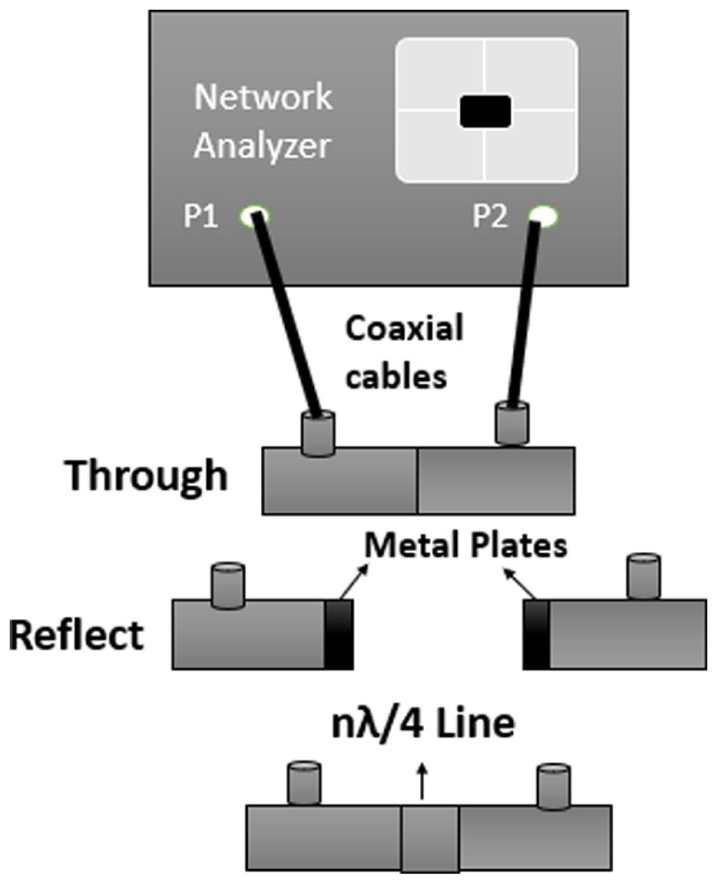
TRL calibration.
The accuracy rate was less than 0.01% when calculated using the reflection coefficient on a linear scale to determine the accuracy rate as a percentage error. All experiments were repeated three times and analyzed statistically. The mean and standard deviation (SD) of reflection, absorption, and EMSE values were calculated. Statistical analysis was performed using one-way analysis of variance (ANOVA) to compare EMSE values among different knitted fabric structures. Data normality was verified prior to the analysis to ensure the applicability of parametric statistical testing. The significance level was set at p < 0.05. 1 × 1 rib knit and Milano rib knit fabrics showed notably higher total shielding effectiveness compared to single piqué knit fabrics, consistent with structural differences affecting wave interaction mechanisms. All physical and electromagnetic measurements were conducted at least three times for each fabric sample, and the reported values represent mean values. Measurement uncertainty was quantified using the standard deviation, which was calculated from repeated measurements and considered in the statistical analysis. Statistical analysis data are given in Table 2.
Statistical analysis.

Results and discussion
Prior to physical and electromagnetic characterization, all knitted fabric samples were allowed to reach a relaxed state through dry relaxation. Then, the S-parameters from the experimental setup and the hybrid knitted fabrics’ reflection, absorption, and EMSE at X-band frequencies were calculated in dB. Prior to physical and electromagnetic characterization, all knitted fabric samples were allowed to reach a relaxed state through dry relaxation. The reflection value of hybrid 1 × 1 rib knit, single piqué knit, full cardigan rib knit, and Milano rib knit fabrics was found in dB depending on the frequency, as seen in Figure 5. The results are given between 8.2 and 12.4 GHz to show the EMSE values for different fabric types depending on the frequency.

The measurement result of the reflection.
The reflection values of hybrid fabrics exhibit moderate variation across the 8.2–12.4 GHz range, indicating that while reflection contributes to overall shielding, it is not the dominant mechanism. This suggests its stitch structure provides a more pronounced impedance mismatch at the material-air boundary. In contrast, the single piqué knit fabric maintains relatively low and stable reflection, particularly after 10 GHz, implying a smoother surface interface or better impedance matching. Full cardigan rib knit and Milano rib knit fabrics show reflection peaks around 10 GHz, possibly due to their more complex or denser knit architecture, causing localized wave bouncing. This is attributed to its alternating knit-purl stitch arrangement, which creates more abrupt changes in surface topology and impedance mismatch at the air-fabric interface. This behaviour can be attributed to the alternating knit–purl stitch arrangement, which introduces periodic variations in surface geometry and local conductive pathways. Such variations lead to non-uniform electromagnetic boundary conditions and localized impedance mismatches at the air–fabric interface, enhancing wave reflection and scattering. Moreover, the three-dimensional loop architecture increases the effective interaction path of the incident electromagnetic waves within the fabric, facilitating multiple internal reflections and improved energy dissipation through absorption mechanisms. Together, these effects contribute to the enhanced shielding behaviour observed in knit–purl-based structures. In contrast, the hybrid single piqué knit fabric, with a more continuous and porous surface geometry, demonstrated the lowest reflection. The smoother transition between air and fabric reduces abrupt impedance changes, allowing more electromagnetic wave penetration and lower reflected energy. The absorption results of hybrid fabrics in the 8.2–12.4 GHz range are given in Figure 6.

The measurement result of the absorption.
Absorption varies markedly by the structure of hybrid knitted fabrics. The 1 × 1 rib knit fabric achieves maximum absorption between 8.2 and 9.0 GHz, corresponding to its more open stitch structure, facilitating deeper penetration and internal dissipation of electromagnetic energy. With its thicker and heavier structure, the full cardigan rib knit fabric shows peak absorption between 9.5 and 10.5 GHz, benefiting from longer wave interaction paths. The Milano rib knit fabric, characterized by dense and less porous knitting, reaches high absorption between 12.0 and 12.2 GHz, indicating its suitability for high-frequency shielding. Interestingly, single piqué knit fabric maintains a moderately stable but lower absorption across the band, hinting at limited wave entrapment and lower internal scattering. The EMSE results of hybrid fabrics in the 8.2–12.4 GHz range are given in Figure 7.

The measurement result of EMSE.
The total EMSE is determined by the combined contributions of reflection and absorption, with the results indicating that absorption plays the dominant role, as evidenced by its strong correlation with the absorption curves. Each fabric exhibits a distinct peak EMSE within specific frequency bands, corresponding to its structural characteristics. The 1 × 1 rib knit fabric achieves a maximum EMSE of approximately 20.06 dB in the 8.2–8.6 GHz range, making it particularly suitable for lower X-band applications. Meanwhile, the single piqué knit fabric demonstrates optimal performance with an EMSE of around 19.8 dB at 9.6–9.8 GHz, rendering it effective for mid-band shielding. The full cardigan rib knit fabric, with a peak EMSE of 19.9 dB within the 9.8–10.2 GHz range, proves advantageous for upper-mid frequency applications. In contrast, the Milano rib knit fabric shows markedly shielding performance at higher frequencies, reaching an EMSE of 20.0 dB in the 12.0–12.2 GHz band, thus making it ideal for high-frequency environments such as radar or satellite systems. These findings underscore the importance of fabric structure in electromagnetic shielding, suggesting that material selection can be strategically tailored to match the intended operational frequency range. Maximum EMSE frequency ranges for hybrid knitted fabrics are given in Table 3.
Frequency ranges of maximum EMSE for hybrid knitted fabrics.
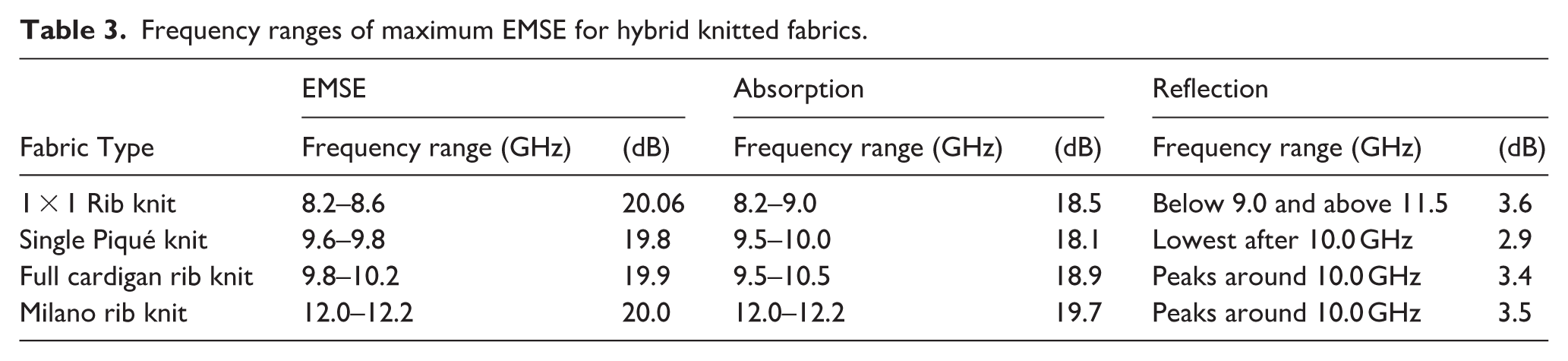
The 1 × 1 rib knit fabric may be more efficient for general consumer electronics or Wi-Fi shielding, whereas Milano rib knit fabric is better suited for advanced high-frequency applications. The interaction of the incident electromagnetic wave with the selected production parameters and the shaping of the conductive copper wire knitted fabric structure according to multiple reflections explain the absorption ratio in the total EMSE. Although absorption dominates the EMSE performance, increasing the reflection component may enhance the overall EMSE value. This can be achieved by increasing the thickness of the conductive copper within the textile structure; however, this would reduce flexibility and may, therefore, be more suitable for curtains or protective applications rather than wearable structures. In wearable textile applications, reflection can be increased by designing multilayered or sliding textile structures. According to the EMSE classification, values between 10 and 20 dB are acceptable for general use in classifying materials. 45 When knitted fabrics are examined, it is seen that they do not cover the entire band but can be used between certain frequencies. Knitted fabric structures can also be considered, and a choice can be made according to the application frequency. It will be a cost-effective solution while preserving the characteristics of the textile structure.
Comparison with recent literature
The findings of the present study are largely consistent with recent literature emphasizing the decisive role of knitted fabric structure on EMSE.38,46 Previous studies have reported that complex knitted architectures, such as Milano and interlock structures, exhibit higher EMSE compared to simpler rib and plain knit configurations, which is primarily attributed to loop geometry and the reduction of surface porosity.47,48
Sirková et al. 49 demonstrated that weft-knitted structures composed of a single continuous conductive yarn tend to form parallel conductive pathways, resulting in lower EMSE and pronounced anisotropy when compared to the orthogonal grid-like conductive networks typically observed in woven fabrics. The results of the present study align with reports indicating that increased porosity facilitates electromagnetic wave penetration, thereby adversely affecting EMSE. However, Tezel et al. highlighted that single piqué structures can exhibit higher EMSE than plain knits containing higher metallic content, attributing this behaviour to the ability of tuck and miss stitches to narrow the gaps between conductive pathways. This observation supports the notion that structural configuration can be more influential than conductive material content alone.46,49
From a mechanistic perspective, although reflection mechanisms generally dominate metal-based shielding materials, 16 the method by which conductive wires are incorporated into the textile structure can fundamentally alter the balance between reflection and absorption. Arabuli et al. 34 reported that simultaneous feeding of conductive wires with cotton yarn increases volumetric density and reduces porosity, thereby promoting absorption-dominated shielding behaviour, deviating from the theoretical response of purely reflective parallel conductive paths. Furthermore, the additional tuck and float yarns present in Milano rib structures have been reported to introduce extra reflection sites, enhancing impedance mismatch and contributing to improved shielding stability.38,40
The strain-dependent sensitivity of SE observed in the present study is also consistent with the findings of Palanisamy et al., 50 who reported that increased contact points under tensile deformation result in a reduction of electrical resistance, leading to a near-linear improvement in EMSE. Overall, these results reinforce the growing consensus that, in knitted electromagnetic shielding textiles, loop-geometry-controlled void distribution and conductive pathway continuity play a more critical role than material conductivity alone.40,49
Conclusion
By integrating high-conductivity copper wires into their structure, this study investigated the EMSE of hybrid 1 × 1 rib knit, single piqué knit, full cardigan rib knit, and Milano rib knit fabrics. All samples were produced using controlled and standardized textile parameters, including yarn count, copper content, stitch density, machine gage, and knitting settings. They were measured across the X-band frequency range (8.2–12.4 GHz) using a TRL-calibrated waveguide setup to ensure high measurement precision.
The experimental findings demonstrate that fabric structure is pivotal in the EMSE performance. Each knitted fabric exhibited maximum shielding efficiency at distinct frequency intervals within the X-band. Specifically, 1 × 1 rib knit fabric provided optimal shielding at lower frequencies, while Milano rib knit fabric was most effective at higher frequencies. These differences can be attributed to the variation in stitch geometry, density, and internal porosity, which influence how electromagnetic waves are absorbed and reflected within the fabric. Notably, absorption was identified as the dominant shielding mechanism in all cases, underscoring the importance of internal dissipation paths in knitted structures.
Despite achieving moderate shielding levels of approximately 20 dB, these fabrics offer notable advantages in flexibility, breathability, and cost-effectiveness, facilitating their integration into wearable and functional systems. Their performance levels are sufficient for general-purpose EM shielding applications, particularly where lightweight and conformable materials are required. Depending on the target frequency range, fabric selection can be customized; for example, 1 × 1 rib knit fabrics can be used for consumer electronics and Wi-Fi shielding, and Milano rib knit fabric can be used for radar or satellite communication systems operating at higher frequencies.
Moreover, the results emphasize that hybrid textile structures can be tailored as frequency-selective shielding materials, making them ideal for tunable and adaptive applications. This opens pathways for use in wearable electronics, health-monitoring textiles, interior shielding panels, and lightweight enclosures in medical, defense, and aerospace sectors. Their scalable production using conventional knitting techniques also enhances their industrial viability.
Future work could explore strategies to enhance EMSE performance, such as multilayer fabric assemblies, incorporating magnetic fillers, or combining advanced coating techniques without compromising textile comfort or flexibility. In addition, although key knitting parameters such as yarn count, copper content, and stitch densities were kept constant to isolate the effect of fabric type, other intrinsic structural characteristics, such as porosity, cover factor, and tortuosity, were not quantitatively measured in this study. These microstructural features influence electromagnetic wave absorption and internal scattering behaviour, particularly in porous and stitched textile architectures. Therefore, future investigations should include measuring and analyzing these parameters to enable a deeper physical understanding of how textile geometry governs EMSE performance across frequency ranges. Additionally, studies may investigate long-term durability, mechanical stability, and user safety for wearable applications.
In conclusion, this research highlights the viability of cost-effective, structure-dependent hybrid knitted fabrics as promising candidates for next-generation electromagnetic shielding solutions, particularly in the expanding field of smart and functional textiles. Structural features, such as stitch shape and fabric porosity, substantially influence reflection and absorption mechanisms. Statistical analysis demonstrated that the observed variations are statistically meaningful. Including schematic diagrams and key physical parameters has strengthened the understanding of structure–property relationships in knitted shielding textiles. These insights are valuable for tailoring fabric designs to application-specific electromagnetic shielding needs.
