




Abstract
A mathematical model for objective evaluation of hand value of car seat fabrics was developed using a step-wise block regression method. The subjective assessment of fabrics was conducted by a panel of judges to identify the primary hand attributes and the related mechanical parameters playing an important role in the fabric hand evaluation. The primary attributes selected by judges were conformability, smoothness, softness and stretchability. The coefficient of concordance was determined to find out the agreement among the judges. From consumer point of view, conformability got the highest weightage in the survey. There is an excellent correlation between the subjective and objective primary hand values. The correlation between the subjective and the objective total hand values found to be very high (R > 0.9) both with and without stretchability parameter.
Keywords
Introduction
With the advancement in technologies, new designs and products, the consumers have become more conscious about their comfort and therefore, while entering inside the car, the first assessment they perform is touching and sensing the car seat fabrics. Nowadays seat comfort is one of the most essential factors for car passengers and also, the most important part of the car interior because it is the first interface between customer and car. Comfort is very essential as people spend more time in cars for business, domestic, social and leisure activities. Many a times, the car seat fabrics are rejected on the basis of the feel and the mechanical comfort. The most widely used material in car seat coverings is the polyester fiber. The fabric structures used are woven, weft knitted, and warp knitted fabrics etc. [1]. Automotive textiles are growing in the same phase as the increase of the global vehicle production and the weightage of the comfort and safety is increasing gradually [2,3] with the demand of the new vehicle concepts.
Car seat fabric has various functions such as comfort, decorative, functional and safety. With gradual improvement in vehicle models and increased emphasis on luxury and comfort, the seat cover markets has witnessed uptrend in the market [4,5]. The desired characteristics are durability, ultra-violet fade, wear resistance, water-proofing, flexibility and stretchability along with smoothness and softness of the fabric. Car seats must fulfil multiplicity of demands like aesthetic appeal, rigorous mechanical properties for durability and offer protection to passengers. At the same time, car seats should also be comfortable [6]. This comfort must include both the mechanical support that the seat gives to the human body as well as good climatic conditions, which are paramount for a driver’s performance [7]. Climatic comfort means good thermoregulation, which can balance the body’s energy and offer good microclimate around the human skin [8].
In one of the research work, the texture of car seats was studied and it was investigated that how the covering fabrics were influenced by the physical properties by using sensory test and objective measurement and analysed the physical properties of covering fabrics by using principle component analysis and developed objective evaluation equation for predicting texture images of covering fabrics by multiple regression analysis [9]. In another research, the performance of car seat fabrics was investigated in terms of their compression and recovery properties and physiological comfort of sitting [10]. Slater defined comfort as pleasant state of psychological, physiological, neurophysiological and physical harmony between environment and human being [11]. Automotive textiles must satisfy very strong requirements for security, safety and comfort. Its security and comfort were studied by automobile manufacturers, seat makers, fabric producers, and textile research centres and universities [12].
The quality and characteristics of fabrics were estimated by the hand, which was the subjective judgement of the fabrics for a long time. Kawabata et al. [13–17] was successful in developing objective hand evaluation for men’s suiting fabrics around 1972. Objective evaluation of fabric hand allows the scientific understanding of the fabric properties as well as quality quantitatively in a single digit. They carried out subjective evaluation by a group of professional judges and then transferred this subjective evaluation into objective evaluation by precisely measuring fabric parameters using a set of equipment which measure low stress mechanical properties of the fabric. After its success in men’s suiting, this method became widespread and applied in wide range of other fabrics like shirting, ladies dress materials [18], futon cloth [19], terry fabrics [20], disposable diapers top sheet [21], blankets [22], performance of bed linen fabrics [23] etc. Kawabata et al. developed a series of hand equations for different fabrics and end uses. These hand equations cannot be applied for the automotive textile as they are specific to normal apparel fabrics and the kind of stresses acting on car seat cover are different from those of apparel fabrics.
In this research, an attempt is made to develop an objective method of fabric hand evaluation of automotive textile i.e. car seat fabrics in order to engineer, design and production of good quality of car seat fabrics. An expert team is constituted to make a logical survey of the requirement of automotive textile so as to decide the primary hand attributes and their relative weightage in calculation of total hand value. With the help of these parameters, a mathematical equation was developed using step-wise block regression method for objective evaluation of car seat cover fabrics.
Experimental procedure
Materials
The automotive car seat fabrics were manufactured in textile industry under standard condition. Ten samples were prepared and the details are given in Table 1. EPCM refers to ends per cm, PPCM refers to picks per cm in case of woven fabrics and CPI refers to course per inch, WPI refers to wales per inch in case of knitted fabrics. All the fabric samples were made of 100% polyester filament yarn. Mayer & Cei circular knitting machine was used to manufacture circular knitted fabrics whereas Karl Mayer warp knitting machine was used to produce warp knitted fabrics. And Dornier air jet was used for producing woven fabrics.
Particulars of fabric samples.

Methodology
Automotive textile hand evaluation approach
In case of automotive car seat fabrics, the standard KES equation available for apparel textiles may not be suitable for automotive textile as the performance criteria for automotive fabrics are completely different from that of apparel fabrics. Therefore, there is a need to develop a system approach to find out the essential performance criteria of automotive textile and hence to develop a new set of hand equations. The algorithm used for the objective evaluation is given in Figure 1.

Algorithm to develop automotive textile hand equation.
Evaluation of low-stress mechanical properties of the automotive textile
The Kawabata Evaluation System was used to measure the low-stress mechanical properties of the fabrics. The four modules KES FB 1, KES FB2, KES FB3, and KES FB4 were used to determine the sixteen properties i.e. tensile, shear, compression, surface, and bending [24–27] of the fabrics as given in Table 2.
Fabric mechanical properties.

Determination of the primary hand attributes along with weightage contribution
The selection of the judges is very critical as their opinion should match the common opinion of the consumer as well as the producer. The persons working in different section of the automotive textile industry plays an important role in the survey. The person working in finishing and quality assurance department are the main persons involved in production and maintaining the quality of fabric. The person involved in design and engineering of the fabric directly interacts with the purchaser who places his order based on the opinion of the consumers and also plays an important link between the purchaser and the producers. Research scholars and the senior professors from the academic institutes are also important persons to be included in panel of judges. Therefore, the judges include the experts from automotive textile industry, research scholars, academicians and consumers. All the evaluations were made under identical environment conditions. To identify the primary hand attributes of car seat fabrics, a survey was conducted by a panel of 38 judges. In the first step the judges identified the primary hand attributes that plays an important role in quality assessment of good automotive fabrics.
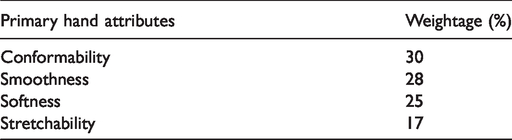
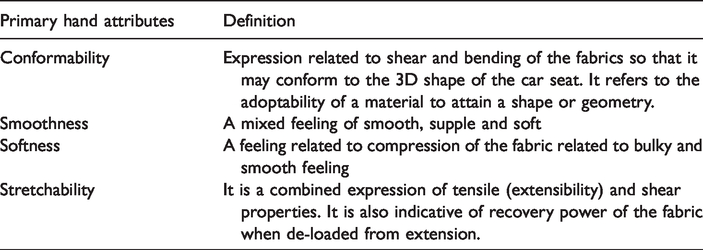
In the second step, on the basis of the selected samples the importance of each attribute was determined by a suitable weightage given by the judges. The primary hand attributes identified are given in Table 3 along with their weightage contribution such that the total of all the attributes was 100%. The properties associated with these primary hand attributes were surface, compressional, bending, shear and tensile properties. The flexibility obtained the least weightage i.e. its importance in the quality evaluation of fabric was least. The reason being in case of apparel fabric, the fabric needs to bend according to body contour and also according to body movement. But in case of car seat fabrics, the fabric is tightly wrapped over the cushioning material and thus, no such cantilever bending takes place. Therefore, flexibility is not a prime criterion and was rejected. Instead, and a new primary hand expression ‘Conformability’ was identified by the judges for a good car seat fabric which is a mix expression of bending and shear properties so that the fabric may conform to the 3 D shape of the car seat. The weightage was redistributed among the final short-listed hand attributes as given in Table 4. The final selected primary hand attributes and their meaning are given in Table 5.
Primary hand attributes and their weightage contribution.

Final selected primary hand attributes and their weightage contribution.
Primary hand attributes and their expression.
A discriminant analysis was carried out to determine the variation among the contribution of the individual primary attributes by the experts as shown in Figure 2. From the above survey it was found that the conformability has the maximum contribution towards fabric hand followed by smoothness, then softness and stretchability in the descending order.

Discriminant analysis of weightage of primary hand attributes.
Subjective assessment of primary and total hand value
A panel 38 judges performed the subjective assessment of the ten automotive fabrics for the primary and total hand value. The judges have ranked the fabrics according to the intensity of the primary and total hand expressions. The primary hand attributes were ranked in the scale 0-10 with 0 being the poorest and 10 being the excellent intensity of the attributes. And the total hand values were ranked in the scale 0-5 with 0 being the poorest and 5 being the excellent. To determine the agreement among the judges the coefficient of concordance was calculated using the equation (1).
The coefficient of concordance for the subjective rating of primary hand attributes of conformability, smoothness, softness, and stretchability were found to be 0.82, 0.78, 0.86, and 0.88 respectively. The coefficient of concordance for total hand values was found to be 0.85.
Development of primary hand equations of automotive textiles
For development of primary hand equation a statistical method was followed. The multi-variable stepwise regression was used to calculate the coefficients of the general fabric hand equation with respect to automotive textile. And the order of the blocks was obtained. The six blocks of the low stress mechanical properties were taken according to their importance in explaining the behavior of the car seat fabrics. The subjective primary hand values obtained were regressed with the mechanical properties of each block and thus six regression equations were obtained.
1st Block: Yc = CO + C1 [LC] + C2 [WC] + C3 [RC]
2nd Block: Yc = CO + C4 [MIU] + C5 [MMD] + C6 [SMD]
3rd Block: Yc = CO + C7 [W] +C8 [T0]
4th Block: Yc = CO+C9 [LT] +C10 [WT] +C11 [RT]
5th Block: Yc = CO + C12 [B] + C13 [2HB]
6th Block: Yc = CO + C14 [G] + C15 [2HG] + C16 [2HG5]
The values in the brackets are the normalised characteristic values. Every block gives Yc value calculated from the developed equation and every block’s Yc value will be correlated with the subjective values which were obtained from the experts. Then the block which shows highest correlation with the subjective value was taken and named as the first block. Now the first chosen blocks’ Yc was replaced with the residual where residual is Y–Yc and Y were the subjective values with which the blocks were regressed.
The residual is then regressed with the remaining blocks and the block which showed the best correlation was taken as the second block and the same procedure was carried. And this gave the importance of each block. Likewise procedure was followed individually within each block to prioritise the characteristic values within the blocks. Thus, finally a linear equation was obtained for the primary hand expressions. The same procedure was followed for each primary hand attribute. The block order shows the importance of block for the particular attribute. The standard equation for primary hand value is represented by equation (2).
where, Y= primary hand value; Xi= ith logarithm of the characteristic value; Xmi = mean of the ith characteristic value; σi = standard deviation of the ith characteristic value; C0, Ci parameter (constant coefficient), n = total number of mechanical properties. Different hand equations Y1, Y2, Y3, Yk were obtained for different primary hand attributes.
Development of total hand value equation of automotive textiles
For the development of total hand value equation, all the determined primary hand values and their squares were regressed with the subjective total hand value. The stepwise block regression method was used to determine the coefficients of the generalised KES equations (3) and (4) for the automotive seat fabrics. As 83% of the automotive textile quality depends on conformability, smoothness and softness of the fabric. Stretchability that depends on tensile properties received the lowest weightage. Thus, the total hand value was evaluated in two ways i.e. with and without stretchability in order to find out the importance of stretchability in the hand evaluation of automotive textile. And the variation in the correlation between the subjective and objective total hand values obtained by the developed equations (3) and (4).
With and without stretchability
The total hand value generalised equation with tensile factor is represented by equation (3).
And the generalised equation without tensile factor is represented by equation (4).
Yi is the primary hand values; Mi1 and Mi2 are mean values of Yi and Yi, 2 бi1 and бi2 are standard deviation of Yi and Yi 2 respectively; C00, Ci1, Ci2 are constant parameters.
Results and discussion
Determination of new primary hand equation for smoothness (BM-201-AT)
The subjective smoothness was the dependant variable that depends on the independent variables like surface and mechanical properties. These independent variables help to predict the objective smoothness value. The blocks were obtained by using stepwise regression as shown in Figure 3 along with their correlation factor. The correlation coefficient was highest for shear and surface properties with respect to smoothness. The surface properties include geometrical roughness and coefficient of friction of fabric surface that contributes maximum to the smoothness expression. The least correlated property was the thickness and areal density of the fabric that means these properties has least significant impact on smoothness. The blocks were used in equation in the same order as in Figure 3. With the order of the blocks, coefficients of the equation were also obtained by multivariable regression within the blocks as given in Table 6.

Stepwise block regression for the investigation of smoothness attributes (PHV1).
Coefficients of primary hand equation BM-201-AT.

Thus, equation (5) obtained for the smoothness of the automotive textile.
Ysmoothness = 8.667 + 0.095*(MIU+4.47)/1.38–2.285*(MMD+60.25)/1.69–0.683*(SMD-5.62)/1.51 + 0.486*(G-2.45)/1.44–0.850*(2HG-6.02)/1.99–0.431*(2HG5–7.76)/1.66 + 0.015*(B+4.17)/1.82–0.028*(2HB+6.92)/1.62 + 0.017*(LT+1.26)/1.12 + 0.057*(WT-19.49)/1.78 + 0.038*(RT-44.67)/1.38–0.004*(LC+1.12)/1.15 + 0.006*(WC+4.47)/1.66 + 0.025*(RC-41.68)/1.09–0.013* (W-2.39)/1.29 + 0.006*(T0+2.24)/1.28 (5)
Determination of new primary hand equation for softness (BM-202-AT)
The subjective softness was the dependant variable that depends on the independent variables like surface and mechanical properties. These independent variables help to predict the objective softness value. The blocks were obtained by using stepwise regression as shown in Figure 4 along with their correlation factor. The highest correlated properties were the shear, friction and bending properties with respect to the softness attribute. The blocks were used in equation in the same order as in Figure 4. By using multivariable regression method, the coefficients of the equation were obtained as given in Table 7.

Stepwise block regression for the investigation of softness attributes (PHV2).
Coefficients of primary hand equation BM-202-AT.
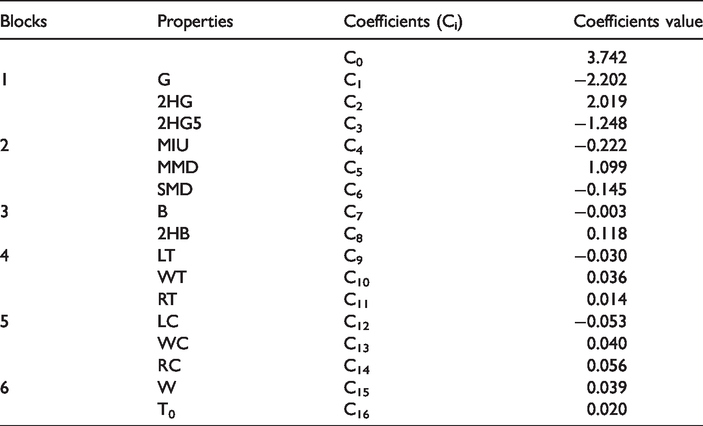
Thus, the equation (6) is obtained for the softness of the automotive textile.
Ysoftness = 3.742–2.202*(G-2.45)/1.44 + 2.019*(2HG-6.02)/1.99–1.248*(2HG5-7.76)/1.66–0.222*(MIU+4.47)/1.38 + 1.099*(MMD+60.25)/1.69–0.145*(SMD-5.62)/1.51–0.003*(B+4.17)/1.82 + 0.118*(2HB+6.92)/1.62–0.030*(LT+1.26)/1.12 + 0.036*(WT-19.49)/1.78 + 0.014*(RT-44.67)/1.38 + 0.053*(LC-1.12)/1.15 + 0.040*(WC-4.47)/1.66 + 0.056*(RC-41.68)/1.09 + 0.039*(W-2.39)/1.29 + 0.020*(T0+2.24)/1.28(6)
Determination of new primary hand equation for conformability (BM-203-AT)
The subjective conformability was the dependant variable that depends on the independent variables like surface and mechanical properties. These independent variables help to predict the objective conformability value. The blocks were obtained by using stepwise regression along with their correlation factor as shown in Figure (5). The most correlated properties were thickness and weight of the fabric, tensile, surface and bending that contributes maximum to the conformability attribute. With the order of the blocks, coefficients of the equation were also obtained by multivariable regression within the blocks as given in Table 8.

Stepwise block regression for the investigation of conformability attributes (PHV3).
Coefficients of primary hand equation BM-203-AT.
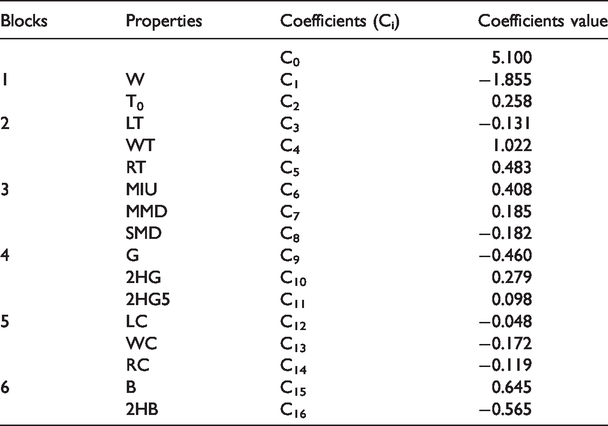
Thus, the equation (7) is obtained for the conformability of the automotive textile.
Yconformability = 5.1–1.85542*(W-2.39)/1.29 + 0.257924*(T0+2.24)/1.28–0.13089*(LT+1.26)/1.12 + 1.021877*(WT-19.49)/1.78 + 0.48298*(RT-44.67)/1.38 + 0.40845*(MIU+4.47)/1.38 + 0.185553*(MMD+60.25)/1.69–0.18224*(SMD-5.62)/1.51–0.46084*(G-2.45)/1.44 + 0.279367*(2HG-6.02)/1.99 + 0.098411*(2HG5-7.76)/1.66–0.04823*(LC-1.12)/1.15–0.17203*(WC-4.47)/1.66–0.1195*(RC-41.68)/1.09 + 0.645334*(B+4.17)/1.82–0.5655*(2HB+6.92)/1.62 (7)
Determination of new primary hand equation for stretchability (BM-204-AT)
The subjective stretchability was the dependant variable that depends on the independent variables like surface and mechanical properties. These independent variables help to predict the objective stretchability value. The blocks were obtained by using stepwise regression as shown in Figure 6 along with their correlation factor. The most correlated properties were tensile, compression and shear of the fabric that plays an important role in stretchability primary hand value. The blocks were used in equation in the same order as in Figure 6. With the order of the blocks, coefficients of the equation were also obtained by multivariable regression within the blocks as given in Table 9.

Stepwise block regression for the investigation of stretchability attributes (PHV4).
Coefficients of primary hand equation BM-204-AT.

Thus, equation (8) is obtained for the conformability of the automotive textile.
Ystretchability = 5.31 + 1.943831*(LC-1.12)/1.15 + 0.81485*(WC-4.47)/1.66 + 1.070361*(RC-41.68)/1.09 + 0.366479*(LT+1.26)/1.12–0.71948*(WT-19.49)/1.78–1.45931*(RT-44.67)/1.38 + 0.31624*(MIU+4.47)/1.38 + 0.163929*(MMD+60.25)/1.69–0.24608*(SMD-5.62)/1.51 + 0.958167*(B+4.17)/1.82–1.0066*(2HB+6.92)/1.62–1.02883*(G-2.45)/1.44 + 0.928845*(2HG-6.02)/1.99 + 0.048941*(2HG5-7.76)/1.66 + 0.044993*(W-2.39)/1.29 + 0.002184*(T0+2.24)/1. (8)
Determination of total hand value of automotive textile (BM-205-AT1 & BM-205-AT2)
The subjective total hand value and the obtained primary hand values from the developed equations were regressed in the same way as primary hand values and mechanical properties and the two sets of equations were obtained with stretchability and without stretchability. The stepwise block regression method was used to obtain the coefficients of the equations.
Without stretchability (BM-205-AT1)
The equation (9) was obtained without using stretchability primary attribute. Hence, only three primary hand values were regressed with the subjective total hand values. The subjective total hand value was the dependant variable that depends on the three independent variables that were objective smoothness, softness and conformability primary hand values. These independent variables help to predict the objective total hand value. The coefficients of the equation are given in Table 10.
THV (Without stretchability) = 3.062 + 0.768*(Y1-5.795)/1.108)–0.652* (Y12-34.688)/11.617–0.107*(Y2-5.124)/1.350 + 0.532*(Y22-27.893)/12.926–0.553(Y3-5.100)/1.797–0.624*(Y32-28.918)/17.833 (9)
Primary hand expression’s coefficients without stretchability (C00 = 3.062).

The equation derived was in the form as given below:
With stretchability (BM-205-AT2)
The equation (10) was obtained by including stretchability. The subjective total hand value was the dependant variable that depends on the four independent variables that were objective smoothness, softness, stretchability, and conformability primary hand values. These independent variables help to predict the objective total hand value. Hence, four primary hand values were regressed with subjective total hand values. The coefficients of the equation are given in Table 11.
THV (With stretchability) = 3.062 + 0.673*(Y1-5.795)/1.108) – 0.243* (Y12-34.688)/11.617–0.375*(Y2-5.124)/1.350 + 0.621*(Y22-27.893)/12.926 – 5.305*(Y3-5.100)/1.797 + 4.466*(Y32-28.918)/17.833 + 2.886*(Y4-5.310)/2.444 – 1.927*(Y42-33.572)/23.623 (10)
Primary hand expression’s coefficients with stretchability (C00 = 3.062).

The equation derived was in the form as given below:
Correlation between subjective primary hand value and objective primary hand value
The correlation between the four subjective and the objective primary hand values was established as shown in Figures 7 to 10. These graphs show the correlation between subjective and objective values and the line represents the best fit curve between the data points. The correlation coefficient turned out to be high in most of the primary hand attributes because all the characteristics values were included in the primary hand equations and all the blocks has contributed to the overall equation development.

Correlation between subjective and calculated smoothness.

Correlation between subjective and calculated softness.

Correlation between subjective and calculated conformability.

Correlation between subjective and calculated stretchability.
Correlation between subjective total hand value and objective total hand value
The values obtained from the developed total hand equations are referred as objective value. These objective values were correlated with the subjective total hand values provided by the experts. Two conditions were observed one with stretchability and another without stretchability as shown in Figures 11 and 12 respectively.

Correlation between subjective and objective total hand value with stretchability.

Correlation between subjective and objective total hand value without stretchability.
It was observed that with stretchability, the total hand value correlation with the subjective total hand value was higher than without stretchability. This states that the stretchability attribute included in the total hand value equation is contributing to the fabric hand of the automotive textile and thus affecting the correlation factor of total hand value.
Contribution of different primary hand expression to total hand value
Contribution of primary hand expressions to total hand value was determined using following equation as given below,
Z1 (Smoothness) = 0.673*(Y1 – 5.795)/1.108 −0.243*(Y1 2 – 34.688)/11.617;
Z2 (Softness) = −0.375*(Y2 – 5.124)/1.350 + 0.621*(Y22 – 27.893)/12.926;
Z3 (Conformability) = −5.305*(Y3 – 5.100)/1.797 + 4.466*(Y32 – 28.918)/17.833;
Z4 (Stretchability) = 2.886*(Y4 – 5.310)/2.444 –1.927*(Y42–33.572)/23.623;
In the Figure 13, Z represents the contribution of each primary hand value to verify the prediction of experts regarding the importance to the hand expressions. Conformability has the highest importance which is later on decreasing and again increases. There is decrease in importance of stretchability as the curve later on bends. Softness and smoothness curve shows increasing trend.

Contribution of PHV factor to the THV, drawn on the basis of developed THV equation (BM-205-AT).
Conclusions
The objective method of evaluating the fabric hand of automotive fabrics was developed using a step-wise block regression method. The subjective assessment of fabrics was conducted by a panel of judges identifying some appropriate primary hand attributes such as conformability, smoothness, softness and stretchability. The primary hand and the total hand equations for the automotive car seat fabrics were developed successfully. Statistical analysis concludes that the conformability plays an important role in the evaluation of fabric hand followed by smoothness, softness and stretchability of the fabrics. The coefficient of concordance calculated indicated a good agreement among the judges. There is also an excellent correlation between the subjective and objective primary hand values. The correlation between the subjective and the objective total hand values found to be very high (R > 0.9) both with and without stretchability parameter. This research concludes that the total hand value of the car seat fabrics could be estimated well using the developed equations and high quality car seat fabrics can be engineered and produced by performing the objective evaluation of fabric hand. Thus, the developed equations can be utilised by the automotive industries for car seat fabric manufacturing, product development and quality assurance.
Footnotes
Declaration of conflicting interest
The author(s) declared no potential conflict of interest with respect to the research, author-ship, and/or publication of this article.
Funding
The author(s) received no financial support for the research, authorship, and/or publication of this article.
