




Abstract
Engineering the surface morphology of fibers has been attracting significant consideration in various areas and applications. In this study, polyvinylidene fluoride (PVDF) branched nanofibers with a diameter of less than 50 nm are electrospun directly at a low relative humidity by adding tetrabutylammonium chloride. The effects of the branched structure on the specific surface area and pore size distribution are investigated, and the filtration properties of the air filter based on branched nanofiber webs with different basis weights are studied. The results exhibit that the air filter based on PVDF branched nanofibers with the basis weight of 1 g/m2 has an outstanding filtration efficiency (99.999%) to 0.26 µm sodium chloride particles under the pressure drop of 126.17 Pa. We believe that this study can be used as a useful reference for the preparation of branched nanofibers through one-step electrospinning.
Introduction
Recently, with the fast growth of the economy, the global problems associated with air cleanliness have gained more and more awareness. Therefore, the demands of air filters have increased and especially high-efficiency air filters and ultra-low penetration air filters have been used in different areas such as chemical, medical, microelectronics, food processing, and so on. Based on European standard EN1822-1, the filtration efficiency of high-efficiency air filters and ultra-low penetration air filters should be 85–99.995% and over 99.9995%, respectively, for 0.15–0.3 µm particles [1–4].
The traditional nonwoven webs are unqualified of catching tiny particles owing to the micro-sized fiber diameter [5,6]. Studies proved that filters with smaller fiber diameters have higher filtration efficiency [7,8]. Filters formed from nanofibers are the best choice for air filtration because of their improved filtration capacity and enhanced service life in real operating environments [9–13].
As an increasingly widespread ultrathin fibers production technique, electrospinning is an effective and adaptable method for forming fibers with a diameter ranging from few nanometers to several micrometers [14,15].
Electrospun nanofibers have exhibited exceptional properties such as high porosity [16,17], small diameter [18], variety of morphologies and structures [19], high specific surface area [20], ease of functionality [21], flexibility [22], and good pore structure [23] which make them a desired material form for air filtration [24–27]. Therefore, air filters based on electrospun fiber webs have been fabricated from different materials such as polyamide-6, polylactic acid, polyacrylonitrile, polyethylene terephthalate, and so on [11,28–30].
Previous studies have proved that the morphology of fibers and the type of materials used play an important role in determining the filtration performance (FP) of air filters [31,32].
Generally, surface morphology and properties of electrospun fibers can be altered or changed by controlling the working parameters (solution parameter, processing parameters, and ambient parameters) of the electrospinning process [19,23,33–36].
Wang et al. [37] electrospun polyamide-6 spider-net nanofibers webs for air filtration by controlling the solution parameters and processing parameters.
Wang et al. [29] fabricated air filters based on electrospun polylactic acid porous bead-on-string nanofiber webs by maneuvering the solvent system and polymer concentration.
Ogi et al. [38] fabricated air filters based on electrospun polyacrylonitrile nanofiber webs with different morphologies such as straight, ribbon-like, spindle-like beaded, and filters consist of beaded fiber exhibited the highest air filtration capacity.
Consistent with classical filtration theory, there are several mechanisms for depositing particles of the fiber webs including Brownian motion, direct interception, inertial impaction, gravitational force, and electrostatic trapping [39,40]. Moreover, the van der Waals interactions between nanoparticles and nanofibers represent another mechanism responsible for agglomerating particles in the filter media [41].
This mechanism has the ability to serve successfully when the ratio of particle-to-fiber diameter is ∼1, and the ultrathin fibers (∼50 nm) can be used as potential “magnets” in the fibrous media [42]. The theoretical studies proved that by decreasing the fiber diameter into the range of ∼20–50 nm, the efficiency of capturing nanoparticles (∼10–100 nm) will increase by an order of magnitude [43]. Nevertheless, beaded free nanofibers with a diameter of < 50 nm cannot be usually electrospun.
Starting from the importance of tiny diameters of nanofibers and their surface morphology in determining the desirable applications, the branched structure has shown great potential in different applications such as wound dressings, filtration, water repellency, self-cleaning surfaces, tissue engineering, energy harvesting, and so on [27,44–49].
To the best of our knowledge, this is the first time that beaded free polyvinylidene fluoride (PVDF) branched nanofibers with a diameter of less than 50 nm have been electrospun. We explored the formation mechanism of the branched structure and investigated its ability for serving in the field of air filtration. Herein, PVDF was selected as a model because it can be used in different applications due to its unique properties such as good flexibility, good chemical resistance, high sensitivity, membrane-forming properties, piezo-, pyro- and ferroelectricity, high thermal stability, its ability to be dissolved in many solvents, formed in different structures, and so on [19,50–52].
Experimental procedure
Materials
PVDF pellets (Mw = 275,000 g/mol) and tetrabutylammonium chloride (TBAC) were purchased from Sigma-Aldrich, Inc. Acetone (ACE) and N, N-dimethylformamide (DMF) were purchased from Shanghai Chemical Reagents Co., Ltd, Shanghai, China. All materials were used without further purification.
Methods
Electrospinning:
PVDF/(ACE/DMF) solutions (10% and 15%) at the solvent ratio of 1:2 were prepared. In addition, 10% PVDF/(ACE/DMF) solution was prepared by adding 0.1 mol/L of TBAC in the PVDF solution with stirring for 1 h. The solutions were loaded into a plastic syringe.
The salt type and content were selected based on their effects on the spinnability and surface morphology of the fibers [53–55]. In this work, the solvent ratio was the volume ratio, and the solution concentration was weight/volume (w/v) (g/ml). A 21 gauge syringe needle was used as the spinneret, which was fixed on a syringe pump (KDS 100, KD Scientific Inc., USA) connected to a high-voltage supplier (Tianjin Dongwen Co., Ltd, China). A stationary collector was placed 18 cm away from the spinneret. The setup for electrospinning is demonstrated in Figure 1. All the experiments were carried out at a temperature of 20°C and relative humidity of ∼10%, flow rate of 1.5 ml/h, and applied voltage of 18 kV in order to get the thinnest diameter [23]. The description of the electrospun samples is listed in Table 1.
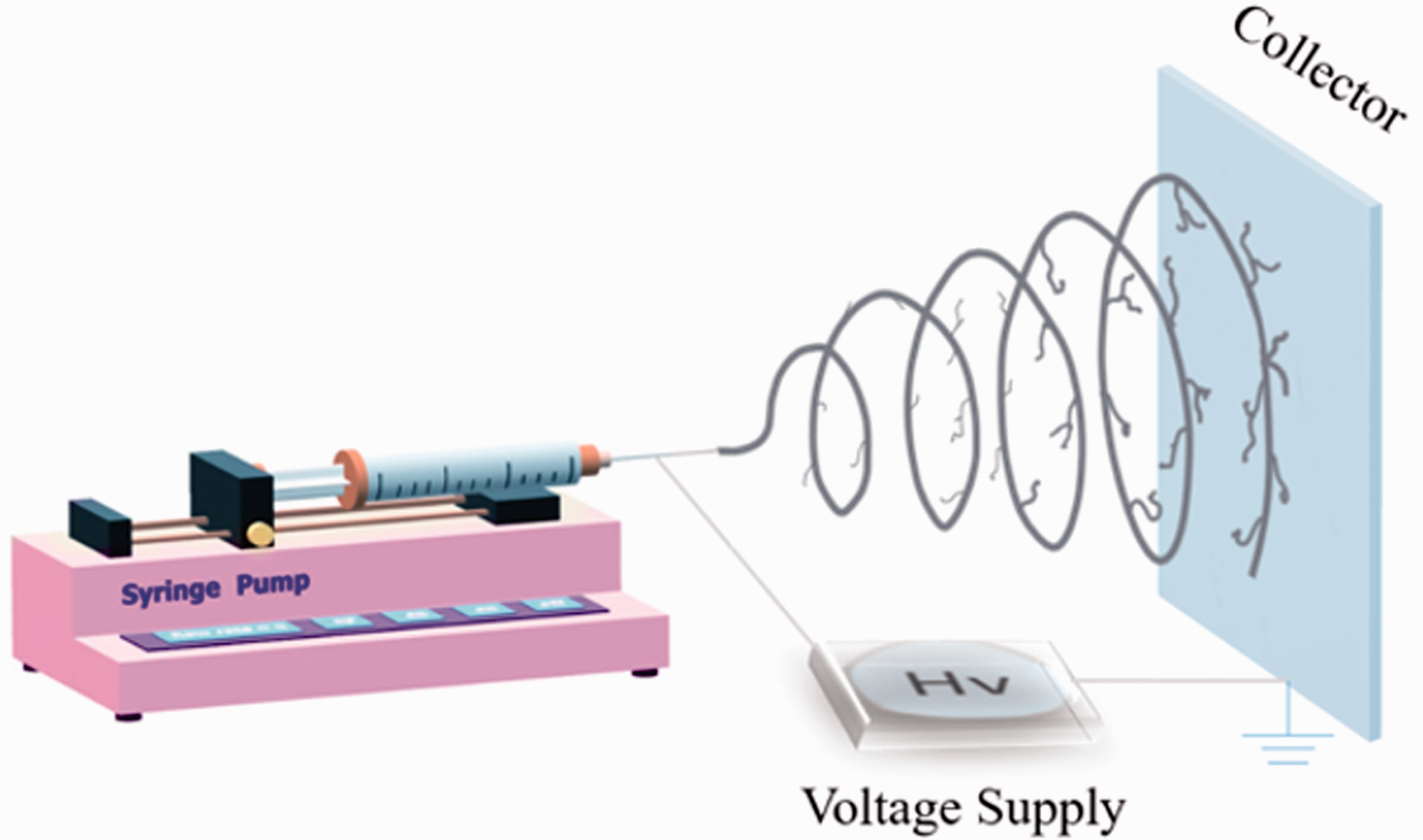
Schematic diagram illustrating the electrospinning process of branched fibers.
The samples’ descriptions fabricated in this study.

ACE: acetone; DMF: N, N-dimethylformamide; PVDF: polyvinylidene fluoride; TBAC: tetrabutylammonium chloride.
Characterization
The surface morphology of electrospun PVDF nanofibers was observed under the field emission scanning electron microscopy (FE-SEM) (S-4800, Hitachi Ltd, Tokyo, Japan) after gold coating. In order to determine the diameters of fibers accurately, we measured them using three different software (Nano measurer 1.2, Image J 1.45s, and Adobe Acrobat X Pro 10.1.2.45) according to the SEM images, and their mean and standard deviation were calculated. N2 physical adsorption-desorption isotherms (JW-BK132F, Beijing Science and Technology Co., China) were tested to determine the specific surface area. The pore size and distributions of nanofiber webs were analyzed by the capillary flow porometer (CFP-1100AI, PMI Co., USA), which could directly determine them. The filtration efficiency and filter resistance were measured directly using the TSI Model 8130 Automated Filter Tester (TSI, Inc., MN, USA) which has the ability to provide charge neutralized micron monodisperse solid sodium chloride (NaCl) particles with a diameter of ∼0.26 mm. The NaCl particle tests were worked at room temperature under a continuous airflow of 32 L/min. Five samples (n = 5) were tested for each group to obtain an average.
Results and discussion
Determining the surface morphology of nanofibers
In this study, the PVDF nanofibers were electrospun at the polymer concentrations of 10% and 15%, and the effect of adding salt on the formation of beaded free branched nanofibers was studied. Figures 2(a) and S1(A) show that beaded free electrospun PVDF nanofibers with an average diameter of 199 ± 37 nm were electrospun at the polymer concentration of 15%, while beaded electrospun PVDF nanofibers with an average diameter of 108 ± 29 nm were electrospun at the polymer concentration of 10% (Figures 2(b) and S1(B)). Importantly, by adding TBAC (organic salt), beaded free PVDF nanofibers with an average diameter of ∼40 ± 8 nm and branches with tiny diameters (<10 nm) were electrospun from 10% PVDF solution (Figures 2(c) and (d) and S1(C)). TBAC could be dissolved easily in the PVDF solution and increasing the electrical conductivity of the solution. When the density of the jet’s charges exceeds a certain threshold value, the electric forces overcome the surface tension resulting in the schism of the jet. Furthermore, the TBAC decreased the forces between the PVDF molecules due to its space steric structure and accordingly serving for the schism of the jet [56].
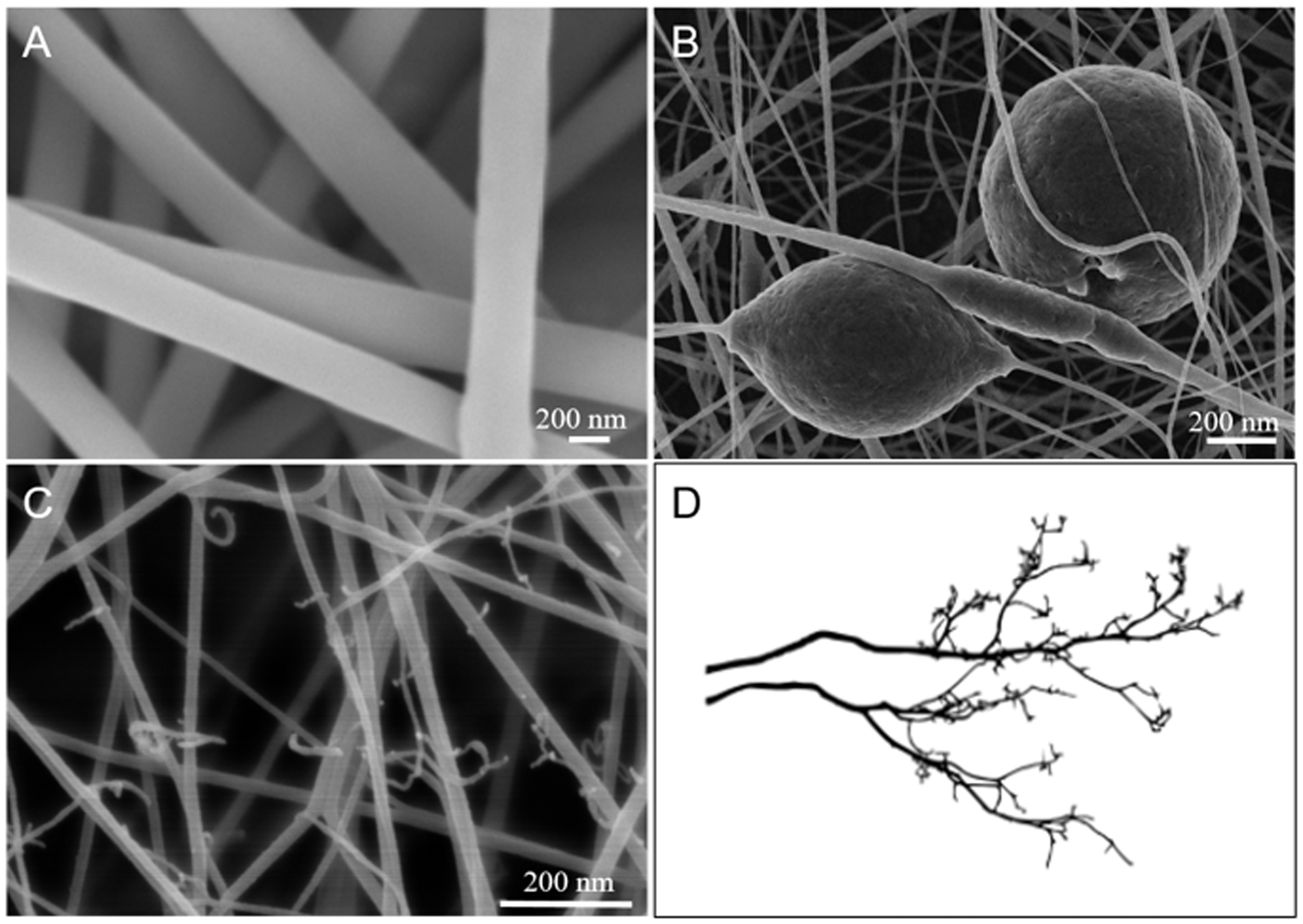
SEM images of (a) 15% PVDF, (b) 10% PVDF, (c) 10% PVDF-TBAC, (d) an optical image of actual branches.
Figure S2 illustrates the effect of adding TBAC on the distribution of the pore size of electrospun PVDF nanofiber webs. The pore size of nanofiber webs decreased sharply after adding TBAC owing to the formation of branched nanofibers and decreasing the diameter of fibers [57].
In addition, it was clear that the pore size distribution range of the sample S3 is narrower than those of S2 and S1 which is beneficial for air filtration.
Since the specific surface area of the nanofiber webs was affected by the morphologies of the nanofibers, the results showed that the specific surface area of the sample S3 (61 ± 5.3 m2/g) is larger than those of the samples S2 (36 ± 4.2 m2/g) and S1 (27 ± 3.8 m2/g), which are coordinated with the maximal nitrogen adsorption of the samples S3, S2, and S1 (Figures 3 and S3). These results should be ascribed to the small air gaps between the nanofibers. In other words, the active contact area between fibers of air filters and target particles can be enhanced by decreasing the diameter of nanofibers and the pore size.

The specific surface area of samples S1, S2, and S3.
Estimating the FP of air filters
In order to discover the importance of the PVDF branched nanofibers in the air filtration field, the electrospun webs were deposited directly on a nonwoven polypropylene substrate.
The filtration efficiency and pressure drop of the nonwoven substrates were negligible ∼1.9% and 0.8 Pa, respectively, thus they can be ignored.
Figure 4(a) shows the relationship between the basis weight of the webs and filtration efficiency of the samples S1, S2, and S3. For the sample S1, the filtration efficiency was 89.143, 99.001, 99.099, and 99.115% at the webs’ weight of 0.25, 0.5, 0.75, and 1.0 m2/g, respectively. For the sample S2, the filtration efficiency was 96.671, 99.113, 99.378, and 99.491% at the webs’ weight of 0.25, 0.5, 0.75, and 1.0 m2/g, respectively. For the sample S3, the filtration efficiency was 99.351, 99.887, 99.995, and 99.999% at the webs’ weight of 0.25, 0.5, 0.75, and 1.0 m2/g, respectively.

(a) Filtration efficiency and (b) pressure drop of electrospun webs at different basis weights of webs.
Apparently, the filtration efficiency improved by the increase in the webs’ basis weight, which was induced by extended electrospinning time, because increasing the webs’ basis weight leads to overlapping the internal nanofibers and the captured possibility of tiny particles into web increased.
Generally, the filtration efficiency increased sharply until the basis weight of 0.25 m2/g and then reached almost a steady value at the basis weight of 0.5 m2/g. Clearly, the sample S3 exhibited higher filtration efficiency than the samples S2 and S1owing to the smaller air gaps caused by the tiny diameter of nanofibers and the presence of branches of fibers. In other words, the high specific surface area of branched nanofiber webs improved the effective contact area between the fibers and target particles (the van der Waals attractive forces) resulting in enhancing the capture of the particles. The FP of sample S3 was analogous to the ULPA standard (the level of U15).
Figure 4(b) illustrates the basis weight necessity pressure drop of samples S1, S2, and S3. Similar to the previous literature, the relationship between the basis weight and pressure drop was quite linear because increasing the basis weight of webs leads to increased air resistance through web thanks to increasing the combination between nanofibers [58].
With the same basis weight, the pressure drop of sample S3 was higher than those of samples S2 and S1 owing to the presence of branches of fibers and the small air gaps between them.
By increasing the basis weight of webs to 1.0 m2/g, their pressure drop was increased from 88.1 Pa for the sample S1, to 90.9 Pa for the sample S2, and to 126.17 Pa for the sample S3.
It is clear that the sample S3 exhibited outstanding air filtration efficiency and lower pressure drop compared with previous studies (Table S1).
Generally, the FP of air filters can be enhanced by increasing their collection efficiency at low possible pressure drop, and it can be determined based on the quality factor (QF) according to the following equation [37]
QF is considered as the benefit to cost ratio between filtration efficiency and pressure drop.
According to this experiential relationship, it can be obviously seen that higher QF requires superior filtration efficiency and lesser pressure drop. Consequently, good efficiency and high QF are the key factors for enhancing the FP [59].
Figure 5 shows the QF value of the filter medium investigated in this study. The results showed that the QF value of the sample S3 is higher than those of samples S2 and S1, which confirm that the sample S3 exhibits the highest FP.

The quality factor of electrospun webs at different basis weights of webs.
Furthermore, the QF value of the sample S3 decreases by increasing the basis weight of the webs, which proves that the smaller basis weight of the web is preferred for enhancing the FP.
It is worth mentioning that the filter based on branched nanofiber webs is a hopeful candidate for air filtration with ultra-high performance.
Conclusions
In summary, a PVDF branched nanofiber web with a diameter of less than 50 nm was electrospun via one-step electrospinning. The branched structure was produced using 10% PVDF/(ACE/DMF) solution at the solvent ratio of 1:2 with a voltage of 18 kV, tip to collector distance of 18 cm, flow rate of 1.5 mL/h, and relative humidity of ∼ 10%. The formation mechanism of the branched structure was demonstrated. Furthermore, the effect of the branched structure on the FP was studied. The results exhibited that the branched structure increases significantly the specific surface area and reduces the pore size of the nanofiber webs, resulting in enhancing the ability for catching the small particles. In addition, the tremendously small diameter of branched nanofibers (<10 nm) improves the van der Waals attractive forces between particles and nanofibers, resulting in enhancing the FP of air filters according to the ULPA standard (the level of U15).
Since the PVDF branched nanofibers have outstanding properties (e.g. extremely tiny diameters, high specific surface area, small pore size, and so on), they have the ability to serve as a prospective candidate for various applications including filtrations, sensors, energy harvesting, self-cleaning surfaces, catalysis, and so on.
Supporting information
The histogram of the diameter distribution of studied samples is shown in Figure S1. The pore size distribution of studied samples is illustrated in Figure S2. The nitrogen adsorption isotherms of studied samples are shown in Figure S3. The comparison of the filtration properties of electrospun nanofiber filters for 0.26 mm particles of this study with other studies is listed in Table S1.
Supplemental Material
sj-pdf-1-jit-10.1177_1528083720923773 - Supplemental material for Branched nanofibers with tiny diameters for air filtration via one-step electrospinning
Supplemental material, sj-pdf-1-jit-10.1177_1528083720923773 for Branched nanofibers with tiny diameters for air filtration via one-step electrospinning by Bilal Zaarour, Hussen Tina, Lei Zhu and XiangYu Jin in Journal of Industrial Textiles
Footnotes
Declaration of conflicting interests
The author(s) declared no potential conflicts of interest with respect to the research, authorship, and/or publication of this article.
Funding
The author(s) disclosed receipt of the following financial support for the research, authorship, and/or publication of this article: The work is supported by the National Natural Science Foundation of China (51403033), “Chen Guang” Project sponsored by Shanghai Municipal Education Commission and Shanghai Education Development Foundation (14CG34) and the Fundamental Research Funds for the Central Universities.

Supplemental Material
Supplemental material for this article is available online.
References
Supplementary Material
Please find the following supplemental material available below.
For Open Access articles published under a Creative Commons License, all supplemental material carries the same license as the article it is associated with.
For non-Open Access articles published, all supplemental material carries a non-exclusive license, and permission requests for re-use of supplemental material or any part of supplemental material shall be sent directly to the copyright owner as specified in the copyright notice associated with the article.
