




Abstract
The development of novel nanofibrous filters has received much attention. Nanofibrous nonwoven mats are applicable in air filtration, but their structural characteristics lead to weak mechanical properties. By incorporating graphene with polyimide, we fabricated nanofibrous mats for air filtration. The results indicate that these mats are highly efficient (up to 99.1%) for air filtration and have strength improvement and thermal stability. These mats are expected to be applied for extreme conditions.
Introduction
Filtration materials have drawn people’s attention due to the deterioration of air quality.1–4 Traditional filter materials include nonwoven spun bonds, melt blown nonwoven fabrics, needle-punched nonwoven fabrics and glass fiber materials, and so on. These materials are generally made of micro-fibers. However, such materials are less effective while removing contaminants with complex compositions.5,6 Therefore, the development of novel nanofibrous filters has received much attention.7–10 The nanofibers in these filters can adhere to the contaminant particles due to van der Waals forces. 11 The existence of such an adhesion phenomenon brings with it a result that the filtration efficiency of nanofiberous filters is higher than that of traditional filters. At present, nonwoven mats prepared via electrospinning are the most common type of nanofibrous filter. However, the disordered accumulation of nanofibers results in poor mechanical properties, which limit their applications.
In order to enhance the strength of electrospun nonwoven mats, the combination of high-performance polymer matrix and inorganic nano-reinforcement is widely used.12–14 Polyimides (PIs), a polymer family of aromatic imide monomers, are well known for their comprehensive performance, especially their great thermal stability and excellent mechanical properties.15,16 Due to these excellent properties, PI nanofibrous materials are very good candidates for filtration. For example, Qiao et al. 17 fabricated PI fibrous aerogel and tested its filtration efficiency. Its removal efficiency of PM2.5 was 99.83% with a maximum compressive stress of 7.03 kPa at 50% strain. Li et al. 18 fabricated a three-layer composite with eletrospun PI nanofibers on needle-punched aramid felt; this composite shows 100% efficiency in removing particles large than 2 μm. Zhang et al. 19 developed high-efficiency (>99.5%) PI nanofiber air filters for high temperatures; the removal efficiency was kept unchanged when temperature ranged from 25 to 370°C, and these filters had high air flux with very low pressure drop.
Graphene exhibits excellent mechanical and electrical properties, and extremely high specific surface area, due to its extremely special 2D monolayer structure.20–22 These properties allow graphene to significantly improve the composites when used as a reinforcement. In this work, we incorporated graphene in the preparation of nanofibrous mats, and expected performance improvement. By electrospinning, we fabricated graphene/PI nanofibrous mats with excellent filtration efficiency, mechanical strength, and thermal stability. This comprehensive performance will greatly broaden the applications of such reliable nanofibrous material.
Experiments
Preparation of Graphene/PI Nanofibrous Mats
A widely used two-step method was used to prepare PI. Polyamic acid (PAA) precursor solution was synthesized from pyromellitic anhydride (PMDA) and 4,4ʹ-oxydianiline (ODA) monomer. About 2.400 g of ODA was dissolved in 20 g of N, N-dimethylformamide (DMF) and stirred until fully dissolved. Then, 2.616 g PMDA and 25.14 g DMF were added to the ODA solution in three portions. The solution was then continuously stirred in an ice-water bath for 2 h to obtain a 10 wt% PAA precursor solution.
Graphene, as used herein, was provided by the Institute of Physics and Chemistry, Chinese Academy of Sciences. 23 The graphene was prepared by a ball milling method and it was dispersed into a slurry in N-methylpyrrolidone (NMP) at a concentration of 20 mg/mL. The estimated average number of layers is 4.4; the average length of the graphene is 650 nm.
Different amounts, 0, 0.5, 1, 1.5, 2, and 2.5 mL, of the graphene-NMP dispersion were diluted to 3.5 mL and then added to 10 g of as prepared PAA solution. The graphene/PAA ratio will be 0, 1, 2, 3, 4, and 5 wt%. The stirring continued for 3 h until the solution turned uniformly bright gray to obtain graphene-PAA dispersions.
Graphene-PAA composite mats with different graphene ratio were fabricated by electrospinning. These fibrous mats were placed in a muffle furnace and imidized at 300°C for 2 h to obtain graphene/PI nanofibrous mats. According to the different ratios of graphene, which were 0–5 wt%, the samples were named 0 Gr, 1 Gr, 2 Gr, 3 Gr, 4 Gr, and 5 Gr, respectively.
Characterization
Morphology characterization was performed using a JSM-7500F cold-field emission scanning electron microscope (FESEM) manufactured by JEOL, Japan (acceleration voltage 5 kV). X-ray diffraction (XRD) characterization was performed using an XRD-6000 X-ray diffractometer manufactured by Shimadzu Corporation (CuKα X-ray source, scan angle of 20–45°). A Fourier transform infrared spectroscopy (FTIR) test was performed on an iN10MX microscopy infrared spectrometer (ATR mode) manufactured by Nicolet, USA. A filtration efficiency test was carried out using a Model 8530 Aerosol particle counter manufactured by TSI (2.5 μm cutting head, test time of 5 min, sampling interval of 10 s, with cigarettes as the particle source). The mechanical properties were tested using a Shimadzu AGS-X 1KN universal mechanical testing machine (tensile mode, tensile speed 1 mm/min). A piece of 3M 8210 mask was used for comparison. Thermo gravimetric analysis (TGA) was performed with an STA449F3 thermal analyzer manufactured by NETZSCH, Germany.
Results and Discussion
Preparation of Graphene/PI Nanofibrous Mats
By electrospinning graphene-PAA dispersion solutions, we prepared a series of nanofibrous mats with different graphene ratios. The color of the prepared samples gradually changed from yellow to gray, with the increase in graphene.
Figure 1 shows the FESEM photos of different samples. Flakes appear in the fibrous mats after the addition of graphene, which is consistent with the flaky 2D structure of graphene. There is a clear transitional structure between the fiber and the sheet, indicating that graphene is embedded in the fiber. In the 4 and 5 wt% added samples, slight agglomeration was observed. These phenomena indicate that graphene disperses well in the PI matrix when the addition of graphene is below 4 wt%. Moreover, after the addition of graphene, we found a significant change in fiber diameter distributions. The fiber diameter distribution of the neat PI mat is 160–320 nm, and the mean diameter is about 235 nm. After the addition of graphene, they formed several ultra-thin fibers. These fibers have a diameter of less than 100 nm. This decreases the mean diameter to about 170, 190, 110, 120, and 120 nm in samples 1–5 Gr. We infer that this change is brought about by the addition of graphene. The morphology of electrospun nanofibers is highly related to the solution properties, such as viscosity, conductivity, surface tension, and so on, 24 and the influence of these properties is very complex. Some research25,26 has found that adding nanoparticles like graphene into the spinning solution will split the jet, resulting in the formation of ultrafine fibers. Of all these samples, 3 Gr contains the highest proportion of these ultrathin fibers. These ultrathin fibers are demonstrated to be beneficial for the filtration 11 and mechanical ptoperties 27 of the mats.
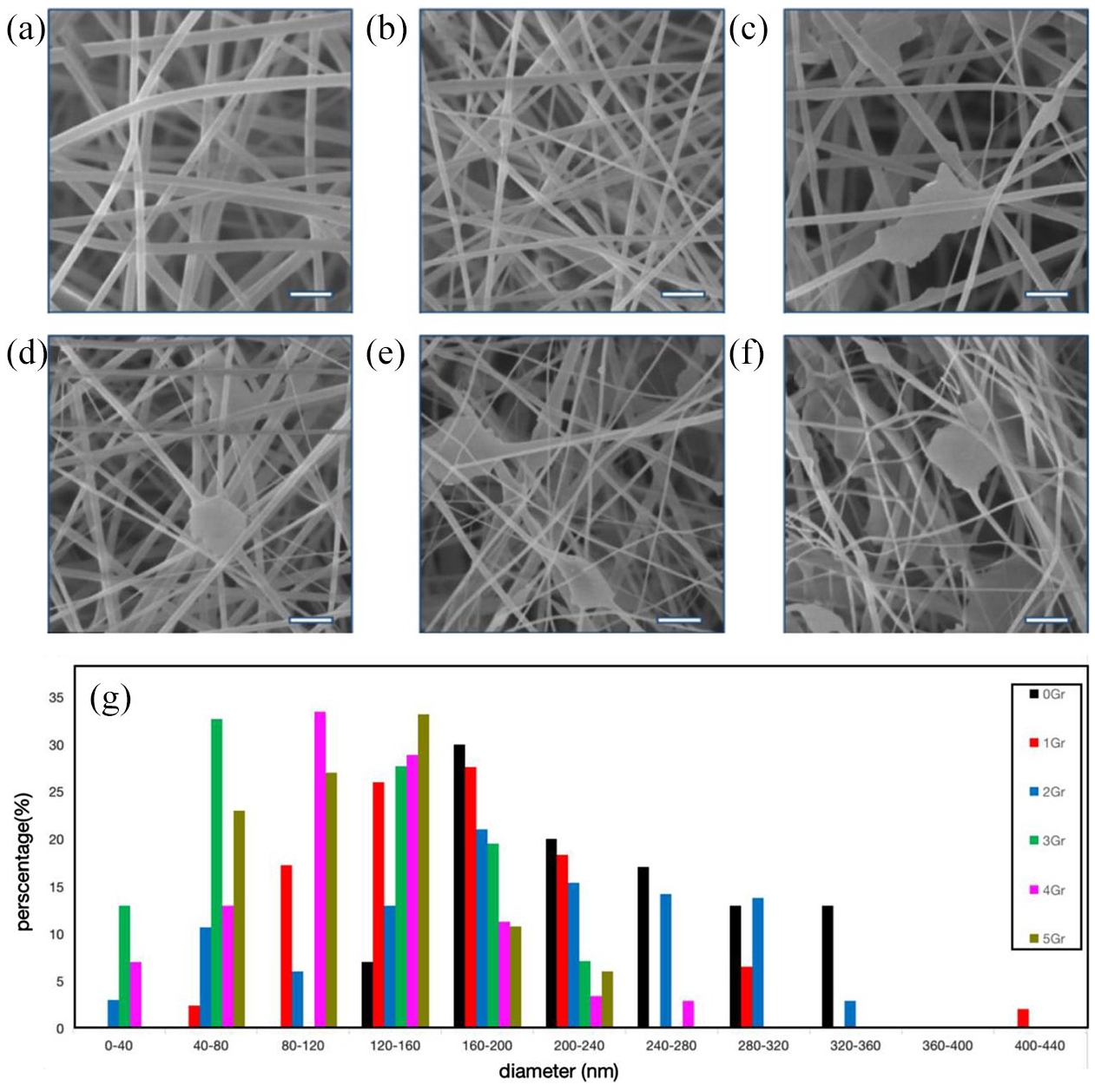
Microstructure of samples with different graphene additions: (a) 0 Gr, (b) 1 Gr, (c) 2 Gr, (d) 3 Gr, (e) 4 Gr, and (f) 5 Gr. The scale bar corresponds to 1 μm. (g) Their histogram of diameter distribution.
In order to characterize the chemical composition and the structure of the nanofibrous mats, we performed FTIR and XRD tests. Figure 2(a) shows the FTIR spectra of the fibrous mats with different graphene loadings. The following characteristic peaks of PI appear in these spectra: 1776 cm−1 of asymmetric imide C=O, 1726 cm−1 of symmetric C=O, and 1373 and 725 cm−1 of imide C–N. Characteristic absorption peaks of the PAA precursor like anhydride at 1860 cm−1 were not observed,24,28 which indicates that the imidization process is fully complete. The above results demonstrate that after high temperature imidization, regardless of the amount of graphene added, all samples were fully imidized. Meanwhile, the absence of peaks of other oxygen-containing groups, like 1056 cm−1 of C–O vibrational mode and 1356 cm−1 of C–OH, 29 indicates that no oxidation of the graphene occurred during the imidization process. Figure 2(b) shows the XRD patterns of the fibrous mats with different graphene loadings. With the increasing of the amount of graphene, gradually increasing peaks of the graphene’s layered structure are observed. 20 The appearance of this characteristic peak indicates that graphene retains its original multilayered structure and does not convert to graphene oxide. In short, we prepared a series of graphene/PI nanofibrous mats with different graphene contents. Graphene distributes well in the PI matrix, and it is not oxidized during the imidization process.
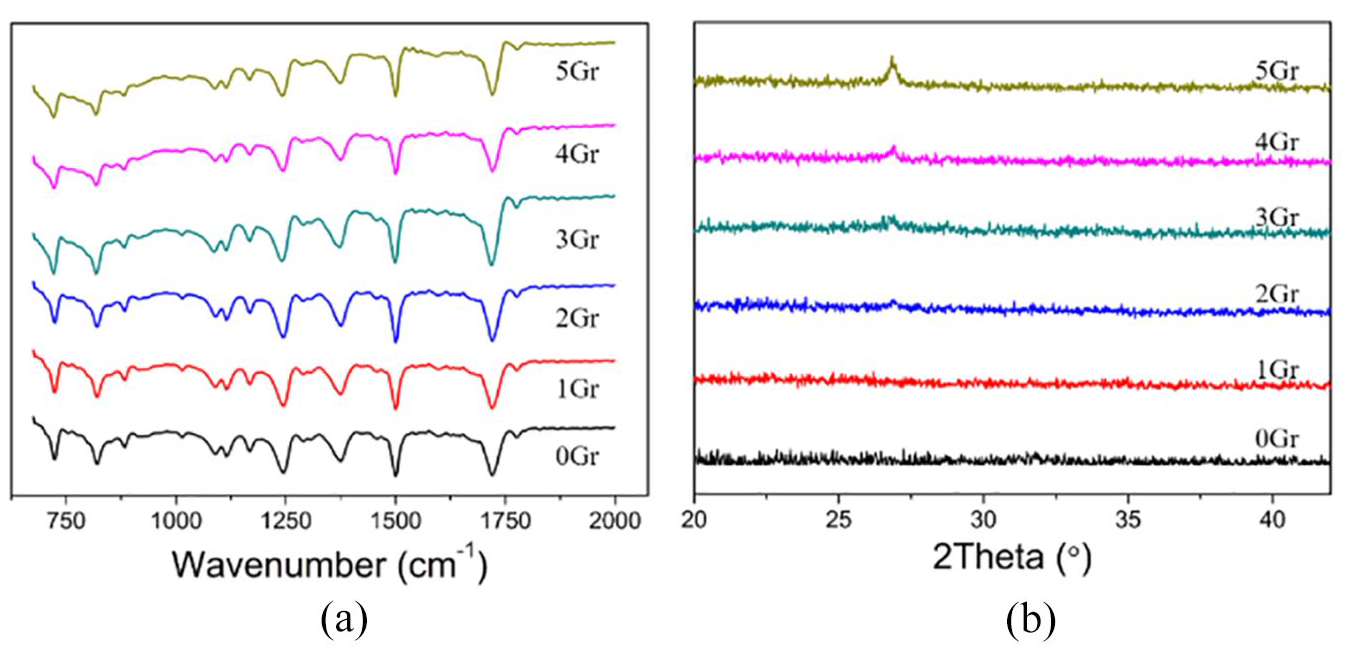
(a) FTIR spectra and (b) XRD spectra of different samples.
The Filtration Performance of Graphene/PI Nanofibrous Mat
Aerosol particle counters were used to test the air filtration efficiency of the samples. Figure 3(a) shows the filtration efficiencies of the samples and a commercial mask. All samples showed far superior filter capacity to the commercial mask. This is because nanofibers in the samples have strong adhesion to the contaminants. The combination of contaminants and nanofibers is so tight that samples can trap pollutant particles with high efficiency and thus provide higher filtration performances of 98.0 ± 0.2%, 98.3 ± 0.3%, 99.1 ± 0.4%, 99.4 ± 0.3%, 97.1 ± 1.3%, and 94.9 ± 3.1% with 0–5% of graphene added, respectively. Figure 3(b)–(g) shows the samples after filtration. The change for different graphene addtion amounts metamorphoses the pattern of the contaminant particles’ distribution. These morphology differences cause the filtration efficiency of the samples to alienate. With the increase in the ratio of ultrafine fibers, the morphology of the pollutants adhering to the fibers is changed from uniform wrapping to spindle shape. Especially for 3 Gr, contaminants are adhered by their ultrathin fibers, and they form approximately spherical structures. A previous study 11 has shown that particles adhering to the ultrafine fibers will exhibit an approximately spherical shape, resulting in higher adhesion per volume of the fibers. In addition, the time it takes the contaminants to saturate the ultrafine fibers is faster. As a result, 3 Gr with most ultrafine fibers offers the highest air filtration efficiency. Briefly speaking, adding graphene can further improve the filtration efficiency.
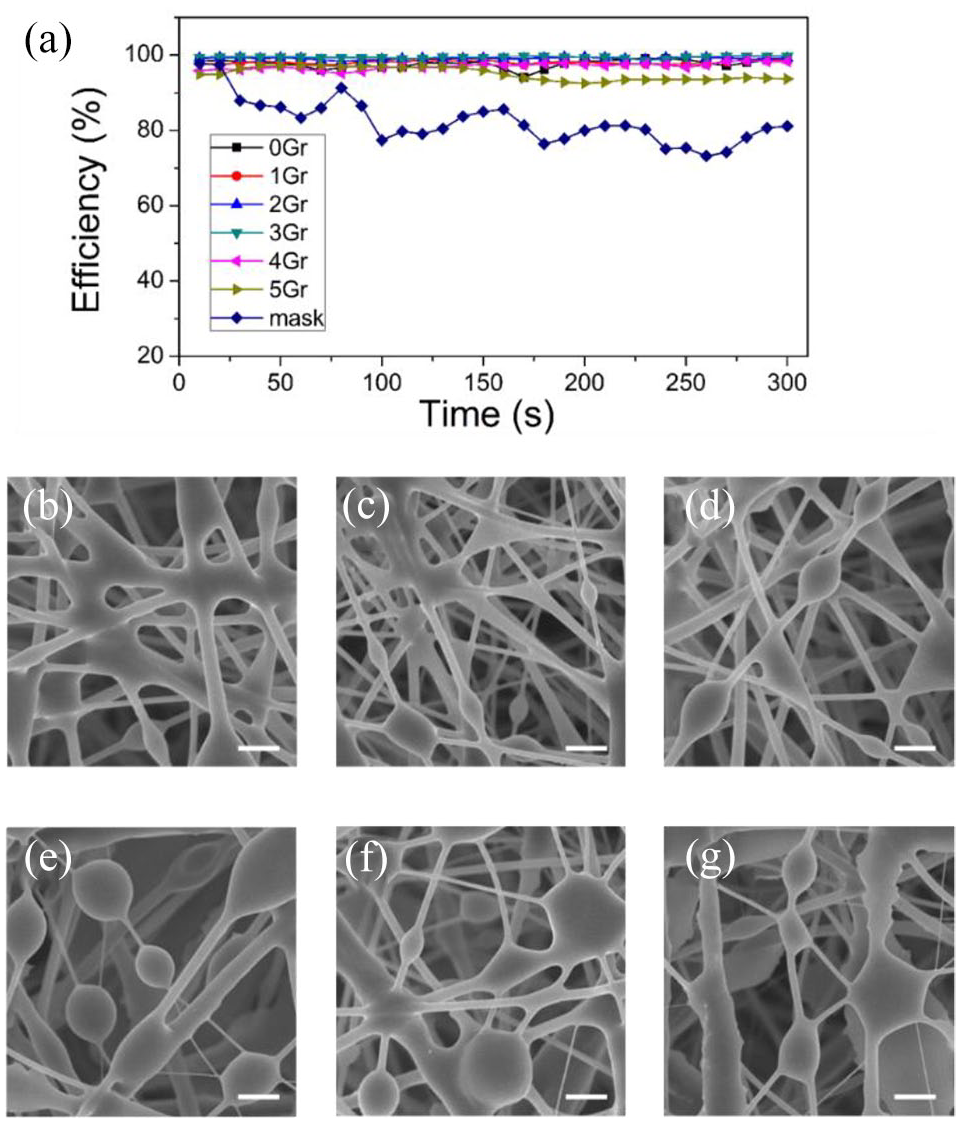
The filtration efficiency (a) of samples and commercial masks. And FESEM pictures of (b) 0 Gr, (c) 1 Gr, (d) 2 Gr, (e) 3 Gr, (f) 4 Gr, and (g) 5 Gr loading contaminants. Scale bar corresponds to 1 μm.
Mechanical Properties and Thermal Stabilities of Graphene/PI Nanofibrous Mats
As shown in Figure 4(a), the introduction of graphene endows the composites with greater rigidity. Taking 0 Gr, 1 Gr, and 3 Gr as examples, as shown in the Figure 4(a) insert, when the stretching procedure starts, the fibers are easily deformable so that the moduli of the samples are 4.0, 16.1, and 29.4 MPa, respectively. As the stretching continues, the fibers align in the stretching direction. Then the samples’ moduli increase to 25.4, 56.1 and 90.6 MPa because of the alignment. The enhanced rigidity of the graphene/PI fibrous mats makes it stiff enough to withstand its weight, as shown in Figure 4(b). Meanwhile, the rigidity-enhanced mat remains flexible, as seen in Figure 4(d). Such properties make the mats less sensitive to sudden changes and more reliable.
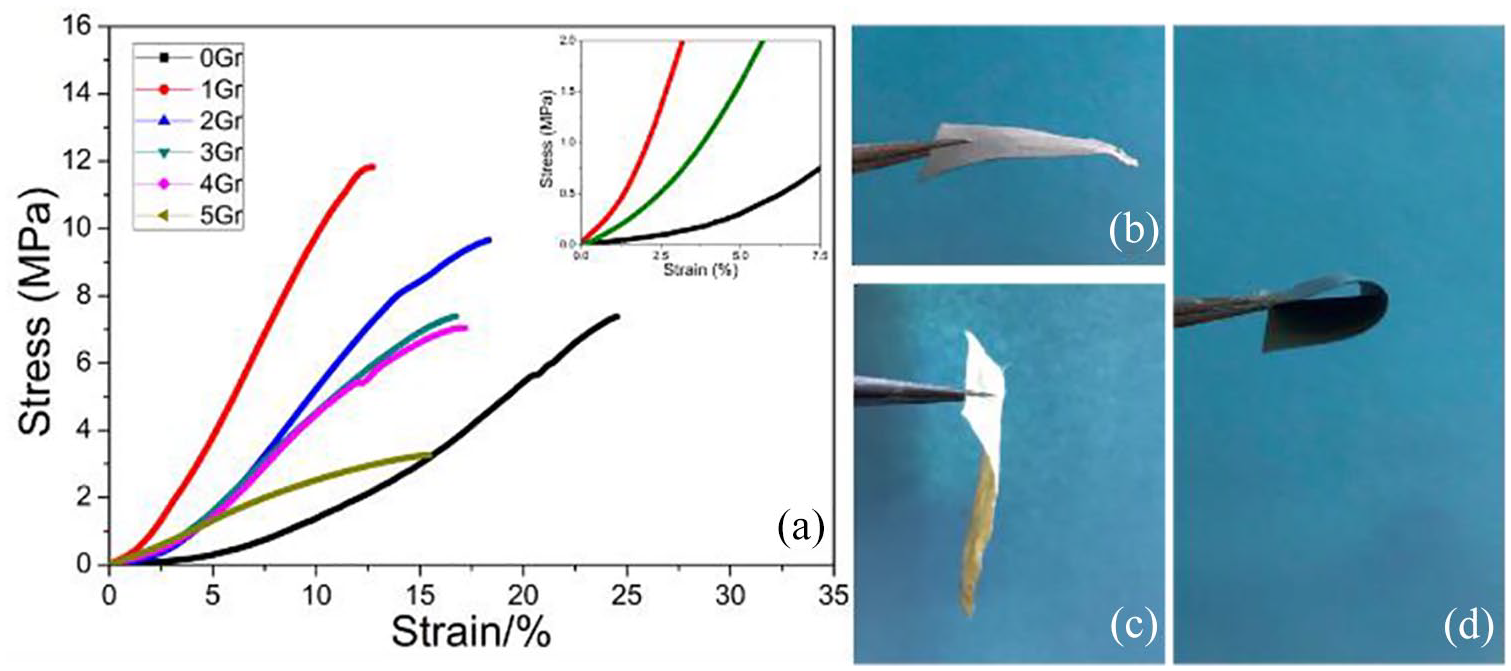
Stress–strain curves (a) of graphene/PI nanofibrous mats. Insert shows magnification of initial part of stress–strain curve to illustrate moduli variations. The composite film can withstand its weight (b), while neat electrospun PI mat cannot (c). The graphene/PI composite mat remains flexible (d).
Figure 5 shows the thermogravimetric curves of a graphene/PI nanofibrous mat with different graphene contents in a nitrogen atmosphere. The initial decomposition temperature is 550°C, and the maximum rate of weight loss is achieved at 600°C. The addition of graphene does not adversely affect the original high heat resistance of the PI matrix. We believe that nanofibrous mats with such thermal stability can meet application requirements where extreme heat may occur.
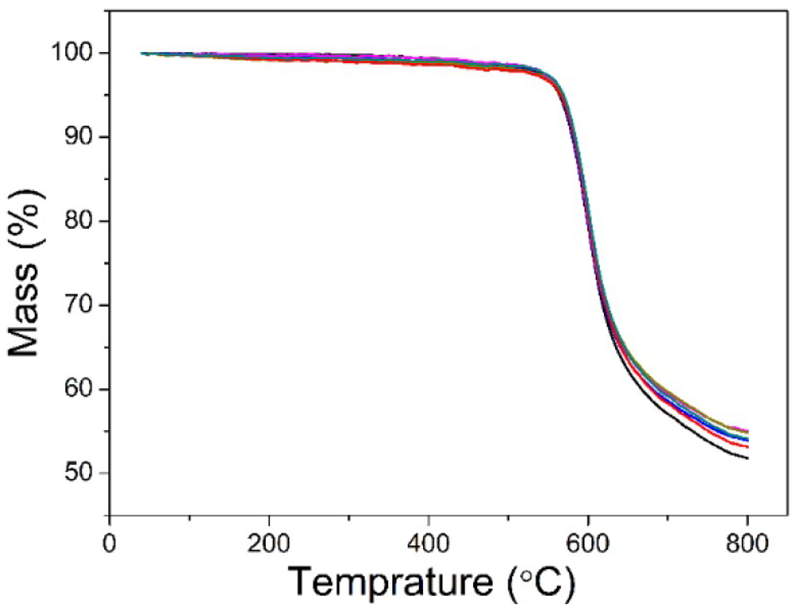
TG curves of graphene/PI nanofibrous mats.
Conclusion
The graphene/PI nanofibrous composite mats were fabricated via a simple electrospinning method. Graphene can be uniformly distributed in the PI matrix. Due to the introduction of graphene, the fiber diameter in the mats is regulated. Thus, this leads to improvements in filtration efficiency, mechanical strength, and thermal stability. These comprehensive practical properties provide evidence that the composite mat is suitable for applications in extreme environmental conditions.
Supplemental Material
sj-docx-1-aat-10.1177_24723444221084403 – Supplemental material for Graphene/Polyimide Nanofibrous Mat for High-Efficiency Filtration
Supplemental material, sj-docx-1-aat-10.1177_24723444221084403 for Graphene/Polyimide Nanofibrous Mat for High-Efficiency Filtration by Depeng Meng, Yihe Zhang and Juntao Wu in AATCC Journal of Research
Footnotes
Declaration of conflicting interests
The author(s) declared no potential conflicts of interest with respect to the research, authorship, and/or publication of this article.
Funding
The author(s) received no financial support for the research, authorship, and/or publication of this article.
Supplemental material
Supplemental material for this article is available online.
References
Supplementary Material
Please find the following supplemental material available below.
For Open Access articles published under a Creative Commons License, all supplemental material carries the same license as the article it is associated with.
For non-Open Access articles published, all supplemental material carries a non-exclusive license, and permission requests for re-use of supplemental material or any part of supplemental material shall be sent directly to the copyright owner as specified in the copyright notice associated with the article.
