




Abstract
In this paper, in order to identify the lifetime of energy scavenging devices, the effect of a cyclic compressive load on the performance of polyvinylidene fluoride micro-nano fibrous nanogenerators was investigated, and the electrical output of layers was measured at different cycles and frequencies. Results showed that as the number of cycles increased at the constant frequency, the electrical output initially largely increased and then reached to a maximum level with a very gentle slope. Moreover, the crystalline structure and β-phase of the PVDF nanofibrous mats improved by applying a periodic compressive force. This study showed that, although the PVDF electrospun micro-nano fibers have suitable piezoelectric properties, it is necessary to make some post-treatment to fabricate an energy harvester with constant performance. Results also showed that when the number of cycles at a constant frequency increased, mechanical properties also improved. These results enable us to have an idea about the expected lifetime of a fibrous nanogenerator exposed to cyclic compressive pressure.
Introduction
With the growing demand for portable electronic devices, the power supply of these devices has attracted enormous attention. Due to battery limitations, the possibility of providing a sustainable energy source has captured the imagination of many researchers and scientists. The process of converting ambient energy into the consumable electrical energy is called energy harvesting. Energy harvesters based on available ambient energy sources such as light, thermal, chemical, biological, vibration, or mechanical operate by different methods including electromagnetic [1,2], electrostatic [3,4], pyroelectric [5,6], photovoltaic [7,8], triboelectric [1,5], and piezoelectric [9,10]. Among these sources, mechanical energy has appeared as a qualified applicant due to its accessibility, and it is specified for human motion-related applications [11,12]. Several materials have been developed for such purpose, and piezoelectric materials are the most leading among them [13–15]. Piezoelectricity is the inherent property of materials that is able to convert electrical and mechanical energy into each other [16].
Polyvinylidene fluoride (PVDF) and its copolymers have the most efficient properties owing to their admirable characteristics such as flexibility, biocompatibility, chemically resistant, UV and nuclear radiation-resistant, low dielectric constant, pyroelectricity, and ferroelectricity, which make them adjustable materials for a large number of applications, e.g. actuators, sensors, biosensors, etc. [17–20]. PVDF is a semi-crystalline polymer with four crystalline phases α, β, γ, and ε, which differ by chain conformations; β and γ have TTTT (all trans) and T3GT3G configuration though the α-phase possesses TGTG type of configuration. In the β-phase, all hydrogens oppose fluorine atoms, and it causes the highest dipole moment among PVDF phases [21]. However, the α-phase is generally the most common phase due to its high thermodynamic stability, and β is the most important phase in terms of piezoelectric properties [22,23].
Stretching can promote the transformation from α-phase to β-phase, and it is a common method for preparing high β-phase content PVDF with high-performance piezoelectric properties [24]. During stretching, the energy to cross over the energy barrier between the α-phase and the β-phase will be provided by the moderate temperature (>60°C) and external force. Moreover, stress on the molecular chains may make the micro-fibrillar morphology (β-phase) to be formed easier than the spherulite morphology (α-phase). The other purpose of stretching is to improve the crystallinity degree of the polymers [24,25]. Poling is recognized as another effective method to manipulate power generation proficiency by re-orientating the dipole moments. When a stretched chain is induced by an electric field perpendicular to the chain, the rotation of CF2 and CH2 will be occurred around the chain axis in opposite directions. The direction of transformation from α-phase to β-phase can be predicted whenever the electric field is enough [26].
In the electrospinning process, which is a cost-effective method to fabricate ultrafine fibers, the polymer undergoes both uniaxial stretching and poling simultaneously due to the nature of the process [27–29]. For these reasons, electrospun PVDF nanofibers exhibit more desirable piezoelectric properties than polymeric films. Hereunto, various studies have been carried out to improve the piezoelectric properties of nanofibers webs, especially PVDF nanofibers, and their applicability to use in energy harvesting. Using additives and fillers to improve the electroactive properties of PVDF, optimizing the fabrication process parameters, changing the structure and configuration of the harvester, and identifying the optimal operating mode are some topics of such studies [30–34]. In addition to the mentioned issues, some researchers tried to use 3 D printing to fabricate a PVDF electroactive meshes as a ready-to-use products [35–38]. Despite the wide range of studies on PVDF nanofibers, limited researches have been done on their performance over the usage time.
All electrical and electromechanical devices have a useful lifetime, and energy harvesters follow this rule. Some researchers have evaluated the performance of electrodes [39,40] and the thermal and chemical stability of energy harvester [41,42], but there is still a lack of study in the lifetime of nanofibrous piezoelectric materials. In this paper, with the aim of investigating the lifetime of fibrous PVDF energy harvesters and their performance during the usage period, it is tried to evaluate the properties of nanofibers mats under a periodic pressure load. To achieve this aim, PVDF nanofiber mats were exposed to a periodic pressure load in different cycles (100–20,000) and frequencies (1, 5, 10, and 15 Hz), and their electrical properties were measured as sensitivity (=
Experimental
PVDF pellets (HaloPolymer—Mw 46,000 g/mol) were dissolved (26% wt./wt.) in N,N-dimethylformamide (DMF, Merck Chem. Co.) and acetone (Merck Chem. Co.) (acetone/DMF = 2/3). The solution was stirred on a heater stirrer for 2 h at 60°C until a transparent viscous solution of PVDF was prepared. A horizontal electrospinning (FNM© electrospinning system, Iran) was employed to fabricate PVDF micro-nano fiber mats according to previous studies (applied voltage: 18 kV, distance: 17 cm, needle gage: 22, drum speed: 100 r/min, flow rate: 0.5 mL/h, 1 mL of solution), and nanofibers were collected on an aluminum foil [22]. The fabricated nanofiber mats were kept in a desiccator to vaporize their remaining solvents.
The morphology of the nanogenerator was tested by scanning electron microscope (model: XL30, PHILIPS Co.), and then the mean diameter of fibers was calculated using image processing software (ImageJ, National Institutes of Health, USA) by measuring 100 nanofibers. The crystalline structure of the nanofiber mats was evaluated by differential scanning calorimeter (DSC) (model: DSC 2010, TA Instruments.co—the heating rate: 20°C/min) and FTIR spectroscopy (model: NEXUS 670, Nicolet Co.). The amount of crystallinity and the β-phase ratio of mats were calculated by equations (1) and (2), respectively, where Aα and Aβ are absorption in 766 and 840 cm−1 for α and β-phases, respectively, and Xα and Xβ are the degree of crystallinity in α and β phases [23,43]


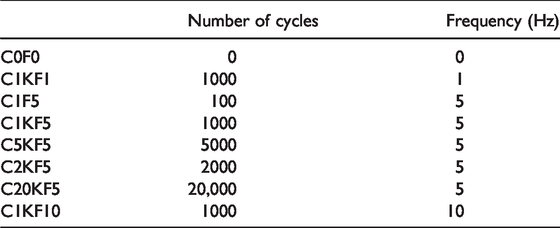
The electrical output of samples, as an important parameter to determine the performance of piezoelectric devices, was examined by the PiezoTester (Functional Fibrous Materials Lab, http://ffm.aut.ac.ir) [22] at a constant load (2.66 N) and compressive mode with different frequencies and cycles. Samples, which were prepared from a 3 × 3 cm nanofiber mats as an active layer, were placed between two aluminum foils as collectors (Figure 1) and fixed by a very thin tape. Shirley fabric thickness tester, model SDL34 (based on ASTM D1777), was used to measure the thickness of the layers (results are shown in Supplementary data, S2). The samples were named based on the number of cycles and frequency (Table 1), and their mechanical and crystalline properties were examined after loading.

Schematic view of PVDF micro-nano fiber mats prepared as an energy harvester device to test electrical output by the PiezoTester.
Naming the samples based on the number of cycles and frequency of the applied load.
The mechanical behavior of the mats was measured by an Instron 5566 universal testing systems instrument (stretching speed: 5 mm/min, load cell: 50 N) and DMTA (Eplexor© 100 N – Gabo) at a constant temperature based on Choia method [44].
Result and discussion
Monotonously, properties of micro-nano fibrous mats come from their uniform and beadless webs, so the morphology of nanofibers was first evaluated. The optimized electrospinning conditions were then defined to produce samples. As can be seen in Figure 2, the fabricated mat has an appropriate and uniform structure, and the mean diameter of fibers is 620 nm.

Scanning electron microscope images of the fabricated web with mean fibers diameter of 620 nm (more details are in Supplementary data, S1).
In order to evaluate piezoelectric performance, samples were tested at different cycles and frequencies, and their outputs were evaluated using the PiezoTester. The measured outputs were divided by the load value to calculate the sensitivity of the samples. As plotted in Figure 3 (and Supplementary data, S2), at a constant load and given frequency, the output increases with a steep slope by rising of cycles number and then it reaches to a saturated level with a very gentle slope. Indeed, a logarithmic trend was observed at the output by increasing the number of cycles.
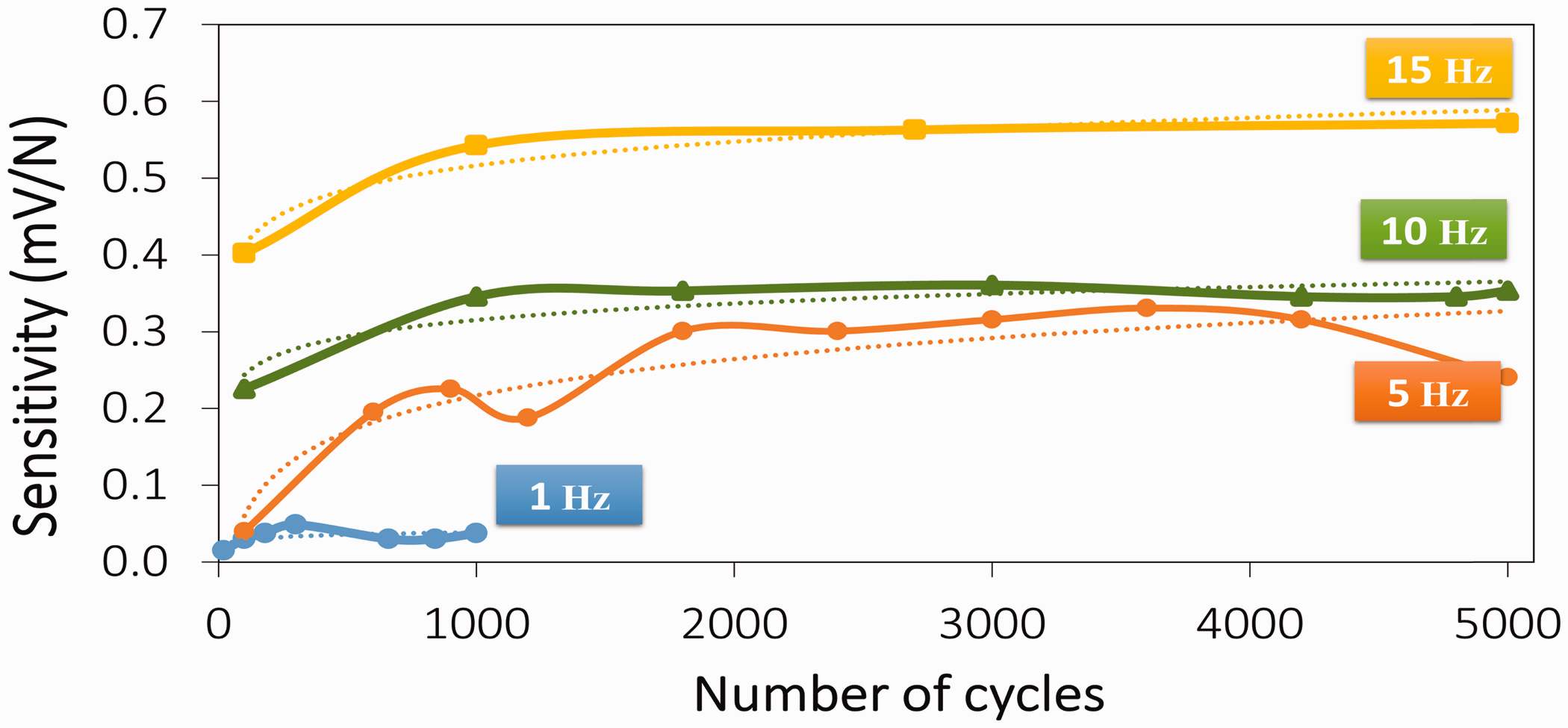
The trend of sensitivity as an electrical output property by the varying number of cycles at different frequencies (more details are in Supplementary data, S2).
The trend of the results can be depicted from several perspectives. The first issue changes the thickness of samples which is caused by loading. Every deformation in nanofiber meshes can be divided into two parts: the deformation of the structure and the deformation of constructive components. In order to generate piezoelectric output, it is necessary to induce a piezoelectric material (here are nanofibers) by a stress/strain. When a nanofiber mat is compacted during loading by increasing the number of cycles, the structural deformation of mat reduces, and the distortion of PVDF fibers increases. As time passes, the layer is compacted and the output increases; but this compactness has a limitation, and it leads to a drop at the slope of the plot. To investigate more in depth this phenomena, the DMTA test was performed on two samples with different thicknesses, and the energy damping was measured. Damping can be defined as the dissipation of energy in material under a cyclic load, and the measure of how well a material can dissipate the energy which is reported as the tangent of the phase angle [45].
As can be seen in Figure 4, the thicker specimen has higher energy damping, and damping reduces by increasing the frequency. Thus, by compacting the sample, energy losses will be dropped, and more deformation will be applied to the PVDF electrospun fibers; therefore, more voltage can be generated on both sides of the layers. The difference in energy damping also comes from the viscoelastic nature of the polymer. The thicker layers contain more polymers, so that more energy will be absorbed without any deformation. For this reason, as the thickness of fiber layers increases, the output does not increase linearly. The results also show that the tan δ and energy damping falls as the frequency increases. Therefore, an increase in the frequency of applied forces leads to improvement in the electrical output of the nanogenerator device. It is clear that the frequency variations cause a change in electrical properties of the samples, such as the impedance; however, because of the low-frequency range in this study, these changes in the electrical properties were negligible.
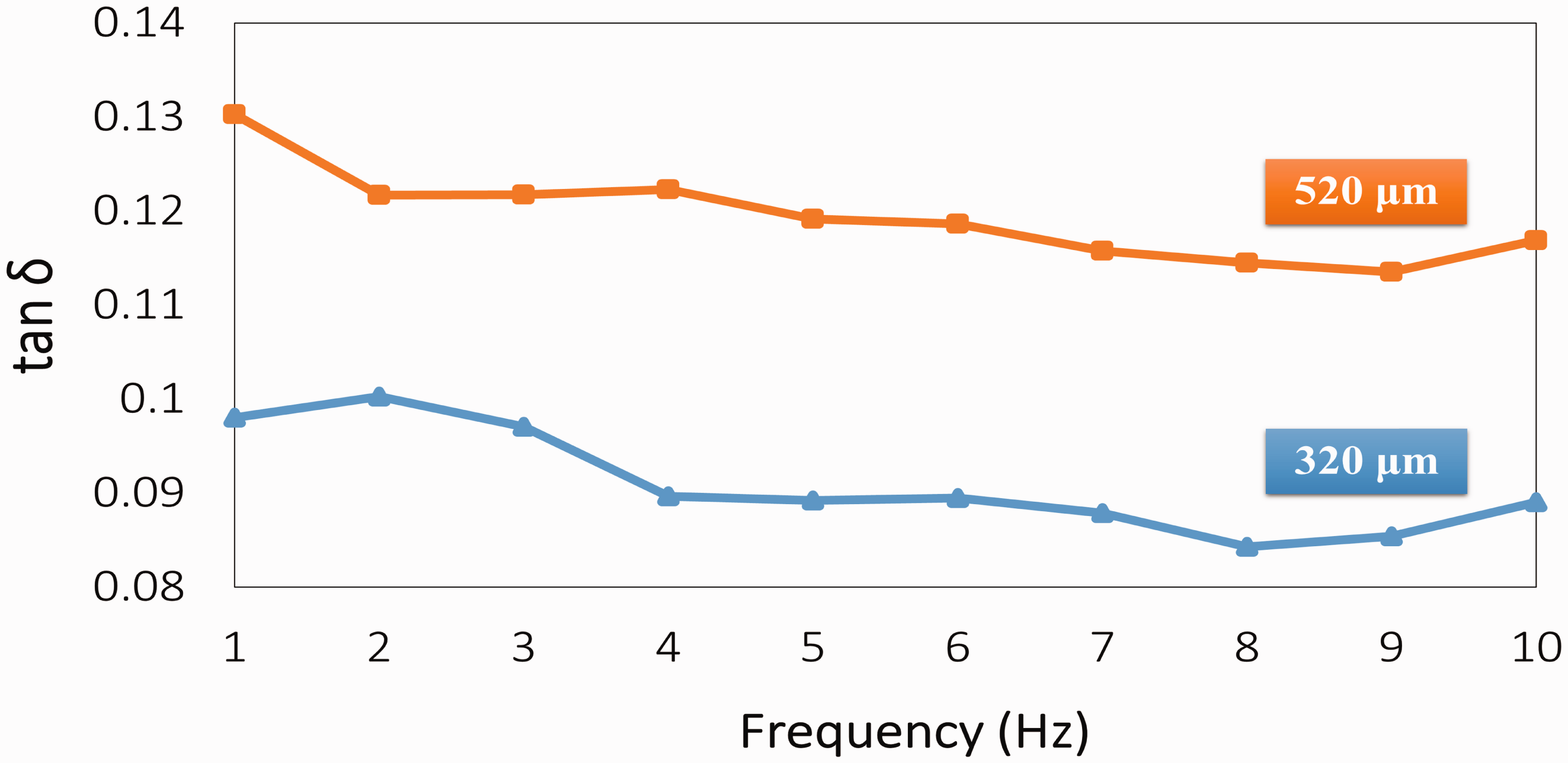
Effect of thickness on energy damping (tan δ), measured by DMTA in compressive mode (frequency sweeps from 1 to 10 Hz), sample C0F0 with a difference in the number of layers (320 µm: three layers, 520 µm: five layers).
The nature of the polymer is another reason for the changes in the electrical output imposed by the compressive forces. As previously stated, PVDF is a semi-crystalline polymer, and the β-phase is the most important phase in its piezoelectric properties. DSC tests were performed to investigate the deviations of nanofibers crystallinity due to the loading. As it can be seen in Figure 5, the crystallinity of the fibrous layers changes from 44.63% (for unloaded sample—C0F0) to 45.95 and 56.15% after 2000 and 20,000 cycles loading, respectively (C2KF5 and C20KF5). DSC results of PVDF nanofiber layers exposed to different cycles (0, 2000, and 20,000 cycles) at 5 Hz frequency and 2.66 N periodic pressure load (1.66 kPa): (a) heat flow diagrams and (b) crystallinity percentage of samples.

FTIR diagram of PVDF nanofiber layers exposed to different cycles at 5 Hz frequency and 2.66 N periodic pressure load (1.66 kPa).
FTIR results for samples exposed to different cycles.

In addition to the aforementioned reasons, another reason for changing in electrical output can be attributed to the inner stresses of the mats and nanofibers which are presumably changed during the loading. Internal stress particularly in nanofibers, which piezoelectric properties are mainly induced by crystal lattices distortion, has a great effect on the piezoelectric performance [48,49].
The effect of the cyclic compressive load on the mechanical properties of the layers was also investigated. As can be seen in Figure 7, by applying the cyclic pressure load, the elongating at the break and the tensile strength are significantly changed. At a constant frequency, by increasing the number of cycles, the tensile strength increases from 4.92 MPa (C0F0) to 6.0, 6.53, and 6.91 MPa for C1F5, C1KF5, and C5KF5, respectively. Contrary to this, at a constant cycle, the tensile strength has a smooth diminution from 6.47 MPa (C1KF1) to 6.32 MPa (C1KF10). These results show that by increasing the frequency, the nanofiber structure reaches to its fatigue point faster.
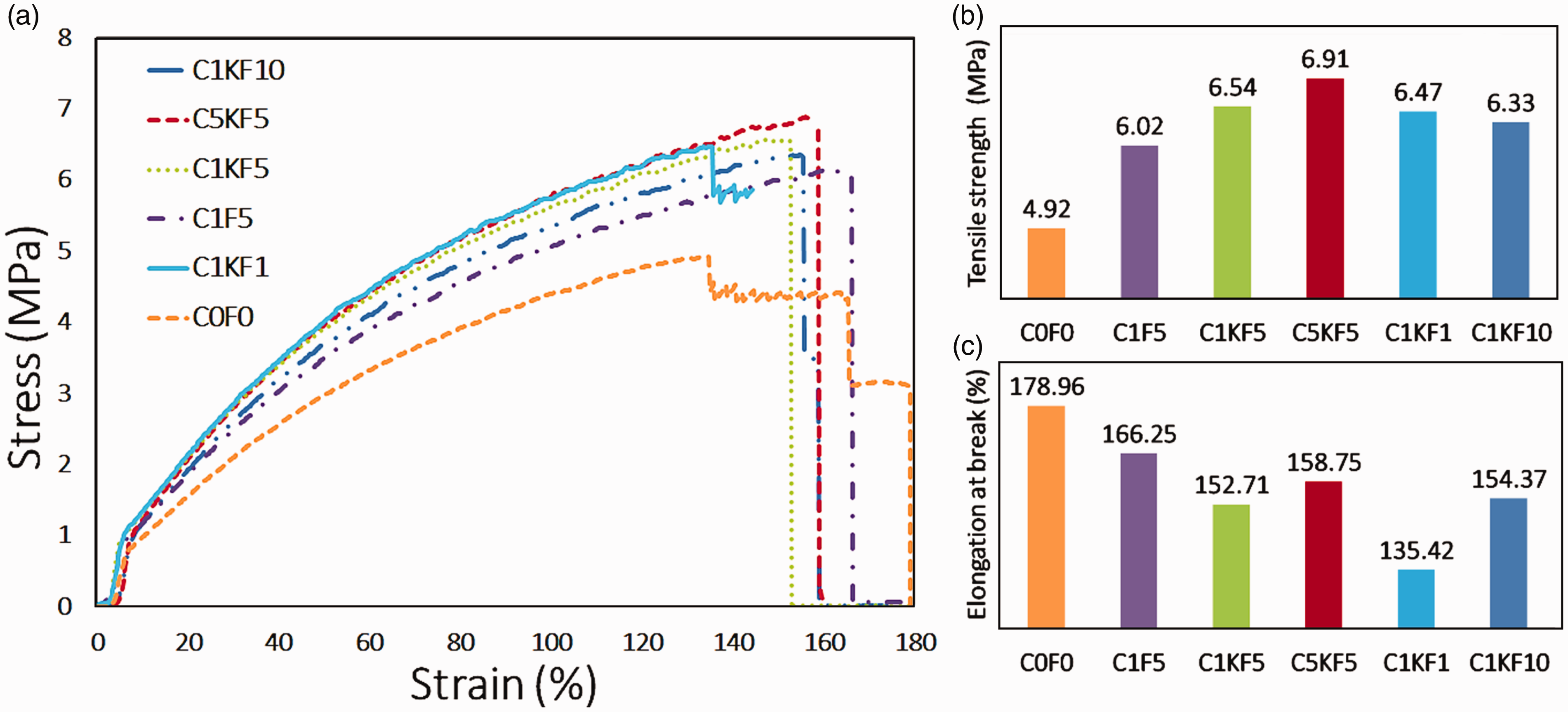
Results of tensile test: (a) stress–strain curves of samples which were placed under a constant compressive load with various frequencies and cycles; (b) tensile strength values of samples, c) elongations at break of samples.
The remarkable point in the results of mechanical tests is how the nanofiber webs break. The web, which has not been subjected to any compressive forces (C0F0), breaks in multiple stages. Initially, after applying the tensile stress to the nanofibers web, due to the poor connection between the nanofibers, the structure will be slid. But because of the low speed of the tensile test and the good adhesion of nanofibers which comes from their high surface to volume ratio, re-bonding will be occurred among the fibers. Thus, the web keeps its structure, and the stress will be transferred to the fibers again. As the tensile increases, this happens again until the fibers are broken, and the web is completely ruptured. But as a result of the compression created on the web, meshes were tightly pressed into each other, and the fibers become tighter in their position in the web structure. For this reason, in addition to increasing strength, friction does not occur, and in turn, the elongation reduces.
Conclusion
In this paper, in order to identify the lifetime of energy scavenging devices, the effect of a cyclic compressive load on the performance of PVDF micro-nano fibrous layers was investigated. To achieve this aim, the electrical output of layers was measured at different cycles and frequencies of applying load to determine the effect of the frequency and the number of cycles. The results showed that the loading made compression in layers, which reduced the damping and the energy loss (structural improvement). As a result, the main part of the applied force was spent on the deformation followed by increasing the piezoelectric output. Moreover, the periodic compressive force improved the crystalline structure and increased the percentage of β-phase. The results also showed that as the layer thickness increased, the amount of energy losses increased. For this reason, with the increase in the thickness of the piezoelectric layer, particularly, PVDF, which is a viscoelastic polymer, the output value did not increase linearly. The DMTA also showed that by increasing the frequency of the load, the energy damping was reduced, and it explained the output increase by increasing the frequency. It is clear that the frequency variations cause a change in electrical properties of the samples such as the impedance, but because of the low-frequency range, in this study, these changes in the electrical properties were negligible. This study revealed that, although the PVDF electrospun micro-nano fibers have suitable piezoelectric properties, it is necessary to make some post-treatment on layers and devices to fabricate an energy harvester with sustainable and monotonous performance. The prepared energy harvester also performs well up to 20,000 cycles. In addition, the results of mechanical properties showed that when the number of cycles at a constant frequency increased, the tensile strength increased, and the elongation at break decreased.
Supplemental Material
sj-pdf-1-jit-10.1177_1528083720915835 - Supplemental material for Expected lifetime of fibrous nanogenerator exposed to cyclic compressive pressure
Supplemental material, sj-pdf-1-jit-10.1177_1528083720915835 for Expected lifetime of fibrous nanogenerator exposed to cyclic compressive pressure by Mohammad Sajad Sorayani Bafqi, Masoud Latifi, Abdol-Hossein Sadeghi and Roohollah Bagherzadeh in Journal of Industrial Textiles
Footnotes
Declaration of conflicting interests
The author(s) declared no potential conflicts of interest with respect to the research, authorship, and/or publication of this article.
Funding
The author(s) disclosed receipt of the following financial support for the research, authorship, and/or publication of this article: Amirkabir University of Technology and The Iran National Science Foundation (INSF, Grant No. 92004158).

Supplemental material
Supplemental material for this article is available online.
References
Supplementary Material
Please find the following supplemental material available below.
For Open Access articles published under a Creative Commons License, all supplemental material carries the same license as the article it is associated with.
For non-Open Access articles published, all supplemental material carries a non-exclusive license, and permission requests for re-use of supplemental material or any part of supplemental material shall be sent directly to the copyright owner as specified in the copyright notice associated with the article.
