




Abstract
In recreant years, the attention of researchers has been focused on enhancing the electrical outputs of energy harvesting devices. This study reports the generation and characterization of electrospun polyvinylidene fluoride (PVDF) nanofiber webs obtained from different solvents (Acetone (ACE), ACE: N, N-dimethylformamide (DMF) /3:1, ACE: DMF/1:1, ACE: DMF/1:3, and DMF). These electrospun webs will be used as active layers for piezoelectric nanogenerator (PENG). We found that fibers electrospun using DMF have the highest phase content (F(β)), while fibers electrospun using ACE have the lowest one. Furthermore, the results show that PENG based on fiber web electrospun using DMF has the highest electrical outputs, whereas, the lowest electrical outputs were for PENG based on fiber web electrospun using ACE. We believe this work can serve as a good reference for investigating the effect of solvent systems on diameters of fibers, crystalline phases, and piezoelectric properties.
Introduction
In recent years, energy harvesters have been attracting the attention of researchers and scientists as noticeable by expanding the number of publications and the development of product prototypes.1 –8
Running portable electronic devices with batteries such as sensors, watches, light-emitting diodes, and so on has obstacles because of batteries disadvantages such as the need to recharge or replace them, occupying a significant percentage and weight of portable products, and dangerous environmental impact.8,9 Consequently, the best choice for exceeding these difficulties is using energy harvesters which are defined as devices that collect energy from the surrounding environment and convert it into electric power for later use.10,11
Piezoelectric materials can generate electrical energy when subjected to mechanical deformation.12 –14 Piezoelectric polymers have many advantages due to their lightweight, flexibility, and simple manufacturing process compared with other piezoelectric materials.15,16 Therefore, they are used for various applications such as wearable sensors, actuators, artificial skin, energy harvesting, drug delivery, wound healing, and so on.8,17 –23
Polyvinylidene fluoride (PVDF) which is a semi-crystalline polymer with a molecular structure [C2H2F2]n is considered the most important piezoelectric polymer thanks to its excellent piezo-, pyro-, and ferroelectric properties, outstanding mechanical properties, low cost, low density, high flexibility, good chemical stability, ability to be generated in different surface morphologies, and so on.24,25
PVDF can be found in different polymorphs (α, β, γ, δ, and ε). The β, γ, and δ are the polar phases while the α and ε are non-polar phases. 26 Generally, there is a positive relationship between the piezoelectric response of the PVDF and β phase content [F(β)] because the β-phase has all-trans planar zigzag chain conformation (TTTT).27,28 However, improving the F (β) of PVDF fiber webs is still a big challenge for researchers. Different methods were used to improve the F(β) of PVDF such as plasticizer treatment, 29 mechanical drawing,30,31 thermal treatment, 32 electrospinning, 33 hydrated salt, 34 the inclusion of nanofillers,35,36 electric poling, 37 and so on. 38
Electrospinning is an effective method for fabricating nonwoven fiber webs with fiber diameters ranging to a few hundred nanometers, as well as enhancing the F (β) of PVDF webs at the same time because poling and stretching the polymer jet at high applied voltage during the electrospinning process orientate the dipoles of PVDF molecular chains, leads to a further transformation of α to β crystalline phase. 39 Electrospun fibers have outstanding properties such as low density,40,41 high specific surface area,42,43 good pore structures,44,45 tiny diameters,46,47 excellent mechanical properties,48,49 and so on. Therefore, they can be used in multiple applications.50 –52
Previously, our group studied the influence of surface morphology on the piezoelectric properties of PVDF fiber that can be used directly as active layers to form a piezoelectric nanogenerator (PENG). We found that the PENG based on the aligned wrinkled fiber web has the highest electrical outputs owing to their high F(β), pillar wrinkled surfaces, fewer air gaps between the fibers, and interior pores. 2
In addition, we demonstrated the effect of plasticizer treatment on the electrical outputs of PENG based on PVDF fiber webs. The results showed that the F(β) was enhanced after plasticizer treatment resulting in improving the electrical outputs of PENG owing to the interaction between a plasticizer and PVDF. 29
Furthermore, we explored the effect of the molecular weight of electrospun PVDF nanofibers on the electrical outputs of the PENG-based. We noticed that increasing the molecular weight leads to enhancing the F (β) due to their high F (β) and high roughness. 53
The main objective of this study is to explore the relationship between the solvent system and the electrical output of PENG based on the electrospun PVDF nanofibers web.
To the best of our knowledge, up to now, no study has comprehensively studied the effect of the solvent systems (single solvent system and binary solvent system) on the piezoelectric properties of PVDF fiber webs. We report the formation of PVDF fiber webs using both high boiling point solvent (HBPS), low boiling point solvent (LBPS), and HBPS/ LBPS and studied their piezoelectric properties (Table 1). In addition, we designed a PENG based on PVDF nanofiber webs electrospun using different solvent systems and measured its electrical outputs.
The basic properties of solvents. 54

Experimental
Materials
PVDF pellets (Mw = 530,000 gmol−1) were purchased from Sigma-Aldrich, USA. Acetone (ACE) and N, N-dimethylformamide (DMF) were bought from Shanghai Chemical Reagents Co., Ltd, China. All chemicals were used as received.
Electrospinning
18% (w/v) PVDF pellets were dissolved in ACE, DMF, and ACE/ DMF at different solvent ratios (3:1, 1:1, and 1:3). Then, the solution was loaded into a plastic syringe. A syringe needle (21 gauge) was used as the spinneret, which was fixed on a syringe pump (single-syringe infusion pump KDS 100, KDmScientific Inc., Holliston, USA). A high-voltage supplier (high-voltage direct-current power supply, DW-P503-2ACDE, Tianjin Dongwen Co., Ltd., Tianjin, China) was connected to the syringe needle (Figure 1). The solution concentration was presented as weight/volume ratio (w/v%). To keep the electrospinning process under control, electrospinning parameters were adjusted at the needle to collector distance, flow rate, applied voltage, temperature, and relative humidity (RH), and were adjusted at 18 cm, 1.5 ml/h, 18 kV, 22°C, and 60%, respectively.

Schematic diagrams demonstrating the electrospinning technique.
Fabrication PENG
It consists of an active layer of PVDF nanofiber web with a thickness and working area of 100 μm and 15 cm2, respectively. Fabric electrodes were selected to increase the friction between them and the PVDF nanofiber web. The electrodes were brushed with a silver paste to ensure the electrical connection. For the electric contacts, copper wires were adhered using a double-sided carbon adhesive tape. To prove the protection, the whole sensor was completely packaged with the polyurethane (PU).
Characterization
The surface morphology of the electrospun PVDF fibers was detected under field emission scanning electron microscopy (FE-SEM, S–4800 Hitachi, Japan). Fiber diameter was measured using image analysis software (Adobe Acrobat X Pro 10.1.2.45). X-ray diffraction (XRD) was carried out on a diffractometer (Panalytical XRD, Netherland) using Cu radiation 1.54 Å. All samples were scanned in the 2θ range of 5° to 30°. Fourier transform infrared (FTIR, USA) spectra were recorded on a Bruker Optics spectroscopy in ATR mode. Differential scanning calorimetry (DSC, USA) was measured by heating the samples from 40°C to 190°C at the heating rate of 10 °C/min in nitrogen atmosphere. The thickness of the webs was checked using a micrometer (Anytime, USA). The open-circuit voltage and the short-circuit current of the PENGs with the working area of 15 cm2 were measured via an oscilloscope (LeCroy, Wavesurfer 104MXs-B, USA) and current preamplifiers (Stanford Research SR570, USA), respectively, under impacts frequency of 5 Hz, peak force of 10 N. Periodic force of 10 N was applied to the samples with a Mark-10 ESM 303 force tester fitted with an M5-500 force gauge and flat compression plates.
Results and discussion
Solvent systems
To discover the relationship between solvent systems and piezoelectric properties of electrospun PVDF nanofibers, 18% of PVDF pellets were dissolved in both single solvent system and binary solvent system. DMF which is classified as a good solvent for PVDF was used as a single solvent system, while ACE which is categorized as a poor solvent for PVDF was used also as a single solvent system, whereas ACE/DMF at different solvent ratios (3:1, 1:1, 1:3) were used as binary solvent system. 55
The results showed that the diameter of fibers obtained using ACE was 1639 ± 143 nm, while the diameter of fibers formed using ACE/DMF at the solvent ratios of 3:1, 1:1, 1:3 was 1533 ± 132 nm, 1221 ± 113 nm,773 ± 51 nm, respectively, whereas, the diameter of fibers generated using DMF was 592 ± 45 nm (Figure 2). It can be noticed the diameter of fibers increased by increasing the ratio of LBPS (ACE) owing to its fast evaporation rate during the traveling from the tip to the collector. 55
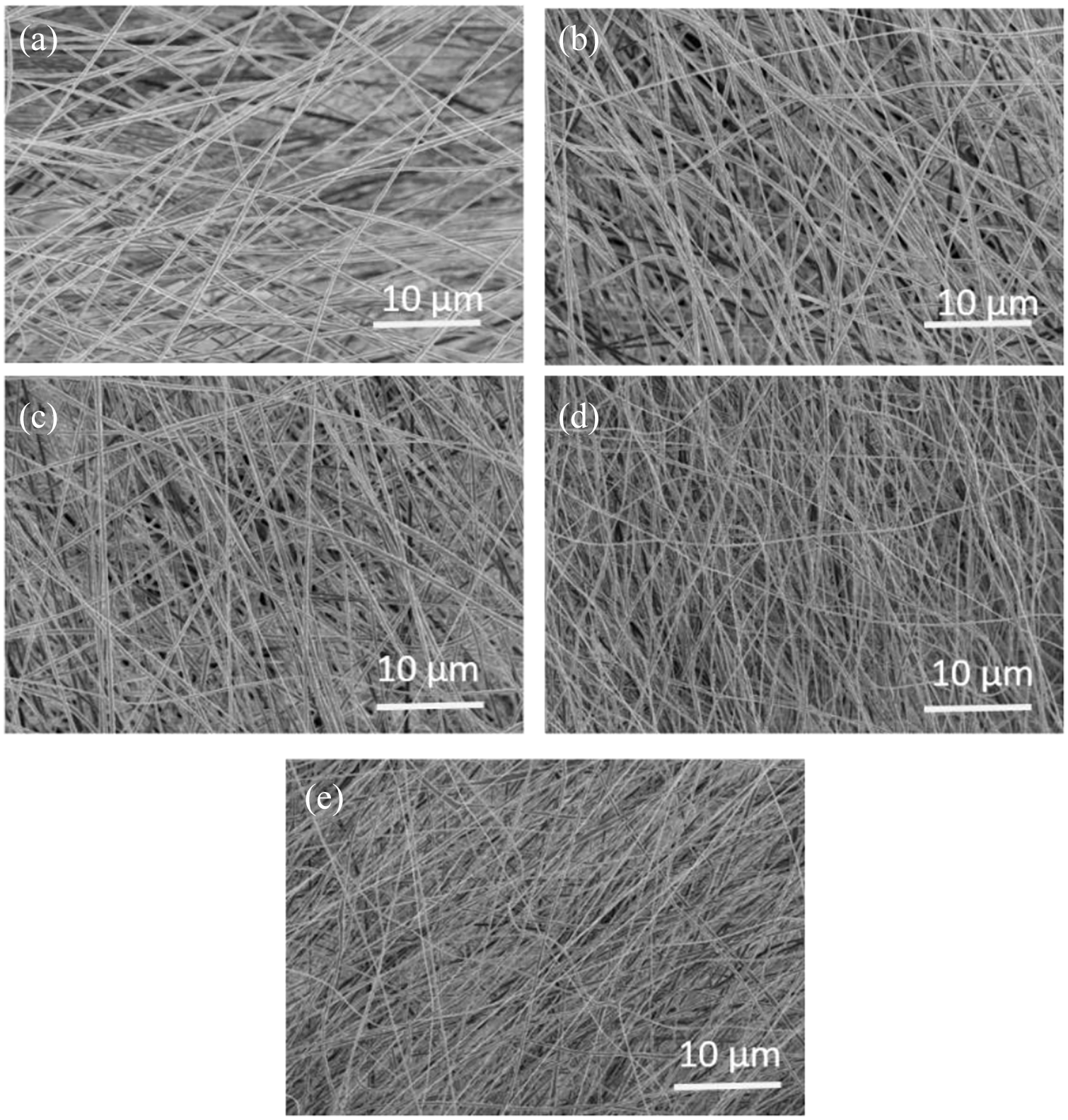
SEM images of PVDF nanofibers electrospun using different solvents: (a) ACE, (b) ACE:DMF/3:1, (c) ACE:DMF/ 1:1, (d) ACE:DMF/1:3, and (e) DMF.
Crystalline phase characterization
To detect the effect of the solvent systems on the crystalline phases of the electrospun PVDF nanofibers webs, the crystal structure of samples electrospun using different solvents was checked. The XRD patterns of electrospun PVDF nanofibers formed using different solvents are shown in Figure 3(a). The results showed peak at 2θ = 18.4° which refers to α phase corresponding to the (020) crystal plane, and peak at 2θ = 20.6° which refers to β phase corresponding to the (110) and (200) plane. The sample electrospun using DMF showed the highest intensity of β crystal phase, while the sample electrospun using ACE exhibited the lowest one. FTIR spectrophotometry was used to confirm the crystal phase structure of studied samples.

(a) XRD patterns for the PVDF nanofiber webs electrospun at different solvents, (b) FTIR spectra for PVDF nanofiber webs electrospun at different solvents, (c) DSC for PVDF fiber webs electrospun at different solvents, and (d) ∆Xc and F(β) for PVDF nanofiber webs electrospun at different solvents.
Figure 3(b) exhibited that the characteristic bands of the α phase crystals had been observed at bands of 762 and 976 cm−1, while β phase crystals had been identified at 840 cm−1 (CH2 rocking) and 1274 cm−1 (trans band). PVDF can be existed in different polymorphs: α and δ phases trans-gauche–trans-gauche (TGTG′), β phase all trans (TTTT), and (T3GT3G′) for γ and ε phases. It is worth mentioning that there is a positive relationship between the F (β) of the PVDF fibers and the piezoelectric response. F(β)of the studied samples can be calculated this using equation 56 :
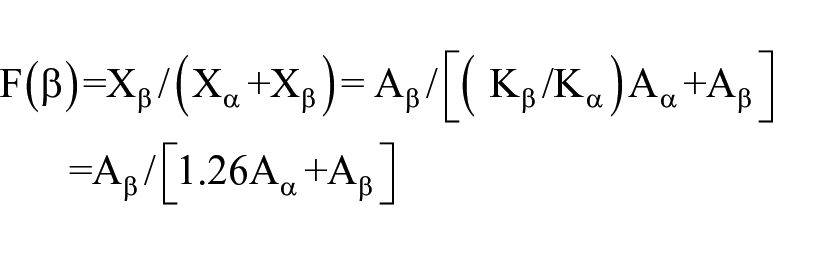
Where Xα and Xβ are the crystalline rate of α and β phases, respectively. Aα and Aβ represent the height of absorption bands at 762 and 840 cm−1, respectively. Kα = 6.1 × 104 cm2/mol and Kβ = 7.7 × 104 cm2/mol are the absorption coefficients at the respective wavenumber.
F (β) was 70.13% for sample electrospun using ACE, 81.79%, 83.28%, and 88.14% for samples formed using ACE/DMF at the solvent ratios 3:1, 1:1, and 1:3, respectively, and 93.88% for sample generated using DMF. To determine the crystallinity of samples (ΔXc), DSC analysis was used (Figure 3(c)). ΔXc content can be calculated using this equation 56 :

Where, ∆Xm is the melting enthalpy of the sample; ∆Xα = 93.07 Jg−1 and ∆Xβ = 103.4 Jg−1 are the melting enthalpy of a 100% crystalline sample in α and β phases, respectively, while X and Y are the amount of α and β phases in the sample, respectively.
ΔXc content was 48.27% for samples formed using ACE, 50.28%, 52.89%, and 54.78% for samples electrospun using ACE/DMF at the solvent ratios 3:1, 1:1, and 1:3, respectively, and 59.19% for the sample obtained using DMF.
It should be noted that the ΔXc as well as the F (β) increase when the ratio of HBPS increases thanks to the enhanced degree of molecular orientation during the electrospinning of the PVDF fibers (Figure 3(d)). In other words, ΔXc and F (β) improve by increasing the time of evaporation solvents. 53 The F (β) and ΔXc content of all of the fiber webs formed are listed in Table 2.
β Phase content and crystallinity of electrospun PVDF nanofiber webs electrospun using different solvents.

Piezoelectric effect of PVDF nanofiber webs electrospun at different solvents
To discover the influence of solvent systems on piezoelectric properties of the PENG, five PENGs based on PVDF fiber web electrospun using ACE, ACE/DMF:3/1, ACE/DMF:1/1, ACE/DMF:1/3, and DMF were fabricated. For comparison, each PENG consists of a small piece of PVDF fiber web with a thickness of 100 μm and a working area of 15 cm2 and was positioned between conductive fabric electrodes. For the electric contacts, copper wires were used. In addition, the PENG was covered by the PU to protect it, improve its mechanical properties, and protect us from electrical noises (Figure 4(a) and (b)). For a perfect comparison, all PENGs were tested at the same repeated compressive impacts (peak force 10 N and frequency 5 Hz). The results indicated that the voltage and current outputs of the PENGs were 0.98 V and 1.23 μA using ACE, 1.43 V and 1.41 μA using ACE/DMF:3:1, 1.61 V and 2.21 μA using ACE/DMF:1:1, 2.11 V and 2.87 μA using ACE/DMF:1/3, 2.72 V and 3.35 μA using DMF (Figure 4(c) and (d)). Herein, it is obvious that the electrical outputs of PENG increased by increasing the ratio of HBPS (Table 3). These results should be attributed to the high F(β) of samples. 34 The highest electrical outputs of the PENG based on the PVDF nanofibers electrospun using DMF solvent should be attributed to its high F(β), and tiny diameter of fibers.
The electrical outputs of electrospun PVDF nanofiber webs electrospun using different solvents.


(a) Schematic diagram of the PENG, (b) digital photo of the actual PENG, and (c and d) voltage and current outputs generated by the piezoelectric device based on the PVDF nanofiber webs electrospun at different solvents.
Conclusions
In summary, the effect of solvent systems (ACE, ACE: DMF/3:1, ACE: DMF/1:1, ACE: DMF/1:3, and DMF) on the electrical outputs of the PENG-based on electrospun PVDF nanofiber webs were demonstrated. The results exhibited that the F (β) and ΔXc of electrospun PVDF fiber webs can be enhanced using HBPS owing to enhancing the degree of molecular orientation during the electrospinning of the PVDF fibers. Furthermore, we found that the PENG based on PVDF fiber webs electrospun using DMF had the highest voltage and current outputs thanks to its high F (β) and small diameter of fibers. We believe our work may serve as an important reference for improving the voltage and current outputs of PENG.
Footnotes
Declaration of conflicting interests
The author declared no potential conflicts of interest with respect to the research, authorship, and/or publication of this article.
Funding
The author received no financial support for the research, authorship, and/or publication of this article.
