




Abstract
Energy scavenging has been attracting the consideration of researchers in recent years. In this study, the fabrication and characterization of electrospun randomly oriented and aligned grooved polyvinylidene fluoride (PVDF) and poly(vinylidenefluoride-co-trifluoroethylene) (PVDF-TrFE) fiber webs are studied. The fibers are generated with comparable diameters and the webs which are used as an active layer to directly make a piezoelectric nanogenerator are fabricated with the same thickness for accurate comparison. The results show that PVDF-TrFE fiber webs have better mechanical properties, crystallinity, and piezoelectric properties than PVDF fiber webs. Furthermore, the piezoelectric nanogenerator based on PVDF-TrFE fiber webs has higher electrical outputs than piezoelectric nanogenerator based on PVDF fiber webs owing to its high β phase content (F(β)). Moreover, the electrical outputs of the piezoelectric nanogenerator based on aligned fiber webs are higher than those based on randomly oriented fiber webs due to the increase in the friction area. We believe that our work can be served as a good reference for the comparison between the mechanical, physicochemical, and piezoelectric properties of PVDF and PVDF-TrFE fiber webs generated via electrospinning.
Introduction
In recent years, the demand for energy harvesters has been increasing sharply as obvious from the expanding product prototypes and the number of publications.1–5 Using batteries for running portable electronic devices has drawbacks because of the need to recharge or replace them, occupying an important percentage and weight of portable products, and causing a considerable environmental impact such as the probable seepage of electrolyte solutions.6–8 Energy scavenging (also known as energy harvesting or power generation) is defined as capturing different amounts of energy from surrounding environments and converting them into electric power for upcoming use.9,10 Organic materials are considered preferable materials for constructing flexible devices because of their low-cost manufacturing, lightweight, compatibility with biological systems, and mechanical flexibility. 11 Piezoelectric polymers are usually used for sensors, energy scavenging, artificial skin, and so on.12–15 Among the numerous piezoelectric polymers, polyvinylidene fluoride (PVDF) and its copolymer poly(vinylidenefluoride-co-trifluoroethylene) (PVDF-TrFE) have been used widely in the field of energy harvesting owing to their outstanding piezo-, pyro-, and ferroelectric properties, low cost, high flexibility, low density, and robust mechanical stability against repeated mechanical stress compared with inorganic materials.10,16,17 Both polymers are semi-crystalline polymers and they can exist in five polymorphs: (α, β, γ, δ, and ε).18,19 Generally, electrospun fibers have gained the awareness of researchers in different areas owing to their unique properties such as small diameters, flexibility, high specific surface area, their ability to be formed in different structures, and so on.20–27 In addition, poling and elongating of the polymers during the electrospinning process at a high applied voltage have the ability to orientate the dipoles of PVDF and PVDF-TrFE molecular chains, subsequent an extra transformation of α to β crystalline phase.28–30 It is worth mentioning that piezoelectricity of PVDF fiber webs and its copolymers can be enhanced by increasing their β crystalline phase and area density and regulating their surface morphology.10,31 Nonetheless, the comparison between the electrical outputs of the piezoelectric nanogenerators (PENGs) based on electrospun PVDF and PVDF-TrFE fibers webs have not been investigated yet.
The main objective of this work is to compare the mechanical properties, crystalline phases, and piezoelectric properties of electrospun PVDF and PVDF-TrFE fiber webs.
To the best of our knowledge, so far no studies have been comprehensively compared between physicochemical, mechanical, and piezoelectric properties of PVDF and PVDF-TrFE fiber webs formed via electrospinning. The results showed that PVDF-TrFE fiber webs have better mechanical properties (stress, elongation at break, and Young’s modulus), higher crystallinity, and piezoelectric properties than PVDF fiber webs. We believe this work can be used as a good reference for the comparison between the physicochemical, mechanical, and piezoelectric properties of electrospun PVDF and PVDF-TrFE fibers webs.
Experimental
Materials
PVDF pellets (Mw = 275,000 g/mol) and PVDF-TrFE (70/30 mol %) were purchased from Sigma-Aldrich, USA, and Piezotech, Arkema, respectively. Acetone (ACE), and N, N-dimethylformamide (DMF) were purchased from Shanghai Chemical Reagents Co., Ltd, China. Thermoplastic polyurethane (PU) was purchased from Shenzhen Huayang Plastics, China. All chemicals were used as received.
Electrospinning
After dissolving 24% PVDF and 24% PVDF-TrFE in ACE/DMF at the solvent ratio of 3/1, the solutions were loaded into a plastic syringe. The polymer concentrations and solvent ratio were selected to get grooved fibers with similar diameters. 32 The solution concentration was presented as weight/volume ratio (w/v %). A 21-gauge syringe needle was used as the spinneret, which was fixed on a syringe pump (KDS 100, KD Scientific Inc., USA) connected to a high-voltage supplier (Tianjin Dongwen Co., Ltd., China). A grounded drum collector (40 cm in length and 20 cm in diameter) was placed 18 cm away from the spinneret, and the rotating speed was set at 2 rpm to get randomly oriented fibers and at 2000 rpm to obtain aligned fibers (Figure 1). The thickness of the webs was controlled at ~100 μm for accurate comparison (Table S1). The electrospinning process was performed at the relative humidity of 65%, working temperature of 22°C, flow rate of 1.5 mL/h, and applied voltage of 18 kV, in order to get grooved fibers with comparable diameters.24,27

Schematic diagram of the electrospinning device used in this study.
Characterization
The surface morphology of electrospun fibers was detected under the field emission scanning electron microscopy (FE-SEM, S-4800 Hitachi, Japan). 5 FE-SEM images were taken for each sample tested. Fiber’s diameter was measured using image analysis software (Nano measurer 1.2). X-ray diffraction (XRD) was recorded on a diffractometer (Panalytical XRD, Netherland) using Cu radiation 1.54 Å. The samples were scanned in the 2θ range of 5° to 30°, Cu (40 kV, 150 mA), step 0.02°/0.06 s, and the speed of 20°/min. Fourier transform infrared (FTIR, USA) spectra were measured on a Bruker Optics spectroscopy in diamond crystal attenuated total reflectance (ATR) mode. The spectra were corrected for the atmosphere of H2O. Five specimens with one layer from different samples were checked for XRD and FTIR tests. Mechanical properties of the electrospun fiber webs were measured using an Instron Universal Testing Machine (5967, USA) at load cell of 50 N and a crosshead speed of 10 mm/min. Up to 10 specimens with dimensions (50 × 15) mm2 were tested for each group. The thickness of the webs was measured using a micrometer (Anytime, USA). Herein, glass coverslips (~9 cm2) between the measuring jaw were used to increase the contact area to reduce compression. Furthermore, we confirmed the accuracy measurement by cutting of membrane viewing of cross-section under a microscope. The open-circuit voltage of the PENG was measured via the oscilloscope (LeCroy, Wavesurfer 104MXs-B, USA) with the working area of 7.5 cm2. The short-circuit current of the PENG with the same working area was checked using the current preamplifiers (Stanford Research SR570, USA). The samples were tested under impacts frequency of ~1 Hz at the folding and releasing action of the elbow at angle ~90°. The PENG was attached to the elbow using adhesive tape, and the test was performed 90° movements by using a template with 90°.
Fabrication of self-powered monitoring devices
PENGs comprise of a small piece of fiber webs (PVDF and PVDF-TrFE) used as an active layer with a working area and thickness of ~7.5 cm2 and 100 μm, respectively. Two pieces of stretchable fabrics were used as electrodes after brushing them with a silver paste for electrical connection, whereas the copper wires were adhered for the electric contacts. Afterward, the whole generator was fully packaged with the thin thermoplastic polyurethane (PU) for protection.
Results and discussion
Surface structure of electrospun PVDF and PVDF-TrFE fibers
Piezoelectric PVDF and PVDF-TrFE fiber webs were electrospun and their surface morphologies were detected using FE-SEM analysis. Starting from the effect of area density and fiber diameters on the properties of electrospun fiber webs, randomly oriented and aligned grooved PVDF and PVDF-TrFE fibers with similar diameters were electrospun by adjusting the solvent system and polymer concentration (Figure 2).31,33 Grooved PVDF fibers appeared using 24% PVDF in ACE/DMF (3/1) (Figure 2(a) and (c)), while grooved PVDF-TrFE fibers formed using 24% PVDF-TrFE in ACE/DMF (3/1) (Figure 2(b) and (d)). The average diameter of the randomly oriented and aligned PVDF and PVDF-TrFE fibers is shown in Figures S1–S4.

SEM images of (a) randomly oriented grooved PVDF fibers, (b) randomly oriented grooved PVDF-TrFE fibers, (c) aligned grooved PVDF fibers, and (d) aligned grooved PVDF-TrFE fibers.
Crystalline phase characterization
The molecular structure of PVDF and PVDF-TrFE fiber webs is shown in Figure 3(a). The XRD patterns of randomly oriented and aligned grooved PVDF and PVDF-TrFE fibers are shown in Figure 3(b), (c). It has been known that the α phase showed peak at 2θ = 18.4°, corresponding to the (020) crystal plane, while the sum β phase exhibited peak at 2θ = 20.6°, corresponding to the (110) and (200) plane.28,34 The PVDF-TrFE fibers have a higher intensity of the β crystal phase than PVDF fibers. To confirm the crystal phase structure, FTIR spectrophotometry was used. As shown in Figure 4(a) and (b), characteristic bands of the β phase crystals had been identified at 840 cm−1 (CH2 rocking) and 1274 cm−1 (trans band), whereas α phase crystals had been observed at bands of 762 and 976 cm−1.34–37 Both of them can be found in five phases; α and δ phases (TGTG′) trans-gauche–trans-gauche, β phase (TTTT) all-trans, and (T3GT3G′) for γ and ε phases.38–42 Moreover, the β phase orientation of the PVDF and PVDF-TrFE polymer correlates with its piezoelectric response.9,42 The β phase content (F(β)) was calculated using the equation S1. The highest F(β) and the degree of crystallinity (∆Xc) were observed at aligned PVDF-TrFE fibers, while the lowest ones were observed at randomly oriented PVDF fibers (Table 1). These results should be ascribed to lower/reduced polarity of PVDF-TrFE compared with pure PVDF; therefore, the PVDF-TrFE typically has a much higher crystallinity. 43 Furthermore, the aligned fibers showed higher F(β) and ∆Xc than randomly oriented owing to the high rotation speed of the collector.9,44,45 In other words, the molecular chains in the polymer jets will be oriented and stretched more at a high rotation speed of the collector.
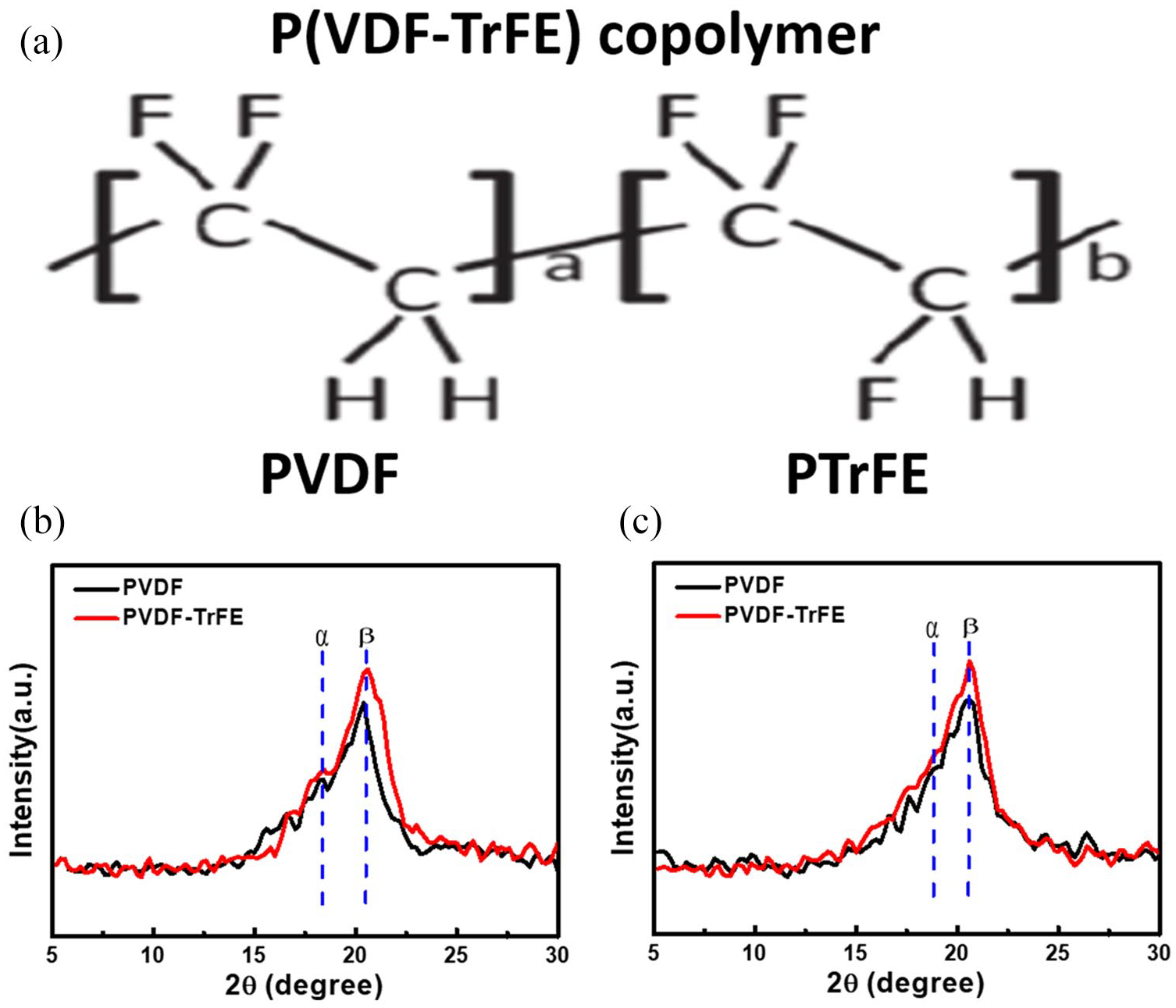
(a) Molecular structure of PVDF-TrFE. (b) XRD patterns of randomly oriented grooved PVDF and PVDF-TrFE fibers. (c) XRD patterns of aligned grooved PVDF and PVDF-TrFE fibers.
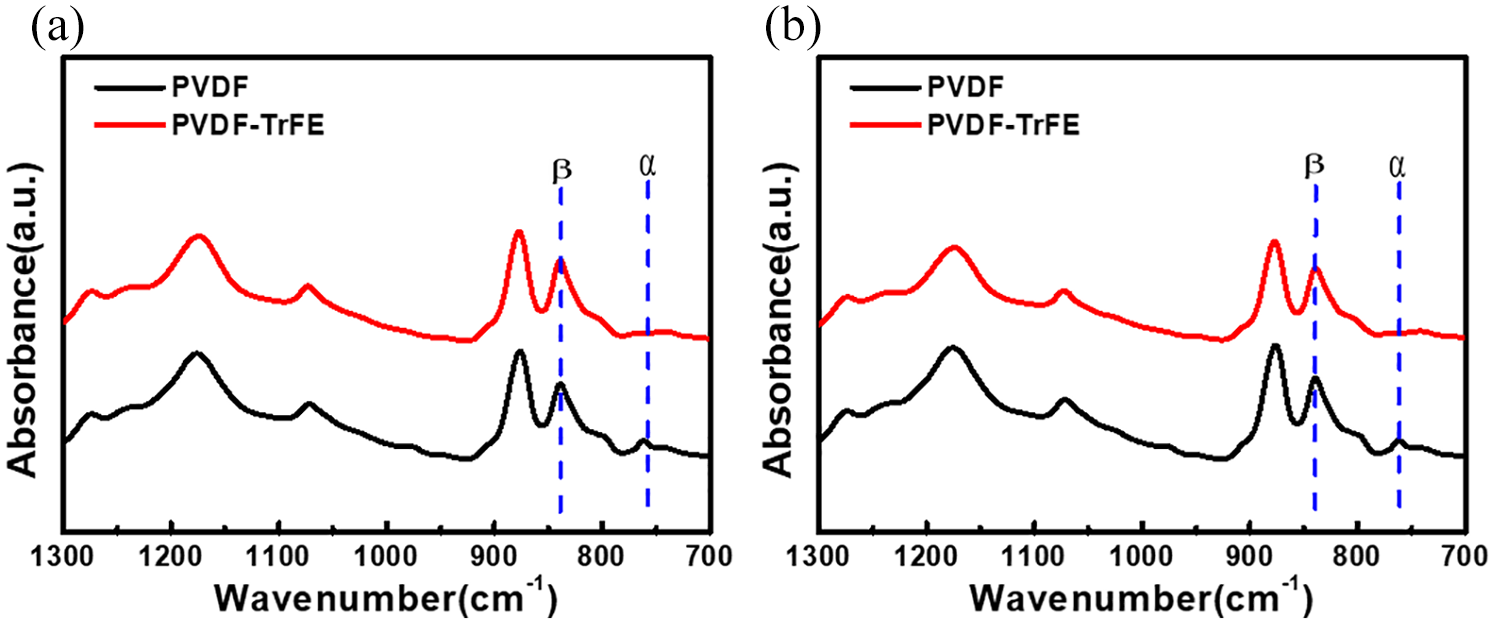
(a) FTIR spectra of randomly oriented grooved PVDF and PVDF-TrFE fibers. (b) FTIR spectra of aligned grooved PVDF and PVDF-TrFE fibers.
The F(β) and ∆Xc contents of electrospun grooved PVDF and PVDF-TrFE fibers.

PVDF: polyvinylidene fluoride.
Mechanical properties of PVDF and PVDF-TrFE fibers
Herein, the mechanical properties of randomly oriented and aligned grooved PVDF and PVDF-TrFE fiber webs are demonstrated. The stress-strain curves of randomly oriented and aligned PVDF and PVDF-TrFE fiber webs are presented in Figure 5(a) and (b). The fiber webs based on electrospun PVDF-TrFE fibers exhibited higher stress, strain, and Young’s modulus than those based on PVDF fibers (Table 2). These results should be ascribed to the positive relationship between the crystallinity and mechanical properties of polymers because in the crystalline phase, the intermolecular bonding is more significant. Hence, the polymer deformation can result in higher strength leading to oriented chains. 46 In addition, the fiber webs based on aligned fibers showed lower strain, higher stress and Young’s modulus than those based on randomly oriented fibers owing to orienting the axis of aligned fibers in one direction. 9
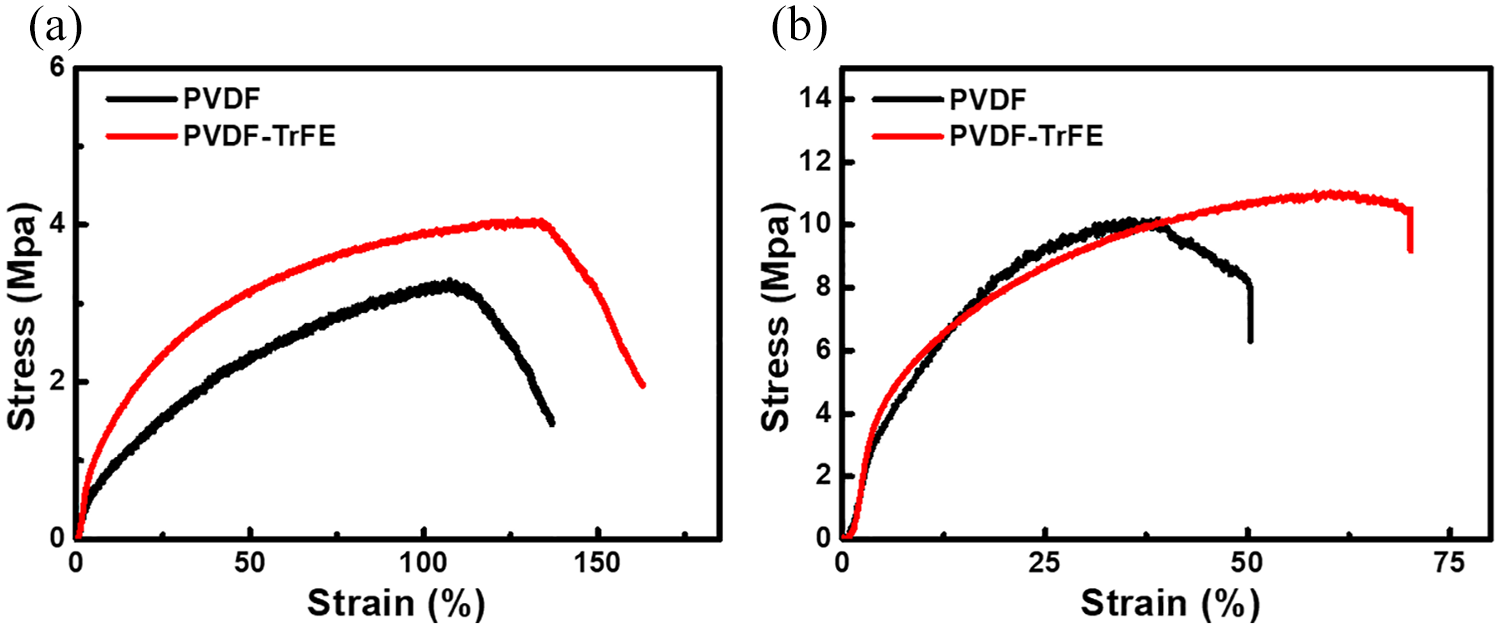
(a) A comparison of the tensile mechanical tests of randomly oriented grooved PVDF and PVDF-TrFE fibers. (b) A comparison of the tensile mechanical tests of aligned grooved PVDF and PVDF-TrFE fibers.
The mechanical properties of electrospun grooved PVDF and PVDF-TrFE fibers.

PVDF: polyvinylidene fluoride.
Piezoelectric effect of PVDF and PVDF-TrFE fibers
Figure 6(a) shows the schematic structure of our PENG. A small piece of PVDF and PVDF-TrFE fiber web with a working area of 7.5 cm2 and thickness of ~100 μm was placed between two pieces of conductive fabric electrodes, and the copper wires were agglutinated for the electric contacts. To protect the human body from undesired electrical noises, preserve the sensor from external weather factors, and enhance its mechanical properties, the PENG was encapsulated by the PU. For comparison, the PENG based on randomly oriented and aligned PVDF and PVDF-TrFE fiber webs were both tested at the same conditions. The PENG was attached to the human elbow to estimate its performance depending on the folding-releasing of an elbow for ~90°. The electrical outputs of the PENG based on randomly oriented fibers were ~0.33 V and ~260 nA for PVDF and ~0.56 V and ~329 nA for PVDF-TrFE, whereas the electrical outputs of the PENG based on aligned fibers were ~0.74 V and ~457 nA for PVDF and ~0.97 V and ~ 590 nA for PVDF-TrFE (Figure 6(b)–(d)). Generally, the electrical outputs of the PENG based on PVDF-TrFE fiber webs are higher than those based on PVDF fiber webs owing to their high F(β) and high roughness. 18 In addition, since the aligned fiber webs have high area density than randomly oriented fiber webs, the electrical outputs of the PENG based on aligned fiber webs are higher than those based on randomly oriented fiber webs owing to their high F(β) and high area density.9,31 In other words, aligned fibers webs have fewer air gaps (high friction area) comparing with randomly oriented fiber webs.

(a) Schematic structure of the PENG. (b) Voltage output generated by the PENG during the folding and releasing action of the elbow at angle ~90°. (c) Current output generated by the PENG during the folding and releasing action of the elbow at angle ~90°. (d) Statistical results of the average voltage and current outputs generated by the PENG during the folding and releasing action of the elbow at angle ~90°.
Conclusions
In summary, a comparative study between the mechanical properties, crystallinity, and piezoelectric properties of electrospun PVDF and PVDF-TrFE fiber webs were investigated in detail. The results showed that PVDF-TrFE fibers have higher crystallinity and F(β) than PVDF fibers because of the less polarity of PVDF-TrFE compared with pure PVDF. Moreover, the PVDF-TrFE fibers exhibited better mechanical (stress, elongation at break, and Young’s modulus) properties than PVDF fibers owing to the positive relationship between the mechanical properties of polymers and the crystallinity. Furthermore, the PENG based on aligned PVDF-TrFE fibers showed the highest electrical outputs under the folding and releasing the human elbow at ~90° and a frequency ~1 Hz owing to its high F(β) and fewer air gaps between the fibers. We believe this work can be used as a guide for investigating the mechanical, physiochemical, and piezoelectric properties of electrospun PVDF and PVDF-TrFE fibers.
Supplemental Material
Supporting_Information_5 – Supplemental material for A comparative study of electrospun polyvinylidene fluoride and poly(vinylidenefluoride-co-trifluoroethylene) fiber webs: Mechanical properties, crystallinity, and piezoelectric properties
Supplemental material, Supporting_Information_5 for A comparative study of electrospun polyvinylidene fluoride and poly(vinylidenefluoride-co-trifluoroethylene) fiber webs: Mechanical properties, crystallinity, and piezoelectric properties by Wenxin Zhang, Bilal Zaarour, Lei Zhu, Chen Huang, Bugao Xu and Xiangyu Jin in Journal of Engineered Fibers and Fabrics
Footnotes
Author contributions
B. Zaarour and W. Zhang contributed equally to this work. B. Zaarour, W. Zhang, and X. Jin conceived the original concept. B. Zaarour and W. Zhang designed the manuscript. W. Zhang conducted the experiments, and analyzed the data. B. Zaarour wrote the manuscript. B. Zaarour, W. Zhang, L. Zhu, C. Huang, B. Xu, and X. Jin revised the manuscript.
Declaration of conflicting interests
The author(s) declared no potential conflicts of interest with respect to the research, authorship, and/or publication of this article.
Funding
The author(s) disclosed receipt of the following financial support for the research, authorship, and/or publication of this article: The work is supported by the Fundamental Research Funds for the Central Universities and Graduate Student Innovation Fund of Donghua University (CUSF-DH-D-2020016), the National Key Laboratory Foundation (ZR1903), the National Natural Science Foundation of China (51403033), “Chen Guang” Project sponsored by Shanghai Municipal Education Commission and Shanghai Education Development Foundation (14CG34) and the Fundamental Research Funds for the Central Universities.
Supplemental material
Supplemental material for this article is available online.

References
Supplementary Material
Please find the following supplemental material available below.
For Open Access articles published under a Creative Commons License, all supplemental material carries the same license as the article it is associated with.
For non-Open Access articles published, all supplemental material carries a non-exclusive license, and permission requests for re-use of supplemental material or any part of supplemental material shall be sent directly to the copyright owner as specified in the copyright notice associated with the article.
