




Abstract
This research presents an engineering approach to fabricate multilayered electrospun nanofiber mats with high conversion performance of mechanical to electrical energy as well as improved physical stability. Electrospun polyvinylidene fluoride nanofiber webs were prepared with predefined nanofiber alignments. Fiber alignments and layer-by-layer deposition angles are considered as a tool to adjust the piezoelectric responses of multi-layered fibrous mats. Samples with optimized drum speed and maximum aligned nanofibers were utilized to fabricate multi-layered mats in different layering angles from the fiber direction of base layer (0°, 30°, 60°, 90°, 120°, 150°, and 180
Introduction
Energy harvesting technology has attracted significant attention, because such devices are becoming smaller and lower-powered. Many research groups have been studying piezoelectric harvesting technology for converting mechanical vibrations into electric energy because of its outstanding power density. Many of these research studies have made performance improvements on the piezoelectric constant of active layers and/or the efficiency of charge transport [1].
It is believed that generator devices made of aligned fibers perform with improved electrical response compared to those with randomly orientated fibers. There are various methods for producing nano-web piezoelectric layer made of aligned nanofibers, one of the most common of which is the use of rotary drum for aligned nanofibers production [2]. The rotary drum method use to produce fibers with different alignment by changes in the speed of the drum [2,3].
Poly(vinylidene fluoride) (PVDF) is a representative piezoelectric material having greater flexibility, lower cost, less damage to the environment, and the highest piezoelectric constant among other piezoelectric polymers [4–8]. The piezoelectric characteristics of PVDF are the result of the β-phase crystals in the polymer. β-phase is responsible for most piezoelectric responses and is obtained through the electrospinning process [9–11]. The electrospinning process by applying the electric field and uniaxial drawing the polymer solution leads to molecular chain arrangement along the fiber axis, polarization of bipolar moments, dipoles orientation, and consequently, the formation of β-phase crystals [12].
In this study, first, the electrospun PVDF webs with various alignments were collected using a rotating drum at four different harvesting speeds using the electrospinning process to improve the electrical output of nanogenerator devices. We further investigated the effects of various take-up speeds on the degree of nanofiber alignment, the formation of β-phase in the crystalline structure of fibers as well as improvement of the electrical output.
In studies of piezoelectric response testing in nanogenerator devices, the layout angle of the active layers is usually 0° in the direction of the rotational drum rotation. In this study, we have tried to find the optimum piezoelectric response in a generator containing aligned nanofibers using layout of active layers at different angles. In the second stage of this research, we fabricated specific nanogenerator device. PVDF layers with high fiber alignment were selected from the first stage, and the layers were placed on each other at 0°, 30°, 60°, 90°, 120°, 150° and 180° angles from the fiber direction of the base layer. Output voltage of these samples is then compared to each other to find out the best layering strategies for multilayer devices in terms of their piezoelectric output.
Experimental details
Materials
PVDF formamide pellets with molecular weight viscosity of 275,000 (g/mol) were purchased from Sigma-Aldrich. The solvents used in this work were N,N-dimethyl formamide (DMF, Merck Chem. Co.) and acetone (Merk Chem Co.); both were used without any further purification.
Electrospinning PVDF fibers
For use as a piezoelectric active layer, the PVDF web was prepared by electrospinning. PVDF solution was prepared by the addition of PVDF pellets to DMF/acetone solvent mixture (DMF/acetone = 7/3 wt/wt), and then the resulting heterogeneous solution was stirred by a magnetic stirrer at a 60°C temperature for almost 4 h. PVDF solution was prepared on 27% (wt/wt). After stirring, a homogeneous solution was obtained and used for electrospinning. The electrospun PVDF fibers were prepared in a horizontal electrospinning setup (Fanavaran Nano-Meghyas Company, Iran). Electrospinning was performed by a 1.0 ml plastic syringe tipped with a 22-gauge stainless steel needle. The positive lead from a high voltage supply (Gamma High Voltage Research) is connected to the metal needle, with the applied voltage of 20 V. The solutions were injected into the needle at a constant rate of 0.5 ml/h with a syringe pump (KD Scientific, USA). A cylindrical drum collector (outer diameter 26 cm) wrapped with AL foil, with some modification to be able to put the conductive electrodes on it during the electrospinning, was used as the collector. The distance between the needle tip and the collector was 15 cm, and rotational speed of collector was from 500 to 1800 r/min.
Fabrication of power harvesting devices
In the first step to investigate the effect of different take-up speeds on output voltage and degree of fiber alignment for multilayer samples, nanofibers webs at 500, 1000, 1300, and 1800 r/min were produced on AL foils (3

Schematic diagram of fabricated power generator.
In the second step, to investigate the effect of different layering angle of multilayer samples, nanofibrous mats consisted of aligned nanofibers (electrospun web at 1800 r/min) were produced on a piece of AL foils (3×7 cm2 and thickness 120
Characterization
Scanning electron microscopy (SEM) images was used for characterizing the microstructure and the morphology of the nanofibers (SEM, model: XL30, PHILIPS Co.). Each sample was sputter-coated with gold before the examination. The fiber alignment was measured from SEM images using Matlab software. The fiber alignment was obtained by using the two-dimensional fast Fourier transform (FFT) function to transform SEM images into FFT images. The nanofiber diameter was measured using image processing software (Image J, National Institutes of Health, USA). FTIR spectra of PVDF nanofibers were documented by spectrometer (model: NEXUS 670, Nicolet Co.) over a range of 400–4000

Piezoelectric property measurement device [13].
To measure the open circuit voltage, we have used a standard 10:1 passive probe and connect it to the oscilloscope. Data sets were statistically analyzed by one-way ANOVA (P-value < 0.05) to compare the effect of drum speeds on fibers alignment and piezoelectric responses. The normality and equal variance tests were subjected to pairwise multiple comparisons (Duncan test,
Result and discussions
Fiber morphology
The influence of different take-up speeds (500, 1000, 1300, and 1800 r/min) on the resulting fibers morphology was studied by SEM micrographes. Figure 3 shows the SEM images of PVDF nanofibers prepared by electrospinning. Acording to the literature [15], nano-fibers collected at a low drum speed (500 r/min) are not aligned in the direction of rotation. The use of higher drum speeds (1000, 1300, and 1800 r/min) produces aligned fibers in the direction of rotation. In fact, at higher speeds, the centrifugal force around the rotary drum, with the help of shear force during the electrospinning process, helps to align the fiber in one direction [15]. However, there were still a few irregular fibers in Figure 3(e) and (g) due to the repulsive interaction of residual charges on the electrospun fibers [16]. The fiber-diameter distribution histogram drawn using the software SPSS is shown in Figure 3. The average diameters of 529.18, 448.94, 303.59, and 292.20 nm are evaluated for drum speeds of 500, 1000, 1300, and 1800 r/min, respectively.

SEM images and fiber diameter distribution histograms of electrospun PVDF nanofibrous mats collected at different drum speeds (500 (a), 1000 (c), 1300 (e) and 1800 r/min (g)).
Image processing procedure to study the fiber alignment
Improving pizoelectric response in nanofiber mats is heavily dependent on well-aligned PVDF nanofibers. The degree of fiber alignment was evaluated using the derivatives of Fourier transform. The FFT function converts information present in an original data image from real space into mathematically defined frequency space [17]. The graphical depiction of the FFT frequency distribution generated by placing acircular projection on the FFT output image and conducting a radial summation of the pixel intensities for each degree between 0
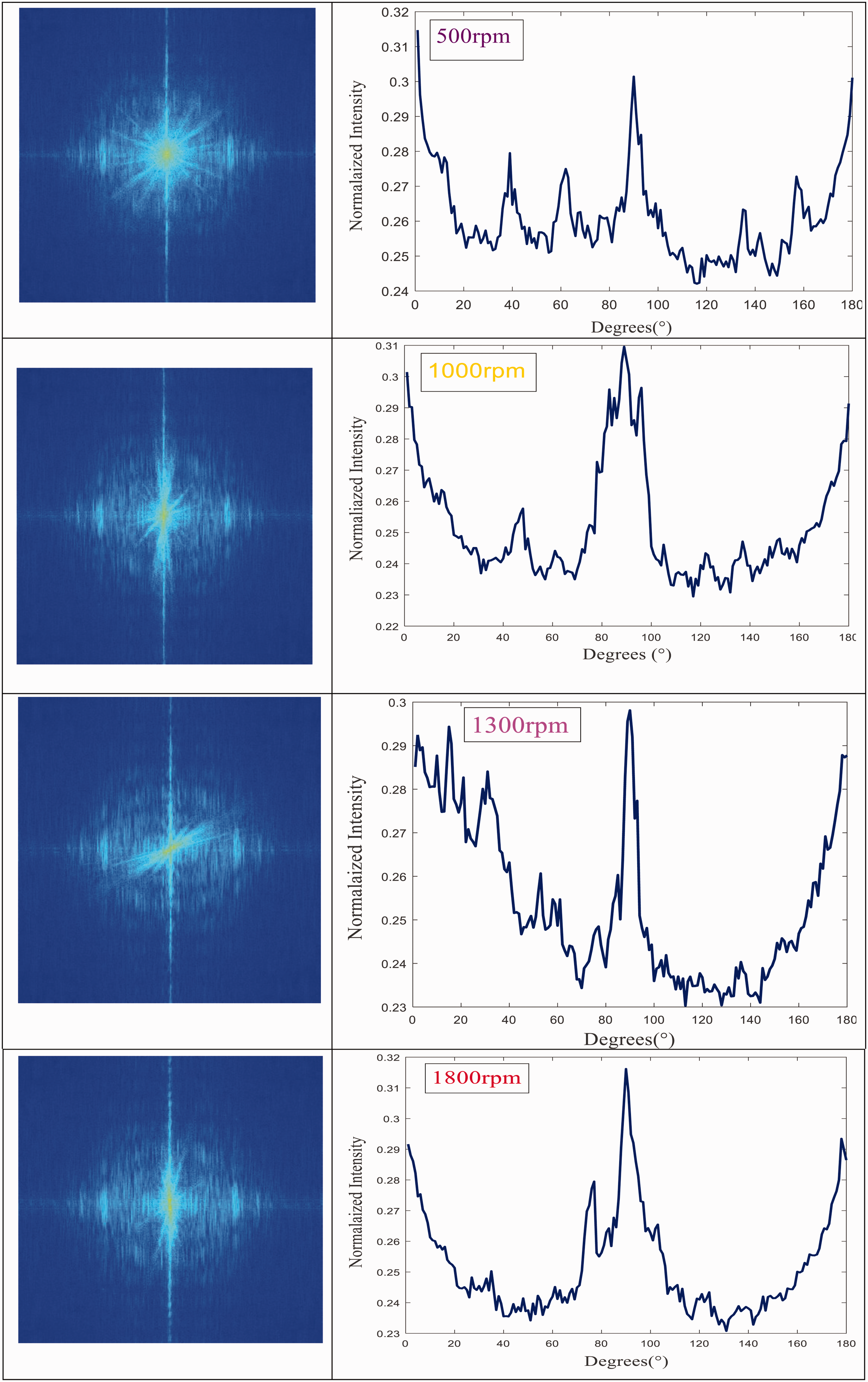
FFT patterns and pixel intensity graphs as a function of the angle of acquisition for electrospun PVDF nanofiber processed with different collector speed.
At 1300 and 1800 r/min high speeds, FFT pattern displays a circular distribution that includes high frequency pixels focused on a 90
Crystalline structure of PVDF nanofiber
Figure 5 shows the FTIR spectra from PVDF nanofiber mats collected at different take-up speeds. The presence of absorption bands at 614, 766, 795, and 976

FTIR absorbance from PVDF nanofiber mats collected at different drum speeds.
To determine the percentage of

FTIR result of electrospun PVDF nanofiber mats (500–1800 r/min).
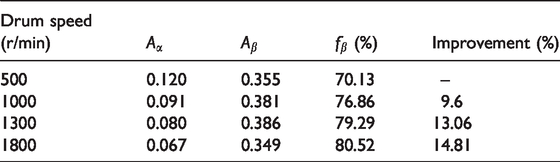
The DSC curve and data for the PVDF nanofibers collected at different drum speeds are shown in Figure 6 and Table 2. Equation (2) is also used to calculate sample crystallites, where 
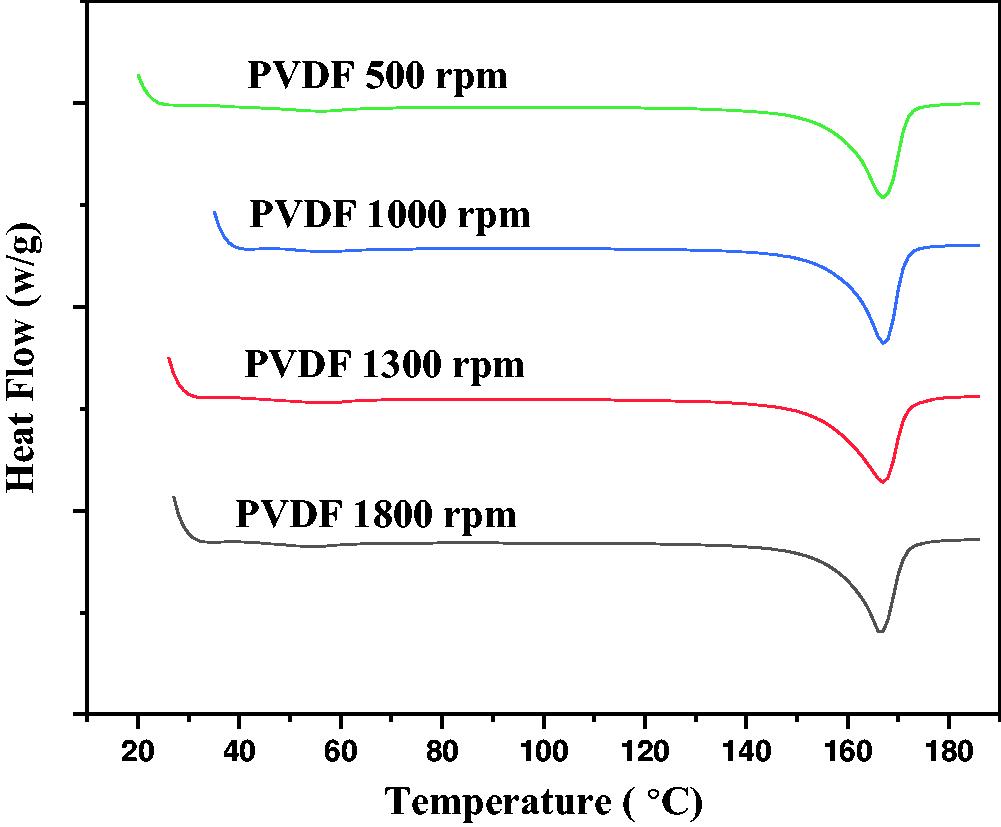
DSC thermograms for the electrospun PVDF nanofibers collected at different drum speeds.
DSC result of electrospun PVDF nanofiber mats (500–1800 r/min).

Results showed that the crystallinity percentage of nanofibers did not obviously enhance with increasing the drum speed. This could be explained by the fact that there are two contrary factors affecting the crystallization of PVDF nanofibers. Columbic force in the high electric field and mechanical drawing force caused by the rotating drum would enhance the orientation and crystallization of PVDF molecular chains in the direction of the fiber axis [26,29]. At the same time, the higher drum speeds also decreased the diameter of the jet fluids and increased their specific surface area. The increasing solvent evaporation rate and jet fluids curing rate then led to decreased crystallization time. To confirm formation of
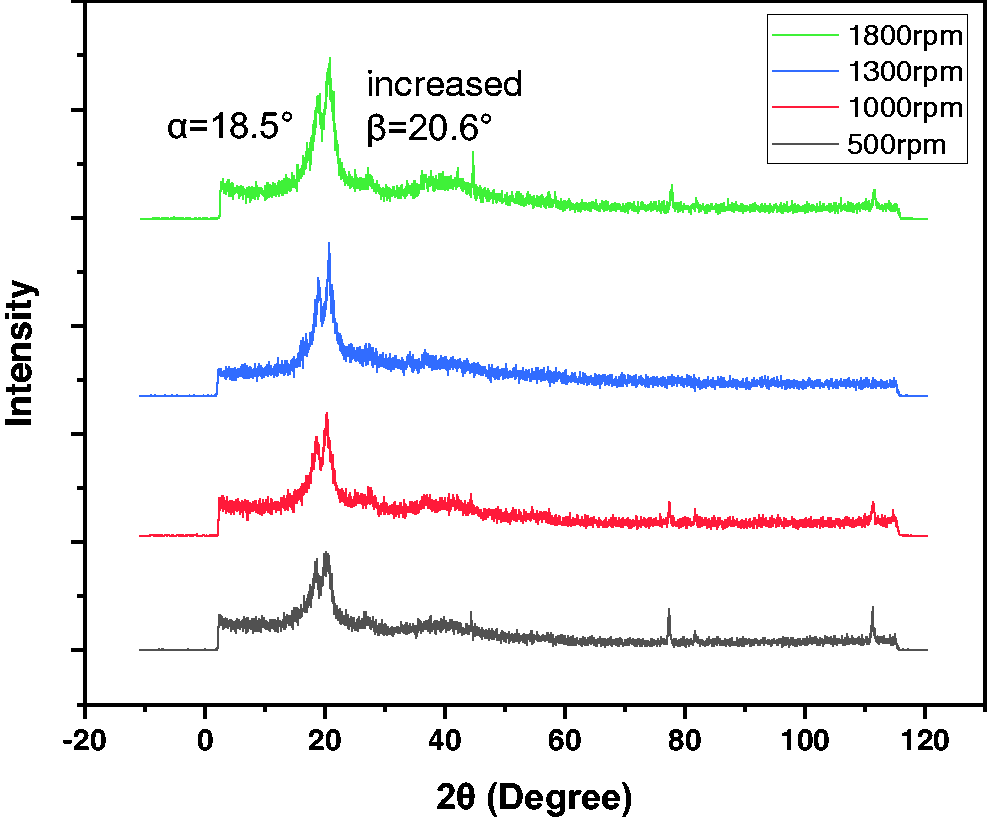
XRD patterns of electrospun PVDF nanofiber mats collected at different drum speeds.
These results indicate the co-existence of the
The appearance of the peak diffraction at 20.6
Moreover, the presence of shear and elongation forces during electrospinning creates the lamellae to form fibrils aligned along the fiber axis. In other words, increasing the speed of the collector directly caused the increase of beta crystal [15]. Due to FTIR result (Figure 5), DSC (Figure 6), and XRD spectra (Figure 7), the contribution of the
Pizoelectric properties
Piezoelectric properties of different power harvesting devices made from electrospun PVDF nanofiber webs collected at different drum speeds were examined by applying a periodic mechanical impact with a force of 2.6 N. When the impact is applied to the PVDF nanogenerator, a pizoelectric potential difference is produced between two electrodes, which leads to a free electron flow occuring around the external circuit and is detected as an output signal, and recovery, the pizoelectric potential disapears and an opposite potential. The free electrons in the external circuit flow back and forth, resulting in a alternating output [31].
For ensuring the reliability of these results, each sample was evaluated five times at the same testing condition (
Electrical response for measured samples.


Electrical response for measured samples.
In the second step, piezoelectric properties of different generator devices made from electrospun PVDF nanofiber webs collected at drum speed of 1800 r/min with different layout angles (0°, 30°, 60°, 90°, 120°, 150°, and 180
Electrical response for measured samples with different layering angles.

Conclusion
In this work, PVDF nanofibers with different fiber orientations were prepared from 27% (wt./wt.) solutions by electrospinning. The degree of fibers alignment in electrospun PVDF membrances increased with increasing drum speeds. XRD analysis, FTIR, and DSC characerizations showed that increase in drum speeds had a relative improvement in the crystal structure of electrospun PVDF nanofibers. In the first step, piezoelectric properties of different power harvesting devices made from electrospun PVDF nanofiber webs collected at different drum speeds were examined by applying a periodic mechanical impact with a fixed force of 2.6 N and led to 94.49% improvement in electrical output of the well-aligned PVDF nanofiber web collected at 1800 r/min compared to non-aligned PVDF nanofiber web collected at 500 r/min. In the second step, piezoelectric properties of different generator devices made from electrospun PVDF nanofiber webs collected at drum speed of 1800 r/min with different layout angles (0°, 30°, 60°, 90°, 120°, 150°, and 180
Footnotes
Declaration of conflicting interests
The author(s) declared no potential conflicts of interest with respect to the research, authorship, and/or publication of this article.
Funding
The author(s) disclosed receipt of the following financial support for the research, authorship, and/or publication of this article: Funding is received from Amirkabir University of Technology and INSF (Grant No. 95828199).
