




Abstract
This review presents an overview of electrospun nanomembranes produced from various polymers to filter air pollutants. Air pollutants can be categorised as particulate matter and gaseous pollutants. Both differ from each other in terms of size and chemical composition. Hence, the filter characterisation techniques and capture mechanism also vary. Particulate matter can be effectively captured in nanomembranes, in relation to microfibres, due to its small fibre diameter, small pore size and high specific surface area. Recently, electrospun nanomembranes have been used to filter gaseous pollutants owing to their potential of active surface modification. Different additives which functionalised the nanofibre surface for gaseous pollutant adsorption are also highlighted in this review. The characteristic features of nanofibres influencing the filtration efficiency have been discussed. Furthermore, various research challenges and future trends of electrospun nanomembranes in air filtration have been discussed.
Introduction
Air pollution is an increasing concern all over the world due to its adverse effects on human health. It claims thousands of lives every year [1] in countries like USA [2], Europe, Australia, Japan [3], China [4] and the Netherlands [5]. Air pollution due to particulate matter (PM) and gaseous pollutants can cause asthma, nausea, skin irritation, high blood pressure, cancer, birth defects [6, 7] along with respiratory and cardiovascular diseases [1,4,8]. The severity of health hazard depends on exposure level and nature of air pollutants.
The classifiation of air pollutants [9] is shown in Figure 1. Eventually, all air pollutants are either PM or gaseous pollutants. They are ubiquitous and present indoor as well as outdoor. Indoor air is typically two to five times more polluted than the outdoor air [10]. Indoor smoking, cooking, heating and air conditioning elevate PM concentration [9,11]. Outdoor industrial activities such as petroleum processing expel PM and chemicals into atmosphere [12–14]. These activities detract from healthy, breathable air quality, by seriously polluting the open air, a public wealth held in common.
Air pollutants – classification and examples.
An efficient air filter is a better choice to capture different air pollutants. The efficacy of an air filter depends on the type of air pollutant and can be tuned by the pollutant capturing mechanism. Fibre-based non woven high efficiency particulate air (HEPA) and ultra-low particulate air (ULPA) filters capture tiny PM with ≥99.97% and ≥99.999% filtration efficiency, respectively [15,16]. However, they have high pressure drop than woven media and quick clogging due to limited specific surface area. Smaller fibre diameter can increase the specific surface area of filter media that improves filtration performance [17]. Hence, nanofibres have received increased attention in air filtration applications.
A number of techniques are available to fabricate nanofibres. These include conjugate spinning (sea-island technique), chemical vapour deposition, phase separation (sol–gel process), drawing, self-assembly, melt-blowing and electrospinning [18]. Among these, electrospinning is a versatile and widely accepted process for producing air filter media [19].
Electrospun materials produced from synthetic polymers are preferred to prepare air filter media [20–22], although some biopolymers are also studied [23–25]. Recently, electrospun nanofibres have been functionalised with some additives to capture gaseous pollutants [26,27] along with simultaneous filtration of PM [28,29]. Compiled information on electrospun nanomembrane to capture different air pollutants will be useful for scientific community as a reference to develop advanced electrospun filters.
This review is centred on the different polymeric materials electrospun to prepare nanofibre membranes for the filtration of PM and gaseous pollutants as well as additives used to improve their functionality. This paper will provide useful information to readers on the evaluation efficacy of electrospun filter material against PM and gaseous pollutants with appropriate characterisation techniques. Furthermore, the challenges of the research and future prospects of electrospun materials to filter different air pollutants have been highlighted.
Filter for air pollutants
PM and gaseous pollutants vary in their size and chemical composition. Hence, a particular filter material may not be appropriate for both. PM filter is generally made up of fibrous materials, which can be engineered depending upon the target PM size. Based on inhalable particle size, PM is classified into coarse (2.5–10 µm), fine (0.1–2.5 µm) and ultrafine (<0.1 µm) particles and known as PM 10 [30], PM 2.5 [31] and PM 0.1 [32], respectively. PM filter is thinner, lighter and more porous than gas filter [33]. Gas filters are generally made from granules of activated carbon, which have extremely high surface area [33].
Common filter material can be fabricated to capture PM and gaseous pollutants. Electrospun nanofibre material can be potentially employed for this purpose. However, characterisation and capture mechanism of the filter may be quite different. Understanding the filter characterisation and capture mechanism of PM and gas filter can help in designing better combination filter media.
Filter performance characterisation
Air filtration performance can be characterised in terms of efficacy of a filter to capture different pollutants. However, PM and gas filters give negligible protection against each other’s hazard [33]. Hence, separate characterisation techniques are applicable to assess the performance of PM and gas filter.
PM filter
PM filtration is mostly characterised in terms of filtration efficiency, penetration pressure drop and quality factor [34]. These terms are expressed using equations (1) to (4), respectively [35,36] and can be determined using principle setup shown in Figure 2. Air filtration can also be characterised in terms of filter resistance [27], minimum efficiency reporting value (MERV) and most penetrating particle size (MPPS) [16]. Filter resistance determines the breathability of the filter and is more related to pressure drop [33]. MERV is minimum fractional particle size efficiency in three different particle size ranges. MPPS is the particle size at which no set of capture mechanism is able to filter it. The typical MPPS for most filters is in between 0.1 and 0.3 µm.
PM filter characterisation setup.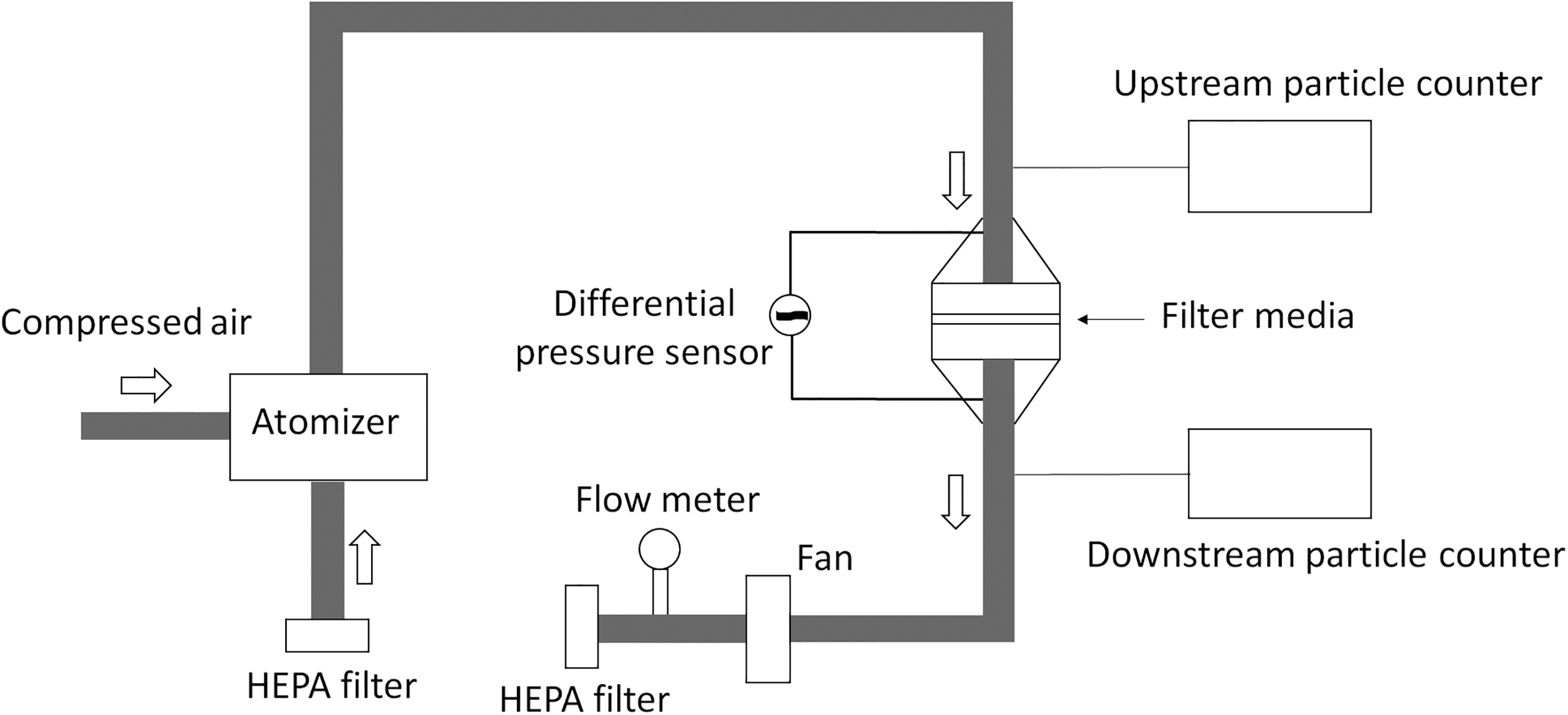


High filtration efficiency often causes high pressure drop [37,38]. The pressure drop for respirator filters should be less than 147 Pa [39] which can be difficult to achieve with high efficiency filter media. The filtration efficiency is desired while the simultaneous pressure drop is unfavourable, and hence the benefit to cost ratio is judged by the term quality factor or figure of merit [34,36]. Recently, the term specific filtration efficiency is coined, where filtration efficiency is normalised to basis weight of the filter media [40].
Gas filter
The gaseous pollutants’ capture efficiency or detoxification efficiency [27] may be expressed as the change in chemical concentration or mass before and after filtration. However, due to the volatile and complex nature of gaseous pollutants, the efficacy of material is measured against specific pollutants of low concentrated suspension as a function of time [23,27,41]. The solutions are then analysed using adsorption [42], catalytic reduction [43,44], high performance liquid chromatography (HPLC) [28], ultraviolet (UV) [26,27,45], gas chromatography (GC) [29] and direct pyrolysis mass spectrometry [41] spectroscopy.
Previous studies developed different experimental setups for the measurement of gaseous pollutants. They can be demonstrated by a principle setup as shown in Figure 3. Concentrated target gas pollutant is injected into an air-tight container. A blower fan maintained a homogenous concentration of gas vapours in the container. A filter media is exposed to the pollutant vapours and an air sample is drawn from the chamber at different time intervals. The air sample drawn through Tenax tubes is analysed with chromatography [29]. Alternatively, the change in pollutant concentration over the time can be measured using commercial gas meters, for example, Formaldemeter™ [23]. The filtration performance of PM and gas filter largely depends on the capture mechanism of the filter material.
Principle of experimental setup for characterisation of gas filter.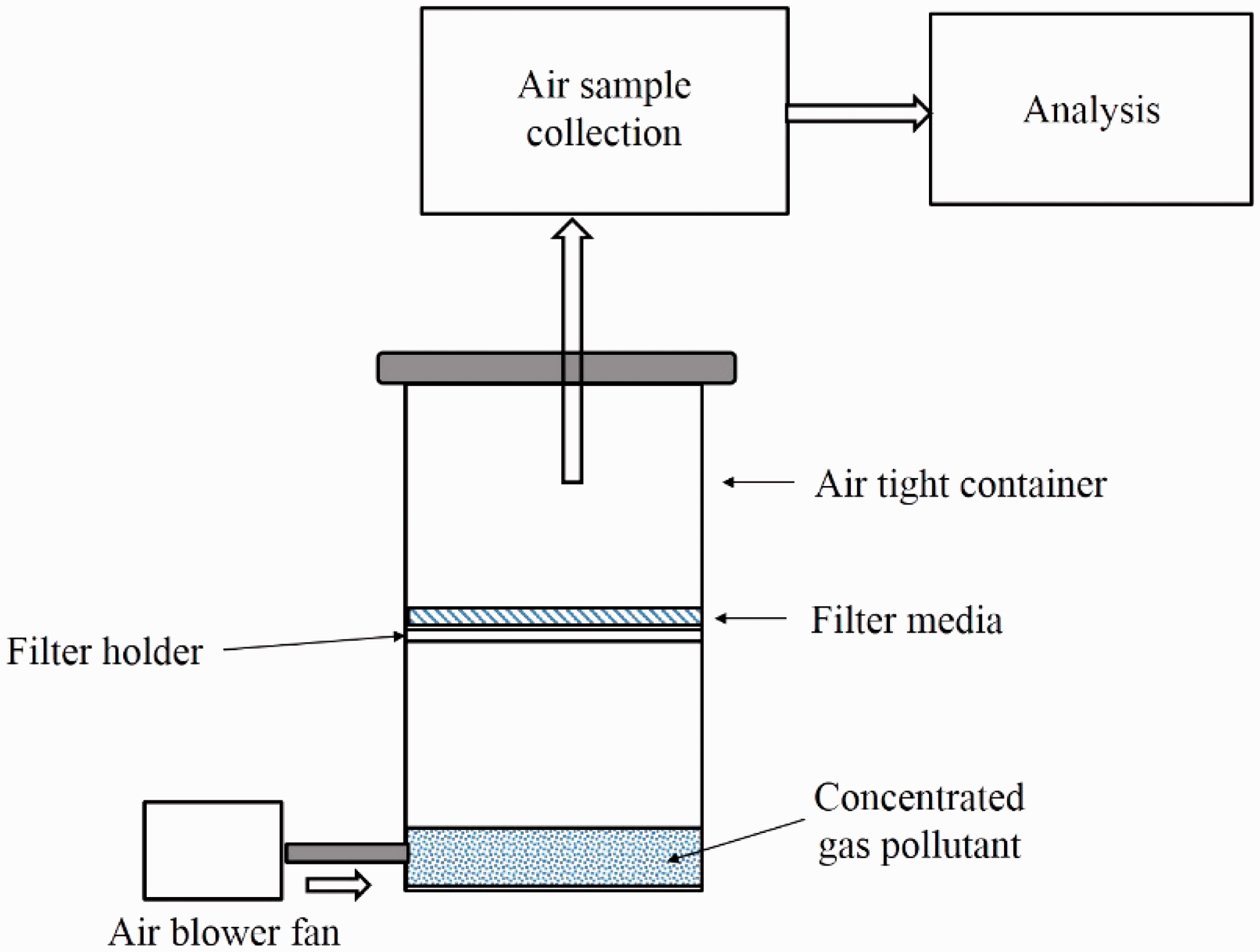
Pollutants capture mechanism of fibrous filter
Air filtration mechanism is the way by which pollutants adsorbed, attached and captured by the filter medium. It largely depends on the properties of filter medium and nature of pollutants. Filtration mechanism of PM and gaseous pollutants can be similar physically, to some extent but chemically can be entirely different. PM filtration by micro and nanofibres is dominated by physical parameters such as pollutant size, filter geometry and rate of air flow.
PM
The filtration mechanism determines the pollutant’s retention on the filter. The fibrous micro and nanomaterials can retain the particles physically much smaller than its pore size which is beyond simple sieving. The mechanisms of filtration include diffusion, interception, intermolecular interaction, straining, inertial impaction, gravitation and electrostatic interaction of particles on the filter surface (Figure 4).
Particle capture mechanism of fibre.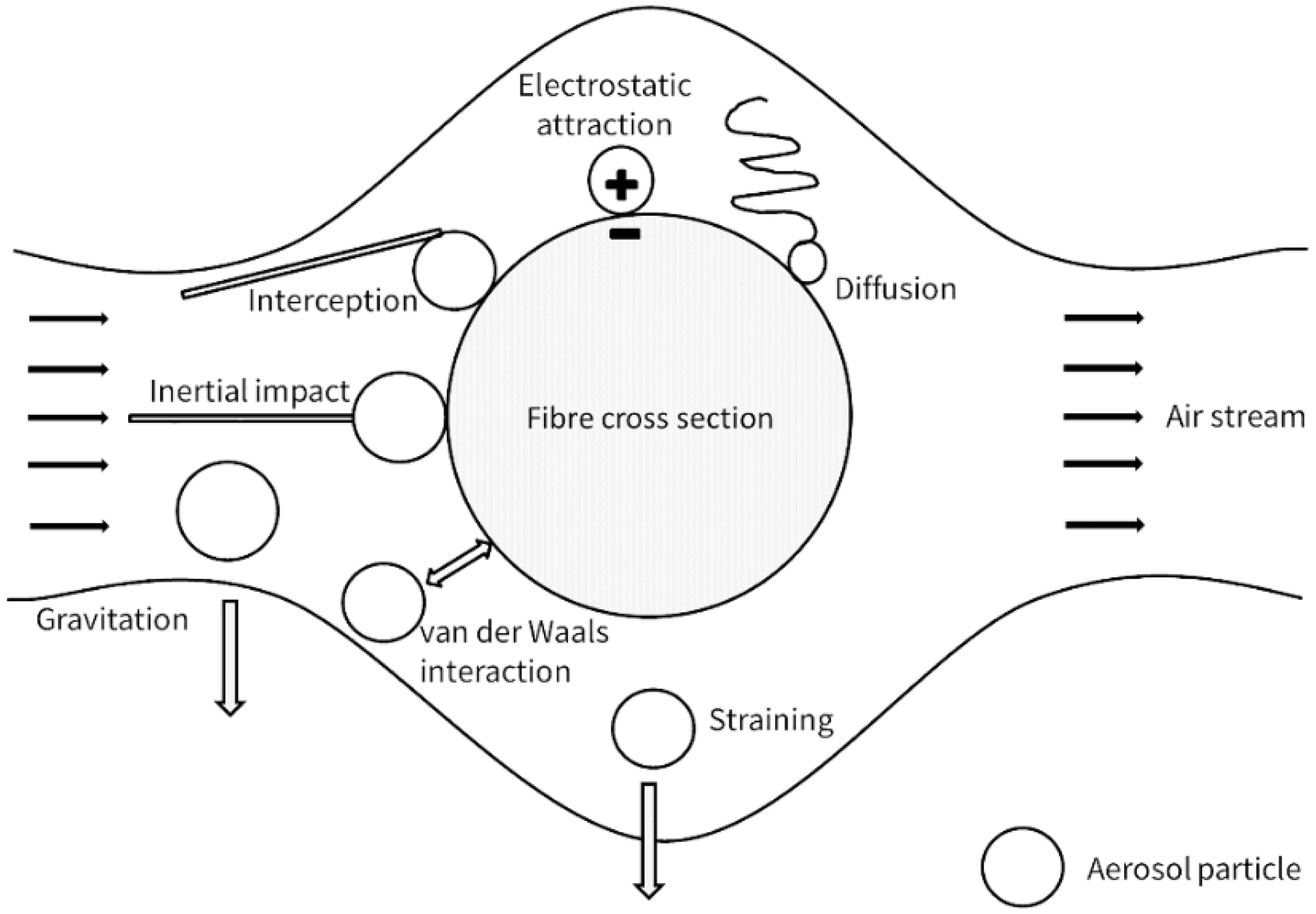
Diffusion and interception can be the most important particle capture mechanisms of nanofibres. Diffusion captures fine particles below 0.5 µm that move randomly due to Brownian motion [16,46]. A particle intercepts with the fibre, when the distance between fibre surface and the particle centre is equal to or less than the particle radius [47]. Maze et al. [48] simulated that nanofibre effectively filtered particles of size 50–500 nm mainly due to Brownian diffusion and interception. The small fibre diameter nanofibres improve particle interception effect [39].
Particle capture by nanofibres depends on Peclet number, Knudsen number and nanofibre packing density [49]. Peclet number represents the relative strength between interception and diffusion mechanisms. Knudsen number is the ratio of mean free path of air molecules to the particle size. The smaller Peclet number and higher Knudsen number indicates strong diffusion. However, with high air flow, aerosol retention time on nanofibres gets reduced making the diffusion mechanism ineffective. Nanofibre packing density is the mass of nanofibres per unit length. It depends on fibre density and filter thickness. High packing density indicates effective particle capture.
Straining occurs in a filter when the particles enter passages between two or more fibres that have dimensions less than the particle diameter. Straining is an important capture mechanism of HEPA and ULPA filters [50]. However, in case of nanofibre media, straining along with inertial impact and gravitation may be less effective than diffusion and interception.
Intermolecular attraction (Van der Waals forces) captures non-charged particles of size less than 0.5 µm and moving with velocity of 0.01 m/s [51]. However, more experimental data are required to understand particle capture by nanofibres. Electrostatic interaction captures PM particles according to Coulomb’s law [51]. This mechanism is preferred for PM capture of particle size between 0.1 and 1 µm [46]. Electrostatic interaction can be helpful in simultaneous filtration of PM and gaseous pollutants, and studies in this direction may find new possibilities for nanofibre filtration.
Gaseous pollutants
Physiosorption and chemisorption are the two basic capture mechanisms of gaseous pollutant capture. Physiosorption refers to capturing at the surface pores of the fibre structure due to intermolecular attraction (Van der Waals forces) [23]. Nanofibres can have strong Van der Waals interaction with gaseous pollutants due to higher surface area that increases the physiosorption capacity. Hence, the fibrous filter with extremely high surface area should be aimed to capture gaseous pollutants.
Chemisorption means converting pollutants into simpler compounds by a chemical action including catalytic or non-catalytic reduction. Chemisorption is more selective than physioosorption. It can be improved by imparting surface functionality and surface active chemistry on fibre structure. The functionalised electrospun nanofibres may be helpful for this purpose.
Electrospinning
Principally, electrospinning is a technique to produce artificial textile filaments using an electric force on polymer fluid. It was first patented by Formhals [52]. Further, Taylor [53] mathematically modelled the electrospinning process to describe the effect of electric force on the fluid droplet forming a cone shape, known as Taylor cone. However, electrospinning gained real momentum after 1990 mainly due to knowledge advancement in nanoscience.
Process
Electrospinning is a simple, easy and versatile process to produce nanofibres and control their shape [20,26,54,55]. In a typical electrospinning setup (Figure 5), a capillary tube mounted on the syringe pump contains viscoelastic polymer fluid. The fluid may be polymer dissolved in a solvent or melt solution. A high voltage is applied to a fluid in the capillary tube. Electrically charged fluid overcomes its surface tension, forms a Taylor cone at the needle tip and elongates in a jet form towards the grounded collector. The simultaneous effect of jet stretching and evaporating of the solvent during the jet travel results in nanofibres with diameter range of tens to few hundred nanometres [17,56,57].
Electrospinning setup.
Air filtration is the first commercial application of electrospun nanofibres [58]. Early uses of electrospun nanofibres, probably in 1940s, are Petrynov respiratory filter [51] with high electrostatic charge on nanofibres. The Petrynov filter is effective in respiratory protection to filter PM; however, its effectiveness against gaseous pollutants is not reported. In the 1980s, ultra-high efficiency air filters were produced from electrospun nanofibres [59]. The commercial companies either producing or using nanofibre filter media reported elsewhere [60].
Nanofibre membrane, a thin layer of nanofibres, is suitable to prepare filter media for HEPA, antimicrobial air filter, cabin air filter and filter for personal protective clothing [60–62]. Nanofibre membrane is generally used in tandem with conventional air filter media and aimed to capture PM in applications such as turbine air filters, pulse filters and vacuum bag filters [16]. It can be positioned upstream (before microfilter media) for surface filtration or can be downstream (after microfilter media) for depth loading and dust holding. Electrospun nanofibres have strong potential in clean energy, health and environment sectors [51], since they can efficiently and effectively capture different air pollutants.
Advantages
Electrospun materials are suitable for air filtration due to their small pore size and high specific surface area. The average pore size can be 4–100 times smaller than microfibre membranes [59] which can capture dust particles on its surface and ultimately improves filtration efficiency [39,63]. The specific surface area can be 1000 times higher than microfibres [64] due to micropores (less than 2 nm) and mesopores (2–50 nm) generation [60] in the fibre structure during electrospinning. Hence, a small layer of electrospun fibres can significantly improve filtration efficiency.
Electrospun nanofibres also have potential to incorporate surface active chemistry or functionality on nanoscale without deteriorating the breathability or moisture vapour diffusion [62]. This may be desirable for the adsorption of gaseous pollutants along with comfort in personal protective clothing. The problems associated with bulky respiratory filter such as sweating, thermal stress and breathing difficulty [65] can be resolved by electrospun nanofibres. The other important advantage is that a variety of structures including layered structures can be easily produced with a wide choice of material selection.
Electrospun nanofibre materials to filter air pollutants
Different synthetic polymers and biopolymers, along with or without additives, have been electrospun to develop air filter media. Polymer concentration, molecular weight and solvent system decide fluid characteristics such as viscosity, surface tension and conductivity [66,67]. Electrospinning process parameters largely depend on the fluid characteristics and can vary from polymer to polymer.
Synthetic polymers
Electrospun synthetic polymers for air filtration applications.

Note: TFE: 2,2,2-tri-fluoro ethanol; FA: formic acid; DMF: N,N-dimethylformamide; IPA: isopropyl alcohol; PVAc: polyvinyl acetate; AA: acetic acid; DW: deionised water; PEO: polyethylene oxide; PAN: polyacrylonitrile; PVA: polyvinyl alcohol; PU: polyurethane.
PA is easy to spin due to its shorter di-acid and di-amine segments. PA fibre is good for air filtration owing to small fibre diameter, narrow diameter distribution [68], large surface area and improved dirt-loading capacity along with high electrostatic charge [20]. PA electrospun fibres showed excellent filtration efficiency, 250% higher as compared to pristine cloth [37], five times reduced areal density and almost three times less pressure drop than the commercial glass filter media [22].
PAN nanomembrane efficiently captured PM and gaseous pollutants than counterpart polymers such as PA [74], polyvinyl pyrrolidine, polystyrene (PS), polyvinyl alcohol (PVA) and polypropylene [21]. It captured PM 2.5 under extreme hazardous air-quality conditions (PM 2.5 index >300) with 95–100% efficiency for the duration of 100 h in Beijing field test [21]. PAN nanofibre membrane captured pollutants 10 times of its own mass owing to better surface properties, better single fibre capture ability and higher dipole moments (Figure 6) [21]. PAN nanofibre membrane also has good tensile strength and excellent moisture vapour transport properties [54,70].
SEM image showing PM tightly wrapped around the PAN nanofibre which is beyond surface attachment. Scale bar, 1 µm [21] (with permission from Nature publishing group).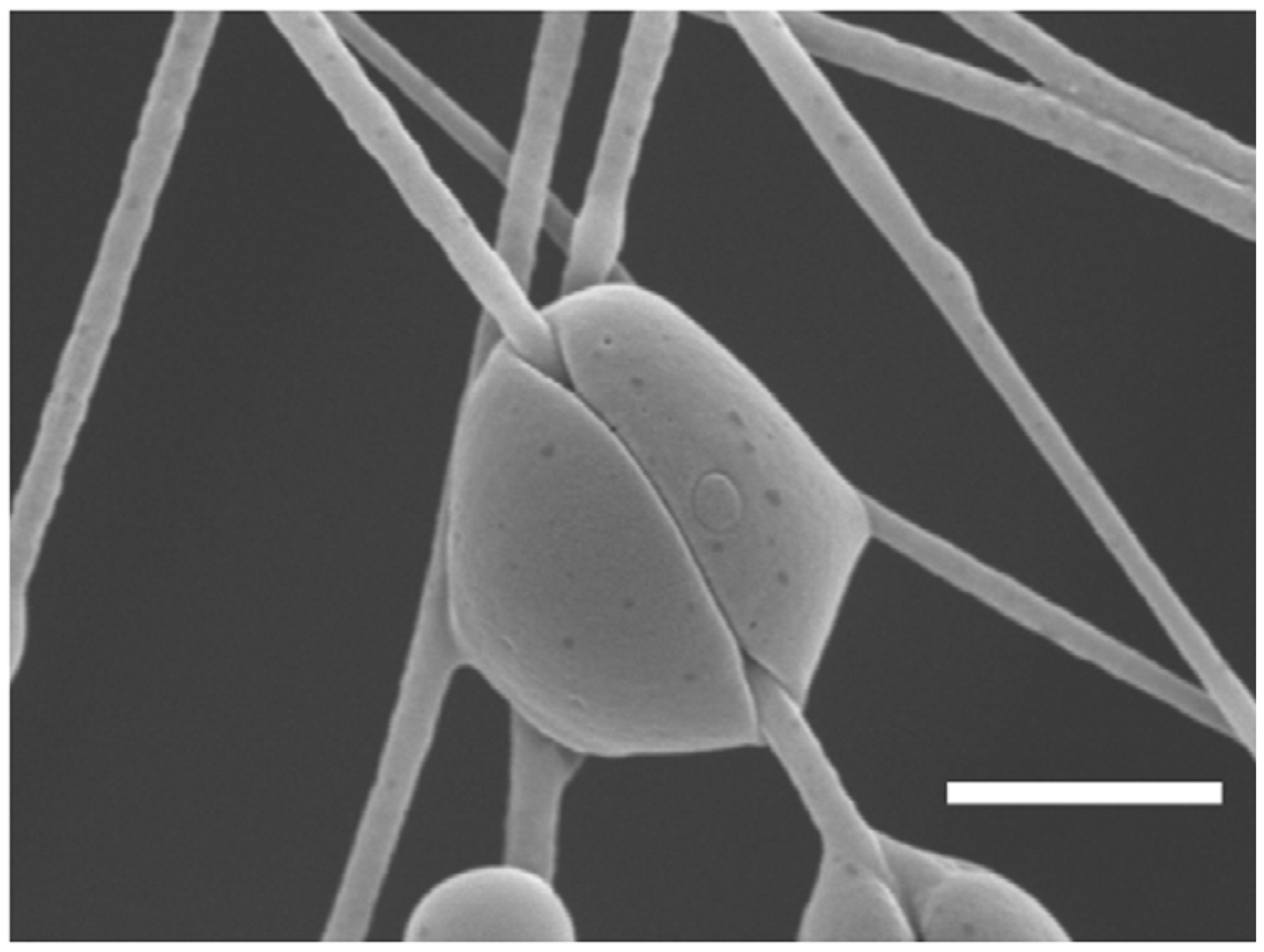

The other synthetic polymers (Table 1) used in electrospinning for air filtration application include PVA [39,75], polyurethane (PU) [29,42,57], polyethylene oxide (PEO) and polyvinyl acetate (PVAc) [74]. The filtration efficiency and pressure drop of PVA nanofibre membrane were better than conventional cotton [39]. PU-based reaction polymers [64,71] were electrospun for absorption of volatile organic compounds (VOCs) in air [42] and were developed as a protective textile against chemical and biological threats in the air [70]. PVAc has good adhesive properties, while PS does not form inclusion complexes with chemicals used in electrospinning. Hence, they are a good fibre matrix for adsorption of organic compound in the air [45].
Additives
Polymer/additive combination used in electrospinning for air filtration.

Note: BTEAC: benzyl triethylammonium chloride; PC: Polycarbonate; FAP: fly ash particles; PS: polystyrene; PET: polyethylene terephthalate; CD: cyclodextrin; PSU: polysulphone; TiO2: titanium dioxide; PVA: polyvinyl alcohol; PVDF: polyvinylidene fluoride; Ag: silver; Al2O3: aluminium oxide; PAN: polyacrylonitrile; SiO2: silicon dioxide; PMMA: polymethyl methacrylate; FA: formic acid; AA: acetic acid; MEK: methylethyl ketone; DMF: N,N-dimethylformamide; DCM: dichloromethane; TFA: trifluoroacetic acid; NMP: N-methyl-2-pyrrolidone; DMAC: N,N-Dimethyl acetamide; PEI: polyetherimide.
Metal oxide additives can enhance specific surface area and surface roughness of the nanomembrane. TiO2 presence in polysulphone (PSU) [77] and PVA [26] solution reduced the fibre diameter, due to weakened viscosity, and created nanoprotrusions in the membrane with micro and nanoscale roughness (Figure 7a) that enhanced filtration. TiO2 created free radicals in the presence of UV light which reacts with gaseous pollutants like acetone [26]. The metal oxides can purify toxic gases by converting them into basic element. Al2O3 enabled polyvinylidene fluoride (PVDF)–silver nanofibre composite membrane removed PM, biological contaminants and chemical pollutants in a single step air filtration [27]. It detoxified the nerve agent simulant, Paraoxon, by approximately 36% mainly due to metal oxide. PAN/SiO2 nanomembrane produced energy efficient and effective air filter media due to its rough cross-section and microporous structure [19].
β-CD assisted in preparing bead-free polymethyl methacrylate (PMMA) and polyethylene terephthalate (PET) nanofibres at low polymer concentration [78]. PMMA/CD nanofibres [41] trapped styrene, toluene and aniline compounds. Addition of β-CD into PET [28] and PS [45] entrapped aniline vapour and phenolphthalein compound, respectively. It forms inclusion complexes with the pollutants and captures them in the empty cavities. The cavities can be blocked by producing a complex structure [78] in which CD molecules are aligned and stacked on top of each other.
FPU has a low surface energy of 18.08 mJ.m−2, excellent hydrolytic stability, good abrasion resistance and provides micro-nano roughness to the nanomembrane [71]. Electrospun PU/FAP composite nanomembrane was employed for the removal of VOCs from air. FAPs possess physicochemical properties such as bulk density, particle size, porosity and surface area which make them suitable for air filtration (Figure 7b) [29]. Boehmite improved the dielectric behaviour of PA6 nanofibre and enhanced the charge storage capacity of the filter media [81]. All additives studied so far aimed to functionalise synthetic polymers. However, no studies reported the effect of these additives for functionalisation of biopolymers to capture gaseous air pollutants.
Biopolymers
Bio-based polymers and their electrospinning parameters for air filtration.

Keratin biopolymer has the potential for active filtration. It absorbs and removes toxic substances in air such as formaldehyde [84,85] and other hazardous VOCs [86] due to its special molecular structure and chemical properties. Electrostatic wool-based microfibre filters removed PM via columbic attraction [87]. However, no data are available about the use of keratin nanomembranes for air filtration. Nanofibre membrane of chitosan biopolymer yielded good quality factor with antibacterial properties [25]. Chitosan can also provide positive charge on filter fibre surface and can effectively neutralise air pollutants by unique physical and chemical means.
PLA can have promising use as a respiratory filter application due to its sustainable and carbon neutral nature. The nanostructure composition, made up of 5% PLA polymer in 10% solvent, is optimised to yield maximum quality factor [24]. Biopolymers blend, PLA/polyhydroxybutyrate [82] and bio-based PA-56 [83] showed good mechanical strength, high filtration efficiency, low pressure drop, high dust loading and dust cleaning regeneration ability.
Characterisation of electrospun nanofibres
It is necessary to characterise the properties of nanofibres such as fibre diameter, pore size, surface area and surface chemistry to assess their effect on air filtration. In general, nanofibres can be grouped according to their geometrical, chemical and mechanical characterisations.
Geometrical characterisation
The fibre diameter and pore size are important geometrical properties of nanomembranes that can significantly affect air filtration. The fibre diameter, its distribution and orientation, cross-sectional shape and surface roughness can be determined using microscopic evaluation techniques such as scanning electron microscope (SEM), transmission electron microscopy (TEM) and atomic force microscopy (AFM) (Figure 8) [59,67,88] followed by image analysis techniques. TEM is more useful when the nanofibre diameter is less than 300 nm [88]. With AFM, it is slightly difficult to measure fibre diameter accurately, but it is a versatile technique to determine the surface morphology accurately [59,88].
Microscopic images electrospun nanofibres that confirm porous structure random orientation (a) SEM of PAN nanofibre (authors’ own work) (b) SEM and TEM (upper inset) of PU nanofibre [29] (with permission from Elsevier).
Many studies reported nanofibre thickness using SEM images. However, it is difficult to prepare a uniform cross-section of a sample from delicate polymeric nanofibre membrane, unlike microfibres. Hence, the thickness measurement preciseness on SEM is questionable.
Pore size, pore distribution and porosity can be measured using microscopy and porosimetry techniques [67]. In microscopy techniques, SEM, TEM and AFM images can be used to measure the pore size on nanofibre surface. Porosimetry techniques include intrusion (mercury), extrusion (capillary flow) and molecular resolution (Brunauer–Emmett–Teller (BET) analysis). The advantage of BET analysis is that it can measure surface area and porosity in addition to pore size and its distribution [67].
Chemical characterisation
Chemical characterisation of nanomaterials can identify the chemical nature of materials before and after electrospinning. Fourier transmission infrared spectroscopy and nuclear magnetic resonance can determine the molecular structure of polymers, their interaction with other polymers and additives [29,64] and the presence of specific additives [78].
The configuration of macromolecules and crystalline nature of nanomaterial can be studied using X-ray diffraction (XRD) (wide and small angle). The difference in the diffraction peak can chemically identify different materials present in the nanofibre membrane. For instance, XRD confirmed the presence of FAP in PU [29] and homogeneous distribution of CD molecules in PMMA [78] and PET [28] nanofibre membrane.
Surface chemistry of nanofibre membranes can be characterised using X-ray photoelectron spectroscopy (XPS) and water contact angle measurement. XPS can quantitatively determine the atomic concentration of elements present at the surface of nanofibre membrane using SEM images [25,28,41]. The water contact angle measurement of nanofibre membrane can explain the hydrophilic/hydrophobic nature along with surface chemistry. The high water contact angle of FPU nanofibre membrane indicates hydrophobic behaviour [77] which may be useful in improving antifouling properties of the filter.
Mechanical characterisation
For air filtration, high tensile strength and elongation of nanofibre membrane are desirable to ensure dimensional stability and durability. Generally, nanofibre membranes alone (without microfibre substrate support) are mechanically poor and fail to withstand the macroscopic impacts of air flow [60]. Nanofibre membranes can be mechanically characterised using tensile tester and techniques such as AFM and dynamic mechanical analysis (DMA). The tensile tester measures mechanical properties such as mechanical strength and elongation. The elastic modulus is measured using AFM [59,88]. DMA determines different dynamic moduli of polymers.
The tensile strength of nanomembrane can be tuned through polymer concentration and solvent type. PAN nanomembrane yielded highest strength at 11% concentration than 7% and 13% due to increased friction force and high packing density, respectively [71]. Combination of N-methyl-2-pyrrolidone and N,N-dimethylformamide (DMF) solvent (50:50] resulted in higher strength and elongation of PSU nanofibre membrane than a single solvent system [77]. Sometimes, additives employed during electrospinning can also improve the tensile stress, Young’s modulus, elongation and elastic modulus of nanofibre membrane. PAN [71], polyvinyl chloride (PVC) [64], PU [29], PET [28] nanofibre membranes enabled with PU, FAP and CD, respectively, improved the mechanical properties mainly due to the intermolecular interaction.
Poor dimensional stability and less adhesion with the microsubstrate are a researchable issue with nanofibre membranes. The dimensional stability can be improved using a thermal treatment. A two-step tension and relaxation heat setting treatment to PA6 nanofibre membrane improved the dimensional stability and mechanical properties by multiple times [20]. Such nanofibre membranes can withstand high air flow during the filtration.
Effect of nanofibre parameters on air filtration
Air filtration is largely tuned by fibre diameter, pore size, surface area, thickness, mass coverage and structure of the membrane. The effect of these properties for PM filtration is discussed. However, response relation between these properties and gaseous pollutants is not investigated in detail as of now.
Fibre diameter
The fibre diameter has profound influence on the filtration performance of filter media. The nanofibre diameter up to 300 nm can be suitable to attain more than 99% filtration efficiency of sodium chloride (NaCl) particles of size up to 300 nm. The reduction of PA6 fibre diameter from 300 to 120 nm significantly increased the filtration efficiency at all levels of mass coverage of nanofibres [37]. The filtration efficiency of PAN filter increased from 48.21 to 98.11% as the fibre diameter reduced from 1000 nm to 200 nm [21].
The fibre diameter distribution can influence the filtration performance. It causes less pressure drop and normalised thickness than wider distribution of the same fibre diameter [73]. The bimodal fibre diameter distribution of 600–700 nm PAN nanofibres [19] created scaffold-like structure that decreased packing density and facilitated the air flow across the membranes. This may be potentially useful for high-performance filter media.
It is recently reported that the small diameter nanofibres (<100 nm) provide enhanced aerodynamic slip, where air molecules do not collide with nanofibres [77]. This slip flow reduced the friction effect and presure drop was not elevated drastically, which is generally reported [89].
The small fibre diameter increases filtration efficiency but with high pressure drop irrespective of the PM size (Figure 9). However, PM size can influence quality factor. Nanofibre of 185 nm showed high-quality factor than 94 nm fibres for 50–90 nm PM and vice-a-versa for 100–380 nm PM [49]. Smaller PM gets diffused easily into relatively higher fibre diameter. In the latter case, interception dominates over diffusion. The small fibre diameter reduces the pore size by decreasing the pore aperture and enhances the direct-interception effect for particle capture [39].
Fibre diameter effect on filtration (a) small fibre diameter showing high filtration efficiency at high pressure drop at same mass coverage and face velocity (b) dependence of quality factor on fibre diameter and PM particle size [49] (with permission from Elsevier).
Pore size
Nanofibres produce closed pores, blind pores and through pores in the structure [76]. Closed pores are not accessible and blind pores terminate inside the structure itself. Through pores are open and hence important for air filtration. The smallest, largest and mean pore diameters are important characteristics of through pores. The smaller pore size can achieve high filtration efficiency but adversely affects air permeability and pressure drop of the filter media.
Pore size can greatly alter pressure drop of the filter media. The strategic combination of different pore size improves the filtration performance. Sambaer et al. [57] stacked PU nanofibres, of identical fibre diameter but different pore size, over one another. The membrane with high and small pore size combination exhibited better air filtration than the one with small pore size at same thickness. This is due to the less tortuous path of air flow compared to less porous membrane. Thus, highly porous membrane can result in lesser pressure drop.
Pore size is reduced by additives employed to functionalise electrospun nanofibres. FPU decreased the pore size from 4.3 to 1 µm as its concentration in the solution increased from 0.25 to 1% [71]. Al2O3 (8%) reduced the pore size of PVDF nanofibre membrane from 0.56 to 0.36 µm [27]. Silica reduces the fibre diameter and decreases the contact area among fibres resulting in small pore size [80]. The pore size distribution of PAN/SiO2 nanofibre membrane was in the range of 10–60 nm [19]. With increase in PU concentration in PVC/PU solution, pore size and porosity highly reduced [64].
The pore size of PA6 nanofibre membranes [22] can be reduced through higher electrospinning time and post thermal treatment. However, just 15 min of PA6 electrospinning significantly reduced the pore size and also satisfied the filtration requirement for particle size up to 0.3 µm [20]. Besides pore size, its uniform distribution is also important to get good filtration performance.
Specific surface area
This can increase the probability of particle deposition on the fibre surface and can delay the saturation which may improve the filter life. Nanofibres exhibited high filtration efficiency [17] and are potentially suitable for the removal of air pollutants, along with biological contaminants, owing to the high specific surface area [90]. However, the exact relation between the specific surface area and air filtration performance needs to be quantified.
The surface area of electrospun polymeric material (8–30 m2/g) [24,29] is relatively lower than the activated carbon granules. This may be a limiting factor to capture gaseous pollutants on electrospun nanofibre membrane. However, the surface area of electrospun nanofibres can be increased by functionalisation with various nanoparticles and specific additives.
Membrane thickness and mass coverage
Membrane thickness linearly depends on electrospinning time [91]. It is directly proportional to pressure drop and inversely proportional to air permeability [92]. Nanofibres with a very thin layer of few microns restrict the air flow of membrane to a great extent [20]. Filtration can be improved if the nanofibre membrane is of comparable thickness and if arranged in layers instead of a thick layer [57]. The membrane thickness does not improve PM filtration beyond certain limit, but it goes on increasing the pressure drop and thus deteriorating the quality factor [68].
Sometimes additives such as Al2O3 and BTEAC also contribute to higher thickness [27,79]. Nanofibre membrane thickness reported from several studies range from 2.3 to 71 µm [20,39,57,68,75] and depends on the type of end use. However, no specific data are available to suggest suitable nanofibre membrane thickness level for different air filtration applications. Thickness optimisation studies may help in achiveing high quality factor.
Membrane thickness and mass coverage of nanofibre membrnane are complementary to each other. A small mass coverage of nanofibres can have a signifcant effect on filtration efficiency and pressure drop (Figure 10). The mass coverage of 0.5 g/m2 with 100 nm fibre diamter yielded maximum benefit to cost ratio in filtration [68].
Effect of mass coverage on filtration efficiency and pressure drop at constant face velocity and identical fibre diameter [49] (with permission from Elsevier).
Nanofibre membrane structure
Electrospinning technique offers different versatile structures to improve quality factor. Innovative structures such as hybrid [93], bead on string [24] and multilayered [19] have been studied to maximise quality factor. In hybrid coarse fine nanofibre structure, fine fibres contribute to filtration efficiency, while coarser fibre contributes to rigidity. A sandwich pattern of hybrid nanofibre structure in integrated filter may have multipurpose applications [94].
Bead on string structure has been prepared [24] by electrospinning low concentration PLA solution on the continuous matrix of PLA nanofibre. The beads form pores in the fibre structure due to the low viscosity and insufficient stretching of the solution. It is like a composite structure, where matrix and reinforcement comprised the same PLA biopolymer. This structure increased distance between nanofibres and reduced the volume fraction of the membrane allowing easy air flow through the filter. Bead on string structure exhibited high filtration efficiency and a relatively low pressure drop.
A multilayer composite structure is formed using twin jet, one with pristine PAN and another with PAN/SiO2 blend solution [19]. The heterogeneous nature of solutions created an interpenetrating bonding and non-bonding structure, eventually yielding a good quality factor. Recently, the composite structure of PAN/PA with 2/2 jet ratio showed good filtration efficiency [95]. In another study [96], five layers of nanofibre membrane were arranged in a reducing pore size order that showed dramatic increase in filtration efficiency over other arrangements of nanofibre membrane layer.
Multiple thin layers of nanofibres, instead of single thick layer, deposited for shorter times with similar basis weight showed improvement in quality factor [49,97]. PEO nanofibres sandwiched between two non woven microfibre structures showed consistent pore size, filtration efficiency and pressure drop when subjected to cyclic compressions [76]. In addition, the new electrospun structures such as core shell, hollow and porous nanofibre structures [98] can also be useful in preparing combined ultrafiltration materials for PM and gaseous pollutants.
Filtration performance evaluation of electrospun nanofibre membrane
The aim of this section is to compare the PM and gaseous pollutants filtration performance of different electrospun nanomembranes. Test conditions of filtration characterisation can greatly influence the results in PM and gaseous pollutants filtration. Hence, the filtration performance of different nanomembranes is compared at the chosen test conditions.
PM filtration performance
PM filtration performance of different electrospun polymers against PM.

Most test conditions preferred a face velocity of 5.3 cm/s. The higher face velocity, for instance 15 cm/s, elevates pressure drop by two times or higher. It is a challenge to obtain lower pressure drop with electrospun nanofibre membrane at high face velocity. NaCl aerosol particles of size 300–500 nm are most commonly used as a PM; however, other aerosol particles such as potassium chloride can also be used. The correlation between quality factor and nanofibre properties, especially fibre diameter and pore size, at common test conditions, is still not established and can be investigated further.
Filtration performance on gaseous pollutants
Gaseous pollutants filtration using electrospun nanofibre membrane is a relatively complex issue. Principally, gaseous pollutants can be chemically reduced or can be adsorbed/absorbed by the nanofibre membrane. Recently, studies reported oxides of nitrogen (NOx) abatement by chemical reduction and VOCs capture by adsorption using electrospun nanofibre membrane.
NOx abatement
Nanofibre membrane can be a good choice as a filter media to adsorb the hazardous NOx and other gaseous pollutants in the ambient air. Nanofibre membrane filter media is efficient in capturing gaseous pollutants without producing any harmful by-products [90]. Porous carbon nanofibres were prepared by oxidation and carbonisation of PAN electrospun nanofibres [43] for NO removal at room temperature. The removal mechanism follows the sequence of adsorption, catalytic oxidation of NO into NO2 and reduction of N to N2. PU nanofibres containing metal oxide particles showed good photocatalytic activity to neutralise NOx and carbon monoxide (CO) [44]. Tin oxide/chromium oxide (95/5) particles with 3% concentration in PU showed 70–80% catalytic efficiency (ratio of emission before and after the filter) towards NOx, CO and carbon dioxide [44]. NOx and other gaseous pollutants captured by electrospun membranes is a recent approach and only limited studies are conducted.
Capture of VOCs
Electrospun polymers and pollutants used for detoxification study.

Keratin biopolymer-based nanofibre membranes proved effective against formaldehyde [23,99]. It is due to porous network on the surface and large number of functional groups on the keratin backbone. The functional groups include peptide bonds and side chains of amino acid residues which offer active chemical sites to entrap VOCs. The keratin/PA nanofibre membrane reduced formaldehyde concentration by 70% in relatively quick time as compared to pristine polyamide and polypropylene nanofibres [23].
TiO2 nanoparticle-enabled electrospun membranes degraded 98% of acetone (250 ppm) in 10 s [26]. However, high concentration of acetone (1500 ppm) occupies the photocatalyst activity of TiO2 and reduces degradation efficiency to 54% [26]. CD-enabled nanofibres effectively entrapped aniline vapours [28] due to the formation of inclusion complex and large surface area. HPLC analysis showed that nanofibre membranes of pristine PET, PET/α-CD, PET/β-CD and PET/β-CD captured approximately 1300, 2600, 2600 and 3400 ppm of aniline, respectively, in an exposure time of 12 h [28]. The high adsorption of β-CD attributed to bigger size cavity of β-CD that allowed more amount of aniline to form a complex. β-CD chemically activated fibre surface and catalytically cleaved reactive esters or phosphates [100].
PU nanomembrane absorbed toluene, chloroform, acetone, and hexane VOCs [42]. The VOC absorption capacity of PU enhanced at least 2.5 times using FAPs [26]. The composite nanofibres can form a π-complex with VOCs and thus adsorb them on the surface. The PU/FAP nanofibre membrane was most effective against styrene followed by xylene, toluene, benzene and chloroform [26].
Concluding remarks
This review presented an overview of electrospun nanomembranes employed to filter different air pollutants. Several studies have been reported on the effectiveness of electrospun nanofibre membranes for PM filtration. However, the gaseous pollutant filtration has not been studied in detail. This has great importance in the context of environmental concerns of complex air pollutants on human health. Electrospun nanofibre membrane can be a promising filter media to capture PM and gaseous pollutants simultaneously. Research in this direction is in infancy.
Biopolymers need more attention to prepare electrospun materials for air filtration and detoxification. There is a possibility to exploit breathability of biopolymers to reduce pressure drop, a big challenge of electrospun nanofibres. Various biomaterials have potential to adsorb various VOCs, NOx and oxides of sulphur in the ambient air. Biopolymers can also be used as additives, if not alone, in electrospinning. However, their compatibility with other polymers, process optimisation and nanofibre membrane development with desired characteristics requires critical assessment. Studies are required to reveal more about this possibility in electrospinning for air filtration.
More efficient and innovative nanofibre membranes will be in demand for the removal of VOCs, chemical and biological pollutants, warfare contaminants and toxic agents from air. Electrospun nanofibres can be functionalised with new additives including various biomaterials. They can substantially improve the surface area to capture PM and can react with different gaseous pollutants to convert them into simpler compounds. New additives can be explored to abate air pollutants as a continuous process for long time.
Although electrospun nanofibre membranes are effective in capturing particles of size less than 1000 nm, their potential to capture particles 1–100 nm is not yet established. Electrospun nanofibre membranes can be effective electrets to improve the filtration through electrostatic attraction; however, the electrostatic particle capture by nanofibres is not explored and reported in detail either.
The fibre diameter, pore size and nanofibre membrane thickness can be optimised mathematically and empirically to achieve maximum quality factor. There is an absence of a common index that decides the spinnability of the fluid with different characteristics and electrospinning parameters. The good correlation between this common index and quality factor can help in designing better filter media.
Further studies are required to prepare dimensionally stable nanofibre membranes and to improve adhesion between nanofibre membrane and microfibre medium. Thickness of nanofibre membrane can be more precisely and accurately determined if new sample preparation techniques and advanced computational methods are developed.
Footnotes
Declaration of Conflicting Interests
The author(s) declared no potential conflicts of interest with respect to the research, authorship, and/or publication of this article.
Funding
The author(s) disclosed receipt of the following financial support for the research, authorship, and/or publication of this article: Vinod Kadam is thankful to RMIT University, Australia for scholarship support towards PhD study and Indian Council of Agricultural Research, Government of India for granting study leave.