




Abstract
A new solid unit cell model is developed based on the microstructure analysis of three-dimensional (3D) six-directional braided composite (6DBC) produced by four-step 1 × 1 procedures in this research. First, the volume control method is applied to analyze the spatial movement traces of yarns. Then the microstructure configuration and squeezing condition of yarns is analyzed in detail by the mathematical modeling. The relationships between the microstructure parameters of unit cell and the braiding process parameters are derived. The parametrical solid unit cell model for modeling the microstructure of 6DBC is established. Finally, the main microstructure parameters of specimens are calculated to validate the effectiveness of the model. The predicted results agree well with the available experimental data. In addition, the squeezing conditions of the braiding yarns and the axial yarns are analyzed in detail, respectively. The variations of the key microstructure parameters with the braiding angle are discussed. Results indicate that the parametrical unit cell model has provided a better understanding of the relationship between the microstructure and the braiding process parameters for 3D 6DBC.
Introduction
Textile composites have received great attention from the academic and industrial fields due to their special advantages over the classical laminated composite [1–4]. As a new type of textile composites, 3D six-directional braided composite (6DBC) have shown better mechanical performances, such as in-plane and out-of-plane stiffness and strength, than 3D four-directional braided composite (4DBC) by adding the in-plane longitudinal and transverse axial yarns. Since 6DBC are more suitable for the primary load-bearing structures subjected to complex loading cases, an increasing attention has been paid to them by the aeronautics and astronautics industries, which shows the potential application in the design of the stiffened panels, the load-bearing frames, etc. However, as for 3D 6DBC, the introduction of the in-plane longitudinal and transverse axial yarns also makes their microstructure more complicated than 4DBC. Therefore, it is valuable to develop an effective microstructure model used for the microstructure analysis and the prediction of the mechanical properties of 3D 6DBC.
In the past, many models [5–15] were proposed to analyze the microstructure and mechanical performance of 4DBC. Ko and Pastore [5] first developed a cuboid unit cell to represent the microstructure of 3D rectangular braided preforms, which contains four diagonally intersecting yarns. Yang et al. [6] analyzed the elastic properties of 3D 4DBC by the ‘Fiber inclination model’ with four inclined unidirectional laminas. Wang and Wang [7] investigated the yarn topological structure and defined three types of unit cells for the interior, surface, and corner regions, respectively. Byun and Chou [8] conducted the experimental observation and proposed five types of unit cells. Sun et al. [9] developed the digital-element model to study the elastic properties of 4DBC. Chen et al. [10] proposed a finite multiphase element method to analyze the elastic properties. Tang and Postle [11] developed the prediction model of the tensile and shear moduli of 4DBC based on the numerical simulation. Yu and Cui [12] developed a two-scale method to predict the mechanics performance of 4DBC. Fang et al. [13] conducted a detailed analysis of the effect of yarn distortion on the mechanical properties of 4DBC. Shokrieh and Mazloomi [14] presented an analytical method for the stiffness calculation of 4DBC. Recently, Xu and Qian [15] analyzed the microstructure in detail and developed a new multiunit cell model for 4DBC.
Previous studies indicate that 3D 5DBC have better mechanical properties in the predetermined loading direction by adding the longitudinal axial yarns to 4DBC along z-axis. In recent years, many scholars took great efforts to investigate the microstructure and mechanical performance of 3D 5DBC [16–23] Wu [16] first studied the yarn microstructure and proposed a three-unit cell model for 5DBC. Chen et al. [17] investigated the tensile properties in accordance with the experimental research. Xu and Xu [18] presented a finite element model (FEM) to calculate the mechanical performance of 5DBC based on an interior solid unit cell. Li et al. [19] developed a FEM to predict the mechanical properties of 5DBC based on the microstructure analysis. Gao and Li [20] studied the effect of the braiding angle on the modal experimental analysis of 5DBC. Zhang et al. [21] proposed a three-unit cell FEM for calculating the stiffness properties of 5DBC. Recently, Liu [22] defined a new concept of 3D full five-directional braided composite (F5DBC) by placing the carriers of axial motionless yarns in the corresponding vacant positions on xy machine bed based on five-directional braiding process. Xu and Qian [23] further analyzed the microstructure of 3D F5DBC and proposed a new multiunit cell model used for the mechanical analysis. The study shows that 5DBC and F5DBC have better load-bearing capability along z-axis than 4DBC due to the addition of the longitudinal axial yarns. However, the mechanical properties along the transverse axial direction x-axis are comparatively lower than that in the longitudinal direction.
3D 6DBC have been receiving increasing attention by introducing the transverse axial yarns into the braided preforms of 5DBC. However, there is little literature pertaining to the microstructure and mechanical analysis due to the complicated microstructure of 6DBC. Liu [24] adopted the volume control method to analyze the yarn movement traces and studied the compressive properties of 6DBC. Li et al. [25] developed a topological unit cell model and applied the stiffness-volume averaging method to analyze the elastic properties. Lu et al. [26] proposed a solid unit cell model used for the finite element modeling, which is suitable for 6DBC with the fiber volume fraction less than 45%. Therefore, the available models have obvious limitation in modeling the actual microstructure used for predicting the mechanical performances of 6DBC.
The objective of this paper is to present a new parametrical solid unit cell model based on the analysis of the microstructure of 3D six-directional braided preform produced by four-step 1 × 1 braiding procedures. First, the volume control method is applied to analyze the spatial movement traces of yarns for 6DBC. Then the microstructure configuration and squeezing condition of yarns is analyzed in detail by the mathematical modeling. The relationships between the microstructure parameters of unit cell and the braiding process parameters are derived. Finally, the parametrical solid unit cell model for modeling the microstructure of 6DBC is established. To validate the effectiveness of the model, the main structural parameters of unit cell model are calculated to compare with the experimental values of specimens. In addition, the squeezing condition of yarns is analyzed in detail. Some valuable conclusions are drawn herein.
3D six-directional braiding process
3D six-directional braided preforms are usually produced based on four-step 1 × 1 braiding procedures. Figure 1 shows the pattern of the yarn carriers on a machine bed in xy plane and their movements in one machine cycle. As shown in Figure 1(a), there are two categories of yarn carriers. One is the braiding yarn carrier and the other is the longitudinal axial yarn carrier, which carry the braiding yarn and the longitudinal axial yarn, respectively, to produce the braided preform. As illustrated in Figure 1(b), the longitudinal axial yarn carriers lie alternately between the braiding yarn carriers in rows. The braiding yarn carriers in the main part of the braiding machine bed is denoted by m × n, i.e. m being the row number of braiding yarn and n being the column number of braiding yarn.
3D six-directional four-step 1 × 1 braiding process scheme. (a) Illustration of braiding machine and the preform of 6DBC [24]. (b) original position, (c) first step, (d) second step, (e) third step, and (f) fourth step.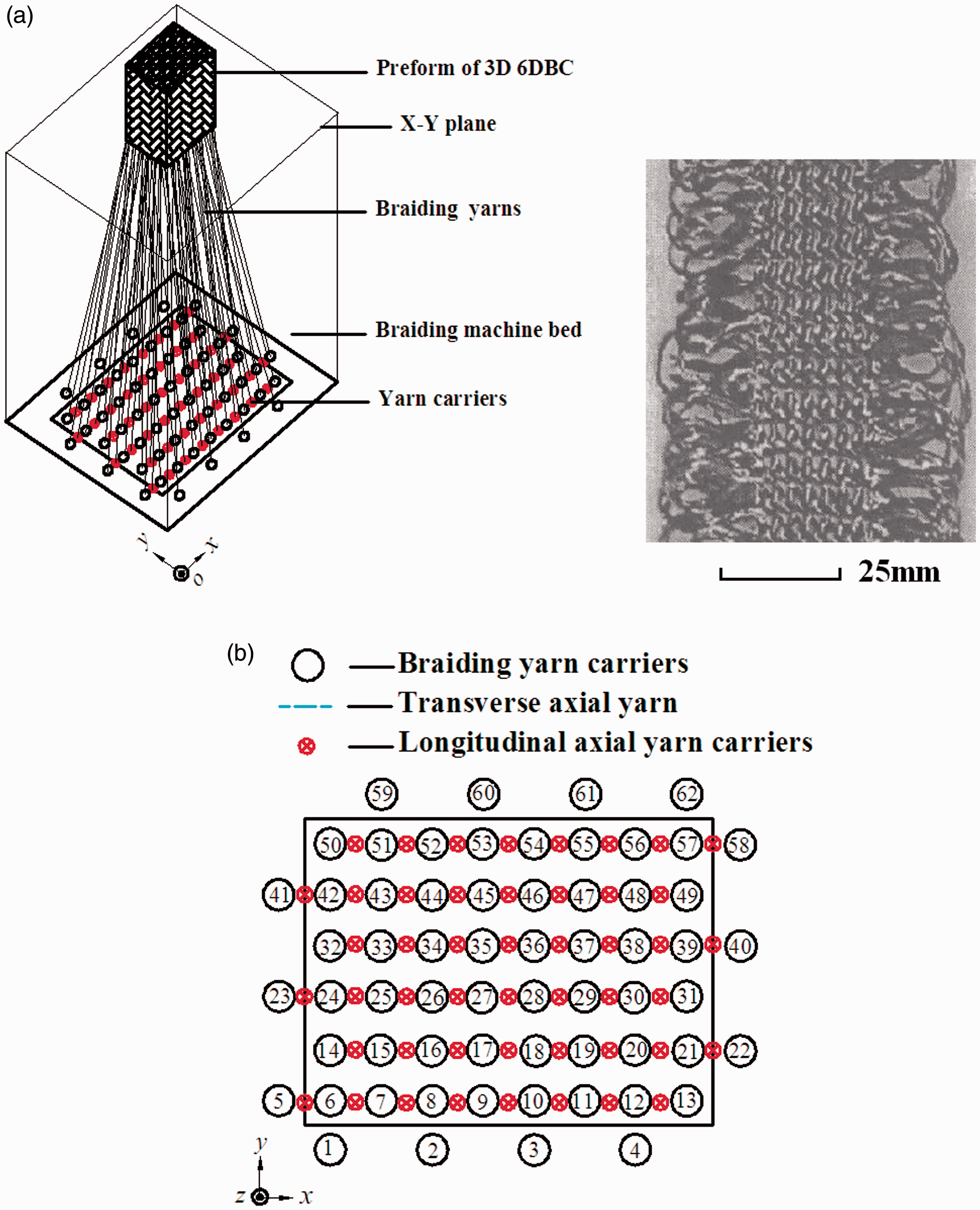
During one machine cycle of 3D six-directional braiding process, the movement traces of the braiding yarn carriers and the longitudinal axial yarn carriers are the same as those of 3D 5-directional braiding process by 4-step 1 × 1 rectangular braiding procedures except for the transverse axial yarns. From Figure 1, one machine cycle consists of four movement steps and each braiding yarn carrier moves one position at each step along x or y direction. At the first step shown in Figure 1(c), the braiding yarn carriers in columns move one position vertically in an alternating manner. However, all longitudinal axial yarn carriers keep static and stay in the present positions without moving. At the second step shown in Figure 1(d), the braiding yarn carriers and the longitudinal axial yarn carriers in rows move one position horizontally in an alternating manner. Just then, the transverse axial yarns are added into the braided preform along x-axis. Then a “jamming” action is imposed to make all intertwined yarns stabilized and compacted in space. At the third and fourth steps in Figure 1(e) and (f), the movements of these carriers are opposite to that at the first and the second steps, respectively. It is noted that the transverse axial yarns are added into the braided preform along the x-axis again after the fourth step. Then the “jamming” action is imposed on all yarns. When the four-step cycle is completed, all yarn carriers return to their original pattern as shown in Figure 1(b). As a result, the finite length of the resultant preform is defined as the braiding pitch denoted by h. With these steps of motion continuing, all yarns are interlaced together to form six-directional braided preform as shown in Figure 1(a).
As shown in Figure 1, there are two sets of the transverse axial yarns joining the braided preform during a machine cycle. Ntay denotes the number of each set of transverse axial yarns, which can be given as follows


Microstructure analysis
Microstructure analysis based on the braiding process contributes to laying an important foundation for establishing a reasonable unit cell model of 3D 6DBC. In this section, the planar and spatial movement traces of all yarns are identified by the volume control method.
The planar movement traces for the braiding yarn carriers, the longitudinal axial yarn carriers, and the transverse axial yarns are shown in Figure 2. From Figure 2, the volume control region marked with ‘abcd’ is taken as a typical sample of interior region. Carrier 53 is chosen as a tracer for the braiding yarn carriers, which follows a zigzag way from point A to point B during a machine cycle. By observing the movement of braiding yarn carriers in the region during a machine cycle, their spatial movement traces are shown in Figure 3. As shown in Figure 3(a) and (b), the braiding yarns follow the zigzag traces simultaneously while extending h/4 along z-axis for each movement step. During a machine cycle, the braiding yarns are repositioned to maintain straight traces by the ‘jamming’ action every two steps. However, it is noted that the spatial trace of each braiding yarn has to move a certain distance along z-axis due to the introduction of the transverse axial yarns, which naturally results in the displacement components sb and tb along Movement traces of carriers in the xy plane. Movement traces of yarns during a machine cycle. (a) Yarn movement traces in sub-cell A, (b) yarn movement traces in sub-cell B and (c) movement traces of longitudinal axial yarn.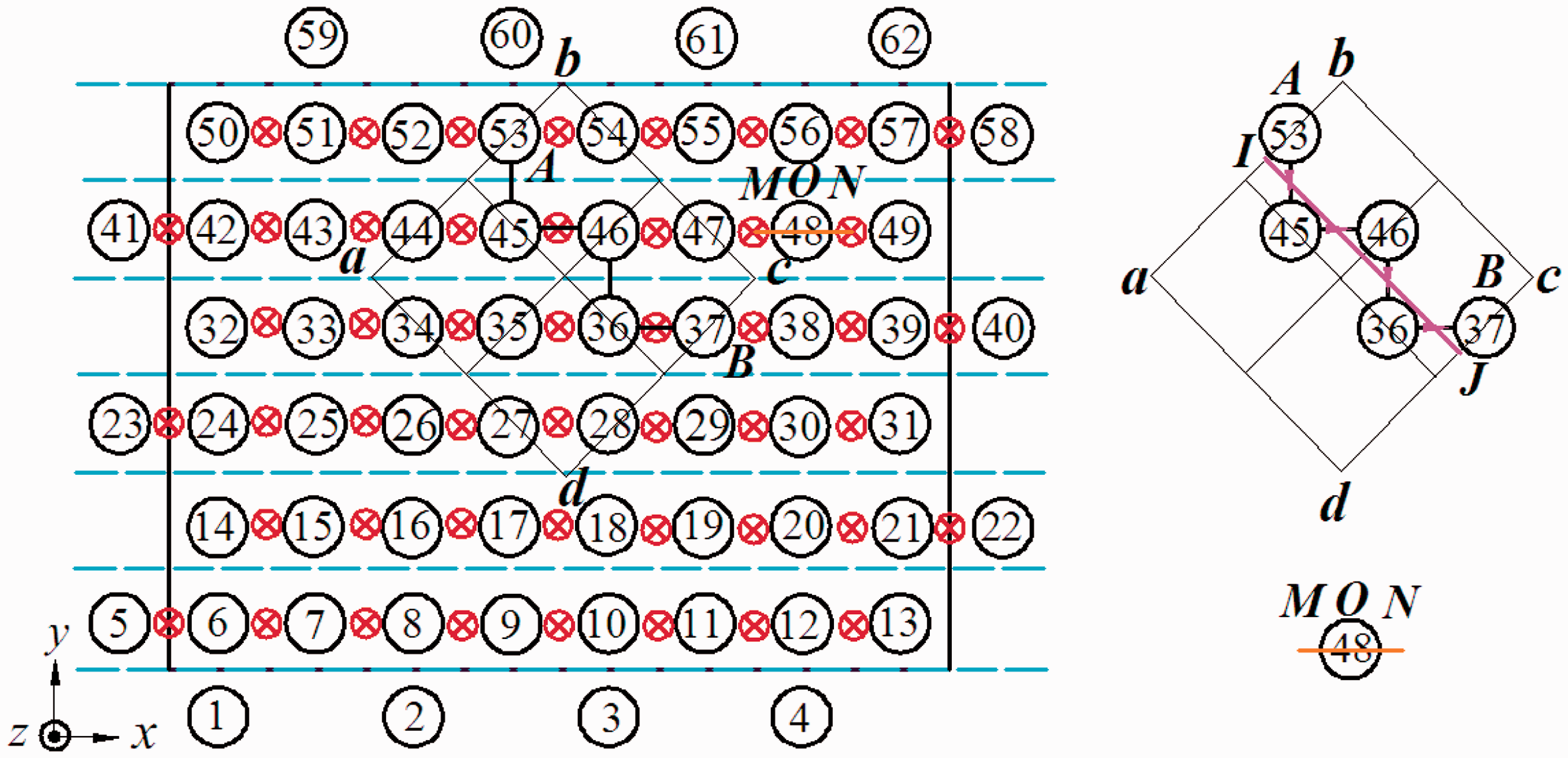

The spatial traces of the transverse axial yarns always keep straight lines along x-axis without participating in the braiding process as shown in Figure 3(a) and (b). It can be seen that the spatial traces of the transverse axial yarns have moved a certain distance along z-axis due to the squeezing of adjacent braiding yarns, where the distance is denoted as hz1. Meantime, during one machine cycle, the spatial movement trace of the longitudinal axial yarn controlled by carrier M in Figure 2 is shown in Figure 3(c). Since carrier M always moves horizontally between position M and position N, ‘jamming’ actions make the longitudinal axial yarn maintain straight line parallel to z-axis. As shown in Figure 2 and Figure 3(c), it is obvious that the projection of the longitudinal axial yarn controlled by carrier M is point O, which is just the original position of braiding yarn carrier 48. Therefore, the traces of the longitudinal axial yarns are located in the middle points of adjacent axial yarn carriers in rows.
According to the spatial traces of yarns, Figure 4 shows the definition of unit cell model and the distribution of sub-cells A and B for the preform of 6DBC. Sub-cell A and sub-cell B distribute alternately every half of a pitch length h along the braiding direction of z-axis. It is noted that the sub-cells are oriented at a 45 ° angle with x-axis. For sub-cells A and B, there are altogether four sets of braiding yarns, a set of longitudinal axial yarns, and a set of transverse axial yarns. Four sets of braiding yarns distribute in two sets of intersecting parallel planes. Each yarn in the adjacent parallel planes has +γ or −γ distribution, respectively.
Composition of sub-cells A and B. (a) Distribution of unit cell and its sub-cells, (b) yarn configuration of sub-cell A and (c) yarn configuration of sub-cell B.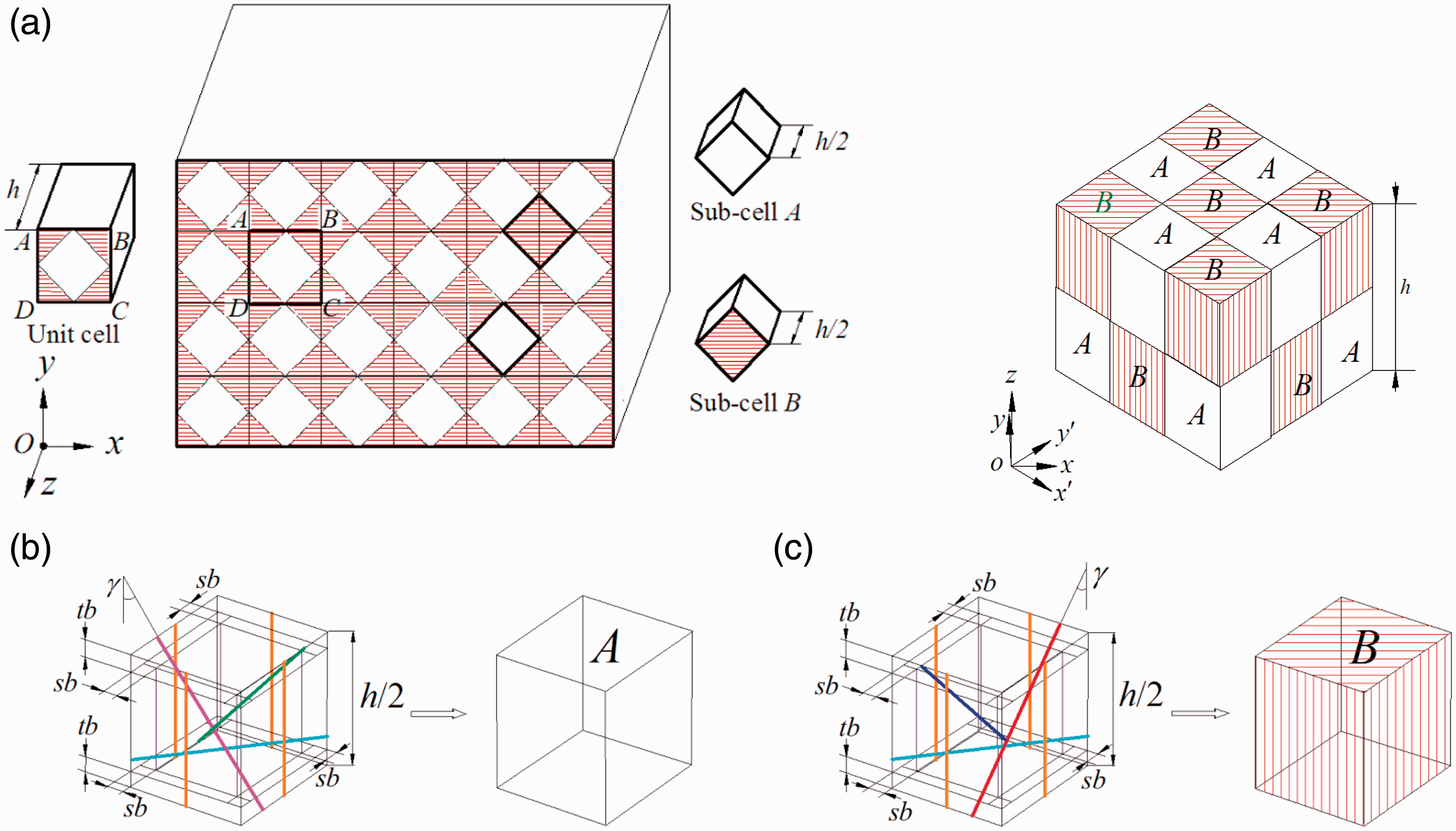
Parametrical solid unit cell modeling
The parametrical solid unit cell model is developed for 6DBC based on the microstructure analysis. First, the basic assumptions for the microstructure configuration are made. Second, the mutual squeezing relationship of yarns is analyzed in detail based on the mathematical modeling. Then the unit cell model reflecting the crucial microstructure feature is proposed for 6DBC. Finally, the key microstructure parameters of unit cell model for 6DBC are derived in detail.
Basic assumptions
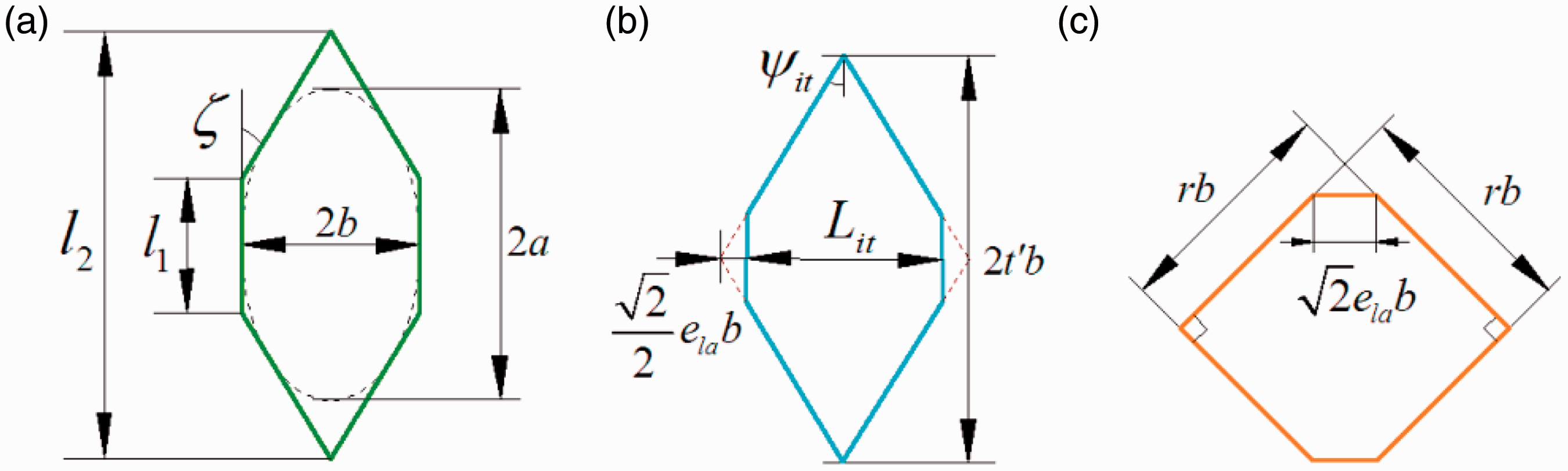
According to the mutual squeezing of yarns, the cross-sectional shape of the braiding yarn is assumed to be hexagonal and the hexagon contains an inscribed ellipse with the major and minor radii, i.e. a and b, respectively. The cross-sectional shape of the transverse axial yarn is assumed hexagonal. Meantime, the cross-sectional shape of the longitudinal axial yarn is assumed as a square with side length rb, but one set of opposite angles vertical to x-axis is cut away due to the squeezing of the transverse axial yarns. r is defined as the size factor of the longitudinal axial yarn. The specific details for the cross sections of yarns are shown in Figure 5. The axes of the braiding yarns keep straight lines. The central axes of the longitudinal axial yarns and the transverse axial yarns also maintain straight lines. However, due to the mutual squeezing of yarns, the cross-sections of the longitudinal and transverse axial yarns cannot keep constant but vary along z-axis and x-axis, respectively. For simplicity, the mutual squeezing deformation of yarns is assumed to only act on the longitudinal and transverse axial yarns in the model while the cross-section of the braiding yarns keeps constant hexagon. All braiding yarns and axial yarns have the same flexibility, size, and properties. The braiding procedures maintain steady and the braided structure keeps uniform. The yarn packing factor is defined as the fiber volume fraction in a fiber bundle. The yarn packing factors for the braiding yarns, the longitudinal axial yarns, and the transverse axial yarns are assumed equivalent. Cross sections of yarns. (a) Braiding yarn and (b) transverse axial yarn along the x-axis and (c) longitudinal axial yarn along the z-axis.
Squeezing analysis of the yarns
Based on the microstructure analysis and the basic assumptions, the squeezing configuration of the yarns is analyzed in detail in the section. Figure 6 shows the topological structure of the corresponding yarns in the two cubic sub-cells in Squeezing condition of yarns. (a) Topological relationship of yarns, (b) top view of yarns, and (c) squeezing configuration of the solid yarns.
From Figure 6(a), the braiding yarns and the axial yarns take on the regular configuration in

According to the geometrical relationship shown in Figure 6(a) and (b), the inscribed elliptical equations of the inclined elliptical-cylinder surfaces for the braiding yarn 1 and the braiding yarn 2 in the local coordinate system


Figure 6(c) shows the representative yarns in the sub-cells based on the cross-section assumption of the model. Due to the addition of transverse axial yarns, the braiding yarn 1 and the braiding yarn 2 no longer contact with each other. As illustrated in Figure 6(c), the plane P1 and the plane P2 keeps tangent relationship with the braiding yarn 1 and the braiding yarn 2, respectively. The equations for P1 and P2 can be expressed as


As illustrated in Figure 6(c), the plane P1 tangent with braiding yarn 1 is parallel with the central axes of the inscribed ellipses for the braiding yarn 1 and the braiding yarn 2 simultaneously. Meanwhile, the plane P2 tangent with the braiding yarn 2 is also parallel with the central axes of the inscribed ellipses for the braiding yarn 1 and the braiding yarn 2 simultaneously. Therefore, according to the tangent relationship between the elliptical-cylinder of the braiding yarn 1 and the plane P1 [15], the coefficients of the plane P1 can be obtained by coupling equations (5) and (7). Similarly, the coefficients of the plane P2 can be solved based on equations (6) and (8) by the tangent relationship of the elliptical-cylinder of the braiding yarn 2 and the plane P2. Then the normal distance between the two parallel planes, Hp, can be derived as follows

According to the squeezing relationship of the transverse axial yarns, the actual height of the two parallel planes can also be expressed as


The squeezing factor for the braiding yarns, k, is defined as

Figure 7 shows the specific squeezing relationship between the braiding yarns and the transverse axial yarns. Figure 7(a) shows the normal cross-section vertical to x-axis for the transverse axial yarn 1. From Figure 7(b), it can be seen that the contact plane 1 between the transverse axial yarn 1 and the braiding yarn 1 is marked with the purple solid line on the cross-section by cutting the transverse axial yarn 1 longitudinally at a 45 ° angle with x-axis. The overlapping factor eta is defined for representing the extent of the squeezing deformation between the transverse axial yarns and the braiding yarns. Then the depth of the overlapped region between the transverse axial yarns and the braiding yarns is assumed to be etab, where b is the minor radius of the inscribed ellipse for the braiding yarn.
Squeezing relationship of transverse axial yarn and braiding yarns. (a) Normal cross-section, (b) cross-section cutting longitudinally at 45 ° angle with x-axis.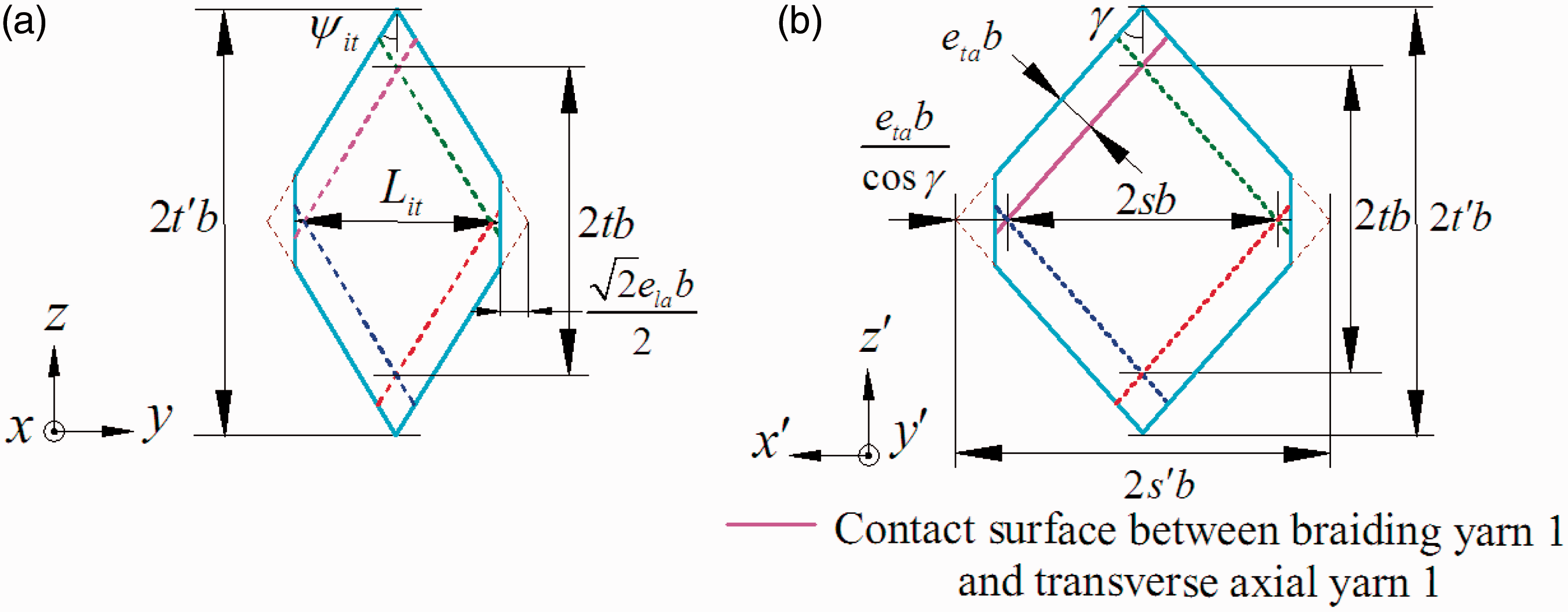
As shown in Figure 7(b), it is noted that the cross section used for defining the depth of overlapped region between the transverse axial yarn and braiding yarn due to mutual squeezing is located in

Substituting equation (13) into equation (12), the squeezing factor for the braiding yarns can be expressed as the following

As shown in equation (14), the addition of the longitudinal and transverse axial yarns has an obvious effect on the squeezing factor of the braiding yarns by introducing r and
As shown in Figure 7, the relationship between

The relationship between t and s can be given as following

As illustrated in Figure 7, it is not difficult to derive the expressions for Lit and ψit as follows


According to the squeezing relationship, the variable hz1 used for describing the position for the central axis of the transverse axial yarn as shown in Figure 6(a) can be derived as

Yarn packing factor
The yarn packing factor for the braiding yarns, the longitudinal axial yarns, and the transverse axial yarns means the fiber volume fraction in the corresponding fiber tows, which is given as follows:

Based on equation (11), the cross-sectional dimensions of the braiding yarn can be derived by analyzing the geometrical relationship as shown in Figure 6. The cross-sectional area of the braiding yarn is given as

The expressions for the cross-sectional dimensions of the braiding yarns in Figure 5 are given as follows


As shown in Figure 5, the basic cross-sectional shape of the longitudinal axial yarn is assumed as a square with the side length rb, but its set of opposite angles vertical to x-axis are cut away due to the squeezing of the transverse axial yarns. However, the cross-sectional shape of the longitudinal axial yarn changes periodically along the z-axis due to the squeezing of the braiding yarns.
Figure 8(a) illustrates the spatial configuration of one longitudinal axial yarn and its transition of cross-sectional shape in the pitch length h. It is obvious that the regular squeezing action of the braiding yarns on the longitudinal axial yarn makes the cross-sectional area no longer keep costant, but maintain periodical variant along thr z-axis. Therefore, the average cross-sectional area of the longitudinal axial yarn is defined as
Cross sections of the axial yarns. (a) The longitudinal axial yarn and (b) the transverse axial yarn.


Figure 8(b) illustrates the spatial configuration of one transverse axial yarn and its transition of cross-sectional shape in a unit cell width Wi. Similarly, the cross-sectional shape of the transverse axial yarn changes along the x-axis. Therefore, the average cross-section area of the transverse axial yarn is defined as


To obtain the yarn packing factors as described in equation (20), it is necessary to determine the cross-sectional areas of yarns as given in equations (21), (24), and (26). First, the size factor of the longitudinal axial yarn r is to be calculated. In accordance with the third assumption of the model, i.e. the same yarn packing factors for the braiding yarns and the longitudinal axial yarns, the size factor of the longitudinal axial yarn r can be derived by equating equations (21) and (24). According to the squeezing relationship as given in equation (14), the value of ela should decrease when the braiding angle α increases. In the model, ela is assumed to vary with α in a linear manner as follows

Structural parameters of the solid unit cell model
As illustrated in Figure 4(a), 3D 6DBC are considered to comprise infinite periodic unit cell models in this study. In accordance with the periodic distribution feature of sub-cells A and B, the smallest unit cell model reflecting the spatial configuration of yarns is defined as shown in Figure 9. The main topological relationship of yarns in a rectangular hexahedron is established based on the microstructure analysis.
Topological structure of the unit cell model. (a) Spatial distribution of the main yarns and (b) top view.
As shown in Figure 9, the width Wi and the thickness Ti of the unit cell model can be given by



The structural parameters, such as the unit cell volume Ui, the yarn volume Yi, the yarn volume fraction Viy, and the fiber volume fraction Vf for the unit cell model can be given as follows




Parametrical solid unit cell model of 6DBC
The parametrical solid unit cell model of 6DBC with considering the mutual squeezing of yarns is established as shown in Figure 10. According to the above modeling strategy, the key braiding process parameters for 6DBC, such as the braiding angle α and the fiber volume fraction Vf, are regarded as the basic input parameters for establishing the microstructure unit cell model.
The parametrical solid unit cell model. (a) Microstructure of solid yarns and (b) top view.
Results and discussion
Structural parameters of specimens [24].

In the model, the braiding angle α and the fiber volume fraction Vf are taken as the basic input parameters used in the prediction model. The size factor of the transverse axial yarns
The predicted results and the experimental values
The main structural parameters predicted by the model.

Meanwhile, the predicted pitch length h for two sets of specimens are less than the measured values. However, the errors are limited to be within 10%. The reason leading to the errors could be that the surface-corner region of the specimen has been neglected in the microstructure modeling. The pitch length h begins to decrease with the increase of the braiding angle. As shown in Table 2, it is noted that the yarn volume fraction of the unit cell model V iy can reach about 70%, which is extremely important for improving the mechanical properties of 6DBC. The values of the fiber packing factors for all yarns in the models equal about 80%, which are reasonable for the common cases. The size factors of the longitudinal axial yarn r are equivalent to be 3.219 and 2.684, respectively. The squeezing factor k of the braiding yarn varies from about 2.0 to 1.5.
Therefore, the predicted results obtain a good agreement with the measured values of the key structural parameters for the composite.
Analysis of the squeezing condition of braiding yarns
It is extremely important to analyze the squeezing condition of braiding yarns for modeling the microstructure of 6DBC. The squeezing factor k defined as the ratio of the major radius a to the minor radius b for the braiding yarn can be obtained as shown in equation (14). k actually indicates the ellipticity of the cross-sectional shape for the braiding yarns due to the mutual squeezing.
As given in equation (14), it can be found that k is determined mainly by such key parameters as the interior braiding angle γ, the size factors of the axial yarns, i.e. r and Variation of the squeezing parameters with α for the braiding yarn. (a) Variation of the squeezing factor k with α and (b) variation of the overlapping factors with α.
Except for the braiding angle α, the size factors of axial yarns also have significant effects on the squeezing factor of braiding yarns. From equation (14), it can be seen that the longitudinal axial yarns makes the squeezing factor of the interior braiding yarns larger due to the introduction of the size factor r. Meanwhile, the transverse axial yarns contribute to decreasing the squeezing factor of the interior braiding yarns due to introducing the size factor
Discussions indicate that k represents the basic cross-sectional shape of the braiding yarns due to their mutual squeezing, while the overlapping factors ela and eta further show the overlapped condition between the braiding yarns and the axial yarns. As illustrated in Figure 11(b), the overlapping factor ela decreases linearly from 0.85 to 0.6 as the braiding angle α increases. However, the overlapping factor eta decreases dramatically when α is less than 25 °. When α is greater than 25 °, eta begins to decrease slowly.
The results indicate the squeezing factor k well reflects the relationship between the squeezing condition of the braiding yarn and the key micro-structural parameters. The overlapping factors are important for improving the fiber volume fraction of 6DBC.
Analysis of the squeezing condition of axial yarns
The axial yarns in the unit cell model consist of the longitudinal axial yarns and the transverse axial yarns. According to the cross-section assumptions as shown in Figure 5, the cross-sectional shape of the longitudinal axial yarns is assumed as a square with side length rb but its set of opposite angles vertical to x-axis are cut away due to the squeezing of the transverse axial yarns. It is obvious that such a cross-sectional assumption has reflected the basic squeezing relationship between the longitudinal axial yarns and the other yarns. Especially, the geometrical shape obtained by cutting the opposite angles away from the square actually embodies the squeezing relationship between the longitudinal axial yarns and the transverse axial yarns. Correspondingly, the cross-sectional shape of the transverse axial yarns has highlighted the mutual squeezing action between the transverse axial yarns, the longitudinal axial yarns, and the braiding yarns.
According to the assumption having the same yarn packing factors, the size factor r can be derived by equating equations (21) and (24). The variation relationship between the braiding angle α and r is shown in Figure 12(a). r begins to decrease fast first and then decreases slowly when α is greater than 25 °. The variation of the squeezing angle ψit with α is shown in Figure 12(b). It can be found that ψit increases linearly with the increasing α and it has the same value as α. Therefore, the cross-sectional shape of the transverse braiding yarn well reflects the relationship between its squeezing condition and the braiding angle α.
Variation of the microstructure parameters with α for the axial yarns. (a) Variation of the size factor r of longitudinal axial yarn with α and (b) variation of the angle ψit of transverse axial yarn with α.
From the above analysis, the cross-sectional shapes of the axial yarns have reflected the mutual squeezing condition. The discussion indicates that the unit cell model has considered the effects of the key braiding parameters.
Conclusions
In this research, a new solid unit cell model of 6DBC is proposed on the basis of the microstructure analysis of 3D six-directional rectangular braided preform produced by four-step 1 × 1 braiding procedures. To validate the effectiveness of the parametrical model, the main structural parameters of unit cell model are calculated to compare with the experimental values of specimens. Due to considering the mutual squeezing of the yarns, the yarn volume fraction of the present unit cell model can reach about 70%. The squeezing factor k well reflects the relationship between the squeezing condition of the braiding yarn and the key micro-structural parameters, which is important for modeling the parametrical unit cell model. k decreases with the increasing α. The introduction of the longitudinal axial yarns and the transverse axial yarns actually plays a different role in determining the squeezing factor of the braiding yarn. It is extremely important to introduce the overlapping factors ela and eta for the microstructure modeling, which is crucial for improving the fiber volume fraction of 6DBC. The overlapping factors begin to decrease with the increasing α. Analyses indicate that the cross-sectional shapes of the axial yarns have reflected the mutual squeezing relationship of the yarns.
The model has reflected the basic yarn configuration of 6DBC, which should be further improved and optimized against the microscopy or micro-CT data in future work.
Footnotes
Declaration of Conflicting Interests
The author(s) declared no potential conflicts of interest with respect to the research, authorship, and/or publication of this article.
Funding
The author(s) disclosed receipt of the following financial support for the research, authorship, and/or publication of this article: The authors would like to acknowledge the support received from the National Natural Science Foundation of China (grant no. 11302045) and China Postdoctoral Science Foundation (grant no. 2014M552345).