




Abstract
In this study, a new multiunit cell model is proposed based on the microstructure analysis of three-dimensionally full five-directional braided composites produced by four-step 1 × 1 procedures. The new multiunit cell model consists of five kinds of unit cells, namely interior, exterior surface, interior surface, exterior corner, and interior corner unit cells, which are developed by control volume method to characterize the unique microstructure features for different regions of three-dimensionally full five-directional braided composites. The relationships between the microstructure parameters of unit cells and the braiding process parameters are analyzed in detail and the structural parameters of the preform are derived. Especially, the squeezing condition of the yarns in the interior region is studied. Finally, the main microstructure parameters of braided specimens are calculated to validate the effectiveness of the multiunit cell model. Good agreement has been obtained between the predicted values and the available experimental data. In addition, the variation of the volume proportion of five kinds of unit cells to the overall specimen with the number of yarn carriers is discussed, respectively. The effect of braiding angle on the squeezing factor of braiding yarn is analyzed. Results indicate that the presented multiunit cell model can be adopted to effectively predict the microstructure and structural parameters of three-dimensionally full five-directional braided composites.
Introduction
Three-dimensional five-directional braided composites (5DBC) have received increasing popularity by the aeronautics and astronautics industries because of their better mechanical performances, such as better in-plane and out-of-plane stiffness, strength, high impact resistance, etc. As the uniaxial reinforced yarns based on the four-step braiding procedures are added, the in-plane mechanical performance in the predetermined loading direction of 3D 5DBC is obviously improved compared to 3D four-directional braided composites (4DBC). However, since the complicated microstructure of 3D 5DBC greatly depends on the braiding parameters, such as braiding angle, pitch length, fiber volume fraction, and so on, it makes rather difficult establishing a theoretically perfect microstructure model used for predicting their mechanical properties. Even so, many scholars have spent great efforts on the understanding of investigating the microstructure and mechanical properties of 3D 5DBC [1–11].
In the past, Wu [1] focused on the yarn microstructure and developed a simple three-unit cell model for 5DBC. Li et al. [2] analyzed the braiding process of 5DBC and proposed a topological model. Zheng [3] and Chen et al. [4] conducted the tensile experimental research to evaluate their mechanical properties. Lu and Liu [5] proposed a simple analytical model to determine the elastic properties of 5DBC by volume-averaging method. Xu and Xu [6] presented a finite element model (FEM) to calculate the mechanical performance of 5DBC based on an interior solid unit cell. Li et al. [7] analyzed the whole braiding process of 5DBC and predicted the mechanical properties based on the laminate theory. In recent years, Li et al. [8] presented a FEM to study the mechanical properties. Li et al. [9] analyzed the microstructure and proposed a FEM to predict the mechanical properties of 5DBC. Gao and Li [10] investigated the effect of the braiding angle on the modal experimental analysis of 5DBC. Zhang et al. [11] applied three-unit cell model to calculate the stiffness properties of 5DBC by using finite element method. The aforementioned researches indicate that it is vital to present an accurate microstructure model for predicting the mechanical performances of 5DBC.
Previous studies indicate clearly 3D 5DBC have better longitudinal mechanical properties due to the introduction of axial yarns, which makes them better suited for application in the primary load-bearing structures. However, it must be noted that 3D 5DBC have comparatively low fiber volume fraction because the introduction of axial yarns results in the existence of the pure resin cavities between the yarns, which is an extremely crucial microstructure feature to be resolved for further improving the mechanical properties of 5DBC. In order to strengthen their mechanical properties, it is a feasible method to add more axial yarns called as axial motionless yarns along the axial yarn direction of 5DBC. Recently, Liu [12] proposed a new concept of 3D full five-directional braided composites (F5DBC) by placing the carriers of axial motionless yarns in the corresponding vacant positions on xy machine bed during the original braiding process of five-directional braided preform, as shown in Figure 1. Thus, the increase of the fiber volume fraction of F5DBC contributes to further enhancing the mechanical properties in the predetermined direction by eliminating the cavities. However, compared to 5DBC, there are few literatures pertaining to the microstructure investigation of 3D F5DBC. Zhang et al. [13] introduced the implementation techniques of full five-directional braided preform and proposed a manually braided practicality. Meantime, the internal structure of F5DBC was analyzed. Pi et al. [14] proposed a relatively simple topological model of F5DBC by assuming the cross-section shapes of all braiding yarns to be identical ellipse, in which the fiber volume fractions for all braiding yarns and all axial yarns were assumed as constant values, respectively. Lu et al. [15] proposed a FEM to predict the elastic constants and thermal–physical properties based on an interior unit cell of F5DBC. Therefore, according to the aforementioned, the works on the microstructure analysis and modeling of F5DBC are relatively limited. To the authors’ knowledge, on the one hand, due to the different squeezing condition in interior and surface–corner regions during the process, the difference of cross-section shapes of braiding yarns has not been considered in the microstructure modeling. Especially, the squeezing condition of the interior yarns should be analyzed in detail and the relationship between the braiding angle and the cross-section parameters of the interior braiding yarns and axial yarns should be derived. On the other hand, the effects of the process parameters such as the numbers of yarn carriers and the braiding angle on the microstructure features of the composites should be discussed in detail.
3D full five-directional four-step 1 × 1 braiding process scheme.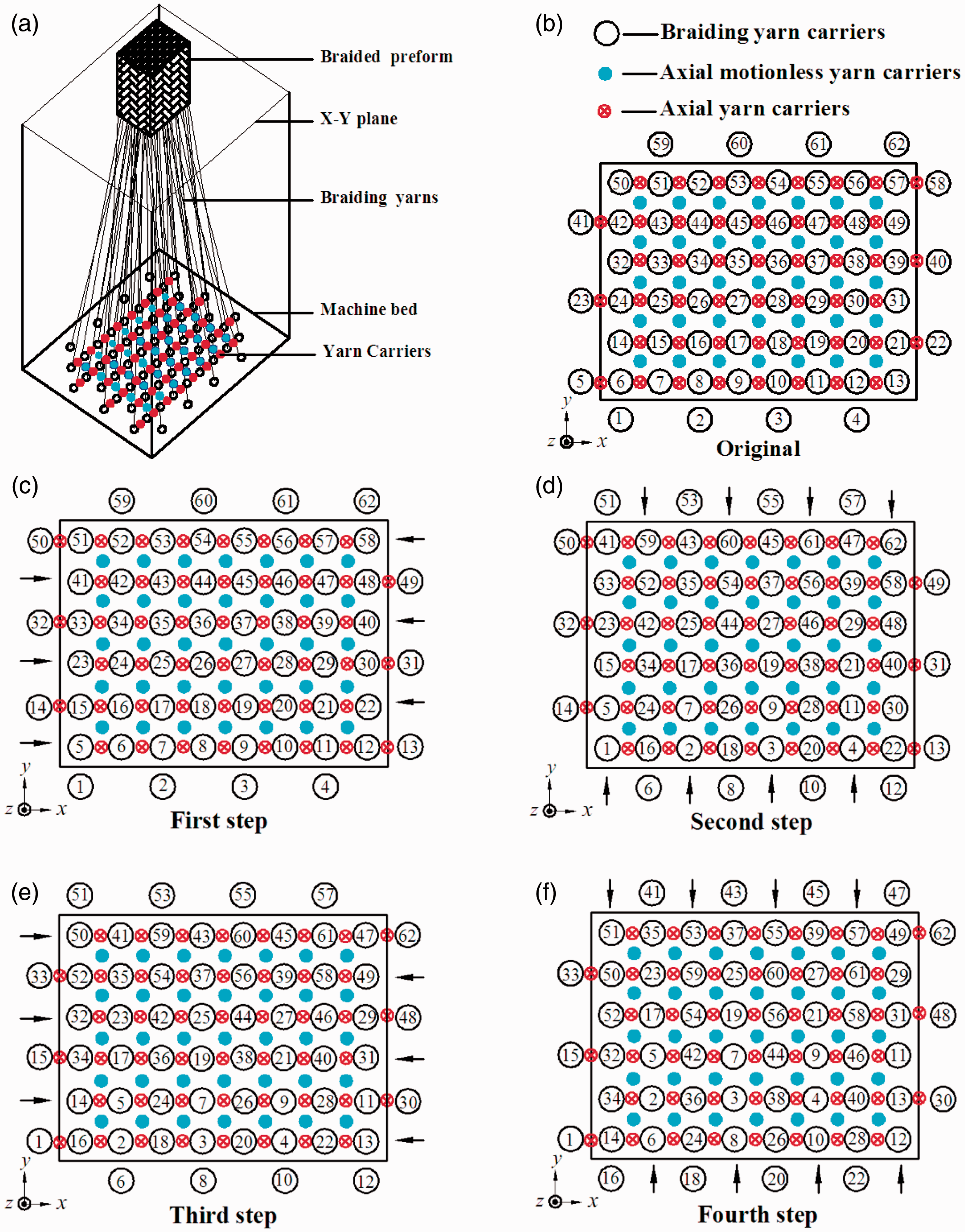
The objective of this paper is to present a new multiunit cell model (MUCM) on the basis of analyzing the microstructure of 3D full five-directional braided preform produced by four-step 1 × 1 braiding procedures. The new MUCM consists of five kinds of unit cells, namely interior, exterior surface, interior surface, exterior corner, and interior corner unit cells, which are developed by control volume method to characterize their unique microstructure features for different regions of 3D F5DBC. Meanwhile, the relationships between the structural parameters of unit cells and the braiding parameters are analyzed in detail, such as the braiding angle, the fiber volume fraction, the yarn packing factor, the braiding pitch length, and so on. Especially, the squeezing condition of the interior yarns is studied. Finally, the main structural parameters of braided specimens are calculated to validate the effectiveness of the MUCM. The predicted results agree well with the available experimental data. In addition, the variation of the volume proportion of five kinds of unit cells to the overall specimen with the number of yarn carriers is discussed, respectively. The effect of braiding angle on the squeezing factor of braiding yarn is analyzed. Some valuable conclusions are drawn herein.
Three-dimensional full five-directional braiding process
As a significant kind of fabric reinforcement, 3D full five-directionally braided preforms are usually produced by four-step 1 × 1 braiding procedures. As illustrated in Figure 1, the pattern of the yarn carriers on a machine bed in x-y plane and their movements in one machine cycle is given. The yarn carriers can be classified as three categories, i.e. the first is the braiding yarn carrier, the second is the axial yarn carrier, and the third is the axial motionless yarn carrier. As shown in Figure 1(b), the axial yarn carriers lie alternatively between the braiding yarn carriers in rows. Meantime, the axial motionless yarn carriers are arranged alternatively between the axial yarn carriers in columns. It is noted that the carriers arranged in such a pattern on the machine bed have made the number of axial yarns reach the maximum.
Naturally, the preform developed by such a braiding pattern can be called as full five-directional braided preform. According to the rectangular cross-sectional shape, the braiding yarn carriers in the main part of the braiding machine bed can be denoted by m × n, m being the number of braiding yarn rows and n being the number of braiding yarn columns, which often determines the cross-sectional dimensions of 3D F5DBC.
The total number of yarns used for producing 3D F5DBC equals the number of all carriers. Nby, Nay, and Namy represent the number of braiding yarns, axial yarns, and axial motionless yarns, respectively. Their formulae are given as follows


The whole braiding process of 3D full five-directional braided preform is similar to that of 3D four-directional braided preform produced by four-step 1×1 rectangular braiding procedures. During one machine cycle of 3D, full five-directional braiding process, the track movement of all braiding yarn carriers is the same as that of the braiding yarn carriers in 3D four-directional braiding process. As illustrated in Figure 1, there are four movement steps in one machine cycle and each braiding yarn carrier moves one position at each step along x or y direction. At the first step, the braiding yarn carriers and the axial yarn carriers in rows move horizontally one position in an alternating manner as shown in Figure 1(c). At the second step, the braiding yarn carriers in columns move one position vertically in an alternating manner as shown in Figure 1(d) and all axial yarn carriers stay in current positions without moving. At the third and fourth steps, as illustrated in Figure 1(e) and (f), the movement of these carriers is opposite to their previous movements, respectively. It is obvious that the axial motionless yarn carriers always keep static during the whole braiding process. After the cycle consisting of four steps is accomplished, all yarn carriers return to their original pattern as shown in Figure 1(b). Then a certain “jamming” action is imposed on all intertwined yarns, which makes the yarns stabilized and compacted in space. As a result, the finite length of the resultant preform is defined as the braiding pitch, denoted by h. With these steps of motion continuing, the yarns move throughout the cross-section and are interlaced to form a full five-directional braided preform as shown in Figure 1(a).
Structural analysis of 3D F5DBC
A new MUCM is proposed based on the structural analysis of 3D F5DBC in the study. In this section, according to the shell–core structure feature of 3D F5DBC, the yarn microstructure for three different regions, named the interior, the surface, and the corner, is identified by the control volume method, respectively.
In accordance with the movement of the yarn carriers in different regions, the typical movement traces of braiding yarn carriers and axial yarn carriers in the control volume region are shown in Figure 2. From Figure 2, the control volume region marked with “abcd” is regarded as a sample of interior region, where carrier 36 acts as a tracer of braiding yarn carrier. It can be seen that carrier 36 follows a zigzag way from point A to point B during a machine cycle. Similarly, the same process can be repeated for the other carriers in this region. By observing the movement of braiding yarn carriers in that control volume during a machine cycle, several typical movement traces of braiding yarns in space are shown in Figure 3. Prior to a “jamming” action, braiding yarns 36, 27, and 7 in Figure 3(a) and braiding yarns 26, 17, and 3 in Figure 3(b), respectively, follow the zigzag traces while extending h/4 along z direction simultaneously. After a four-step movement during a machine cycle, the “jamming” action repositions all interior yarns and makes them maintain straight traces as shown in Figure 3(a) and (b), respectively. Since the spatial position of braiding yarns is determined by the motion of braiding yarn carriers, the projection traces of braiding yarns in x–y plane are fitted to be the straight lines by connecting middle points of the braiding yarn carriers in conjunction with least squares principle. For instance, the red line AB for carrier 36 is shown in Figure 2.
Carriers’ movement trace in x–y plane. Movement traces of yarns during a machine cycle and yarn topology paths after a “jamming” action. (a) Movement traces and topology of two sets of interior braiding yarns, (b) movement traces and topology of two sets of interior braiding yarns, (c) movement trace and topology of axial yarn and (d) movement trace and topology of axial motionless yarn.

Regarding to the movement of axial yarn carriers, the spatial movement of the axial yarn controlled by carrier M in the control volume region on the machine bed during one and a quarter machine cycle is illustrated in Figure 3(c). Since carrier M always moves horizontally between position M and position N, Figure 3(c) also gives that the axial yarn maintains straight line and is parallel to z-axis after a “jamming” action. As illustrated in Figures 2 and 3(c), it is clear that the projection of the axial yarn controlled by carrier M is point O, which is just the original position of braiding yarn carrier 28. Therefore, the traces of all axial yarns are located in the middle points of adjacent axial yarn carriers in rows. More simply, for the axial motionless yarn carriers, they stay in their original positions without participating in the braiding process. As shown in Figure 3(d), the spatial trace of axial motionless yarn controlled by carrier Q in the control volume region always keeps straight line and is parallel to z-axis even after the “jamming” action. It is easy to find that the traces of axial motionless yarns on the machine bed are the original location points of their carriers. Furthermore, the spatial traces of all axial yarns in the surface and corner regions are identical to those in the interior region.
Figure 4 illustrates that the interior region of 3D F5DBC is made of two kinds of subcell A and B. It is noteworthy that subcell A and subcell B distribute alternately every half of a pitch length h along the braiding direction of z-axis. There are altogether four sets of braiding yarns, a set of axial yarns, and a set of axial motionless yarns in subcell A and subcell B. The four sets of braiding yarns distribute in two sets of intersecting parallel planes. Each yarn in the adjacent parallel planes has Composition of interior subcell A and B.
For surface region, more attention is paid to the movement of the braiding yarns. In Figure 2, the control volume region marked with “defgh” is chosen as a typical surface region. For carrier 8 in the region, it first enters from the main part of the machine bed into the surface and then returns. Generally, the carrier follows such a way from point C by point D to point E during a machine cycle. At step 1 and step 2, it moves one position along the +x-axis direction and moves one position along the –y-axis direction. Then, the carrier holds its position at step 3 and returns to the main part after step 4. Meanwhile, the braiding yarns extend h/4 along z-axis simultaneously during each step. Figure 5(a) shows its movement trace in space prior to the “jamming” action. Similarly, the motion traces of other braiding yarns 18 and 2 are also shown in Figure 5(a). After the aforementioned four-step movement, all surface braiding yarns are repositioned by the “jamming” action. In fact, since the paths of the braiding yarns in surface region are retraced abruptly, it is noted that the yarn axes closely neighboring the surface region are extremely complex and take on spatial curved lines. However, for simplicity, the surface yarn axes in the model are assumed to consist of two segments of straight lines as shown in Figure 5(b). For instance, the axis of yarn 8 includes two segments due to the three-step movement in the surface region. After the three steps from point 1 to point 4, the resultant path marked with “JKL” consists of two segments of straight lines JK and KL. Yarn topology in surface region. (a) Yarn movement traces in surface region during a machine cycle, (b) yarn topology paths after a “jamming” action.
Corner region has its unique microstructure characteristics because the movement of the braiding yarn carriers in the corner region is different from that of surface region. As illustrated in Figure 2, the control volume region marked with “lkjip” is taken as a sample of typical corner region. Based on analysis, the movement process of the braiding yarn carrier in the corner region can be divided into two main stages and each stage contains three steps. For instance, carrier 12 in the corner control volume first enters from the main part of the machine bed into the side of the corner along x-axis and then returns. In the process, it moves from point F by point G to point I, the main part of the machine bed. Second, it enters again into the side of the corner along y-axis and then returns. In the process, it moves from point I by point H to point I during the second stage. Similar to the movement in the surface region, whether in the first stage or in the second stage, the braiding yarn carrier holds its position at the middle step while located in point G and H. Meanwhile, all yarns extend h/4 along z direction simultaneously for each step. Figure 6(a) shows its spatial movement trace prior to the “jamming” action. Similarly, the motion trace of braiding yarn 13 is also shown in Figure 6(a).
Yarn topology relation in corner region. (a) Yarn movement traces in corner region during two machine cycles, (b) yarn topology paths after a “jamming” action.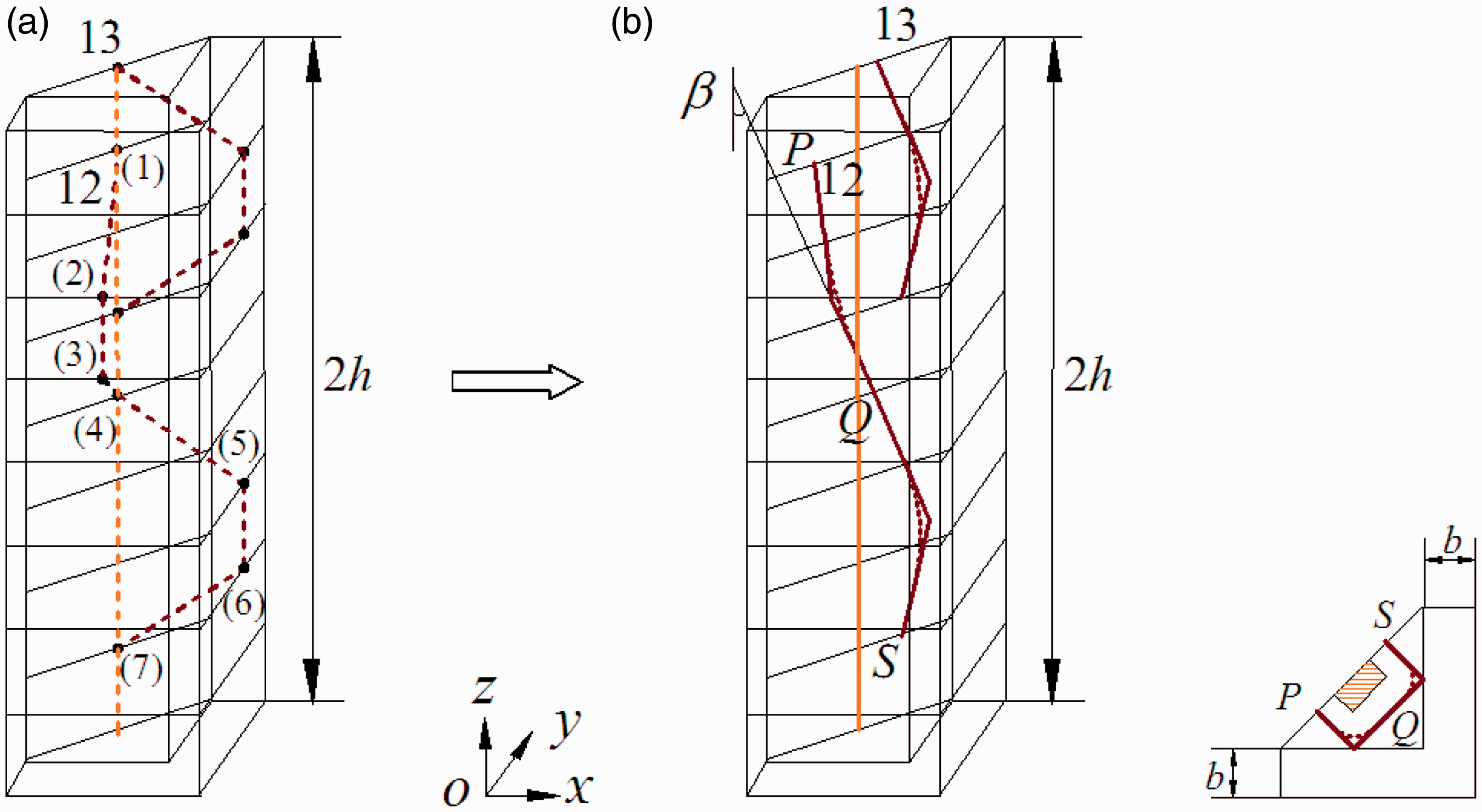
After the aforementioned four-step movement, all corner braiding yarns are repositioned by the “jamming” action. As the paths of the braiding yarns are retraced abruptly, the yarn axes neighboring the corner region actually become more complicated. For simplicity, the braiding yarn axis in the corner region can be assumed to comprise three segments of straight lines. It is clear that the braiding yarn traces in the corner model can be divided into two sets of the surface yarn path by rotating the orientation angle of yarn path for 90°. For instance, as shown in Figure 6(a), the axis of braiding yarn 12 contains five segments due to six-step movement in the corner region. After the six steps from point 1 to point 7, the resultant path denoted by “PQS” comprises three segments of straight lines as shown in Figure 6(b). The path “PQ” and the path “QS” have the same geometrical characteristics as shown in Figure 5(b). The angle of the straight line with respect to z-axis is defined as the corner braiding angle β. Regarding to the movement trace of the axial yarn in corner region, it is identical to that of interior region.
Multiunit cell model for 3D F5DBC
In order to make 3D F5DBC successfully applied in engineering industries, it is valuable to establish an effective microstructure model for predicting their mechanical properties. Since 3D F5DBC have the unique microstructure for different regions, it is a feasible strategy to develop the representative volume element called as unit cell for each region based on their periodical microstructure features. In this section, a new MUCM is presented for 3D F5DBC based on their microstructure analysis.
Basic assumptions
According to the mutual squeezing of the yarns, the cross-section shape of the interior braiding yarn is assumed to be hexagonal and the hexagon contains an inscribed ellipse with major and minor radii, a and b, respectively. Since the squeezing condition of braiding yarn in surface–corner regions is different from that of the interior yarns, the cross-section shape of the exterior braiding yarn is assumed as an ellipse with the same size. The cross-section shape of the axial yarn and the axial motionless yarn is a square with side length rayb and ramyb, where ray and ramy are the size factors of the axial yarn and the axial motionless yarn, respectively. For simplicity, the size factor of the axial yarn ray can be assumed to be equal to the axial motionless yarn ramy, i.e. ray = ramy = r. The assumed cross-section shapes for all yarns are shown in Figure 7. The axes of interior braiding yarns keep straight lines and the axes of the braiding yarns in surface–corner regions consist of two segments of straight lines. Meantime, the axes of all axial yarns and axial motionless yarns maintain straight lines. The cross-section shape of the braiding yarn changes gradually from the surface–corner region to the interior region, which is neglected in the model. The braiding procedure maintains steady and the braided structure is uniform, at least in a certain length of interest. Cross-section of yarns in the multiunit cell model. (a) Interior braiding yarn, (b) surface–corner braiding yarn, (c) axial yarn, and (d) axial motionless yarn.

Structural parameters of MUCM
The typical yarn traces of braiding yarns, axial yarns, and axial motionless yarns in the interior, surface, and corner regions are analyzed in detail by adopting control volume method in “Structural analysis of 3D F5DBC” section. Since the microstructure of 3D F5DBC has its unique feature called as the shell–core structure, a new MUCM including five kinds of unit cells is shown in Figure 8. The unit-cell partition scheme can make all unit cells oriented in the same reference frame as the cross-section of specimen, which contributes to analyzing the mechanical properties. No matter m and n equal, even number, or odd number, the partition scheme can obtain a unique result for F5DBC.
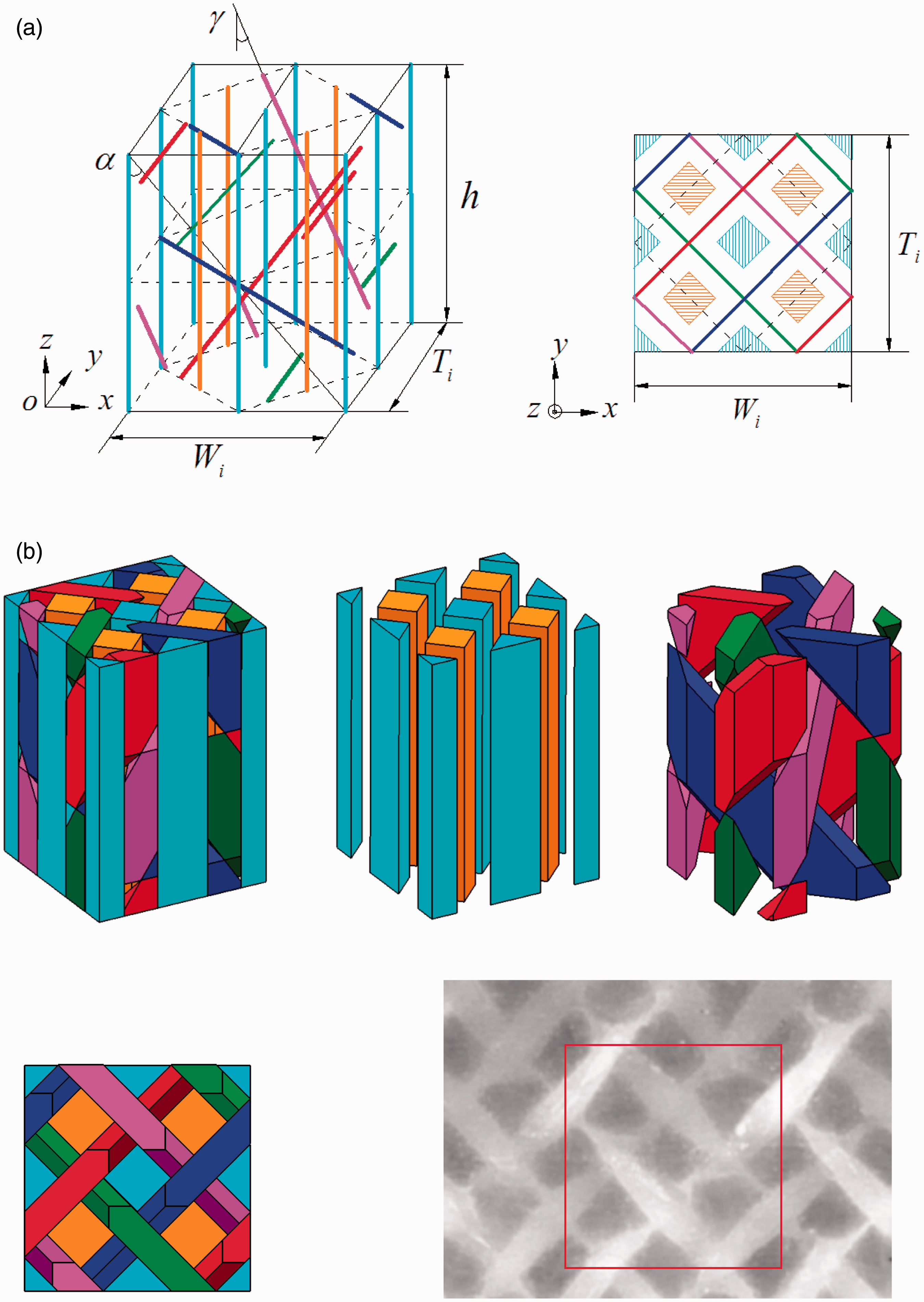
As shown in Figure 9, an interior unit cell is selected by considering the periodic distribution feature of the interior subcell A and B, which is the smallest interior unit cell. Based on the microstructure analysis, Figure 9(a) shows the topological relation of the main yarns in a rectangular hexahedron, where the width is Wi, the thickness is Ti, and the pitch height is h. α is defined as the braiding angle between the grain formed by the adjacent braiding yarn with the same orientation on the surface and z-axis. γ is denoted as the interior braiding angle between the central axis of the interior braiding yarn and z-axis. Figure 9(a) also gives the projection of the axes of all braiding yarns, axial yarns, and axial motionless yarns on x–y plane. As shown in Figure 9(b), the solid interior unit cell model is established, which clearly indicates that the presented solid interior unit cell model reaches a good agreement with the actual microstructure of the composites [14].
Multiunit cell distribution on the cross-section of rectangular specimen. The interior unit cell model. (a) Yarn topology of interior unit cell, (b) comparison of cross-section of specimen [14] with the solid unit cell model.
As illustrated in Figure 10, except for the axial yarns and the axial motionless yarns, the surface unit cell actually includes two sorts of braiding yarns with the interior braiding angle γ and the surface braiding angle θ, respectively. According to the microstructure feature of the braiding yarns shown in Figure 10(a) and (b), the surface unit cell can be divided into two kinds of surface subcells: the exterior surface unit cell and the interior surface unit cell.
The surface unit cell model and its subcells. (a) The exterior surface unit cell, (b) the interior surface unit cell.
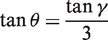
From Figure 10(a), the braiding yarns in the exterior surface unit cell keep straight lines and take on four permutations. The angle between the two sets of braiding yarns and z-axis can be
As illustrated in Figure 11, except for the axial yarn and the axial motionless yarn, the corner unit cell contains two kinds of straight braiding yarns with the interior braiding angle γ and the corner braiding angle β, respectively. Similarly, according to the orientation angle of the braiding yarns, the corner unit cell can also be divided into two types of subcells: the exterior corner unit cell and the interior corner unit cell as shown in Figure 11. As illustrated in Figure 11(a), the braiding yarns in the exterior corner unit cell keep straight lines and take on three permutations. The angle between the two sets of braiding yarns and z-axis can be The corner unit cell model and its subcells. (a) The exterior corner unit cell, (b) the interior corner unit cell.
The structural parameters of the new MUCM are analyzed in detail. First, it is important to establish the angle relationship between the braiding yarns in the MUCM for F5DBC. It is no doubt that measuring the interior braiding angle γ is generally difficult. However, the braiding angle α can be measured directly as shown in Figure 12 [16].
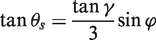
Surface projection angle θs and braiding angle α [16].
Based on the trigonometry as shown in Figures 3 to 6 and 9 to 12, the relationship between the angles can be obtained as follows



As illustrated in Figures 9 to 11, the width W and the thickness T of the interior unit cell, the surface unit cell, and the corner unit cell are given by, respectively



According to the geometry relationship shown in Figures 8 to 11, the cross-section dimensions of the rectangular specimen can be given as follows
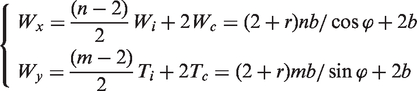
As illustrated in Figures 9 to 11, the pitch length h for all unit cells is given by

According to equations (12) and (13), the dimensions of preform sample can be calculated ideally. However, it should be pointed out that the final dimensions of composite specimens depend upon the mold size largely. Therefore, it is suggested that the mold size should be designed based on the expected size of braided preform.
Squeezing analysis of interior yarns
According to the braiding process, it is not difficult to find that the proportion of the interior region is usually larger than surface–corner region for general cases. Therefore, modeling the microstructure of the interior yarns reasonably is valuable for establishing the MUCM. On the basis of the microstructural analysis, the microstructure configuration of the interior yarns is established in Figure 13.
Yarn configuration of the interior yarns. (a) Interior yarns configuration, (b) squeezing relation of yarn 9 and yarn 10.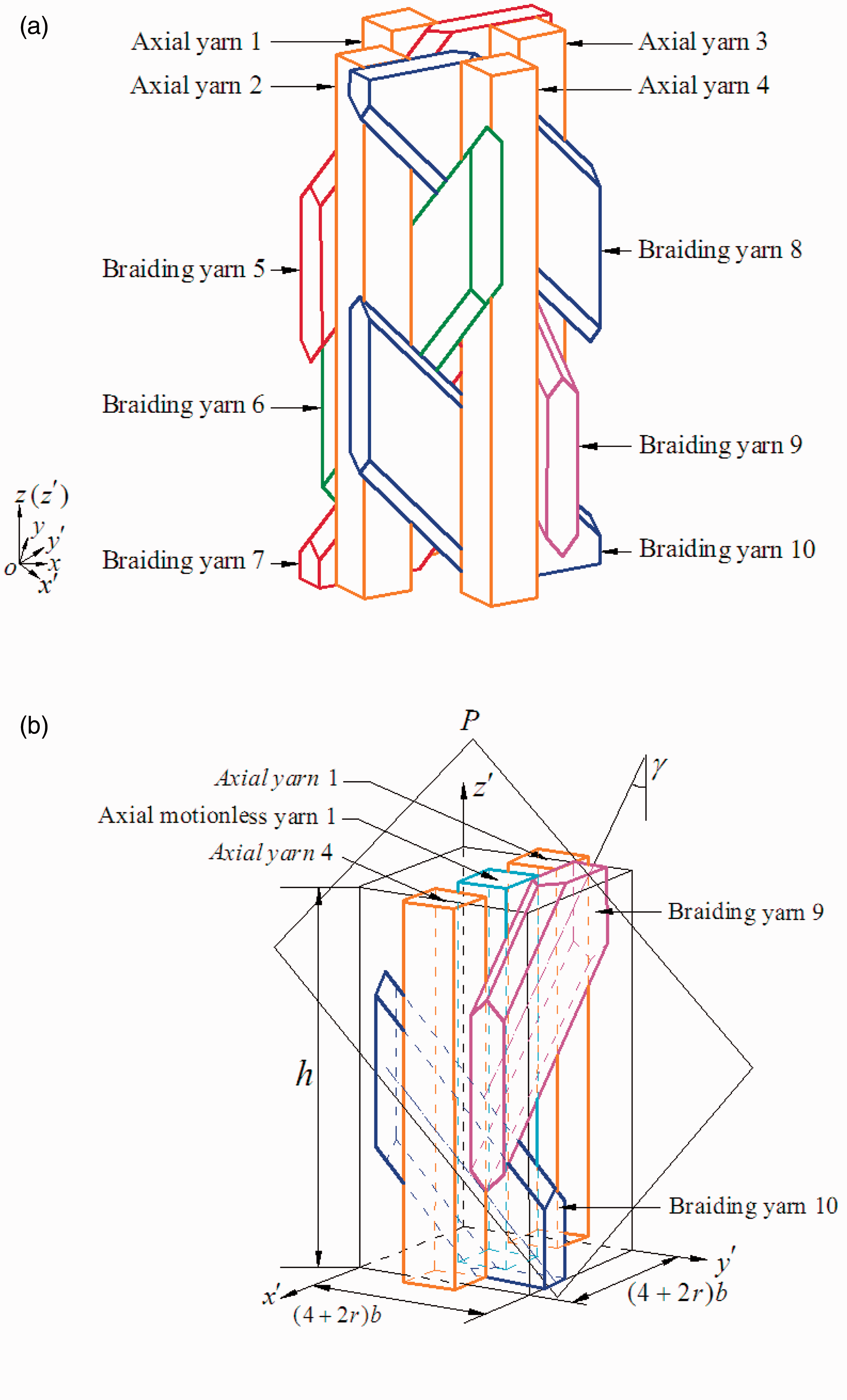
In order to show the contact relation of interior yarns clearly, the axial motionless yarns have been removed out from their original position while only the axial yarns remain, as shown in Figure 13(a). It is clear that the braiding yarns and the axial yarns contact with each other and take on regular configuration in the local coordinate system


The plane P parallel to the elliptical cylinders of Yarn 9 and Yarn 10 can be expressed as

In conjunction with Figure 13(b), it is recipient that the inscribed ellipses of the two braiding yarns have a unique tangent point in plane P. According to the tangent relationship of the elliptical cylinders and plane P, the relationship between the major and minor radii of the inscribed ellipse, i.e. a and b, can be derived as

The squeezing factor for the interior braiding yarns, k, is defined as

From equation (18), due to the introduction of axial yarns, it is clear that the squeezing extent of braiding yarns for 3D F5DBC is obviously intensified compared to 3D 4DBC with the same model assumptions, such as the cross-section shape of braiding yarns, etc.
After analyzing the parameter relation as shown in Figure 13(b), the cross-section dimensions of the interior braiding yarn can be given as follows


The cross-section area of the axial yarn and the axial motionless yarn is given by

The cross-section area of the interior braiding yarn and the exterior surface-corner braiding yarn is given by, respectively


Judging from the above analysis, determining the size factor of axial yarn r is crucial for modeling the microstructure of F5DBC. In accordance with the model assumptions, the size factor of axial yarn r can be derived as by equaling equations (21) and (22)

Then the squeezing factor of the braiding yarn k in equation (18) can also be calculated once the interior braiding angle γ is given based on equation (4).
Fiber volume fraction of unit cells
Structural parameters of five kinds of unit cells.
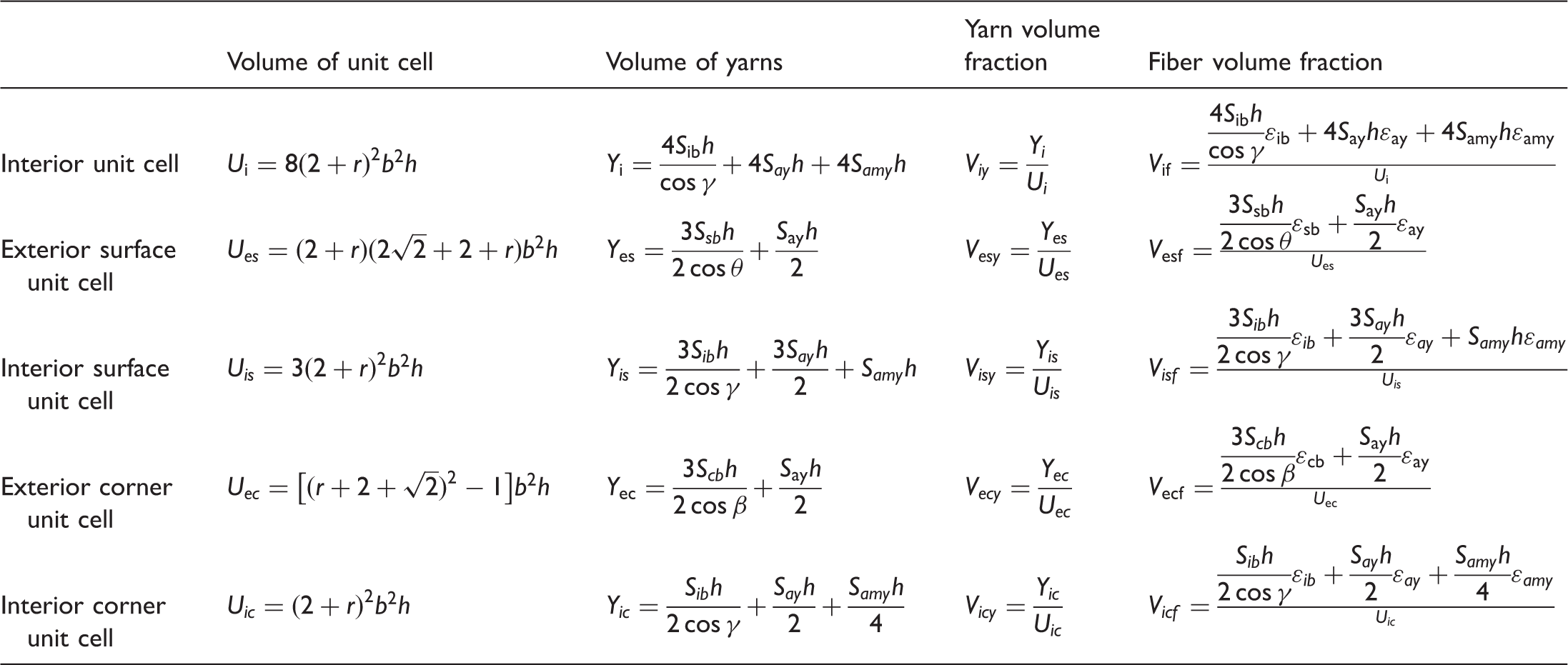
From Table 1, the yarn volume of unit cell is defined as the volume ratio of yarns to the whole unit cell. As shown in Table 1, the fiber volume fraction for each unit cell can be obtained through multiplying the yarn volume fraction by their corresponding yarn packing factor. The yarn packing factor is defined as the fiber volume fraction in a fiber bundle. The yarn packing factors for different yarns in the interior, exterior surface, and exterior corner regions are given as follows


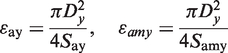
For F5DBC, the fiber volume fraction Vf is calculated by the volume averaging method, namely


As for F5DBC, the braiding process parameters have their inherent relationship, which determines the structural parameters of the composites. The braiding angle α, the fiber volume fraction Vf, the number of yarn carriers m and n of the composites, and the equivalent diameter of a solid braiding yarn Dy have great effects on the geometry parameters of the specimens. As a whole, once the above parameters are determined, all structural parameters of specimens can be obtained finally.
Results and discussion
Structural parameters of specimens [14].

Comparison and analysis of theoretical prediction results and experimental values
Comparison of the structural parameters between the prediction models and experimental data.

The yarn volume fraction for five kinds of unit cells.

The volume fraction and fiber volume fraction for five kinds of unit cells.

Effect of m and n on volume fraction of unit cells
To discuss the number of yarn carriers m and n on the volume fraction of unit cells, the specimens with a given braiding angle α are taken as samples. The braiding angle α is assumed to be 25° for the specimens reported herein. Thus, the size factor of axial yarn r can be calculated. The variation of the calculated volume fractions of five kinds of unit cells with m and n is given in Figure 14. As shown in Figure 14(a), the proportion of the interior unit cell to the overall braided structure increases when m or n increases. When m is greater than 20 and n is greater than 10, the volume fraction of interior unit cell is more than 70%. With the increasing of m or n, the volume fraction of interior unit cell becomes larger and reaches more than 90%.
Variation of volume fraction of multiunit cells with m and n. (a) Variation of volume fraction of interior, (b) variation of volume fraction of exterior unit cell with m and n surface unit cell with m and n, (c) variation of volume fraction of interior, (d) variation of volume fraction of exterior surface unit cell with m and n corner unit cell with m and n, and (e) variation of volume fraction of interior corner unit cell with m and n.
As illustrated in Figure 14(b) and (c), the proportion of the exterior and interior surface unit cell to the overall braided structure decreases when m or n increases. When m is greater than 20 and n is greater than 10, the volume fraction of exterior surface unit cell is less than 10%. With the increasing of m or n, the volume fraction of exterior surface unit cell becomes smaller. Similarly, as shown in Figure 14(c), when m is greater than 20 and n is greater than 15, the volume fraction of interior surface unit cell can be less than 15%. When m or n increases, the volume fraction of interior surface unit cell becomes smaller.
As illustrated in Figure 14(d) and (e), the proportion of the exterior and interior corner unit cell to the overall braided structure decreases when m or n increases. When m is greater than 10 and n is greater than 20, the volume fraction of exterior corner unit cell can be less than 3%. With the increasing of m or n, the volume fraction of exterior corner unit cell becomes smaller. Similarly, as illustrated in Figure 14(e), with the increasing of m and n, the volume fraction of interior corner unit cell becomes smaller. When m is greater than 10 and n is greater than 20, the volume fraction of interior corner unit cell can be less than 1%.
Therefore, when either of m or n is small, it is noteworthy that the proportion of the surface–corner region to the overall specimen is so large that they cannot be neglected for appraising the mechanical performance of 3D F5DBC.
Effect of braiding angle on the squeezing condition of braiding yarns
From equation (24), the size factor of braiding yarn r is determined by the interior braiding angle γ. Then the squeezing factor of interior braiding yarn k is calculated by equation (18), which is defined as the ratio of major radius a to minor radius b. k actually indicates the ellipticity of cross-sectional shape of braiding yarns due to their mutual squeezing. The variation of the squeezing condition with the braiding angle α is given in Figure 15. Combining equation (18) and Figure 15, it is clear that the introduction of both the axial yarn and the axial motionless yarn makes the squeezing deformation of the interior braiding yarn more obvious compared to 3D 4DBC with the same model assumptions, such as the cross-section shape of braiding yarns, etc. For general specimens, α varies from 10° to 45°. With the braiding angle α increasing, the squeezing factor k decreases. Therefore, the braiding angle α has a great effect on the deformation of the braiding yarns, which directly determines their microstructure and spatial configuration of braiding yarns.
Variation of squeezing factor k for the braiding yarn with the braiding angle α.
Conclusions
In this study, a new MUCM is proposed on the basis of the microstructure analysis of 3D full five-directional rectangular braided preform produced by four-step 1 × 1 braiding procedures. The MUCM consists of five kinds of unit cells, namely interior, exterior surface, interior surface, exterior corner, and interior corner unit cells, which are developed by control volume method to characterize their unique microstructure features. The relationship between the microstructure parameters of unit cells and process parameters is analyzed in detail. Analysis results indicate that each unit cell has its own distinct microstructure features. The fiber volume fractions of the exterior surface unit cell, the interior surface unit cell, the exterior corner unit cell, and the interior corner unit cell are obviously different with that of the interior unit cell.
Based on the modeling strategy of MUCM, the nine specimens are selected as the samples and good agreement is obtained between the predicted results and experimental results, which validates the effectiveness of the model. Discussion reveals that the number of yarn carrier has a significant effect on the volume fraction of each unit cell. With the increasing of m or n, the volume proportion of interior unit cell increases. When the number of m or n is small, the volume fraction of the surface–corner regions can reach as high as 50%. The effect of braiding angle on the squeezing factor of the interior braiding yarn is discussed, which indicates that the introduction of axial yarns and axial motionless yarns makes the squeezing deformation of braiding yarns more obvious. Results prove that the presented MUCM can provide a better foundation for the optimization design and mechanical analysis of 3D F5DBC.
Footnotes
Declaration of Conflicting Interests
The author(s) declared no potential conflicts of interest with respect to the research, authorship, and/or publication of this article.
Funding
The author(s) disclosed receipt of the following financial support for the research, authorship, and/or publication of this article: The authors wish to acknowledge the support received from the National Natural Science Foundation of China (Grant No. 11302045) and China Postdoctoral Science Foundation (Grant No. 2014M552345).