




Abstract
We explore the structure of a textile absorber in terms of its electromagnetic and absorption properties in the microwave region. Its absorption characteristics are similar to those reported for various metamaterial-based absorbers, exhibiting absorption as high as 98% at resonance. In addition, the angular behavior of the absorption properties of the sample reveal incident angle independency, which is the other added value of the study. Also, the suggested textile absorber has a simple configuration, which introduces flexibility to adjust its material properties and easily tune its structure to suit other frequencies. The proposed textile absorber and its variations have myriad potential applications in radar technology, long distance radio telecommunication, and so on. Although in its current state the proposed structure provides almost perfect absorption covering a wide range of microwave C-Band, the developing technology will soon allow manufacturing textiles that can manipulate lights, leading to the design of invisibility cloak and other science fiction devices besides finding important application areas in medical science.
Introduction
Metamaterials (MTMs) have gained considerable attention in the scientific community [1–7] due to their unconventional electric and magnetic features and beneficial applications in numerous devices for different regimes of electromagnetic (EM) spectrum, from radio to optical frequencies [8–12]. These handmade artificial materials have wide potential application areas—EM cloaking [13], super lens [14], sensing [15], absorber [16,17], improvement of antenna characteristics [18], and so on [19–21]. The design and fabrication of MTMs for further and vast number of applications, either for a research purpose or at an industrial level, is highly desirable, with high yield and use of cost-effective technologies for the desired EM filtering, absorber, polarization control, sensing, or any other supplementary studies. Among the above-mentioned applications, absorbers have been one of the most studied topics and to date they continue to be investigated by the EM society [16,17]. A prototypical metamaterial absorber (MA) customarily consists of some special resonator and metallic plate separated by a dielectric substrate which is not an issue in the proposed structure anymore. In the literature, there are many studies on EM interference shielding applications including shielding based on textile materials, which describes the investigation of metal coatings and their deposition parameters on the sample [22–28]. These are generally based on some particular parameters influencing the EM shielding properties of the designed sample. Recently, many studies were performed to investigate the EM shielding properties of textile materials since the effects of EM waves emitted from electronic equipment on human health is a current problem to solve. Therefore, a number of studies were carried out to design textile-based shielding material. In order to introduce EM shielding into textile materials, various methods were used in research studies such as coating yarn using vapor phase polymerization technique [29], using metallic hybrids [30,31] or cores [32] or plied yarns [33] in fabric samples, and using composite textile materials [34]. However, there are almost no studies on use of Arc physical vapor deposition (PVD) method for imparting EM shielding properties to textile materials. In this scenario, the aim of this study is to design, realize, and experimentally analyze a perfect textile material absorber to be used in appropriate applications such as in radar technologies. Thus, we introduce and investigate a textile absorber based on Arc PVD system by adopting metallic particles on any type of surfaces for microwave C-Band. Although the main aim of the present study is to design and characterize an MTM-based textile absorber using the developing technology, the proposed method may also be used to design and realize novel types of MTMs for different applications.
It is well known that thin film coating can be realized with a thickness of a few nanometers. Different types of deposition techniques are used to meet this criterion. All of these techniques including vacuum are used to minimize unwanted reaction with the free space and to shape the film composition easily. Two main techniques based on vacuum deposition are known as chemical vapor deposition (CVD) and PVD. In CVD technique, thin film design is realized by chemical reaction between precursors. The reaction needs hot substrate or exact deposition chamber. Due to the need of gas phase for surface coating, CVD technique is suitable for large and complex-shaped surfaces. Physical processes such as evaporation and sputtering are used in PVD technique. Some PVD methods are well known such as thermal evaporation, electron beam evaporation, and molecular beam epitaxy. Besides, many sputtering techniques are used to form plasma by collision effects of the gases in the background. All PVD methods are useful for coating surfaces faced with deposition flux. Substrate type, thin film material, necessity for uniformity, and thickness control are important parameters that help in the choice of the deposition method. In this study, cathodic arc PVD method is chosen due to its advantages over the other mentioned methods. Some of them are: materials can be co-evaporated at the same rate, better adhesion can be achieved as a result of the intermixed reaction, decent coating of heat-sensitive substrates/components, multilayered coatings, and functionally graded compositions. Because of these properties, it is preferred to be used widely in both research (as in the present study) and industrial areas to create decorative, protective, and/or wear resistant coatings without using background gases. Besides, more importantly, according to the best of our knowledge, there is no study in the literature related to the fabrication of MTMs or MTM-based devices (i.e. MTM absorber) using the cathodic arc PVD method. This may lead to design and fabrication of novel MTMs and MTM-based devices for functional components for a myriad of applications.
The absorber properties of the proposed textile absorber structure with metallic nanoparticles as textile MAs are explored and discussed in the microwave C-Band region using the reflection and transmission measurements. The coating is made of sputtered titanium nanoparticles via Arc PVD technique. There are several crucial reasons why titanium is the most appropriate metal for this type of application. First, titanium has very high temperature levels for entering into a reaction with other materials compared with the other commonly used metals. Second, Titanium is the best candidate for the health reasons. Since our structure contains fabrics, it is highly possible it comes in contact with human skin, and titanium does not cause any allergic reaction on the human body; in other words, it is health friendly. Last, titanium is lighter compared with the other commonly used metals and it has low density and high strength. Because of all these reasons, we have chosen titanium as the sputtering metal on our structure. It can precisely be fabricated without deformation over considerably large surfaces. Unlike most typical MAs, the structure does not require particular unit cell design; thus the structure provides a flexibility to design various textile MTMs, textile absorbers, and shielding structures. Besides, the structure does not suffer from the weight of the metal since it is in the form of the (nano)-particle. In general, textile structures coated with metallic nanostructures may be considered as textile MTMs since they present properties that are similar to those of conventional MTMs. The unique properties of the textile structure also offer possible angle-independent absorbers due to their characteristic features. Besides, the proposed textile absorber has many potential advantages with respect to the conventional MA structures such as flexibility and its weight. Consequently, the suggested structure with high quality features will be a good candidate among its counterparts and can be used in radar absorbing applications. Note that, to the best of our knowledge, the present work is the first experimental study of textile MTM absorber for microwave C-band, and the data show that we succeed in achieving good absorption level for the proposed sample for the mentioned frequency range.
Materials and methods
Preparation of the sample
Properties of the textile material.

Coating of the sample
The reason for selecting the test material in fabric is to locate the nanoparticles in the material in two-dimension and non-uniformly. Figure 1 shows a typical Arc-PVD system block. Filtered Arc-PVD system is used to evaporate titanium metal up to 15,000℃. Consecutively, cathode spot was formed and vaporized metal nanoparticles were accelerated between 200 and 600 V and then filtered with EM toroid. The plasma thus formed is highly ionized and uncharged. Macroparticles (droplets, clusters) are filtered by 90o magnetic filter and the mentioned plasma is sputtered on textile materials. The titanium plasma sputtered on the material penetrates at various depths. The penetration depth depends on anode voltage, density of the material, and structural properties of textile materials. This method is chosen because of its various advantages. In this method, coating can be performed at room temperature, and coated surface temperature does not reach high levels; therefore, this method can be beneficial for textiles (natural and manmade) and other surfaces such as plastics, ceramic, metals, glass, and so forth, to be coated without deformation. Acceleration voltage (anode voltage) and average penetration depth can be well-controlled as required. Therefore, the adhesion of nanoparticles on most surfaces is good. The coating thickness can be controlled with the number of arc pulses, which can be considered as another advantage of the system.
Arc-PVD system block diagram.
Measurement of EM properties of the sample
The textile material is composed of cotton and polyamide in different ratios. Hence the effective permittivity and permeability of the uncoated-structure should be evaluated to analyze the EM properties of the proposed textile absorber. Hence the effective permittivity and permeability of the uncoated textile sample were extracted from the measured data. The measurement system is shown in Figure 2. To measure the reflection and transmission coefficients, a vector network analyzer with the range of 1–6 GHz and two horn antennas are used in this experiment [16].
The test instruments used in the measurement.
Results and discussion
The extracted effective permittivity and permeability of the uncoated textile sample is shown in Figure 3. Extracted effective parameters (permittivity and permeability) show insignificant changes with frequency (almost fixed as expected) because the uncoated sample has almost fixed constitutive parameters, as known. In addition, there is no metallic inclusion in the pure textile sample that affects and interacts with the incident wave to provide dispersive or frequency-dependent permittivity and permeability. Note that in the extraction process, the following equations are used: ɛ
eff
= n/z and μ
eff
= n × z, where n is the refractive index and z is the impedance of the medium. In order to verify the existence and validity of the refractive index, a unique retrieval of effective parameters from the reflection and transmission data is obtained by enforcing the causality. The applied extraction method is based on the Kramers–Kronig (KK) relations, which have been used to calculate the index of refraction using calculated or measured data sets [35]. While the real part of the complex refractive index has multiple solutions, the imaginary part of the refractive index is not affected by the branch problem of the standard retrieval method. Thus, the imaginary part has a unique solution and it can be calculated without ambiguity. By knowing the unique imaginary part of the refractive index, the real part can be determined using KK relations and the guidance of the imaginary part for the correct choice of the branch. The KK relation for the real part of the refractive index can be written as follows
Extracted constitutive parameters of uncoated textile sample.

Moreover, views of the textile material and Arc-PVD processed textile material using scanning electron microscopy (SEM) are shown in Figure 4. SEM generates images of any sample by scanning it with a focused beam of electrons. The electrons interact with atoms in the sample, generating various EM signals. These signals can be detected and contain information about the surface topography and the composition of the sample. Scanning generators supply necessary voltages or currents for the deflection circuits of the microscope and of the display. The ratio of these deflections gives, of course, the magnification of the instrument. The pictures are magnified with a ratio of ×100 (Figure 4(a) and (b)) and ×1000 (Figure 4(c) and (d)). Evidently, the yarns coated with titanium nanometals are brighter (Figure 4(b) and (d)) than the uncoated ones (Figure 4(a) and (c)). The metallic surfaces on yarn and metallic ground plane will have both electric and magnetic responses to provide a resonance within the studied frequency region. In this case, the impedance of the textile material will be matched with the free space impedance at the resonance frequency. Hence, incident wave can penetrate the material abundantly.
SEM images of the textile samples, (a) and (c) uncoated and (b) and (d) coated, with metal using Arc-PVD method.
For the perfect absorption, the transmission and reflection coefficients of incident waves have to be nearly zero
The transmission, S21, will be zero in the proposed absorber due to the metallic background of the sample. Therefore, only the measured reflection S11 and absorption results are presented in Figure 5. The resonance appeared at 4.42 GHz with S11 = 0.08. Experimentally, the maximum value in the absorption was obtained around 98% at resonance. The reflection and absorption values are very significant for such samples in the microwave region. There is also absorption of 0.75 at 5.20 GHz, but this peak value does not match with standard absorption values.
Reflection and absorption coefficient of the sample.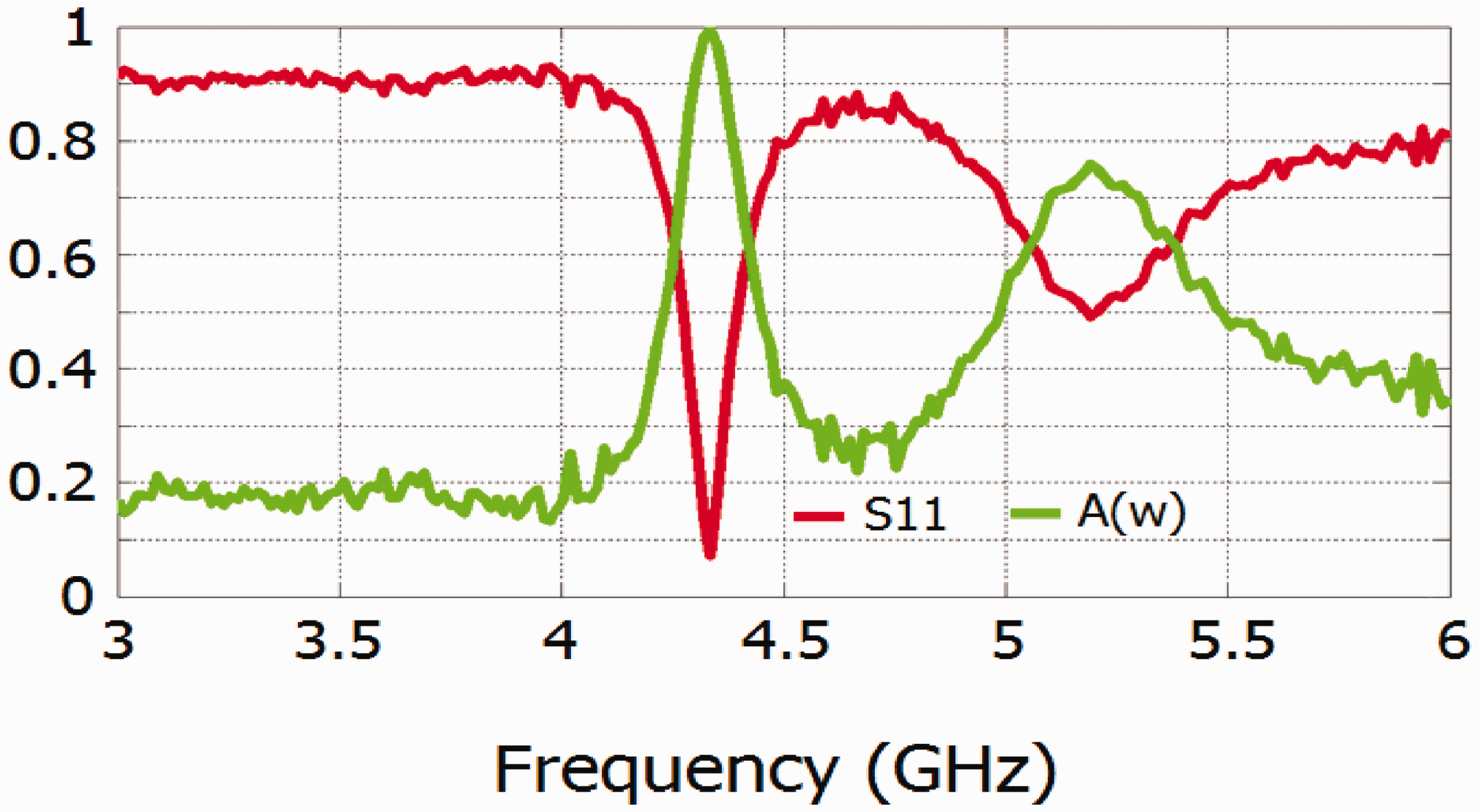
It is a well known fact that there are many factors that affect the resonance frequencies such as effective permittivity, effective permeability, loss tangent, thickness of textile sample, surface density of coating metal, and so on. For example, maximum absorption is observed in the case of equivalent impedance values of free space and overall textile sample composed of coated surface, pure textile material, and metallic ground plane. While the free space impedance is
Next, the incident angle is changed to understand the angular properties of the proposed absorber. Figure 6 shows the reflection coefficient versus frequency under different incident angles. Reflection coefficient does not change with respect to the variation of the incident angle, meaning that the textile absorber also is independent of the incident angle, which can be used in many applications.
Reflection coefficient of the sample for different incident angles.
The proposed textile absorber is incident angle independent since the Arc PVD metallization for coating is homogenously deposited on the textile sample and the metallization does not exhibit axial dependency, as shown in SEM images (Figure 4). Hence, change of the incident wave angle does not affect current distribution of the homogenized metallic inclusions.
Conclusion
In conclusion, the proposed textile absorber was introduced and experimentally investigated for microwave C-Band frequency region. The results obtained show that the model can be used as a perfect absorber with incident angle independency. In addition to that, it is also suitable for myriad absorber applications due to its flexibility of design. To the best of our knowledge, this is the first study on such a textile absorber that is independent of the incident angle. Since the structure provides a resonance at the microwave C-Band frequency region and offers perfect absorption with independence from the incident angle at the mentioned regime, it can also be used in long-distance radio telecommunications (as directly related with C-Band), and it will be a very good candidate in the application of satellite communications transmissions, Wi-Fi devices, cordless telephones, weather radar systems, and so on. Moreover, the proposed model can be retailored for different frequencies to be used in different applications.
Footnotes
Funding
MK acknowledges the support of TUBITAK (project number 113E290) and partial support of the Turkish Academy of Sciences.