




Abstract
Aims:
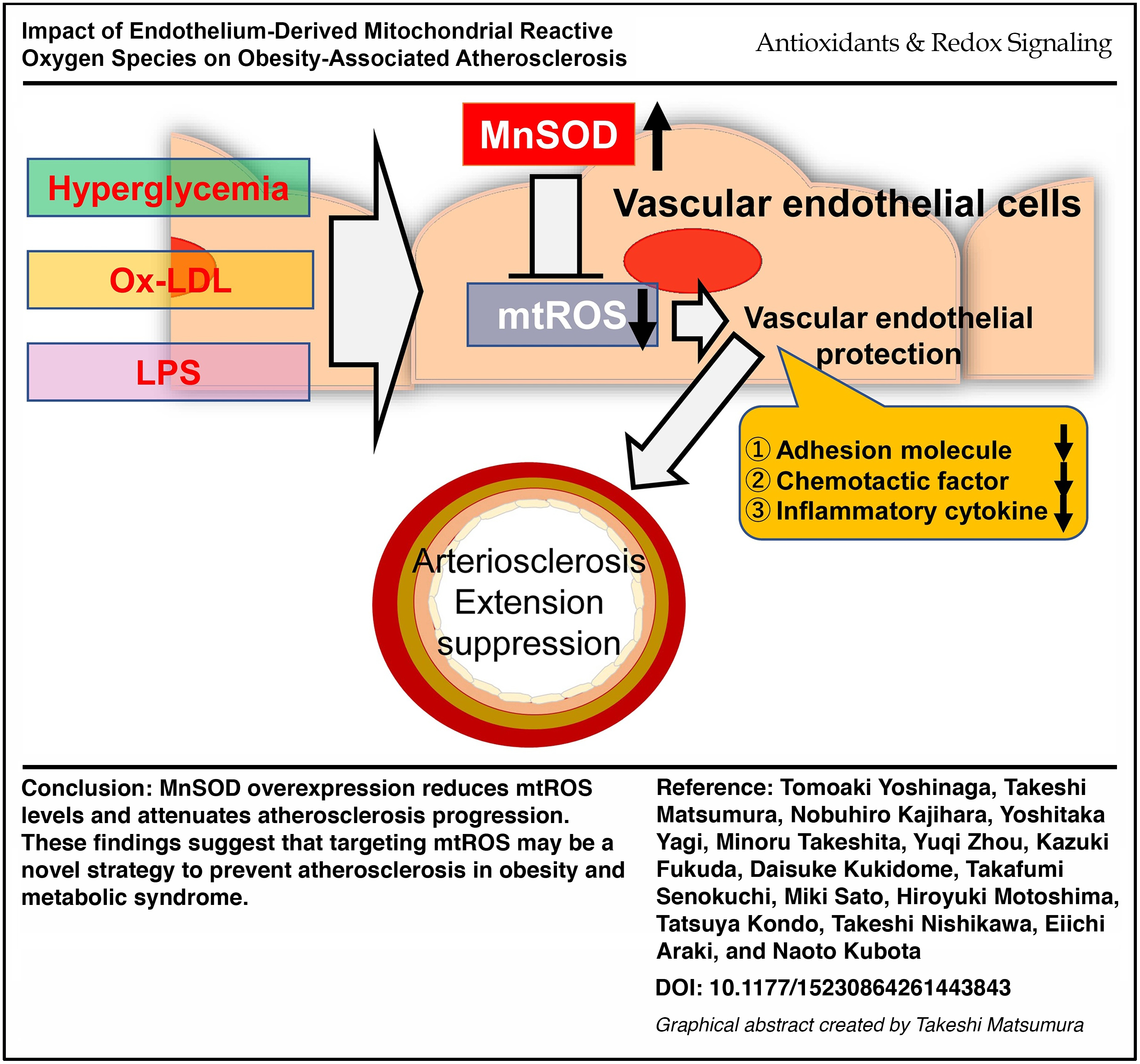
Obesity, a risk factor for atherosclerosis development and progression, is marked by excessive reactive oxygen species (ROS) production. We previously demonstrated that high-glucose (HG) conditions induce mitochondrial ROS (mtROS) production in aortic endothelial cells (ECs). However, the link between elevated mtROS levels in obesity and atherosclerosis progression remains unclear. This study aimed to investigate whether endothelial-specific mtROS suppression by overexpressing manganese superoxide dismutase (MnSOD) could attenuate atherosclerosis progression in high-fat diet (HFD)-induced obese apolipoprotein E-deficient (ApoE KO) mice.
Results:
Atherosclerotic lesion formation did not differ significantly between normal chow-fed control ApoE KO mice and endothelial cell-specific MnSOD-overexpressing ApoE KO (eMnSOD-Tg/ApoE KO) mice. However, in HFD-fed groups, eMnSOD-Tg/ApoE KO mice exhibited reduced atherosclerotic lesion size, decreased relative ROS levels, and lower Icam1 and Ccl2 expression compared to HFD-fed control ApoE KO mice. In obese ApoE KO mice, serum glucose, lipopolysaccharide (LPS), and low-density lipoprotein (LDL) levels were elevated. In human aortic endothelial cells, exposure to LPS, oxidized LDL, and high glucose increased relative mtROS levels, which was effectively attenuated by MnSOD overexpression. MnSOD also suppressed intercellular adhesion molecule-1 and monocyte chemoattractant protein-1 expression under these conditions.
Innovation:
Our findings demonstrate that endothelial-specific MnSOD overexpression suppresses obesity-related atherosclerosis in ApoE KO mice.
Conclusion:
mtROS plays a pivotal role in obesity-associated atherosclerosis, and targeting endothelial mtROS may offer a therapeutic strategy for preventing vascular complications in obesity. Antioxid. Redox Signal. 45, 63–77.
Keywords
Get full access to this article
View all access options for this article.
References
Supplementary Material
Please find the following supplemental material available below.
For Open Access articles published under a Creative Commons License, all supplemental material carries the same license as the article it is associated with.
For non-Open Access articles published, all supplemental material carries a non-exclusive license, and permission requests for re-use of supplemental material or any part of supplemental material shall be sent directly to the copyright owner as specified in the copyright notice associated with the article.


