



Abstract
Areas high in collective efficacy – where residents know and trust one another and are willing to intervene to solve neighbourhood problems – tend to experience less crime. Policing is thought to be one antecedent to collective efficacy, but little empirical research has explored this question. Using three waves of survey data collected from London residents over three consecutive years, and multilevel Structural Equation Modelling, this study tested the impact of police visibility and police–community engagement on collective efficacy. We explored direct effects as well as indirect effects through trust in police. The findings showed levels of police visibility predicted trust in police. Trust in police fairness, in turn, predicted collective efficacy. There was a small indirect relationship between police visibility and collective efficacy, through trust in police fairness. In other words, police presence in neighbourhoods was associated with more positive views about officer behaviour, which in turn was associated with collective efficacy. The findings have important implications for policies designed to build stronger, more resilient communities.
Neighbourhoods in which residents know and trust one another and are motivated to take collective action experience fewer crime problems. Decades of research across different contexts has confirmed this finding: when neighbourhoods are higher in collective efficacy – a construct that relates to social ties among neighbours, combined with a willingness to intervene to solve local problems – crime tends to be lower (Armstrong et al., 2015; Burchfield and Silver, 2013; Gerell and Kronkvist, 2017; Mazerolle et al., 2010; Sampson et al., 1997; Sampson and Wikström, 2008; Weisburd et al., 2020). Collectively efficacious neighbourhoods also experience other benefits, such as lower levels of fear of victimization and perceived disorder (Brunton-Smith et al., 2014), better overall health (Browning and Cagney, 2002), a lower frequency of bullying in schools (Williams and Guerra, 2011), and decreased levels of partner violence (Wright and Benson, 2011). But, despite these benefits, little research has examined how collective efficacy is generated and sustained over time (Hipp and Wickes, 2017; Wickes et al., 2013).
Policing is thought to be one factor shaping collective efficacy within neighbourhoods, but how and why police activity and officer behaviour are expected to facilitate and encourage collective efficacy is not well understood (Kochel and Gau, 2019; Sargeant, 2017; Sargeant et al., 2013). Three mutually compatible mechanisms have been proposed in the literature: (1) that trust in police fosters collective efficacy (Drakulich and Crutchfield, 2013; Kubrin and Weitzer, 2003; Silver and Miller, 2004); (2) that police legitimacy encourages collective efficacy (Kochel, 2012; LaFree, 1998); and (3) that certain types of policing strategies help build collective efficacy (Kochel and Weisburd, 2019; Renauer, 2007; Sargeant et al., 2013; Scott, 2002). However, there is a lack of empirical research – in particular, research that uses a longitudinal design – testing these mechanisms. Understanding the mechanisms through which policing might facilitate collective efficacy would go some way to helping design policies to aid neighbourhoods in developing better defences against crime.
In this study, we use three waves of repeated cross-sectional survey data from neighbourhoods in London, UK. Although not a true longitudinal design, by focusing attention at the neighbourhood level (with different residents providing assessments of the same areas each year) we are able to examine the dynamic relationship between police activity and collective efficacy. We use multilevel Structural Equation Modelling to explore the relationship between police visibility, police–community engagement and collective efficacy, and potential indirect effects through trust in police. The article proceeds as follows. First, we outline the concept of collective efficacy, and then we discuss the theoretical and empirical evidence base linking policing and collective efficacy. We next introduce the rationale and research questions guiding the current study before proceeding with methods, results and discussion.
Collective efficacy
Within the criminological literature, collective efficacy is defined as ‘the process of activating or converting social ties among neighbourhood residents in order to achieve collective goals, such as public order or the control of crime’ (Sampson, 2010: 802). Collective efficacy is a combination of social cohesion and trust among neighbourhood residents, along with shared expectations for social control. Neighbourhoods are thought to be high in collective efficacy when residents know and trust one another and are willing to act to address local problems – for example, to break up fights or intervene if children are skipping school. Research findings across a range of contexts have shown that, when collective efficacy is high in neighbourhoods, crime tends to be lower (Armstrong et al., 2015; Burchfield and Silver, 2013; Gerell and Kronkvist, 2017; Mazerolle et al., 2010; Weisburd et al., 2020; Wikström et al., 2012). Collective efficacy has also been shown to mediate the relationship between concentrated disadvantage and crime (for example, Browning et al., 2004).
Collective efficacy is considered to be an important factor explaining why some neighbourhoods with predisposing structural characteristics, such as concentrated disadvantage, ethnic heterogeneity and residential mobility, experience high crime rates, whereas others do not. According to social disorganization theory, crime occurs when regulatory mechanisms – for example social organization and neighbourhood attachment – collapse (Shaw and McKay, 1942). When neighbours do not know or trust one another, or are unwilling to intervene when incidents occur, crime increases (Sampson et al., 1997). However, when neighbours have opportunities to interact with one another, trust and solidarity increase and neighbours develop and conform to shared norms for behaviour. Neighbourhood residents increasingly act to defend these norms, including intervening to solve neighbourhood problems, ultimately leading to a reduction in crime and disorder (Sampson et al., 1997).
Collective efficacy is considered to be an attribute of neighbourhoods rather than of individuals. Yet the construct is typically measured using individual ratings by survey respondents, which are then aggregated to the neighbourhood level. In the literature, there are numerous debates over the measurement and conceptualization of collective efficacy. For example, although Sampson and colleagues (1997) originally conceptualized collective efficacy as a single construct, many studies treat social cohesion and informal social control as separate constructs in analysis. Some evidence has shown the two are not always highly correlated (Horne, 2004), they do not consistently load onto a single factor (Armstrong et al., 2015; Gau, 2014; Wickes et al., 2013), and the causal ordering of the constructs, and downstream variables such as crime rates, might vary across contexts (Rhineberger-Dunn and Carlson, 2011). There is also debate over the measurement of informal social control: for example, whether it should be measured using perceptions or actions; whether it should relate to the actions individuals report they would undertake as opposed to what their neighbours would do; and whether these actions are direct (for example, intervening themselves to solve the problem) or indirect (for example, seeking help from outside agencies) (Gau, 2014; Warner, 2007).
Policing and collective efficacy
Most of the research on collective efficacy has focused on its outcomes rather than its causes. However, given the widespread benefits of collective efficacy, it is important to understand the factors that might generate and sustain collective efficacy over time. Policing is thought to be one such factor, but the role of police in building collective efficacy has not been adequately explored empirically. Three potential mechanisms have been proposed in the literature. These are not mutually incompatible but do differ in more or less nuanced ways.
First, some scholars have suggested that trust in the police fosters collective efficacy, particularly across dimensions of fairness and effectiveness. When residents view the police as a capable and effective resource, and believe officers exercise their authority in a fair and just manner, they may be more inclined to take collective action to address neighbourhood problems and may feel more empowered ‘to intervene when confronted with local acts of deviance’ (Silver and Miller, 2004: 558). On the other hand, when residents do not feel the police are a viable resource, they may feel too vulnerable to intervene in neighbourhood issues, because they may see their own actions as both less effective and more risky (Drakulich and Crutchfield, 2013; Kubrin and Weitzer, 2003).
Second, researchers have suggested that the police may facilitate collective efficacy through their legitimacy (LaFree, 1998). Legitimacy refers to the extent to which people believe the police behave in an appropriate manner and feel a normatively grounded obligation to obey the police (Jackson et al., 2013). Through their role as moral guardians, the police construct and enforce shared norms and values and provide guidance about appropriate and inappropriate behaviour (Kochel, 2012; LaFree, 1998; Triplett et al., 2003). When residents do not see the police as legitimate, the validity and force of these mutually shared norms and values diminishes, and residents are less willing to cooperate with police, less willing to grant police discretion, and even less likely to obey the law (Jackson et al., 2013; Sunshine and Tyler, 2003; Tyler and Fagan, 2008; Van Damme et al., 2013). Similarly, when police lack legitimacy, neighbourhood social processes may break down, such that residents ‘struggle to develop a working trust and so cannot be confident that other neighbours will act in the best interest of the neighbourhood’ (Kochel, 2012: 389).
The third proposed mechanism is that certain types of policing strategies will increase collective efficacy within communities. Community or neighbourhood policing is a law enforcement approach that emphasizes community involvement in crime prevention and seeks to increase contact between police and local residents (Gill et al., 2014). Community policing scholars argue that, if crime is the result of social disorganization, policing strategies should seek to build and sustain vital social processes within neighbourhoods (Rosenbaum, 1987; Skogan, 1990). Community policing is expected to increase collective efficacy by providing more opportunities for residents to interact with one another, by increasing access to police resources, and by stimulating ‘self-help’ within communities (Renauer, 2007; Sargeant et al., 2013; Scott, 2002). Another aspect of community policing – police presence or visibility – is also thought to contribute to collective efficacy through reassuring residents of safety and reducing fear of crime, allowing them to confidently engage in their own informal social control behaviours (Kochel and Weisburd, 2019).
Variables underlying these three mechanisms are likely to be associated with one another in multiple ways. Most pertinently for the current purposes, a key aim of community policing is very often to enhance public trust and legitimacy by making police more present, visible and engaged in local areas and thus strengthening relationships with residents (Skogan, 2019). There is significant evidence to support this idea. Police visibility has been shown to be a consistent positive predictor of trust in the police, in the UK at least (Bradford et al., 2009; Sindall and Sturgis, 2013), and studies have shown that engagement with communities via information provision can have a direct effect on public trust (Hohl et al., 2010). Since trust seems a more proximate predictor of the actions implied by the notion of collective efficacy than, for example, the flow of information between police and public, any effect of community policing on collective efficacy may be partly or even fully mediated by trust (and/or legitimacy).
A recent rapid evidence assessment (REA) (Yesberg and Bradford, 2021) reviewed the literature on policing and collective efficacy. Overall, trust in police was the aspect of policing most consistently associated with collective efficacy. There was also some evidence that community policing activities, such as visibility and community engagement, predicted collective efficacy. By contrast, police legitimacy was largely unrelated to collective efficacy. Over half (54 percent) of the 39 studies reviewed tested the impact of collective efficacy on measures of policing, such as trust and legitimacy, rather than the other way around, arguing that neighbourhood context and concerns about social order play an important role in shaping attitudes toward the police (for example, Jackson et al., 2013; Jackson and Sunshine, 2007; Nix et al., 2015). Of course, in reality, any association between policing and collective efficacy is likely to be bi-directional. Furthermore, the vast majority of studies reviewed used cross-sectional designs, which the limits the conclusions that can be drawn about causal processes.
Only a handful of studies in the REA used a longitudinal design to test relationships between policing and collective efficacy. Kochel and Gau (2019) used a panel community survey from the US, with three waves of data collection, to test the impact of perceptions of police visibility, police–community engagement and satisfaction with police tactics on perceptions of informal social control and social cohesion. They found that satisfaction with police visibility, satisfaction with police tactics and police–community engagement (at wave 1) were significant predictors of social cohesion (at wave 2), and, through social cohesion, these policing measures indirectly predicted informal social control (wave 3). There were no significant direct effects of the policing measures on informal social control, and perceptions of police visibility (as opposed to satisfaction with visibility) were not a significant predictor of social cohesion or informal social control.
In another study, Kochel (2018) used three waves of resident surveys in Trinidad and Tobago to explore how legitimacy and police competence influence collective efficacy and violent victimization. Police legitimacy did not produce greater collective efficacy (or vice versa), but there was a direct positive relationship between police competence (a measure including effectiveness, procedural justice and trust) and collective efficacy. Kochel (2018) concluded that the way police are perceived to act is more important for neighbourhood social processes than people’s general impressions of the policing institution. In other words, how people perceive the actions of police officers and organizations may be more enabling of their engagement in informal social control than any sense of duty toward the police generated by legitimacy. This idea fits with the overall findings from the REA, which showed police legitimacy had only a weak relationship with collective efficacy.
Taken together, prior research suggests that perceptions of the police, particularly perceptions linked to the action of individual officers (that is, trust in fairness and effectiveness), are associated with collective efficacy. When people feel the police are a trustworthy and effective resource, they may be more inclined to take collective action. There is also some evidence that aspects of community policing enhance collective efficacy: police visibility and police–community engagement significantly predict collective efficacy. There is much to suggest, therefore, that policing has a potential role to play in helping neighbourhoods develop the vital community social processes needed to protect against crime.
Current study
The current study uses three waves of repeated cross-sectional survey data from neighbourhoods in London to test the conceptual model shown in Figure 1. First, we expect that trust in police fairness and effectiveness will be important predictors of collective efficacy. Second, given that aspects of community policing have been found to be important in encouraging collective efficacy, particularly visibility and engagement, we also test direct relationships between police visibility and police–community engagement and collective efficacy, as well as indirect pathways through trust in police. We use multilevel Structural Equation Models to test these relationships. We measure police visibility and police–community engagement at wave 1, trust in the police at wave 2 and collective efficacy at wave 3, and include lagged (wave 1) controls for trust and collective efficacy.
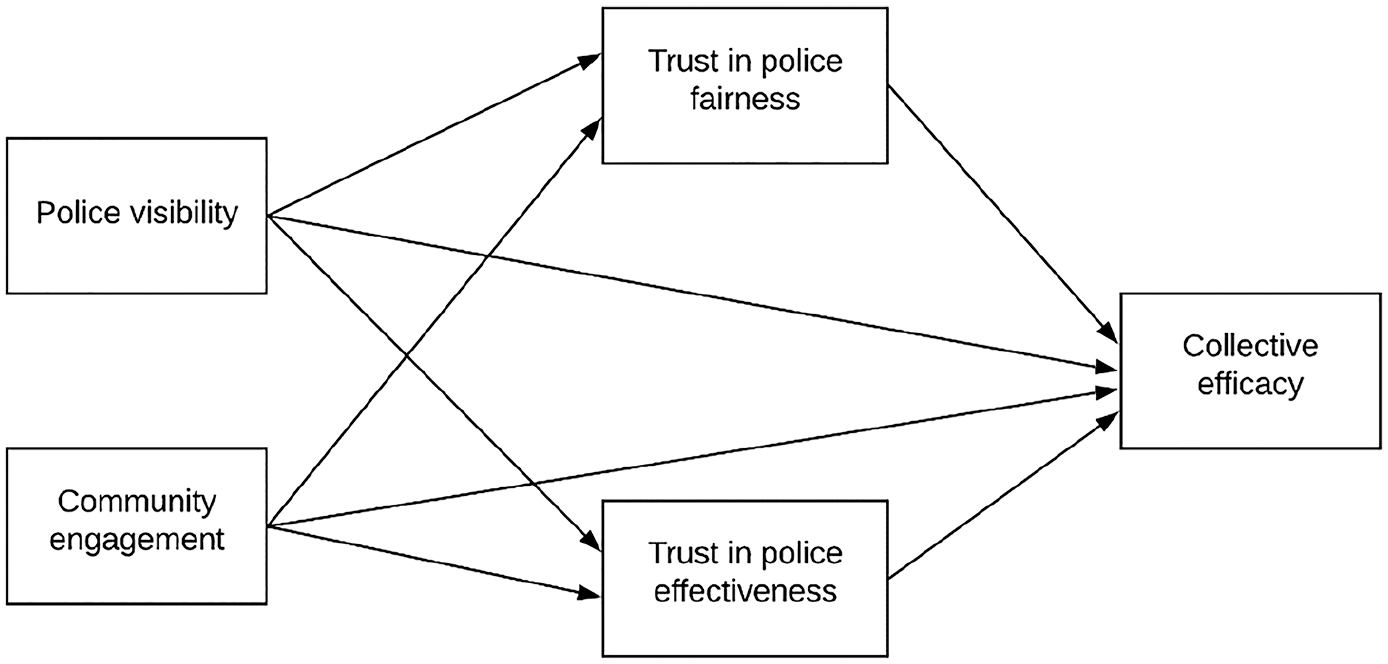
Conceptual model.
Method
Data
Data are drawn from a large sample of 40,080 respondents to the Mayor’s Office for Policing and Crime’s (MOPAC) Public Attitude Survey (PAS) who were interviewed between October 2014 and September 2017 (see Table 1 for sample characteristics). The PAS is conducted on a rolling basis and includes a representative sample of residents from across London. Approximately 3200 Londoners are interviewed face-to-face each quarter at pre-selected addresses aiming to achieve 100 interviews in each of the 32 London boroughs. The PAS asks about people’s experiences of crime and anti-social behaviour and, pertinent to the current study, includes questions about perceptions of community policing, trust in the police and collective efficacy. The dataset also contains electoral ward identifiers, making it possible to look at area-level effects. Wards are the basic unit of electoral geography in London, with an average size of 3 km2 and an average population of around 13,800 in 2015.
Demographic characteristics of sample.
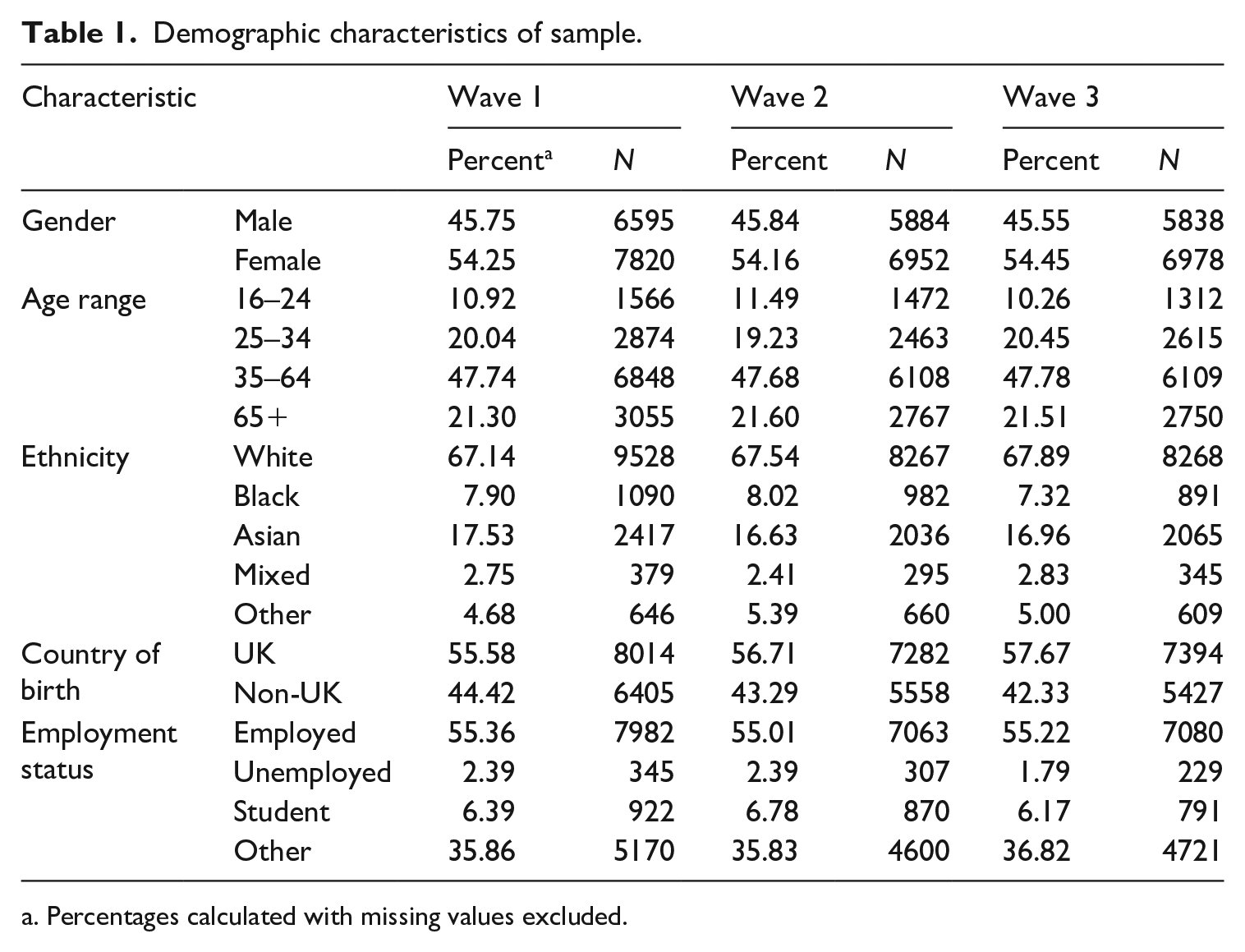
Percentages calculated with missing values excluded.
Some 629 wards are represented in the dataset, with an average of 64 respondents per ward (ranging from 12 to 116 respondents). To investigate potential causal effects, we split the data into three waves (wave 1: October 2014 – September 2015; wave 2: October 2015 – September 2016; wave 3: October 2016 – September 2017) and use multilevel Structural Equation Models to connect levels of police visibility and police–community engagement (wave 1) to trust in police fairness and effectiveness (wave 2), to collective efficacy (wave 3). Importantly, because different respondents complete the survey at each wave, these pathways (and hence our focus of inference) are estimated at the ward level. 1 At the individual level, correlations between the three waves must be fixed to 0, since respondents are interviewed only once. 2
Measures
Collective efficacy
Collective efficacy was measured using eight items on a five-point agree/disagree scale. Four items measured respondents’ perceptions of the social cohesiveness of their neighbourhood, including: ‘people in this neighbourhood can be trusted’ and ‘people act with courtesy to each other in public space in this area’; and four items measured their perceptions of informal social control, including: ‘local people and authorities have control over the public space in this area’ and ‘if I sensed trouble whilst in this area, I could get help from people who live here’ (α = .81 for all eight items; see Table 4 in the Appendix for the other item wordings).
Trust in police fairness
Trust in police fairness was measured with seven items asking residents their agreement with statements about police in their area (on a five-point agree/disagree scale), including: ‘they can be relied on to be there when you need them’ and ‘the police in this area treat everyone fairly regardless of who they are’ (α = .89; see Appendix Table 4 for the other item wordings).
Trust in police effectiveness
Trust in police effectiveness was also measured using seven items. Respondents were asked – on a seven-point scale from very well (1) to not at all well (7) – how well they think the Metropolitan Police: prevent terrorism; respond to emergencies promptly; provide a visible patrolling presence; tackle gun crime; support victims and witnesses; tackle drug dealing and drug use; and tackle dangerous driving (α = .86).
Police visibility and police–community engagement
We include two items capturing aspects of community policing. The first item measures police visibility on a six-point ordinal scale, asking respondents how often they see police patrolling on foot, bicycle or horseback in their area (defined as within 15 minutes’ walk from their home) from: at least daily (1) to never (6): 3 29 percent of respondents said they saw police patrolling at least daily or weekly; 24 percent said they saw police at least fortnightly or monthly; and 46 percent said they saw police less often or never. The second variable measured police–community engagement on a three-point ordinal scale. Respondents were asked ‘how well informed do you feel about what the police in this area have been doing over the last 12 months?’ and responded on a three-point scale from very well informed (1) to not at all informed (3). Only 6 percent of respondents said they felt very well informed about what the police in their area are doing; 40 percent felt fairly well informed; and 55 percent felt not at all informed.
Neighbourhood controls
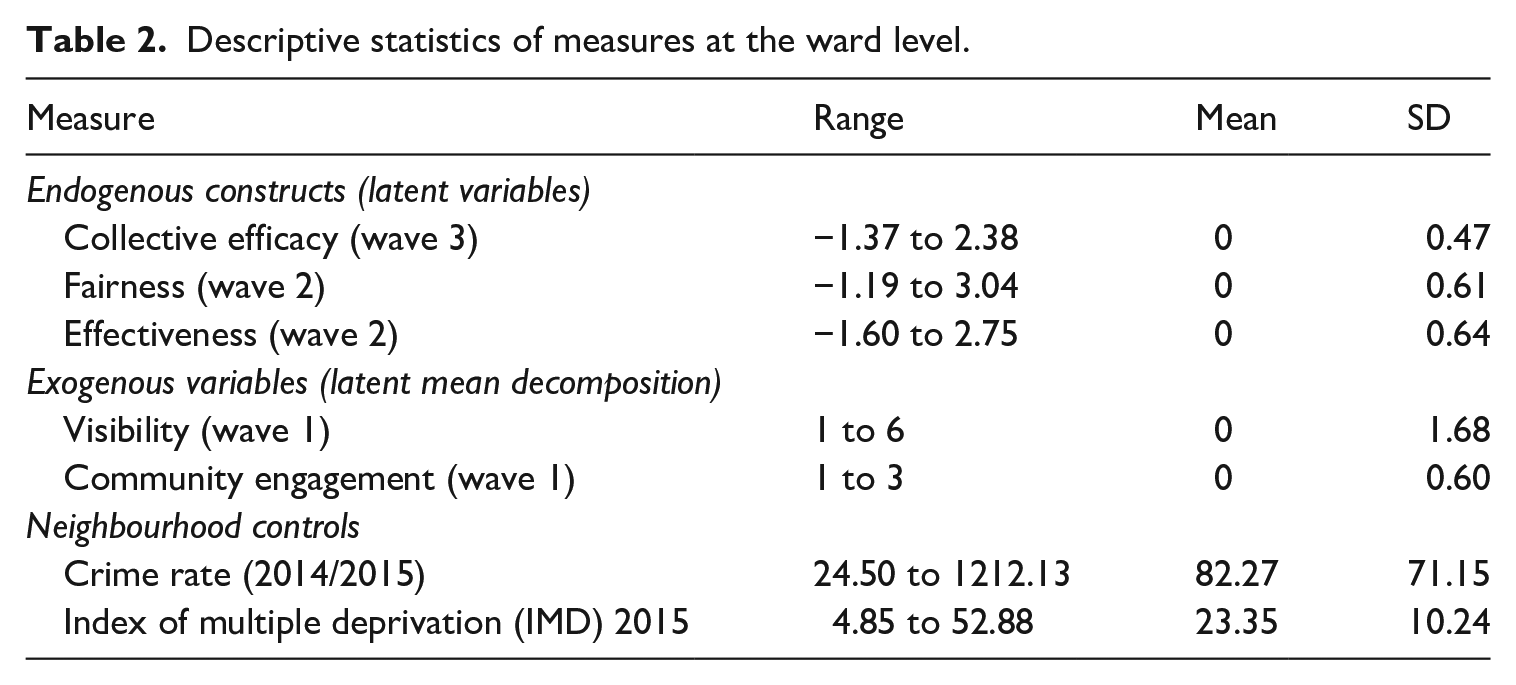
Finally, we control for two aspects of neighbourhood context in the models: crime rate and deprivation. Crime rate was measured at the ward level using police-recorded crime data from 2014/15 and represents the rate of total crime per 1000 population (the logged rate of crime is used in all analyses). Deprivation was measured using the 2015 Index of Multiple Deprivation (IMD) (Noble et al., 2004). IMD is a measure of unique deprivation at a small local area level (Lower-layer Super Output Areas; LSOA) across England. IMD scores are based on seven domains of deprivation: income, employment, education, health, crime, barriers to housing and services, and living environment. We calculated ward-level IMD scores by using the average score for LSOAs within each ward (see Table 2 for descriptive statistics).
Descriptive statistics of measures at the ward level.
Analytic strategy
We use multilevel Structural Equation Models (Muthén and Muthén, 2012) to specify the ward-level causal pathways outlined in Figure 1 between police visibility and police–community engagement (measured at wave 1), trust in police fairness and police effectiveness (wave 2), and collective efficacy (wave 3). This is an extension to standard Structural Equation Modelling – combining a latent variable modelling framework with directed regression pathways – that correctly distinguishes the variation that occurs within each ward from the variations that occur between wards. Two multilevel measurement models (CFA) are first specified for collective efficacy (wave 3) and for trust in police fairness and effectiveness (wave 2). 4 These have a within-ward component, which is the estimated factor structure derived from the correlations between the identified survey items at the individual level. We use this within-ward factor model to identify the between-ward component, allowing the estimated intercepts for each item from this factor model to vary randomly across wards, with the associations between these varying intercepts used to define the between-ward factor structure. Following Jak (2019), the ward-level factor loadings are constrained to equal the within-ward loadings to ensure that the ecological measures of each construct correctly represent ward-level aggregates of the scores for each resident. The between-ward factors can then be connected using directed pathways such as a standard Structural Equation Model. 5 Factor loadings, ICCs and model fit are reported in Tables 5 and 6 in the Appendix. 6
The two single-item exogenous predictors – police visibility and police-community engagement – measured at wave 1 are included at the ward-level using the latent mean decomposition specification (Muthén and Muthén, 2012). This separates respondent-level differences in ratings of each item from the ward mean, with the ward mean score then used as a predictor in the ward-level model. Importantly, by deriving these ward-level scores during the model estimation process, this corrects for unreliability at the ward-level and results in unbiased estimates of the ward-level effects by incorporating the uncertainty associated with the within-ward individual deviations (Lüdtke et al., 2008). 7 Table 2 presents descriptive statistics at the ward level for the latent variables measured at waves 2 (trust in police fairness and effectiveness) and 3 (collective efficacy), the ward-level mean decompositions at wave 1 (police visibility and police–community engagement) and the neighbourhood controls.
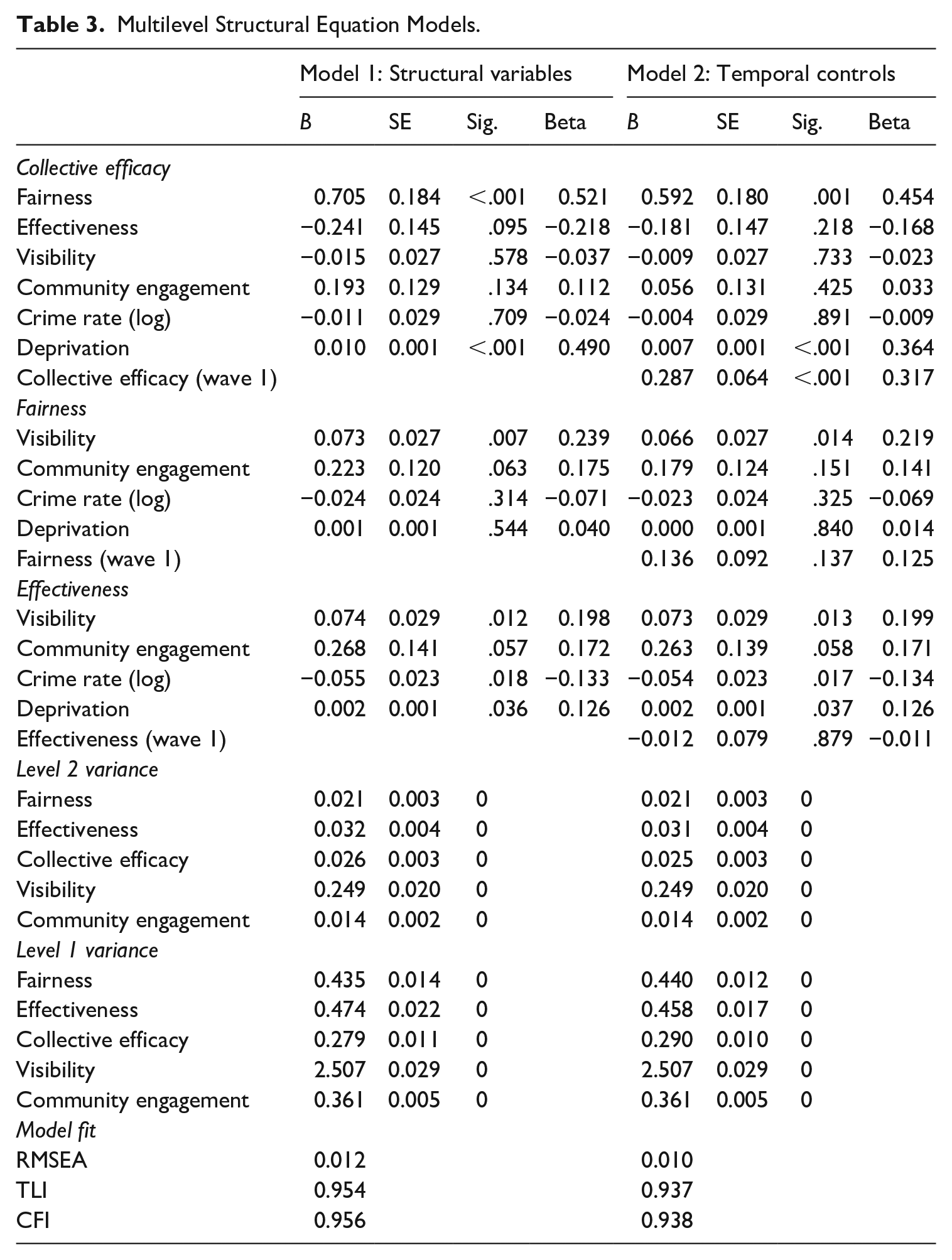
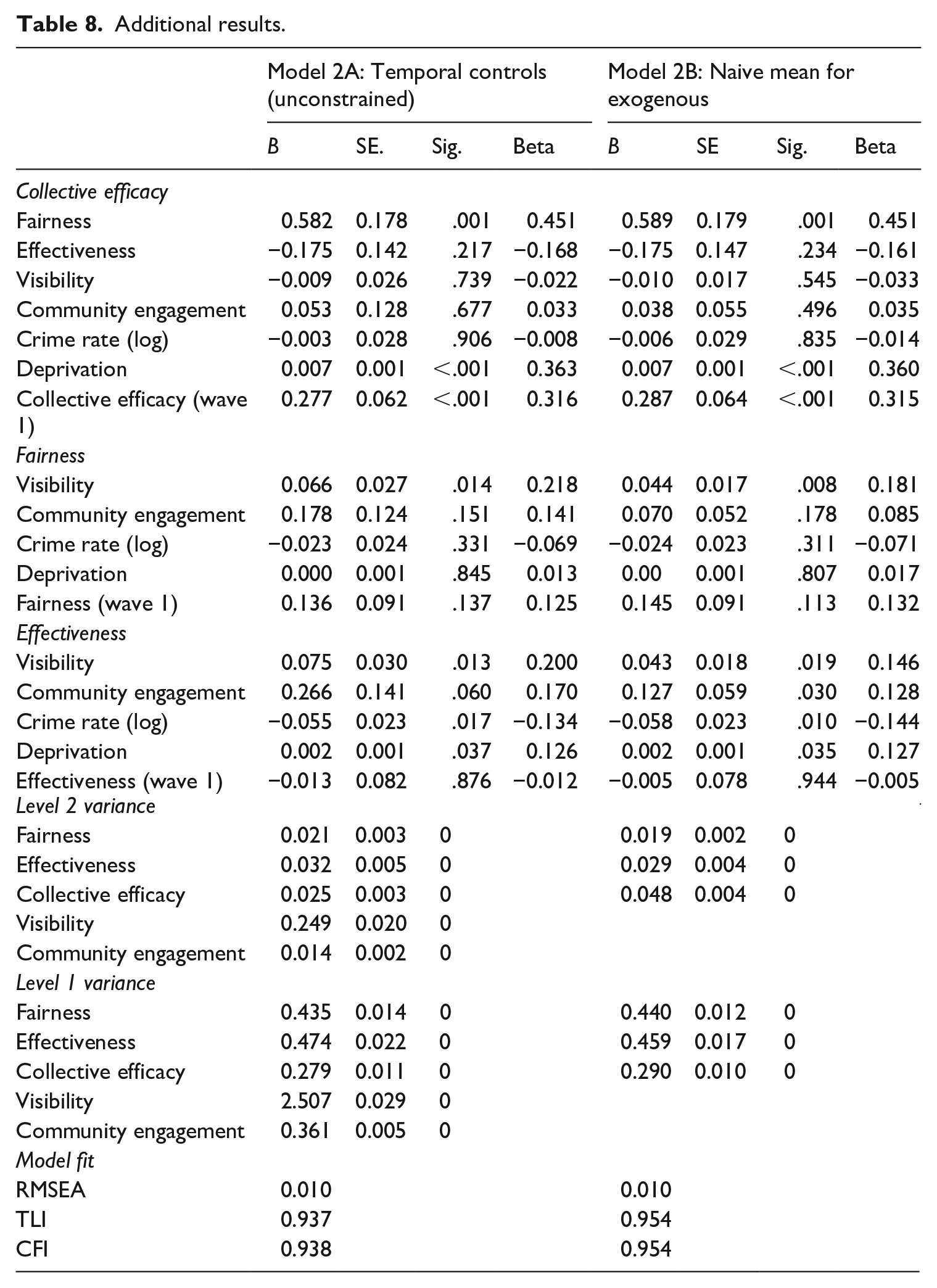
At the ward level we estimate directional pathways between the ward-level mean decompositions (wave 1) and the ward-level latent variables measured at waves 2 and 3. Here collective efficacy measured at the final time point is regressed on trust in police fairness and trust in police effectiveness measured at wave 2. In addition, collective efficacy, police fairness and police effectiveness are all regressed on the latent mean of police visibility and police–community engagement from wave 1. Finally, we also include ward-level lagged controls for collective efficacy, police fairness and police effectiveness measured at wave 1 (see Table 7 in the Appendix for the CFA results for the lagged controls). Accounting for prior levels of each construct in each ward reduces the potential impact of temporal autocorrelation, reflecting the high degree of stability exhibited by each construct over time (models without these lagged control variables demonstrated the same substantive results – compare Models 1 and 2 in Table 3 – although the magnitude and significance of some directional pathways were larger). 8 Here we constrain the factor loadings for each latent variable to be equal at each time point to ensure we are consistently measuring each construct (models freely estimating the factor structure at each time point showed the same result – Table 8 in the Appendix, Model 2A).
Multilevel Structural Equation Models.
Although directional pathways are estimated at the ward level across the three waves of data, to enable identification of the model, at the within-ward level the associations between collective efficacy, police fairness and effectiveness are fixed at 0. Similarly, the associations between the latent constructs and the observed within-ward measures of police visibility and community engagement are also fixed at 0. Fixing these pathways to 0 reflects the fact that the underlying individual data are cross-sectional, with all respondents interviewed at only a single time point. Conversely, the within-ward correlation between effectiveness and fairness (measured at the same time point) is freely estimated. The model is estimated using a robust maximum likelihood approach (MLR) using Mplus version 7.11, which is robust to non-normally distributed data (Muthén and Muthén, 2012).
Results
Findings from the multilevel Structural Equation Model are presented in Figure 2 and Table 3 (Model 2). 9 First, as the figure shows, police visibility has a significant association with both trust in police fairness and police effectiveness. Police–community engagement, on the other hand, has a significant association only with police effectiveness at the p < .10 level. Second, trust in police fairness has a significant association with collective efficacy, whereas trust in police effectiveness does not. Third, neither police visibility nor police–community engagement have direct associations with collective efficacy.
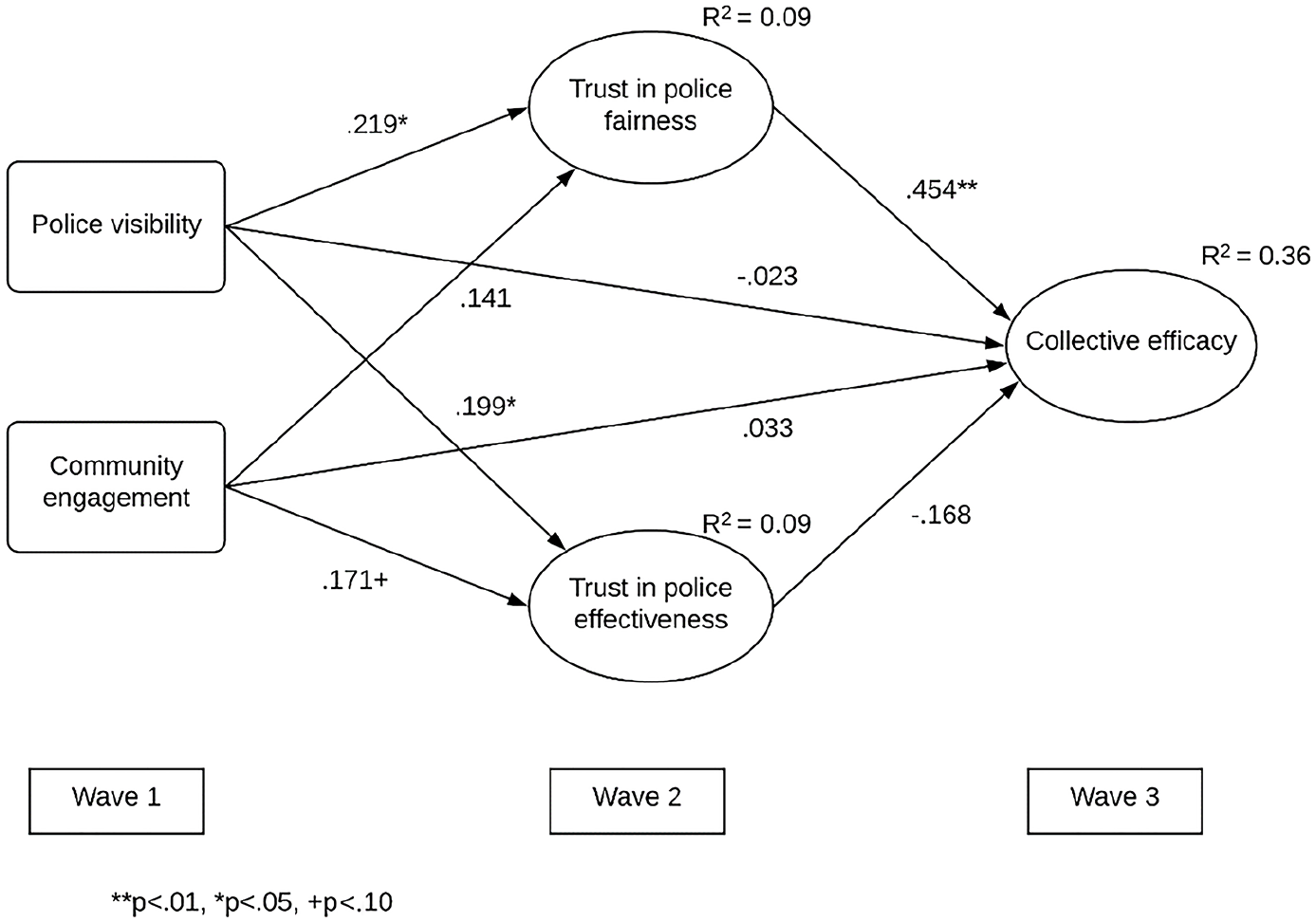
Multilevel Structural Equation Model of policing measures on collective efficacy (Model 2).
Examining the sequential processes, there was a small indirect effect of police visibility on collective efficacy, through trust in police fairness, but this effect was only significant at the p < .10 level (B = .039, SE = .020, p = .055). These findings suggest that, when police are more visible in neighbourhoods, this leads to more positive perceptions from residents about officer behaviour (that is, the fairness with which the police treat residents), which in turn leads to more collectively efficacious neighbourhoods.
Looking last at our neighbourhood controls, the logged crime rate has a significant negative association with trust in police effectiveness (Table 3). In other words, in areas with lower rates of crime, people perceived the police to be more effective. Deprivation, on the other hand, has a significant positive association with trust in police effectiveness and a significant positive association with collective efficacy. Areas with more deprivation are more likely to have high social cohesion and informal social control. Overall, the model explained approximately 36 percent of the variance in collective efficacy (R2 = .358) and 9 percent of the variance for both trust in police fairness (R2 = .088) and effectiveness (R2 = .086).
Discussion
This study used a longitudinal design and multilevel Structural Equation Modelling to test the impact of police visibility and police–community engagement, and trust in police, on collective efficacy. Using three waves of repeated cross-sectional survey data collected from London residents over three consecutive years, we tested for direct and indirect effects, with trust in police fairness and effectiveness as the intermediary constructs. First, we found that police visibility was a significant predictor of both trust in police fairness and effectiveness at the neighbourhood level. Trust in the police tended to be higher in wards where police visibility was also higher. This finding fits with previous research showing the significant effect police visibility can have on perceptions that the police are ‘doing something’ to control crime (Hawdon et al., 2003: 481) and to their overall judgements of trust, satisfaction and confidence in police (Innes and Innes, 2011; Sindall and Sturgis, 2013).
Police–community engagement, on the other hand, was associated with effectiveness judgements only at the p < .10 level. Although we were limited in this study by our measure of engagement, other research has shown that police presence has a stronger effect on trust and confidence than do other community policing variables such as knowledge about police tactics and police engagement with local businesses and community groups (Hawdon et al., 2003; Kochel and Gau, 2019). We know that, when people view police as trustworthy, legitimate authorities, they are more likely to comply and cooperate with the structures and rules the institution represents and to engage in other pro-social behaviours (Bolger and Walters, 2019; Jackson et al., 2013; Tyler and Huo, 2002; Walters and Bolger, 2019). Therefore, teasing apart the types of policing activities that generate trust has important implications for crime prevention. Our findings suggest that visibility is one important aspect of this equation.
Our second main finding was that trust in police fairness significantly predicted collective efficacy. When residents believed the police exercised their authority in a fair and just manner, perceptions of collective efficacy were higher. Trust in police effectiveness, on the other hand, was not significantly related to collective efficacy, and, in fact, the coefficient between these variables was negative. This finding is in contrast with research from the UK showing that measures of police effectiveness are significantly associated with collective efficacy judgements (for example, Jackson et al., 2013; Jackson and Sunshine, 2007).
An argument proposed by some scholars is that, when the police are seen to be effective, residents will be less likely to exercise informal social control themselves because they believe the police are capable of dealing with local issues on their own (Silver and Miller, 2004). This idea is rather similar to the bystander effect in the psychological literature, whereby the likelihood of intervening decreases as the number of other people present increases (Fischer et al., 2011). The bystander effect is due, in part, to a diffusion of responsibility (that is, people assume that others are responsible for taking action); similarly, when people feel the police are effective, they may believe the police will act for them to address issues of crime and disorder. However, when the police are seen as ineffective, this may actually encourage informal social control because residents assume the responsibility for instilling order in their communities (Kochel, 2018; Kubrin and Weitzer, 2003). This idea has some empirical support; for example, Schaefer and colleagues (2017) found that police effectiveness was negatively associated with taking action to solve local crime problems. The negative (although not significant) coefficient between effectiveness and collective efficacy provides some small further support for this hypothesis, but more research is clearly needed to understand how perceptions of police effectiveness influence residents’ willingness to take action.
Finally, we found a small indirect effect of police visibility on collective efficacy, through trust in police fairness. When the police are more present in neighbourhoods, perceptions of fairness are higher, which, in turn, enhances perceptions of collective efficacy. It seems it is not enough for the police to be a visible presence; people also need to feel they can trust the police to exercise their authority in a fair and just manner. The implications of these findings seem to be that police can maximize their influence on collective efficacy through not only making themselves more visible to residents, but by treating them fairly and respectfully, and by giving them voice in their interactions with them.
That it is community understandings of police fairness, not effectiveness, that appear to be important in generating collective efficacy means that the results presented here resonate with the wider literature on procedural justice. At the individual level, people are more ready to cooperate with the police when they feel that officers behave in a procedurally just fashion (Bolger and Walters, 2019). We find that at the neighbourhood level this extends to more general efforts to intervene and maintain order. There are two mutually compatible interpretations of this finding. First, believing that the police operate in a fair and just manner may provide reassurance to residents that, should they intervene in a particular situation, the police will support them in an appropriate manner. Second, research has shown that perceptions and experiences of procedural justice, specifically, are linked to feelings of security and belonging within wider society (Bradford, 2014; Murphy et al., 2015). It may therefore be that fair policing strengthens social bonds within communities and neighbourhoods by fostering a sense of collective inclusion within wider social structures and, therefore, collective efficacy.
Considering the two control variables in our analysis, the association between crime rates, trust and collective efficacy was much as expected: when crime was higher, for example, trust in police effectiveness was lower in following years. However, the positive association between deprivation and collective efficacy is at first sight puzzling. A key aspect of Sampson and colleagues’ conceptualization of collective efficacy is that it is the mechanism linking deprivation to crime: more deprived neighbourhoods are less able to organize themselves to combat crime problems because they lack the economic and social capital required (for example, Sampson, 2012). Yet, in these London data, we find that, all else equal, more deprived areas had greater collective efficacy in following years.
The answer to this puzzle may partly lie in the residential mobility patterns seen in London and indeed elsewhere in the UK. Around 10 percent of households in London move each year (GLA, 2020). Although unemployment and other markers of deprivation are associated with greater mobility (Gambaro and Joshi, 2017), studies have shown that, when moving home, people living in social housing, for example, tend to move less far, whereas people with more education move further (Langella and Manning, 2019). Furthermore, an important feature of the London property market specifically is the number of properties in the richest parts of town bought by overseas investors and then left empty (for example, Transparency International UK, 2017), meaning many such areas have relatively few permanent residents. These and other factors may combine to mean that people living in some of the more deprived parts of London are more likely to know their neighbours and feel they can get help from other residents if they need it – key items used in the collective efficacy scale used in this article and many other studies.
Of course, this study has a number of limitations, most notably the limited measures available in the dataset, particularly those representing different aspects of community policing. We had no measures of important community policing activities, such as problem-solving or partnership working. Our only measure of police engagement was whether people knew the priorities of their local policing team. Although knowledge of these priorities could represent active engagement by the police to ensure residents are kept informed of their work, other measures would more effectively capture police–community engagement. For example, Kochel and Gau’s (2019) police engagement measure asked residents whether the police met and worked with local businesses or residents to address crime and other problems. There was also no measure of legitimacy in the dataset, so we were unable to test whether trust in individual officers is more or less important for fostering collective efficacy than perceptions of the legitimacy of the policing institution (Kochel, 2018; Yesberg and Bradford, 2021). Future research should seek to replicate these findings using better measures of community policing, and there should be a more thorough investigation into potential intervening variables (for example, legitimacy).
In addition, we were limited to data from repeated cross-sections of London residents, rather than a fully longitudinal design where the same respondent views are tracked over time. Our focus is at the ward level, and as such we assume that sampled residents at each survey wave are providing unbiased assessments of the true level of collective efficacy and police activity in their local area. But, without repeated measurements from the same individuals, the possibility remains that our results are actually a reflection of differences in the sample of residents measured at each time point. However, we have no reason to believe sampling within wards was biased, and ICCs for each construct were similar in magnitude at each wave. Our model specification also required us to fix all within-ward correlations to 0 over time, reflecting the absence of repeated measurements from individuals.
To assess the sensitivity of our results to this model specification, we re-estimated all models using a two-stage process. First, predicted scores derived from single-level CFA were saved and aggregated to the ward level to generate a set of ward-level characteristics. In a second stage we estimated the path model outlined in our conceptual model (Figure 1) on this ward-level dataset. We estimated equivalent models using predicted scores derived at the ward level from multilevel CFA. Results using both specifications were consistent with the results reported in Table 3. Future research using a true longitudinal design is needed to further corroborate our findings.
Conclusion
This study adds to the literature on policing and collective efficacy. Using three waves of data from London, and multilevel Structural Equation Modelling, we demonstrate a clear link between collective efficacy and prior levels of trust in police fairness. Trust was, in turn, predicted by prior levels of perceived police activity, most notably visible patrolling presence. In line with other studies, we conclude that collective efficacy, at the neighbourhood level, may be enhanced when policing is visible and above all, fair.
Our results have important implications for policy. The London Metropolitan Police ‘Vision and Values’ statements argues that to ‘[t]o make London the safest city it can be it is clear that everyone needs to play their part in preventing crime’ (MPS, 2018: 14). More widely, the police and policy-makers around the world speak constantly of the need to engage citizens in the task of order production and maintenance. Results from this study underline the importance of fairness: it is this aspect of police behaviour, not effectiveness, that appears most likely to bolster community engagement in such activity. Resonating again with the procedural justice literature, it would seem that, in a city such as London, fairness should be at the top of police priorities, both for their own sake and because these aspects of police–community relations are so closely linked to outcomes such as, here, collective efficacy.
This message has often been difficult for police leaders and policy-makers to swallow, both because of a widely held belief that effectiveness is more important and because making policing fairer can seem a nebulous and hard to achieve policy aim. The link between police presence and trust should therefore provide some reassurance. Neighbourhoods where the police were more visible tended to be significantly higher in trust (on average – an important proviso is that not all communities will respond the same way to visible policing); and trust was linked to collective efficacy. It seems visible patrolling can, perhaps simply by indicating that police are present in and care about an area, bolster outcomes of significant value to both police and community.
This is certainly an easy, familiar, policy recipe to follow. It does, though, run somewhat against current fashion in police science and management, which stresses that (a) undirected police patrol is ineffective in reducing crime and (b) patrols should be targeted toward high-crime locations (Braga et al., 2019). Both these things may very well be true, but they may also miss an important aspect of police–community relations, in London at least, which is that people and communities value a visible police presence in their neighbourhood and that this may encourage them to play an active role in addressing threats to social order. Withdrawing police from the majority of neighbourhoods to focus on a relatively small number of high-crime locations may therefore have negative longer-term effects. This possibility is poorly understood at the current time, has significant resource and other implications for the police and other security actors, and would be a fruitful topic for future research.
Footnotes
Appendix
Additional results.
| Model 2A: Temporal controls (unconstrained) | Model 2B: Naive mean for exogenous | |||||||
|---|---|---|---|---|---|---|---|---|
| B | SE. | Sig. | Beta | B | SE | Sig. | Beta | |
| Collective efficacy | ||||||||
| Fairness | 0.582 | 0.178 | .001 | 0.451 | 0.589 | 0.179 | .001 | 0.451 |
| Effectiveness | −0.175 | 0.142 | .217 | −0.168 | −0.175 | 0.147 | .234 | −0.161 |
| Visibility | −0.009 | 0.026 | .739 | −0.022 | −0.010 | 0.017 | .545 | −0.033 |
| Community engagement | 0.053 | 0.128 | .677 | 0.033 | 0.038 | 0.055 | .496 | 0.035 |
| Crime rate (log) | −0.003 | 0.028 | .906 | −0.008 | −0.006 | 0.029 | .835 | −0.014 |
| Deprivation | 0.007 | 0.001 | <.001 | 0.363 | 0.007 | 0.001 | <.001 | 0.360 |
| Collective efficacy (wave 1) | 0.277 | 0.062 | <.001 | 0.316 | 0.287 | 0.064 | <.001 | 0.315 |
| Fairness | ||||||||
| Visibility | 0.066 | 0.027 | .014 | 0.218 | 0.044 | 0.017 | .008 | 0.181 |
| Community engagement | 0.178 | 0.124 | .151 | 0.141 | 0.070 | 0.052 | .178 | 0.085 |
| Crime rate (log) | −0.023 | 0.024 | .331 | −0.069 | −0.024 | 0.023 | .311 | −0.071 |
| Deprivation | 0.000 | 0.001 | .845 | 0.013 | 0.00 | 0.001 | .807 | 0.017 |
| Fairness (wave 1) | 0.136 | 0.091 | .137 | 0.125 | 0.145 | 0.091 | .113 | 0.132 |
| Effectiveness | ||||||||
| Visibility | 0.075 | 0.030 | .013 | 0.200 | 0.043 | 0.018 | .019 | 0.146 |
| Community engagement | 0.266 | 0.141 | .060 | 0.170 | 0.127 | 0.059 | .030 | 0.128 |
| Crime rate (log) | −0.055 | 0.023 | .017 | −0.134 | −0.058 | 0.023 | .010 | −0.144 |
| Deprivation | 0.002 | 0.001 | .037 | 0.126 | 0.002 | 0.001 | .035 | 0.127 |
| Effectiveness (wave 1) | −0.013 | 0.082 | .876 | −0.012 | −0.005 | 0.078 | .944 | −0.005 |
| Level 2 variance | ||||||||
| Fairness | 0.021 | 0.003 | 0 | 0.019 | 0.002 | 0 | ||
| Effectiveness | 0.032 | 0.005 | 0 | 0.029 | 0.004 | 0 | ||
| Collective efficacy | 0.025 | 0.003 | 0 | 0.048 | 0.004 | 0 | ||
| Visibility | 0.249 | 0.020 | 0 | |||||
| Community engagement | 0.014 | 0.002 | 0 | |||||
| Level 1 variance | ||||||||
| Fairness | 0.435 | 0.014 | 0 | 0.440 | 0.012 | 0 | ||
| Effectiveness | 0.474 | 0.022 | 0 | 0.459 | 0.017 | 0 | ||
| Collective efficacy | 0.279 | 0.011 | 0 | 0.290 | 0.010 | 0 | ||
| Visibility | 2.507 | 0.029 | 0 | |||||
| Community engagement | 0.361 | 0.005 | 0 | |||||
| Model fit | ||||||||
| RMSEA | 0.010 | 0.010 | ||||||
| TLI | 0.937 | 0.954 | ||||||
| CFI | 0.938 | 0.954 | ||||||
Acknowledgements
The authors would like to thank the Mayor’s Office for Policing and Crime – in particular Dr Paul Dawson – for access to the data used in this study.
Declaration of conflicting interests
The author(s) declared no potential conflicts of interest with respect to the research, authorship, and/or publication of this article.
Funding
The author(s) disclosed receipt of the following financial support for the research, authorship, and/or publication of this article: This work was supported by the first author’s Economic and Social Research Council (ESRC) New Investigator Grant [ES/S010629/1].
