



Abstract
Collective efficacy theory states that neighbourhood variation in crime can be attributed to social cohesion and informal social control. Despite a substantial body of work, the theory has been subject to little testing in Europe and few studies have compared different outcomes. The current study employed a cluster sampling design to study violent crime in a sample of 70 suburban housing estates built in the 1960s and 1970s throughout Finland. Police-recorded violent crime in public and private space and survey-based measures of neighbourhood violence were studied using register data on neighbourhood characteristics and the residents’ perceptions of social cohesion and perceived capacity for informal control. The results showed that, in a sample of Finnish suburban housing estates, collective efficacy was negatively associated with violence in private space and a survey-based measure of neighbourhood violence, while the association between collective efficacy and violence in public space was not significant. Neighbourhood disadvantage was directly associated with police-recorded violence in private surroundings but not violence in the public sphere.
Introduction
The link between neighbourhood characteristics and various social outcomes, including crime, was famously proposed in the ecological models conceptualized by the Chicago School in the first half of the 20th century (Park et al., 1925; Park, 1936; Shaw and McKay, 1942/1969). Since the 1980s, a newly found interest in neighbourhood-level processes has emerged, most notably in the body of research that focuses on collective efficacy, operationalized as a combination of social cohesion and trust among neighbours and perceived capacity to exercise social control. Concerning crime in particular, collective efficacy theory states that neighbourhoods vary in their ability to build and sustain social ties and informal social control that influence the opportunities for interpersonal crime in the neighbourhood (Sampson et al., 1997).
Although the research tradition on collective efficacy and crime is well established, the generalization of the findings remains a potent problem. First, the bulk of the studies have been conducted in the United States, more specifically in Chicago (see, for example, Sutherland et al., 2013: Appendix A) and it remains unclear whether the findings are replicable in areas with differing social, cultural and economic settings (Sampson, 2012: 162). Indeed, in Europe, the results have thus far been mixed (Bruinsma et al., 2013; Gerell and Kronkvist, 2017; Sutherland et al., 2013; Wikström et al., 2012), which could indicate that the communal mechanisms might operate differently under different societal conditions. Second, the quality of the current evidence is hampered by ambiguity regarding different measures of crime, because few studies have examined both survey-based measures and police-recorded crime, or differentiated between crimes that take place in different surroundings (see Browning, 2002; Hipp and Steenbeek, 2015; Sampson and Groves, 1989).
The research question for the current study is whether collective efficacy explains neighbourhood-level variation in violent crime in Finnish suburban housing estates, using three different outcomes: (a) police-recorded violent crime occurring in private space, (b) police-recorded violent crime occurring in public space and (c) survey-based measures of interpersonal violence. Here, both the societal and local contexts are important: Finland is a relatively egalitarian Nordic society characterized by comprehensive social security, but the suburban housing estates are characterized by multiple dimensions of structural disadvantage (Stjernberg, 2015; Vilkama et al., 2013). In addition to the main research question, the individual and neighbourhood-level factors associated with collective efficacy are analysed, because it is important to understand the validity of the measure in the context of the study setting.
Regarding the association between neighbourhood characteristics, collective efficacy and violent crime, it is hypothesized that collective efficacy is negatively associated with all crime outcomes (H1), especially violence in public space, because communal processes are usually understood to prevent crimes that happen in places in which social control can be most effective (Gerell and Kronkvist, 2017; Sampson and Groves, 1989). Furthermore, it is hypothesized that concentrated disadvantage, immigrant concentration and residential instability have an indirect effect on violent crime and this association decreases as the measure for collective efficacy is entered into the model (H2).
The survey data used in this study were collected using a novel cluster sampling design, targeting residents living in post-war housing estates built in the 1960s or 1970s across Finland. Combining survey-based measures with geocoded point data on violent crimes, as well as statistical grid data on the social composition of the housing estates, the study data allowed a detailed enquiry into the association between social disadvantage, collective efficacy and different measures of crime, while controlling for many of the structural elements of the study areas.
Theoretical background
In their influential book Juvenile Delinquency and Urban Areas (1942/1969) Shaw and McKay argued that three neighbourhood-level structural factors, namely low socioeconomic status, ethnic heterogeneity and residential mobility, could lead to the disruption of local community ties and weak social control, which accounted for the spatial variation in delinquency. Thus, instead of focusing on individual factors, Shaw and McKay posited that disadvantaged neighbourhoods were characterized by enduring structural deficiencies that undermined the ability to realize the common values of its residents and to maintain effective social control (Bursik, 1984; Sampson and Groves, 1989). Contemporary research on social disorganization and its derivative models has generally included the original components of low socioeconomic status, residential mobility and ethnic heterogeneity, while broadening the focus on the different dimensions of the social ties (see Bruinsma et al., 2013, for a simultaneous test of different indicators). Indeed, modern accounts of social disorganization theory have typically argued that a focal point of interest should not be the structural deficiencies per se, but rather the consequences of neighbourhood deterioration, such as the erosion of social trust and the diminished ability to exercise effective informal control in the neighbourhood.
Building on the earlier work on social disorganization and social capital, Sampson et al. (1997) introduced the concept of collective efficacy, defined as ‘the process of activating or converting social ties among neighbourhood residents in order to achieve collective goals, such as public order or the control of crime’ (Sampson, 2010), which attempted to combine the neighbourhood-level mechanisms of social cohesion and shared expectations of informal social control (Sampson, 2012: 152). Overcoming an earlier critique of social disorganization theory, which argued that even disadvantaged neighbourhoods could be socially organized (Whyte, 1943), collective efficacy theory posited that, instead of focusing on the mere existence of social ties, what mattered was the quality and purpose of informal networks that could be activated to foster informal social control in the community (Sampson, 2012: 154). Indeed, a study by Browning et al. (2004) argued that dense social networks, especially in disadvantaged neighbourhoods with limited capacity for social control, might diminish the regulatory effectiveness of collective efficacy. Thus, collective efficacy theory essentially states that neighbourhoods vary in their ability to build and sustain prosocial ties, trust and solidarity, and therefore in their ability to activate informal social control that influences the opportunities for interpersonal crime in the neighbourhood (Sampson et al., 1997).
An intriguing but rather undeveloped aspect of collective efficacy theory concerns the exact nature of collective efficacy and its subjects (Hipp et al., 2018; Hipp, 2016). In many cases the empirical implementations of the theory have been rather ambiguous about the ways in which a given neighbourhood’s ‘capacity to intervene’ could be communicated to potential offenders and whether the deterrent effect operates similarly in crimes that take place in different settings (see Hipp and Steenbeek, 2015). In practical terms, many studies do not make a distinction between crimes committed by residents or outsiders, nor do they separate crimes that take place in different settings (such as public or private spheres). The view adopted by most scholars approaches the relationship between social ties, social control and crime primarily from the perspective of predatory street violence or violence in general (for example, Armstrong et al., 2015; Gerell and Kronkvist, 2017; Sampson et al., 1997; Sutherland et al., 2013), and only a handful of studies have compared different outcomes (Sampson and Groves, 1989) or studied essentially different outcomes such as intimate partner violence (Browning, 2002). Thus, the research literature can be seen as lacking a coherent idea about the ways in which collective efficacy could reduce opportunities for crime (Hipp, 2016), and whether such deterrent effects apply to all criminal behaviour or to specific kinds of crime.
Previous research on collective efficacy and crime
In recent years, research on the relationship between collective efficacy and crime, and spatial dimensions of crime in general, has proliferated. However, the bulk of the studies have been carried out in the US and there is a lack of research that uses police-recorded crime as a measure of criminality, because many studies resort to either survey-based measures of crime and disorder or use extreme forms of aggression such as homicides as a measure of neighbourhood violence. Although there are well-known shortcomings in police-recorded crime data, survey-based measures also suffer from inaccuracy owing to, for example, unequal non-response and frame effects (Hart et al., 2005; Kivivuori et al., 2012; Laaksonen and Heiskanen, 2014).
Sampson and Groves (1989) employed a survey-based study utilizing data from the British Crime Survey, using local friendship networks, organizational participation and youth supervision as predictors of violent crime victimization, and found that communities characterized by sparse friendship networks, unsupervised teenage peer groups and low organizational participation had disproportionately high rates of crime and delinquency. Sampson et al. (1997), in what is considered the first formal test of the collective efficacy theory, studied collective efficacy, perceived neighbourhood violence, self-reported victimization and official homicide data, and concluded that collective efficacy mediated a substantial proportion of the variance explained by structural disadvantage.
Subsequent studies have drawn from earlier findings on a variety of outcomes and specifications, concluding that concentrated disadvantage and collective efficacy predicted homicide (Morenoff et al., 2001), observed and perceived disorder (Sampson and Raudenbush, 1999) and unstructured socializing with peers and violence among urban youth (Maimon and Browning, 2010). Outside Chicago, a study found that a measure of collective efficacy predicted perceived neighbourhood violence in Mesa, Arizona (Armstrong et al., 2015), and results from Georgia and Iowa similarly showed a negative association between collective efficacy and self-reported delinquency (Simons et al., 2005). However, a study conducted in Denver, Colorado, found little to no effect of social control or cohesion on self-reported delinquency (Kingston et al., 2009). In a somewhat different social context, in Brisbane, Australia, Mazerolle et al. (2010) concluded that higher levels of neighbourhood collective efficacy predicted lower self-reported victimization.
In Europe, research has picked up the concept of collective efficacy only recently and, thus far, with somewhat mixed results. In the United Kingdom, a nationwide longitudinal study on children’s antisocial behaviour concluded that collective efficacy may have a protective effect on children living in deprived contexts (Odgers et al., 2009). In the city of Peterborough, Wikström et al. (2012) studied the association of social disorganization, collective efficacy and multiple crime outcomes and found that poor collective efficacy predicted police-recorded counts of violent crime, serious theft and vandalism. Sutherland et al. (2013) studied official data on violent crimes and knife injuries in London neighbourhoods and concluded that collective efficacy was associated only with violent crime (but not ambulance call-outs for knife crime injuries) and did not seem to mediate the relationship between disadvantage, residential instability and recorded violent crime.
Studies conducted in continental Europe and Scandinavia have produced equally mixed results. In a comparative study between Chicago and Stockholm, Sampson and Wikström (2008) found that community processes explaining violent crime were very similar despite their different societal contexts. However, Bruinsma et al. (2013) used official crime rates for all available crimes and a measure of collective efficacy in The Hague, concluding that collective efficacy was not associated with spatial variation in total crime or the offender rate, yet concentrated disadvantage, residential instability and the rate of single-parent families varied with neighbourhood-level crime rates. A recent study in Malmö, Sweden (Gerell and Kronkvist, 2017) found a substantial effect of collective efficacy on public environment violent crime yet found no association between crime and measures of structural disadvantage.
The more formal test of the effectiveness of collective efficacy lies in both experimental evidence and longitudinal studies, which, to this day, are virtually absent, because the majority of studies use cross-sectional designs. Because collective efficacy is a product of a dynamic process, it is likely that violent incidents or perceived social disorder cause residents to update their perception of communal properties (Hipp, 2016). A recent study by Hipp and Wickes (2017), conducted in Brisbane, managed to study the changes in collective efficacy in a longitudinal setting, yet found no evidence of higher levels of collective efficacy affecting crime rates at subsequent points in time. What the study did find, however, was the association between concentrated disadvantage and violent crime over time, suggesting a reciprocal effect and a downward spiral for certain neighbourhoods.
In conclusion, studies on the relationship between collective efficacy and crime have thus far produced very heterogeneous results. Studies using survey-based information on crime and disorder have generally been supportive of the hypothesis but might struggle with method-induced problems, because the informants on collective efficacy are the same informants as those reporting perceived violence, disorder or victimization (see Kemppainen et al., 2018, and Pauwels and Hardyns, 2009, for alternative approaches). Similarly, studies using homicide as the outcome have found evidence of the link between collective efficacy and violence, yet these results are restricted to the US, particularly Chicago. On the European side, studies have utilized police-recorded crime with mixed results, as some studies found that low collective efficacy predicts violent crime, although the findings are not unanimous. Longitudinal analyses, although scarce, have not produced supportive evidence for the theory.
Neighbourhood definitions
All studies that use geographical units either as units of analysis or as a defining boundary are susceptible to the so-called modifiable areal unit problem (MAUP), which states that the choice of geographical scale and zonation can have an impact on neighbourhood estimates (Lloyd, 2014; Openshaw, 1984). In recent years, research in environmental criminology has increasingly stressed the importance of a ‘proper’ level of aggregation, often advocating the use of micro-places instead of large-scale neighbourhoods (Oberwittler and Wikström, 2009; Steenbeek and Weisburd, 2015), whereas others stress the importance of multiple scales (Boessen and Hipp, 2015). The move towards the smallest possible scale of analysis has been bolstered by the compelling evidence that crime is generally highly clustered and that a small number of buildings, street segments and other crime hotspots are responsible for most recorded crimes, especially theft and violent crimes, a phenomenon Weisburd (2015) has described as ‘the law of crime concentration’.
Research on collective efficacy has generally tended to favour meso-level neighbourhood units, a solution that could be considered more in terms of a practical decision (owing to the survey instrument) rather than a solution based on a theoretically oriented judgement. In the initial studies on collective efficacy, Sampson et al. (1997) combined census tracts in Chicago to form ‘natural’ neighbourhood clusters that were geographically contiguous and homogeneous on key census indicators, resulting in neighbourhoods that had an average of 8000 residents (see also Sampson, 2012: 79). A recent study by Sutherland et al. (2013), conducted in London, employed Lower Layer Super Output Areas (LSOAs) to represent neighbourhoods, which resulted in a substantially smaller geographical scale compared with many previous studies, with each ‘neighbourhood’ comprising an average of 1500 residents (see also Gerell and Kronkvist, 2017). An even smaller scale was achieved in the study by Wikström et al. (2012), who used UK Output Areas (OAs) with an average of 300 residents per neighbourhood ‘setting’.
An emerging consensus among criminologists posits that, when studying spatially dependent phenomena, research should aim for the smallest practical scale (Oberwittler and Wikström, 2009). However, as Hipp (2007) has argued, different aggregation levels might produce different outcomes, and there might not be a single ‘proper’ level of aggregation, because neighbourhood mechanisms could operate on multiple levels. Regarding collective efficacy in particular, the research has produced mixed results. Studies in the US have typically found supportive evidence for collective efficacy, even in larger study areas (Armstrong et al., 2015; Morenoff et al., 2001; Sampson et al., 1997), whereas studies conducted in Europe have thus far shown that collective efficacy appears significant only at very detailed levels of analysis (Bruinsma et al., 2013; Sutherland et al., 2013; Wikström et al., 2012). Gerell (2015), in a study conducted in Malmö, argued that there was little evidence of collective efficacy operating on large-scale neighbourhoods, as originally suggested by Sampson et al. (1997), highlighting the need to study collective efficacy in more detailed settings.
Data and methods
Study setting
The current study is based on a Finnish nationwide community survey, collected under the auspices of the PREFARE project (New Urban Poverty and the Renovation of Prefabricated High-Rise Suburbs in Finland). The specific aim of the community survey, conducted in 2013, was to study the living conditions and attitudes of residents living in suburban housing estates (or housing developments) built between 1960 and 1979, a period characterized in Finland by a post-war rural exodus and rapid urbanization (Heikkilä and Järvinen, 2002).
In the context of social policy and urban development, the issues concerning large post-war housing estates are equally relevant across Europe and the US, because the housing estates built in the post-war era were influenced by the same architectural notions in most of the developed countries (Wassenberg, 2013). In Northern and Western Europe, these housing estates have been characterized by the influx of ethnic minorities, and, specifically in Northern Europe, large housing estates function at the bottom of the housing market (Dekker and Van Kempen, 2004). In Finland, such housing estates are more socioeconomically disadvantaged compared with other neighbourhoods in terms of unemployment, educational level and income (Stjernberg, 2015) and have been subject to ethnic segregation caused by selective migration (Vilkama et al., 2013). Previous studies have also shown that residents living in rental-dominated housing estates are more likely to experience social disorder in their neighbourhood (Kemppainen et al., 2018).
In this study, the choice of the studied neighbourhoods was largely determined by the explicit interests of the research project and the operationalization of the survey instrument. In the first stage, housing data were used to identify multi-storey residential buildings built between 1960 and 1979 and further narrowed down to buildings located outside city centres, using the Finnish Environmental Institute’s classificatory system. In order to be able to identify wider housing areas, and to distinguish housing areas from each other, buffer zones were calculated around individual buildings, thus allowing for the identification of building clusters. Buffer zones were calculated for all cases in which there were at least five buildings located within 250 metres of each other and that had a total of at least 300 residents. This resulted in 318 multi-storey clusters in proximity to city centres (Stjernberg, 2013).
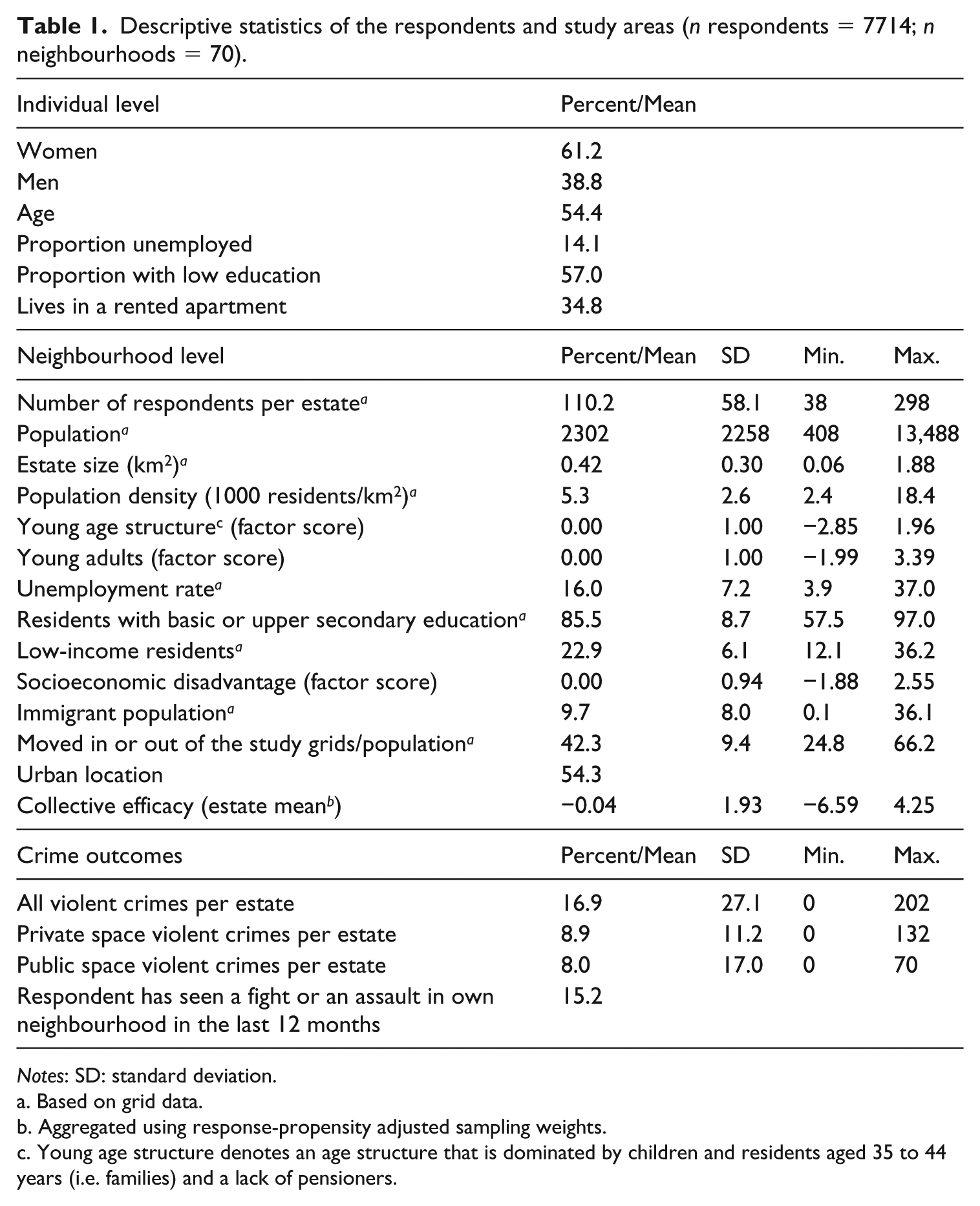
The community survey was based on a stratified two-stage cluster sample. In the first stage, five housing estates were hand-picked for the study. After that, a stratified sample of 66 housing estates was drawn based on city size and unemployment rate, resulting in a sample of 71 housing estates across Finland. In the second stage, 19,844 Finnish-speaking residents aged 25 to 74 years were sampled from the Finnish Population Register using housing IDs. The total response rate in the survey was 39 percent, with an average of 110 respondents per housing estate (see Table 1). For the purposes of the current study, one housing estate, consisting solely of student apartments, was excluded from all analyses.
Descriptive statistics of the respondents and study areas (n respondents = 7714; n neighbourhoods = 70).
Notes: SD: standard deviation.
a. Based on grid data.
b. Aggregated using response-propensity adjusted sampling weights.
c. Young age structure denotes an age structure that is dominated by children and residents aged 35 to 44 years (i.e. families) and a lack of pensioners.
Because the housing data contained little statistical information about income, employment or population, the survey data were combined with grid data, courtesy of Statistics Finland. The Grid Database contains data describing the population’s structure, education, main type of activity and income, households’ stage in life and income, as well as buildings and workplaces on 250 metre by 250 metre grids. The base year for grid data was the end of calendar year 2010, except for age structure, which used data from the end of year 2008. The neighbourhood measures were derived from the Grid Database by aggregating the grid cells that overlapped with the housing estates.
The size of the study neighbourhoods varied greatly owing to the identification method (high-rise clusters). Of the housing estates 40 percent comprised either three or four grid units (0.19 to 0.25 square kilometres). The average size of the estates was 0.42 square kilometres (median 0.31 square kilometres). Underlining the relatively disadvantaged position of the suburban housing estates, the mean unemployment rate was 16 percent, roughly double the national average at the time, and the proportion of the population with an immigrant background was more than twice the national average. Yet, notable differences between the neighbourhoods also emerged; there were considerable differences between the most well-off and worst-off neighbourhoods in the data, with around a 30-point difference in the main structural indicators, including unemployment rate, proportion of lowest educated, low-income residents, as well as immigrant population.
The average population in the study areas was 2302, with a median of 1541 residents. In comparison with other studies conducted on the relationship between collective efficacy and crime, the classificatory scheme employed in the current study fell somewhere between the larger (for example, Armstrong et al., 2015; Bruinsma et al., 2013; Sampson et al., 1997) and smaller neighbourhood categorizations (Wikström et al., 2012). As it stands, this scheme was roughly similar to studies conducted in London (Sutherland et al., 2013) and Malmö (Gerell and Kronkvist, 2017). Given the current trend of focusing on a smaller geographical scale, the size of the study areas could be considered reasonable. An additional advantage of the operationalization was the ability to study historically and spatially uniform areas, as all were situated outside city centres, were of equal age and built utilizing roughly similar architectural principles. This presumably reduces the heterogeneity caused by different neighbourhood characteristics, because the built environment may have an independent effect on collective efficacy (Cohen et al., 2008).
Measures
Crime measures
Point data on police-recorded violent crimes were obtained from the Data System for Police Matters (Poliisiasiain tietojärjestelmä). The geocoding procedure was conducted in ArcGIS version 10.3.1 (Esri, 2015) using a dataset that consisted of violent crimes (homicides, aggravated assaults, assaults, minor assaults and robbery; all including attempts) recorded in the studied municipalities in calendar year 2014. Attempts were included in the data because they predominantly constitute an act that is similar to ‘successful’ violent acts. The reference database for the geocoding procedure was the Road network with the addresses element from the Topographic database, which is maintained by the National Land Survey of Finland. A total of 18,673 violent crimes out of 23,097 were successfully geocoded, resulting in an 80.8 percent match rate, which is lower than some have suggested as the minimum reliable threshold for criminal justice research (Ratcliffe, 2004). The low match rate was explained by missing information, either street name or house number, in the police data. Given the limitations of the data, a total of 18,955 incidents could realistically be geocoded, equalling a match rate of 98.5 percent on incidents with sufficient information for the procedure.
The resulting point data were aggregated to each housing estate using a buffer. Incidents that took place within 125 metres of the respective buildings were categorized as belonging to that particular cluster. Overall, this procedure resulted in a total of 861 recorded incidents and an average rate of 16.7 violent crimes (6.7 violent crimes per 1000 residents) in the 70 study neighbourhoods. To account for different places of occurrence, the incidents were classified as taking place in either private or public places utilizing the classificatory scheme used by the police. Commercial areas, including bars and restaurants, were classified as public. When multiple places were indicated in a single incident, ‘public space’ was deemed an overriding condition.
The variable for witnessing an assault or a fight was obtained from the community survey, measured as seeing an assault or a fight in the respondent’s own neighbourhood over the last 12 months. An obvious caveat in this formulation is the ambiguity concerning the definition of ‘neighbourhood’; it is by no means certain that the respondents have understood the term ‘neighbourhood’ in accordance with the technical definition proposed here.
Collective efficacy
Collective efficacy was measured similarly to Sampson et al. (1997), consisting of two related dimensions. Social cohesion and trust was measured by asking the respondents how strongly they agreed with the items on their neighbourhood’s social relations and social control by asking about the likelihood that the neighbours would intervene in a set of hypothetical situations. The items were similar to the original scales, with a minor exception on the scale concerning informal social control, where the V item (‘the fire station closest to their home was threatened with budget cuts’) was replaced with two measures, (i) ‘drunken people were disturbing other residents’ and (ii) ‘there were loud noises coming from an apartment during the night’.
Factor analysis of the survey items indicated that social cohesion and willingness to intervene were separate but closely related constructs, which was an expected result based on some previous studies (for example, Armstrong et al., 2015; Sampson et al., 1997; also Kemppainen et al., 2018, using the same dataset). The alphas were 0.80 for the social cohesion scale and 0.88 for the social control scale, indicating strong individual-level consistency on both scales. The measures were closely correlated on a neighbourhood level (0.72), suggesting that the constructs were tapping the same latent neighbourhood-level processes. Following the theoretical link proposed by Sampson et al. (1997), where social cohesion is expected to enhance the willingness to intervene, the measure for collective efficacy was formed by summing the standardized scores of the survey items from both scales. The neighbourhood-level score for collective efficacy was then formed by aggregating the measure to the neighbourhood level using response-propensity adjusted sampling weights (see Methods).
Independent variables
Individual-level variables were derived from either the survey or the Population Information System maintained by the Population Register Centre. Gender and age were available from the registry, while recent unemployment, educational level and tenure were derived from the survey. Unemployment was used as a dichotomized variable indicating either no unemployment or unemployment over the last three years. Educational level was similarly used as a dichotomized measure indicating either vocational or basic education, or higher than vocational education. Tenure was defined as living in either a privately or publicly owned rental apartment versus other forms of ownership (primarily an owner-occupied apartment).
Neighbourhood-level measures were based on administrative data obtained from the Grid Database. Concentrated disadvantage was constructed as a latent variable using factor analysis with principal factors method. The measure was constructed using unemployment rate, proportion of residents with less than tertiary education and proportion of low-income residents (lowest income quintile). Immigrant concentration was measured as the proportion of the population that spoke a language other than Finnish or Swedish as their native language. Neighbourhood-level correlations of immigrant concentration and other measures ranged from 0.22 (unemployment rate) to 0.41 (low educational level), and factor analysis confirmed that the proportion of immigrants did not load strongly on the factor for disadvantage, evident in the high value of uniqueness. This, along with the theoretical significance of immigrant concentration, warranted the use of immigrant concentration as a dedicated predictor, instead of being part of a broader concept of neighbourhood disadvantage.
The age structure of the estates was formed using factor analysis with principal factors estimation on seven variables on the proportion of different age groups. These could be reduced to two dimensions, young age structure and young adults. Young age structure denotes a structure dominated by families with children and a small presence of pensioners, while young adults refers to a structure dominated by residents aged 18 to 34 years. Residential instability was measured as the proportion of the population that had moved either in or out of the study grids in 2011 (including those who moved from grid to grid within the study neighbourhood) relative to the total population of the estate. Population density was measured as residents per square kilometre (using total population derived from the Grid Database). The neighbourhood-level structural indicators were standardized for the analysis. In addition, a dummy variable for the size of the city was constructed using 100,000 residents as the cut-point.
As a potential limitation, it should be noted that the definition of ‘neighbourhood’ might not have been consistently understood among the study subjects. Moreover, what the residents themselves understood as their neighbourhood might be incongruent with the technical definition of the housing estate that was used in this study. Also, the grid-based calculation of the socio-structural variables was not identical to the identified housing clusters. These limitations could potentially have ramifications on the accuracy of the estimation.
Methods
A key methodological issue in neighbourhood research is the choice of suitable statistical models, because spatially dependent phenomena exert constraints on modelling alternatives. Indeed, when study units exhibit spatial autocorrelation, the assumptions of many regression models are violated, resulting in spatially correlated error terms and increasing the chance of type I error. To address this, studies on crime and neighbourhood effects typically aim to control for spatial proximity in the statistical models (for example, Andresen, 2006; Bruinsma et al., 2013; Hipp and Boessen, 2013).
In the current study, however, spatial autocorrelation between neighbourhoods did not pose a potent issue; the study areas were not spatially conjoined but were scattered around the geographical area of Finland. Because the main outcome was a relatively rare count variable (violent crimes in the neighbourhood) and the distribution was highly skewed, the models were estimated as negative binomial regression models using population size as the exposure variable. This strategy had the additional benefit of being more robust against bias caused by the small incidence count and small population size of the study neighbourhoods (Osgood, 2000). Although the use of population size has problems in itself (Andresen and Jenion 2010), there were no available measures for ambient population. At the same time, it is worth noting that the study areas consist mostly of residential areas, where this problem might be more manageable. Other analyses were carried out using multilevel models, taking into account the clustered nature of the survey design. The analysis on the determinants of individual perceptions of collective efficacy was conducted using random intercept linear regression models, with study neighbourhood as the group-level variable. Similarly, the analysis on witnessing an assault or a fight was conducted estimating random intercept logistic regression models using neighbourhood as the group-level variable. All statistical analyses were conducted using Stata version 15.1 (StataCorp, 2017) with either mixed, melogit or nbreg procedures.
To counter unequal non-response in different population groups, the analysis employed a response-propensity adjusted weighting scheme based on information available from official registers, such as gender, age, education, income, unemployment and the study estate. The use of such weighting should reduce bias and increase the accuracy of the estimation (see Kemppainen et al., 2018; Laaksonen et al., 2015). The final weights account for the varying inclusion probabilities on both levels and response propensity on an individual level.
Results
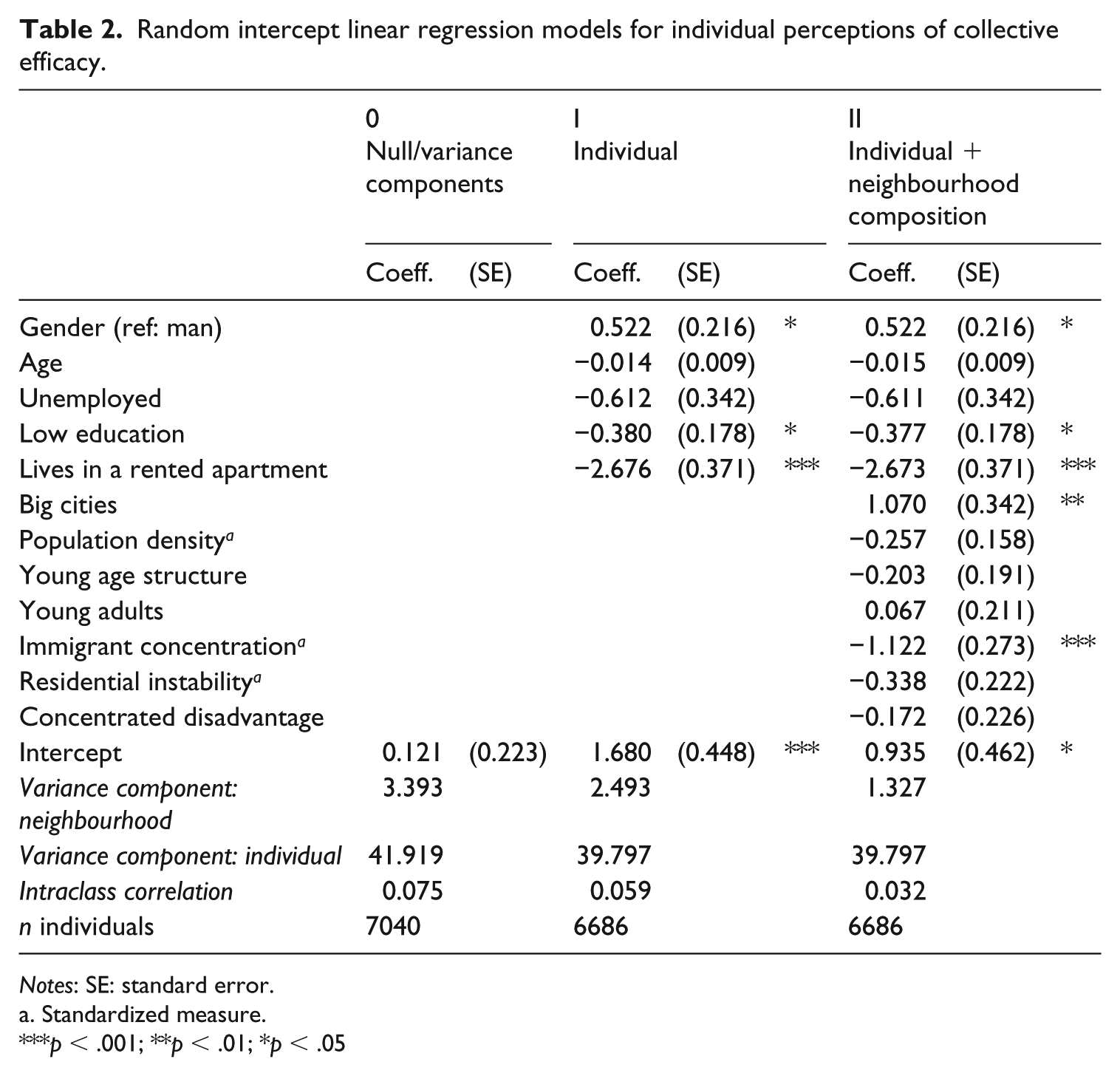
The first analysis concentrates on the main variable of interest, using individual perceptions of collective efficacy as the outcome variable. The analysis employed a linear multilevel model in which the null model presents the variance components without predictors; Model I contains the individual-level predictors and Model II adds the neighbourhood-level measures into the model (see Table 2).
Random intercept linear regression models for individual perceptions of collective efficacy.
Notes: SE: standard error.
Standardized measure.
p < .001; **p < .01; *p < .05
Results from the null model suggest that a rather meagre 7.5 percent of the variability in collective efficacy was situated at the neighbourhood level, lower than what has been observed in previous studies (for example, Gerell and Kronkvist, 2017; Sutherland et al., 2013), indicating that most of the variability was between residents. To a degree, this finding might stem from the low variability in the general characteristics of the estates, because the sampling procedure itself targeted very specific neighbourhood configurations. In the studied population of residents living in suburban housing estates, women were more likely to perceive higher levels of collective efficacy, while low educational level and living in a rented apartment were negatively associated with collective efficacy. The age of the respondent was not statistically significant. Out of the contextual variables, immigrant concentration in particular was highly significant (p < .001) and reduced perceived collective efficacy to a great degree. Somewhat surprisingly, socioeconomic disadvantage was not statistically significant. The variables in the full model explained 10 percent of the variability between individuals and 85 percent between neighbourhoods.
Apart from the results on gender and age, the findings were consistent with the findings in the existing literature: persons with low socioeconomic status and who lived in rented apartments tended to express lower levels of collective efficacy. Regarding neighbourhood-level measures, the results conflicted slightly with previous studies: only immigrant concentration, but not residential instability or concentrated disadvantage, was associated with perceived collective efficacy. Similarly to the studies conducted in the US (Armstrong et al., 2015; Sampson et al., 1997) and Sweden (Gerell and Kronkvist, 2017), but unlike the study conducted in London (Sutherland et al., 2013), the presence of an immigrant population seemed to predict lower perceived collective efficacy. Although this finding is consistent with other studies, it might also be a by-product of the sampling frame that included only residents with Finnish as their native language. Overall, the conflicting findings on both the individual and the neighbourhood level could be explained by the sampled neighbourhoods and the characteristics of the population, because suburban housing estates constitute a special kind of housing category characterized by socioeconomic disadvantage. However, the interpretation that collective efficacy operates differently in Finland cannot be ruled out.
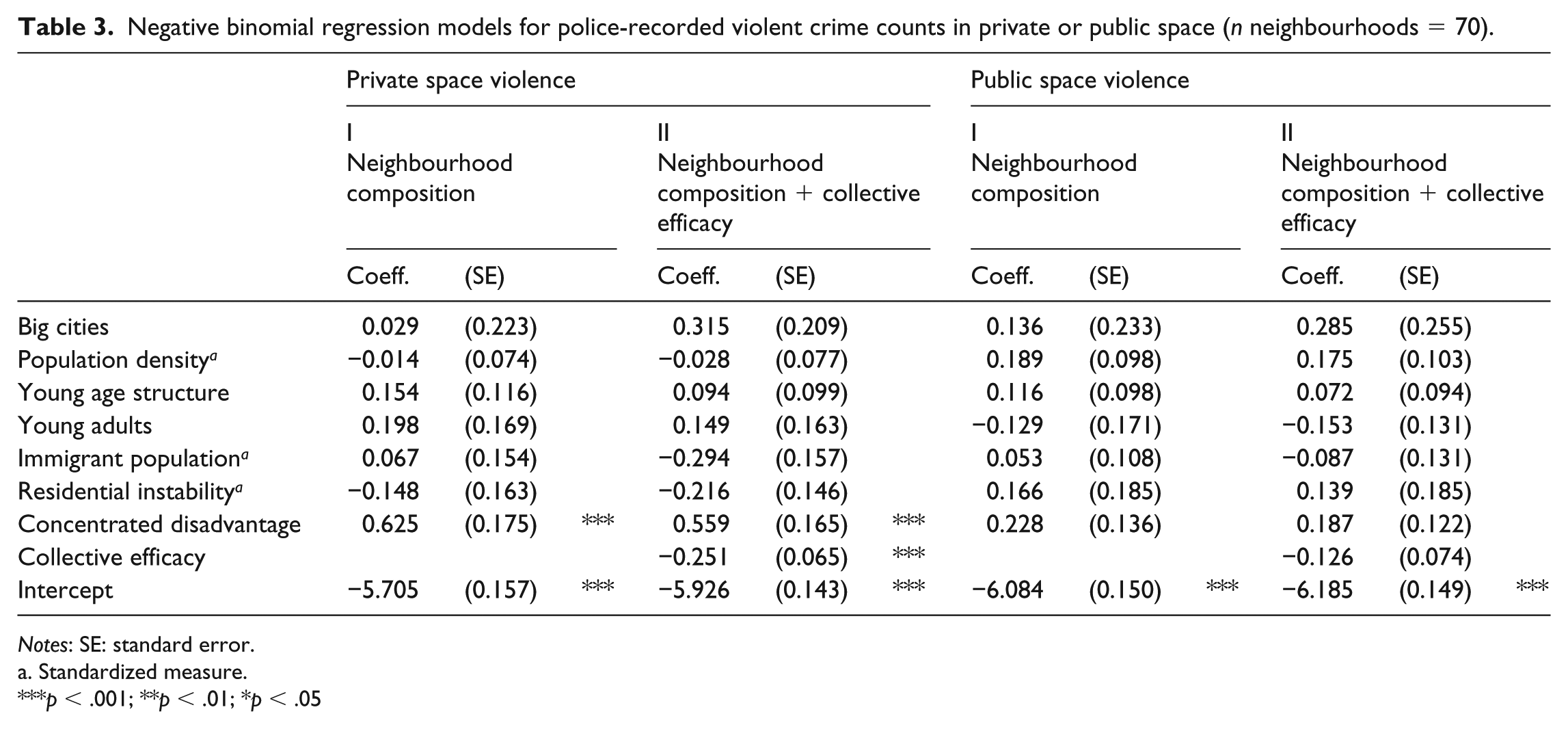
Turning to the key focus of this article, the neighbourhood crime rate was estimated using negative binomial regression models, with violent crime count as the outcome and residential population as the exposure variable (Table 3). The models presented here include two discrete outcomes: violent crime counts in private spaces and violent crime counts in public places. Two models were specified for both outcomes: Model I depicts the association between the level of violent crime and the social composition of the housing estate sans collective efficacy, while Model II incorporates the measure of collective efficacy into the model.
Negative binomial regression models for police-recorded violent crime counts in private or public space (n neighbourhoods = 70).
Notes: SE: standard error.
a. Standardized measure.
p < .001; **p < .01; *p < .05
Concentrated disadvantage predicted violent crime in private space (0.625, p < .001), but the association with violence in public space was not statistically significant, although in the expected direction. Counter to the hypothesis, residential instability and immigrant concentration were not associated with either outcome in the first set of models. The same was observed for the controls for population density, age structure and city size: none of the coefficients were statistically significant. The variance inflation factors were below 2.65, indicating little concern for collinearity between the predictors.
With the addition of collective efficacy into the model (Model II), the results showed a negative association between collective efficacy and violence in private space (−0.251, p < .001), while the association between collective efficacy and violence in public space was in the same direction but failed to reach statistical significance (p = .089). Here it should be noted, for the sake of comparison, that the model with any violent crime (regardless of the place of occurrence) produced a statistically significant coefficient for collective efficacy in the full model (not reported). However, this association was much more pronounced regarding violence in private space: the coefficient for collective efficacy was twice as large relative to the model with public space violence as the outcome. With collective efficacy fitted into the model, concentrated disadvantage remained a highly significant predictor (0.559, p < .001) regarding violence in private places. None of the predictors in the full model for violence in public places were significant.
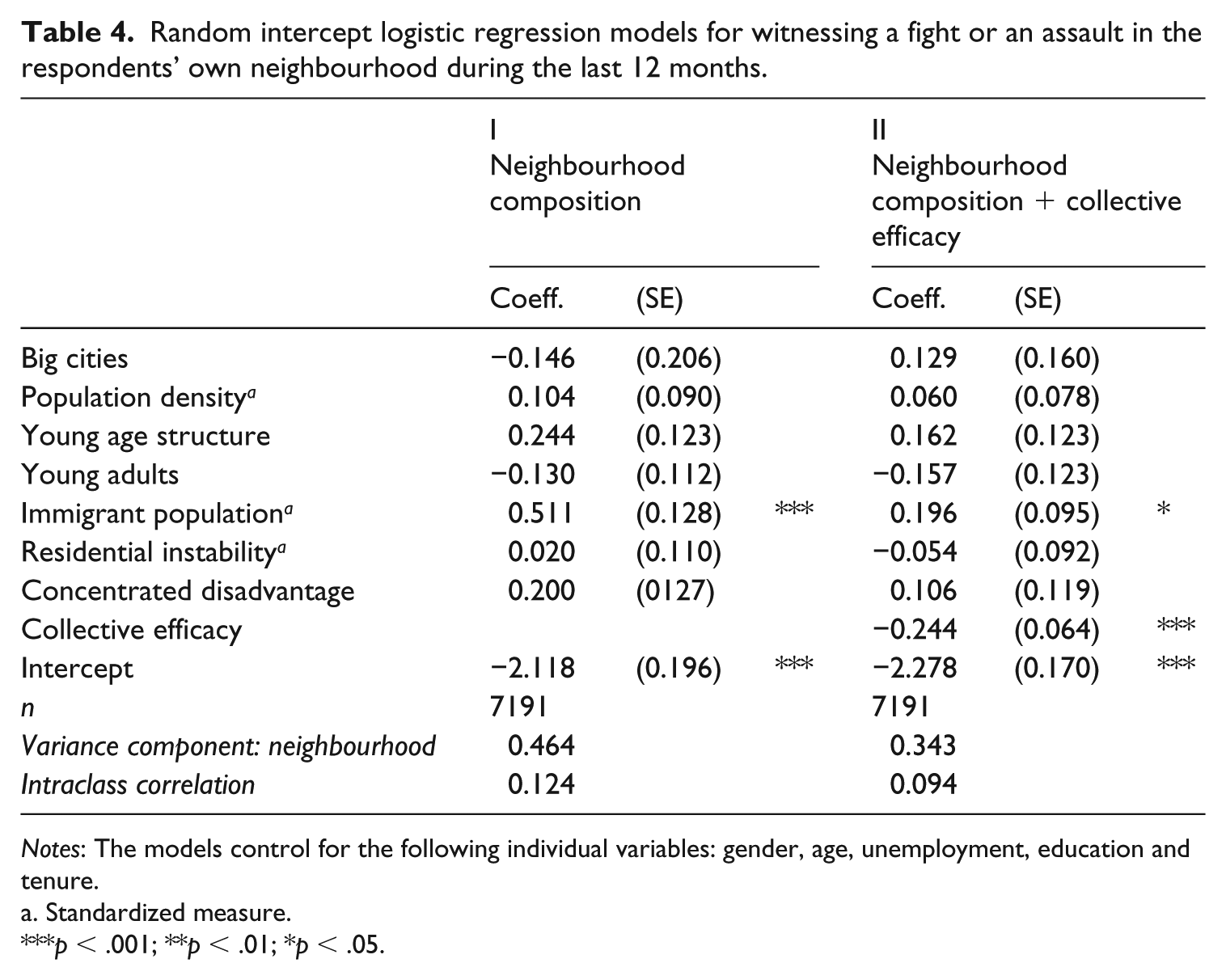
The results of the survey-based measure of witnessing interpersonal violence in the neighbourhood are reported in Table 4. Similarly to the previous models on police-recorded violent crime, Model I depicts the association between neighbourhood social composition and neighbourhood violence, while Model II incorporates the measure on collective efficacy.
Random intercept logistic regression models for witnessing a fight or an assault in the respondents’ own neighbourhood during the last 12 months.
Notes: The models control for the following individual variables: gender, age, unemployment, education and tenure.
a. Standardized measure.
p < .001; **p < .01; *p < .05.
The results suggest a stronger association between violence and immigrant concentration (0.511, p < .001) than in police-recorded crime, while concentrated disadvantage was not associated with the outcome (Model I). Other neighbourhood-level measures were not statistically significant. With the addition of collective efficacy into the model (II), the association between seeing violence and immigrant concentration became less pronounced but was still statistically significant (0.196, p = .036). As hypothesized, collective efficacy was highly significant and in the expected direction (−0.244, p < .001). The finding that the association of immigrant concentration with the outcome was reduced with collective efficacy fitted into the model is consistent with the previously reported result showing a negative association between immigrant concentration and individual perception of collective efficacy (Table 2). Again, it is worth pointing out that the respondents were people with Finnish as their native language, which might explain some of the findings about ‘seeing violence’ in estates with a relatively high proportion of residents with an immigrant background, because immigrant concentration might produce visual cues that are interpreted as disorder and/or crime (Hipp, 2007; Sampson and Raudenbush, 1999).
Conclusions
The specific aim of this study was to assess the validity of collective efficacy in explaining neighbourhood variation in violent crime in a Nordic context, specifically in a sample of 70 suburban multi-storey housing estates across Finland. The association between collective efficacy and violent crime was studied in relation to three different measures of crime: police-recorded violent crime in private and public spaces and a survey-based measure of seeing violence in the neighbourhood. Using a novel method for identifying neighbourhoods, the study combined survey measures with geocoded point data on police-recorded crime, as well as block-level administrative data sources, focusing on suburban housing estates built in the post-war period. This operationalization enabled a detailed study of communal processes in a setting that essentially held most of the physical and structural elements, including the age of the neighbourhood, as well as some of the architectural structures, constant across the studied neighbourhoods. Because these structural factors might affect collective efficacy as such (Cohen et al., 2008), and in ways that are often not measured in collective efficacy studies, the current study had an additional benefit of focusing on comparable neighbourhoods.
This study contributes to the existing literature by providing evidence that collective efficacy was negatively associated with violent crime in a suburban setting in Finland, thus offering further proof that, despite the considerable differences in societal context between the US and European countries, there appear to be similarities in community-level processes with regard to outcomes such as violent crime (Sampson and Wikström, 2008). However, collective efficacy was associated only with violence that occurred in the private sphere and a survey-based measure of neighbourhood violence, but not with violence that occurred in public or semi-public settings. Therefore, the first hypothesis (H1) received only partial support. The results concerning police-recorded crime also suggested that concentrated disadvantage was directly associated with violence in private places (but not public places) because the association between socioeconomic disadvantage and crime was nearly unaffected by the inclusion of collective efficacy in the models. Immigrant concentration, on the other hand, was associated only with the survey-based measure of interpersonal violence, and this association was deemed somewhat indirect. Residential instability was not significant in any of the models. Thus, the second hypothesis (H2) also received only partial support.
Regarding collective efficacy itself, most studies have found concentrated disadvantage to be negatively correlated with collective efficacy (Armstrong et al., 2015; Brunton-Smith et al., 2018; Mazerolle et al. 2010; Sampson et al., 1997; Sutherland et al., 2013), whereas this study, along with the study in Malmö (Gerell and Kronkvist, 2017), suggests this might not be the case in a Nordic context. Instead, ethnic heterogeneity or immigrant concentration – although hard to separate from socioeconomic disadvantage – appear to be the main forces that inhibit neighbourhood cohesion and the capacity for effective social control in both Finland and Sweden. This could suggest that collective efficacy operates differently in different kinds of neighbourhoods, or that collective efficacy simply operates under different conditions in the Nordic societies where the proportion of the immigrant population has increased substantially in recent decades (Norlén and Rispling, 2018; see also Brunton-Smith et al., 2018).
Although the main findings in this study conform to the overall hypothesis on the link between collective efficacy and violent crime, the results are nevertheless puzzling to a certain degree. A study conducted in The Hague (Bruinsma et al., 2013; Sutherland et al., 2013) concluded that collective efficacy appeared nonsignificant in explaining neighbourhood variation in crime, but the study did not differentiate between violent offences, property crime and drug offences. The London study, however, identified a weak effect on all violent crimes but not ambulance call-outs for knife injuries (Sutherland et al., 2013). Perhaps the most comparable study in societal and cultural terms was conducted in Malmö, stating that collective efficacy had a substantial effect on public place violent crime (Gerell and Kronkvist, 2017). Thus, although the main framework – high rates of collective efficacy are typically connected with lower rates of violent crime – holds true in most studies, the results are not robust across the spectrum. With regard to the Malmö study in particular, the current study found similar results, but on a different outcome (private place violence).
There are multiple possible reasons for the mixed results observed in the current as well as previous studies. Although the frame in the current study, studying comparable neighbourhood configurations, can be seen as a strength, it also opens the door for the possibility that the findings are unique to particular kinds of suburban housing estates. In addition, the use of residential population as the exposure population might be suitable for violence in private places, but not public places. Other measurement issues, of course, include the choice of crime measures and ultimately the willingness to report incidents to the police, which itself might be affected by neighbourhood social networks and trust. Overall, it is not clear whether the concept of collective efficacy as such is fit for purpose in the European and/or Nordic context; some evidence suggests that only the social cohesion dimension of collective efficacy is related to the variation in neighbourhood crime in European studies (see Pauwels et al., 2018, for overview). Recent evidence also suggests that the consensus for collective efficacy could be an important factor, because it gives the residents confidence that others will intervene and give support to their own actions (Brunton-Smith et al., 2018).
This study suggests that there might be value in analysing the relationship between collective efficacy and crime in a more detailed way by making a distinction between crimes that take place in different settings. Different types of crime and different places of occurrence are bound to have varying mechanisms that contribute to their presence (Hipp and Steenbeek 2015), especially on a small geographical scale. Gerell and Kronkvist (2017) state that collective efficacy as a public property should have a greater impact on visible rule violations than non-visible violations, yet the results from this study suggest otherwise. In fact, one could argue that the deterrent effect of collective efficacy could be most effective against local residents rather than arbitrary visitors, since locals are bound to be more aware of the collective structure of the neighbourhood (see Browning, 2002). Thus, the question also concerns the issue of whether and how collective efficacy affects the choice of crime location (Bernasco and Block, 2009). Overall, future research could probably benefit from exploring these issues in a more detail, while clarifying the hypothesized mechanisms at the same time.
