



Abstract
While levels of public confidence in the police have declined internationally, the Republic of Ireland appears to have bucked this trend with confidence levels that remain ‘strikingly and stubbornly high’ ( Mulcahy, 2016: 275). This situation appears all the more puzzling given the wave of scandals to have hit the force in recent decades, ranging from police corruption in Donegal in the late 1990s to a more recent whistleblower scandal that has resulted in the resignation of a slew of Ministers and high-ranking officials. Such developments beg important questions as to the factors sustaining public confidence over this tumultuous period. Drawing on international and domestic data, this article aims to probe this ‘paradox’ of public confidence in the Irish police. It argues that, although confidence is high, there is more to the dynamics of confidence in the police in Ireland than this initial appraisal suggests. Indeed, it advances the Irish case as an illustration both of the dimensionality of the public confidence concept and the complexity of the pathways to trust in the police.
Introduction
As a ‘core function’ of the state, it is essential that the public feel confident in the police. The police are symbols of state authority (Bittner, 1980), and, as such, trust in the police reflects the legitimacy of the state as a whole, with a lack of confidence interpreted by some as a problematic democratic deficit (Gilling, 2010). Confidence in the police is also essential to their effective functioning since it facilitates greater reporting of crime, higher levels of cooperation and compliance, and greater effectiveness and efficiency (Sunshine and Tyler, 2003; Jackson and Bradford, 2010). In short, ‘public trust makes the life of a police officer considerably easier’ (Schaap, 2020b: 28). Moreover, as noted by Hough et al. (2013: 43) ‘encounters with the most public-facing element of the CJS [criminal justice system] – the police – can inform ideas about other elements of the system (especially the courts and prisons), and about its fairness as a whole’ (see also Hamilton and Black, 2019; Hough and Roberts, 2004; Indermaur and Roberts, 2009).
Despite the vaunted importance of confidence or trust in the police, the data appear to show a decline in these measures in certain Western jurisdictions dating from at least the 1980s. In England and Wales, for example, British Crime Survey/Crime Survey of England and Wales data show a pattern of decline in confidence in police from 1984 to 2000, consistent with trends in relation to the criminal justice system more broadly (Hough, 2003; Jansson, 2008; Bradford et al., 2009; Bradford, 2011). Reiner (2000) uses the marked decline between 1984 and 2000 in those rating their local police as ‘very good’ as support for the idea that the ‘haemorrhage’ in support for the police that started in the 1960s continued right up to the turn of the century. In his view, successive scandals and a failure to evolve with society have resulted in a police service that is now ‘beyond legitimation’ (Reiner, 2010: 96). This decline in confidence in the police corresponds with World Values Survey data showing that in many countries confidence in the wider justice system fell considerably in the period from the early 1980s to the early years of the new century (Van de Walle and Raine, 2008). Inglehart (1997) attributes this to a general decline in respect for authority, having an impact on citizens’ attitudes towards the police and justice system, but also other institutions such as the church or army. While subsequent decades have seen small but significant increases in confidence levels, concerns about waning confidence in the police persist such that it has now become a ‘fully fledged policy domain’ (Tonry, 2007). Schaap (2020a) also raises the valid point about the need for the police to achieve a ‘re-legitimation’ (Reiner, 2010: 99) in the very challenging conditions in which police now operate, which include, inter alia, demands to respond to technological developments and a changed media landscape. Such imperatives have given rise to extensive literature on the drivers of police legitimacy and related concepts such as confidence/trust, including an explosion of research on the impact of procedural justice (the quality of decision-making procedures and fairness in the way citizens are treated by police) on levels of confidence/trust in law enforcement officials (Tankebe, 2008; Tyler, 2003; Tyler et al., 2007).
Against this background, the case of Ireland presents as a useful puzzle. In seeming contrast to our nearest neighbours in the United Kingdom, Irish rates of confidence in the police have, in the words of one leading commentator, remained ‘strikingly and stubbornly high’ (Mulcahy, 2016: 275; see also Conway, 2010, 2019; Manning, 2012). This is even more perplexing given the wave of scandals to have hit the force in recent decades, ranging from police corruption in Donegal in the late 1990s (Conway, 2010), to more recent whistleblower scandals resulting in the resignation of a slew of government Ministers and high-ranking officials. We may wonder, with Conway (2019: 529) why, ‘[i]t has long been a notable factor that public confidence in policing is high in Ireland’, and, further, ‘[why] the scandals of recent years have done little to affect that’. Understanding why the Irish police (or Garda/Gardaí) has putatively held the confidence of its citizens better than other countries, and in the face of documented corruption and scandal, provides an opportunity for new insights. Do the very high levels of confidence in the police recorded in domestic surveys accurately reflect levels of public confidence? If so, why has public support consistently remained so high over the years? Why do well-publicised cases of corruption, abuse of rights, and other scandals appear to affect confidence in the police in the United Kingdom and other countries, but not Ireland? What factors might underpin the high levels of public support? Do the key tenets of the procedural justice literature hold in an Irish context?
In an effort to address some of these questions and probe this ‘paradox’ in Irish policing, this article firstly examines several key dimensions of what appears to set the Irish police apart in this regard, such as its close connection to the origins of the state and strong local affiliation. It then discusses the empirical evidence showing the consequences and implications of these dimensions, including the impact of scandals. It is argued that the Irish case serves to complicate the existing narrative around public confidence in the police in two ways: first, through highlighting the dimensionality of the concept, including its symbolic and more specific aspects, and second, by pointing up the multiple, and sometimes contradictory, pathways through which trust in the police can be achieved. In an Irish context, it may be that the procedural justice principles referenced above are enacted in distinct and nationally specific ways, including a greater reliance on informal rather than formal contacts and processes.
Before proceeding thus, a note on terminology is appropriate. The article will analyse findings from surveys that examine a range of types of attitude, such as confidence, trust, and satisfaction, which are often defined differently from study to study. As will become clear, however, we accept that these terms are not synonymous 1 and take care to differentiate between these concepts where appropriate. 2
An Garda Síochána and cultural nationalism
As is so often the case, criminal justice policies both reflect and articulate with local struggles and issues relating to national identity. This is particularly evident in Ireland where the historical development of policing became a means through which the canons of Irish cultural nationalism were asserted. Thus, An Garda Síochána established in the wake of the Irish War of Independence, while similar in organisational structure to the old Royal Irish Constabulary (RIC), deliberately and consciously pursued a distinct ideological ethos and cultural identity. Indeed, in many ways, it defined itself in contradistinction to the RIC as a colonial police force which had been heavily targeted by the IRA (the Irish Republican Army) during the Anglo-Irish War (Connolly, 2002). This is clear in early statements about the ethos and culture of the Gardaí: they were to be models for the community, ‘Irish in thought and action’ in the words of the first Garda Commissioner, Michael Staines (McNiffe, 1997), with an emphasis on the use of the Irish language, Roman Catholicism, sobriety, and involvement in Gaelic games. The new force was also, unlike its predecessor, to be unarmed. The founding Commissioner of the organisation famously declared that the success of An Garda Síochána would be dependent not by force of arms or numbers but on its ‘moral authority’ as servants of the people (Connolly, 2002). It is important to note, however, that the organisation did not always live up to this idealised vision, and low-level violence was a feature of the force from its inception (Conway, 2013). Indeed, Brady (2000) has argued that not only was this situation tolerated by the force and the wider community but also the use of informal measures such as a ‘good thrashing’ for petty crimes was in fact necessary for the new police force to be accepted by the people.
Crucially, the new Irish police force established post-independence cannot be understood without reference to the wider context of Irish society in the decades post-1922. For a 40-year span, Ireland was a predominantly rural country with low crime rates (O’Sullivan and O’Donnell, 2007), while the Catholic Church held considerable influence and wielded power ‘without a rival institution’ until the 1960s (Ó Corráin, 2018: 726). Indeed, it is no exaggeration to say that the Church, with whom the Gardaí developed close links, was regarded as another key institution that came to define the character of the Irish state since independence. As such, it enjoyed what Inglis has termed a ‘moral monopoly’, and Ireland in these years was a conservative and relatively monocultural nation (Inglis, 1998). It was in this context, and as part of the broader process of what Declan Kiberd has termed ‘inventing Ireland’ (Kiberd, 1995), that the Gardaí enjoyed considerable authority.
Local roots
A similar strategy of policing in and with communities, rather than the colonial model where policing was imposed from the outside, was adopted at a local level. In reinventing the force, Mulcahy (2006) argues that the new organisation pursued legitimacy in two ways; first, at a national, and symbolic level, as an expression of political independence, and second, at a more local, practical level, through the development of organic ties in local communities.
Since its foundation, An Garda Síochána has therefore sought to emphasise its local roots. This was particularly evident through Garda involvement in sports, both GAA (Irish sports of hurling and football) and athletics, with Garda sports days drawing huge crowds (Conway, 2013). Mulcahy (2008: 194) has drawn attention to the particular significance of the spatial hierarchy or the way in which sports are organised in this context. In particular, their Gaelic and amateur nature, based at parish, club, and subsequently, county level, ‘provided a ready means of identifying the police with “the people” and of signifying police involvement in and affiliation with community life in Ireland’. In the achievement of this, the Gardaí were facilitated by the barracks-based distribution of personnel inherited from the RIC and the decentralised functioning of the organisation outside of Dublin (despite a centralised command structure). Reflecting the more diffuse nature of policing authority in Ireland, Manning (2012: 355) describes the organisation as one ‘in process, large and unresponsive to centralised command, immensely decentralised’ (emphasis added).
For many decades, therefore, local community input into policing in Ireland has been informal rather than formal in nature. It was as if the establishment of formal structures facilitating police-public contact would somehow ‘sully’ the more implicit and organic links with the community that the Gardaí had fostered since their creation (Mulcahy, 2006, 2008). This proved to be the case even with the emergence of a more ‘negotiated legitimacy’ (Shapland, 2008: 23) that accompanied growing urbanisation and secularisation in the 1990s and early 2000s and attempts in the Garda Síochána Act 2005 to involve local authorities and politicians in policing through Joint Policing Committees. The committees, and network of local policing fora under them, allocated only a few seats to community or voluntary representatives and as Walsh (2009: 179) has written, represented ‘a pale version’ of analogous reforms pioneered in England and Wales.
An Garda Síochána as ‘sacred’?
As noted above, Ireland’s relatively unique position as both a Western European democracy and postcolonial territory meant that the Gardaí formed an important part of the process of cultural reaction and transformation that occurred upon independence. Clearly, the question of trust and confidence in policing is different in postcolonial societies with much of the literature tending to suggest a failure of legitimation in postcolonial policing associated with serious police misconduct and increases in violent crime (Brogden, 2005; Tankebe, 2008). In Ireland, colonial legacies manifested themselves through a ‘top-heavy, overcentralized bureaucracy’ (Salmon, 2020: 92); the absence of a tradition of policing by consent (Ellison, 2000) and the placement of the organisation on ‘an unfeasibly high pedestal’ (Connolly, 2002: 496). Manning (2012: 354) puts it well when he speaks of a ‘certain sacredness’ attributed to An Garda Síochána in their representation of ‘authority of an indigenous sort’.
Another inheritance from the colonial era was the fact that the Gardaí are responsible for national security functions as well as domestic policing. This aspect of their mandate was thrown into sharp relief following the outbreak of widespread violence in Northern Ireland in the late 1960s and its inevitable spillover into the Republic. The close identification of the Gardaí in the fight against political violence served to consolidate their ‘iconic’ or ‘semi-sacred’ status resulting in a situation where for many years criticism of the organisation was almost considered unpatriotic (Mulcahy, 2002; Conway, 2013). Walsh (1998: 400-401) quotes a former Minister for Justice who described as ‘obscene’ the idea of him leading criticism of the Gardaí in the context of a bungled kidnapping, remarking ‘there is nothing between us and the dark night of terrorism but that force’. Indeed, the closed and largely unaccountable nature of Irish policing during these years is well illustrated by the minimal impact of scandals related to the heavy-handed interrogation tactics of some units in the 1970s and 1980s, the activities of which earned them the moniker of the ‘Heavy Gang’ (Conway, 2013). The immediate context of escalating political violence and a culture of deference ensured that official and public concern was negligible.
Probing the paradox: Levels of public confidence in the Irish police
The characteristics discussed above have not been without consequences for the practice of policing in Ireland with domestic and international data on trust, confidence and satisfaction generally supporting the high esteem in which the organisation is held. This is particularly evident along the ‘community’ dimension discussed above with comparative data providing strong support for the embeddedness of the police in many communities in Ireland. Less positively, however, the decentralised and informal nature of policing in Ireland has led to an ‘avalanche of scandal and controversy’ (Mulcahy, 2016: 273), triggering a series of reforms and impacting public confidence, at least in the short term.
‘ Strikingly and stubbornly high’?
While public attitudes to the Gardaí have not received sustained attention historically (Mulcahy, 2016), knowledgeable commentators such as McNiffe (1997: 175) have described them as ‘one of the striking successes of the new state’. Moreover, gaps on our knowledge of historical levels of confidence can be supplemented by comparative data which provide a very healthy assessment of levels of public confidence. Drawing on World Values Survey data, Inglehart (1997: 225) observes that Ireland was one of only two countries (with Iceland) where the percentage of those indicating they had a ‘great deal’ of confidence in the police increased between 1981 and 1990. Indeed, in the next sweep in 1999–2000, the percentage of respondents stating that they had a ‘great deal’ of confidence in the police was highest in Ireland (34%) out of 28 European countries surveyed (Halman, 2001: 190). This trend is confirmed by European Social Survey (ESS) data, which measures ‘trust’ rather than confidence, and which ranks Irish respondents second only to those in Nordic countries in terms of their levels of trust with the police (Breen and Healy, 2016: 103
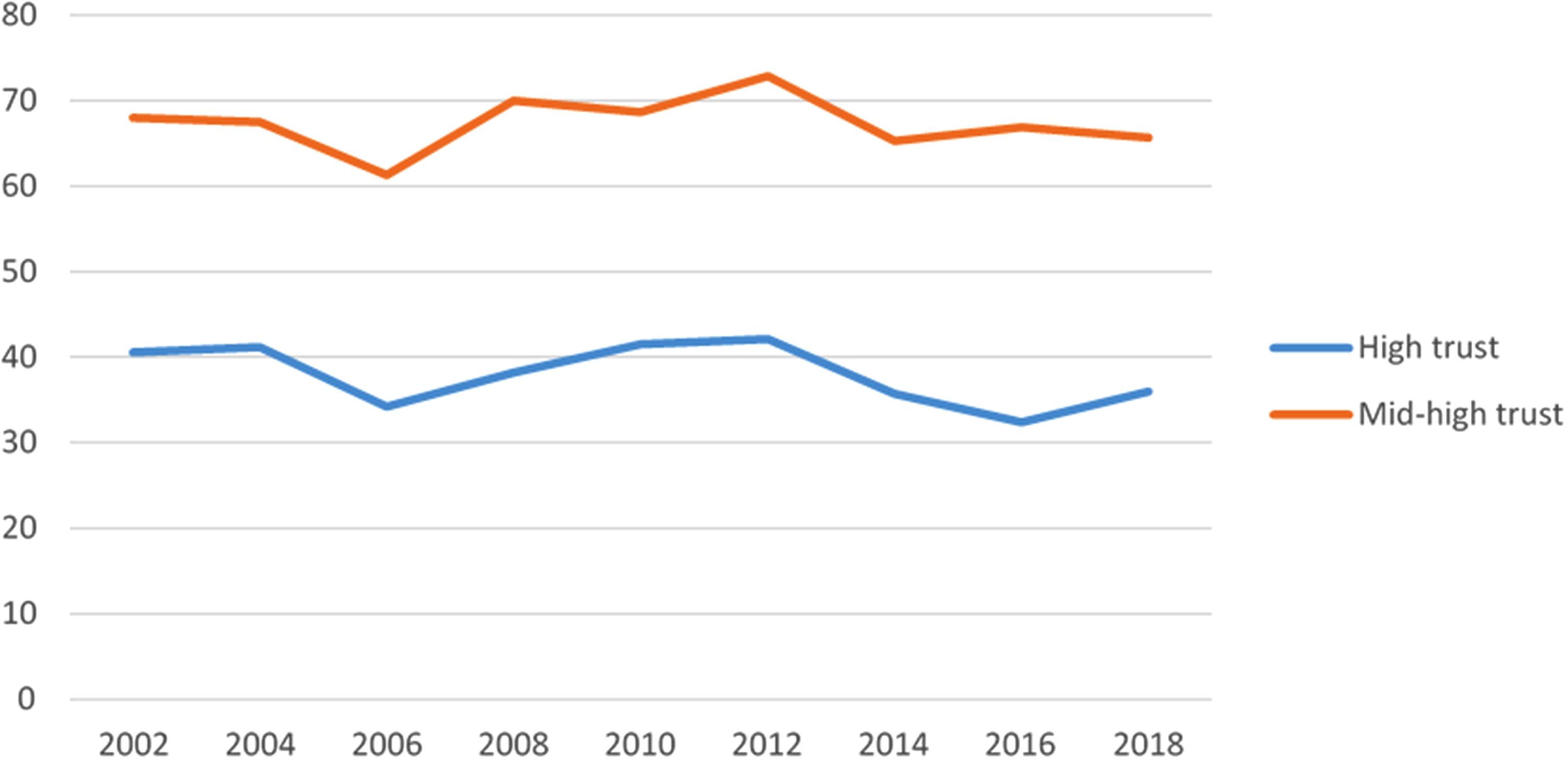
‘Mid’ (8-10) and ‘Mid-High’ (6-10) Trust in the Police by ESS Round- Ireland. Source: ESS data. Available at:http://nesstar.ess.nsd.uib.no/webview/.
These trends are also discernible in the Garda Public Attitudes Survey (GPAS) data, conducted on an annual basis from 2002 to 2008 and relaunched in 2015 after a break of some years. 5 It is important to note that GPAS traditionally measures levels of satisfaction rather than confidence. Until 2008, therefore, respondents were asked how satisfied they are with ‘overall’ Garda service to the community, with responses measured on a four-point scale: very satisfied, quite satisfied, quite dissatisfied or dissatisfied. A version of this question was included in the later (post-2015) iterations of the survey but rephrased to measure satisfaction with Garda service to the local community. Additionally, since the survey was relaunched it has included a question on levels of trust as well as satisfaction in An Garda Síochána. Respondents are asked to assign a number between 1 (lowest) and 10 (highest) to quantify their level of trust in the police which is then recoded to ‘High trust’ (8, 9, or 10), ‘Mid trust’ (5, 6, or 7) and ‘Low trust’ (1, 2, 3 or 4). 6 A general question of ‘satisfaction’ with policing has therefore splintered into two questions: one asking about ‘trust’ in An Garda Síochána and another asking about ‘satisfaction’ with local policing. 7
The available data are shown in Figure 2, which also includes data from earlier surveys conducted in 1986, 1994 and 1996 (An Garda Síochána, 2003). While analysis is necessarily hampered by the gaps in the data, an initial reading suggests very high, and quite consistent, levels of support for the Garda Síochána over the 33-year period. Satisfaction levels, the only measure of confidence available between 1986 and 2008, ranged from a low of 79% in 2006 to a high of 89% in 1994 and 1999. Satisfaction ratings taken from 2015 onwards are probably not directly comparable, given that the question relates specifically to satisfaction with local policing, although these, too, remain relatively consistent, hovering between 67% in 2016 and 80% in 2019. Overall trust levels, measured as those falling in the ‘high’ or ‘medium’ trust category combined, have also remained high in the period since 2015, with rates increasing incrementally each year from 2015 to 2019.
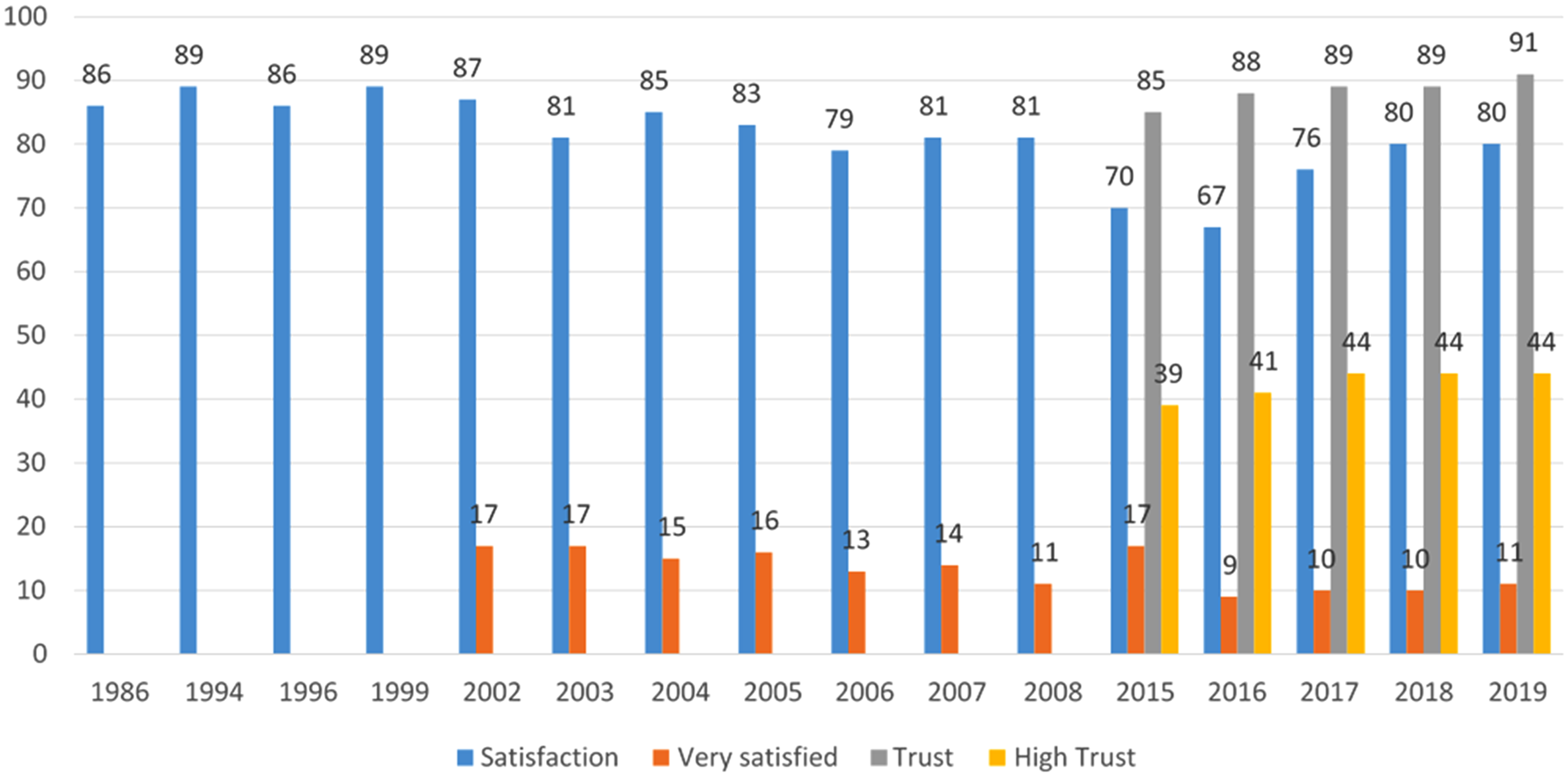
Garda Public Satisfaction and Trustratings 1986 to 2019. Sources: O’Donnell (2004); Garda Public Attitudes Surveys 2002-2019.
A closer look, however, reveals what would appear to be some cracks in historically high levels of confidence, particularly when the ‘very satisfied/high trust’ responses are separated out from the ‘quite satisfied’/‘mid trust’ responses. This includes significant falls in the percentage of survey respondents expressing themselves ‘very satisfied’ (with the Gardaí overall) from 17% in 2002 to 11% in 2008, and (with local Gardaí) from 17% in 2015 to 11% in 2019. Hough (2007: 71) has argued that in many instances ‘fairly good’ (arguably similar to ‘quite satisfied’ in this context) is equivalent to ‘don’t know’ or ‘undecided’, so that these higher levels of satisfaction may be more likely to better reflect a ‘firm’ level of support that is relatively invariant over time (Bradford, 2011: 186). This observation is particularly pertinent to the ‘mid trust’ category in the post-2015 GPAS which includes respondents with a rating as low as 5/10, affording, ‘a rather generous interpretation of “mid”’ (Conway, 2019: 529).
Public confidence data and relations with the community
As already noted, two key historical factors appeared to present pathways to trust for the Irish police, namely, their postcolonial embodiment of cultural nationalism, and their development of organic links with local communities (Mulcahy, 2008). In relation to the latter point, it seems undeniable that a key strength of the organisation is the role it plays in communities, and this has been identified as a strong positive both for members of the organisation and the public in the recent Cultural Audit of the organisation (Price Waterhouse Coopers, 2018). Indeed, when ‘high’ trust scores are correlated with perceptions of the Gardaí in the GPAS, those factors showing the strongest association are views of the Gardaí as ‘friendly or helpful’ (99%) and ‘community focussed’ (88%) (An Garda Síochána (GPAS), 2020). This view also derives support from the stark differences between the scores achieved by An Garda Síochána in domestic polls on metrics relating to community engagement and those attained by the police in Scotland, a country of similar size and culture (though arguably not ‘post-colonial’ in the same way as Ireland). These include: ‘community relations are poor’ (60% disagree vs. 24% in Scotland); ‘Gardaí listen to the concerns of local people’ (75% agree vs. 50% in Scotland); and ‘Gardaí are not dealing with things that matter to the local community’ (54% disagree vs. 20% in Scotland) (GPAS, 2020; Scottish Government, 2019).
‘An avalanche of scandal and controversy’
Thus far the implications, in terms of levels of public support, of the way in which legitimacy was pursued by the Gardaí, would appear to have been largely positive. Yet, the reluctance to criticise what had come to be seen as in effect a ‘moral force, mirroring authority generally’ (Manning, 2012: 348), combined with the decentralised functioning of the organisation outside of Dublin, also had more sinister effects which revealed themselves in a series of corruption scandals surrounding the force in recent decades. This ‘fifteen years of scandal’ (Conway, 2019: 523) began with a scandal over police corruption in Donegal in the late 1990s/early 2000s and the subsequent establishment of a Tribunal of Inquiry chaired by High Court judge, Mr Justice Morris. The Tribunal’s reports, spanning the years 2004–2008, make for grim reading, incorporating mistreatment, false arrests, harassment, and the orchestration of hoax bomb finds. The reports also had much to say about Garda culture and the failure of management to address these problems appropriately. Indeed, one notable finding in the 2004 report was that Garda culture ‘generally militates against open and transparent cooperation with investigations, both internal and independent’ and manifests itself in a policy of ‘you don’t hang your own’ (Morris, 2004: 447, 448). 8 The findings of the report formed a watershed moment in Irish policing, lending credence to claims of a cultural malaise within the Gardaí and identifying concerns about human rights abuses and the need for reform. The legislative response, in the form of the Garda Síochána Act 2005, led to the establishment of two new oversight bodies, the Garda Síochána Ombudsman Commission (GSOC) and the Garda Inspectorate, but proved largely inadequate to the task of addressing problematic behaviour in the Gardaí. This is averred to by the late Supreme Court judge, Mr Justice Hardiman, 9 when he compared the observations in the Morris Reports to those made in the Smithwick Tribunal report (of December 2013): ‘there prevails in An Garda Síochána today a prioritisation of the protection of the good name of the force over the protection of those who seek to tell the truth. Loyalty is prized above honesty’ (Smithwick Tribunal, 2013: 154). As he notes, this ‘clearly demonstrates that there was little or no change in what the Morris Tribunal called “garda culture” in the intervening period between the two reports’. 10
More recent events involving two Garda whistleblowers, Sergeant Maurice McCabe and Garda John Wilson, mark another period of intense controversy (Mulcahy, 2021). In 2012, the two Gardaí, having failed to have their concerns addressed satisfactorily internally, made allegations to various politicians about significant numbers of people having their penalty points wiped, as well as allegations of failures to investigate serious crimes in the Cavan-Monaghan area. These allegations were at least partially supported by a number of reports into the penalty points and fines system (Comptroller and Auditor General, 2013; Garda Inspectorate, 2014) and by the report of the O’Higgins Commission (2016), despite comments from the then Garda Commissioner Martin Callinan in 2014 that he regarded them as ‘quite disgusting’. 11 The Commissioner resigned in March 2014 amid mounting public and political backlash over these remarks. In February 2017, following media coverage of Garda treatment of Maurice McCabe, the scandal reignited and a further Tribunal of Inquiry (Charleton/Disclosures Tribunal) was established into an alleged smear campaign against Sergeant McCabe, including false allegations of child sexual abuse. The Disclosures Tribunal found that this allegation was made unintentionally but went on to find that McCabe ‘was repulsively denigrated for being no more than a good citizen and police officer’ (Charleton, 2018: 301) and that, within the force, ‘a cultural shift requiring respect for the truth is needed’ (Charleton, 2018: 295).
Some indication of the magnitude of these events can be gleaned from the political fallout, resulting in the resignation of two Garda Commissioners, two Ministers for Justice, and two Secretaries General. Moreover, at the height of the whistleblower scandal in February/March 2014, a number of overlapping controversies emerged: one involving claims that incoming/outgoing telephone calls were taped and recorded in a large number of Garda stations, and another relating to suspicions that the offices of GSOC were under covert electronic surveillance by an unknown party. While subsequent inquiries found no evidence of improper interference or widespread misuse of recorded information (Cooke Report, 2014; Fennelly, 2017), there remained ‘many questions unanswered’ (Mulcahy, 2016: 273). Of particular note are the Fennelly Commission’s observations in April 2017 that the recording of the calls was unlawful, that there was a lack of regulatory control over matters of crucial importance, and that there was no procedure to deal with the situation (Fennelly, 2017). The report, as Kilpatrick argues (2018: 104), ‘recorded and was critical of the history of apathy towards human rights obligations within the Garda Síochána’. All of this, combined with a highly critical report from the Garda Inspectorate into Garda investigation practices, resulted in the publication, later that year, of draft legislation for a Policing Authority, envisaged as an independent oversight body with a role in the provision of policing services, and its establishment in January 2016.
Analysis: More apparent than real?
The above discussion sheds some interesting light on what we have termed the ‘paradox’ of ‘strikingly and stubbornly high’ levels of public confidence in policing in Ireland. While European and domestic surveys do little to disturb traditional views concerning high levels of confidence in the years up to 2000, in the period after this we may question whether a paradox exists at all. Focussing solely on more robust indicators of public confidence in the police over the relevant period permits a number of tentative conclusions to be drawn. First, we can discern one, very clear period of decline in levels of satisfaction in the police in the years between 2002 and 2008. This is evident in the domestic survey data, which register a fall in the percentage of respondents declaring themselves ‘very satisfied’ from 2002 to 2008 (from 17% to 11%). It is also supported by international survey data. As seen in Figure 1, the ESS shows a fall in the percentage of those having high levels of trust in the Gardaí from 41% in 2004 to 34% in 2006. The decline is particularly marked in the EVS data, with the percentage of those registering ‘a great deal’ of confidence in the police remaining fairly stable (34%–38%) between 1981 and 1999, before plummeting to 18% in 2008 (EVS, nd). Second, while we have little information on levels of public confidence between 2008 and 2015, owing to the suspension of the domestic surveys, it seems reasonable to conclude from the ESS data that high levels of trust decreased quite considerably from a peak of 42% in 2012 to a low of 32% in 2016. The third pattern that can be discerned from a reading of the domestic and international data combined is a steady increase in confidence levels in the period after 2016. Both the domestic and ESS data show increases in levels of confidence/trust after 2016, although the GPAS dates this one year earlier, with high trust levels increasing from 39% in 2015 to 44% in 2017 and remaining stable thereafter. One complicating factor is the fact that high trust is increasing at the same time that the percentage of those stating they were ‘very satisfied’ with the service provided by Gardaí to their local communities has fallen. This divergence, and the fact that the two metrics of ‘high trust’ (ranging from 39% to 44%) and ‘high satisfaction’ (ranging from 9% to 13%) appear to be measuring very different phenomena, raises interesting questions about the drivers of public confidence in the police in Ireland, one to which we return below.
The fact that confidence appeared to fall in the periods 2002–2006/2008 and 2012–2015/6 is an interesting finding as it coincides closely with the two periods of controversy (discussed above) leading to the establishment of the GSOC and Policing Authority in 2005 and 2016, respectively. This would suggest, contrary to received wisdom, that successive scandals have in fact had an impact on public confidence in Irish policing, albeit one which was relatively short-lived. Far from being an outlier or exception in this regard, this finding aligns Ireland with other jurisdictions where well-publicised incidents of police misconduct (and consequent reform) are commonly followed by erosion of support for the police (Tuch and Weitzer, 1997; Holmberg and Balvig, 2013; Fyfe et al., 2021). While the recovery in high levels of public support in the years following the scandal may be partly due to a general tendency for attitudes to rebound as an incident recedes in the collective memory, it may also be, as commentators on criminal justice in Ireland have frequently written, that Irish public opinion followed its traditional pattern of subjecting such controversies to ‘rapid and thorough’ scrutiny prior to the introduction of legislation designed to assuage public opinion (O’Mahony, 1996: 11; Fennell, 1993).
Outside of the knee-jerk reaction that often appears to accompany criminal justice crises in Ireland, the stability of confidence measures up to 2000, and their more volatile trajectory in the period after that, raises interesting questions about the degree to which the new century marked something of a watershed in the relationship between the public and the Garda Síochána. Certainly, the late 1990s and early years of the 21st century saw other institutions with a powerful connection to the emergence of the Irish state, notably the Catholic Church, lose their purchase as important governing power blocs in society (Inglis, 1998). As Mulcahy (2021) has suggested, recent Garda scandals may have played out to a public more attuned to institutional scandals after three decades of other high-profile examples. In this regard, it is notable that Conway (2019) has argued that the traditional deference afforded the Gardaí, formerly so entrenched in Ireland, has begun to unravel in recent years. As evidence for this, she points to the decline in the percentage of respondents in the GPAS indicating that the Gardaí are well managed between 2015 and the beginning of 2018. While the percentage of those expressing confidence in Garda management has significantly increased in the period since the publication of Conway’s research 12 (a fact in itself worthy of exploration), her point about the significant shift that has occurred in public and media discourse on policing is important, and one that is difficult to gainsay.
Reasons for resilience
If the above discussion suggests that the Gardaí are in no way ‘immune’ or ‘insulated’ from the vagaries of public opinion (Manning, 2012: 346), this is far from the complete picture. As noted, the steady recovery of levels of high trust in the Gardaí evident in the ESS and GPAS data in both the post-2008 and 2015 periods indicates strong residual levels of confidence in the police in Ireland that reassert themselves once a legislative or institutional solution to a policing ‘crisis’ is found. This is well illustrated by the continued high levels of trust in the organisation in the post-2015 period, reaching 91% in the 2019 GPAS. In particular, the 44% of respondents indicating ‘high’ levels of trust in the same survey compares very favourably with the 16% of respondents in the 2003–2004 British Crime Survey who rated the job being done by their local police as ‘very good’ (cited in Bradford, 2011: 186). 13
Returning to the reasons for this resilience, as noted above, perceptions of procedural justice, or the argument that fair and respectful treatment of the public by the police is a key element in building trust, now represents the dominant seam of theorising in the criminological literature on confidence/trust in the police (Tyler et al., 2007; Bradford et al., 2009; Hamilton and Black, 2019). An initial survey appears to support the argument in an Irish context also. Ireland’s high scores in the ESS model on this measure are supported by strong scores in the GPAS for recently introduced questions relating to respect and fairness. This is confirmed by comparison with the Scottish Crime and Justice Survey: 95% of Irish respondents strongly agree or agree that the police would treat them with respect, compared with 88% in Scotland (GPAS, 2020; Scottish Government, 2019). Despite these very positive associations between confidence/trust and the elements of fair treatment associated with procedural justice, the manner in which procedural justice principles are enacted in Ireland may differ to other countries (Tyler, 2010). These differences relate to what could be termed ‘informalism’ in Irish policing. As noted, satisfaction levels have held firm in Ireland largely in the absence of any formal structures of police-community consultation, suggesting it is ‘proximity’ and ‘informal links’ to the community, rather than ‘propriety or professionalism’ that holds the key to police legitimacy (Mulcahy, 2016: 275). Further, ‘informalism’ in Irish policing has also encompassed seeming acceptance by the public of a certain level of police-perpetrated violence (Bohan and Yorke, 1987; Conway, 2013), surely the antithesis of procedural justice principles. This is supported by previous surveys where significant numbers of respondents expressed serious doubts about the force’s moral integrity (57% believed Gardaí sometimes abuse suspects physically and mentally), while simultaneously expressing satisfaction in the organisation (85%) (Bohan and Yorke, 1987). 14 Within such contradictions, it is possible to see the dangers of accepting uncritically high levels of confidence/trust in police.
While, as noted, this symbolic attachment and reluctance to criticise the Gardaí has begun to fray in recent years, the strong association between An Garda Síochána and cultural nationalism may perhaps provide an explanation for the divergence between the two metrics of satisfaction and trust recorded in the GPAS in the post-2015 period. Thus, the more diffuse emotional and symbolic aspects of the force as a whole may account for the much higher ratings on the ‘trust’ measure with the satisfaction measure perhaps capturing more specific aspects of performance. The disparity between the ‘global’ question (An Garda Síochána overall) and the question on the force’s performance at a local level therefore suggests a cleavage of meaning between these two measures, a finding which warrants further study within research on the contingent nature of police legitimacy. Several studies have found diffuse support for the police, defined as ‘an overall evaluation of an organisation’s performance’, to be lower than specific support, which evaluates ‘specific organisations, policies or individuals’, with others drawing attention to the broadly analogous distinction between ‘image’ and ‘efficacy’ (for an overview see Brown and Benedict, 2002: 564). In this regard, Kilpatrick (2018) has noted low levels of reporting of crime and dissatisfaction with Garda treatment of victims of crime, and the GPAS has consistently shown low levels of confidence in the Gardai as a ‘world class service’. 15 It is telling that of the 20% of victims who said they did not report crimes to the Gardai in the 2019 survey, 26% stated that this was because they did not believe that the Gardaí would do anything about it (GPAS, 2020: 14). That Irish people can hold such contradictory and ambiguous views towards their police service is also reflected in the Bohan and Yorke (1987) survey discussed above, which, in addition to a certain cynicism towards Garda methods, also revealed concerns about service provision (50% believed the Gardaí are never around when you need them) coexisting with high levels of public support for the organisation. A similar dynamic, though operating in the reverse direction, is also evident in Northern Ireland during the Conflict where respondents drew sharp distinctions between the Royal Ulster Constabulary’s effectiveness at a localised, operational level (largely positive) and the legitimacy of the organisation as a whole (more negative) (Mulcahy, 2006).
Conclusion
This article has sought to shed light on the ‘paradox’ of the ‘strikingly and stubbornly high’ levels of public confidence in the Garda Síochána that has for many years informed discussion on Irish policing. The argument advanced, while broadly sympathetic to the ‘resilience’ of public opinion on the police in Ireland, suggests that the paradox may be more apparent than real. In particular, this article seeks to trouble any suggestion that the Gardaí are in some way ‘immune’ or ‘insulated’ from the vagaries of public opinion in the face of scandal (Manning, 2012: 346). Focussing solely on high levels of confidence/trust, Irish and international survey data reveal significant dips in confidence levels during the period of the Donegal and whistleblower scandals, although these losses seemed to be regained once institutional reform has been achieved. As noted above, this finding chimes with Conway’s (2019) arguments regarding changing levels of deference shown to the organisation in recent years, not least perhaps on account of the ‘depressing frequency’ (Commission on the Future of Policing, 2018: vi) with which such scandals have erupted in the previous two decades.
Acknowledging this important qualification, it would appear that it is the social alignment of the Irish police with the Irish public, its role as a representative of the (Irish, nationalistic) state, and most notably its status as a guardian of the community that underpins the confidence expressed in it by the Irish people (Jackson and Bradford, 2010; Stanko et al., 2012). Beyond this, the Irish case serves as an illustration both of the dimensionality of the confidence concept and the complexity of the pathways to police legitimacy. In particular, stark differences in the level and trajectory of those very satisfied with service to the local community compared with those with high levels of trust in the force overall substantiates a view of support for the police as a ‘“fuzzy”, complicated, and multidimensional concept’ (Worrall, 1999: 62). Morrell et al. (2020) may well be correct to argue for a view of confidence as a composite concept, a combination of generalised beliefs about the police, perceptions of fairness/appropriateness, and more localised experiences. Similarly, the tensions that are apparent in the Irish situation between high levels of trust in police fairness and the acknowledgement of informalism, discretion, and occasional impropriety are suggestive of multiple pathways to confidence and legitimacy. While the procedural justice model marks a significant contribution to the criminological literature, as several authors have sought to argue, the underlying sources of confidence in the police are not always clear, or unidirectional, and may be highly context dependant (Morrell et al., 2020; MacQueen and Bradford, 2015; Herbert, 2006). In the Irish context, it may be that commitment to the goals of procedural justice (dignity, respect, empathy) is enacted through informal as well as formal processes, as has been argued for restorative justice conferencing (Miller and Hefner, 2015). Indeed, given the tensions inherent between the procedural rigour associated with the procedural justice model and subcultural currents within the police that ‘celebrate police authority’ (Herbert, 2006: 486), a drift towards informalism in certain contexts, and the discretion and autonomy that this brings, may not be that surprising. Whether this is the case for postcolonial societies more generally, given their more ambiguous relation to authority, or whether it is peculiar to Ireland, remains a question that could usefully be examined in further research.
Footnotes
Acknowledgements
The authors would like to thank Dr Aogán Mulcahy, Dr Ian Marder and the anonymous reviewers for their very helpful comments on earlier drafts of this article. All errors remain those of the authors.
Declaration of Conflicting Interests
The author(s) declared no potential conflicts of interest with respect to the research, authorship, and/or publication of this article.
Funding
The author(s) received no financial support for the research, authorship and/or publication of this article.
