




Abstract
We conducted a qualitative study of the category of independent tourism entrepreneurs in the politically contested territory of Northern Cyprus to understand how a collective of entrepreneurs whose shared identity is deeply rooted in place perceives and copes with threats arising in an extreme context. Northern Cyprus is an extreme context as it suffers from enduring political and socio-cultural challenges. Our findings reveal that the entrepreneurs’ collective identity is rooted in a deep-seated attachment to local family, culture, and region. This place-based collective identity drives not only their entrepreneurial engagement, but also their explicit concern for cultural suppression and dilution as a core identity threat and commons problem within the extreme context. Our findings show how the place-based entrepreneurs, in coping with this threat, become custodians of local culture as they engage in a set of collective custodial activities aimed at preserving the local cultural heritage. Our study holds important contributions for research on categories and place, custodianship, and entrepreneurship in extreme contexts.
Introduction
Studies at the intersection of category research and entrepreneurship have flourished over the last decades. Organization and strategy scholars have turned to categories and categorization processes to better understand how groups of like-minded entrepreneurs team up to build a collective identity to legitimate their nascent product and market categories (Navis and Glynn, 2010; Wry et al., 2011). A collective identity—“an intangible commons that binds all entrepreneurs who share it” (Hiatt and Park, 2022: 4)—is critical because it creates a sense of we-ness, provides the foundation for what it means to be part of the collective (Hsu and Hannan, 2005), lends meaning to a category’s products and services vis-à-vis other existing categories (Lamont and Molnár, 2002), and affects external audiences’ assessment of a category as distinct and appropriate (Navis and Glynn, 2010).
Much of the category literature is highly context-sensitive and has implicitly recognized place and localism as important building blocks for identity construction and category formation. However, we still lack an explicit theorization of place-based collective identity, including implications for identity-related action that a category may engage in. For instance, in their study of the emerging market category for grass-fed beef, Weber et al. (2008) emphasize how the community of organic beef entrepreneurs felt motivated to join the category based on identity codes connected to local traditions, local breeding practices, and the uniqueness of origin and place. That is, although places “bring people together” (Gieryn, 2000: 476), little work has been dedicated to place as a constitutive element of a category’s collective identity (for a recent exception see Boghossian and David, 2021).
Furthermore, the main focus of existing category studies has been on entrepreneurs’ collective efforts to promulgate a novel, coherent identity in the context of nascent category formation and legitimation (Wry et al., 2011). We thus know little about the role of place-based collective identity in guiding collective action among entrepreneurs (i.e. new members) in established categories, for instance, when they are confronted with significant environmental threats arising in extreme contexts. An extreme context is a setting characterized by frequent threatening events that individuals and organizations lack the capacity to prevent and that heavily affect embedded actors by causing significant material, physical, or psychological consequences (Hannah et al., 2009). Extreme contexts, including those characterized by events that disrupt political stability or foster social unrest and cultural suppression, are a ubiquitous phenomenon that affects entrepreneurial collectives worldwide, whether they be entrepreneurs in authoritarian regimes that suppress entrepreneurship such as North Korea (Kibler et al., 2022), entrepreneurs in dangerous and violent environments such as Colombia (Hiatt and Sine, 2014), or independent tourism entrepreneurs facing political instability and socio-cultural threats in the territory of Northern Cyprus, the research setting of our article. Category research has yet to turn explicit attention to categories’ collective coping response to extreme contexts.
Existing category research has highlighted how category members navigate uncertain and at times highly challenging environmental conditions, including activist opposition (Hiatt and Park, 2022), extensive skepticism, and unfavorable social evaluation (Delmestri and Greenwood, 2016; Sine et al., 2007). However, it has largely focused on challenges that target a specific market category. There is scarce research on categorical responses to environmental threats that do not directly pertain to a category but arise in and affect the wider context in which an organizational collective operates, as is the case with extreme contexts. In this article, we address this research gap by asking the following research question: How do category members whose collective identity is rooted in place cope with threats that arise within extreme contexts? We specifically focus on categories with a place-based collective identity, as such a form of place attachment—deep emotional attachment to a specific place (Cresswell, 2014)—may form a vital link between category members’ behavior and the context in which they are embedded. Answering this research question is important for understanding how place-bound organizational collectives struggle to survive in extreme contexts, but also because the collective actions they take may have repercussions beyond the firm or category levels, and affect the societal and contextual levels.
Empirically, we draw on a qualitative study of the category of local, independent tourism entrepreneurs operating in the northern part of the island of Cyprus, or “Northern Cyprus” for short. While the southern part of the island of Cyprus is recognized as a sovereign state under the name “Republic of Cyprus,” Northern Cyprus represents “the occupied part of the Republic of Cyprus” (Security Council, 1984) and has been subject to ongoing political and socio-cultural interventions from Turkey for more than four decades. As we will explicate in our description of the research setting and findings, this enduring political instability has placed indigenous Cypriot culture under threat. This represents a particularly salient concern for the members of the independent tourism entrepreneurship category, who define themselves as strongly place-bound. Guided by our research question, we abductively analyzed qualitative data on almost the entire population of local tourism entrepreneurs throughout Northern Cyprus to better understand the specific elements of their identity, their perceptions and concerns over being situated in the extreme context, and their collective coping strategies.
Our findings reveal that the collective identity of Northern Cyprus’ independent tourism entrepreneurs is rooted in a deep-seated attachment to local family, culture, and region. These forms of place attachment shape the entrepreneurs’ place-based identity and drive their motivation to join the category of independent tourism entrepreneurship. Our findings further suggest that despite the many category-related challenges that the entrepreneurs experience, it is their place-based identity that drives their explicit concern for cultural suppression and dilution as a shared identity threat and commons problem that threatens “who they are.” More specifically, they perceive indigenous Cypriot culture to be at risk and in need of protection and maintenance. We find that this situation activates collective action that surpasses promoting the place-based entrepreneurs’ own market category and securing venture survival; they become custodians of local culture by collectively engaging in a range of custodial activities aimed at preserving the cultural heritage they feel is under attack.
Based on our findings, we develop a theoretical model on how categories characterized by a place-based collective identity cope with extreme contexts. Specifically, our model suggests a moderating role of place-based collective identity between the extreme context a category is embedded in, the type of environmental threat that is perceived as most salient, and the type of collective coping response. These results hold important implications for the literature on categories and place. First, we respond to recent research calls to turn “attention to place as a basis for collective identity” (David et al., 2017: 682) by highlighting various forms of place attachment (family, culture, region) as constitutive of collective identity. Second, we advance category and collective action research, which has mainly shown entrepreneurs to collaborate at the stage of category emergence, before striving for distinctiveness and competitiveness once a category is established (Navis and Glynn, 2010). Instead, we highlight the conditions that can mobilize collective action among members of a category at a post-formation stage, and unpack a more complex, reciprocal relationship between environment, identity, and categorical action than is commonly assumed. Next, we reconcile research on categories and entrepreneurship in extreme contexts by offering an identity perspective to explicate how and why entrepreneurial collectives engage in coping strategies that go beyond the firm or category levels, addressing the contextual level. Finally, our insights complement work on custodianship (Montgomery and Dacin, 2020; Wright et al., 2021) that has highlighted the role of custodians in engaging in place-protective actions to maintain critical societal institutions. However, what activates actors to become custodians in the first place, as well as the specific activities chosen to comprise the custodial work, has been less examined. We contribute to this work by unpacking the role of place-based collective identity as a critical precursor for local entrepreneurs to become custodians in extreme contexts and an influence on the custodial activities they undertake.
Theoretical background
Category research on place-based collective identity
Categories are socially constructed, bounded systems that allow the clustering of “objects, people, practices, and even time and space” (Lamont and Molnár, 2002: 168) based on similar attributes and shared meanings. When a category comes into existence, it becomes associated with a widely accepted identity expressing what the collective stands for (Hsu and Hannan, 2005). Typically, intersubjectively shared similarities and attributes form the basis of a category’s identity (Durand and Paolella, 2013). Reviewing the category literature, the implicit recognition of place and localism as important sources of collective identity becomes obvious, yet an explicit theorization of place-based collective identity seems lacking.
This is surprising, given that place, like categories, has been proposed as a basis for grouping and categorization, because “place is the distinction between here and there, and it is what allows people to appreciate near and far” (Gieryn, 2000: 464). It is also surprising given the rich empirical evidence within the category literature that acknowledges place-bound elements as constitutive of identity. These elements include everything from local traditions, practices, tastes, and values to local resources, logics, and cultural heritage. For instance, Weber et al.’s (2008) study of the grass-fed beef industry explicates how entrepreneurial producers felt motivated to join the category based on local traditions, local breeding practices, and the value of local food. Similarly, studies of craft brewers and Scotch whisky distillers have shown how their respective collective identities are firmly rooted in localism, clustered around the use of local ingredients, traditional knowledge, and historically developed, place-based practices (McKendrick and Hannan, 2014). In a recent study, Boghossian and David (2021) demonstrate how the umbrella category of Quebec terroir products, and categories nested under that umbrella such as Quebec artisanal cheese, have formed in close connection to Quebec’s land, culture, traditions, and taste.
Emphasizing cultural heritage and the place-bound historical context, in a study on the emerging category of Australian fine wine, Croidieu et al. (2016) demonstrate how proponents aiming to breathe meaning into the newly emerging category closely linked it to its place—in this case, to Australia’s national history, cultural heritage, and national values. Entrepreneurial winemakers started to emphasize identity attributes by appealing to Australia’s history and national identity, including simplicity and closeness to Australia’s rough and dry natural environment. In their study of the rise of grappa from a low-status to a high-status category, Delmestri and Greenwood’s (2016) detailed empirical account exemplifies how noble grappa gained legitimacy by invoking its place of origin and regional traditions such as artisan production methods, “authentic” family-owned artisanal distillers, and the use of local grapes, and by associating it with Italy’s cultural heritage and traditions.
No doubt, certain local contexts give rise to certain market categories, and the local place can provide important building blocks for category members’ identity. This is because place, as a distinct geographic location, is imbued with and provides meaning as people work with “the material and social stuff gathered there” (Gieryn, 2000: 472). Yet, place has not been systematically investigated in category studies. One way to bridge this knowledge gap is to turn to sense of place or place attachment, defined as an emotional and subjective attachment of individuals or groups to the immediate location they are rooted in and operate in (Cresswell, 2014). Most people feel strongly attached to the place where they were born and grew up, or where they live and work (Knez, 2005). Place attachment becomes ingrained in people’s values, perceptions, and beliefs, and they tend to construct deep cognitive and emotional conceptions of the place. Moreover, when people have strong emotional bonds to a particular place, it can become part of their extended and conceptual selves, that is, their identity. As such, place attachment can set in motion place-related identity processes (Neisser, 1988).
Place-based identity, environmental threats, and collective action
The overt focus of many of the existing category studies has been on collective action for identity construction and nascent category formation, and not on how a category’s place-based identity affects the behavior of its members once a category is established, for example, when it faces severe challenges. What role does place-based identity play in how category members perceive and cope with significant environmental threats, like those that are salient for many entrepreneurs in extreme contexts?
Identity scholars suggest that when actors are bound together by a shared identity, they are more likely to engage in actions on behalf of the collective, particularly when a problem arises that challenges the group’s identity. That is, identity and action are closely linked, influencing how organizations respond to threats (Dutton and Dukerich, 1991). Similarly, scholars of collective action suggest that environmental adversity and threats, particularly if experienced collectively by a group, can be an important trigger for coordinated and collective action (Almeida, 2003; Hiatt and Park, 2022). However, much category research has focused on how category members engage in collective efforts to cope with challenges that target their specific market category, such as legitimacy deficits and highly negative social evaluations (Delmestri and Greenwood, 2016; Sine et al., 2007). There has been a dearth of research on categories’ collective response to environmental adversity that does not directly pertain to a category, but affects the wider context in which an organizational collective operates.
Building on insights into place attachment, we investigate whether and how place-based identity forms a link between the collective action of category members and its context, including how category members cope with challenging contexts. Research on place attachment suggests that a deep sense of place fosters people’s tendency to stay close to their own place, even if they have a chance to move elsewhere (Knez, 2005). Hence, being deeply connected to a place likely fosters commitment to it, nurturing the desire for it to thrive.
Research setting
We conducted an abductive, qualitative study of the category of independent tourism entrepreneurs in the territory of Northern Cyprus. We chose Northern Cyprus as a research setting because it represents a particularly extreme context, characterized by strong political and socio-cultural constraints that heavily affect the local population and economy. Cyprus, a small island with an area of 9251 km² (3572 sq mi) located in the Eastern Mediterranean, represents a politically contested terrain. While the southern part is officially recognized as an independent, sovereign state under the name “Republic of Cyprus,” the northern part of the island, despite proclaiming itself as the “Turkish Republic of Northern Cyprus,” is not recognized under international law (European Parliament, 2000). International bodies refer to it as “the occupied part of the Republic of Cyprus” (Security Council, 1984). Many past attempts to reunify Southern and Northern Cyprus have failed. Figure 1 presents a timeline of key events and gives a sense of the long-standing political frontline involving the Republic of Cyprus, Greece, Northern Cyprus, and Turkey. In brief, the existing and highly challenging political and socio-cultural context of Northern Cyprus can be traced back to the inter-community conflict between Greek Cypriots and Turkish Cypriots, Turkey’s territorial occupation and sustained military intervention in Northern Cyprus, the settlement of foreigners and the displacement of the local population, loss of life, and the destruction of cultural heritage (European Parliament, 2000). The latter topic was of paramount concern to the Turkish Cypriot independent tourism entrepreneurs that we studied.
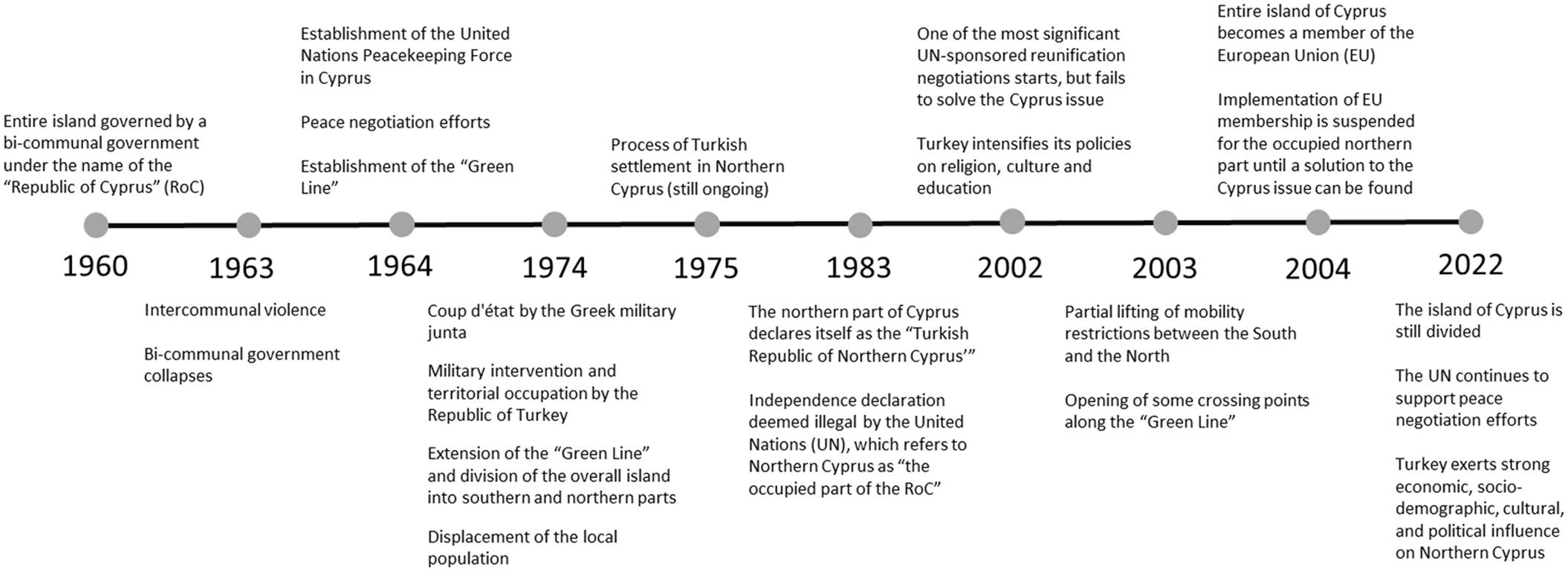
Timeline of key political events affecting Northern Cyprus.
As the timeline shows, the island of Cyprus, and particularly its northern part, is shaped by one of the longest and so far unresolved political conflicts in history (İlter, 2015). Historically, the island is home to two main communities: Greek Cypriots, who now live in the southern part of the island, and Turkish Cypriots in the north (Drevet and Theophanous, 2012). Cyprus, previously a British colony, gained its independence in 1960. A bi-communal state under the name of the Republic of Cyprus (RoC) was established based on power-sharing between the Greek Cypriot and Turkish Cypriot communities. In 1963, political disagreements between the two communities emerged. Tensions deepened over proposals to tie the island either to Turkey, which were largely supported by the Turkish Cypriot community, or to Greece, supported by the Greek Cypriot community. As a result, serious intercommunal violence arose between December 1963 and August 1964 (European Parliament, 2000), resulting in Turkish Cypriots withdrawing from the bi-communal agreement, which collapsed. After this, Greek Cypriots continued to govern the Republic of Cyprus. In 1964, to prevent a recurrence of fighting between the Turkish and Greek Cypriot communities, the United Nations Peacekeeping Force in Cyprus (UNFICYP) was established, as well as the so-called “Green Line” dividing the island’s capital Nicosia in two (Drevet and Theophanous, 2012).
In 1967, the civilian government in Greece was overthrown by a military junta, which reignited the intercommunal conflict in Cyprus (Security Council, 2021). In 1974, Turkey intervened with a military invasion of the northern part of Cyprus (European Parliament, 2000). This intervention and the subsequent occupation by Turkey triggered the displacement of the local population: Turkish Cypriots were moved from the southern part of the island to the north, and Greek Cypriots were moved from the north to the south. A ceasefire was declared later in 1974, and Turkey stationed its military forces on the northern part of the island (European Parliament, 2000). After the ceasefire in 1974, the Green Line, patrolled by the United Nations (UN), was extended to minimize the interaction between the two communities. It divided not only the capital Nicosia, but also the entire island into two parts (Drevet and Theophanous, 2012).
In 1983, the Turkish Cypriot authorities declared the northern part of Cyprus “the Turkish Republic of Northern Cyprus” (Drevet and Theophanous, 2012), attempting to create an independent state. However, the UN Security Council considered this independence declaration legally invalid and called for its withdrawal (Security Council, 1983). The Security Council confirmed that “the Republic of Cyprus is an independent sovereign republic” (European Parliament, 2000) and “calls upon all States not to recognize any Cypriot State other than the Republic of Cyprus” (Security Council, 1983). The northern part is officially declared “the occupied part of the Republic of Cyprus” (Security Council, 1984). Several attempts have been made to defuse the political tension. Since 1964, the UN has put forward various proposals and diplomatic initiatives to foster negotiation toward a peaceful resolution on the island (European Parliament, 2000). Also, the decision to admit the entire island of Cyprus as a full member of the European Union can be viewed as a step toward resolving the long-lasting conflict. As things stand, however, none of these efforts and reunification attempts have led to a political settlement (Security Council, 2021).
Today, Northern Cyprus is politically occupied by and economically highly dependent on Turkey (İlter, 2015). Thirty-five thousand heavily armed Turkish soldiers are stationed in Northern Cyprus (Drevet and Theophanous, 2012). There is no freedom of passage between the North and the South (European Parliament, 2000), except under certain conditions. Since 2003, the restrictions have been partially lifted, and some crossing points have been opened across the Green Line (Drevet and Theophanous, 2012). However, Northern Cyprus is still subject to international embargoes and sanctions, which are a powerful impediment to trade, tourism, and the inflow of international aid (European Parliament, 2000), leaving the Turkish Cypriot community living in Northern Cyprus economically isolated.
Another key concern for the local population of Turkish Cypriots has been the massive relocation of Turkish settlers into the Turkish Cypriot-administered areas (European Parliament, 2000). Following its invasion and occupation, in 1975, Turkey, in collaboration with the Turkish Cypriot political leadership, implemented a program supporting the arrival of migrant families from Turkey to the northern part by providing economic incentives (Talat Zrilli, 2019). This population transfer program was executed in three waves, with the most recent wave starting in the 2000s and lasting until the present day (Drevet and Theophanous, 2012). The massive transfer of civilian population has been condemned by the UN as illegal; it has drastically altered the demographic structure of the island, with impeding effects on the local population. Indeed, these socio-demographic changes have started to worry local Turkish Cypriots, who fear they will become a minority, since Turkish migrants have begun to outnumber the local population (Bryant and Yakinthou, 2012; İlter, 2015).
These and other issues have started to erode the alliance between Turkey and Northern Cyprus’ local population. There is a growing divide and a lack of mutual understanding between Turkey and Turkish Cypriots (Bryant and Yakinthou, 2012). Although Turkish Cypriots, by and large, previously identified themselves with Turkey and Turkish nationalism, these perceptions are shifting. In fact, many Turkish Cypriots have growing concerns about the dilution of their own values and identity (Drevet and Theophanous, 2012) given Turkey’s growing influence on the economic, demographic, cultural, and political life of Northern Cyprus. For instance, since 2002, Turkey has intensified its religious-oriented policies (e.g. increasing numbers of mosques, opening theological schools, promoting religious education), with many Turkish Cypriots perceiving these initiatives as a significant threat to their secular values (Bryant and Yakinthou, 2012). Furthermore, due to the population influx, many local Turkish Cypriots have started to feel that the socio-cultural landscape around them is changing, and fear that their indigenous local culture and social values are being undermined (Bryant and Yakinthou, 2012; İlter, 2015). As we will explain in more detail in the findings section, these socio-cultural concerns, strongly linked to the political occupation, are vital to the local Turkish Cypriot tourism entrepreneurs we study.
Methodology
Independent tourism entrepreneurship in Northern Cyprus
Given our research question, we chose to study the category of local, independent tourism entrepreneurs in Northern Cyprus as a group of actors who we assumed to be particularly place-bound. Previous research has suggested that tourism entrepreneurs are closely tied to their immediate location (Getz and Carlsen, 2000). We focused on tourism entrepreneurs who run small and independent (i.e. not part of a chain) accommodation sites with fewer than 20 beds. We consider these entrepreneurs to be a distinct category because local authorities classify businesses with fewer than 20 beds as such, and differentiate them from larger tourist establishments such as hotels. Based on interview and archival data collected from various sources (e.g. the North Cyprus Hoteliers Association, the Ministry of Tourism and Environment), we learned that facilities with more than 20 beds are categorized as “hotels” and must join the North Cyprus Hoteliers Association. Facilities outside of this category are considered “small businesses” and are subject to the supervision of the regional municipality. Furthermore, and importantly, the members of the independent tourism entrepreneurship category also recognize themselves as a distinct collective, defining themselves in stark opposition to generalist tourism establishments such as hotel chains and casinos, which are generally owned by foreign investors, whereas most small tourism establishments are run by local Turkish Cypriots.
While independent tourism entrepreneurship is an established category, it is also characterized by a constant in- and outflow of category members. As the population of small businesses fluctuates, we focused on entrepreneurs who had managed to survive for more than 3 years, because we wanted to be sure that they had been assimilated into the collective and had a chance to connect with like-minded peers. We based this sampling decision on the assumption that entrepreneurs whose firms fail shortly after startup do not truly have a chance to become part of the collective. Currently, in the overall territory of Northern Cyprus, there are 37 businesses providing accommodation with fewer than 20 beds that have been established for more than 3 years. Their average age is 8 years. Their owners typically run smaller hotels, boutique hotels, guesthouses, or apartments for rent and employ between one and six people.
Since the division of Cyprus in 1974, the tourism sector has been rapidly developing in the Republic of Cyprus, with the northern part lagging behind. The difficult political situation in Northern Cyprus is a drag on the tourism sector, and tourism establishments in the north have significantly lower occupancy rates than those in the south. Since the partial opening of the border gates in 2003, there has been a rise in occupancy rates of tourism establishments in the North (Kanol, 2007). Most visitors to the North are leisure travelers, sex tourists, gamblers, and higher education students from Germany, Britain, and Turkey (Ekiz et al., 2010).
Data collection
We gathered three types of qualitative data, interview data, field visits and observations, and archival data involving two phases of data collection (see Table 1 for an overview of the data collected). While the interview and field data constitute our main data source, covering around 70% of the overall category population, our archival data cover the entire population. The first phase of data collection was used to understand the category, get to know the challenging context, and to gain insights into various coping strategies. Being intrigued by the many conversations on culture, concerns related to the loss of local culture, and the deep place attachment that the entrepreneurs frequently expressed, we engaged in a second phase of data collection explicitly targeted at understanding aspects of this place-based identity, including the entrepreneurs’ cultural concerns and associated coping strategies.
Overview of data collection.
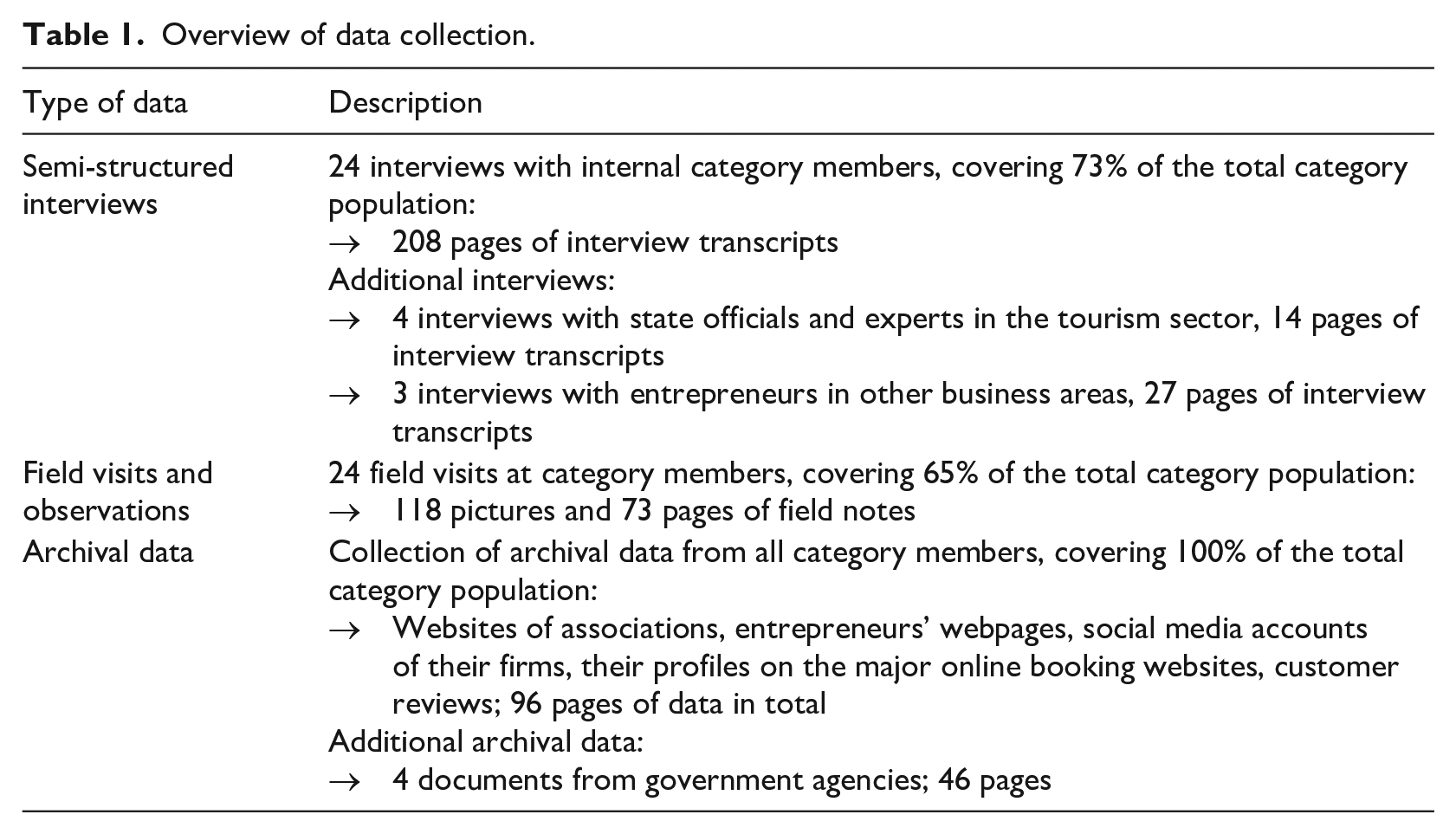
In total, we conducted 24 face-to-face semi-structured interviews with the owners of our sampled category throughout Northern Cyprus. The interviews lasted between 20 and 80 minutes. All interviews were audio-recorded and transcribed verbatim. The interview guideline was jointly developed by both authors and targeted at understanding the main challenges faced by the entrepreneurs, their perception of these challenges, how they try to cope with them, and how their identity influences these coping strategies. During the first data-collection stage, 15 interviews were conducted by the first author between July and October 2020, resulting in 152 pages of interview transcripts. In addition, four interviews with state officials and experts in the tourism sector were conducted to gain an overview of the tourism sector in general, to better understand how local authorities categorize tourism establishments in Northern Cyprus, and the difficulties the sector generally faces. Furthermore, three interviews were conducted with entrepreneurs in other business areas (i.e. manufacturing) to gain additional insights into the challenges that owners of small businesses face in Northern Cyprus. For the second stage of data collection, a more specific interview guideline was prepared including questions focusing on place, culture, custodial activities, identity, and collective action. During this second stage, nine in-depth interviews were conducted between July and August 2021, and 56 pages of interview transcripts generated.
During both data-collection phases, the first author engaged in site visits and observations, and crafted rich field notes to support and triangulate the insights with non-interview-based data. During the field visits, we took pictures, collected firms’ brochures (if available), and took field notes on the organizational context and activities, the owner(s) and their background, and the immediate local environment. In the first data collection phase, 15 field visits were completed, leading to 43 pages of field notes. In the second phase, 9 field visits were arranged, 112 pictures taken, and 30 pages of field notes produced.
A wide range of archival data were also collected. In the first phase, we collected mostly governmental data, such as official business registries, laws, and regulations related to the tourism sector. These data helped us to identify and contact our interview partners, and to understand how the tourism sector is categorized (i.e. small, independent businesses with fewer than 20 beds vs hotels). In total, we collected 46 pages of data from four different governmental sources. In the second stage, we collected documentary data on the entire category of independent tourism entrepreneurs. Specifically, we collected data from various online resources such as websites and social media accounts of small tourism associations, firm webpages, profiles on online booking websites, and social media accounts of tourism establishments (if existing). These data were used for triangulation. We also aimed to collect external audience data, such as tourists’ perceptions of Northern Cyprus and the tourism establishments they visited. We did so by collecting reviews on Google Maps and online booking sites. Our archival data cover all 37 firms in the category and their six associations, making 96 pages of data in total.
Data analysis
Our data analysis proceeded via an iterative process by actively and continually moving between the empirical puzzle, data, additionally collected data, and theory (Grodal et al., 2021). The goal was to build theory from our qualitative study. We analyzed the data throughout the two phases of data collection; hence, we went through two main phases of data analysis until theoretical saturation was reached (Glaser and Strauss, 2017). This analysis was supported by open coding using the software MAXQDA. During coding, we related, split, merged, and dropped codes along the way. We then started to group common codes into tentative categories and theoretically driven themes and formulated working propositions on the nature and role of place-based identity in coping with extreme contexts. Our coding process, which iterated through several steps, was heavily influenced by the initially unexpected turn toward, and focus on, culture and culture-related coping activities. As such, it can best be described as a process of abductive reasoning (Behfar and Okhuysen, 2018). Eventually, this analytical process acted as a foundation of theory-building and helped us to develop our final theoretical model by closely moving between the empirical puzzle, data, and theory. Important steps in our data analysis were the following:
Step 1: Detecting initial insights. We engaged in our first coding and reasoning process to better understand the empirical puzzle at hand, which derived from the general assumption that our category of entrepreneurs is place-bound and constrained by significant contextual challenges, yet still highly motivated to engage as entrepreneurs. We worked through the interview and archival data collected from different government organizations and realized how the small tourism establishments form a specific and distinct market category and how they lay claim to differences from other categories (i.e. generalist hotel establishments). We were particularly intrigued by the many difficulties that our informants encountered in the setting they operate in, their collective and place-oriented spirit, and their wide range of coping strategies, which particularly related to raising awareness of and maintaining local cultural heritage. We decided to focus on this empirical puzzle; it formed the main motivation for our subsequent round of data collection and coding aimed at providing possible explanations for the entrepreneurs’ cultural concerns and culturally oriented coping activities (Behfar and Okhuysen, 2018).
Step 2: Open coding. To address and theorize on this empirical puzzle, we engaged in open, in-vivo coding of the tourism entrepreneurs’ perception of the contextual challenges and their own coping strategies. In this first coding process, we obtained 1061 coded segments, which we grouped into 26 sub-categories (i.e. first-order codes) and six higher-level themes (i.e. second-order themes). In a next step, we analyzed the field notes by utilizing the same coding scheme and further refined and narrowed down our sub-categories and main themes based on our research question. Through this iterative coding process, we continuously refined our analysis, focused on relevant theoretical concepts that would help us answer our research question, and also added nuance to our understanding of those concepts. This round of analysis particularly supported the entrepreneurs’ strong place attachment and their deep concern for preserving local culture and traditions.
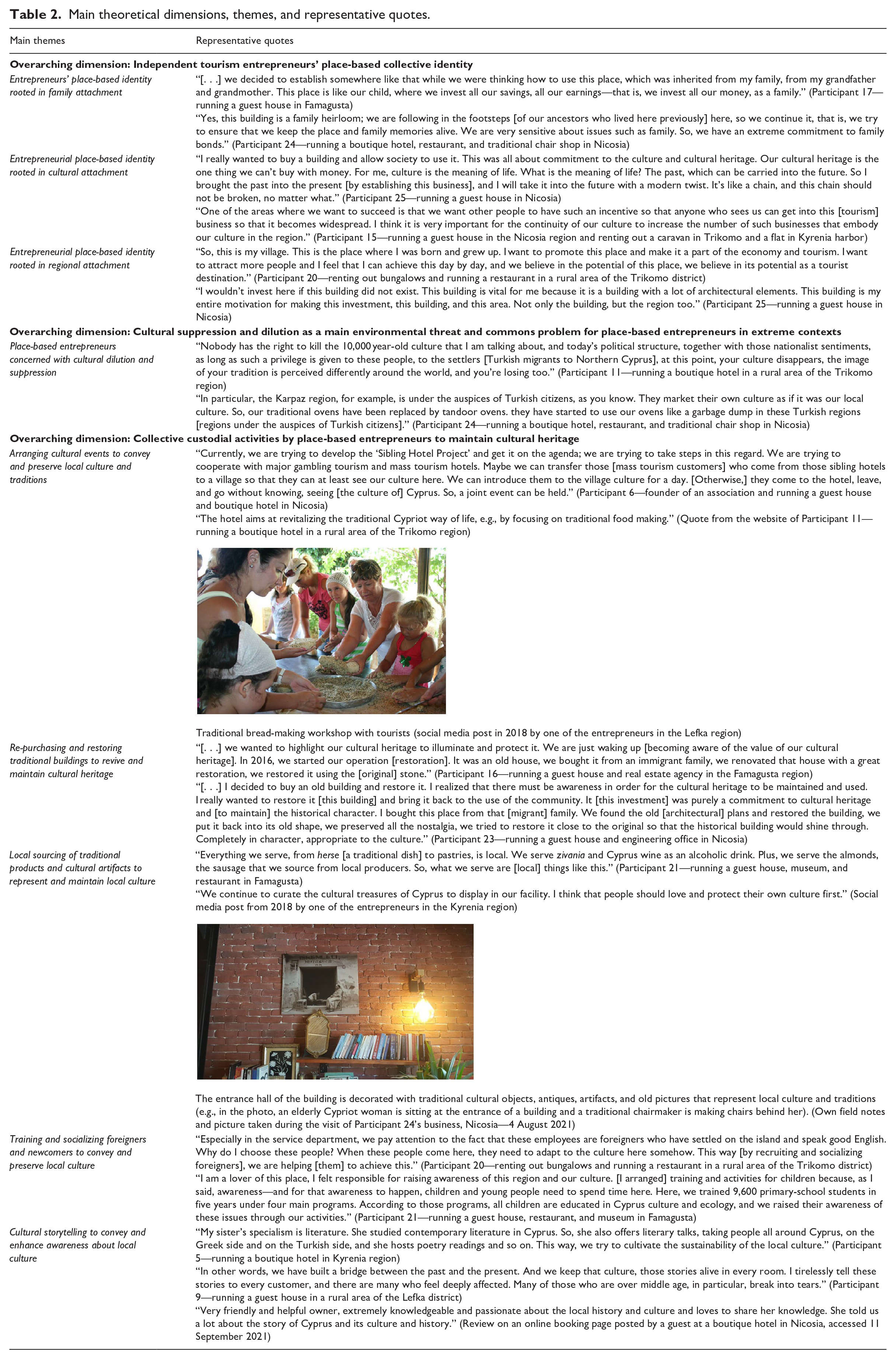
Step 3: Theory-building. Having arrived at these insights, we engaged in at least two more rounds of coding that were more theoretically informed, focusing on specific forms of place attachment as a basis for identity, culture-related challenges, and custodial activities to cope with cultural challenges. At this stage, we continuously refined our existing coding scheme and emerging themes. As we iterated between the literature, emerging themes, and data, we also discussed our research findings with other scholars. A last step in our coding was our fine-grained coding of the many custodial activities we observed. To better theorize these activities given the collective we studied, we decided to focus specifically on collective and collaborative activities. In doing so, we went back to field notes and pictures to lend empirical substance to the collective activities in support of culture. At this stage, we also finalized our overarching theoretical dimensions by clustering all second-order themes. We then developed a final coding table with representative quotes for our own overview, and to be presented when reporting on our work (Table 2). This table acted as an anchor for our analysis and theory development, and we referred to it throughout.
Main theoretical dimensions, themes, and representative quotes.
Findings
Based on our analysis, we find that the Turkish Cypriot independent tourism entrepreneurs form a category that is driven by a strong attachment to place. This place attachment serves as a defining element of the category’s collective identity, connects a venture to its peers, and fosters differentiation from the mainstream tourism category such as major hotel chains and casinos. Furthermore, we find that it is the shared place-based identity that drives the entrepreneurs’ explicit concern for cultural suppression and dilution as a core environmental threat and commons problem that affects all category members within the extreme context of Northern Cyprus—a problem that is better tackled through collective action than through individual, distributed efforts. One of our place-based entrepreneurs, located in Nicosia, the divided capital, explains how she considers independent tourism entrepreneurship as a collective that differs from mainstream tourism establishments, and how important it is to form and act as a collective, given the commons problem that this collective faces in Northern Cyprus: Now look, when you have [around] six rooms or so, we [independent tourism entrepreneurs] do not even make one branch of a big hotel when you gather us all together, but if we all get together, we can have a voice, I mean, that common voice. So, everyone here knows us [the territory] for casino tourism, knows us for our beaches, but they do not know us for our cultural heritage. Hence, when there is only one voice, you have the opportunity to open up a little more both to the authorities in the country and abroad, have a chance to introduce yourself [and our cultural heritage]. When you look at everyone’s problems, you can already see that we [small independent tourism establishments] all have common problems. Our troubles are common, our gains are also common. (Participant 25)
However, before we dive deeper into elaborating on those problems, we first reveal how Turkish Cypriot tourism entrepreneurs are characterized by a strong place-based identity as rooted in their attachment to family, culture, and the local region.
The place-based collective identity of Turkish Cypriot independent tourism entrepreneurs
Our interview partners shared various reasons for their strong place-based identity. Most referred to family sentiments and past stories, and how they are tied to specific places and properties that belong to the family and are now at the heart of their entrepreneurial engagement. Since our informants grew up in these places, these family properties acquired deep meaning for them. This deep-seated family attachment drives their entrepreneurial motivation and identification with the place. For instance, one of the entrepreneurs, who runs a guest house in a rural area of the Lefka region, in the western part of the island, emphasized the significance and specific meaning of family and family heritage for her, and her great effort to keep her family heritage alive through her entrepreneurial engagement: Every room here has a story, a life in it. While decorating this place, we tried to reflect those experiences and stories [of my family] to the guests. We named the different rooms after the people who had lived in the house, and we decorated each room using their belongings. And we kept that culture and our stories alive in every room. I never get tired of telling these stories to every customer, and many of them get emotional. (Participant 9)
Our participants also mentioned that their strong attachment to local culture and traditions and their willingness to sustain the cultural heritage have a strong influence on their entrepreneurial motivation and represent a critical part of their place-based identity. It seems that local culture, traditions, and cultural heritage have a special meaning and value for them and form a central attribute of their place-based identity. One of our informants, an engineer who runs a guest house in the Nicosia region, explained the significance of local culture for herself and the objective of her business in this way: Cyprus culture is already in the foreground [in my business]. My only goal is to keep the identity and culture of the country alive; I have no other purpose, I do not do it [run this business] to earn money. We already have a very rich culture, we have very rich traditions, customs, but we failed to protect them. Our region should not be in this situation, and I wanted to take some actions [to protect the local culture]. We should strive to keep this culture alive. To achieve this, we are trying to give [convey] this culture to these people [visitors], introduce and reflect this culture to our guests here. (Participant 23)
This deeply felt attachment to local culture became even more evident during the site visits, for instance, during a visit to one of the entrepreneurs, an architect and owner of a guest house, museum, and restaurant in a rural area of the Famagusta district in the east of the island. As Figure 2 shows, the site features two columns either side of the entrance; one is shaped like a mosque, representing Turkish Cypriots, and the other one resembles a church, representing Greek Cypriots. A sign attached to one of the columns provides information about the building, in three different languages: “This building has been built in memory of all Cypriot refugees with the aim of commemorating the common Cypriot culture, which has been forgotten” (Participant 21).
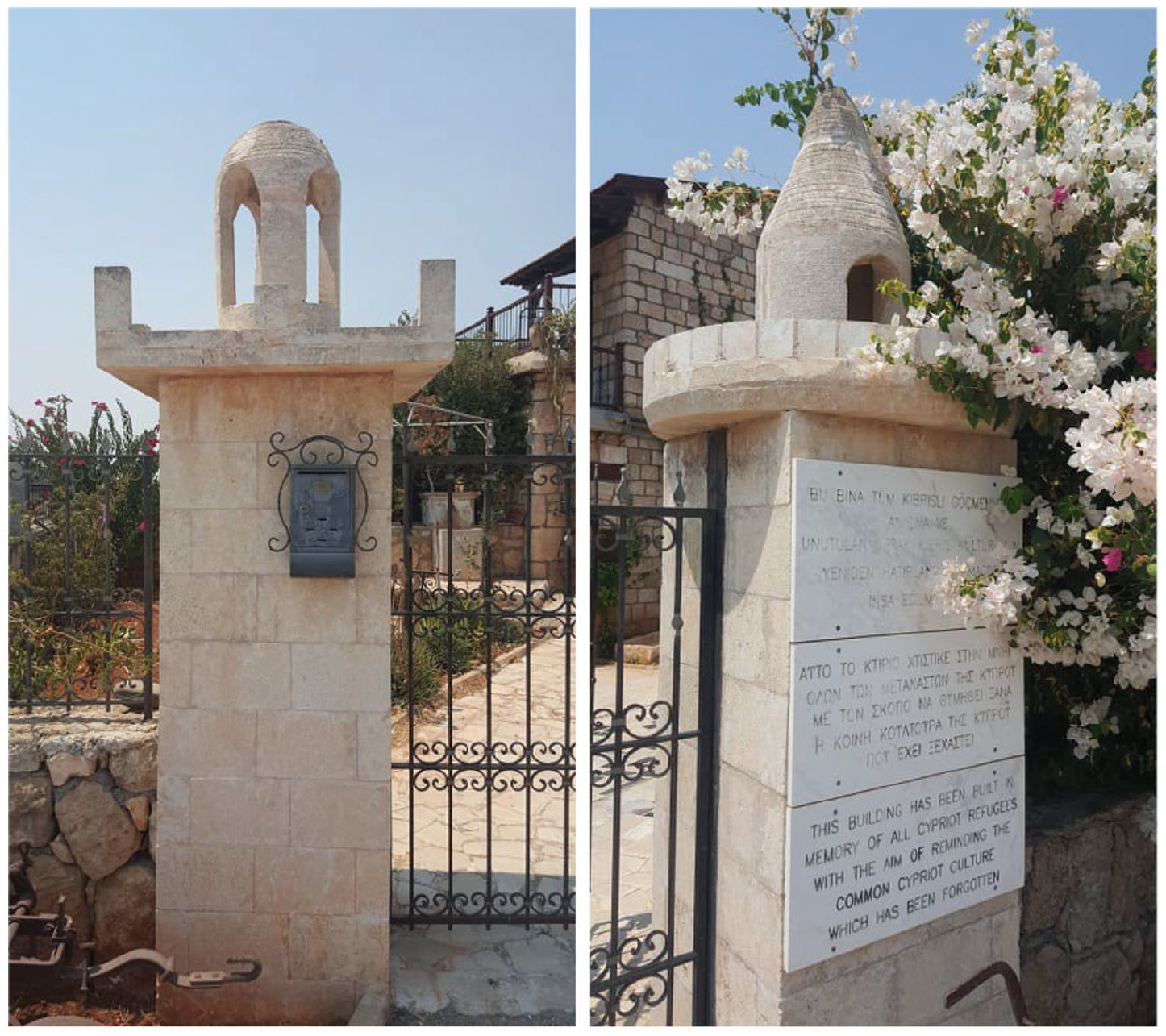
An independent tourism entrepreneur’s building.
Our interview partners were also outspoken about their deep-seated attachment to the local region and their desire to develop it. This strong regional attachment is an important source of their entrepreneurial motivation and dedication, and one that fuels their place-based identity. For instance, an entrepreneur who rents out bungalows and runs a restaurant in a rural area of the Trikomo district, a region in the north-eastern part of the island, emphasized his strong attachment to the local region and how it is a central attribute of his identity: [. . .] this place is important for me. Küçük Erenköy [region in Northern Cyprus] is not a well-known place, but with this business, we are trying to promote Küçük Erenköy even more; we are trying to develop the region, we want our work to benefit the people of the region, and we have actually come a long way in the last few years. One of the things that drives me to be an entrepreneur is to provide benefit to my region. (Participant 20)
Next to these identity attributes, our research findings also provided insights into the entrepreneurs’ perception of core challenges as being situated in the extreme context of Northern Cyprus. Our entrepreneurs encounter numerous categorical challenges that render Northern Cyprus a challenging place for them, such as the lack of socio-political support for their category, Northern Cyprus’ questionable image as a proper tourism destination, and operational issues such as the inability to register their businesses at online tourism platforms. However, what stood out in our data was the entrepreneurs’ explicit concern for cultural suppression and dilution. The perceived loss of culture and local cultural heritage is understood as a specifically important and mutual threat given their collective identity, and one that activates a collective coping response.
Cultural suppression and dilution as a main environmental threat and commons problem for place-based entrepreneurs in extreme contexts
One element that struck us was the intensity with which our informants lamented cultural dilution and the perceived loss of local culture as a primary environmental threat arising from the politically challenging situation in the territory of Northern Cyprus. They feel that “original” Cypriot culture and traditions—culture and traditions developed before the island was divided in 1974 and before the Turkish settlement beginning in 1975—have started to be suppressed, misrepresented, or diluted since the invasion and continued domination by Turkey. In particular, the entrepreneurs perceive the immense population influx from Turkey as a significant issue, as they feel that it leads to cultural misrepresentation and dilution.
One of our interviewees, a tourism lecturer and the owner of a boutique hotel in the urban Kyrenia region in the north of the territory, shares her thoughts about the influence of Turkey’s population settlement on the local culture: We are having a huge population influx coming in from Turkey, particularly working class. So, our own community cannot withstand these conditions. When you go to a restaurant, the people running it are mainly Turkish. When you look at how the culture is changing, you don’t find Cyprus cuisine in the restaurants. But actually, it is not good in the long run, and our grandchildren will not have a future. We are even going to become “little Turkey” and we are not going to be Cypriot anymore. (Participant 5)
Another participant, who runs a guest house and restaurant in a rural area of the Famagusta district, explains how concerned he is about cultural misrepresentation and dilution, and how this is linked to the problematic dominance of Turkey, which is also influencing his own business: The Turkish government [of the Republic of Turkey] did not want foreign tourists to visit my place because I am saying negative things about the government. And the organization in Northern Cyprus—I do not call it a government, because to call it a government, you have to be independent—has started to cancel, prevent, ban all visits of foreign tourists to my place. We cannot show our real culture to foreign tourists. This place is very different. There is an authoritarian [Turkey] here, it is an invisible authoritarian, and everything goes through there. Our fight is big, but it is not visible yet. We do not want our threads tied to Turkey to rule and assimilate us. (Participant 13)
These quotes provide insights into the entrepreneurs’ strong concern about cultural misrepresentation and dilution as a core environmental threat in the extreme context where they operate. All of our informants were very outspoken about their perceptions of their local culture and cultural heritage as threatened and in risk of dilution, assimilation, and misrepresentation. Based on our analysis, we suggest that it is the entrepreneurs’ place-based collective identity that makes them particularly vulnerable and sensitive to the loss of culture and cultural dilution as a critical environmental threat. Furthermore, given their common identity, they perceive this threat as a commons problem: a common fate that affects all firms in a category (King et al., 2002). In other words, because the entrepreneurs’ collective identity is closely connected to place and culture, they perceive this environmental threat as a threat to their identity. The following quote from one of our interview partners, a lecturer running a boutique hotel in Trikomo, illustrates how the cultural environmental threat is perceived as a threat to the tourism entrepreneurs’ identity. Also note how our informant uses the personal pronoun “we” when talking about the entrepreneurial collective, implying that the threat is a commons problem that needs to be acted upon: The dominant [Turkish] population that comes here, the settled population, that is, the population that is many times larger than my population here. You can’t compete with the Turkish population, never. Because the goal is to destroy you as an identity, as a culture. Since these models [tourism ventures] also carry culture, these also naturally disappear. This, apart from home life, is a factor that causes misrepresentation of the local culture internationally. This is a problem. We [local tourism entrepreneurs] do our duty here. Our aim is to sustain the ecology and culture here. With all our strength, until the last breath. Because this is a sensitive issue, it is not a joke; we are talking about the destruction of a 10,000-year-old culture. (Participant 11)
This quote already foreshadows our next set of findings, namely, how and why the entrepreneurs engage in collective action to cope with the perceived identity threat of cultural misrepresentation and dilution.
How place-based entrepreneurs become custodians: collective custodial activities to maintain cultural heritage
Being highly concerned about the loss and dilution of local culture and cultural heritage, we find that place-based entrepreneurs turn into custodians as they engage in custodial activities targeted at protecting and preserving the local cultural heritage. Custodians are vested individual or collective actors who “have a sense of community” (Scares, 1997: 14) and seek to actively maintain central institutions and institutional arrangements (Dacin and Dacin, 2008; Montgomery and Dacin, 2020). We refer to the entrepreneurs as custodians because they purposefully engage with their environment in an effort to maintain and protect challenged institutions endowed by a society or community—in our case, a community’s cultural heritage and local culture and traditions (Dacin and Dacin, 2008). Custodians typically engage in custodial (Dacin et al., 2019) or institutional work (Lawrence and Suddaby, 2006) to maintain, protect, defend, repair, or renew the institution they care deeply about and whose survival is at risk (Lok and De Rond, 2013; Montgomery and Dacin, 2020; Wright et al., 2021).
We find that the local tourism entrepreneurs collectively engage in five custodial activities, namely organizing cultural events, re-purchasing and restoring traditional buildings, training and socializing newcomers, local sourcing of traditional products and cultural artifacts, and cultural storytelling. As we will explain, these activities are linked to the everyday operations of their business, yet specifically targeted at conveying and preserving local culture and traditions. Furthermore, although there are slight differences in terms of how individual entrepreneurs implement these activities (e.g. some may prefer specific cultural events over others), we found strong evidence in our data that the category members engage in these custodial activities in a collaborative and coordinated manner. That is, there is a strong collective mindset behind these activities. Many are organized and coordinated through the six category associations, which include independent tourism entrepreneurs in the various regions of Northern Cyprus. Each association promotes and directly organizes joint culturally oriented activities in its respective region. Some have also started to invite entrepreneurs from other regions to incorporate them into their associations and joint activities.
The associations have been founded with the aim of helping their members develop coping strategies given the severe environmental constraints that they face, yet, a main focus is specifically on developing and initiating strategies for dealing with the commonly perceived core threat of cultural dilution and loss of culture. In that sense, the associations are “organizations created to represent business interests within specific domains, mobilizing firms within their domain so that collective action can be taken on common problems” (Aldrich and Staber, 1988: 111). In our case, the associations frequently invite the entrepreneurs to formal and informal meetings to discuss cultural challenges and associated coping strategies. The entrepreneurs and association representatives we talked to emphasized that these meetings helped the entrepreneurs to work together and jointly develop ideas and projects they could engage in. Other activities are implemented individually by the entrepreneurs at their business sites, however, this is done in the knowledge that others in the collective are doing similar activities. This mutual awareness and coordination has mostly been facilitated by the associations (i.e. activities they promote in their membership meetings and information brochures), yet also through communication and direct exchange among the entrepreneurs themselves. Many of the entrepreneurs have formed informal coalitions and meet regularly to exchange ideas and share their experiences about the various activities.
Through their collective engagement as custodians, the category members hope to reach a wider audience and find a unified voice that will be more effective in cultural maintenance than distributed attempts. To revisit a quote from the opening of our findings, “If we all get together, we can have a voice, I mean, that common voice” (Participant 25), meaning that the collective’s voice is more convincing than the individual’s. The various custodial activities target different external audiences that are key to the category, such as migrants, foreigners (i.e. tourists), and the local community. Importantly, our data suggest that the activities are strongly identity-related; they align with the entrepreneurs’ close attachment to place and concern for local culture.
First, the sampled entrepreneurs frequently organize cultural events and workshops to convey original culture and traditions to their guests, seeking to revive and sustain them. For example, one of our interview partners, an architect and owner of a guest house, museum, and restaurant in a rural area of the Famagusta district, talked about the events his business held for tourists and highlighted the significance of maintaining local culture when asked about the main purpose behind these activities in relation to his business and identity: My aim is to keep this culture alive here; that’s why we built this place from scratch. We do activities specific to Cyprus here, such as henna nights, small weddings, and similar events. We offer our culture to people who come here. We show the truth, the real culture. We organize different workshops and events that are unique to the Cypriot culture, belonging to our real culture. When our guests come here, they see, learn how our ancestors made flour, extracted oil, what they ate and how, what they did, what they used in the past. They learn about the cuisine, tradition, and history. (Participant 21)
Other cultural festivals and events are directly organized through the associations to increase awareness of the indigenous local culture and traditions. These events are mainly aimed at foreign visitors (i.e. tourists from Europe) who are a key target audience of the category of independent tourism entrepreneurs. Many entrepreneurs expressed a concern and wish to educate their guests about local culture so they would be able to distinguish it from foreign cultural influences to prevent further cultural dilution and deterioration. One of our informants, the head of a regional association in a rural area of the Trikomo region, highlights the importance of arranging such activities conjointly via the association, arguing that collective action is important because a unified voice may be more effective in reaching a wider audience and raising awareness of the common problem: [. . .] some hostels were built in the villages in the Karpaz region, family businesses; we have [established] a union, [name of the association] and so we have joint cultural projects and activities together, we are arranging [culture and art] festivals and [cultural] events and try to present our culture and traditions to all visitors. Thus, we, as an association, can convey our common values, true culture, and identity to our visitors more easily and effectively. When we conduct such activities together, we believe that our efforts become more visible, and we can reach more people. (Participant 19)
Like many other statements from our informants, this quote illustrates the close connection between the activity of collectively organizing cultural events and the shared identity and values that characterize the collective of independent tourism entrepreneurs.
Next, many local tourism entrepreneurs have started to re-purchase and restore traditional buildings with the explicit purpose of reviving and maintaining local cultural heritage. These old stone-built buildings have been homes for local people for many years. After the Turkish invasion and the inception of the population transfer program, some were abandoned and Turkish settlers moved in. The entrepreneurs explained to us that they have started to buy and renovate these old traditional buildings not only as business venues, but primarily because they embody and reflect important elements of the local community’s original cultural heritage. That heritage had become forgotten, obscured, or destroyed because the buildings were not properly maintained, either due to financial constraints, or because the Turkish settlers who moved in had little motivation to do so. By buying and restoring these buildings, the entrepreneurs seek to make the original cultural heritage visible to external audiences and restore and maintain the existing cultural heritage in service of the local community. They have started to use these renovated buildings for a variety of purposes, turning them into restaurants, coffee shops, bars, and accommodation. As many of our interviewees pointed out, these buildings are also important as they make up and reflect the cultural heritage of the entire local community, just like a city or a region, shaping its visual and cultural appearance. This purpose is illustrated by an entrepreneur who runs a guest house and engineering office in Nicosia: “I really wanted to restore it [this building] and bring it back to the use of the community. It [this investment] was purely a commitment to cultural heritage and [to maintain] the historical character” (Participant 23).
This custodial activity is either orchestrated through the industry associations or implemented individually by some of the entrepreneurs, driven by their place-based identity and with an awareness of the collective’s shared concern for protecting and maintaining local culture and cultural heritage. For instance, the leaders of the industry associations emphasized that they consciously raise awareness among the entrepreneurs of the cultural value of these buildings and encourage them to make community investments by buying and restoring them. One of the informants, the leader of the regional association in Famagusta, explains how the association encourages local entrepreneurs to buy and restore traditional buildings, and how such an investment is a cultural and community-oriented one as it helps to maintain the cultural heritage of a city or region: [. . .] stone houses, old houses in Famagusta were deemed worthless and abandoned. Workers from abroad started to settle in these abandoned houses. Now, we have re-entered a period of recovery. With the work [awareness-raising work by the association] we have done, people [independent tourism entrepreneurs] have started to realize the importance of these places that reflect our history and culture and started to look for stone houses, they have started to buy and restore these houses. In the last three or four years, we have done a lot of work as an association in terms of reviving the Walled City of Famagusta in order to raise awareness of this issue. (Participant 3)
Another custodial activity we encountered is the local sourcing of traditional products such as food and cultural artifacts such as furniture. Many category members do a great deal of local sourcing, and our interview partners stated that they do it to increase awareness of Cyprus’ local culture, and to represent and maintain it. For instance, many of the entrepreneurs serve locally sourced traditional foods for breakfast, even though similar products imported from Turkey are available more cheaply. They also source cultural artifacts such as furniture, paintings, and other accessories locally and use them extensively in the decoration of their establishments to present and reflect aspects of Cypriot culture to their guests. The entrepreneurs regard these locally sourced items as cultural artifacts since they carry and express traditions and cultural values. Certainly, another factor driving this activity may be a firm’s wish to present itself as an authentic local destination, and as such, different from and in competition to mainstream hotels (for a recent study on authenticity as a competitive value, see Voronov et al., 2022). However, similar to the other activities that we identified, our data vividly reveal cultural concerns as the predominant motivation behind this activity. The local entrepreneurs make an effort to source locally and display local items because they are driven by the wish to maintain and convey localism and original culture and traditions to external audiences. Moreover, they also buy local to offer economic support to the local community and region that they feel attached to, highlighting how this activity is also connected to the entrepreneurs’ place-based identity. As one of our informants, the owner of a boutique hotel in the Kyrenia region, explains, [. . .] for us, [community] sustainability is very important. What do we do here? Well, when we were building, the majority of the fixtures and fittings were bought locally. So, the carpenter that we used was a local Cypriot carpenter. Although it is a little bit more expensive [than importing from Turkey or engaging migrant carpenters from Tukey], we still wanted to buy it. We try to convey our culture to our guests by using various artifacts unique to Cyprus, completely local, belonging to our own culture and traditions, both inside and outside the facility. And we pay great attention to the fact that it [our menu] is based on our own culture and local products. So, we do, we try to support the maintenance of local culinary and local culture by working with local suppliers. (Participant 5)
The audience, such as tourists, appreciate the great efforts made by entrepreneurs to source and display local culture. For instance, one guest at a guest house in Nicosia, shared their observation related to the cultural efforts of the local entrepreneur on a travel booking website, explicitly noting the entrepreneur’s efforts to preserve local culture: [. . .] if you want to get to know the culture of Cyprus, this place would be a good choice because everything was arranged to present this environment [Cyprus culture] to you, it was not designed in a haphazard way, it is obvious that there is a great effort. Every detail you can think of is specific to Cyprus. [Name of owner] is very caring and friendly. Her efforts to preserve the culture of the people of Cyprus impressed me a lot. (Review on a travel booking website made by a guest at a guest house in Nicosia, accessed 13 September 2021)
Another custodial activity that is widely used among the category members is training and socializing foreigners and newcomers to raise awareness of and maintain local culture. Our data show that local tourism entrepreneurs explicitly adopt this activity to cope with the shared grievance of cultural dilution and loss of culture. Many of the entrepreneurs hire foreigners, often Turkish settlers, and give them “on the job” cultural training. By doing so, they hope that they can raise awareness among settlers and foreigners of Cyprus’ own indigenous culture and socialize them into it. Hence, this activity has a clear component of education and awareness-raising. The entrepreneurs emphasize that with this activity, they hope to inculcate foreigners with a respect for the local culture, with some expressing the wish that they would adapt to and start living this culture once they had been socialized into it. One of our participants, an architect and runs a guest house and a boutique hotel in Nicosia, put it this way: They [Turkish immigrants] came, brought their own culture. They do not make any changes to adapt [to the local culture]. You can solve this [increase their awareness] by showing, by providing them a chance to interact with us, learn from us. How do we achieve this? By allowing them to work and practice. Thus, we do not only show them our culture, but we also teach them and increase their awareness. While working with us, we try to show and teach our culture [to employees] through one-to-one interaction. Actually, this is the best education in life, practice is the best education. (Participant 6)
Besides adult settlers and foreigners, other entrepreneurs target newcomers, primarily local and migrant children, with this activity. Many of the local tourism entrepreneurs organize training and educational activities for children to teach them about different aspects of local culture. By doing so, they hope to deepen the children’s cultural awareness, as well as socializing migrant children, in particular, into the local culture and help them adapt to it. Figure 3 depicts a screenshot of a participant’s social media post, taken when the entrepreneur was teaching primary school students how to make traditional coffee. The fact that he posted this picture on his business’s social media account also demonstrates the importance of this activity for his tourism business and its identity. Reading the caption, it is clear how closely this activity is linked to the cultural concerns shared by independent tourism entrepreneurs: “A photo while [name of the school] primary school students learn about CYPRUS Culture. They watch and practice the making of Dibek Coffee with curiosity and interest. The perfect way to remember the culture and lifestyle of Cyprus” (Participant 11).
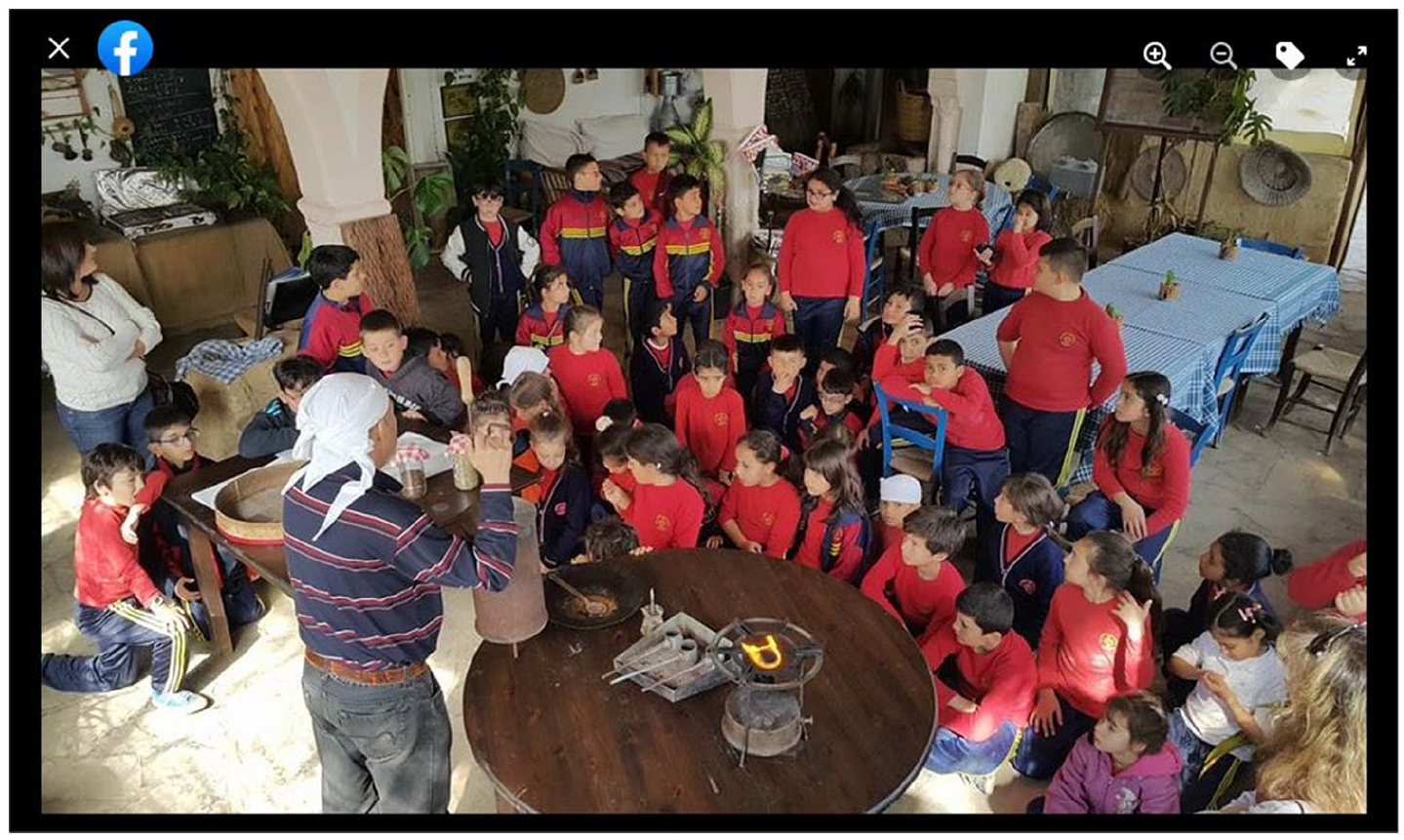
An entrepreneur teaching children about local culture.
The final activity that is widely and collectively used by the independent tourism entrepreneurs is cultural storytelling to convey local culture and enhance awareness of it among foreigners and tourists. Like the others, this activity is also directly aligned with the entrepreneurs’ place-based identity and wish to protect and maintain the culture that they feel is at risk. By telling stories about Cyprus’ political past and present and its historically significant locations and histories, the entrepreneurs want to inform and increase awareness of local cultural and political issues—which they see as closely intertwined—and seek to preempt potential concerns among foreigners about those issues. Hence, for the entrepreneurs, telling stories is a cultural activity, as they regard stories as a medium to transmit cultural and historical insights to the audience. For instance, one entrepreneur who is an accountant and runs a guest house in the Nicosia region, as well as renting out a caravan in Trikomo and a flat in Kyrenia, explains how cultural storytelling helps her to promote and sustain local culture: Well, we also have a language, we like communicating with people. We will tell people the stories we learned from our grandmothers and grandfathers; here, we will convey everything [stories, culture, traditions] to people. The more of the culture we can convey to these people, the better we can introduce people to it. I mean, we tell [explain] them the cuisine, the historical places, and also the stories—that’s the most important thing, the stories. (Participant 15)
Discussion
This study was motivated by the aim of better understanding how a collective of entrepreneurs whose categorical identity is rooted in place is affected by, and copes with, its extreme environment. Studying the category of local, independent tourism entrepreneurs in Northern Cyprus, an extreme context characterized by enduring political and socio-cultural challenges, our findings reveal that the collective identity of the independent tourism entrepreneurs is rooted in a deep-seated attachment to family, local culture, and their own local region. These forms of place attachment drive the entrepreneurs’ explicit motivation to join the category of independent tourism entrepreneurship. Our findings further suggest that it is this shared place-based identity that influences how the entrepreneurs interpret and cope with their extreme context. The entrepreneurs’ collective place-based identity drives their explicit concern for loss of culture and cultural dilution as a salient environmental threat. This threat is perceived as a commons problem that affects all firms in the category as it challenges their shared identity—a situation that triggers a collective coping response. We find that in coping with this identity threat, the place-based entrepreneurs engage in efforts that surpass safeguarding their own businesses; they become custodians of local culture and traditions as they collectively mobilize a set of custodial activities aimed at conveying and maintaining the local cultural heritage. The custodial activities we identified comprise the organizing of cultural events, re-purchasing and restoring traditional buildings, training and socializing newcomers, local sourcing of traditional products and cultural artifacts, and cultural storytelling. Importantly, these custodial activities are strongly identity-driven; they are actions that align with the entrepreneurs’ close attachment to place and shared concern for local culture. These insights, including the identified mechanisms, are summarized in Figure 4, which presents our theoretical model of how categories characterized by place-based identities cope with extreme contexts.
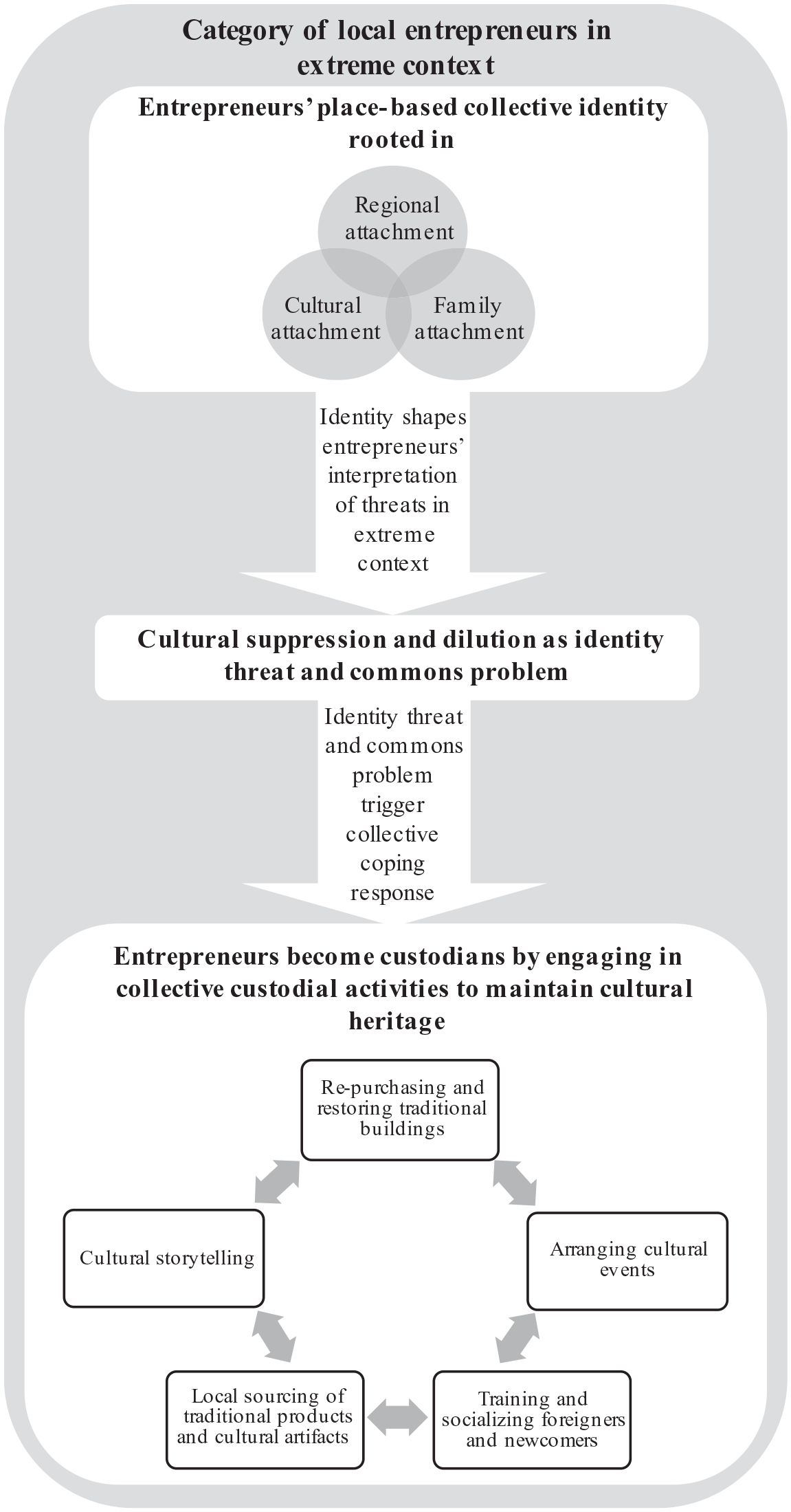
Theoretical model of how place-based categories cope with extreme contexts.
Our theoretical insights hold important contributions for research at the nexus of categories and place. First, we respond to recent research calls to turn “attention to place as a basis for collective identity” (David et al., 2017: 682). Similarly, Relph (1976), albeit in relation to individual rather than collective identity, argued for a better understanding of identity in relation to place. Our findings point out various types of place attachment that form the basis for a category’s identity: in the personal dimension, a deep-seated emotional attachment to family and family heritage; in the cultural dimension, a deeply felt attachment to local culture and the wish to sustain cultural heritage; and in the geographic dimension, a close attachment to the entrepreneurs’ respective regions and the wish to support regional development. These insights are, of course, closely entwined with our research setting, and their generalizability would need to be confirmed through future research. Yet, they present an important step toward a more explicit theorizing of the role of place in category and identity. Category research has predominantly focused on the role of discourse and narratives in imparting meaning to categorical identity (Granqvist and Siltaoja, 2020), leaving socio-material resources, including place, underexamined. Our results, thus, move beyond the common language-based perspective on categories and identities and suggest that specific types of place attachment can provide the intersubjective property that forms the basis of a category’s collective identity. In this sense, there are important synergies in combining category research with place literature, understanding place not only as a geographical site, but as a source of meaning (Gieryn, 2000). Second, while much prior work has assumed a one-way influence of the environment on categories, our theoretical model indicates a reciprocal relationship between the category and its environment. 1 The environment, that is, place, provides the basis for a category’s identity, while identity-related categorical action, in turn, has the capacity to influence and mold that very place. In our case, the custodial activities that the place-based entrepreneurs conjointly mobilize are strongly driven by their place-based identity and aimed at protecting and maintaining important local institutions. Hence, our findings unpack a more complex, reciprocal relationship between environment, identity, and categorical action than is commonly assumed.
Next, our insights advance category and collective action research, which has mainly argued that entrepreneurs are motivated to collaborate at the stage of category emergence, while striving for distinctiveness and competitiveness once a category is established (Navis and Glynn, 2010). Instead, we show how place-based identity can trigger collaboration and collective action among members of already established categories when confronted with threats that arise in extreme contexts. This represents an important extension to the category literature, as much of our existing knowledge of collective action stems from work at the stage of category formation, leaving post-emergence category dynamics under-researched (Delmestri et al., 2020). Our study thus enriches research on category dynamics by shedding light on the conditions that activate joint efforts at a category’s post-formation stage. Specifically, our model suggests a moderating role of place-based collective identity in both interpreting the environment, including prevailing threats, and in influencing category members’ coping response to those threats. Hence, we highlight that place is both perceived and enacted (see also Gieryn, 2000) through embedded actors’ identity and identity-driven actions.
Our study also contributes to the literature on categories and entrepreneurship in extreme contexts. Although organization scholars have started to pay heightened attention to extreme contexts (Hällgren et al., 2018), category research has tended to focus on challenges that target a specific market category. As a consequence, much work has examined entrepreneurs’ coping response directed at securing venture survival and category legitimacy (Hiatt and Park, 2022; Hiatt and Sine, 2014; Sine et al., 2007). Our study, instead, provides an identity perspective to explicate how and why entrepreneurial collectives feel addressed by, and cope with, challenges that occur in their broader environment, as is frequently the case in extreme contexts. Our study is one of the first to reconcile the literatures on categories and extreme contexts by suggesting that collective identity forms an important linkage between micro- and macro-level dynamics, that is, the behavior of category members and the extreme context they operate in. Through our identity lens, we also explicate why certain environmental threats are perceived as a commons problem, and hence more salient to entrepreneurs than others in extreme environments. This may be particularly important because extreme contexts are rife with threats, and it is vital to better understand the threats that activate coping responses by local entrepreneurs versus those that are less attended to, as coping responses may eventually shape the context itself. In other words, our study helps to “unpack further what it means to be an entrepreneur in contested contexts” (Värlander et al., 2020: 15) by pointing to the importance of entrepreneurs’ shared place-based identity as an important precursor for entrepreneurial action on behalf of that very context. Our emphasis on place-based identity and specific contextual constraints also helps to recontextualize organization and entrepreneurship research given concerns of highly decontextualized theorizing (Welter, 2011).
Last, our insights complement the emerging body of work on custodianship (Montgomery and Dacin, 2020; Wright et al., 2021). Research on custodianship has given prominence to the importance of custodians in initiating actions to maintain, protect, repair, or renew challenged institutions about which they care deeply (Lok and De Rond, 2013; Montgomery and Dacin, 2020; Wright et al., 2021). While existing work has focused on identifying who these custodians are, such as specific professional actors, including doctors, nurses, or policymakers (Maguire and Hardy, 2009), the conditions under which a broader collective of actors becomes custodians has been less examined (for an exception see Montgomery and Dacin, 2020). Similarly, while extant studies have shed light on a wide range of custodial activities in relation to the institution at risk, including upholding rituals, enforcing institutional roles and rules, and socializing newcomers (e.g. Lok and De Rond, 2013), how those specific activities are selected and relate to the custodians themselves has been little investigated. In line with existing work that has highlighted how custodians engage in custodial work to safeguard a place (Howard-Grenville et al., 2013; Wright et al., 2021), we propose that attachment to place can form an important motivation for custodianship and for acting on behalf of that place. Next, we show how a shared identity not only activates custodianship, but also imprints the custodial activities that are undertaken. While some of the activities that we identified, such as the socialization of newcomers (Lok and De Rond, 2013) and storytelling (Montgomery and Dacin, 2020), have been mentioned in prior studies, the set of custodial activities that we identify offers fresh insights to the literature on custodianship, as those activities are not only carriers through which culture, tradition, and other important institutions can be maintained over time, but are also closely aligned with the custodians’ identity. This alignment between collective identity and custodial work may be particularly important for mobilizing a collective to engage in collaborative, rather than distributed, custodial activities and roles (Dacin et al., 2019; Montgomery and Dacin, 2020).
Among the various types of custodians that the literature has identified, our entrepreneurs closely resemble convert custodians. Converts have been conceptualized as locals who are deeply engaged with and closely connected to the local community and local issues such as community development, political issues, and civil rights (Montgomery and Dacin, 2020). Given our identity-based explanations for becoming a custodian and the type of custodial work, the concept of identity custodians (Howard-Grenville et al., 2013) also seems highly relevant. However, Howard-Grenville et al. (2013) define identity custodians as those who revitalize a dormant or forgotten community identity of the past. In contrast, our custodians are actors who engage because of and through their shared identity. In that sense, our collective of entrepreneurs resembles an identity movement of converts, yet one that strives for institutional maintenance rather than institutional change (Rao et al., 2003). Certainly, by engaging in custodial work aimed at maintaining local culture and traditions, societal institutions may also be changed or reinvented in the course of action. Such insights can best be gained via longitudinal studies. Future research could investigate how custodians whose explicit focus is on institutional maintenance may also unintentionally change institutions.
Limitations and future research
Our study offers a contextually sensitive account of how a category of place-based entrepreneurs is affected by, and copes with, its extreme environment. While offering deep insights into Northern Cyprus as a politically and socio-culturally disrupted setting, our research design also presents, at the same time, a limitation. We mainly focused on a single setting, building our findings on one specific market category and actions by internal members, which lessens the generalizability of our results. Future studies could examine the same or different market categories within similar contexts to deepen our understanding of the role of place-based collective identity in catalyzing collective action and custodianship. This is crucial, as political instability, cultural oppression, and territorial occupation is a reality in many parts of this world, and one that tends to suppress indigenous local culture. For instance, research could be conducted in the occupied Gaza strip and the West Bank of Palestine, where local people experience severe restrictions due to the high level of political contestation and the Separation Wall (Dana, 2017). Likewise, Tibet is another interesting setting for such studies. In 1949, China occupied Tibet and started to implement culture-shaping policies, such as mandating Communist political education and Chinese-language classes at monasteries and schools, fostering demographic change, and separating the younger generation from their original cultural heritage (Houston and Wright, 2003). A setting that is suffering from recent political occupation and potential cultural suppression is the Crimea and the Donbass region of eastern Ukraine, where Russia has recently started to conduct military operations and occupy the territory (Mbah and Wasum, 2022). In addition, future work could examine how place-based entrepreneurs engage in custodial work under authoritative regimes, such as that in Afghanistan, where the Taliban set out to destroy all the statues in the country and erase the Afghan cultural heritage (Manhart, 2001).
Another limitation is our use of cross-sectional data. An important avenue for future research would be to trace the effect of collective action and custodial work over longer periods of time. What impact might collective custodial work have on maintaining important institutions in society? We encourage future work to study custodians’ work and effectiveness over time. Finally, while our study presents an important step in understanding the conditions under which category members become custodians of local culture and act in a collaborative and collective manner, we have not taken into account the role of other actors within the setting in interfering with or influencing such efforts. As existing research on custodianship has pointed out diverse types of custodians, who may work in a distributed or aligned way (Dacin et al., 2019; Montgomery and Dacin, 2020), an important opportunity for future research would be to examine collective action among heterogeneous actors who either join forces because of a similar identity and shared concern, or investigate how oppositional actors and actor groups may compete over various types of custodial activities in response to complex societal issues.
Footnotes
Acknowledgements
The authors would like to thank Special Issue Co-editor Robert David for his exceptional guidance throughout the revision process, and their three anonymous reviewers for their excellent feedback and suggestions. They also thank the participants of the 2021 EGOS subtheme on “spaces, places, and institutions” for their valuable comments, and all interviewees who generously gave their time to talk to them. Finally, they express their appreciation to Professor Cem Tanova for sharing his detailed knowledge of Northern Cyprus as a specific research setting, and thank Havva Ulusular for her support during the proofreading process.
Declaration of conflicting interests
The author(s) declared no potential conflicts of interest with respect to the research, authorship, and/or publication of this article.
Funding
The author(s) received no financial support for the research, authorship, and/or publication of this article.
