



Abstract
This study addresses the critical issue of bridging diverse perspectives and fostering meaningful collaboration among stakeholders in place governance. It establishes SI as a powerful action research approach for fostering inclusive and actionable place-based governance. The study contributes to this special issue by showing how place identities can be leveraged as governance tools to bind actors together to collaborate towards a collective goal. Through a case study of the Spanish Muntanya d’Alacant region, currently undergoing a regional development process under the EU LEADER program for rural development, it highlights the transformative potential of sociological intervention (SI). Rooted in sociology and social movement theory, SI provides a reflective space where actors can share experiences and reconcile individual and collective values associated with place. This iterative and reflexive approach addresses the challenges posed by contested identities and value conflicts that often hinder governance and cooperation. Furthermore, SI facilitates deeper engagement with the emotional and embodied dimensions of place identity, strengthening connections and shared goals. The SI approach emphasizes the significance of sense of belonging and shared purpose as prerequisites for building trust, enabling cooperation, and driving collective action. These foundational elements are key to overcoming governance challenges and facilitating sustainable societal change. The case study showcases how SI can help reconfigure social dynamics to enhance self-organization and promote collective action. By leveraging place identity as a governance tool, the study illustrates how SI can align actors around shared goals and catalyze sustainability transformations.
Keywords
Introduction
The European Union (EU) LEADER program (Links between the Rural Economy and Development Actions) emerged in 1991 as an EU special financial instrument to address regional and rural issues due to continued pressure of urbanization trends and their associated effects, such as depopulation, lack of investment and related social and structural injustices. LEADER follows ‘EU’s participatory and bottom-up approach to involve local communities in project development and decision-making processes’ (European Union, 2022, p.67). LEADER requires the establishment of Local Action Groups (LAGs). LAGs are defined as civil society-led governance mechanisms that cover certain (non-administratively defined) rural areas. LAGs must include wide socioeconomic representation of and participation by public, private, and civil society actors (see Appendix 1).
LEADER has a strong commitment to bottom-up local development and promoting rural and regional sustainability. The EU understands sustainability as progress towards the United Nations 2030 Agenda for Sustainable Development focusing on tackling poverty, developing inclusive and sustainable development solutions, and protecting human rights for all. However, the latest report by the European Court of Auditors (2022) questions the benefits of the LEADER approach to community-led local development beyond facilitating local engagement. In this context, existing power dynamics and institutionalized practices might affect the ability of LAGs to transform the original governance framework (LEADER) under which they emerged, and to support more innovative, inclusive and just governance arrangements.
In this context, place branding emerges as a participatory governance framework to address the challenge of transforming LEADER into a more participatory governance system. Place branding facilitates the co-creation of collective place identities that encompass geographical, social and ecological aspects of place whilst enhancing democratic legitimacy and participation (Ripoll González & Gale, 2020). There are examples of co-creation of place brand narratives in support of sustainable transformations based on social practices and storytelling (e.g. Grenni et al., 2020; Rebelo et al., 2020; Ulug et al., 2021). Place brand identities have also been conceptualized as systems of place experiences that are embodied, relational and constantly in flux (see Eshuis & Ripoll González, 2025). This paper adopts this conceptualization and defines collective place identities as sensemaking processes grounded in place experiences. Place identities are the sum of different experiences (and views) of places that are often contested (McGaurr et al., 2015). We introduce the method of sociological intervention (SI, Touraine, 1978) as an action research approach to co-creating a place identity in order to enable collective action and transformation of governance. Transformations are understood here as organized attempts to effect change in socio-ecological systems (Folke et al., 2016). Using SI as a tool for co-creating a place identity can help promoting mutual understanding among actors with seemingly opposed interests towards a common future vision for the region.
SI was originally developed as a reflexive method to observe collective identity formation in social movements and is relevant here because it enables participants to collectively reflect on their place experiences towards a collective place identity guiding collective action. By focusing on both relational dynamics among actors, as well as individual and collective experiences of place, SI allows us to pay specific attention to the emotional and embodied aspects (Bradbury et al., 2019) of the process. We apply SI to a case study of the Spanish LAG ‘GALRMA’ (from Catalan Grup d’Acció Local Rural Muntanya d’Alacant). We specifically focus on the process of co-creation of a region brand identity as part of the regional development process in the non-administratively defined Muntanya d’Alacant area (Grup d’Acció Local Rural Muntanya d’Alacant, 2017; Hjorth & Johannison, 2003). The application of SI to this case unravels relational and power dynamics and contestation around place values whilst legitimizing different experiences and voices in the process, as a necessary step to develop collective place identities. It reconfigures relational dynamics by providing a space for critical reflection and transformation of relationships among actors akin to the participatory governance principles advocated by the EU leader program. Finally, SI allows local actors to take a more active role and share responsibility in local development. The paper contributes to the aims of this special issue and more broadly to a recent call to action research for transformations (Bradbury et al., 2019) as it focuses on developing reflexive and critical relational spaces where actors can share emotional and embodied place experiences and create knowledge in the process of redefining place brand identities that couple individual and community needs in support of collective change. As a relational approach to sensemaking, SI provides a space for collective reflection towards anintegrative view of place (individual and community values) grounded on experiences, thus embedding emotional and embodied elements of sensemaking into regional development processes.
The paper is structured as follows: ‘
Regional brand identities: Aligning actors’ differing interests towards collective action
In the last 30 years, public managers have increasingly borrowed the concepts of brand and branding from the marketing and corporate literatures to position places following a top-down logic with little participation from local actors (Braun et al., 2013). Geography, sociology, and public administration scholars, among others, have recently criticized this approach and highlighted that places are public (they belong to all) and hence their brands cannot be reduced to unique attributes and assets, logos and slogans but must be the result of democratic deliberation aimed at delivering public value and ensuring equal benefits to all place actors (Hereźniak & Anders-Morawska, 2021).
This so-called participatory or co-creative ‘turn’ in place branding (Kavaratzis & Kalandides, 2015) has been inspired by sociological conceptualizations of place identities as complex and dynamic entities. Beyond geographical understandings of place, place brand identities are understood as ‘social identities’ and sums of collective experiences (Aitken & Campelo, 2011, p. 919) that are co-created (consciously and unconsciously, and are thus uncontrollable as well as often contested) by a multiplicity of voices (Eshuis & Ripoll González, 2025; Kavaratzis & Hatch, 2013). Following this logic, place is understood as socio-ecologic and spatial context and place identity as shared geographical, cultural, and social realities (Horlings et al., 2020).
Concurrently, an alternative conceptualization of place brands as governance tools to support place development (Eshuis & Klijn, 2012) emerged. The mechanism behind this idea is that brand identities, when collectively shared and democratically developed, can bind actors together around a common purpose and enhance their collaboration on associated actions and policies (for a review of main approaches to branding places see Eshuis & Ripoll González, 2025). Co-creative approaches with wide stakeholder participation have the potential to enhance sense of ownership and increase democratic legitimacy (Eshuis & Edwards, 2013). Co-creation here holds transformative power as it includes rethinking the status quo (who has agency and the legitimacy in the place branding process) and increasing sense of belonging and collective purpose among place actors as (Ripoll González & Gale, 2020).
Place identities are conceptualized in social geography literature as ‘contested social constructs and processes’ that are constitutive of ‘social and political spaces’ (Paasi, 2003, pp. 476–7). They are spaces for dynamic struggle and negotiation as social constructs that are ‘produced and reproduced in discourse’ and generated (and thus potentially deconstructed) through social practices and power relations (Paasi, 2013, p. 1.208). In this vein, place brand identities are conceptualized as the sum of individuals’ beliefs, meanings and values about place (Ripoll González & Lester, 2018). Such identities, we argue, are continuously shaped in relational communicative exchanges in networks of interdependent actors. However, beyond discursive and narrative elements, place identities are also based on different multisensory and embodied experiences of place (e.g. Rodrigues et al., 2020 framework of sensorial place brand identity).
In summary, co-created place brand identities can provide a collective vision and strengthen actors’ bonds with place (and bonds among place actors) and have the potential to transform the relationships between people and place towards collective action. This connects with the literature of sustainability transformations (Frantzeskaki et al., 2018) that similarly emphasises the importance of developing emotional bonds or sense of place in processes of (societal) change. The development of a regional brand identity thus requires active inclusion of all place actors (Ooi, 2011). A dynamic and collectively developed regional brand identity can become a governance tool can foster collective action by increasing actors’ bond and identification with the region (Relph, 1976). This might be particularly useful in regional development processes characterized by the existence of an array of actors not organized around a specific administrative entity and in need of collective action for sustainable development, which is indeed often the case for LAGs under the LEADER program.
Co-creating region brands via sociological intervention
In practice, place brand initiators (and managers) have struggled to provide spaces for true dialogue and collective learning that allow both reflexivity and critical questioning of previous assumptions and identity values due to the multiplicity of interests at play (and fear of lack of control of the process, see Kavaratzis & Hatch, 2013, see also Domínguez García et al., 2013 for empirical evidence). The struggle is often linked to contestation and issues around ownership and legitimacy (McGaurr et al., 2015) after all who owns a place? Hence, despite common scholarly agreement on the need for more participatory branding processes, supporting co-creation of region brands in practice is challenging (Ripoll González & Gale, 2020).
In this scenario, action research can develop a space for collaboration, knowledge production and social learning (Wittmayer & Schäpke, 2014, p. 484) towards collective action processes that are inclusive, as well as reflexive and critical (Bartels & Wittmayer, 2018). Action research provides a level-playing field for communicative interactions and negotiations to occur in which researchers can act as facilitators of dialogue (Rebelo et al., 2020) towards mutual transformation (ART, Bradbury, 2022). In the process of co-creating place brand identities, action research provides a communicative arena for dialogue where actors can reflect and co-construct alternative views of their social (place) reality (Ripoll González & Gale, 2020).
Sociological intervention (SI): Fundamental transformation in the local practices and actor relationships– space for reflexivity beyond reflection
The method of Sociological Intervention (SI), developed by French sociologist Alain Touraine (1978), is particularly relevant as an action research tool for fostering a collective place identity among members of civil society organizations in regional areas. This approach emphasizes the empowerment of participants, enabling them to collaboratively shape the narrative of their regional identity while challenging existing power structures.
The participatory nature of SI encourages critical self-analysis, allowing group members to reflect on their experiences and interpret the outcomes of sociological interventions together. This process not only reinforces a shared identity among participants but also empowers them to actively define their community’s identity. Unlike traditional approaches that may focus on integrative social observation and evaluation, SI concentrates on the complex power relationships and social capital involved in regional development, often characterized by conflict and self-interest (see Bordieu & Macquant, 1992, p. 84 in Brincker & Gundelach, 2005, p. 368; Touraine, 2000, p. 113).
SI starts from the premise that understanding collective behavior is best achieved through interpreting the work of a group of actors analyzing their own experiences within the conditions established by researchers and managed by both participants and researchers (Touraine, 1978, p. 296). As regional identities are dynamic and socially constructed through interactions between place actors, SI’s focus on the social relations and communication that underpin collective action makes it a fitting method for developing regional identities.
Touraine’s framework identifies how social movements negotiate identity through opposition and totality (Touraine, 1978). The SI method fosters a reflective space where participants define themselves in opposition to dominant structures (and/or discourses) which enable them to elucidate their unique values and goals. Simultaneously, SI encourages movements to situate their struggles within broader societal processes and frameworks (totality), linking individual grievances and injustices to collective aspirations for systemic change. In the process, SI articulates the process and analytical capabilities of the group. This approach fits the principles of Action Research for Transformations (ART) around enhancing individual agency whilst observing community needs. More specifically, SI enhances the engagement of all place actors in sharing knowledge and experiences, legitimizing broader participation in shaping regional identity processes and action. Therefore, SI is applied as a tool for joint inquiry, learning, and change, within the context of the GALRMA that we introduce next. SI uncovers stakeholder engagement (power and relational) dynamics by (1) inviting participants to first critically reflect on their practices and learn from others’ experiences and (2) outlining common values that form a common regional identity through a series of stages. During the first stage (witness group’) participants are invited to share their past experiences and reflect on their views of the regions’ identity. In the second stage (‘confrontation group’) the group is inspired to self-analyze from the historical account of experiences. At this stage we move from reflection to analysis. The third stage (‘flexion- conversion’) focuses on establishing a way forward by developing a common identity (vision) to support action. Finally, in the last stage (conversion or permanent sociology’) a long-lasting commitment and relationship between action and analysis is established.
Methodology
Case study: Grup d’Acció local rural muntanya d’Alacant (GALRMA)
In 2015, a series of workshops brought together representatives of public entities (city councils and commonwealths), private organizations (associations, cooperatives) and other territorial agents to (re)establish a LAG in the Muntanya d’Alacant region under the LEADER program (2014–2020). GALRMA was formally established as a non-profit association in 2016. GARLMA is led by a Junta or committee. The committee is formed by 13 members belonging to private, public and voluntary sectors (according to the GALRMA’s Internal Rules of Procedure 51% of members must belong to private and voluntary organizations and presidency must not be held by representatives of public organizations). Beyond the committee, a series of sectoral tables (e.g. youth, women) are formed around different topics with representation of members of civil society.
Its main purpose is to foster social innovation and develop actions in support of sustainable regional and rural development through allocation of LEADER funds. GALRMA comprises 137 entities: 62 public (58 municipalities and 4 commonwealths), and 75 private (small and medium size business, cultural associations, cooperatives, among others)1. Its geographical boundary was artificially defined around the Mountains of Alicante (see Image 1). GALRMA operates within the institutional frame of the government’s regional strategy for rural development (Pla de Desenvolupament Rural de la Comunitat Valenciana, 2014–2020). GALRMA’s main guiding strategic document is its Participatory Local Development Strategy (EDLP). The EDLP was developed through a participatory process following the principles of LEADER (Esparcia et al., 2015) and explicitly states the organization’s mandate to involve all local community actors in local development, building social capital and supporting social learning, social innovation, and collaboration. Area of action of the GALRMA in the province of Alicante, Valencia Autonomous Community, Spain. Sourced from https://www.galruralmuntanyadalacant.com.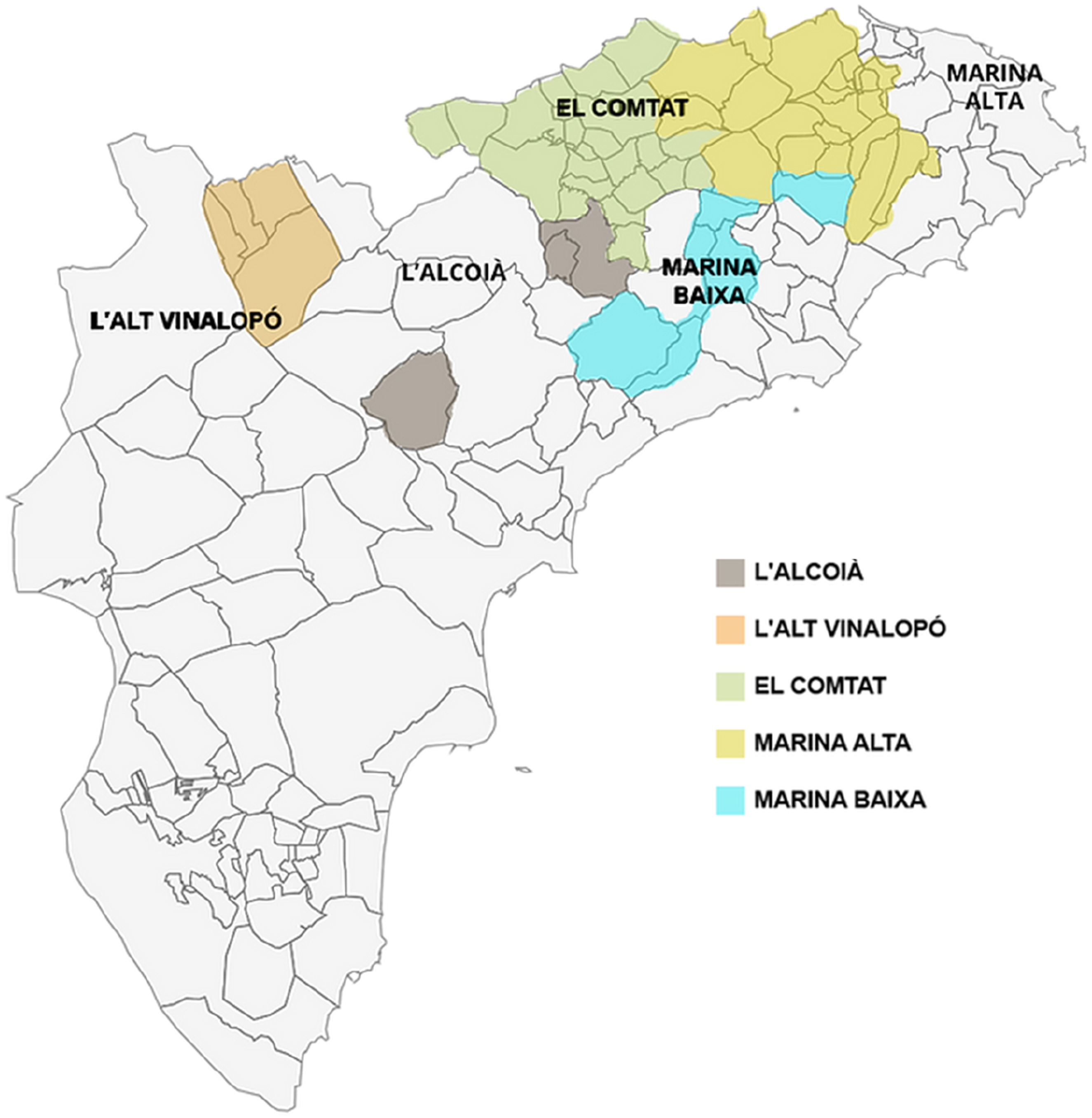
The main researcher worked collaboratively with GALRMA since 2018 to design this action research project (Horlings, 2016). The design follows GARLMA’s expressed intention to ‘increase synergies among actors in the pursuit of actions towards sustainability in the region’ (personal communication, January 2018).
Following the approaches taken by Touraine and Melucci, main proposants of SI, we combined several methods (see Brincker & Gundelach, 2005; and North, 1998) with the different stages. 1. Qualitative individual semi-structured interviews (11) with GALRMA members. Aim: generating understanding about the development of GALRMA, the regional development process and regional identity. 2. We combined SI’s four stages in 2 focus groups discussions (2 hours) and replicated the process in two subregions (total of 4 focus groups, see more details below): a. Pre-intervention (witness and confrontation): participants shared their experiences and discussed issues in the region. Then they shared their views on main regional identity values. Next, participants reflected on the shared experiences and self-analyzed their views and actions considering the new knowledge acquired. b. Intervention (flexion and conversion): participants focused on a way forward by reflecting on collective place values and alternative governance arrangements. An account of issues and opportunities followed. Finally, participants worked towards establishing long-lasting relationships based on continuous reflections and analysis to guide adaptation to the ever-changing nature of place identities to better inform collective action. 3. A final validation workshop (2 hours, open to participants, GALRMA members and other place actors) was set up to reflect on the learnings from the SI. Participants worked towards embedding the region brand identity the upcoming renewal of a 5-year regional development strategy (2024). 4. Ethnographic and participant observer notes were also taken during GARLMA stakeholder meetings prior and during the EU-funded BRANDSUS project (2017-19; 2020–2024 respectively), as well as during the SI process and validation workshop.
To strengthen inclusion, the working languages of the sessions were Catalan and Spanish. The meetings took place in community centers (i.e. community hall) or municipal facilities (such as town hall public gathering rooms) after working hours (6–8pm) and were followed by dinner catered by local businesses or in local restaurants using local produce to strengthen the focus on sustainability and social solidarity with local producers.
Given the length and diversity of the area covered by GALRMA, two sessions with the same format were held (we artificially defined the GALRMA area into east and west sections). The pre-intervention session was held in Xaló (Marina Alta; east) 28 February 2023 and Biar (Alt Vinalopó; west) 2 March 2023. The intervention was held in Sanet (Marina Alta; east) 7 March 2023 and Alfafara (El Comtat; west) 9 March 2023 (see Image 1 below for details).
Finally, the researcher also processed, analyzed and fed back a summary of reflections to participants to inform a critical reflection and provided further opportunities to review and reflect on the knowledge generated during a validation workshop. The learnings from the platform were also shared and reflected upon in subsequent international workshops (see www.brandsus.eu/) and embedded in policy formulation (new EDLP) actively increasing citizens’ agency by embedding the learnings (collective identity values) in institutional processes.
Selecting participants
Participant selection was done in collaboration with GALRMA’s Junta (steering committee) members and snowballed among members of GALRMA to include actors that sit across a continuum of views on regional development, from more conservative to more activist actors. The selection aimed at garnering transformative power (Horlings, 2016; Wittmayer & Schäpke, 2014) and a maximum possible quota representation of a mix of backgrounds: sector (tourism, business, arts and cultural industries, government, politics, farming, education, and communications); gender; ethnic background; age; geographical location (including remote areas) and ability. Selected participants included citizens from the area covered by GARLMA that were formally or informally engaged with GALRMA (Ethical Committee of Erasmus University, 21-013). A total of 38 participants (20 participants in the east and 18 participants in the west area) were recruited.
Researchers as change agents and a note on positionality
Researchers can adopt many (often blurred) roles in action-oriented activities (for a full account see Wittmayer & Schäpke, 2014 for an application in place-based research see Horlings et al., 2020). The main researcher held several roles in the process: change agent, self-reflective scientist and knowledge broker. The main researcher also had a dual identity as insider (being a local) and outsider (acting as researcher, or policy advisor).
The researcher established, facilitated and participated in ‘dialogues for change’ (Miller, TR, 2013, p.287), actively encouraging participation (from contributing to participant selection to actively encouraging all participants to share their viewpoints) and social learning while empowering and motivating collective action (Touraine, 1978).
As change agent, the main researcher had a key role in managing potential conflict among participants and challenges in the societal learning process (Wittmayer & Schäpke, 2014, p. 483). A reflection on normativity is warranted here as the researcher participates in the project informed by a normative view of sustainability as social-ecologic resilience of the biosphere where humans and nature are interconnected and coevolve, adapt but also transform (Folke et al., 2016). At the same time, this influenced structural and relational dynamics (Horlings et al., 2020). The researcher’s expectation was that the action research process could broaden the identity dialogue to include social, ecological and political aspects of place. Additional emphasis was devoted to the importance of cultural and physical elements of place in the analysis, discussion and reflection which can lead to an enhanced understanding of place identity, strengthening of emotional and embodied connections to place (building trust and enhancing collaboration). It can also help address conflicts and value differences towards constructive dialogue, reshape governance structures by integrating local knowledge and values into decision-making and facilitate sharing of experiences to support social learning and transform practices (Horlings et al., 2020).
The main researcher had a ‘dual identity’ as outsider and insider (Horlings et al., 2020) as born in the area with strong family ties albeit living overseas for the last 15 years. To assist ethical and positionality reflections, an additional researcher was engaged with arguably an opposite relationship to place as migrant (born overseas but currently residing in the area). Notwithstanding positionality concerns, the main researcher local ties provided added layers of deep understanding of the existing power dynamics and meanings generated in the discussions. Being a local assisted in connecting with participants at an emotional level (shared first-hand shared experiences of place). In addition, the researcher was very familiar with the political, economic, social and cultural context which helped navigate conflict in the discussions.
As a self-reflective scientist, the main researcher constantly reflected on her own normative orientation and the internal and external power dynamics influencing in the arena for dialogue and the management of relationships among participants (during and at the margins of the group discussions). For instance, the researcher was particularly reflective on who had influence in the internal group dynamics and tried to address preexisting political power imbalances (e.g. between local politicians, prominent local entrepreneurs, and citizens).
By selectively inviting participants to contribute their thoughts to the discussions, the researcher also acted as knowledge broker as mediator of different perspectives, which may have influenced the outcome of discussions. By conferring equal opportunities to engage (often purposively inviting participation). This was also done by continuously questioning the political, social and economic realities underlying participants depictions of the place identity. This included at times, specific questioning on ‘whose view’ of local identity prevails.
Findings and reflections from the SI process
In this section we analyze and discuss how the SI process assisted the co-creation of a regional brand identity. We focus on how the SI process provided a space for reflection, sensemaking and social learning that led a reconfiguration of relationships, shared resources and collective action.
Reaching common understanding
During the witness group stage of SI (pre-intervention), participants shared their experiences and views about the region’s brand identity. The discussion focused on making sense of place and reflecting on individual and collective place values. At the onset, participants primarily emphasized the regions’ perceived value for outsiders (attractiveness) and for locals (livability, wellbeing). Key aspects mentioned included: ‘attractiveness of lifestyle’, ‘rurality’, ‘quality of life’ (tranquility, proximity, freedom, familiarity, contact with nature), ‘uniqueness and variety of the landscape, topography and climate’. The discussion focused largely on place ‘assets’. This may have been influenced by participants view of place branding as an economic development tool.
Participants were then invited to collectively reflect on their shared experiences with the view of outlining a collective place identity based on common values. In this second stage (confrontation group), different needs, views and interests were outlined. First, participants reflected on the region’s rural identity character both as a blessing in terms of its slow and quiet lifestyle, but also a curse due to geographical isolation and lack of opportunity (e.g. jobs). Next, social and cultural values were introduced. These included a common cultural and historical heritage, language (Valencià) and traditions, rich ancestral knowledge (especially around agriculture) and a variety of ways of living (translating in different cooking styles and linguistic variation from village to village).
Despite an apparent positive view of rurality, participants hinted at a crucial paradox: the rural character of the region brings about challenges as fewer people mean less access to main services (i.e. schools or medical) and there are less opportunities for education and work for young people. This observation led to a lively discussion on how identity values were embedded in models of regional development. Most participants advocated for a model based on what they called ‘the region’s agricultural DNA’, which relates to minifundis as a form of small-scale farming based on microplots and aimed at enhancing biodiversity while some even advocated for degrowth models. However, others questioned such views: ‘which model do we want, a 15 th century or a 21 st century system?’ For some, the core issue at hand was the unsuitability of urban planning frameworks for regional areas. Upon reflection, participants agreed that an alternative view of development was needed based on regional collective values.
At this point the analysis became historical, as participants engaged in reflection about how migration waves may have transformed the social fabric of the region resulting on a hybrid identity: ‘we must perhaps open our minds about what this area is nowadays… [referring to second residence newcomers from Netherlands, Germany, etc].’ The arrival of migrants that choose to retire in the area was perceived as a threat to the local identity as they ‘build their own colonies and do not integrate’ and ‘price young people out of the housing market’. The discussion also reflected on current trends promoting rural lifestyle to neorurals (digital nomads) or ‘weekend holidaymakers coming from main urban centres’ which also resulted in land speculation. Furthermore, some lamented how the urban exodus of young people has led to the ‘loss of traditions around livestock breeding and crafts’, as well as ‘a negative perception of jobs in agriculture as non-skilled and backwards’.
Overall, the analysis in this first stage ended with participants’ realisation of the multiple, complex and dynamic character of place identities and the need to transcend individual interests towards collective values.
Transcending individual interests towards mutually transforming power
During the intervention phase participants started to build a common identity (flexion stage) founded on place-based values. Participants highlighted a strong and shared sense of place and care for the local community described as ‘estima al territori' (love for the place). At this stage, the emphasis on the socio-ecologic system allowed an ephemeral removal of the political context in favor of a discussion on the cultural relationship of people with place (Keith & Pile, 2004). Under this socio-ecologic perspective, humans interact with the environment to both gain access to resources and produce nourishment (agricultural component) but also as a place for wellbeing where both physical and emotional (or embodied) relationships with place are embedded in place identity values. This facilitated a shift in discussion from asset-value perspectives on place (places as resource sites for production and consumption, see Horlings, 2015) to character (identity)-value perspectives on place (Aitken & Campelo, 2011).
This stage also unfolded a series of emotional values around the place identity. First, the region was subsequently referred to as la terreta, a popular and colloquial name used by many Valencians to refer to the Valencian Country or a specific region, part of a famous saying ‘la terreta is the best little place in the world’. Participants’ sentiment (feelings) towards la terreta was fueled by a ‘common history’, shared language (‘you hear someone speaking Valencià and you become emotional’) and a strong sense of belonging. The latter was fueled by robust family ties and enhanced by local gatherings during ‘festes’ (local celebrations) and local fairs highlighting local produce, cuisine and traditions. Second, given the agricultural character of the region, it is not surprising that much of the discussion around place identity linking geographical and societal characteristics was linked to food production (agriculture) and consumption (gastronomy and cuisine) as embodied and cultural practices.
The intervention phase shifted the discussion from the management of local assets in the context of sustainable development to stewardship activities aimed at ‘caring for place’ and ‘community’, effectively transforming the relationship and strengthening the connection between people and place (Frantzeskaki et al., 2018) but also among actors (Ripoll González & Gale, 2020). Participants also emphasized the strength of intergenerational social networks and the need to preserve democratic and relational values ‘freedom, pride about this place, colectivism’, ‘humanity’, ‘associationism’ and ‘vitality’. Furthermore, they stressed their collective ‘spirit of survival’ that binds them and prompts them to act to preserve the local ‘way of life’ and ‘wellbeing’.
Institutionalizing social learning: A dynamic (collective) regional identity
In the last stage of the intervention (towards permanent sociology), participants became more critical of their views and practices (Bartels & Wittmayer, 2018) and agreed on the need for a system shift in relations and (power dynamics) where citizens, rather than waiting for governments to solve their problems, join forces, take a more active role and share responsibility for their future (in line with the systemic societal changes needed to face the current environmental crisis, demanding greater involvement and action by civil society actors, see Wittmayer & Schäpke, 2014 for examples). They noted that achieving sustainability depends on citizens’ will to do so and ‘must be collective action… based on our shared goals…’. Participants also expressed the need to ‘protect and revitalize the place for those who live in it’. They noted that responsibility must be translated to everyday actions and behaviors (i.e. ‘we must buy from local producers’; ‘we must engage with agroecology’).
During the intervention phase, the focus was on establishing additional synergies between actors and (2) promoting mutual understanding among actors with seemingly opposed interests towards a common future vision for the region. The last stage ended in an appreciative tone with sharing positive stories and potential solutions to current issues. Participants discussed the types of activities fitting to their collective sustainability ambitions, that most saw connected to a collective ‘agricultural project, agricultural identity’. For instance, some called for incorporating agroforestry in education, whole other suggested transitioning from mass tourism offerings to more experiential, intimate encounters (even with regenerative practices). The involvement of a range of place actors in SI enabled envisioning a fundamental transformation towards more sustainable modes of production and consumption based on collective identity values. At a practical level, participants suggested partnerships between local business to deliver ‘experiential and active tourism’ experiences. These examples demonstrate how the social learnings from the SI process were translated into action (Bradbury, 2022). However, participants noted a lack of communication among different actors or groups but agreed that the intervention provided a conducive space for sharing views and learning from each other’s viewpoints (Brincker & Gundelach, 2005).
Reflection on the transformative power of SI as an action research approach
LAGs are designed as institutionalized forms of networked social innovation towards sustainability (Nordberg et al., 2020) and have a vocation to facilitate social change. As evidenced above, a process of developing a collective identity (SI) provides the necessary space for interaction and reflection as necessary stages for social and sustainability transformations (Folke et al., 2016; Grenni et al., 2020). Unraveling actors’ different place experiences can open a dialogic arena for questioning systemic challenges to delivering sustainability. As a result of the SI process, participants gained an understanding of the different perspectives and visions of the region that form its dynamic place identity. The analysis of collective identity values led to a scoping of capacities and opportunities to work together towards an alternative and more inclusive ‘vision’ of place (Ripoll González & Gale, 2020), rooted on cultural and social capital (Horlings et al., 2020). Specific actions in support of such view included investing in agroecology education (bringing local producers and schools together) or in experiential learning opportunities about water heritage through visits to historical water management sites such as fountains or aqueducts (bringing local historians and teachers together) to shift narratives about rurality and agricultural professions.
The reflective SI process outlined here also challenged current development models for the region (Hjorth & Johannison, 2003). In contrast to the current narrative of innovation for economic growth as a ‘cross-cutting priority’ for the EU’s Rural Development policy, participants suggested stronger emphasis on enhancing or preserving cultural, traditional and social values (‘slower’ and ‘community-oriented’ ways of life, see Snow, 2020 in Ulug et al., 2021).
The analysis confirms the importance of observing ‘place’ as space holding individual values and collective identities of people and a site for transformative action (Horlings, 2015). Transformative action research is often observed in the context of specific sustainability transitions (i.e. energy transitions, see Ulug et al., 2021), and contextualized in communities bounded around a common goal. In complex processes of regional development, the development of collective place identities via SI, as demonstrated by this study, can help establish a collective ‘sense of place’ (Relph, 1976). It can also assist with developing a sense of purpose and of collective, bottom-up agency and action, based on shared identity values but also emotional connections to place (Frantzeskaki et al., 2018).
Conclusion
This study contributes to this special issue on action research as an approach for transformations by exploring how sociological intervention (SI) can provide the joint inquiry, reflection and social learning necessary to transform governance systems in regional areas. The SI process was applied here to develop a collective place identity. The approach provided a space for reflection, dialogue, learning and action (Touraine, 1978). The SI process, as an action research approach to knowledge creation, unveiled citizens’ experiential, relational and emotional practices as legitimate knowledge (expertise) informing the development of collective place identities guiding regional development process. While sociological intervention has been recognized in other contexts for its ability to address social issues and foster collective action, its application in transforming governance systems through the development of collective place identities is relatively novel. This contribution is original in its application of SI to governance systems, emphasizing the integration of citizens’ experiential and embodied knowledge in developing collective place identities. It addresses a gap in the literature by showcasing how SI can transform governance structures and foster sustainable societal change. In addition, the findings highlight the relevance and transformative power of emotional and embodied aspects as binding elements often overlooked in governance processes.
SI, as an action research approach reconfigured relational dynamics (Horlings, 2016) and social learning (Wittmayer & Schäpke, 2014) by (1) reflecting on experiences and uncovering individual interests towards mutual understanding and an integrative view of a collective place identity; and (2) changing the approach to sensemaking from individual to community (collective) values. The SI process provided new ways of thinking, organizing and acting that (re)shaped not only the social world and aspirations of the local community (from economic development to stewardship of la terreta), but also institutional configurations (informing policy on regional development as well as encouraging self-organization). The transformative character of the SI approach is evidenced by (1) engaging different people and perspectives (increasing the diversity of insights; enhancing legitimacy and trust; strengthening sense of belonging and shared purpose needed to drive collective action); (2) providing alterative heuristics (collective place identity) for change (collective action); and (3) embedding the results in policies and strategies (e.g. translating the resulting collective identity values into concrete strategies and actions in the renewed regional strategy or EDLP).
The study shows that SI can enable mutually transformative power and lead to more sustainable relationships and outcomes in line with ART’s principles. The researcher consciously fostered mutually transforming power beyond the researchers’ and participants’ own self-interests (personal, inner) through brokering power and challenging whose ‘expertise’ or ‘what knowledge’ counts (interpersonal, community) in co-creating desired futures. Hence, the researcher was actively engaged and part of the process of developing a collective place identity, creating, facilitating and nurturing a space for dialogue and actor collaboration, managing relationships with participants and developing capacities (knowledge and resource sharing) for collective action.
Furthermore, the case study presented here shows how a focus on embodied place experiences (Eshuis & Ripoll González, 2025), as well as individual and collective place values, helped develop a collective place identity as shared heuristic for envisioning sustainability transformations in complex (and often contested) regional settings as physical, social, ecological and cultural spaces (Horlings et al., 2020). The learnings from this study could be used to develop collective identities to generate transformative outcomes in other settings (places) and contexts; for example processes of urban regeneration, governance of sustainable agriculture, energy transition and the commons (e.g. water, forests).
We conclude that the process of co-creating a regional brand identity through SI as a form of research concerned with transformations facilitated a space where actors come together, learn and build transformative partnerships. The reflective nature of the SI process also helped participants realize that delivering sustainability requires grappling with environmental (or ecological), economic, social, and cultural dilemmas. As part of their collective reflection, participants questioned the politics and institutional arrangements hindering sustainability transformations, as well as the need for trading off singular approaches towards a collective approach that delivers equity for all. SI facilitate collaboration towards sustainability transformations among the local community. The novelty of this approach lies in the application of SI to the co-creation of collective (place) identities, integrating citizens’ experiential and emotional knowledge into governance processes, and bringing local knowledge and values into decision-making processes. While SI has traditionally been used to address social issues and foster collective action, this study uniquely employs SI to transform governance systems. SI provides a space for joint inquiry and social learning facilitating transformative partnerships and providing diverse perspectives as key elements of sustainability transitions.
Upon reflecting on their individual and collective experiences, perceptions and values about the region, participants developed (1) a common understanding of the dynamic, emotional, relational and contested nature of regional brand identities (2) a common focus that transcends individual interests towards ‘mutually transforming power’, and (3) a learning platform where knowledge is accumulated, and power is diffused among the multiplicity of voices that shape the territory’s brand identity (Grenni et al., 2020). The case study highlights how a process of brand identity formation can act both as a learning space to guide structural reconfigurations and a governance tool for actor participation towards transformative change in sustainable regional development processes.
Finally, the SI process embedded reflexivity and collaboration in the regional development process (see practical implications section for more detail). The process focuses on relationships and synergies, rather than outputs, and on learning while addressing the issues communities care about. The findings of the GARLMA case confirm the relevance of ‘emotional’ and ‘embodied’ aspects of societal transformations (i.e. participants observed ‘love for the place’) as binding elements that often overlooked the study of regional governance processes.
Further research
This paper offers learnings from the application of SI as an action research approach linking experience-based learning with ‘sense making’ (collective identity). The process emphasized relational and emotional aspects, as both participants and the researcher share an embodied learning journey towards ‘mutually transformative power’ (Bradbury et al., 2019). This was done through a reflection and analysis of individual and collective identity values. Although the data presented here show a reconfiguration of relationships and the development of additional synergies towards action, a longitudinal evaluation and reflection over time of the transformative potential of SI as a tool for collective action is needed to further enhance and sustain the transformative power of the approach (Salomaa & Juhola, 2020) and ensure inclusivity, increase capacity and social learning over time (Loorbach et al., 2017).
Additional research could also examine if a more plural and co-created regional brand identity can indeed enhance identification, sense of belonging, trust, and ownership among citizens over time. The abovementioned elements, as key ingredients for collective action, may determine actors’ willingness to engage in governance processes and encourage the deep level of reflection needed for mutual understanding as a prior step to establishing mutually transformative power (Bradbury et al., 2019).
Points for practice
Using action research goes beyond addressing a problem, to refocus the aim of place branding as an ‘internal’ process of learning and community building around a collective identity. The reframing of desired futures grounded on collective values to be foregrounded has a double aim of (1) fostering collaboration to collectively achieve such futures and (2) carrying out the necessary systemic transformation to govern collaboration (through more participatory, inclusive processes). The collective identity can serve as a common narrative as well as a governance tool to structure and align wider sustainability action by local actors. At the time of writing, the research is still engaged in discussing with GALRMA how the generated changes can be sustained beyond the life of this research project.
We recommend the establishment (and funding) of a territorial brand identity committee or roundtable as part of official decision-making and deliberative mechanisms in regional organizations such as GALRMA with sectoral and intersectional representation. This will help institutionalize the reflective component of the process and embed collective regional values (and future values as regional identities are dynamic) in all policy and strategic actions of regional organizations such as GALRMA. This will also help advocacy efforts in the interactions with supra-municipal public administrations and other civil society groups and business organizations.
Likewise, organizing extra follow-up sessions to examine how collective identity evolves over time could enhance the reflexive aspect of the process, extending beyond the initial intervention led by the research team—moving towards what Touraine (1978) refers to as permanent sociology. This approach would also help critically address and overcome structural barriers to collective action within regions (an explicit commitment in the case of GALRMA).
Finally, we encourage regional actors in the context of LEADER and beyond to think about place branding not only as an instrument to increase economic activity and support local development, but also a governance tool to strengthening community bonds and enhancing community values.
Footnotes
Acknowledgement
The author wishes to thank editor Koen Bartels and two anonymous reviewers for the excellent and thoughtful feedback received that has resulted in significant improvements to this manuscript. The author also wishes to thank participants and Emma Wikberg for making this project possible.
Declaration of conflicting interests
The author(s) declared no potential conflicts of interest with respect to the research, authorship, and/or publication of this article.
Funding
The author(s) disclosed receipt of the following financial support for the research, authorship, and/or publication of this article: This project has received funding from the European Union’s Horizon 2020 research and innovation programme under the Marie Skłodowska Curie Programme, grant agreement No 895260, project BRANDSUS (Exploring participatory place branding as an inclusive governance framework for sustainable place development).
