



Abstract
Motivated by general theoretical ideas about the societal consequences of diversity among organizations, I examine how the diversity of organizational forms in a local community shapes the formation of its museums. I argue that the diversity of organizations that cut cross major community segregation lines helps to integrate a community and consequently enhances its ability to act collectively, in this instance to create a museum to serve the community. In contrast, the diversity of organizations that are confined to the major segregation lines widens community cleavage and decreases the community’s ability to establish a museum collectively. Empirically, I investigate how diversity in the local press affected the formation of museums in American counties from 1872 to 1976. The findings provide empirical support for my theory. I find that the diversity of general appeal newspapers has a positive relationship with the formation of museums, implying the integrating effects of general appeal newspapers that cut across boundaries of race and ethnicity, the dominant segregation lines in US communities. In contrast, there is a negative relationship between ethnic newspaper diversity and museum formation, showing the segregating effects of ethnic newspapers by race and ethnicity. I conclude the study with a discussion of its implications for a general research program on how organizational diversity shapes social interaction patterns in a community, and consequently influences the community’s civic engagement for public good.
Introduction
Organizational theorists commonly claim that formal organization is crucial for shaping modern society. The solidarity of a community depends intimately on the degree of its formal organization (Stinchcombe, 1965), and organizations are the main vehicles for collective action in communities (Coleman, 1974). Yet the social, political, and economic implications of organizational distribution have not been systematically studied.
A recurrent theme in the social science literature emphasizes that diversity among organizations is central to understanding their impact on society. Evolutionary theorists argue that diverse organizations provide flexibility for the social system to experiment in changing or uncertain conditions because they reflect heterogeneous routines or solutions (Dutta, 2017; Grabher and Stark, 1997; Hannan and Freeman, 1989; Nelson and Winter, 1982). Within the stratification literature, a different general argument arises, namely, that diverse organizations generate optimal (or superior) matching between individuals of different tastes and social positions (Fujiwara-Greve and Greve, 2000; Greve, 1994; Sørensen and Sorenson, 2007). A similar argument within social movement studies maintains that organizational diversity helps broaden the social movement’s recruiting and financial bases (McAdam, 1999 [1982]; Olzak and Ryo, 2004), and enhances the social legitimacy of challenger groups in social movements (Negro et al., 2013). Finally, within political sociology, Gray and Lowery (1996) argued that diverse political representation enhances the functioning of state economy, policy, and politics.
Despite the considerable theoretical interest and empirical studies in the existing literature, the broader socioeconomic implications of organizational diversity have not been examined systematically. Since 1997, economists have published at least 15 different empirical papers examining the consequences of heterogeneous communities on civic engagement (e.g. Alesina et al., 1999; Luttmer, 2001; Miguel and Gugerty, 2005; see Costa and Kahn, 2003 for a review). Their common finding is that heterogeneity reduces civic engagement. An individual’s desire to perform actions that benefit others depends on a perceived level of community solidarity. Social fragmentation, or diversity of the population across observable dimensions, lowers individual investment in the public good. But these economists investigated only the heterogeneity (e.g. ethnic diversity) of the human population, not organizational diversity.
When we open a community up, we see people with different backgrounds and tastes, and organizations with different interests and resources. Organizations provide important communication channels and forums within communities, and form a chain that links different members of a community together. Because they represent heterogeneous interests and resources, diverse organizations shape collective action in communities by matching and activating people of heterogeneous tastes and interests. Although scholars have demonstrated that bridging organizations—with the potential to foster integration across diverse groups within a community—tend to enhance collection action ability in local communities (Longhofer et al., 2019), we still do not have a theory on how organizational diversity affects communal engagement by shaping community solidarity. In this article, I theorize how the diversity of organizational forms integrates or segregates a community, and consequently affects the collective action for public good. Organizational forms and categories are synonymous in this article, and I use them interchangeably. Empirically, I examine how diverse organizations in a local community shape its museum foundation.
The creation of museums in America provides a good context for the study of collective action for the common good in communities. American museums have been founded and maintained by the communities in which they are situated, most through some form of collective action (Fox, 1963; Taylor, 1975), and are the “largest and perhaps the most significant voluntarily supported cultural institutions in modern history” (Fox, 1963: 2). Virtually all are public museums (Blau, 1991). Gifts and bequests from individual citizens have been a major source of museum endowment and income, and most of these generous donors were motivated by a desire to bring the benefits of art and history to more people in the community (Fox, 1963). Historically, museums have offered “educational and publicity programs on a scale which has had few parallels in the history of cultural institutions” (Fox, 1963: 82).
I investigate how the diversity of organizational forms (categories) in the local press shaped the formation of museums in American counties from 1872 to 1976. The crucial role played by the press in civic life has long been documented. De Tocqueville (2003 [1840]) asserted that without newspapers “there would be hardly any communal action” (p. 601) in democratic societies. In order to observe the effects of organizational diversity, I needed multiple autonomous environments, with varying degrees of diversity but enough similarity to be comparable. Because organizational differences play out over long periods of time, I also needed to observe extended environmental evolution. This study provides a unique research design, which allows me to make a rigorous examination of the consequence of organizational diversity in communities.
The findings of this study demonstrate that the diversity of general appeal (boundary-cutting) newspapers has a positive effect on the formation of public museums in American counties, reflecting the integrating effects of general appeal newspapers across people of different racial or ethnic backgrounds. In contrast, the diversity of ethnic newspapers has a negative effect on museum formation in those communities, suggesting the segregating effects of ethic newspapers along the racial and ethnic lines. In addition to contributing to organization theory by theorizing and testing how the diversity of organizational forms shapes a community’s solidarity and consequent collective action ability for the public good, this study contributes to the literature on the emergence of new organizational categories by showing that the emergence of certain new organization categories at a particular locality may hinge on the solidarity and collective action ability of the place. Specifically, the diversity of existing organizational categories in a local community—by integrating or segregating the people across the dominant community segregation lines—influences the community’s solidarity and collective action capability to implement a new organizational category. Moreover, the findings reveal that the diversity of organizational categories in an alternative organizational field (local press)—by influencing community solidarity and collective action capability—can systematically shape the local emergence of a new organizational category in a focal organizational field (public museums).
Theory: integration versus segregation
One of the distinctive characteristics of modern societies is that they are delineated by many lines of social differentiation (Blau and Schwartz, 1984). For instance, people in a community can be segregated on the basis of parameters such as racial and ethnic affiliation, economic strata, profession, industry sector, and place of employment, and so on. But in any society some parameters are more salient (or divisive) than others. “The salience of a nominal parameter is defined as the preponderance of ingroup relations. The more ingroup associations prevail over intergroup associations, the more salient is the parameter” (Blau, 1977). Blau pointed out that race and ethnicity are more salient for intergroup relations than other parameters in the US communities. Residential segregation by race has been shown to persist, independent of occupational segregation and other forms of economic segregation (Duncan and Duncan, 1955; Simkus, 1978; Taeuber and Taeuber, 1965). Using detailed track-level data from one Standard Metropolitan Statistical Area (SMSA), Erbe (1975) found that Black professionals and managers, Black college graduates, and Blacks with income in excess of US$25,000, lived in tracts comparable, respectively, to those of Whites who were unskilled workers, school dropouts, and earned less than US$3,000. In their influential book American Apartheid, Massey and Denton (1993) showed systematic evidence that racial and ethnic segregation predominated over class segregation in accounting for variation in the concentration of poverty in US metropolitan areas. In sum, sociologists have long recognized the dominance of race and ethnicity in segregating American communities. While it is always true that people in a community differ from each other on many social dimensions, the most effective way to consolidate a community is to integrate people across the dominant community segregation lines.
Community organizations provide a channel for people with common interests either to become aware of each other or to interact directly with each other. For instance, women’s magazines connect people who are interested in women’s issues; sports associations connect sports fans; dance clubs connect those who like dancing; and newspapers with a particular ethnic orientation connect people from the ethnic background (e.g. African-Americans or Chinese) in local communities. These organizations can either integrate a community by drawing together members across the dominant community segregation lines (e.g. race and ethnicity in US communities), or reinforce community cleavage by embedding people within the dominant segregating boundaries. From the examples I have cited, women’s magazines, sports associations, and dance clubs clearly have the potential to draw members across racial and ethnic lines, and ethnic-oriented newspapers tend to further segregate people along racial and ethnic lines. I call the former boundary-cutting organizations and the latter within-boundary organizations. The boundaries here refer to the dominant segregating boundaries in local communities. For instance, in the United States, any general interest organization that has the potential to draw members across racial or ethnic lines falls into boundary-cutting organizations category, and in contrast, ethnic organizations tend to be within-boundary organizations.
Integrating organizations
Diverse organizations can activate people and involve them in public life by optimally (or superiorly) matching and activating people of heterogeneous tastes and interests. Assuming people in a community have heterogeneous tastes and interests, diverse types (or forms) of boundary-cutting organizations can optimally (or superiorly) integrate a community by maximizing (or increasing) each individual’s probability to connect with others of similar interests across major segregation lines. For instance, if a US community has people who are concerned about women’s issues in the community but does not have a women’s magazine, it lacks at least one medium (or venue) to break the dominant racial and ethnic lines. Therefore, diverse types of boundary-cutting organizations can optimally integrate the community by breaking the dominant segregation lines at as many dimensions as possible. The interactions or awareness across the major segregating boundaries help to integrate a community and consequently develop a common community identity by making individuals recognize that they are citizens of a larger polity.
Specifically, in the diverse interaction spaces provided by heterogeneous types of boundary-cutting organizations, “citizens engage in brief exchange, come in contact with a diversity of people and opinions, and are exposed to a wide variety of social, political, and cultural stimuli” (Kaufman and Tepper, 1999: 302). In addition, “daily interaction with and among strangers gives citizens a sense of being part of a larger polity” (Kaufman and Tepper, 1999: 302). Furthermore, according to Jacobs (1961), “The sum of such casual, public contact, most of it fortuitous, is a feeling for public identity of people . . . a web of personal trust and respect.” (Jacobs, 1961: 56) The building of common community identity enhances the community’s ability to act collectively. Minkoff (1997: 612) maintains that the web of collective identity encourages individuals to concern themselves with the public good. Landscape historian J. B. Jackson (1987: 279) argues that “we learn to act as citizens when we appear in public spaces.” Therefore, by facilitating the building of a common community identity across major community segregating boundaries, diverse types of boundary-cutting organizations would make individuals more likely to contribute collectively to the public good.
Segregating organizations
In contrast, diverse within-boundary organizations can optimally (or superiorly) segregate a community by maximizing (or increasing) each individual’s likelihood to connect or interact within the major segregating boundaries. As abovementioned, various ethnic organizations can be considered segregating in this way. For instance, the more ethnically diverse newspapers a community has, the more likely it is that each ethnic group will have its own newspaper. Because people may have limited time to read newspapers and a natural interest in things happening in their own ethnic group, their awareness or interactions will be more confined to their own group. By widening community cleavage, within-boundary interactions can reinforce individuals’ identification with their own racial or ethnic group, weaken the sense of being citizens of a larger community, and consequently reduce the sense of common identity at whole-community level. The weaker common community identity is, the less concerned individuals will be about the public good, and the community’s ability to act collectively for the whole community will be lower.
Previous research has shown empirical evidence that organizations confined to certain ethnic groups can segment the community by reinforcing major segregation lines. For instance, Breton (1964) demonstrated that ethnic groups in Montreal, which are “institutionally complete,” are much more likely to be segregated from other groups in terms of residence and the extent of out-group relations. His measure of “institutional completeness” was whether an ethnic group had ethnic newspapers, ethnic places of worship, and ethnic welfare organizations. The more ethnically diverse the organizations, the more likely it is that each racial or ethnic group would be “institutionally complete,” and consequently, the more segregated the community would be. Stinchcombe (1965) commented further that the penetration of a larger group in a community into a smaller group is increased to the extent that the smaller group is not institutionally complete. So the more diverse the segregating organizations in a community, the more likely the interactions within the community are to be fragmented. Within-boundary interactions reduce the common identity at the whole community level and the community’s ability to act collectively. Coleman (1957) stated that cities in which community integration was extremely low had a lower probability of innovation or other collective action. Therefore, a fragmented community is less likely to have the desire and ability to contribute to the public good. Figure 1 summarizes the theoretical delineation of the social mechanisms that link organizational diversity to collective action for the public good.
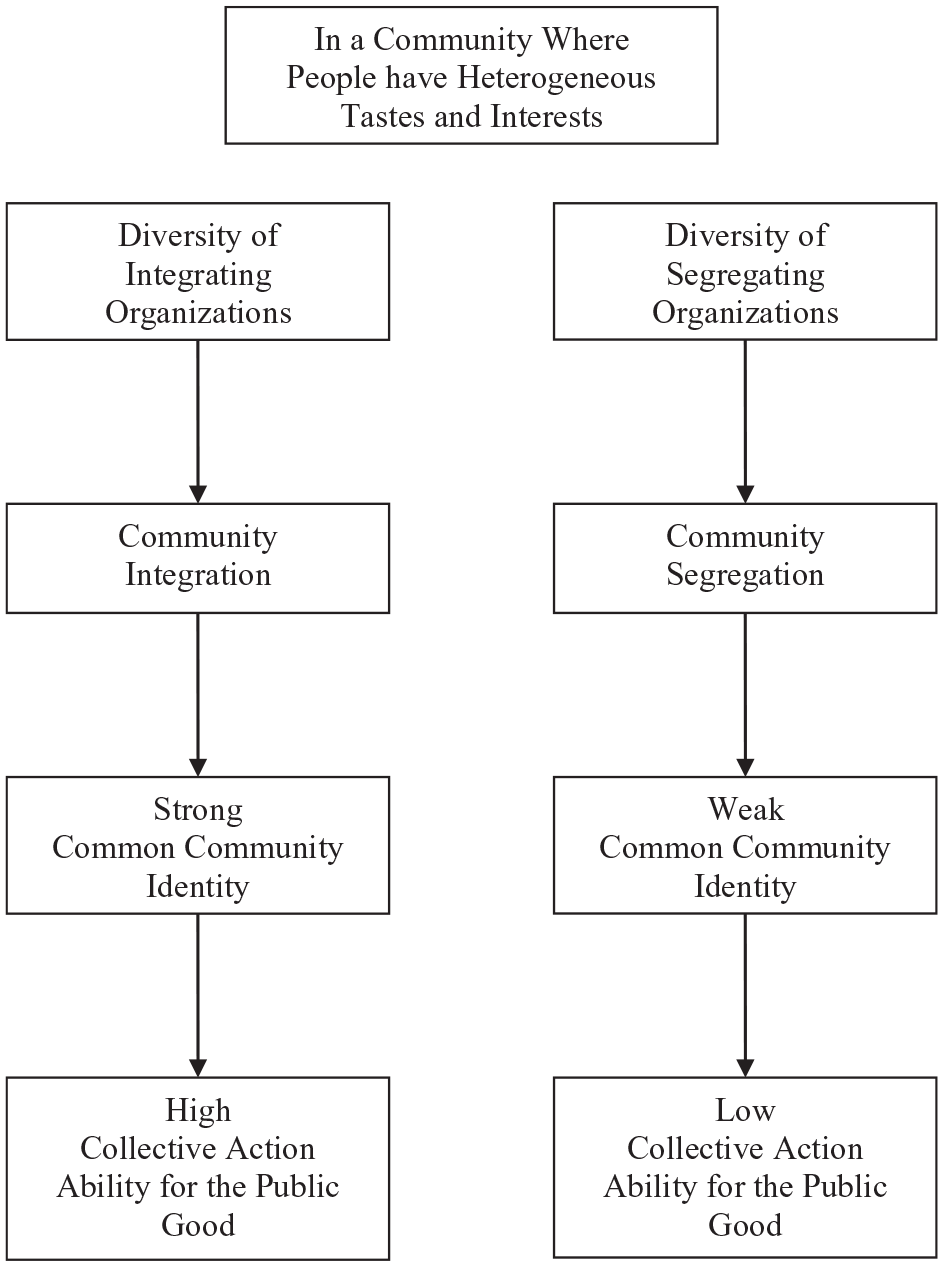
Theoretical delineation of social mechanisms.
Some may ask how those diverse organizations can optimally integrate a community if the affiliated members of each type of organization tend to stay in their own worlds: that is, people who are concerned about women issues connect only with those with similar interests and sports fans interact mainly with sports fans. Wouldn’t the community be segregated by the women’s and sports interest groups? Yes—but they should help to integrate the whole community in general because they draw their members across the dominant community segregation lines such as racial and ethnic lines in the United States. They connect people who are interested in sports or women’s issues with similar-interest others from different racial and ethnic groups in the US communities. Any organization that breaks dominant community segregation lines contributes positively to whole community integration, as long as the social dimension the organization operates on is not as divisive as the dominant segregation lines. For instance, Women’s and sports groups are far less an issue than racial and ethnic groups in segregating the US communities.
The thrust of my theoretical argument in this article is that the diversity of organizations that cut cross major community segregation lines helps to integrate a community and consequently enhances its ability to act collectively for the public good. In contrast, the diversity of organizations that are confined to the major segregation lines widens community cleavage and decreases the community’s collective action ability for the public good.
Because the context of my study is the United States, my arguments are specifically developed on the basis of race and ethnicity, which are among the most divisive parameters in US communities. Basically, an organizational type is considered integrating if it has the potential to cut across racial or ethnic lines, and segregating if it has not.
The founding of museums in communities
The history of the American museum dates from the end of the Civil War. The 1870s marked the founding of several important museums—the Metropolitan Museum of Art in New York, the Boston Museum of Fine Arts, and the Pennsylvania Academy of the Arts. From their early beginnings, these museums were open to the public (Weil, 1983). The Metropolitan Museum of Art offered free admission on three out of five weekdays and Saturdays (Abt, 2001), and the Boston Museum of Fine Arts was “open free of charge at least four times a month” (DiMaggio, 1982), and “the public responded by flooding the Museum on free weekend days in the early years” (DiMaggio, 1982: 42). American museums, without exception, identified with civic virtues of public service, education, and social stability (Abt, 2006).
Accounts of early cultural institutions in the United States emphasized the role of elites as patrons for the founding of these institutions (Whitehall, 1970). Through support and patronage of cultural institutions, the elites further enhanced their privilege and status (Burt, 1977; Hall, 1984; Trachtenberg, 1982). While these studies correctly highlight the significance of wealthy individuals in building museums, they do not give a full picture of the museum founding process in communities, ignoring important communal processes and contributions from ordinary citizens. In a study of the gifts and bequests to US museums, Fox (1963) found that “Money gifts of amounts under twenty-five thousand dollars have accounted for the major part of the income and endowment of most public museums” (Fox, 1963: 27). Gifts and bequests came from a variety of sources including community campaigns, membership drives, resourceful individuals, foundations, civic organizations, and business corporations. Fox concluded that most American museums were founded and sustained by collective action in communities (Fox, 1963). Actually, he asserted that “The conception of nineteenth—and early twentieth century museums as institutions created primarily by and for a social and intellectual elite is a distortion by historians with an animus against the Gilded Age” (Fox, 1963: 27). DiMaggio’s (1982) description of the foundation of the Boston Museum of Fine Arts confirms the crucial contributions from average citizens and community organizations. He wrote, The breadth of response to the first appeal for funds for the museum is striking. Although the economy was not robust, $261,425 was collected for the building. Of this amount, the largest gift was $25,000, only two were larger than $5000 and all but $100,000 came from over 1000 gifts of less than $2000 from such sources as local newspapers, public-school teachers and workers at a piano factory. (DiMaggio, 1982: 41)
The El Paso Museum of Art was created and sustained by several community-wide campaigns in the early days. Using money from the sale of a book entitled One Hundred Points of Interest in El Paso, Texas, and Juarez Mexico, in 1926 the El Paso Chamber of Commerce department bought eight cases from the art collection of a local citizen who had died 2 years previously (El Paso Times, 1950). The exhibit helped crystallize the idea of forming a museum for the El Paso community. There was also a “buy a brick” campaign for establishing a building for the museum (El Paso Times, 1950). The charter for the museum was obtained in 1930 (El Paso Herald Post, 1955), and the original name was El Paso International Museum. The Texas Centennial Coin campaign, another community-wide collective action, was also crucial for the museum’s development in its early years. “When El Paso held its Centennial in 1935, Mr. Hoffecker, a well-known coin collector, was inspired to design a Texas Centennial coin, and offered to divide profits with the museum board if the latter would sponsor its sale” (El Paso Times, 1950). Proceeds from this coin sale enabled the museum to move to a beautiful new home (El Paso Times, 1950).
The Tucson Museum of Fine Arts began as the Tucson Fine Arts Association (TFAA) in 1924: Between 50 and 60 Tucsonans gathered at the women’s club to vote the new association into existence. The date was March 20, 1924, which makes Tucson Fine Arts Association a Thursday’s child, and Thursday’s children, according to the old nursery rhyme, have far to go. (Arizona Daily Star, 1973)
In May 1900, 256 citizens of Erie, Pennsylvania signed together to incorporate the Art Club of Erie (today the Erie Public Museum), which was founded in 1899 (Erie County Public Library Archive, n.d.). After the McLean County Historical Society was established in 1892, the society established a series of public meetings where presentations were made by society members concerning local history. The presented papers and transcribed reminiscences formed the first society collection. People in the community, without solicitation, soon donated objects that related to local history.
1
The first community-wide museum, McLean County Museum of Natural History, was established in 1904 after the historical society had received enough materials from the community.
Contributions from the public do not undermine the importance of wealthy individuals in founding museums. After all, affluent people were the most likely to have the leisure, education, and money to travel and collect works of art or historical objects. Charles C. Perkins, the great-nephew of a China-trade magnate, was the key figure in the founding of the Boston Museum of Fine Arts (DiMaggio, 1982). But without the crucial gifts—62% of overall donations—from ordinary citizens (e.g. workers and teachers) and community organizations, it would have taken much longer to establish the museum.
Given the role community action and support have historically played in founding museums, it is important to study how the local organizational infrastructure shaped community solidarity, which consequently affected the community’s ability to act collectively to create community-wide museums. Presumably, the better local social organizations channel communication across the dominant racial and ethnic lines, the more likely it is that individuals from different racial or ethnic groups will identify with each other as citizens of a larger community, and consequently the stronger the community will be in acting collectively to create a museum to serve the whole community.
In this article, I examine how the organizational diversity of the local press affected the formation rate of the first museum to serve a community as a whole. What manifests the strength of a community the most is not so much its having several museums as having one museum as opposed to none at all. This is the difference between a qualitative and quantitative change. In most cases, the first community-wide museum in a community’s history has the community’s name in its title, and is the most important, if not the only, museum serving the community. And most first museums still exist today, whether they were established merely decades or a century ago.
Organizational diversity in the local press
I investigate the consequences of organizational diversity in the local press on the formation of first museums in US communities. The local press has been important organizational areas in civic life in most US communities over time. Even in the late-eighteenth century, the US newspapers or magazines had a varied readership, and their reading represented “a more broadly democratic activity” (Nord, 1988: 42) than had usually been proposed. For example, Nord (1988) showed that even in 1790, half of the readers of the New-York Magazine were artisans and shopkeepers.
Although newspapers may not facilitate direct interactions among the readers, they can reach a wider audience in a community, and newspaper readers become aware of the existence of others who share a similar interest. Anderson (1983: 15) asserted that “communities larger than primordial villages of face-to-face contact (and perhaps even these) are imagined.” In the “imagined community,” most members of a community never know many of their fellow citizens, but come to understand their community and its membership through information obtained directly or indirectly via newspapers. Although readers may have never met, they “become” connected and unified through ideas in print. In a similar statement, Scherer (1972: 107) argued that “media are creating bonds of style, age, and interest that transcend the particularities of . . . background.” Essentially, readers begin to conceive the community as a representative body due to the simultaneous consumption or “imaging” of the stories in local newspapers, and subsequently develop a sense of community solidarity and responsibility.
Sociologists have long explored the relationship between newspaper use and community integration. As early as Park (1929), the University of Chicago sociologist Robert Park pointed out that newspapers were an important mechanism for integrating individuals into the spatially rooted social arrangements of the metropolis. In his pioneering work, The Community Press in an Urban Setting, Morris Janowitz (1952), another Chicago sociologist, characterized newspaper readership as one of the social mechanisms by which the individual was integrated into a city community. The newspaper is seen as creating, reinforcing, and extending feelings of interdependence and identification held by the members of the community.
Janowitz’s study has provided most of the groundwork for subsequent research on this topic. In the first major follow-up of Janowitz’s study, Edelstein and Larsen (1960) investigated 21,000 households in a high-density residential area in Seattle. They found that people who were most attentive to local newspapers claimed to have the most “community feeling.” Moreover, these respondents credited the newspaper itself with producing that community feeling through exposure to particular kinds of content. In a study of an interurban zone (about 25,000 people) called Intercity, Bogart and Orenstein (1965) concluded that residents of suburbia inevitably acquire a sense of identity with the people and institutions of nearby towns because of day-after-day, month-after-month exposure to the news minutiae of a particular nearby town through reading its newspaper. Stephens (1978) argued even more forcefully that adults expect to find community-oriented news in their newspaper and that they need it to become integrated into the community.
With stories, letters, and editorials, each type of newspaper provides a forum for individuals to become connected with others who share similar interests in the community. For example, educational newspapers create a public space to connect those who are interested in issues related to education; women’s magazines offer a forum for those who are concerned about women’s life and well-being; labor newspapers provide a stage for communication about labor issues and the life of workers. These three types of newspaper focus on specialized topics, but their audience appeal is general in terms of ethnicity because they have the potential to draw people across racial or ethnic lines. I call them general appeal newspapers 2 (or boundary-cutting newspapers). Note that the general appeal in this study is defined specifically based on audience appeal in terms of ethnicity.
There is ample evidence that general appeal newspapers could facilitate the integration of people across racial and ethnic lines. For instance, the Industrial Worker (1909), a labor newspaper, emphasized the inclusiveness of all workingmen regardless of craft or ethnicity from its beginning (p. 4), and was instrumental in covering and disseminating news about the 1912 Lawrence Textile Strike in Massachusetts (Dubofsky, 1974), which united workers from more than 51 different nationalities (Watson, 2005: 8).
In a study of the subscribers of agricultural newspapers in the Midwest, Fry (2005: 77–79) asserted that agricultural newspapers in the 1910s and 1920s reached all types and levels of farmers. Based on the subscribers of a particular agricultural newspaper (Wallaces’ Farmer), Fry (2005: 78) found that the farmer subscribers were from diverse ethnic backgrounds, and 36% of their fathers or mothers had been born outside of the United States. Of all the subscribers with complete education data, 95% of them had received 5–9 years of common school. Rural Midwesterners enjoyed reading newspapers during the winter when darkness came early, and they read local agricultural newspapers for useful information, such as “cure for big jaw in cattle,” “a recipe to kill lice on stock,” and “A disinfectant & vermin destroyer for hogs” (p. 57). The editor personally visited each house to collect subscription money and solicit new subscribers (p. 79).
The prohibition (dry press) and anti-prohibition (wet press) newspapers significantly shaped the public opinions during the prohibition movement (1920–1933) (Udris, 2012), and a surprising consequence of the prohibition movement was that the desire to imbibe and indulge at will led to the flourishment of underground Black and Tan clubs across the United States, where Blacks, Caucasians, Asians, and other racial heritages came together to dance and drink on common ground (Drowne, 2011). Given that the anti-prohibition newspapers associated its discourse with the images of personal freedom, the existence of anti-prohibition newspapers in a local community should help strengthen a milieu that supports the activities of the Black and Tan clubs.
At the turn of the twentieth century, a high proportion of the home owners in the US suburb communities were working class immigrants. Based on a detailed study of Detroit between 1880 and 1920, Zunz (1984) asserted that a striking feature of the turn-of-century ownership was that “working class immigrants owned their homes proportionately more often than middle-class, native white Americans” (pp. 152-153). Women magazines played an important role in Americanizing new immigrants (Kitch, 1998), and by promoting an ideology of domesticity, they facilitated the bonding of people from diverse ethnic backgrounds in suburb communities (Marsh, 1989).
On top of connecting readers from diverse racial or ethnic backgrounds, local general appeal newspapers themselves could call for or demonstrate the collective action of community citizens for the public good. For instance, they could highlight the need of a public art or history museum to serve the wider community (e.g. Omaha Daily Bee, 1913; The Cincinnati Daily Star, 1879; The Wheeling Intelligencer, 1911) or demonstrate donations from different community citizens to a public museum (e.g. New Britain Daily Herald, 1916; The Journal (Caldwell, Ohio), 1956). And, they could reveal specifically how audiences from different ethnic groups worked together in the process of founding a local public museum. For instance, for the first historical museum in Juneau, Alaska, The Alaska Daily Empire (1923) mentioned that Many specimens were donated to the museum, and among the most interesting and valuables ones is a large Chinese coin, dug up at the same place and time when the Oriental lamp, now in the possession of the museum, was found. Mr. Ulanky, of Knik, Cook Inlet, being the fortunate finder. When this coin was shown to some educated Japanese they expressed great wonder and surprise that this coin was found in Alaska. They pronounced it to be Chinese, of great antiquity, coming from very ancient times.
By highlighting this cross-ethnic collaboration, the newspaper would strengthen the building of a common community identity and stimulate further collective action to found the museum.
Previous research has emphasized that by connecting individuals of different backgrounds, the media shapes collective action in communities. For instance, in a study of how the national magazines of America helped create translocal communities (nation-wide communities of faith, purpose, and practice), Haveman (2015) pointed out that the national magazines influenced the collective action in these communities by connecting geographically dispersed readers who “sough to achieve the same goals and forge community identities” (p. 277). Lazarsfeld et al. (1968) found that the Farm Journal significantly affected local voter turnout by connecting the farmers’ community in Erie County, Ohio in 1940.
The more diverse types of general appeal (boundary-cutting) newspapers a community has, the higher the probability that each individual will have a press forum where they can connect with others from different racial or ethnic backgrounds. The more individuals connect with similar-interest others from different racial or ethnic backgrounds, the better integrated the community will be, and people are more likely to have a sense of being part of the larger community. Consequently, the community will have higher collective action ability to establish a museum for the whole community. Hence, I hypothesize:
Hypothesis 1. Ceteris paribus, diversity of general appeal (boundary-cutting) newspapers in a community is associated with faster foundation of a community’s first museum.
Ethnic organizations tend to reinforce segregation by race and ethnicity, the dominant segregation lines in the US communities. For example, a Chinese person in the San Francisco Bay Area can go home and watch a Chinese television channel, send her children to a Chinese daycare center, go to the Chinese section of a public library, attend a Chinese church, read a local Chinese newspaper, go to a Chinese bank, and shop at a Chinese grocery store. All of these ethnic organizational affiliations help embed the Chinese person in the Bay Area in the larger Chinese group, and thus make the Chinese person much less likely reach out to people from other ethnic groups. In Breton’s (1964) words, the Chinese as an ethnic group are more “institutionally complete” in the San Francisco Bay Area than in most other regions of the United States, where there are far fewer Chinese options available on a daily basis. As mentioned earlier, this is also consistent with Stinchcombe’s (1965) insights that the integration of an ethnic group to a community is increased to the extent that the ethnic group is not institutionally complete.
Ethnic newspapers have played a particularly important role in promoting ethnic identities, values, and interests. In a discussion of the segregating effects of ethnic newspapers, Breton (1964: 201) stated that [they] have a role in promoting the national ideology and keeping alive the national symbols and values, national heroes, and their historical achievements. Moreover, they interpret many of the events occurring in the country of adoption in terms of the survival or interests of the ethnic community [group]. It is the very business of the national periodicals or newspapers to be concerned with the events and personalities of the ethnic group.
Similarly, Robert Park (1922) wrote, The immigrant press serves at once to preserve the foreign languages from disintegrating into mere immigrant dialects, hyphenated English, and to maintain contact and understanding between the home countries and their scattered members in every part of the United States and America. These functions of the press naturally tend to preserve national identity and the written mother tongue . . .. (p. 55)
In terms of Anderson’s (1983) “imagined community,” ethnic newspapers encourage people to image others from the same ethnic background, make the ethnic group identity more salient, and consequently weaken their sense of being part of the common larger community.
Given a certain degree of ethnic diversity among the people in a community, with a greater diversity of ethnic newspapers, each ethnic group is more likely to have its own ethnic newspaper—and people from each group are less likely to connect with others from different ethnic backgrounds. Hence, diverse ethnic newspapers segregate people further by race and ethnicity and diminish their identification with the broader community. As a consequence, the community’s ability to act collectively to create a museum that serves the community as a whole will be lower. Hence, I hypothesize:
Hypothesis 2. Ceteris paribus, diversity of ethnic newspapers in a community is associated with slower foundation of a community’s first museum.
Methods: sampling design
I chose to study the consequences of organizational diversity in the local press on the formation of museums in US local communities. The first decision I had to make for my study was what boundaries to use. Cities or municipalities seemed an obvious choice, but the unit boundaries of cities in the United States have changed significantly over time, making them less comparable. The concern about the comparability of American cities over time has prompted the Census Bureau to adopt more aggregated units that define unified and relatively well-bounded metropolitan areas. The SMSA is a county-based unit that aggregates contiguous counties according to their economic and social relatedness. There are both advantages and disadvantages in using SMSAs. The advantages include the relative stability of county boundaries over time, the inclusion of some sizable cities, and consequently, the coverage of a good amount of organizational variation. The disadvantage is that some very large SMSAs contain numerous cities, which might each experience a different value on the outcomes of interest.
I therefore chose to limit the sample to those SMSAs that contained a single county in 1999, and focused the data collection efforts on its largest city (or combined proximate cities). I excluded those SMSAs with more than two large cities separated by more than 15 miles. In most cases, the largest city was the only place of significant economic and social activity, and thus represented the identity of an SMSA. This design also has advantages and disadvantages. The advantage is that most of the cities’ activities are bounded within highly comparable county units. The disadvantage is that some of these counties could be small and had scattered social and economic activities in early historical periods. Some areas could even experience limited organizational variation in modern times. With this concern in mind, I chose the 50 SMSAs that met all the above criteria and had grown to be the largest, without expanding to more than one county. A list of the counties is given in Appendix 1. Figure 2 shows their locations on a map of the United States.
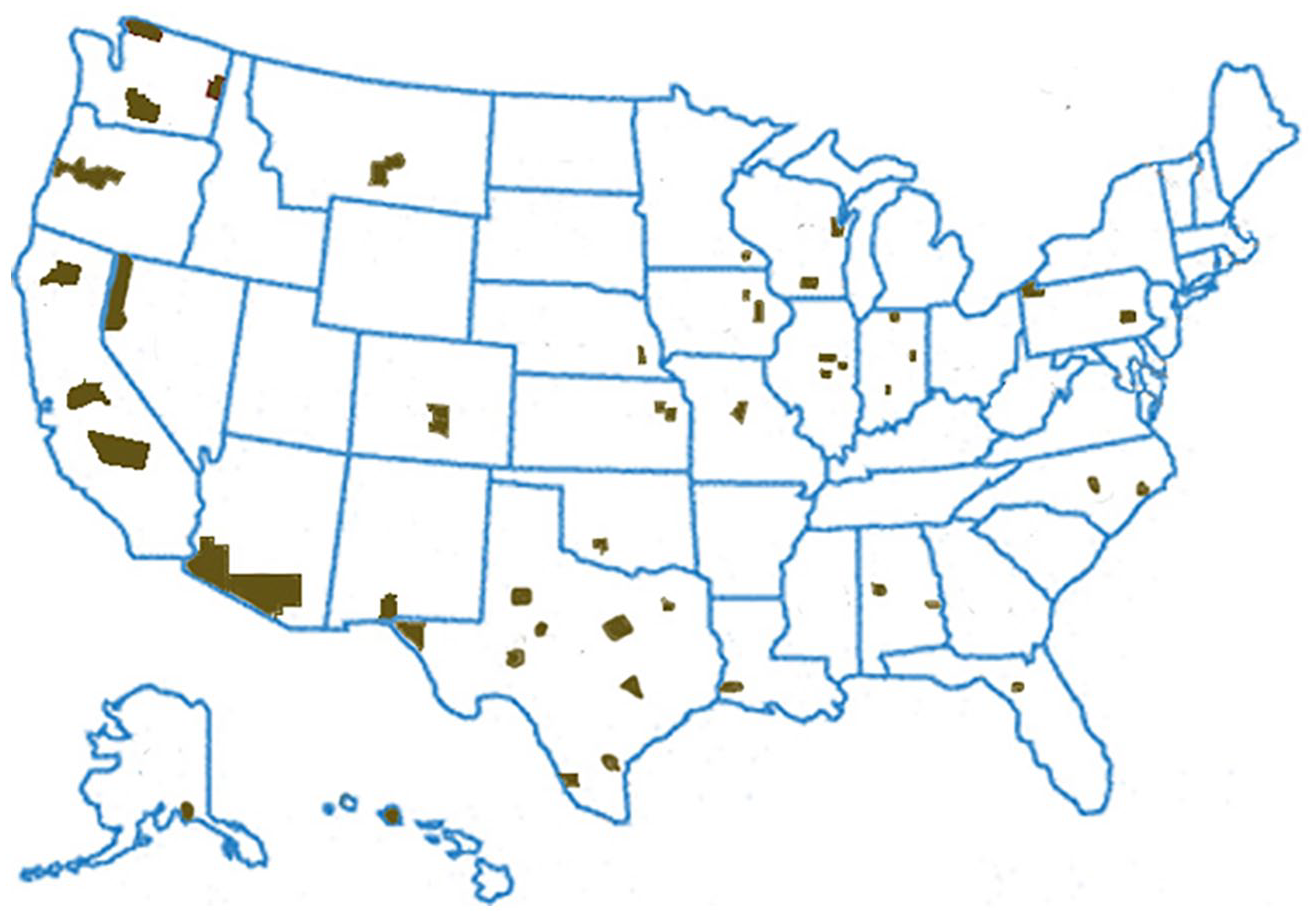
Location of sampled counties.
I examine how diverse newspaper organizations affected the formation of the first museums in the history of the 50 SMSAs. I follow up the 50 communities from the point at which they entered the risk set for establishing a museum. Because the earliest museums were established in visible US cities (e.g. New York, Philadelphia, Boston) in the 1870s, I attempted to collect data on the museums and other information in each of the 50 communities from 1870 until the present time.
Methods: data
A variety of sources were used to compile the data. I identify the sources and discuss the variables constructed below.
Formation years of first museums
I asked reference librarians at the public libraries of the 50 sample center cities to search their local history, and provide me with the names and the founding years of the first museum in their city. I verified their answers by contacting the museums (all of the 50 first museums still exist today).
Newspapers
The source for the newspaper data is the annual directory, Ayer Directory of Newspapers and Periodicals (various years). According to the 1912 volume of the directory, “The object of the Annual is to assist an advertiser in making a selection of papers that will best serve his purpose in the territory he desires to cover.” I collected information on every newspaper in the sampled counties for every 2 years from 1870 to 1980 (the odd-year volumes reported the newspapers in the previous even years).
The directories list newspapers alphabetically by state and city within the state. For each newspaper, the directory records the title, frequency of publication, type (form), established date, pages, size, circulation, and price. The newspaper information contained in the Ayer Directory was initially self-reported by newspaper publishers and then verified by the directory. Every year, the Ayer Directory cut out a printed proof of each newspaper in the annual and mailed to the publisher, with the request that he or she make any necessary corrections and return it (1916 volume: 8). To ensure the accuracy of the self-reported records, the Ayer company asked an auditor experienced in both publishing and advertising to examine all self-reported records, and make a complete, detailed report to the Ayer Directory (see the introduction of the 1912 volume).
While the directory aimed to compile a complete list of all newspapers in the United States, it only included the newspapers considered to have value for the general advertiser or the general public. For instance, they excluded papers that were clearly issued for campaign purposes, published by single churches, or distributed by businesses primarily to exhort the value of their own goods (generally known as “house organs”). For newspapers issued in the interest of institutions, one general rule of inclusion was that the papers must have influence outside of the particular institution by or for which they were published (1918 volume: 5).
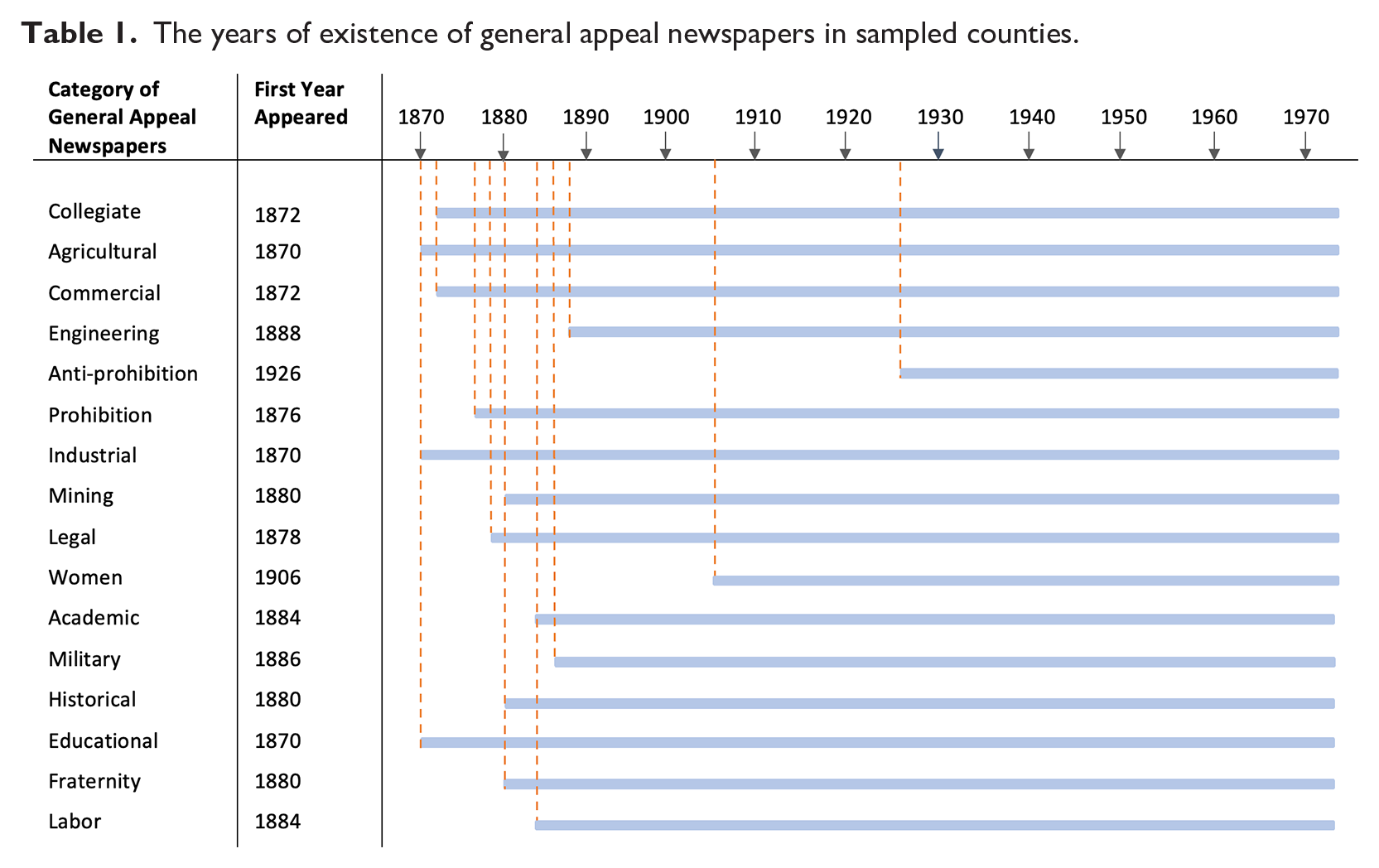
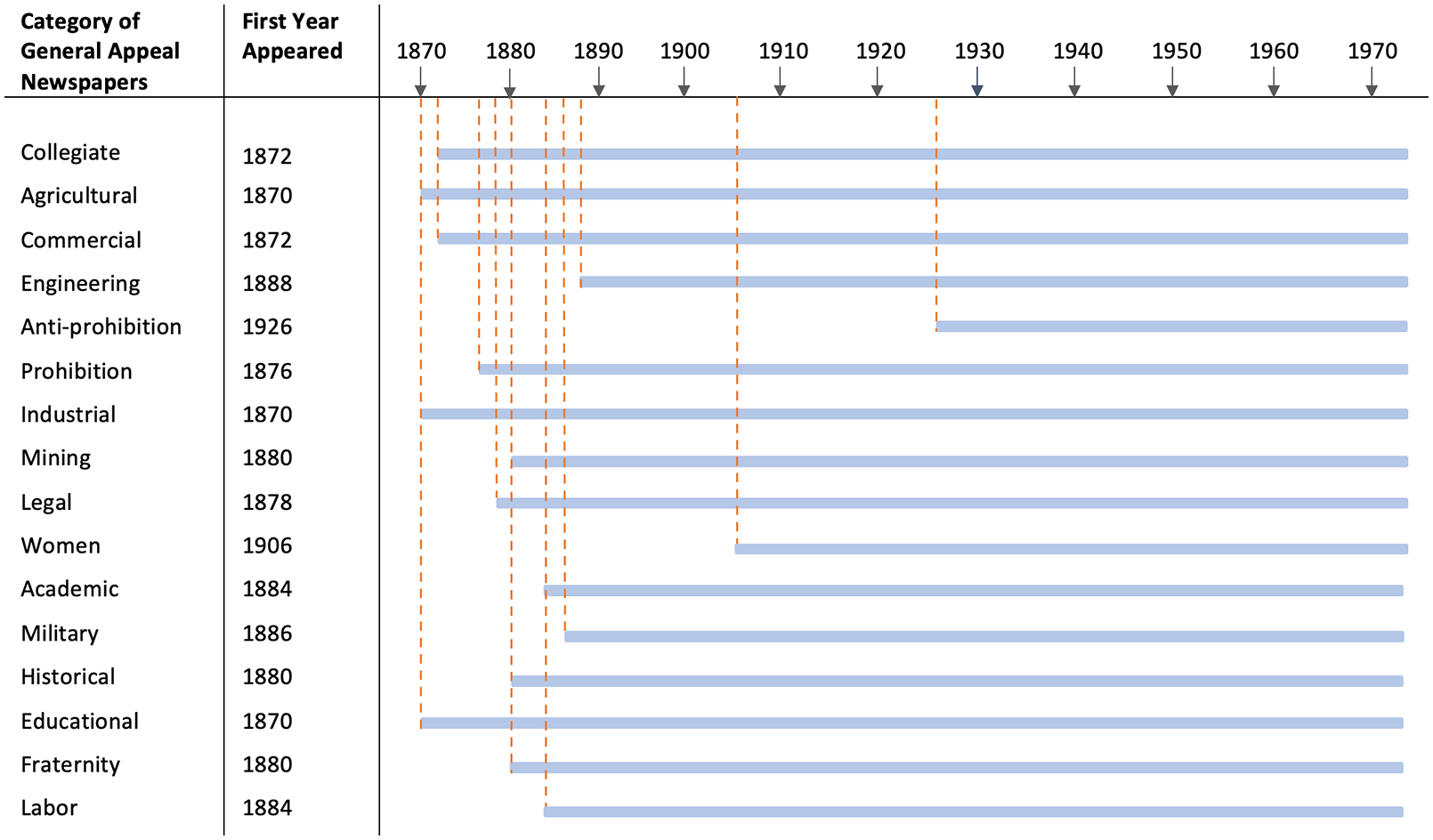
The directory also asked newspapers to reveal their contents and to indicate if they were ethnic publications. For the general appeal (boundary-cutting) papers, the counties in the sample showed 16 major categories of newspapers: collegiate, agricultural, commercial, engineering, anti-prohibition, prohibition, industrial, mining, legal, women, academic, military, historical, educational, fraternity, and labor. I categorized other minor general appeal categories as a 17th category, that is, “other content.” In calculating the diversity of general appeal newspapers, I used these 17 categories in total. I excluded political newspapers (e.g. Democratic, Republican, Independent) from the general appeal diversity calculation because they tend to divide a community based on major ideological lines. Table 1 shows the years of existence of general appeal newspapers in the sampled counties, including the first year of appearance for each general appeal form. Most of the general appeal newspaper forms had existed before the foundation of the earliest first museums in the sampled counties.
The years of existence of general appeal newspapers in sampled counties.
For the ethnic newspapers, there were 12 major forms: Black, Jewish, Spanish, German, Italian, Chinese, Japanese, Hawaiian, Bohemian, Norwegian, Danish, and Polish. Other minor ethnic newspapers were categorized as “other ethnic” form. I categorized non-ethnic newspapers as “non-ethnic” form. The general appeal newspapers are in this “non-ethnic” form. 3 In total, I used 14 forms to calculate the ethnic diversity of newspapers.
I calculated the newspaper diversity variables based on general appeal and ethnic forms using the Simpson diversity index:
A county with high ethnic diversity score was Pueblo County, Colorado in 1912. Pueblo County’s ethnic diversity score of .72 resulted from the presence of seven ethnic newspapers: two Black, two Italian, two Bessemer, and one Slovenia, and three non-ethnic newspapers. On the other hand, Olmsted County, Minnesota in 1880, with only four non-ethnic newspapers, had an ethnic diversity score of zero.
Wealth
I collected the assessed value of real estate and personal property (per capita) by decade from 1870 to 1970 in the 50 sampled counties. The data sources include Wealth, Debt, and Taxation (1870–1932), Financial Statistics of Counties (1941), and Census of Governments (1962–1992). I used the David-Solar consumer price index, extended by Peter Lindert, to convert all those values to 1982 US dollars. The control of wealth is essential because some might argue that wealthier communities are more likely to have the economic resources to create a museum.
Higher education
I controlled for the development of higher education institutions because higher education may stimulate cultural assumption and impact the formation of cultural institutions such as museums. To measure the development of higher education institutions, I used higher education enrollment (per 10,000 persons) at the state level by decade from 1870 to 1970. The higher education enrollment data are from the 120 Years of American Education: A Statistical Portrait published by the National Center for Education Statistics, US Department of Education (1993), and the state population data are from the decennial censuses from 1870 through 1970.
Wealth concentration
I controlled for wealth concentration from 1870 to 1970 because concentrated wealth could affect museum formation through large bequests. I used the wealth percentage of the richest 1% of the US population to capture wealth concentration. For this measure, I used Soltow’s (1989) estimate for the year 1870, DeLong’s (2003) estimate for the year 1900, and Wolff’s (1992) estimates for the years from 1922 to present. Following DeLong (2003), I interpolated this measure for the years between 1870 and 1900.
Socioeconomic controls
A number of additional socioeconomic data on the sampled counties were collected as control variables, including the size of human population, the number of manufacturing employees, and the urbanization level. But many of these and similar variables are limited by their availability and comparability over time. Hence, I focused on a set of control variables that were available and comparable for a long period, at least after conservative interpolation for intervening years. These variables include the natural log of the total human population in a county, the proportion of foreign-born persons in a county, and a simple measure of a county’s racial diversity based on three categories of White, Black, and other. I obtained these variables from the decennial censuses from 1870 through 1980. I linearly interpolated the total population variable for the intervening years.
Temporal and regional controls
Dummy variables of decades and state fixed effects are used to control for temporal and regional heterogeneity.
Methods: statistical model
I use an event history framework to estimate the effects of organizational diversity on the formation of public museums. Event history analyses model the effect of explanatory variables on the rate at which units (in this case, counties) experience an event or transition in qualitative states over time (Allison, 1984; Tuma and Hannan, 1984), yielding the instantaneous rate at which a unit experiences an event during an interval given that the event has not occurred by time
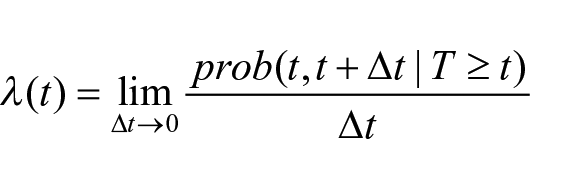
where
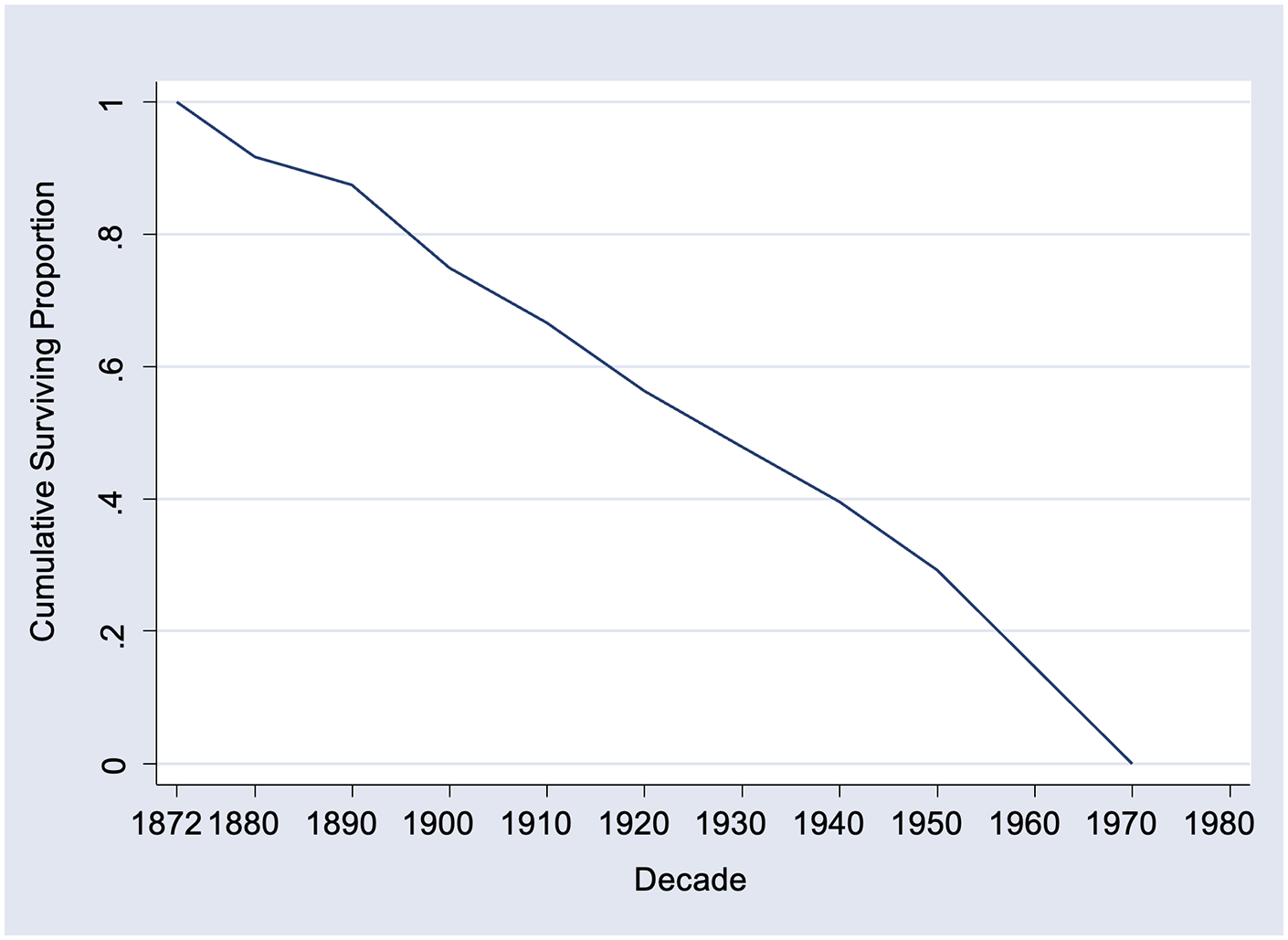
Museums: Cumulative proportion of surviving counties.
A county enters the risk set for establishing a public museum after either the year in which its center city was founded, or 1872, the first year in which the Metropolitan Museum of Art in the city of New York opened to the public, whichever came later. The Metropolitan Museum of Art was one of the earliest and most important museums in one of the most visible American cities. I stop the analysis in 1976, the year in which the last sample county established its first museum.
Table 2 shows the names of the first museums and their founding years. All the first museums in the 50 communities still exist today. Two counties established their first museums before 1872—the Wisconsin Historical Society in Dane County, Wisconsin (1846), and the University of Iowa Museum of Natural History in Johnson County, Iowa (1858)—and are not in this analysis. Six of the museums are located on college campuses, for example, the University of Oregon’s Museum of Art (UOMA); five have the state name in their titles, for example, the Kansas State Historical Society Museum. They are listed as first museums in the communities because I verified with the reference librarians that all of those museums were initiated and sustained by local citizens in the early years.
First museums and formation years in the 50 sampled counties.
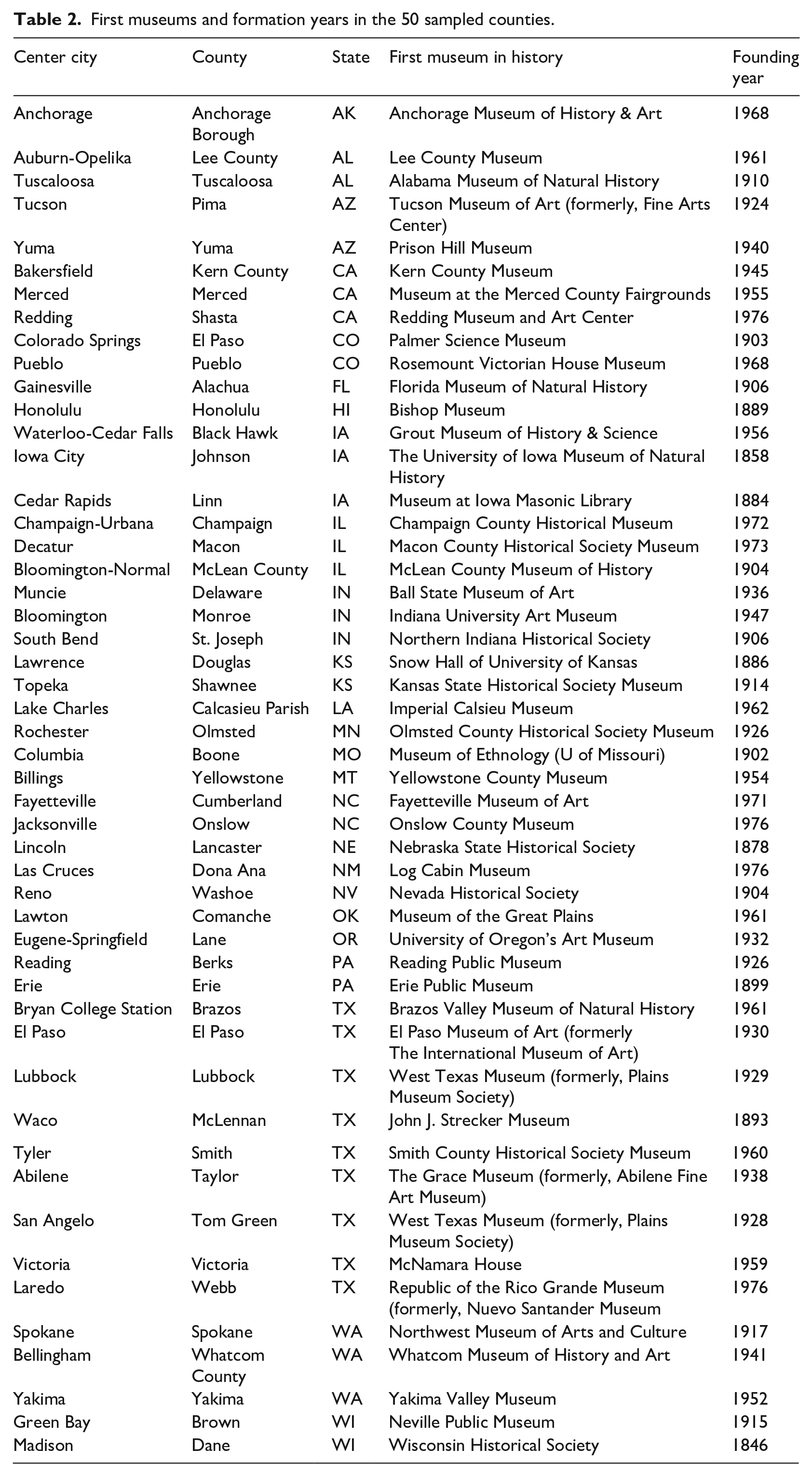
Figure 4 shows the total number of general appeal newspapers and the total number of first museums in the sampled US counties over time. It demonstrates that while the total number of general appeal newspapers fluctuated significantly over the century from 1870 to 1970, the total number of first museums was almost linearly increasing over the century in the sampled counties. Therefore, the development of general appeal newspapers and that of the museums were unlikely to be driven by a common cause. That the number of local newspapers fluctuated constantly is consistent with Janowitz’s (1952) observation. In his classic study of community press, Janowitz (1952: x) wrote that “Deaths of publishers, the changing social composition of neighborhoods, radical shifts in transportation and shopping patterns, rising production costs—all have had their impact [on the survival of local community press],” and “[in Chicago], Twenty-seven of the newspapers operating in 1950 (or almost one-third of the total) were no longer being published fifteen years later.”
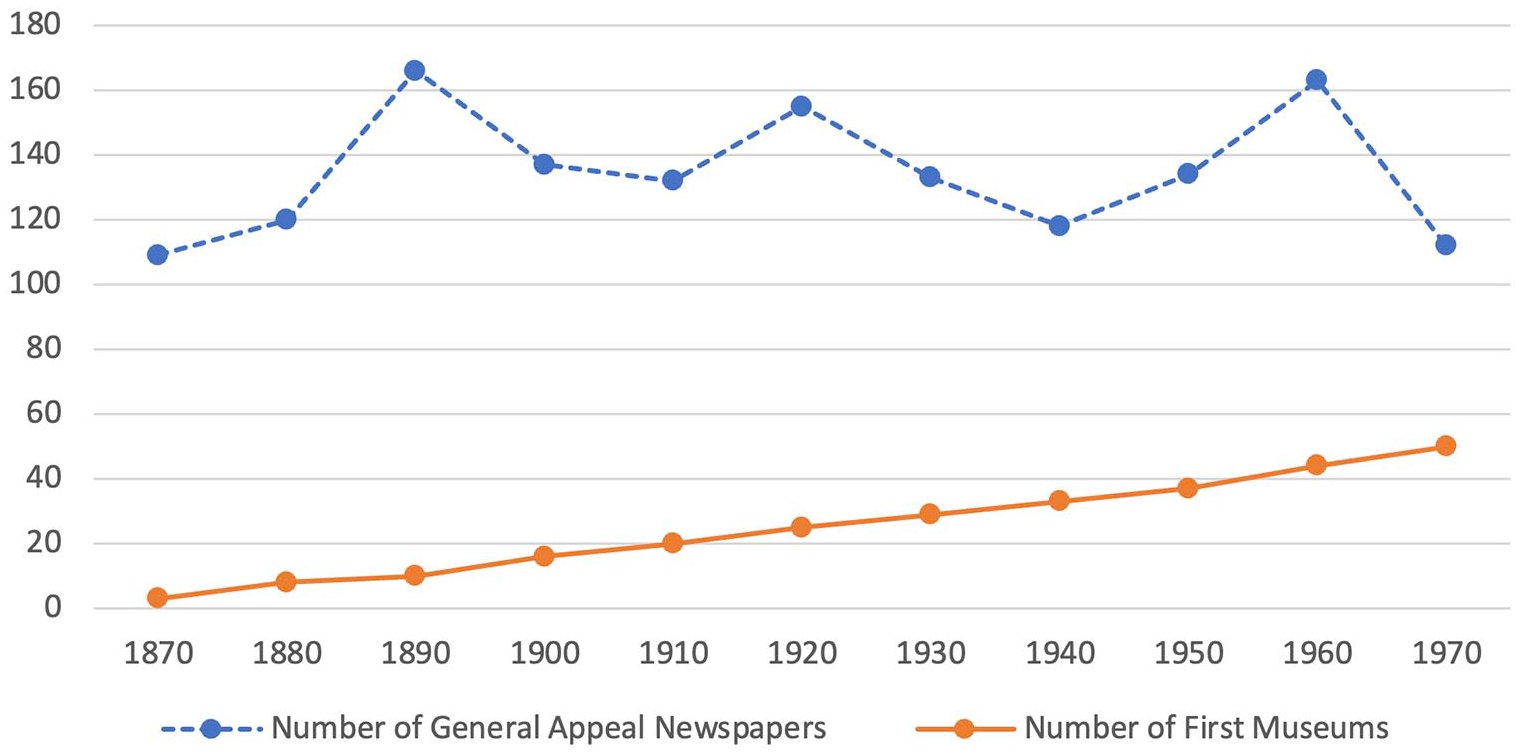
Number of general appeal newspapers and first museums in sampled counties.
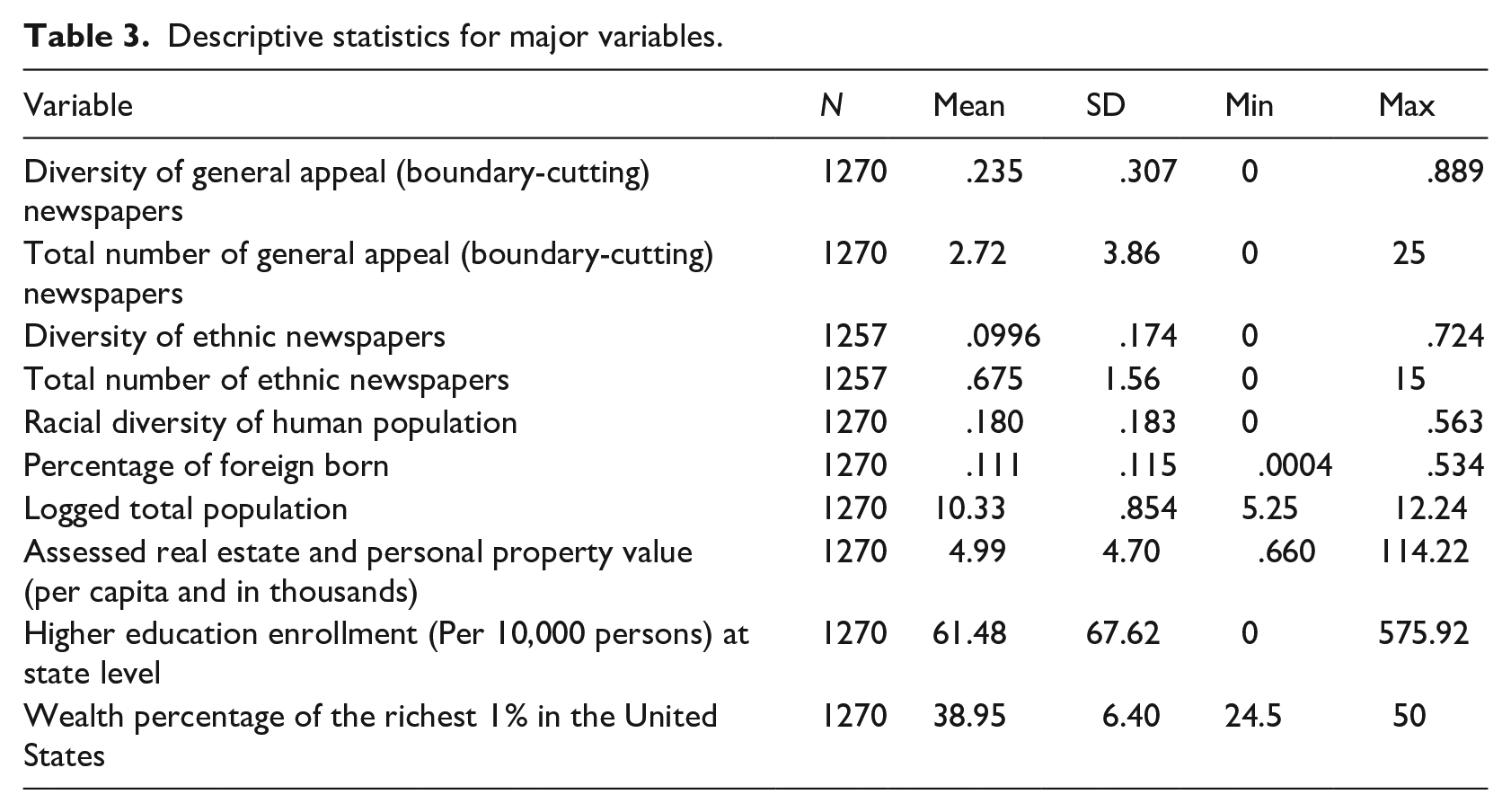
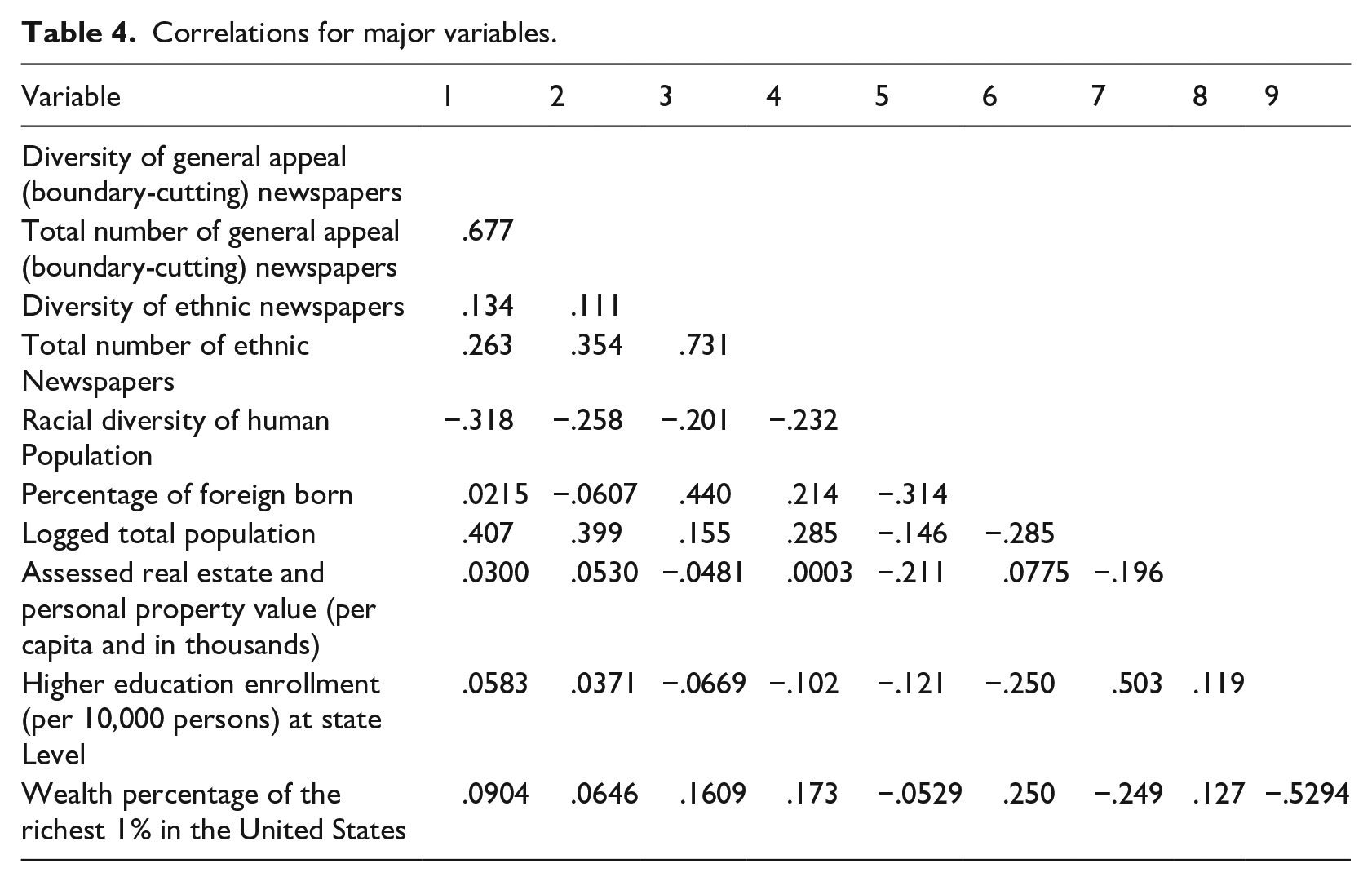
Table 3 gives the basic descriptive statistics for the main variables used in analysis, and Table 4 provides the correlation coefficients between these main variables. I calculated the variance inflation factor scores for all the independent variables with Stata’s Collin command, and all the values were below 3, suggesting that multicollinearity should not be a big concern for the model estimations.
Descriptive statistics for major variables.
Correlations for major variables.
Findings
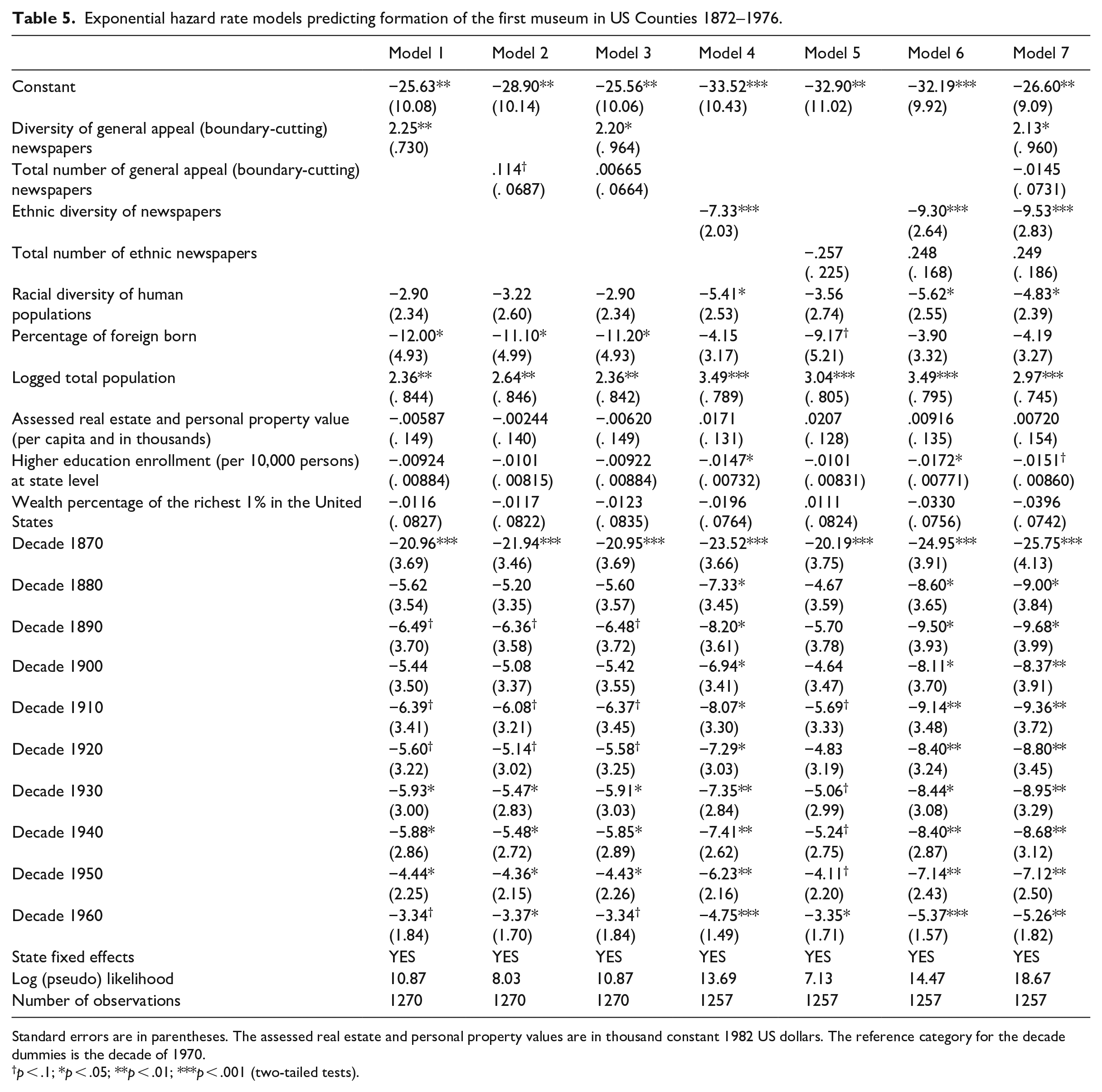
Table 5 presents estimates of the newspaper diversity effects on the formation of public museums using exponential hazard rate models, with a basic set of socioeconomic controls, wealth, higher education enrollment at state level, wealth share of the richest 1%, temporal and regional controls. Models 1–3 show the estimates of the diversity of general appeal newspapers and the total number of general appeal newspapers. In Model 1, the general appeal newspaper diversity variable shows a positive and statistically significant effect (p < .01, two-tailed). Hence, the estimates from Model 1 provide support for Hypothesis 1, which predicts that the diversity of general appeal newspapers in a community should be associated with faster foundation of its first museum Model 2 tests the effect of the total number of general appeal newspapers, and shows that the total number of general appeal newspaper variable is positive and marginally significant (p < .1, two-tailed), suggesting that the density of general appeal newspapers in a community has a positive effect on the formation of its first museum. Model 3 shows the combined effects when both the diversity of general appeal newspapers variable and the total number of general appeal newspapers variable are included in the model. The significance level of both the diversity of general appeal newspapers and the total number of general appeal newspapers variable drops in Model 3. This can be due to the correlation between the diversity of general appeal newspapers and the total number of general appeal newspapers. But the diversity of general appeal newspapers variable remains positive and statistically significant (p < .05, two-tailed). Therefore, Model 3 provides further support for Hypothesis 1.
Exponential hazard rate models predicting formation of the first museum in US Counties 1872–1976.
Standard errors are in parentheses. The assessed real estate and personal property values are in thousand constant 1982 US dollars. The reference category for the decade dummies is the decade of 1970.
p < .1; *p < .05; **p < .01; ***p < .001 (two-tailed tests).
Models 4–6 in Table 4 show the estimates of the ethnic diversity of newspapers and the total number of ethnic newspapers. In Model 4, the ethnic diversity of newspapers variable shows a negative and statistically significant effect (p < .001, two-tailed). Hence, Model 4 provides support for Hypothesis 2, which posits that the ethnic diversity of newspapers in a community is associated with slower foundation of its first museum. Model 5 tests the effect of the total number ethnic newspapers, and shows that the total number of ethnic newspapers variable is statistically insignificant, suggesting that the density of ethic newspapers within a community has no independent effect on the formation of its first public museum. Model 6 combines both the ethnic diversity of newspapers and the total number of ethnic newspapers, and demonstrates that ethnic diversity of newspapers variable remains negative and statistically significant (p < .001, two-tailed). Therefore, Model 6 provides further support for Hypothesis 2. Model 7 in Table 5 is a full model with all the variables included, and all the above statistical patterns stay. Model 7 gives further support to both Hypothesis 1 and 2.
As for the major control variables, the racial diversity of human population variable shows a negative and statistically insignificant effect in Models 1–3 and Model 5. This can be due to the operationalization of this variable. The three categories—White, Black, and others—might be too simple to capture the racial and ethnic diversity of a local community. The racial diversity of human population variable does become negative and statistically significant in Model 4 (p < .05, two-tailed), Model 6 (p < .05, two-tailed), and the full Model 7 (p < .05, two-tailed) when the ethnic diversity of newspapers is included in the models. This may reflect that diversity of ethnic newspapers variable (with much more refined categories) helps “bring out” the effect of the racial diversity of human population variable (with only three simple categories) by reinforcing community cleavage along racial and ethnic lines.
As expected, the percentage of foreign born variable is negative and statistically significant in Models 1–3 (p < .05, two-tailed) and Model 5 (p < .1, two-detailed), suggesting that communities with a higher proportion of foreign born tend to have lower community solidarity and collective action capacity for the public good, such as founding a community-wide museum in this analysis. The significance level of the percentage of foreign born variable drops in Models 4, 6, and 7 when the ethnic diversity of newspapers variable is included in the models. This can be due to the correlation between the ethnic diversity of newspapers variable and the percentage of foreign born variable.
And, as expected, the logged total population variable has a positive and statistically significant effect (p < .01 or p < .001, two-tailed) in all the models. Overall, larger communities should have better resources and stronger demand for cultural institutions such as a public museum. The assessed real estate and personal property value (per capita) variable shows a statistically insignificant effect, suggesting that wealth per capita does not have an impact on the formation of a community’s first public museum. The higher education enrollment (per 10,000 persons) at state level variable is negative and statistically insignificant in Models 1, 2, 3, and 5, but it shows a negative and significant effect in Models 4, 6, and 7 when the ethnic diversity of newspapers is included in the models. This is consistent with Janowitz’s (1952: 117) observation that people with higher education were less interested in local press. He maintained that “Education perhaps constitutes a degree of sophistication leading away from local orientations” (p. 117). Seen in this light, the decreasing interest of those with higher education from local newspapers (and presumably local affairs) could negatively impact community solidarity and collection capacity for the public good, such as founding a community-wide museum. The wealth percentage of the richest 1% variable shows a statistically insignificant effect in all the models, indicating that wealth concentration does not have an impact on the founding of a community’s first public museum.
Discussion and conclusion
While it has long been recognized that organizations play a central role in human communities, the socioeconomic consequences of organizational distribution have not been systematically examined. In this study, I theorize that the diversity of organizations can influence community solidarity by integrating or segregating the human populations, and demonstrate empirically the effects of diverse newspapers on the formation of public museums in the US local communities. To the best of my knowledge, this study is the first attempt to theorize and investigate how organizational diversity shapes social interactions in a community, and consequently influences the community’s civic engagement for public good. It has implications for a wide range of social, political, and economic outcomes. This theoretical perspective should help explain the availability and quality of any public good sustained by collective action in communities.
My findings show that the diversity of general appeal (boundary-cutting) newspapers has a positive effect on the formation of public museums. I interpret this finding as a reflection of the integrating effects of general appeal newspapers. Sociological literature has long recognized that race and ethnicity are among the most divisive parameters in American communities. Diverse general appeal newspapers help integrate a community by increasing public participation and more importantly, interaction and awareness among people from different racial or ethnic backgrounds. Consequently, a diverse array of general appeal newspapers has a positive effect on museum formation by helping to build a shared community identity and enhancing the community’s ability to act collectively. In contrast, the results show that diversity of ethnic newspapers has a negative effect on the formation of public museums. This finding bears out the segregating effects of ethnic newspapers. Given a certain level of ethnic diversity among the human population in a community, the more diverse ethnic newspapers there are, the more likely people would be embedded in their own ethnic group, and less likely to reach out and connect with people from other ethnic groups. Communication at whole-community-level fragments. People in a fragmented community are less likely to maintain a sense of common community citizenship, and less likely to be concerned about the public good at community level. Consequently, diversity of ethnic newspapers has a negative effect on museum formation in a community.
Importantly, the above key findings on the diversity of newspapers are net effects after controlling for the total number of newspapers in a community. Because people in a community have heterogeneous tastes and interests, theoretically, the density of organizations should not have an independent effect in segregating the community. For instance, a higher total number of ethnic organizations would not necessarily exert a stronger segregation effect along racial and ethnic lines. For the sake of illustration, let us consider two hypothetical communities A and B, and assume they have the same ethnic distribution of people (25% White; 25% Black; 25% Hispanic; 25% Chinese). Let us also assume that community A has 15 ethnic newspapers and community B has only eight. But all the 15 ethnic newspapers in community A are White newspapers, and community B has two White, two Black, two Hispanic, and two Chinese newspapers. In this situation, the ethnic newspapers in community B would generate a stronger segregating effect along racial and ethnic lines than those in community A even though community A has more ethnic newspapers than community B. Similarly, a higher total number of boundary-cutting organizations would not necessarily produce a stronger integration effect across dominant community segregation lines. Let us consider another two hypothetical communities, C and D, and assume that C has five educational newspapers and D has three newspapers (one educational newspaper; one women’s paper; one labor newspaper). While community D has a smaller total number of newspapers, it may have better overall integration than community C by covering people in three interest areas, assuming the communities have enough interest in each coverage area. Hence, it is the distribution of organizations (e.g. diversity)—not the density of organizations—that has clear and independent theoretical prediction power on community integration versus segregation. The insignificance of the total number of ethnic newspaper variable and the total number of the general appeal newspapers in my analysis provides support to the above reasoning and statement on the effect of density of organizations in communities.
Theoretically, there could be a potential argument that newspaper diversity effects could be “mechanical” or even artificial, in the sense that as diversity goes up, there is greater chance that the community will have a newspaper (e.g. fine arts newspaper) specifically charged with enacting the formation of museums. According to this argument, it is not the diversity of newspapers that affects community solidarity by integrating or segregating the people but the specific type of newspaper that activates a particular interest group to create the museum. My data do not support this argument. First, at least in my data, it is very rare for a community to have a fine arts or museum newspaper that directly links to a museum. Second, there is no clear pattern to indicate that places with diverse newspapers are more likely to have a fine arts or museum newspaper.
By theorizing the integration versus segregation effects of organizational diversity, this research contributes to organization theory by studying the significance of organizational diversity within a community for shaping a community’s civic engagement for public good. As I discussed earlier, at least 15 empirical economic studies have reached the conclusion that heterogeneity reduces civic engagement (Costa and Kahn, 2003). However, these studies have examined only the heterogeneity of the human population (e.g. ethnic diversity). None of them has studied the effects of organizational distribution in a community, and most are cross-sectional studies. For example, using the 1994 US census data, Alesina et al., 1999) found that public goods expenditure in American cities is inversely related to an area’s ethnic diversity. Luttmer (2001) demonstrated that levels of welfare benefit are relatively low in racially heterogeneous communities. Using 1998 census data from Kenya, Miguel and Gugerty (2005) found that ethnic diversity in the human population has a negative relationship with local school funding and the quality of water wells. The general theory of this research implies that we need to study the integration versus segregation effects of organizational diversity on public goods in addition to the effects of human population diversity.
This study has implications for a growing literature on how the distribution or particular type of organizational forms shapes the collective action capacity in local communities. In a study of California counties from 1990 to 2010, Dutta (2017) demonstrated that counties with more diverse forms of voluntary associations had a higher founding rate of local human services organizations after disasters. He interprets that a diverse array of voluntary organization forms enhanced a local community’s collective action capacity to cope with disasters by providing a richer set of organizing models and resources. This finding supports the early insights of evolutionary theorists that diverse organizations, which represent heterogeneous routines, provide better solutions for the social system in uncertain conditions (Grabher and Stark, 1997; Hannan and Freeman, 1989; Nelson and Winter, 1982).
However, we still lack studies on how organizational diversity in a local community shapes its collective action capacity through another important mechanism, that is, diverse organizations engender optimal (or superior) matching between the diverse organizations and individuals of different tastes and social positions (e.g. Fujiwara-Greve and Greve, 2000; Greve, 1994; Sørensen and Sorenson, 2007). Scholars have recently moved toward the direction of examining how particular organizational forms within a local community affect the community collective action capacity by enacting mandatory or voluntary matching with diverse people in the local community (Longhofer et al., 2019). But how the diversity of organizational forms shapes the communal social interaction patterns and consequently the civic engagement for public good has not been systematically studied. My study contributes to the above growing literature. First, based on the optimal (or superior) matching mechanism, this study theorizes how diverse forms of organizations can optimally integrate or segregate a local community across the major community segregation lines, and consequently shapes its collective action capacity for public good. Second, while the abovementioned recent studies use two or three decades of data to examine organizational effects on community collective action, I complied a century-long data set for this endeavor because organizational differences play out over long periods of time and data with a short time-span may not able to capture effectively the changes of the local environments.
This study has also implications for research on the emergence of new organizational forms (categories). Where new organizational forms come from is a central question of organization theory. Previous literature has studied how changing social values/moral norms (e.g. the rise of Progressive movement) or the institutionalization/structuring of organizational fields influenced the emergence and success of new organizational forms (e.g. David et al., 2013; DiMaggio, 1991; Haveman and Rao, 1997; Rao, 1998). And, the role of field-wide collective actions by institutional entrepreneurs and professionals was highlighted in the process. While these studies have provided important insights on how changes at the societal level and institutionalization at organization-field level shape the emergence and eventual dominance of new organizational forms, they have neglected that the realization of certain new organizational forms at a particular locality may hinge on the solidarity and collective action capability of the place. This is important because the diffusion of a new organizational form must take place across localities and collective action of different local interest groups can be required to successfully implement a new organizational form at a place.
My study moves beyond the impact of social values and institutionalization/structuring of organizational fields on the emergence of new organizational forms, and advances the literature by theorizing and testing how the diversity of existing organizational forms shapes the solidarity and collective action capability of a local community—to implement a new organizational form—by integrating or segregating the people across dominant community segregation lines. First, by doing so, this study shifts the study of the emergence of new organizational forms from societal and organizational-field level to the community ecology, solidarity and collective action ability of a locality. Again, for a new organizational form to take hold, it eventually depends on successful local implementation. Second, to the best of my knowledge, most previous studies of new organizational form emergence were conducted at nation-wide industry level and many of them were qualitative studies. By collecting high-quality, systematic quantitative data at local communities, my study demonstrates how variations in local solidarity and collective action capability shape the local emergence of a new organizational form. Third, although this study does not examine the possible interaction effects of changes at societal level/organization-field level and local solidarity/collective action capability on the emergence of a new organizational form, the theorizing and testing of these local effects helps open the door for future research on this endeavor. For instance, would the effects of local solidarity and collective action capability be stronger for the local emergence of a new organizational form when the value changes at the societal level or the legitimation of an organizational-field are still at early stage?
Fourth, previous studies have largely focused on how the competition between different organizing frames/templates—within an organizational field—impacts the emergence and success of a new organizational form, paying scant attention to the possible systematic influence of organizational distributions outside the organizational field. This study shows that the diversity of organizational categories in an alternative organizational field (local press)—by shaping community solidarity and collective action capability—can systematically impact the local emergence of a new organizational category in a focal organizational field (public museums). The findings suggest that future research needs to examine how the distribution of organizational categories from outside a focal organizational field may trigger some important communal processes at a locality, and consequently influences the local emergence of a new organizational category at the focal organizational field.
In terms of implications to the newer media and contemporary issues, the transition to digital news consumption has tremendously transformed the traditional newspaper industry in recent years. Recent scholarship has documented that with the proliferation of media choices, individuals are paying more attention to national news than local media (Hopkins, 2018; Martin and McCrain, 2019). In 2010, the online sites of local news outlets received less than .05% of page views in a typical market (Hindman, 2011). As a result, many local newspapers have been forced to shut their doors, and the surviving ones have significantly cut off staff and circulation under financial pressures. Abernathy (2018) found that half of the 3143 counties in the United States have only one newspaper, and almost 200 counties have no newspaper at all, leaving thousands of local communities at the risk of becoming news deserts.
Clearly, the diversity of newspapers in US local communities has diminished, with most communities having probably zero diversity of newspaper forms. Based on my theory and empirical findings, this growing trend would continuously worsen communal collective action capacity for the public good. Indeed, Reich (2018) pointed out the decline of public good in US communities over the past decades. Future research can study how the shrinking diversity of local newspaper forms has contributed to the declining public good in US communities. New media researchers may explore how locally oriented social networking sites, platforms, and blogs integrate or segregate a local community across dominant segregation lines and consequently affect community collective action for the public good.
Some limitations of this study deserve discussion and point to future research opportunities. Although qualitative evidence based on various historical studies demonstrate that the general appeal newspapers facilitated integration across racial and ethnic groups, I had no historical data on how different racial or ethnic groups subscribed to general appeal newspapers in local communities. While my study is century-long and tracks down to the beginning of the American museums in the 1870s, future studies that pursue a shorter period with more detailed newspaper subscription data may complement my findings. A second limitation is that this research does not have qualitative data to show that due to the reading of the same type of local newspaper, people from different racial and ethnic backgrounds recognize each other more as citizens of a wider community and become more willing to contribute to local public good. Future studies can demonstrate this causal relationship by conducting interviews with readers of the same local newspaper but from different racial and ethnic backgrounds. A third limitation is that my study examined 50 American counties with only one large city, which was the only place of significant economic and social activity. Although these 50 counties spread out across the US, and are autonomous, well-bounded, comparable environments, the founding of their first museums could be affected by nearby or similar locations. But I did not have data on the founding of the first museums across all the locations in the United States, which would allow me to control for the possible contagion across locations. A fourth limitation is that due to the century-long research design, I was not able to have historical control variables on education and wealth inequality at the county level, which could affect the museum foundation. Future research can test the theory using shorter periods with these control variables at local community level.
Broadly speaking, this research contributes to the literature on the impact of organizations on the larger social system, an agenda envisioned by Weber and reinforced by Parsons. In the inaugural issue of the Administrative Science Quarterly in Parsons (1956), Parsons, one of the most influential social theorists of his day, argued that an adequate organization theory must have three foci. The first is about an organization’s adaptation to the environment within which it operates; the second is structures and processes internal to the organization; and the third is the impact of organizations on the broader social system in which they are embedded. But most research on organization theory has concentrated on Parson’s first two foci rather than the third, since major organization theories such as resource dependence theory, institutional theory, and organization ecology emerged in the late 1970s. By systematically examining the consequence of organizational distribution on a community’s civic engagement for public good, this study helps reestablish the breadth of focus with which organization theory was initially concerned.
Footnotes
Appendix 1
Acknowledgements
The author wishes to thank Strategic Organization coeditor Robert David and three anonymous reviewers, William Barnett, Glenn Carroll, Paul DiMaggio, Henrich Greve, Michael Hannan, and Martin Ruef for their insightful comments.
Funding
The author(s) received no financial support for the research, authorship, and/or publication of this article.
