



Abstract
Grand societal challenges such as forced displacement are extreme and complex issues that are challenging to individuals and might seem insurmountable. How do local actors make sense of, position themselves in and act on such challenges? We conducted a case study of the collective sensemaking narratives of 71 actors involved in the refugee crisis on Lesbos, Greece. We elaborate how actors make sense of their role in the local response to this grand challenge and explain why some ultimately chose to cooperate to address the plight of refugees while others distributed tasks or avoided responding altogether. We identify three collective sensemaking narratives that actors use to validate such action strategies aimed at alleviation, personal recovery or structural change; and as characterized by different forms of interaction and emergent collective sensemaking. We contribute with our article to the study of responses to grand challenges by showing how a collective sensemaking framework can be used to understand local responses. We also contribute to extant theorizing on collective sensemaking by showing how actors make sense of grand challenges through interactions with other actors and how their narratives inform individual and collective action.
Keywords
Introduction
Local families were the first to respond as the beaches of Lesbos became the setting of a humanitarian crisis in 2015, with over 500,000 refugee arrivals – about five times its local population: ‘As an island we were not ready. We didn’t have the means to help these people.’ Local inhabitants felt that their ‘role in this was thrown upon us’. Over a period of several months, local families and entrepreneurs encountered refugees in their direct, daily environment. Men, women, families with grandparents, children and babies arrived – sometimes literally – in their backyards, or along the way to school or work: ‘we had boats arriving right here at the hotel, right at our beach’. Greek emergency services followed, and international organizations and volunteers engaged shortly after that, creating a complex response system. A strategic advisor to non-governmental organizations (NGOs) commented that he came to Lesbos because he saw ‘a nice project’ about ‘the integration of refugees and stuff’. Professionals mentioned wanting to learn new skills and develop professionally, as, ‘to be on the ground, [. . .] can be very good I think for work mobility later on’. Many of these professionals also mentioned they felt a sense of responsibility to get involved, and ‘take my responsibility as European’ and ‘see how I can get a little bit closer to the fire [. . .] without necessarily wanting to go to Syria’. Volunteers commonly took a break from their studies or work to provide humanitarian aid. One international volunteer commented, ‘I have been given an opportunity to learn a lot and how do you say it, discover new skills, so I think that’s very appealing.’ Another international volunteer told us their ‘first motivation to come here is just feeling really, you know, sad and frustrated and kind of helpless watching everything unfold’.
Given these different starting points, perceptions and experiences of crucial actors in this local manifestation of the grand challenge of forced displacement, we wondered how locals, professionals and volunteers individually and collectively made sense of the crisis and how this influenced their individual and collective responses. When we asked how actors experienced the interactions with each other, some local inhabitants shared stories of helplessness as they were warned by law enforcement that helping refugees would be considered human trafficking or were told to ‘go away’ by arriving volunteers or NGOs. Other inhabitants, professionals and volunteers instead shared stories of hope and expressed that they felt that many of the other responders also ‘care for these people’ and began to jointly build schools and facilities for refugees.
As other authors have noted, ‘the world is besieged by [grand] challenges’ (George et al., 2016: 1880) that ‘affect vast numbers of individuals in often profound ways’ (Eisenhardt et al., 2016: 1113) and raise ‘important questions around how individuals, organizations, and society might go about preparing for their impact’ (Hällgren et al., 2018: 111). Forced displacement is one of many highly complex and persistent societal challenges, intersecting with war, climate-change induced natural disasters such as floods, droughts, earthquakes, poverty, water scarcity, famine and disease outbreaks (UNHCR, 2019).
Sensemaking activities are critical ‘in dynamic and turbulent contexts, where the need to create and maintain coherent understandings that sustain relationships and enable collective action is especially important and challenging’ (Maitlis, 2005: 21). Understanding how individual and collective sensemaking informs collective action (Cornelissen et al., 2014; Maitlis, 2005; Quinn and Worline, 2008; Weick, 1993) is particularly important for many of society’s grand challenges as these contexts are not only (1) extreme, exceeding any single individual or organization’s capacity to act on and resolve the issue (Hannah et al., 2009); but they are also (2) highly complex, entailing multiple stakeholders with different views engaged at multiple levels of organizing and (3) persistent, as the extreme context continues beyond particular crisis episodes (Eisenhardt et al., 2016; Ferraro et al., 2015).
So far, however, the study of collective sensemaking has focused on relatively contained crises involving established and tightly coupled systems of formal actors (Cornelissen et al., 2014; Maitlis, 2005; Weick, 1993), creating what we see as two critical blind spots. First, rather contained systems of tightly coupled formal actors are a markedly different setting from grand challenges that are complex and involve iterated interactions between diverse actors with different views on the issue and of what is required in terms of collective sensemaking and action (Ferraro et al., 2015). Second, the short-lived crises that have been studied to date are themselves not representative of persistent challenges where the event continues beyond the initial crisis and despite ongoing actor intervention (Eisenhardt et al., 2016).
There is thus a need, we argue, to better understand collective sensemaking of highly complex and persistent societal problems (Colquitt and George, 2011; Howard-Grenville et al., 2014; Tsui, 2013). To address this need, we formulate two research questions: (1) How do actors make sense of, and position themselves in, the local response to a grand challenge? (2) How do actors enact the situation, and in doing so impact the collective response?
We draw on semi-structured in-depth interviews with 71 actors who were engaged in the refugee crisis on Lesbos, Greece. We inquire about the backgrounds, perceptions, thoughts, feelings and actions leading up to, during and after their engagement with the crisis on the island to reconstruct their collective sensemaking narratives and abductively theorize patterns of collective sensemaking. As part of these patterns, we consider the interactions that trigger collective sensemaking, the formation of collective ‘sense’ in relation to the refugee crisis over time, the action strategies people adopt and their collective impact on the issue locally.
We propose that sensemaking narratives of diverse actors in the local manifestation of a grand challenge can be used to understand the emergence of collective solutions to address society’s complex and persistent societal challenges (Eisenhardt et al., 2016; Ferraro et al., 2015). We offer two main theoretical contributions from our study. First, we contribute to the literature on how individuals make sense of extreme contexts (Brown et al., 2008; Maitlis and Sonenshein, 2010) by looking at how people make sense of grand challenges. Specifically, we conceptualize grand challenges as extreme contexts (Hällgren et al., 2018) that are particularly complex and persistent and we investigate how individuals construct narratives and compress the grand challenge into a personal understanding.
Second, we contribute to extant theorizing on collective sensemaking (Maitlis, 2005; Quinn and Worline, 2008; Weick, 1995; Weick and Roberts, 1993) by adding the influence of complexity and persistence of grand challenges to the understanding of collective sensemaking. Specifically, we identify three patterns of emergent collective sensemaking and show how these inform individual and collective responses over time. In doing so, we answer calls to deepen our understanding of the distributed and heterogeneous nature of organizing in extreme contexts (Hällgren et al., 2018; Maitlis, 2005).
Theoretical background
Grand challenges are complex and persistent issues that are challenging to grasp in their entirety by a single individual. As essentially wicked issues, they resist being captured in a single, simple definition. Here, we theoretically approach the question of how individuals may individually and collectively make sense of grand challenges through a sensemaking lens. The literature that we briefly review involves general work on individual sensemaking, as well as work on the triggers for and processes of collective sensemaking. We end this section by extending a sensemaking lens to the grand challenge of the refugee crisis, as the setting for our study.
Sensemaking
Confrontations with extreme events can be powerful triggers that mobilize and perpetuate decision making and action (Maitlis and Sonenshein, 2010) as they tend to ‘shatter fundamental assumptions’ and ‘trigger sensemaking about the event, the self, and often the world at large’ (Maitlis and Christianson, 2014: 72). Extreme contexts and particularly crisis scenarios have traditionally provided a rich setting for the study of sensemaking among multiple actors (Eisenhardt et al., 2016). Indeed, many scholars have used sensemaking as a valuable lens to understand the occurrence and evolution of such scenarios (Hällgren et al., 2018; Maitlis and Christianson, 2014).
For our study, we understand sensemaking as an ongoing retrospective process that is grounded in personal identity construction (Weick, 1995). Actors make sense of specific circumstances by creating plausible narratives of understandings that are then used to validate and inform past, present and future actions in ways that reflect their own identity-related beliefs and assumptions (Brown et al., 2008; Weick, 1995; Weick et al., 2005). As such, sensemaking processes and actions can vary greatly between individuals owing to differences in personal beliefs and how and to what extent these are triggered in specific circumstances (Barton and Sutcliffe, 2009; Cornelissen et al., 2014; Farjoun and Starbuck, 2007; Rudolph and Repenning, 2002). Making sense of an event implies extracting cues from a situation, putting them into a plausible order and interpreting them based on salient frames, thus answering the questions ‘what’s the story? And now what should I do?’ (Maitlis and Sonenshein, 2010; Weick et al., 2005: 410). Accordingly, sensemaking and the construction of a coherent and plausible narrative go hand in hand.
Extreme contexts provide a particularly interesting setting to understand the role of sensemaking narratives in producing both individual and collective action, because ‘incomprehensible events tend to strip people of identity, leaving them no sensible narrative to enact’ (Quinn and Worline, 2008: 501), and people need, as mentioned, a plausible narrative of events to understand what is going on and how to respond (Weick, 1995). Accordingly, narrative approaches have been used to understand ongoing extreme events (Quinn and Worline, 2008) as well as their role in responses to past events (Boudes and Laroche, 2009). Quinn and Worline (2008) specifically have argued that narratives are crucial for collective action when under duress, as people cannot act without formulating narratives to understand who they are in that context, to explain the duress that they find themselves in, to help them make moral and practical judgements and to understand their place within a collective and (potentially) act as a collective.
Traditions of collective sensemaking
Collective sensemaking during or after extreme events has traditionally followed one of two approaches. The first has been predominantly concerned with the importance of sensegiving and its influence on the way issues are understood and enacted. For instance, Maitlis and Sonenshein (2010) elaborate how initial acts of sensegiving in the form of public statements can create powerful but misleading frames, which particularly in crisis contexts, are likely to generate fatal blind spots. Within the context of extreme events or crises, studies have indeed singled out the role of leaders and others who had an advantageous subject position in giving sense to a crisis scenario and influencing others to follow suit. Examples involve a fire spotter calling the Mann Gulch fire as a ‘10 o’clock fire’ (that would be out by 10 the next morning) (Weick, 1993: 635) and a police commander labeling a civilian as a possible terrorist suspect and asking for the mobilization of a firearms team (Cornelissen et al., 2014). However, singling out the predominant role of leaders or others’ sensegiving underappreciates interactions between disparate actors that are typical for grand challenges and how the ongoing interaction between them influences sensemaking processes (Maitlis, 2005; Maitlis and Sonenshein, 2010).
The second approach to collective sensemaking has focused not just on how sense is given but rather at how it is interactionally accomplished, zooming in on relationships between social structure and sensemaking (Weick, 1993), processes of identity generation and maintenance through social interaction (Brown et al., 2008), sensemaking around interrelations within social systems (Weick and Roberts, 1993) and relationships between collective sensemaking and collective action (Quinn and Worline, 2008). A poignant example of this theoretical focus is the study by Quinn and Worline (2008) who detail the interactions between passengers on Flight 93 with their relatives over the phone and with others on the plane. Passengers aboard that plane, which was hijacked by terrorists, had to ‘reestablish their identities and narratives’ and collectively figured out a possible response (2008: 504). These originally ‘unorganized strangers’ (2008: 504) were ultimately able to create a collective identity that enabled them to jointly attempt to stop the terrorists.
We position our study in the latter tradition of collective sensemaking, where we consider sensemaking to be an inherently social process that is grounded in individual identity creation and maintenance, as individuals interpret their environment in and through interactions with others, constructing accounts that allow them to comprehend individual and joint roles and possibly act collectively (Maitlis, 2005; Quinn and Worline, 2008; Ryle, 1949; Weick and Roberts, 1993).
Collective sensemaking in the local response to a grand challenge
Local responses to grand challenges differ from responses to traditional extreme contexts in terms of complexity and persistence. The complexity of grand societal challenges (Eisenhardt et al., 2016; Ferraro et al., 2015) is in stark contrast to, for instance, the orchestrated functioning of a trained crew on an aircraft carrier, where individual roles and responsibilities are formalized and limited to the ship itself (Weick and Roberts, 1993). The actors involved in the local response to a grand challenge are, again in stark contrast to the crew of an aircraft or a fire-fighting brigade, typically from different personal and professional backgrounds and representing different organizations (Eisenhardt et al., 2016; Ferraro et al., 2015). This is problematic, as having many diverse actors is more likely to lead to multiple and conflicting interpretations of problems, solutions and processes (Ferraro et al., 2015). As more diverse actors engage, power relations and politics may also become particularly influential in promoting (or indeed inhibiting) collective action (Maitlis, 2005; Maitlis and Sonenshein, 2010; Quinn and Worline, 2008). Such conflicting interpretations may undermine effective collective responses, but as previous authors have indicated, also provide specific opportunities for successful change through bottom–up, collective processes of joint action (Battilana et al., 2009; Garud et al., 2007). Indeed, research on responses to grand challenges does suggest promising ways to instigate positive change through collective action. For instance, authors have identified the enabling role of ‘turbulence and chaos’ in the emergence of new collaborative and organizational forms that may thrive under these conditions (Lanzara, 1983: 73) as well as the role of a shared moral dimension across disparate actor groups as facilitating effective collective responses (Kornberger et al., 2018). Theorizing on ways to foster coordination and collaboration without necessarily requiring agreement has suggested the importance of pragmatic ‘participatory structures’, the diffusion of ‘multivocal inscriptions’ and the pursuit of ‘distributed experimentation’ to allow the sustained engagement of diverse actors and actions (Ferraro et al., 2015: 372).
In contrast to a traditional extreme context, grand challenges are also remarkably persistent. This long-term character of grand challenges implies that actors enter or leave the crisis at different moments in time and refine their understanding over time (Weick, 1995). Owing to the dynamic and nonlinear evolution of the crisis over time, actors cannot foresee the consequences of their actions, potential future states or assign probabilities that may guide their actions (Ferraro et al., 2015). The persistence of grand challenges begs the question how diverse actors collectively make sense of their role over time, as they associate and interact with each other in the face of uncertainty regarding how the situation may evolve in the future, consequences of their actions and evaluations of their actions by others (Ferraro et al., 2015).
In short, we need a more systematic understanding of how people make sense of a grand challenge and how complexity and persistence influence collective sensemaking and action.
Approach and method of analysis
Approach
We apply a constructivist approach, in which the sensemaking narratives that emerge are considered ‘a world made real in the minds and through the words and actions of its members’ (Charmaz, 2000: 523). In this view, the stories people narrate provide insight into how they ‘make the unexpected expectable, hence manageable’ (Robinson, 1981: 60) and predict future states and behaviors (Martin, 1982). Thus, collective sensemaking narratives are not in their own right objective truths, but ‘filtered, edited and re-sorted based on hindsight’ (Brown et al., 2008: 1039).
In terms of theorizing, we address our research questions through an abductive approach (Alvesson and Kärreman, 2007; Mantere and Ketokivi, 2013). We selected our explanation of how actors respond to the local instantiation of a grand challenge through iteratively comparing our understanding of our data to extant theory on sensemaking and grand challenges (Harley and Cornelissen, 2020; Ketokivi and Mantere, 2010). Ultimately, we intended to identify how individuals are able to make sense of grand challenges for themselves and how such sensemaking fosters collaboration and possible collective solutions.
Specifically, we previously considered two alternative lenses through which to interpret our data and understand local responses to grand challenges. We originally approached the context from the perspective of robust action (Ferraro et al., 2015), but ultimately found that this lens was not able to account for the differing local approaches. We, for instance, found that the proposed strategies for collective action, for example, ‘participatory structures’, the diffusion of ‘multivocal inscriptions’ and the pursuit of ‘distributed experimentation’ (p. 378) were implemented in the field, but local actors differently utilized these strategies for their individual and organizational goals.
This shifted our attention to the individual sensemaking processes of actors (Brown et al., 2008), which we thought might explain why and how actors chose to utilize these robust action strategies (Ferraro et al., 2015) as well as other potential formal, material and moral tools at their disposal (Kornberger et al., 2018). However, individual sensemaking processes seemed helpful in understanding how and why actors originally chose to engage in the refugee crisis in specific ways (Ferraro et al., 2015), but unable to account for the emergence of collective solutions over time.
Accordingly, to understand how collective solutions might emerge over time, we expanded our search to collective sensemaking. We ultimately specifically looked for interactions between actors and events as triggers of collective sensemaking and consider collective sensemaking as the evolving evaluations of these triggers in terms of emergent understandings of individual and collective roles over time (Quinn and Worline, 2008; Weick and Roberts, 1993).
Iteratively comparing and contrasting our reading of our case with each of these lenses allowed us to make novel candidate inferences about processes of individual and collective sensemaking in response to grand challenges. Consistent with existing work on abductive reasoning (Harley and Cornelissen, 2020; Ketokivi and Mantere, 2010), we used criteria of interestingness (highlighting the distinction from prior theoretical understandings) and usefulness (how useful are these inferences, and how likely are they as interpretations or explanations of the case?) to arrive at our ultimate reading of the case and as a basis for our theory elaboration.
Context
Forced displacement, defined as the movements of those displaced by conflict as well as by natural or environmental disasters, chemical or nuclear disasters, famine or development projects (UNHCR, 2019), reached a record high of 79.5 million people worldwide in 2019, making it the greatest migration flow since the Second World War (UNHCR, 2019). Local instantiations of refugee crisis management have so far received limited attention from organizational scholars (De La Chaux et al., 2017). Existing management literature generally focuses on one specific site or organization providing a particular service or performing a particular task (e.g. De la Chaux et al., 2017). Rather than limiting our study to one specific refugee site, we investigate local collaborative action of the various stakeholders that provide goods and services related to the arrival, stay, processing and departure of refugees on the island of Lesbos. This research approach is purposefully broad to allow for a wide-ranging spectrum of actors and services as well as for variability owing to the subjectivity of appropriate definitions for problems and solutions from the perspective of the actors whom we study.
For our case, we investigate a specific instance of forced displacement that is ongoing on Lesbos, Greece. Conceptually, our research context is extreme, complex and persistent. This situation is extreme as over 500,000 refugees arrived on the shores of Lesbos in 2015, roughly five times its own population of about 100,000 inhabitants. A quick internet search for ‘refugees Lesbos’ nets images of dead men, women and children washed ashore, violent riots and refugees sleeping in the mud among piles of trash. Headlines of international news stories read ‘Fatal fire at packed refugee camp sparks riots among residents’ (John and Labropoulou, 2019), ‘Death threats, despair and deportations: Three years on the front lines of Europe’s migration crisis’ (Vonberg, 2018) and ‘Lesbos migrant camp children “say they want to die”’ (Mazumdar et al., 2019). Local responders do not have the capacity to manage the refugee flow, and most refugees do not have access to appropriate accommodation or critical services such as sanitation, education and healthcare, with deteriorating health and mental conditions of large numbers of camp inhabitants (MSF, 2017). The consequences are also dire for the local Greek population, which was already suffering greatly from a now worsening economic recession owing to a drastic cut in tourism (Tsartas et al., 2019) and for many undermined their financial livelihood. The exposure to the unfolding tragedy has caused secondary trauma for the local families as well as international professionals and volunteers who witness and respond to the tragedy (see Chapman, 2020).
The situation on Lesbos is also complex. In the wake of the record number of refugee arrivals, many Greek and international organizations followed, creating a complex amalgamation of actors and processes, covering experienced emergency professionals and inexperienced volunteers and local inhabitants. Different governmental (GO) and non-governmental organizations (NGO) are involved, including, for example, Europol and Frontex (international GO), UNHCR and IRC (international NGO), the Hellenic Coast Guard (national GO) and Eurorelief (national NGO). Stakeholder responsibilities are not clearly defined, and many different stakeholders provide various goods and services from a variety of backgrounds. The problems, processes and solutions are complex and interconnected, as this local instantiation of the refugee crisis is connected to problems, processes and actors elsewhere, from the nations at war in countries where people are displaced, to the migration policy of European countries and global institutions.
Lastly, the refugee crisis on Lesbos has been persistent. In 2020, the number of refugees on Lesbos still greatly exceeds the current housing and processing capacity and owing to the lack of through-flow, a direct resolution still seems far off.
Data collection
Our data are predominantly textual, derived from in-depth interviews. We studied actors who were engaged locally on Lesbos Greece, between October 2017 and May 2018. We received permission and support from the Mayoral office of Lesbos to speak with relevant local authorities. Furthermore, we sampled for non-governmental actors in and around the capital area of Mytilene and its local refugee sites, Moria and Kara Tepe, as these areas included most refugee-related activities. We focused our sampling on core refugee-related activities, namely reception of arriving refugees (reception); the provision of food and items (basic needs); medical and psychosocial services (PSS); legal support; education; and coordination and logistics. Furthermore, we sampled for a variety of actor backgrounds and levels of seniority to investigate interactions between these divergent actors. Following the differentiation used by local actors, we distinguish between local inhabitants, professionals and international volunteers. Local inhabitants in our sample are those who already lived on the island and worked in occupations unrelated to the refugee crisis, such as tourism or agriculture, or ran a store, bar or restaurant. Professionals are local as well as international and engaged with the refugee crisis professionally, working in relevant occupations such as psychiatry, legal aid, law enforcement or disaster logistics. International volunteers are those who come to Lesbos to volunteer without a professional obligation to do so. This distinction between actors is important as these groups differ in how they engage and disengage from the crisis and do so as part of different organizational structures.
In total we interviewed 71 individuals. We conducted interviews during three field visits in October 2017 (two weeks), March–April 2018 (four weeks) and May 2018 (two weeks). We opted to collect data across eight months to interview a wide variety of actors, incorporate perspectives on the high turnover of volunteers and collect data on the consequences of persistence. The sample was 49% male and 51% female. Out of these individuals, 32 were engaged in the refugee crisis since its inception in 2015. Sixty-seven out of 71 interviews were recorded. Recorded interviews were between 22 and 154 minutes long (with an average of 70 minutes) and conducted by the first, second and third authors. We did not record four of the interviews, of which two at the request of the participant and two as these were brief unscheduled conversations with locals. These four conversations lasted less than 10–15 minutes. See Table 1 for a breakdown of our sample.
Sample characteristics.
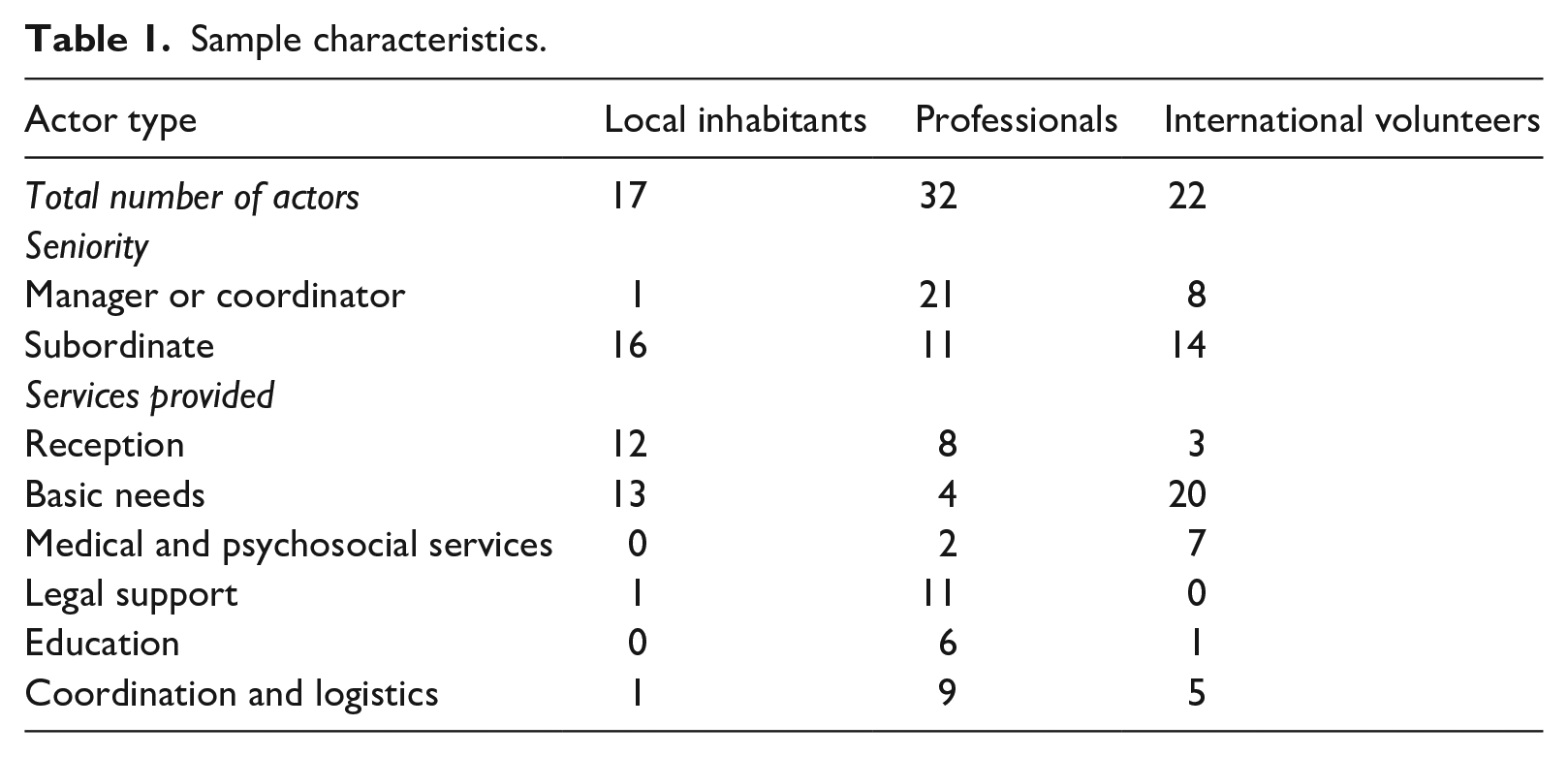
We were originally guided by theoretical sensitivity, with questions constructed to evoke descriptions of the actors’ sensemaking (Glaser, 1978). Later interviews were refined and amended to reflect learning around emergent themes. The recorded interviews were transcribed, resulting in 1219 single-spaced pages of data. In addition, we produced 253 pages of field notes and thick descriptions. Lastly, we gathered rich additional data in the form of photographic and video material, background documentation, media reports and various communications of volunteer WhatsApp and Facebook groups.
Several of our participants raised questions in evaluating the usefulness and risks of our contributions as researcher to alleviating the crisis on Lesbos (Ketokivi and Mantere, 2010). One way of addressing these concerns was that we opted right from the start of our data collection to not interview refugees themselves, as many are considered vulnerable owing to their traumatic experiences and might feel obligated to participate. Instead, we focused as organizational researchers on the response system.
Data analysis
Addressing our research questions incorporated three tasks, which we performed at first sequentially, but iteratively and parallel to each other as new content appeared to be relevant to the sensemaking of actors and emergent findings focused and deepened our study.
In the first task, we sought to immerse ourselves in the interviews and supplementary data, creating a thick description of the actors’ individual backgrounds, experiences, perceptions and actions. This involved iterative coding of the interview transcripts and secondary documents on topic-relevant content through an open coding strategy to identify relevant themes (Corbin and Strauss, 1998).
Second, building on these thick descriptions, we sought to address the first research question, looking for how actors make sense of, and position themselves in, the local response to a grand challenge. Keeping with current practices in narrative approaches to sensemaking, we used individuals’ discourse to construct sensemaking narratives that hold across a larger group of actors (Sonenshein, 2010). In doing so, we maintain the rich narrative detail provided by the ‘stories about remarkable experiences for individuals’ (Brown et al., 2008: 1040) while also acknowledging that most narratives are ‘fragments of stories, bits and pieces told here and there, to varying audiences’ (Boje, 2001: 5). Furthermore, following current practices to understand responses to grand challenges, we aimed for ‘a holistic assessment of the data’, focusing on elements such as temporal sequencing, plot and broader patterns of meaning, rather than ‘coding smaller portions of text’ (Eisenhardt et al., 2016: 1119). Specifically, we looked for interactions with actors and events that reveal some form of turning point or development in personal understandings of the refugee crisis response and compared stories to establish narrative threads based on commonalities, contradictions, vagueness and nuances of various kinds (Sonenshein, 2010).
Third, we deepened our study of narrative changes over time to address our second research question. Specifically, we were interested in the perceived relationships between the actions actors individually and collectively engage in and how these shape, maintain or change the refugee response system in their view. Accordingly, we also looked specifically at accounts of interactions between actors for the processual conditions under which individual and collective approaches appeared to emerge.
We validated our findings in several ways. First, we utilized multiple data sources to triangulate data from interviews, observations and governmental status reports. This allowed us to get multiple perspectives on the same events. Second, the first author analyzed the data and cross-checked findings and interpretations with the second and third author to verify that – as the theoretical development progressed – it remained true to experiences in the field. Lastly, we shared our findings with several participants from Lesbos and other GO and NGO workers at a working conference and they confirmed our understanding.
Findings
We present our findings regarding the collective sensemaking narratives presented by local inhabitants, professionals and international volunteers. We start with a description of the general structure of collective sensemaking in a refugee crisis and we then illustrate how collective sensemaking informs individual and collective action through patterns of collective sensemaking. In these narratives, we distinguish between forms of interaction where we differentiate between the isolating, situating and rejecting interactions that trigger sensemaking, the development of evaluations over time regarding the extreme, complex and persistent nature of the context, and action strategies oriented at alleviation, recovery and change.
Collective sensemaking narratives of strategic action
We found that all actor types typically at first responded by providing any form of alleviation they could. However, actors ultimately resorted to widely differing action strategies, where some would continue to engage through existing organizations and structures to provide alleviation to the refugees, others retreated from the refugee crisis insofar as possible and focused on personal recovery, and yet others continue to engage but did so by creating novel collaborative structures to change the way alleviation is provided. The primary distinction between alleviation and change-oriented strategies is that alleviation is situated in the existing collaborative structures of the refugee response system, while change-oriented action strategies entail creating new collaborations, structures and response systems.
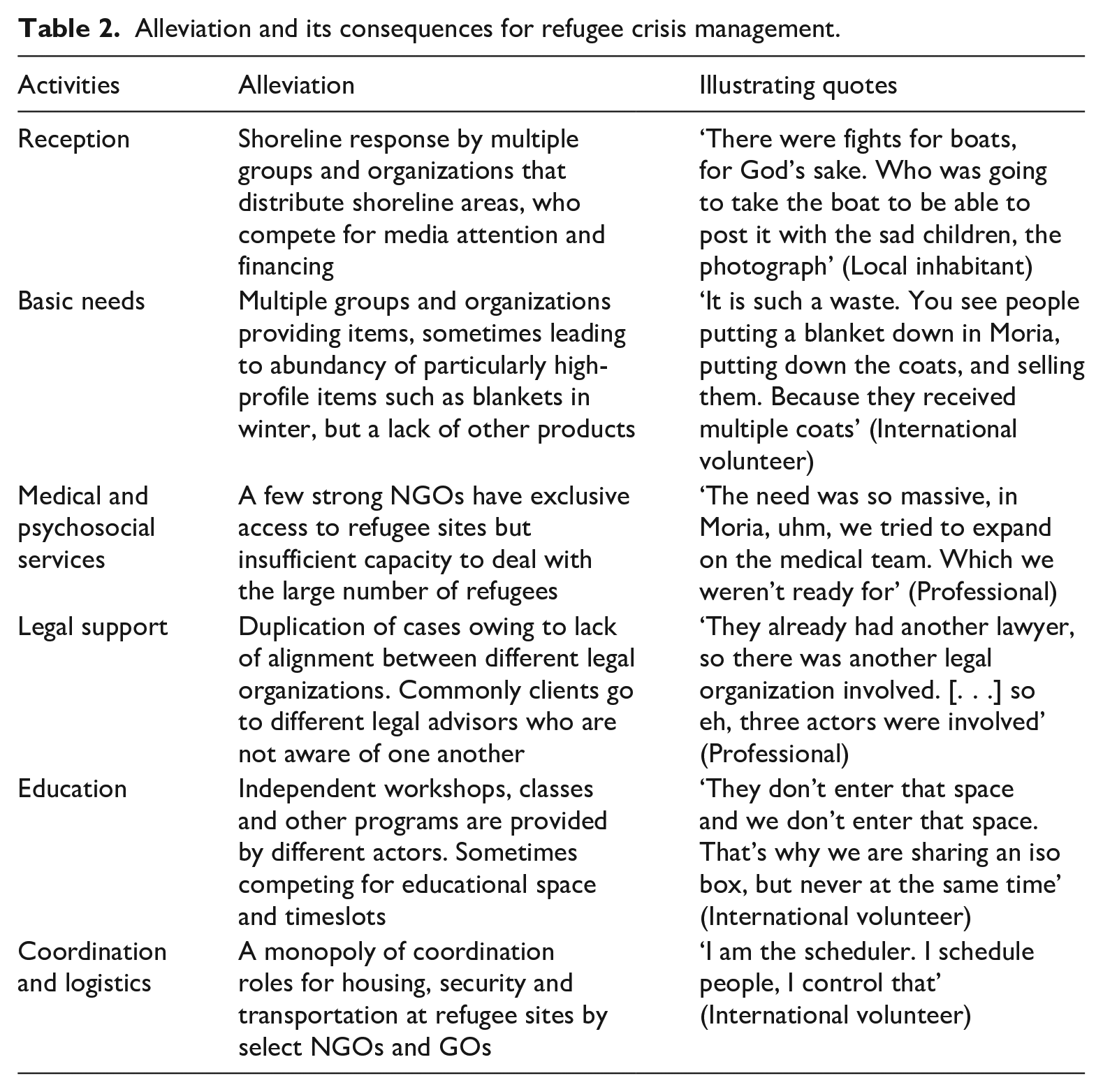
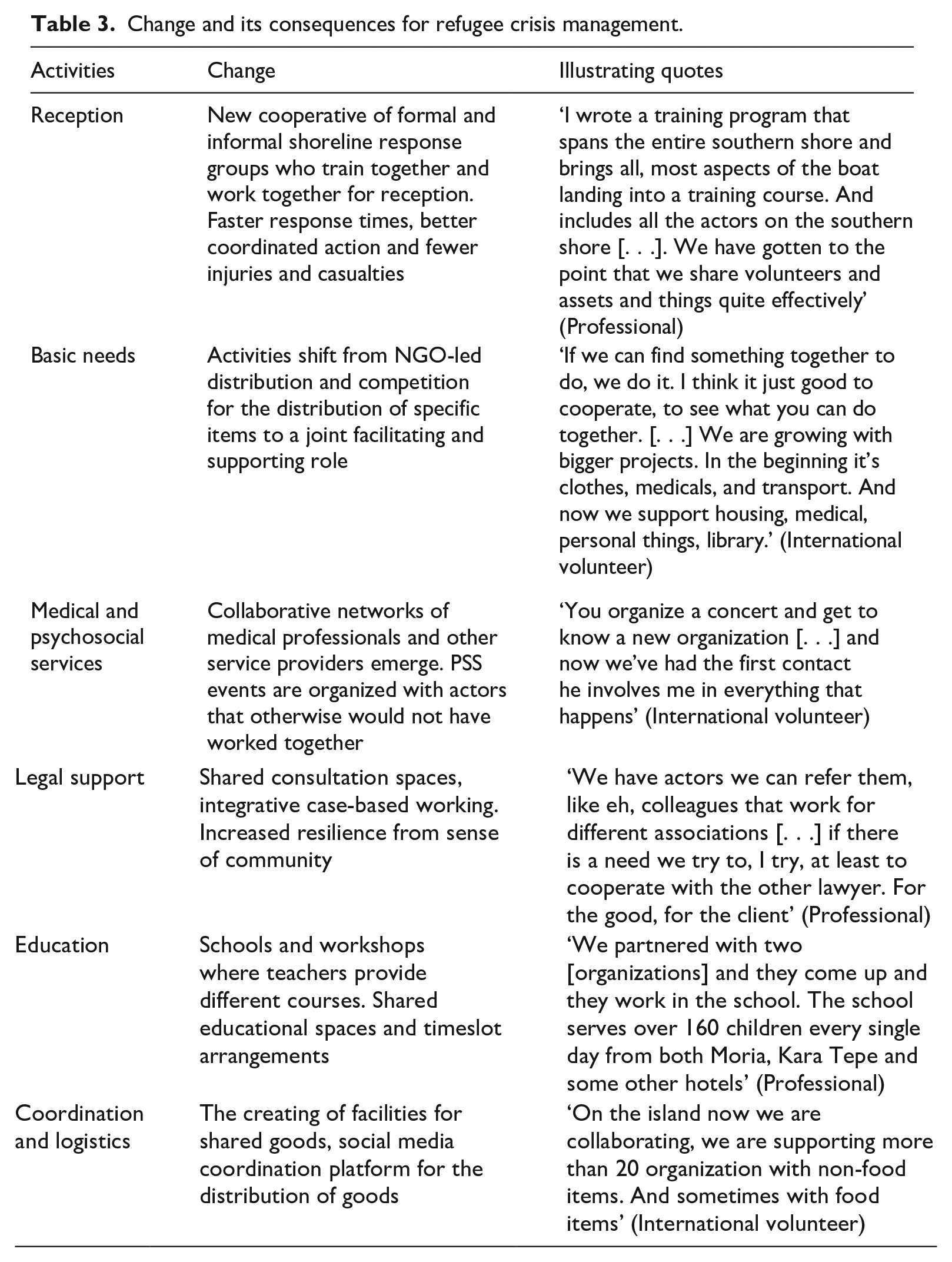
Furthermore, we found that each of these action strategies was typically supported through a particular collective sensemaking narrative, triggered by specific forms of interaction and different emergent evaluations over time. We found that actors who continued working to alleviate the consequences of the refugee crisis by carrying out various tasks within the response system typically described situating interactions, understood as working with or alongside other responding actors within a clearly defined setting and over time felt increasingly capable of providing meaningful aid as part of a collective response. Actors who over time resorted to focus on personal recovery typically presented a narrative in which they described isolating interactions, where they felt isolated or otherwise pushed away by other responding actors, and over time felt increasingly threatened by the interactions with these other actors and less able to cope with the extreme conditions imposed by the crisis. Lastly, actors who we found were increasingly creating changes to the refugee response system by establishing new structures and organizations typically presented a narrative where they interacted in such a way that they rejected other actors or organized responses, over time increasingly bonded with humanitarian ideals and sought out like-minded actors to create novel structures. We describe these patterns of collective sensemaking, using quotes to illustrate how and why these actors ultimately decided to engage with the refugee crisis in their respective ways. Figure 1 summarizes these collective sensemaking narratives and Tables 2 and 3 summarize their actions and action outcomes for each of the six core activities.
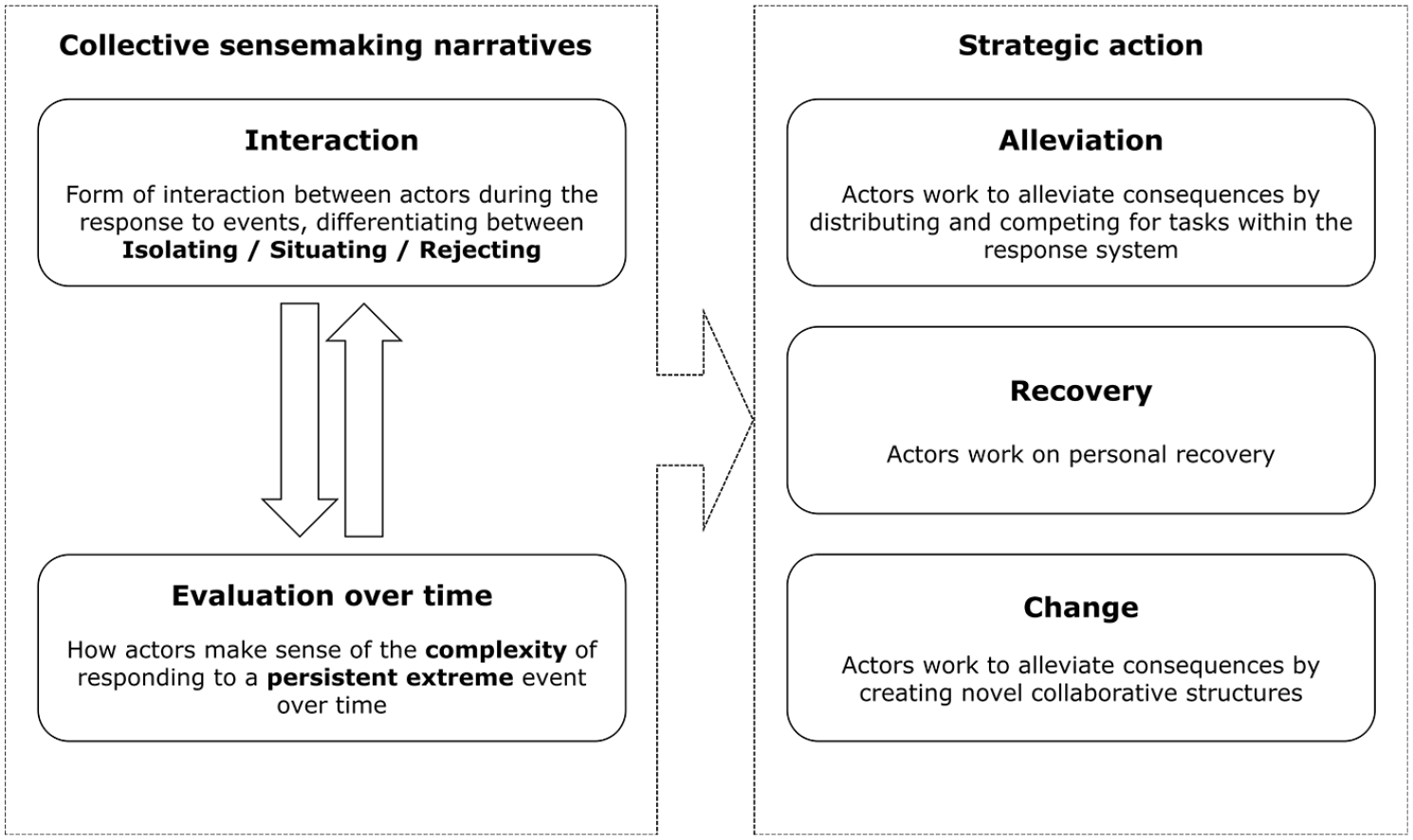
The structure of collective sensemaking narratives in a refugee crisis.
Alleviation and its consequences for refugee crisis management.
Change and its consequences for refugee crisis management.
Alleviation
As mentioned above, most of the actors provided some form of alleviation when they first engaged with the refugee crisis, and some continued to do so over time. In terms of the interactions that trigger their sensemaking, these actors commonly attribute their evolving role in the refugee crisis to being situated within the existing refugee crisis response by other actors. These actors were working with their own organization and other responders either in a professional capacity or an informal collaboration that grew over time. For instance, a Greek professional actor who initially started teaching in Moria for six months but later took on coordinating duties for an education NGO emphasized that ‘we have to work together, even though they don’t agree, or they may not agree on what the problem is or what the solution is, or how to do something’ to ‘do the best for the children’. Accordingly, this actor described how his organization worked together with another education NGO so that combined they ‘would have more capacity to host more children from Moria where the need is bigger’ and they ‘came up with a solution because both had good will for this to happen’. Similarly, an international volunteer who provided day-care activities told us that they ‘work closely with [other organizations]’ and ‘always know what is happening, because we have weekly meetings’. That said, situating within the crisis response also oftentimes entailed competition between organizations. Though these actors present themselves as part of a larger collective response where ‘you all work together’, this does often mean distributing tasks and resources, as one international volunteer stated, ‘we are a different organization, so we don’t work in the activities together’.
As these actors continue to engage with each other to provide alleviation in a situating manner, their evaluation of their own role and position in the refugee crisis develops in a distinct way. Specifically, they present a narrative where they are increasingly capable of dealing with the extreme, complex and persistent nature of the work by drawing on the positive effects of their work, personal value as member of a collective and increased agency and growth as they persist in their engagement. For example, one of the international volunteers related to us: I slowly got better. Strong enough, realized where my energies were supposed to be. Got realigned I guess you could say and taking social work was also to help myself, to learn how to deal with my own insecurities. So now I’ve learned that those tools to counteract an anxiety attack myself, I could teach those towards other people.
Accordingly, this actor learned to cope by learning and growing to eventually provide these experiences as lessons for refugees. Similarly, one of the local professional actors working in housing and accommodation related to us that their ‘experience is really amazing’ because they were able to go from ‘almost no support’ to now accommodating ‘more than 60,000 people in camps and in other places’, emphasizing the collective value that has been created by their organization through the refugee system as they grew.
We find that actors are situated within the response when they either professionally occupy a central position in the coordination of the refugee crisis, or when they are otherwise professionally or financially required to participate in the response. For instance, one of the professionals told us that ‘it is an everyday job’, and another emphasized a professional necessity to ‘coordinate to see who is going to deal’ and that ‘the system is there, it’s in place’. Accordingly, these actors take coordination for granted as being part of their professional role. Similarly, international volunteers often comment on the organizational cooperative format that is already in place for them to engage through. As one international volunteer commented, ‘[. . .] is an umbrella organization and there are various organizations under it’ and ‘they partnered with them to help mobilize volunteers’. However, other actors also comment on the inherent competition between volunteer organizations owing to their need for financing. The most common example mentioned is competition to be the first to respond to a refugee beach landing, where as a local inhabitant commented, NGOs rushed ‘through the village, because the boat is coming, and everybody went there to promote themselves’.
Accordingly, the main driver of situating interactions seems to be a form of organizational centrality, or professional and financial requirement to engage with each other in this manner. Though these actors present a narrative where they situate themselves within the refugee response, this is oftentimes only as part of a specific organization that provides a particular activity. The action strategy that these actors ultimately employ is one where they work to alleviate the consequences of the refugee crisis, but often by distributing tasks between, or competing with, other groups and organizations providing similar activities. As these individuals and organizations learn and grow over time, this often leads to increasingly professionalized but competing alleviation activities between groups. Table 2 presents a summary of how these professionalized forms of alleviation take shape in specific activity categories.
Recovery
Other actors described to us how they initially sought to alleviate the refugee crisis but ultimately disengaged to instead work on personal recovery, oftentimes after long periods of acting to alleviate the suffering of refugees. These actors attribute their decision to disengage from the refugee crisis to isolating interactions with other actors, oftentimes describing that they felt pushed away, ignored or otherwise isolated. For instance, an international volunteer questioned why working at the distribution point was so solitary, with little support from colleagues: ‘how is this happening, how do you not have support?’ and a local inhabitant called their situation ‘total abandonment from everybody. From everybody. Turned their back to us.’ The perceived isolating interaction took different forms, including not getting invited to meetings, which meant that they ‘didn’t even know there were coordination meetings taking place’, accusations where ‘if you say something against, you are racist’ and active boycotting of businesses, where ‘they really, eh, they were so bad against me, that I moved out. My [business] they kicked me out of the [business].’
As these isolating interactions continue, their evaluation of their own role and position in the refugee crisis changed over time. Specifically, they present a collective sensemaking narrative where they feel that their wellbeing is threatened by the complex system of other actors, felt increasingly helpless and hopelessness as these interactions persisted and they are ultimately unable to cope with the extreme nature of the refugee crisis. These actors often referred not only to the lack of help from other actors, but also the threat posed by other actors. For instance, one of the local inhabitants commented that ‘wherever NGOs go, after is burned earth’. Over time, these actors simply feel unable to deal with the refugee crisis, saying, for example, ‘I feel helpless that we cannot help, do more. But we cannot change the asylum system. We, we are tied.’ As a local inhabitant indicated, eventually they were ‘just finally not in a place where I can deal with it anymore, because it’s too much’.
When we consider why isolating interactions are occurring according to the local inhabitants as well as professional actors and international volunteers, we find that their narratives often indicate some form of bystander victimization. Specifically, we find that local inhabitants feel that they are seen as peripheral bystanders to the refugee crisis. As one local inhabitant commented: [T]wo volunteers walked down and a boat was arriving and she, she totally acted like we weren’t even there. She knew we were Greek and she turned to the volunteers and said, ‘should I call for help? Do you need help?’ And these guys have never been on our beach before. And I turned and I looked at her and I said ‘eh, are we invisible?’
These local actors perceived this as a fallacy, as they had been the first to respond, personally suffered from the refugee crisis and felt that they were also well positioned to provide meaningful aid. As this local inhabitant told us, ‘we had been dealing with the situation for months and months on end. We had a very organized and quiet way of dealing with it.’ Similarly, international volunteers and professionals who attribute their role in the refugee crisis to isolating interactions also describe a sense of being considered by other actors as peripheral to the refugee crisis despite their active engagement. One international volunteer who worked in a distribution center and then left to go back home told us that ‘I might have the feeling that I don’t do anything because I’m just there and they take the clothes that they need.’ The main driver of isolating interactions according to these actors therefore seems to be a perceived lack of centrality to the refugee crisis by other actors.
In terms of action strategies these actors ultimately employ, these actors stop engaging with the refugee system and limit themselves to work on personal recovery, which for the local inhabitants means prioritizing personal health and economic recovery, and for the international volunteers and professionals leaving the island. One of the international volunteers for instance concluded ‘I can feel with the people, I can be like “this is a horrible situation” and I can be responsible to them, but I am not responsible for them. Their loss is not my responsibility’ and ‘“I can’t be crying all night for you” [. . .] that they live in those situations doesn’t mean that I should live in those situations.’ A local Greek actor also commented on the motivation to work on personal recovery, mentioning that they ‘have still also families behind us, take care of our children. Why I should feel ashamed when I think about my tomorrow?’
Change
Lastly, some actors were actively striving to create structural changes to the alleviation of the refugee crisis by creating new collaborative structures. Those who ultimately focus on instigating structural change construct a narrative where they are the ones rejecting the existing refugee system during their interactions. Though these actors were often invited to cooperate or collaborate through existing structures, they reacted with a rejecting response. For example, one of the local Greek inhabitants refused to work at a refugee site, calling them ‘detention centers’ where ‘Families, women, children, men, elderly men, doesn’t matter. Everyone was locked in and treated as criminals.’ This actor also refused to associate himself with NGO volunteers, as many are ‘those we call the voluntourists’ who come because ‘it’s sexy. Adrenaline. You can take a few photos and post them on Facebook, and you are a hero. You can attract attention.’ Similarly, an international volunteer told us how he wishes to ‘change the system’ but refuses to do so with European financing as ‘if I apply to European funds, I have to obey to European laws. The European laws are hacking my freedom. Not my freedom only, anybody’s freedom’ or at the official registration center Moria as ‘obviously we do not approve of Moria. Moria should not exist. Why should we put our signature and say “ok we approve this and work in there?”’
Accordingly, though these actors can engage within the crisis response system, these actors refuse to do so on various moral grounds, which they report intensify over time. As these actors continue to interact with the existing refugee crisis response system in a rejecting manner, these actors also develop a specific collective sensemaking narrative in which they make sense of the extreme, complex and persistent nature of the crisis in a specific way. These actors describe how they increasingly felt that the suffering imposed on the refugees is not only extreme but unacceptable, that the existing refugee crisis response is not only complex, but specifically insufficient and in their perception grounded in selfish motivations. For instance, one of the international volunteers told us how they came to feel that the refugee crisis response is selfish and inhumane while working in Moria with medical service providers, commenting how the organizations they worked with contained ‘a lot of egos’, who claimed refugees as their patients ‘so they are not working together and that is really a big problem – the ego problem’. Another international volunteer clarified, saying that ‘everyone is finding its own right to be here, and is fighting for it’ and ‘it is a little bit like saying refugees become a commodity’. Similarly, a group of other international volunteers working in Moria commented on the deteriorating situation in Moria saying that people are ‘looking more sad, you can see it and feel it’ and that refugees in Moria ‘are handled as animals’ and the added value that they provide is ‘giving them the feeling they are a person’ as ‘they lost their dignity not because they lost it, but it was stolen. Step by step.’
When we consider why actors reject the extant crisis response according to local inhabitants, professionals and international volunteers, we find that local inhabitants as well as professionals and international volunteers refer to some form of personal victimization and identification with the plight of the refugees. The main difference here with respect to narratives that involve isolating interaction narratives is that actors who seek to provide structural changes dismiss perceived marginalizing attempts of other actors. It seems that a main motivation to do this is taking the plight of the refugees personally. Specifically, we find that local actors who reject other responding actors commonly refer to a personal refugee history. For instance, one local inhabitant told us ‘we lived the history’ as ‘my family from my father’s side they are all refugees. And yes, we have experienced that type of life kind of first-hand.’ Similarly, one of the international volunteers related to us that this is not a refugee crisis, but a crisis that concerns us all: it is ‘a humanitarian crisis. And we are heading full speed to a place that will not be safe and we will not be free.’ One of the international professional actors strongly identified with the plight of the refugees from a personal history with discrimination, telling us that ‘I have an even higher responsibility to act respectfully, you know with an open heart. Because of where I’m from and who I am and how I am perceived often.’
In a sense, these actors ultimately not only reject the extant refugee crisis response, they themselves become instigators of novel organizations and collaborative structures. Accordingly, the action strategy that these actors ultimately engage in is one where they create new NGOs and collaborations between like-minded actors founded on principles of humanitarianism. Rather than distributing tasks or competing for specific forms of alleviation, these actors adopt an integrative approach of mutual empowerment as their main response. Table 3 presents a summary of how change-oriented strategic action takes shape for specific activities.
Discussion
With our study, we aimed to better understand individual and collective sensemaking of extreme, highly complex and persistent societal problems (Colquitt and George, 2011; Howard-Grenville et al., 2014; Tsui, 2013). We formulated two overarching research questions: (1) How do actors make sense of, and position themselves in, the local response to a grand challenge? (2) How do actors enact the situation, and in doing so impact the collective response?
Our findings show that collective sensemaking is predominantly driven by different forms of interaction between actors. We arrived at three patterns of collective sensemaking that are used to validate approaches aimed at personal recovery, alleviation and change, respectively. These forms are differentiated by the form of interactions that trigger the sensemaking of diverse actors – isolating, situating and rejecting – the emerging ‘sense’ that evolves through these engagements and the individual and collective actions performed. Specifically, actors who feel situated within the collective response system by other actors over time feel increasingly capable of dealing with the extreme, complex and persistent nature of the work by drawing on the positive effects of their work, personal value as member of a collective and increased agency and growth as they persist in their engagement. These actors continue to provide alleviation in increasingly professionalized but competing ways. On the other hand, actors who experienced being isolated by other responding actors felt threatened by the complex system of responders, and ultimately decided to disengage from the refugee response system to work on personal recovery. Lastly, actors who reported that they themselves rejected other actors engaged in the collective response increasingly felt that the refugees were not adequately helped by the existing response system and strongly identified with the plight to overcome shortcomings in the response system in order to find adequate support for refugees. These actors more often create novel collaborative structures to provide humanitarian aid.
Understanding and responding to grand challenges
Our study has important implications for extant research on responding to grand challenges. Specifically, our findings shed new light on previous research on responses to refugee crises, but also similarly complex and persistent extreme contexts more broadly. For instance, the emergence of the Train of Hope, which was a citizen startup that ‘took over state responsibilities and proved incredibly effective in addressing the crisis’ (Kornberger et al., 2018: 317) can be understood through the narratives our actors presented to validate change-oriented strategic action. In this view, we understand the emergence of the Train of Hope through interactions where actors reject the extant response system. Indeed, these actors wished to do better than established aid organizations such as the Caritas or the Red Cross. The argument was that many volunteers left these established NGOs and joined Train of Hope because volunteers did not want to work under what they perceived as a ‘little flexible regime’(Kornberger et al., 2018: 325). Similarly, the evaluations of these actors over time developed such that they united around a shared framing of human tragedy and humanitarian bonding and it ‘gave rise to a strong sense of identity’ and ‘coordinated, collective action’ (Kornberger et al., 2018: 325).
Similarly, we contribute a complementary understanding of the emergence and displacement of new collaborative and organizational forms. Specifically, Lanzara (1983) describes the general process of generating what he calls an ephemeral organization during an extreme event, in Lanzara’s (1983: 76) case an earthquake response, as ‘a diagnosis and an evaluation of the situation’ where an actor’s ‘intervention is a response to this diagnosis, and reveals a strategy which may be tentatively surfaced’. Lanzara describes the emergence of a coffee-shop amid the turmoil, following what we would consider another change-oriented collective sensemaking narrative. Similarly, this actor ‘discovered or made up for itself an organizational niche in which it could operate’, produced change by creating a coffee-shop that ‘enabled other people to take some sort of action’ and did so through interacting ‘with his own environment’ and outside the ‘formal constraints on the relief operations’ (1983: 79, 80). Furthermore, Lanzara (1983: 79) also describes how this coffee-shop is later ‘displaced’ shortly after its formation as formal authorities began requiring official permits for access to the area. Where Lanzara explicated the environmental conditions and personal requirements for ephemeral organizations, we provide a complementary framework to understand the collective sensemaking processes that explain how and why these actors respond in specific ways within these conditions, including the creation of new short-term organizations and the competition for authority and resources between actors.
The influence of complexity on collective sensemaking
Our research also has important theoretical implications for the study of collective sensemaking as a process, as previous research has insufficiently incorporated the influence of complexity (Eisenhardt et al., 2016; Ferraro et al., 2015; Maitlis, 2005; Maitlis and Sonenshein, 2010). Our findings echo previous assertions that change can emerge through collective processes (Battilana et al., 2009; Garud et al., 2007), particularly at the intersection of conflicting fields and logics of actors (Ferraro et al., 2015). We found that our disparate actors held differing economic, humanitarian and religious motivations, and differed between organizational forms such as NGO and government emergency professionals, or between large response systems and grassroots initiatives. The collective sensemaking narratives we found for recovery, alleviation and change-oriented actions have powerful implications for understanding when change may or may not emerge at the intersection of these conflicting fields and logics.
Specifically, we found that actors who adopted a change-oriented action strategy – those who start joint sessions for training and shore response, started warehouses to distribute goods and overcame institutional affiliations to provide integrative care, legal aid and education – strongly rejected the existing refugee system and bonded with each other over a shared overriding sense of humanitarian urgency. Though this echoes previous assertions that collective sensemaking is inherently a social process that is grounded in identity construction (Brown et al., 2008; Weick, 1995; Weick et al., 2005), it also specifies a form of ‘individual-specific needs for self-enhancement, self-efficacy and self-consistency’ (Brown et al., 2008: 1040) where actors derive their sense of self-worth not from a preservation of self or an institutional affiliation, but through collectively bonding and identifying with the plight of refugees. Rather than creating a narrative of personal victimization or of collective instead of personal agency as was the case for recovery-oriented and alleviation-oriented narratives, these actors derive self-consistency and self-worth from a close association with the refugees and a notion of being the same, friends, brothers and sisters, and a shared sense of humanity. This suggests that differing sources of deriving self-worth may influence specific forms of strategic action.
Our results also echo previous findings that collective sensemaking drives the formation and reformation of social roles and relationships through interaction (Maitlis, 2005; Weick, 1993), and that a personal sense of place within a collective system influences outcomes for a collective response (Quinn and Worline, 2008; Weick and Roberts, 1993). Specifically, those actors who ultimately disengaged from the refugee crisis and focused on personal recovery greatly attributed this to a sense of isolation and rejection by other actors, which enforced a personal sense of lack of agency to cope with the refugee crisis and made these actors position themselves outside of the collective response system. Furthermore, we found that those who explicitly commented on their place and value within the collective response system oftentimes continued to provide alleviation in increasingly professional ways. Interestingly, our findings also suggest that – where the collective response system is deemed insufficient – change is generated not by developing a sense of place within the collective response, but by rejection of the extant system in favor of replacing this with other structures. In a sense, these actors position themselves within the larger macro-political context and humanitarian ideals, instead of the local collective response system. This suggests that developing an understanding of a personal role within a response system may not just be dependent on pre-existing normative orders (Ferraro et al., 2015; Weick and Roberts, 1993), but may be a process in which actors renegotiate to which orders and systems they belong and contribute to.
Our findings raise two important questions for future inquiries into the role of complexity in collective sensemaking. First, the assertion that different narratives of identity construction and self-worth are implicated in recovery, alleviation and change-oriented action strategies requires a more fine-grained investigation. Specifically, we strived to be transparent about the role of individual backgrounds of the different actor types in the collective sensemaking narratives they presented, but we were unable to fully disentangle the interplay between their different backgrounds, the identity construction activities during their engagement and the action strategies these actors ultimately adopt owing to our sampling strategy. A deeper investigation into the drivers of individual sensemaking by these different actors is required to make a stronger case for the role of individual actor types and forms of identity construction in collective change.
Second, the assertion that there may be different levels of belonging in a system and that particularly macro-levels of sense of place are implicated in change-oriented action requires further assessment. We do not disagree with the importance of, for instance, heedful interrelating in the functioning of collective responses (Weick and Roberts, 1993), but we suggest that actors may distinguish between different levels of interrelating, for example, individual roles, organizational roles, macro-political roles, and that further study is required to understand their influence on individual and collective action.
The influence of persistence on collective sensemaking
In persistent contexts such as a refugee crisis, long periods of time pass where individual actors remain ‘confused by events and actions without developing sensible accounts’ (Maitlis, 2005: 23), fueling increasing uncertainty regarding how the situation may evolve in the future, consequences of their actions and evaluations of their actions by others (Ferraro et al., 2015). We found that this is indeed the case, as exemplified by the actors who constructed a recovery-oriented collective sensemaking narrative, emphasizing their increased sense of helplessness and hopelessness over time, as they see no meaningful change despite long-term engagement, limited consequences of their own actions and evaluate the actions of others as either ineffective or conflicting with their own interests.
However, we also saw that a refugee crisis response is not a static system, but one that evolves and changes over time as different actors make sense of – position themselves in – and respond in different ways. For instance, our data suggest that the tenure of the actors may factor in not only the development of collective sensemaking narratives but also in the development of agency toward specific strategic actions. For instance, many of our actors made a distinction between stakeholders who have been around for prolonged periods and actors who come and go on short-term bases. Not only does a short-term engagement limit what can be accomplished by this actor, these actors are also perceived as less affected by, and oftentimes less serious about, the refugee crisis. Accordingly, there appears to be a temporal component in the sensemaking of actors and their willingness to engage in forms of cooperation. The tenure of actors is thus a viable candidate in the search for meaningful subtypes within the sensemaking narratives we identified, and a comparison of narratives at different stages of development might lead to further insights into their development.
Limitations
Our study naturally has limitations. First, we collected our data during an ongoing refugee crisis. Though investigating an ongoing crisis allowed us to better understand ongoing collective sensemaking in an extreme context, it also introduced a sampling bias toward actors who were still engaging with the refugee crisis. International volunteers and professionals who had already left the island to focus on their profession or studies are underrepresented. This is not necessarily a problem for understanding collective sensemaking in a refugee crisis and how this influences specific outcomes for the collective response system as we intended, as those who left no longer affect the local response, but it does raise unforeseen additional questions regarding their potential recovery-oriented sensemaking narratives. We were able to interview one international volunteer after returning home, but this is not sufficient to draw general conclusions. Though there are secondary sources of information available such as diaries and blogs shared by ex-volunteers and professionals (see, for example, Chapman, 2020), incorporating these instances was beyond the scope of our current article.
Second, theorizing from a rich and complex dataset such as ours inevitably leads to a simplification, in our case to the identification of the most influential interactions, processes and action outcomes. We had to synthesize and summarize an enormous amount of material to come to a meaningful description of processes and outcomes that hold across interactions. As a result, though we present the key turning points in our analysis as well as the characteristics of our proposed collective sensemaking narratives, we were not able to incorporate more subtle narrative differences or outliers. It should be noted that no actor responded exclusively toward a particular goal, as actors perform many different actions with different actors, and change their approaches over time. This is reflected in the process characteristics of the collective sensemaking narratives. We also do not claim that the narratives we present perfectly reflect all experiences of every individual. Rather, they reflect the prototypical narratives that are used to validate specific ways of working. It is also possible that the collective sensemaking narratives we identify are not exhaustive. It is possible that subtypes exist, for instance, between specific combinations of actors. For the current study however, we argue that the search and identification of such subtypes would have complicated our findings beyond a point of practical or theoretical relevance.
Furthermore, we adopted a narrative approach to understand the experiences and actions related to us. Though this allowed us to accurately reflect the lived experience of the actors as they describe their feelings, thoughts and actions, it does mean we have to be cautious in establishing the boundaries of their lived experience. Insofar as possible, we have triangulated narratives and sources to validate statements related to factual events, actions and contextual changes. Similarly, we acknowledge that the sensemaking narratives of our actors are constructed retrospectively, and therefore subject to the benefit as well as bias of hindsight. Accordingly, we must be cautious to generalize the narratives presented by our actors to factual contextual outcomes. Despite these limitations, our study has significant implications for both research and practice.
Implications for practice
This study has several important practical implications. First, our study informs an understanding of the personal and contextual constraints of humanitarian responses to a refugee crisis. This has implications not just for refugee crises and grand challenges, but also other extreme and complex emergency contexts involving different actors. Specifically, our findings help explain why professional actors, despite being trained to respond to crisis situations, are unlikely to instigate structural changes to the alleviation provided. Though they arguably have more experience and skills to do so, their operation within organizational and professional boundaries seems to predominantly lead to situated forms of alleviation. More likely to seek out structural changes were international volunteers, who more often transcended organizational boundaries and sought out like-minded individuals to create novel structures and collaborations. Yet, international volunteers are often also more transient, engaging on short-term contracts and are often self-employed or bound by the NGOs that employ them. Local inhabitants in turn are most affected by the refugee crisis, yet also poorly positioned to instigate structural changes as they are themselves victims of the refugee crisis (yet not necessarily perceived as such). In the case of our study, local inhabitants faced the refugee crisis in addition to an exacerbated economic crisis. These findings implicate particularly the importance of wielding the skills and knowledge of professional actors in such a way that it enables and informs the more transient international volunteers and alleviates the strain on local inhabitants insofar as possible. Accounting for the transient nature of specific actors in a persistent problem context remains a methodological and theoretical challenge in multi-stakeholder studies.
Second, we found that all our participants were either benevolent actors or victims and attempted to make the best of a difficult situation. Yet, there was widespread emerging misunderstanding, disagreement, a lack of consideration for each other’s positions and in some cases even outward hostility between individuals and particular groups. The collective sensemaking narratives we found help explain why these actors with good intentions still instigate or perpetuate division and isolation. By sharing these narratives with the actors, they may better be able to understand each other’s positions and engage with each other in positive ways.
For instance, actors working through NGOs tend to provide important items such as blankets, water, food and medicine, or activities such as legal aid, education and coastal reception and coordination tasks. However, by taking ownership of responsibilities in competition with other actors, these actors institutionalize competition for resources and responsibilities. This not only meant that NGOs predominantly implicitly or explicitly compete for resources, but also that local actors – the ones living on the island – are pushed aside in the scramble. This resulted in outward hostility and a lack of collaboration between NGOs and certain local groups, who not only feel their livelihood is threatened by the negative exposure produced by many NGOs, but also personally disrespected in how they are treated on their own home island.
Our findings also have implications for our status as researchers in ongoing responses to grand challenges as well as other extreme contexts. Particularly local actors were very vocal against those they called ‘voluntourists’, and by extension, other actors who they perceive to be benefitting from their hardship. Though local actors primarily mentioned NGO volunteers as the primary example, we must also carefully weigh our motivations, methods and contributions.
Lastly, actors should be aware that though they are individually providing important goods and activities, by doing so in isolation or competition they indirectly impede the development of collaborative forms of change. We found considerable opposition between NGOs in individual interviews, yet grassroots NGOs and professional NGOs have more in common than they convey as they engage in the same processes, actions and strive for similar – positive – outcomes. We found that actors can engage in such a way that it promotes the development of joint activities, networks and development through implementing integrative experiments and enhancing their sense of joint agency under a united humanitarian cause.
Footnotes
Acknowledgements
The authors wish to express their sincere gratitude toward the respondents of the study for their willingness to share their experiences with us. Furthermore, we would like to thank Marios Andriotis for providing field access. In addition, we are grateful to the anonymous reviewers and associate editor Timothy Kuhn, who have offered constructive advice in the development of this manuscript.
Funding
The authors received no financial support for the research, authorship and/or publication of this article.
